Search This Blog

Sunday, February 7, 2021

COVID-19: How do inactivated vaccines work?

 Inactivated vaccines use a pathogen that has been modified so that it cannot replicate to stimulate our immune system. They are safe because they cannot cause disease. However, booster doses may be necessary.

Vaccines that make use of the entire pathogenic virus are called whole virus vaccines. Using a pathogen or a part of a pathogen in a vaccine is a traditional approach, and most vaccines available today work this way.

In contrast, the COVID-19 mRNA vaccines by Pfizer-BioNTech and Moderna use genetic material that is chemically synthesized in a laboratory to teach our immune system how to fight off future infections with the SARS-CoV-2 virus.

There are two different types of whole virus vaccines: live attenuated and inactivated.

Live attenuated vaccines use a weakened form of a pathogen. These elicit strong immune responses but are not suitable for people with a weakened immune system.

In an inactivated vaccine, the pathogen is killed or modified in such a way that it is unable to replicate. It cannot cause disease and is, therefore, suitable for those with a compromised immune system.

The inactivation step usually involves heat, radiation, or chemicals to destroy the pathogen’s genetic material, which stops it from replicating.

Inactivated vaccines can trigger a strong immune reaction, but it is usually not as strong as the reaction that live attenuated vaccines can produce. Due to this, a person may need booster shots to ensure ongoing protection.

The COVID-19 vaccines that Sinovac, Sinopharm, and Bharat Biotech have developed are inactivated vaccines.

Other examples of inactivated vaccines include those against polio, hepatitis A, and rabies.


The Chinese state-owned biopharmaceutical company Sinopharm developed the inactivated COVID-19 vaccine called BBIBP-CorV in collaboration with the Beijing Institute of Biological Products.

The researchers studied SARS-CoV-2 samples from three people and chose one as the basis for their vaccine. They expanded the virus in cells and then used a chemical called beta-propiolactone to inactivate it. This chemical modifies the virus’s genetic material, leaving it unable to replicate.

Other companies have used very similar approaches to develop their COVID-19 inactivated vaccines.

Scientists at the private Chinese company Sinovac developed an inactivated COVID-19 vaccine called CoronaVac, while Bharat Biotech and the Indian Council of Medical Research co-developed Covaxin.

All three vaccines contain aluminum hydroxide. This substance serves as an adjuvant, a term that scientists use to describe chemical compounds that boost the effectiveness of a vaccine.

Covaxin has an additional adjuvant called a toll-like receptor (TLR) 7/8 agonist, which also prompts a strong immune response.

All three COVID-19 vaccines require administration in two separate doses.

Safety and efficacy

Experts consider inactivated vaccines that are licensed or authorized for use to be safe. As they do not contain pathogens that can replicate, they are unable to cause disease.

The three inactivated COVID-19 vaccines that are authorized for use in a number of countries across the world cannot cause COVID-19 because the SARS-CoV-2 virus in the vaccine doses has been chemically modified to stop it from making copies of itself.

There are some data on the safety and efficacy of these vaccines, but none of the companies have released the data from their phase 3 clinical trials yet.

Sinopharm published the results of their phase 1/2 trial in The Lancet Infectious Diseases. The data suggest that the vaccine is safe and well-tolerated. About 30% of the trial participants showed some mild-to-moderate side effects, including fever and pain at the injection site.

The company reported an efficacy of 79%, although they have not published the full data.

The results from phase 1/2 trials of CoronaVac, which also appear in The Lancet Infectious Diseases, suggest that this vaccine is also safe but has some mild-to-moderate side effects.

However, there has been controversy about how well CoronaVac works. Scientists and officials from different countries have announced varying rates of efficacy, ranging from 91% in Turkey to as low as 50% in Brazil.

Data on the Covaxin vaccine have not undergone peer review yet. A preprint from the phase 1 study suggests that it is safe and that some participants had mild-to-moderate side effects.

https://www.medicalnewstoday.com/articles/covid-19-how-do-inactivated-vaccines-work#Safety-and-efficacy

Pfizer eyes cut in COVID vax production time by near 50% as efficiencies rise

 Pfizer expects to nearly cut in half the amount of time it takes to produce a batch of COVID-19 vaccine from 110 days to an average of 60 as it makes the process more efficient and production is built out, the company told USA TODAY.

As the nation revs up its vaccination programs, the increase could help relieve bottlenecks caused by vaccine shortages.

"We call this 'Project Light Speed,' and it's called that for a reason," said Chaz Calitri, Pfizer's vice president for operations for sterile injectables, who runs the company's plant in Kalamazoo, Michigan. "Just in the last month we've doubled output."

The increased speed and capacity is not unexpected, said Robert Van Exan, president of Immunization Policy and Knowledge Translation, a vaccine production consulting firm.

“Nobody’s ever produced mRNA vaccines at this scale, so you can bet your bottom dollar the manufacturers are learning as they go. I bet you every day they run into some vaccine challenge and every day they solve it, and that goes into their playbook,” he said.


Pfizer's COVID-19 vaccine is made at three Pfizer plants: starting in Chesterfield, Missouri, moving to Andover, Massachusetts, and finishing in Kalamazoo, Michigan. As of Saturday, about 20.6 million doses of the Pfizer vaccine had been administered nationwide.

Pfizer based its production system on how the vaccine was developed in the laboratory, Calitri said. Normally engineers would spend years improving efficiencies and cost-effectiveness. That's not what happened with COVID-19.

"We just went right to commercial production," Calitri said. 

As soon as vials of vaccine began coming off the production line, engineers started analyzing how production could work faster and better.

"We made a lot of really slick enhancements," he said.

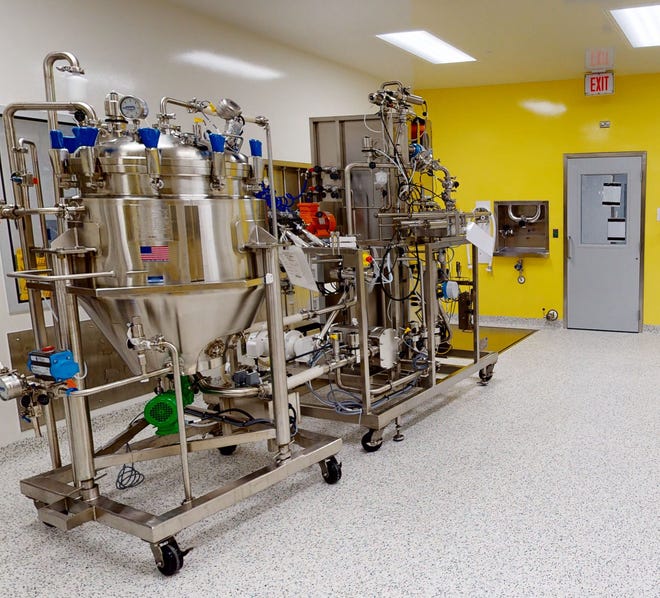
The mRNA suite at Pfizer's Andover, Massachusetts, facility. This is where the mRNA is manufactured  using the DNA template from its plant in Chesterfield, Missouri.

Production is getting faster. For example, making the DNA that starts the vaccine process first took 16 days; soon it will take nine or 10. Though quality control and testing has accelerated, company officials say FDA regulations and best manufacturing practices are still being met. 

Along with improving speed, Pfizer also is increasing output by adding manufacturing lines in all three plants. 

As the vaccine effort continues, more efficiencies are expected. 

"There are going to be profound shifts in the way we do business," Calitri said. "We just demonstrated to ourselves that we can go from a phone call in March to having now delivered 50 to 60 million doses."  

https://www.usatoday.com/story/news/health/2021/02/07/pfizer-expects-cut-covid-19-vaccine-production-time-almost-50/4423251001/

Lipid Nanoparticle-Encapsulated mRNA Promising for Liver Repair

 Lipid nanoparticle-encapsulated messenger RNA (mRNA-LNP) delivered regenerative factors and induced recovery in mice with damaged livers, paving the way for further development for humans, researchers say.

"There are currently no FDA-approved drugs to prevent progression of liver disease," Dr. Valerie Gouon-Evans of Boston University told Reuters Health by email. "We provided proof-of-principle that nucleoside-modified messenger RNA complexed with mRNA-LNP, recently used to develop the FDA approved COVID-19 vaccines, is an effective delivery tool to induce robust and timely controlled expression of liver regenerative factors for about three to four days after injection."

"This is a sufficient time frame to treat features of chronic liver injury such as steatosis and to accelerate liver repair in acute acetaminophen-induced liver injury," she said.

In two mouse models of liver injury, the team injected epidermal growth factor (EGF) and hepatocyte growth factor (HGF) - both necessary for liver regeneration - as messenger RNAs encapsulated in small lipid vesicles. The mRNA-LNP attracted mouse hepatocytes, inducing them to transiently express these factors, as Dr. Gouon-Evans noted.

In the NAFLD model, injections of both HGF and EGF mRNA-LNP reversed steatosis and accelerated restoration of liver function, according to the Nature Communications report.

Similarly, in the acetaminophen liver injury model, injections of both HGF and EGF mRNA-LNP accelerated liver regeneration.

Dr. Gouon-Evans said, "Safety has been demonstrated in clinical trials for cancer immunotherapies and the current COVID-19 vaccines from Pfizer-BioNTech and Moderna. Our next step is to collaborate with biotech companies to initiate preclinical studies and develop the novel application of mRNA-LNP to treat chronic and acute liver diseases in humans."

Dr. Malcolm Alison of Queen Mary University of London, UK, who is familiar with the team's work but was not involved in it, told Reuters Health, "Intravenous injection of two nucleic acids can reverse these potentially life-threatening conditions that our habits impose on the liver. These discoveries could have a major impact on clinical practice since the incidence of fatty liver is reaching epidemic proportions in Western society."

Administered as proteins, he noted, EGF and HGF "would have lasted less than one hour. But in their mRNA form they get converted to their growth-promoting proteins by the receptive cells for up to three days - hence, fewer injections."

"In the case of NAFLD mice, the growth factors immediately reduced the liver's fat content while the release of liver enzymes into the blood, an indicator of hepatocyte damage, was also much reduced," he said. "In the case of acetaminophen poisoning, the growth factors also reduced liver enzyme release and accelerated the removal of damaged liver cells, reducing the likelihood of liver failure-induced patient death."

"This study has shown that it is feasible, by simple intravenous injection(s) of growth factor mRNAs, to reverse potentially lethal complications of common lifestyle habits," he concluded.

SOURCE: https://go.nature.com/3jfjRJS Nature Communications, online January 27, 2021.

https://www.medscape.com/viewarticle/945336

Indonesia approves China's Sinovac vaccine for elderly

 Indonesia has approved Sinovac Biotech's COVID-19 vaccine for use in the elderly, a letter from the food and drug agency shows, potentially changing the country's strategy which has prioritised its working population first.

That strategy was partially due to limited data on the vaccine's safety for the elderly, authorities have said.

The food and drug agency (BPOM) said in a letter seen by Reuters that it had authorised the use of Sinovac's CoronaVac for the elderly "taking into account the emergency situation of the COVID-19 pandemic and the limited information on the benefits and safety of that vaccine".

It was sent to Sinovac's Indonesian partner, state-owned Bio Farma.

Wiku Adisasmito, spokesman for the country's COVID-19 task force, confirmed the authenticity of the letter.

Bio Farma confirmed receiving the letter, though did not provide further details.

A rollout of Sinovac's vaccine in Indonesia last month involved 3 million doses and was aimed at medical workers and public servants.

Government data shows nearly 800,000 have received their first shot, but authorities said they are set to produce 25 million more by the end of March.

Indonesia, which has suffered more than 31,000 deaths from COVID-19, aims to vaccinate more than 180 million people, or roughly two-thirds of its population of 270 million, within a year.

Several countries such as the United States and Britain that have already begun vaccinations are giving priority to elderly people who are more vulnerable to the respiratory disease.

Indonesia's health ministry declined to comment, though it has said the elderly are set to receive the vaccine by April.

China's Sinovac said on Saturday that CoronaVac had been approved for use by the general public by China's medical products regulator.

A Phase I and II trial in China showed the vaccine could safely trigger immune response for older participants but Sinovac cautioned that data for the protection rate among people aged 60 and above was "limited".

"When the relevant institutions ...use this vaccine, the necessity of inoculating this product should be evaluated in consideration of the health status and exposure risk of this age group," it said.

Pandu Riono, an epidemiologist at the University of Indonesia, said that "if we want to stem the number of hospitalisations, we should chase immunisation for the elderly."

https://www.marketscreener.com/quote/stock/SINOVAC-BIOTECH-LTD-5714593/news/Sinovac-Biotech-Indonesia-approves-China-s-Sinovac-vaccine-for-the-elderly-32372970/

Covid-19 Hit to State, Local Revenues Smaller Than Many Feared

 State and local governments in early 2020 expected the pandemic-induced downturn to decimate their budgets, as millions of business closures and layoffs wiped out tax revenue.

In many places, the fiscal picture hasn't been nearly as dire as feared.

A flood of federal aid for businesses and households helped prop up incomes and consumer spending. Unemployment fell and economic activity picked up much faster than expected. Unlike in previous recessions, equity and housing markets have done well.

All of those factors bolstered state and local revenues last year. But pandemic-related costs have soared in many localities, resulting in budget holes that may force states to cut back on other services, lay off workers or raise taxes, absent more federal aid. Policy analysts estimate state and local revenue losses due to the pandemic will total about $300 billion through fiscal year 2022, though that doesn't include rising expenses.

State and local governments employ 18.6 million people, who provide services from collecting trash to teaching children. Democrats in Congress are pushing for $360 billion in aid to cities and states as part of President Biden's $1.9 trillion coronavirus relief bill, while many Republicans argue that would only encourage fiscal profligacy.

Immediately after the coronavirus outbreak last March, states slashed revenue projections by an average of about 8%, with some expecting shortfalls as high as 20%. Those projections were largely based on experiences during the 2007-09 recession, when steep revenue declines lasted several years.

In the end, state revenues fell 1.6% in fiscal year 2020 and were 3.4% lower than projected before the pandemic, according to the National Association of State Budget Officers. While states expect revenues to decline 4.4% in fiscal 2021, which ends on June 30 for most, 18 states are seeing revenues come in above forecast.

"The revenue problem hasn't been nearly as bad as we thought," said Michael Strain, the director of economic policy studies at the conservative American Enterprise Institute. "That's good news."

The bad news, according to Mr. Strain and others: a surge in spending on things like health care, jobless benefits and food assistance. Also, revenue losses vary significantly among states and cities.

"If you're a state that's doing worse, the fact that on average states seem to have held up pretty well doesn't really matter to you," Mr. Strain said.

State and local budget shortfalls have been at the center of discussions in Washington since last spring about what to include in another economic relief package.

Congress has provided state and local governments more than $300 billion in federal aid, including grants for education and higher federal matching funds for Medicaid, though the funds came with restrictions on how they could be spent. Now, some Republican lawmakers are proposing more money for schools and pandemic-related spending, such as vaccine distribution, but no funding specifically for state and local governments.

The left-leaning Center on Budget and Policy Priorities estimates the state and local revenue shortfall will total about $300 billion through 2022, as does Louise Sheiner, director of the Hutchins Center on Fiscal and Monetary Policy at the Brookings Institution. Moody's Analytics puts the figure at about $330 billion, well below the $500 billion it estimated last spring.

State and local governments also have about $75 billion in rainy day funds to offset budget shortfalls. But analysts said it's unclear how much expenses have risen due to the pandemic, making it difficult to estimate how much they may need.

Mr. Strain estimated $100 billion, in flexible funding, would be more than enough to help states get through the next fiscal year, which they must begin planning for now.

From last March, when a nationwide pandemic emergency was declared, through December, overall state revenues declined 1.8% from the same period a year earlier, according to data from Lucy Dadayan, senior research associate at the Urban Institute, a Washington think tank. Twenty states saw increases, including six -- Vermont, Idaho, South Dakota, Utah, Colorado and Alabama -- that saw revenues rise more than 3%. California, whose revenues held steady, projects a budget surplus for this fiscal year.

By contrast, 26 states reported revenue declines in the first 10 months of the pandemic, including nine where revenues dropped more than 5%. Five states -- Alaska, Florida, Hawaii, North Dakota and Oregon -- experienced double-digit declines.

"All states have been impacted by the downturn, but they've been impacted in different ways, by different magnitudes," said Brian Sigritz, NASBO's director of state fiscal studies.

The differences depend in part on states' revenue structure and on the unique features of the current recession.

States that rely more on revenue from services and tourism, such as Florida and Hawaii, have been hit hard as the pandemic limited travel and prompted restrictions on restaurants, entertainment and other in-person business. States that rely heavily on the energy industry, such as Alaska, Louisiana and Texas, also have seen sharp revenue drops as oil prices fell.

On the other hand, states that rely more on income taxes and have more progressive tax systems, such as California, have done better than expected. That's because the pandemic has primarily affected low-income taxpayers, who provide a smaller share of overall revenue.

In Mesa, Ariz., revenue has been steady during the past 10 months. "That's really not telling the whole story though," Mayor John Giles said.

The city government is "ground zero" for pandemic relief, coordinating with hospitals, food banks, schools and other providers to deliver essential services to a population of 500,000, Mr. Giles said. Mesa received $90 million from last year's Cares Act for pandemic-related expenses.

"We could have submitted double that in invoices for Covid-related assistance that the city was involved in," Mr. Giles said.

From his office window at City Hall, the Republican mayor said he sees thousands of cars line up each week outside the Mesa convention center to pick up free groceries. That program is set to expire at the end of February without additional aid.

"People need to acknowledge the obvious, which is the critical role that local government plays in the economy," said Mr. Giles, who is urging Arizona Republicans in Congress to support state and local aid in the next relief package.

Though overall revenues have been resilient, layoffs of government workers have risen sharply, especially among education workers. While some of that can be explained by the pandemic, there is evidence that states with larger revenue losses have seen bigger reductions in local education employment, said Ms. Sheiner of the Brookings Institution.

State and local employment also has been slow to recover, compared with other sectors, and is still 1.3 million jobs below its pre-pandemic level.

https://www.marketscreener.com/news/latest/Covid-19-s-Hit-to-State-and-Local-Revenues-Is-Smaller-Than-Many-Feared--32380598/

Vaccine diplomacy: India seeks to rival China with broad shipments

India has approved the shipment of COVID-19 vaccine to Cambodia and plans to supply Mongolia and Pacific Island states, officials said on Sunday, as supplies arrived in Afghanistan - all part of the country’s widening vaccine diplomacy.

Seeking to steal a march over rival Asian giant China, which has also promised to deliver shots, Prime Minister Narendra Modi’s government has been giving nearby countries millions of doses of the locally made AstraZeneca PLC vaccine, even as its domestic immunisation programme has just begun.

Modi is using India’s strength as the world’s biggest maker of vaccines for various diseases to improve regional ties and push back against China’s political and economic dominance.

New Delhi has approved 100,000 doses for Cambodia on an urgent basis following a request to Modi from Cambodian Prime Minister Hun Sen, India’s envoy to Phnom Penh said.

Cambodia is an important ally of China, which is expected to provide a million doses of COVID-19 vaccines, mainly developed by state firm Sinopharm.

“The supply has been assured through the Serum Institute of India despite innumerable competing requests from partner countries and our commitment to our domestic population,” said Ambassador Devyani Khobragade.

India has given doses to Myanmar, Bangladesh, Nepal, Sri Lanka and the Maldives to help them get started with frontline workers as part of its Vaccine Friendship initiative.

On Sunday it sent 500,000 doses of the AstraZeneca vaccine to Afghanistan, the first to arrive in the war-ravaged country, which is still waiting for emergency approval from the World Health Organization to administer them.

India has invested millions of dollars in Afghanistan over the years in an expansive effort seen as pushing back against arch rival Pakistan’s influence in the country. “The vaccines are being provided on a grant basis,” a government source said.

https://www.reuters.com/article/us-health-coronavirus-india-diplomacy/vaccine-diplomacy-india-seeks-to-rival-china-with-broad-shipments-idUSKBN2A70C8

UK says COVID-19 booster and annual vaccinations very probable

 A COVID-19 booster in the autumn and then annual vaccinations are very probable, Britain’s vaccine deployment minister said on Sunday as countries race to administer injections in the face of new variants.

Britain has already provided nearly 11.5 million first doses of COVID-19 vaccines and is on track to meet a target to vaccinate everyone in the top most vulnerable groups by mid-February.

Among coronavirus variants currently most concerning for scientists and public health experts are the so-called British, South African and Brazilian variants, which appear to spread more swiftly than others.

“We see very much probably an annual or a booster in the autumn and then an annual (vaccination), in the way we do with flu vaccinations where you look at what variant of virus is spreading around the world,” Nadhim Zahawi told the BBC’s Andrew Marr Show.

AstraZeneca said on Saturday its vaccine developed with the University of Oxford appeared to offer only limited protection against mild disease caused by the South African variant of COVID-19, based on early data from a trial.

The success of the UK’s vaccine rollout is spurring debate about how soon the government can ease broader lockdown restrictions, amid plans to reopen schools in England in March.

https://www.reuters.com/article/us-health-coronavirus-britain-vaccine-bo/uk-says-covid-19-booster-and-annual-vaccinations-very-probable-idUSKBN2A70A5