Search This Blog

Sunday, March 7, 2021

DOD IDs More Troops to Help Administer COVID-19 Vaccine

 The Defense Department has identified additional personnel authorized to support the Federal Emergency Management Agency in administering COVID-19 vaccinations at community vaccination centers around the country.

"The secretary authorized an additional 10 Type 2 teams for future FEMA support," said Pentagon Press Secretary John F. Kirby during a briefing yesterday.

46:29
Video Player

FEMA has asked the Defense Department for as many as 50 Type 1 teams to support community vaccination centers, as well as 50 Type 2 teams. A Type 1 team is made up of 222 service members, and can administer about 6,000 vaccinations a day, while a Type 2 team is made up of 139 service members and can administer about 3,000 vaccinations a day. The department is also staffing 25-person teams as well in some locations.

Right now, about 6,235 active duty service members have been identified by the Defense Department to support COVID-19 vaccination centers, though not all of those personnel have deployed yet as part of a team.

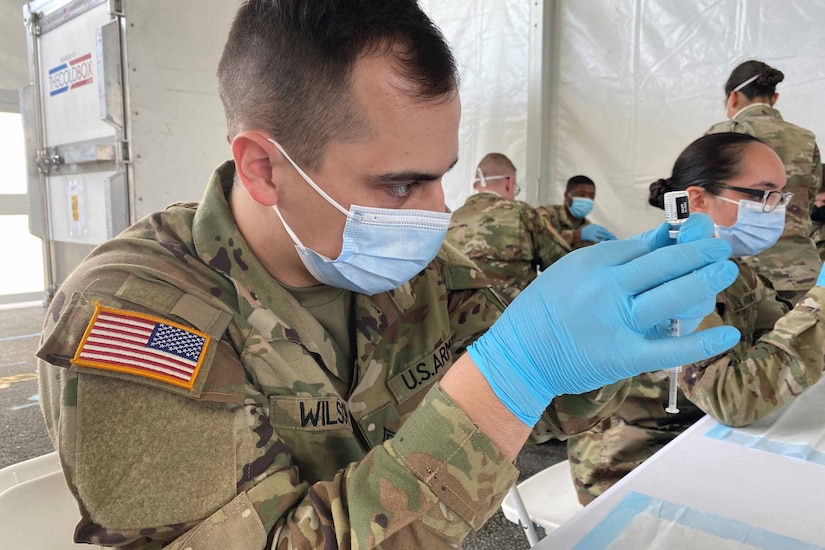
A man in a military uniform fills a syringe with a vaccine.

Just over 2,200 service members are deployed now in 17 teams to California, New Jersey, Texas, New York, the U.S. Virgin Islands, Pennsylvania, Florida, Illinois and North Carolina. Those teams are made up from service members from the Army, Navy, Air Force and Marine Corps.

In the coming weeks, Kirby said, additional teams — about 444 service members — will deploy to both Ohio and Georgia to support vaccination efforts in those states. Together, they will be able to provide around 12,000 vaccinations a day.

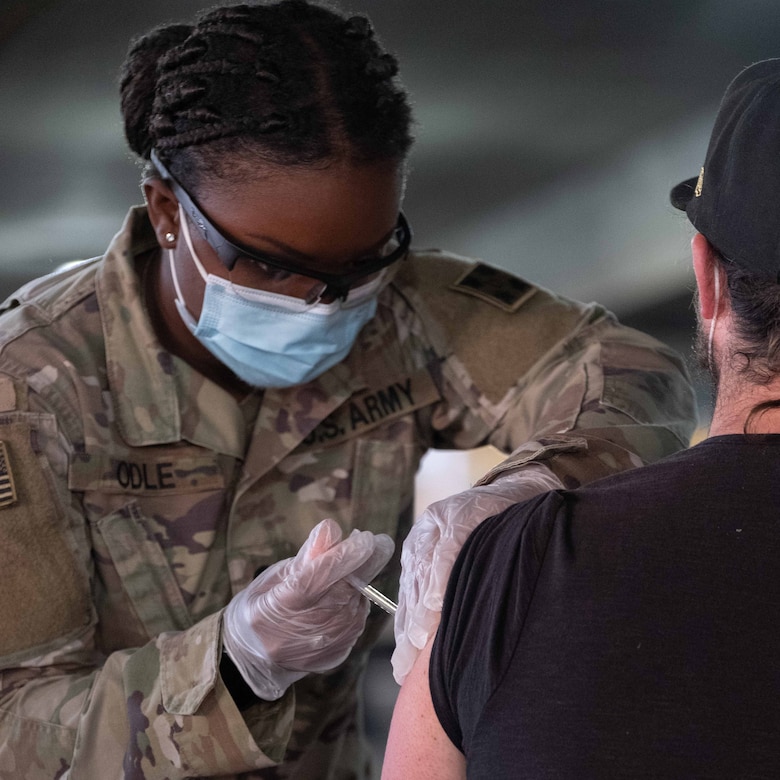
A woman in a military uniform injects a vaccine into the arm of a civilian.

The first community vaccination center to be supported by U.S. military personnel opened in mid-February at California State University in Los Angeles.  At that location, 222 soldiers provide vaccination support, and are able to offer 6,000 vaccinations a day.

GOVERNMENT RESOURCES

www.coronavirus.gov 

www.cdc.gov/coronavirus 

www.usa.gov/coronavirus 


https://www.defense.gov/Explore/News/Article/Article/2526831/dod-identifies-more-troops-to-help-administer-covid-19-vaccine/

Lessons from Charlie Munger at the Daily Journal Meeting

 Charlie Munger held court at the Daily Journal Annual Meeting last week. He answered questions for almost two hours. These were a few lessons to take away from it.

On behavior in market booms.

You get crazy booms. Remember the Dotcom boom? When every little building in Silicon Valley rented at a huge price and a few months later, about a third of them were vacant. There are these periods in capitalism and I’ve been around for a long time and my policy has always been to just ride them out…

In fact, what shareholders actually do is a lot of them crowd in to buying stocks on frenzy, frequently on credit because they see that they’re going up, and of course that’s a very dangerous way to invest. I think that shareholders should be more sensible and not crowd into stocks and buy them just because they’re going up and they like to gamble.

The risk in the ensuing stock crash is that emotions trigger a host of actions that feel just as right as when stock prices were rising but ultimately end up being costly. It’s a story repeated throughout history.

You’ll remember that when the first big bubble came, which was the South Sea bubble in England, back in the 1700s, it created such havoc, eventually, when it blew up, that England didn’t allow hardly any public trading in securities of any companies for decades thereafter. It just created the most unholy mess. So human greed and the aggression of the brokerage community creates these bubbles from time to time and I think wise people just stay out of them.

Bubbles are not easy things to avoid. Unfortunately, many people get caught up in the excitement of rising prices and the appearance of easy money and they learn the lesson the hard way. Bubbles blow up. There’s no real way to avoid it except by not getting caught up in it in the first place. Beyond that…sit back and watch it play out.

On knowing when to sell.

Q: Since we are on the subject of selling potentially overvalued security, could you provide your systems for selling securities?

Munger: I so rarely hold a company like BYD that goes to a nosebleed price that I don’t think I’ve got a system yet, and so I’m just learning as I go along. I think you can count on the fact that if we really like the company and like the management, and that is the way we feel about BYD, we’re likely to be a little too loyal. And I don’t think we’ll change on that.

The selling part of investing is never easy. I doubt anyone ever really masters it. Case in point: even Munger hasn’t quite figured it out.

There are only a few reasons to sell. You might sell because a company isn’t as good you thought it was. Or because management turned out to be fools. Or because the stock price is finally close to the company’s intrinsic value.

Basically, your reason for selling should have something to do with why you bought a stock in the first place. Because the price is rising or falling is not a good reason.

And for anyone facing the situation of seeing a long term investment shoot up to “a nosebleed price,” I’d suggest taking Philip Fisher’s advice after looking back at Motorola: “If I had sold…because I thought it was overpriced…chances are I would not have known when to get back in, and I would have missed a tremendous profit. If one of my stocks gets overpriced, I warn my clients that things may be unpleasant for a little while but it will rise to a new peak later.”

Another option is something Munger suggested. He has a friend in venture capital who always sells half the position anytime a stock gets to irrational heights because that’s what he’s most comfortable doing.

Probably the best answer is to find what works, what’s most comfortable for you, and stick with it.

On the inevitable mistakes.

I’m constantly making mistakes where I can, in retrospect, realize that I should have decided differently. And I think that that is inevitable because it’s difficult to be a good investor. I’m pretty easy on myself these days. I’m satisfied with the way things have worked out and I’m not gnashing my teeth that other people are doing better. I think that the methods that I’ve used, including the checklist, are the correct methods. And I’m grateful that I found them as early as I did and that the methods have worked as well as they have.

Munger mentions a mental checklist he uses when making decisions. A checklist helps you not forget any steps in say, your investment process. It’s a simple tool that helps limit the behavioral mistakes that come with investing. Greed and fear can often push investors into rash decisions while the checklist forces them to slow down.

Of course, one of Munger’s checklists is built around common behavioral mistakes people make so he can better avoid them.

On how to learn about businesses.

The Harvard Business School, when it started out way early, they started out with a history of business and they’d take you through the building of the canals and the building of the railroads and so on and so on and you saw the ebb and flow of industry and the creative destruction of economic changes and so on and so on. It was a background which helped everybody. Of course, what I’m saying is that if I were teaching business, I would start the way Harvard Business School did a long time ago…

But of course you should start out by studying the history of capitalism and how it worked and why before you started studying business and they don’t do that very well. I’m talking about the business schools.

If you stop to think about it, business success long-term is a lot like biology and in biology, what happens is the individuals all die and eventually so do all the species and capitalism is almost as brutal as that. Think of what’s died in my lifetime. Just think of the things that were once prosperous that are now in failure or gone. Whoever dreamed when I was young that Kodak and General Motors would go bankrupt? It’s incredible what’s happened in terms of the destruction. Of course, that history is useful to know.

This was Munger’s reply to a question on how he would build a business school course. It seems like a good place to start for anyone looking to learn on their own.

On seeking disconfirming evidence.

At times in my life, I have put myself to a standard that I think has helped me. I think I’m not really equipped to comment on this subject until I can state the arguments against my conclusion better than the people on the other side. If you do that all the time, if you’re looking for disconfirming evidence and putting yourself on a grill, that’s a good way to help remove ignorance.

What happens is that every human being tends to believe way more than he should in what he’s worked hard to find out or what he’s announced publicly that he already believes. In other words, while we shout our knowledge out, we’re really pounding it in, we’re not enlarging it.

Of course, changing our minds is a difficult but necessary part of learning.

Except, we humans have to fight against arrogance, stubbornness, laziness, and a host of other behaviors to not only learn a topic thoroughly enough to argue any side but to learn something new. The current environment doesn’t make this any easier — when information is at your fingertips, it’s easy to feel smart without grasping a subject.

On setting low expectations.

The first rule of a happy life is low expectations. That’s one you can easily arrange. And if you have unrealistic expectations, you’re going to be miserable all your life. And I was good at having low expectations, and that helped me. And also, if when you get reverses, if you just suck it in and cope, that helps if you don’t just fretfully stew yourself into a lot of misery.

Investing is a game that requires setting expectations that are usually wrong but hopefully not horribly wrong. We can get away with being off a little bit. Being drastically off is the problem and unrealistically high expectations fall into that horrible category. It always means being surprised on the downside.

Source:
2021 Daily Journal Annual Meeting

https://novelinvestor.com/lessons-from-charlie-munger-at-the-daily-journal-meeting/

Oxford Covid Vax Startup in Conflict with University Ahead of Planned IPO

 A startup behind the Covid-19 vaccine developed by the University of Oxford and AstraZeneca PLC is planning an initial public offering that backers hope will be the biggest market debut of an Oxford spinoff in years.

One hurdle: the university itself.

Nine-hundred-year-old Oxford is wrestling with how to rewrite its rules for fostering companies created by its academics or born in its labs, while in a standoff with one that has been thrust into the spotlight by the pandemic. The startup, Vaccitech Ltd., has been pitching to potential investors and laying groundwork for a stock listing in New York as early as this year, according to people close to the plans and marketing documents reviewed by The Wall Street Journal.

Investors are aiming for an IPO valuation of around $700 million, with expectations that Vaccitech could be a $1 billion company by year-end. Big investors like pharmaceutical giant Gilead Sciences Inc. and Lilly Asia Ventures, a venture-capital arm spun off from drugmaker Eli Lilly & Co., have expressed interest in investing, according to people familiar with the matter and documents reviewed by the Journal.

Vaccitech's chief executive, Bill Enright, declined to comment, as did a Gilead spokesman. Lilly Asia Ventures didn't respond to a request for comment.

Vaccitech is among a handful of once-obscure biotechs that have found their moment of opportunity in the pandemic. Vaccitech, though, hasn't yet capitalized on its role. Some investors have been nervous about high-profile stumbles in the shot's rollout and early negative perceptions about its effectiveness compared with other vaccines.

There is another hitch. Longstanding tensions between the startup and Oxford have raised novel hurdles in the complex fundraising process, according to people familiar with the matter. Plans for an IPO are still in flux, and may still fall apart, these people said.

The university owns about 10% of the startup. Vaccitech, its bankers and lawyers have sought access, so far unsuccessfully, to Oxford's exclusive Covid-19 vaccine contract with AstraZeneca, according to these people. The pact was struck last spring when the drugmaker agreed to make and distribute the Oxford vaccine. Vaccitech and its advisers have argued the document spells out financial and legal obligations that are key to valuing the company fairly and for regulatory disclosures.

Oxford and Vaccitech are separately sparring over the narrative of the company's role in the vaccine's development, these people say. Vaccitech wants Oxford's imprimatur to market its scientists' early work alongside Oxford in inventing the vaccine and its assistance in speeding up manufacturing for early clinical trials and providing safety data for regulators, according to people familiar with the matter and related correspondence viewed by the Journal. The two sides also tussled briefly over where to list, with some Oxford-affiliated investors favoring London. Vaccitech executives have insisted on Nasdaq in New York.

Oxford didn't reply to requests for comment. AstraZeneca declined to comment.

Before Covid-19, Vaccitech was a little-known biotech startup focused in part on vaccines -- a low-profile field until last year. Oxford's backing helped keep the company afloat. The Covid-19 shot has lent new credence to Vaccitech's own suite of vaccines and therapies, still in clinical trials, aimed at fighting other viruses and cancers.

The conflict is playing out as Oxford tries to overhaul the way it backs startups, like Vaccitech, that seek to turn science and technology into shareholder returns. The overhaul is part of Oxford's yearslong quest to better compete with leading U.S. schools like the Massachusetts Institute of Technology and Stanford University in attracting startup money and talent.

Vaccitech was co-founded in 2016 by two Oxford scientists now at the center of the vaccine's development. They created key technology underpinning the shot, using a modified chimpanzee cold virus to ferry genetic material into human cells to trigger immunity. Vaccitech owns rights to that technology.

Executives and investors say the Covid-19 shot has shown the potential of Vaccitech's technology to fight hepatitis B, prostate cancer and human papillomavirus -- global health problems with huge markets for effective treatments. Vaccitech scientists believe its so-called viral-vector technology used in the Covid-19 vaccine can unlock other therapies and weapons against infection, some of which it could license to big drug companies.

Human trials of the Oxford-AstraZeneca shot last year -- and real-world evidence since -- showed it worked against Covid-19, preventing deaths and serious disease. But the trials also generated a confusing spectrum of results that created negative perceptions about its effectiveness compared with other vaccines. AstraZeneca has also been on the defensive over shortfalls in doses it said it would deliver to Europe by this month.

Other biotech companies behind Covid-19 vaccines have struck fundraising gold. Germany's CureVac NV raised more than $200 million in an August stock debut that valued it at more than $2 billion. That has soared past $15 billion as its vaccine has reached final-stage trials. Shares of Novavax Inc., which struggled for years to produce a marketable vaccine, have surged as it closes in on authorization in the U.S. of its Covid-19 vaccine.

Vaccitech gave up direct rights to Oxford's Covid-19 vaccine and instead stands to make 24% of any royalties Oxford receives from AstraZeneca's vaccine sales, the Journal previously reported.

Vaccitech's worth is based in small part on potential future royalties from the Covid-19 vaccine, but much more on its plans to adapt the vaccine technology to fight other diseases. That pipeline of drugs needs at least another three to four years to bear fruit, according to marketing documents. Investors previously valued the company at around GBP100 million, equivalent to $138.4 million, but now estimate it is worth more than $250 million, according to updated, nonpublic figures.

Vaccitech's IPO plans are shaping up as a test case for Oxford's spinout process. The university has backed more than 200 startups since the late 1980s, but its record of fostering big moneymakers has trailed leading U.S. institutions. Now the British university is tearing up its existing spinout rules, according to nonpublic communications reviewed by the Journal and people familiar with the process.

In 2015, Oxford created its own venture firm, Oxford Sciences Innovation PLC, raising around $800 million from outside investors. Oxford owns 5% of OSI and set out to take a 50% stake in promising startups, giving half of that automatically to OSI. Oxford has since dialed back its founding stakes to around 28% on average, and it is looking to shrink that further for future startups, people close to the process say, in an effort to attract more founders and outside investors. OSI declined to comment.

Oxford's big initial stakes can give it outsize sway inside the university's startups, even after other investors dilute those holdings. Oxford and OSI, with a more-than-40% stake in Vaccitech, ultimately pressed the biotech to sign over its 50% share of the vaccine intellectual property to enable the AstraZeneca deal, the Journal previously reported. Vaccitech was also kept out of the negotiations with AstraZeneca.

AstraZeneca has publicly promised to provide three billion doses at no profit this year. At the time of the partnership deal, private communications show, OSI told Vaccitech that it, like Oxford, wouldn't be eligible for any vaccine royalties while Covid-19 remained a pandemic, and for a period of 12 months afterward.

Vaccitech backers pushing for access to the contract now want clarity on the full terms that Oxford reached regarding royalty payments, and any other benefits, once AstraZeneca starts profiting on doses, according to people familiar with the matter.

https://www.marketscreener.com/quote/stock/ASTRAZENECA-PLC-4000930/news/Oxford-Covid-19-Vaccine-Startup-in-Conflict-with-University-Ahead-of-Planned-IPO-32626559/

U.S. Set to Power Global Economic Recovery From Covid-19

 The U.S. could help drive a powerful global economic recovery this year, as it plays a more central role in the comeback than after the financial crisis, reflecting the unusual nature of the Covid-19 shock and the flexibility of the American economy.

The world economy is likely to grow by around 6% this year, according to Oxford Economics, the fastest rate in almost half a century, as vaccine campaigns allow pandemic restrictions to be lifted and businesses to snap back.

For the first time since 2005, the U.S. is expected this year to make a bigger contribution to global growth than China, said the research firm. After the 2008 financial crisis, the global economic recovery was powered by China, as the U.S. experienced the weakest revival since the Great Depression.

Since the U.S. economy is about one-third larger than China's, its contribution to global growth will be larger than China's if, as expected, both grow roughly at the same rate this year.

"The U.S. is going to play the role of the global locomotive again in 2021," said Catherine Mann, global chief economist at Citibank. She added though that the international situation would temper the country's economic growth.

The U.S. economy contracted 3.5% last year and is expected to grow about 7% this year, according to Goldman Sachs. China grew 2.3% last year and is expected to grow 8% this year, the bank said.

JP Morgan economists expect the U.S. to surpass its precrisis trend growth rate by the middle of this year, while China has already returned to its pre-pandemic trajectory but won't exceed it. Europe and some emerging markets will lag through next year.

Weak population and productivity growth could weigh on China's output over the coming years, said Joerg Kraemer, chief economist at Commerzbank. Beijing policy makers have signaled that they plan to gradually withdraw stimulus measures this year and focus on reining in debt and heading off a real-estate bubble.

The U.S.'s economic resilience reflects the nation's rapid rollout of Covid-19 vaccines, an expected $1.9 trillion spending package, easy money from the Federal Reserve and pent-up savings. American households are sitting on $1.8 trillion in excess savings, according to Oxford Economics.

Meantime, in the U.S. and elsewhere, the downturn hasn't been characterized by the bursting of asset bubbles or accumulated debt, unlike previous economic crises. That should hasten the recovery, say economists.

Global trade has already exceeded precrisis levels, as people stuck at home ordered products online through the pandemic. And corporate equipment spending has rebounded faster than in the previous two economic recoveries, largely due to generous government support, according to JP Morgan.

Bank credit to businesses grew at an annualized rate of 80% at the height of the pandemic last year in the U.S., eurozone, Japan and U.K., JP Morgan said. That compares with a 13% slump in bank credit during the financial crisis in 2009, the lender said.

Market ripples from the strong U.S. recovery could hurt regions that are lagging, such as Europe and some emerging markets. Rising investor confidence is pushing up U.S. and global borrowing costs and strengthening the greenback, a headache for governments that have borrowed heavily in dollars.

European Central Bank officials have sounded the alarm about rising bond yields. They will gather Wednesday and Thursday to consider whether to increase their emergency measures, which include a EUR1.85 trillion, equivalent to $2.2 trillion, bond-buying program.

Across Europe, the rollout of Covid-19 vaccines has been sluggish, and governments aren't contemplating fresh spending on the scale of the U.S., partly due to concerns about debt. Retail sales in the eurozone unexpectedly slumped more than 6% in January compared with the same month last year as a number of countries extended lockdown restrictions. U.S. retail sales increased 7.4% over the same period.

In Germany, more than 7% of manufacturing staff were on furlough in February, even though production has almost returned to its precrisis level, suggesting that some furloughed workers may be redundant in future.

Kion Group, a Frankfurt-based manufacturer of forklift trucks and warehouse equipment, had its biggest order intake ever last year despite the pandemic, propelled by strong demand for internet shopping in North America and Europe.

"China is not only back where it was but at record levels for industrial output. North America, with all the money put into the system, is not far behind. Europe is lagging," Kion Chief Executive Gordon Riske said.

If the Democrats' stimulus package is approved, Kion is likely to face capacity problems as U.S. growth accelerates, Mr. Riske said. Global investors have started to worry about a sharp uptick in inflation, which could result from strong growth and supply-chain bottlenecks.

There are risks that could weigh more on the U.S. though. Some parts of the global economy may recover more slowly than others, or not at all. Tourism, an important sector across Europe, but also in Asia and the U.S., is unlikely to rebound until border controls are eased. New and more contagious variants of the virus mean such changes may be many months away.

Some businesses may become redundant if behaviors change permanently. If people continue shopping online or working from home, city-center retail jobs may disappear forever.

ECB analysts warned in February that the pandemic could lead to permanently lower economic output globally. Businesses and governments might invest less, including in research and development, as they strive to restore their finances, the researchers said. Capital stock in closed industries like the airline sector could become obsolete, and it is costly to transfer resources from one sector to another. In advanced economies, the labor force might shrink due to discouraged workers or reduced global migration. Widespread school closures could hurt workers' skills.

"Historically, recessions put countries on a permanently lower growth path, and this one is likely to be the same," said Stefan Gerlach, former deputy governor of Ireland's central bank. "The last mile is the tough bit."

https://www.marketscreener.com/news/latest/U-S-Set-to-Power-Global-Economic-Recovery-From-Covid-19--32626547/

Trouble Getting the Covid Vaccine? Your Company Might Soon Offer It

 Large employers, from the meatpacking industry to airlines and pharmaceutical companies, are getting permission from public-health officials to administer Covid-19 vaccines, hoping to speed up inoculations of their employees.

Many businesses see giving vaccine doses to employees at work as a way to efficiently vaccinate staff but, in doing so, are joining a race for scarce shots.

Pharmaceutical company AbbVie Inc. has begun giving staff at its North Chicago headquarters doses, according to people familiar with the matter, giving priority to those over 65 years old and then workers in operations and manufacturing. Abbott Laboratories also has begun giving doses at its nearby headquarters to eligible workers, such as those in manufacturing, food service and daycare, a spokeswoman said, and Tyson Foods Inc. has delivered doses to staff at its Joslin, Ill., beef plant and to some workers in Iowa, a spokesman said.

Other large companies registered to provide doses include energy giant Exxon Mobil Corp., meatpacker Smithfield Foods Inc. and machinery-makers Caterpillar Inc. and Deere & Co., according to Illinois public-health records. Some of those companies run or are planning to run closed vaccine-giving events, meaning only their own staff are eligible, not the broader public. Sites are reliant on state and local public-health authorities for allocations of doses.

Money manager Fidelity Investments has registered to provide doses at its Boston headquarters and will begin giving shots to workers who are over 65 when it receives vaccines from Massachusetts, a spokesman said. A third-party health-and-wellness company will give the shots according to the state's prioritization guidelines, he added.

Throughout the pandemic, companies have jostled for access to safety-related tools, such as protective gear and testing capacity to protect workers and give customers and staff more confidence in shared spaces. Now their focus has shifted to vaccines.

Vaccine prioritization differs from state to state. In some jurisdictions, who is eligible for doses depends purely on age. In others, any worker in a prioritized sector, from healthcare to manufacturing, can get a dose regardless of whether their role involves interacting with the public, the ability to work from home or remotely, or the type of product they work on.

Companies that want to give shots to their workers typically have to register with public-health programs that approve who is eligible to receive allocations of Covid-19 vaccines. In general, the federal government allots doses to states, territories, a few large cities and some federal agencies, who then divvy them up among constituents or local health authorities.

Some healthcare-equity researchers say state prioritization guidelines can be overly broad, and risk having vaccine doses given to people who aren't at a high risk of contracting Covid-19 at work when supply remains constrained nationwide.

Vaccination in the workplace helps remove transit and time-off challenges for hourly workers, and it does efficiently get doses to those in high-risk positions, such as those where social distancing isn't possible, said Dr. Janice Bowie, professor in the department of health, behavior and society at the Johns Hopkins Bloomberg School of Public Health. It also highlights a problem with classifying entire sectors as essential, when workers' roles, on-the-job risks and health conditions vary widely, she said.

"This is certainly not black or white" from an ethical perspective, given the current limited supply of vaccines nationally, Dr. Bowie said about businesses receiving doses to give to staff.

Some healthcare-equity experts said Covid-19 vaccine administration by employers can help speed up distribution because it takes eligible workers out of line at public sites and eases the appointment-making process. The challenge is that not all companies seek or are granted dose allocations, they said.

"It's a balancing act," Mark Pfister, executive director of the Lake County Health Department in Illinois, said of allocations to dose administrators in his jurisdiction, which include Abbott and AbbVie. Vaccine supply has increased since the early days of the rollout, but many more entities now want doses, he said. His department asks companies to give priority to workers who are 65 and older, working close together on manufacturing lines or living in ZIP Codes hardest hit by Covid-19 hospitalizations and deaths.

Providing on-site doses gives employers better visibility into who has received shots than if workers traveled to publicly run facilities, corporate medical advisers say. It also saves employers missed hours if workers have to travel to vaccine-administration sites during business hours and saves staff the cost of lost wages, child care and transit.

"Employers have found this is the best way to get your population back to work as safely as possible," said Tobias Barker, chief medical officer at Everside Health, which assists employers with vaccination events and record-keeping.

An Abbott spokeswoman said the company is working with public-health officials in places where it has manufacturing facilities to offer vaccines to eligible workers when doses are available. Any vaccine doses the company receives go only to employees who meet government requirements for initial vaccine phases, she said.

A Deere & Co. spokeswoman said vaccines for its employees began last week at its five Illinois locations. It will make doses available to production and maintenance employees at its manufacturing units, and for salaried employees who consistently reported to its factories or offices since March 2020, which is a minority of such staff.

Keira Lombardo, chief administrative officer at Smithfield, said the company and its partners can facilitate rapid distribution of vaccines to food and agriculture workers and is doing so based on state-specific guidelines. The company is prepared to help with distribution to workers in other essential categories, she added.

An Exxon spokesman said doses would be given according to local health-authority requirements, prioritized for those in roles deemed critical by the company. A spokeswoman for Caterpillar declined to comment.

Airlines including United Airlines Holdings Inc. and American Airlines Group Inc. said they started giving doses of the Johnson & Johnson vaccine last week to certain staff at their respective health clinics at Chicago's O'Hare International Airport. United said employees who live or work in Chicago would be eligible if they are at least 65 years old or are flight-crew members. American said its O'Hare-based mainline and regional employees are eligible, but those with customer-facing roles would be given priority.

The Biden administration expects to have vaccine doses available for all adults nationwide by May, though it isn't clear when people would be able to receive them. Increases in vaccine supply have fanned some employers' hopes for bringing staff back to offices this year.

Many have tried to encourage but not mandate vaccination. Several companies with public-facing staff, from Trader Joe's to Instacart Inc. and Dollar General Corp., have given workers the equivalent of several hours of pay in exchange for getting vaccinated.

Medical advisers say offering doses on site can create a network effect in which colleagues see their bosses or co-workers get doses and then become more receptive to doing so themselves.

https://www.marketscreener.com/quote/stock/DEERE-COMPANY-12279/news/Having-Trouble-Getting-the-Covid-Vaccine-Your-Company-Might-Soon-Offer-It-32626352/

Almost done with COVID curbs, Netanyahu says as Israel reopens restaurants

 Israel has almost emerged from its COVID-19 closures, Prime Minister Benjamin Netanyahu, who is on the campaign trail, said on Sunday as restaurants reopened under an exit plan fuelled by fast-paced vaccinations.

But health officials cautioned that rising contagions could trigger another lockdown - a possible dampener on Netanyahu’s hope of parlaying his pandemic policies to victory in a March 23 ballot.

“Restaurants are coming back to life,” Netanyahu said after he and Jerusalem Mayor Moshe Lion clinked mugs and tucked into pastries outside at a park cafe.

“We still have to watch ourselves, we have to wear masks, keep distances that people require, social distances - but we’re coming out of it, and there’s not much more,” he told Reuters.

As 53% of Israelis having received at least one dose of the Pfizer Inc vaccine, according to Health Ministry data, the government has been gradually reopening businesses, schools and the country’s main airport with caps on capacity.

Some leisure venues have limited access to customers who can prove COVID immunity with a so-called “Green Pass” issued by the Health Ministry, in what officials hope will win over Israelis still reluctant to get vaccinated.

Nachman Ash, the national pandemic response coordinator, voiced concern the public might not observe the remaining curbs.

“We are worried by the rise in morbidity in recent days, and the possibility of reverse measures certainly exists,” Ash told 103 FM radio. Asked if that may include a lockdown, he said: “We may have to decide to do this before the election, certainly.”

Israel emerged from its third lockdown last month. The Netanyahu government has pledged there will not be a fourth.

Polls see Netanyahu’s conservative Likud party taking the most votes in the election. But his biggest challenger, Yair Lapid of centrist Yesh Atid, could muster more like-minded allies and be tasked with forming the next coalition government.

https://www.reuters.com/article/us-health-coronavirus-israel-restaurants/were-almost-done-with-covid-curbs-netanyahu-says-as-israel-reopens-restaurants-idUSKBN2AZ09C

COVID-19 travel insurance becoming a vacation staple

 COVID-19 insurance policies are increasingly joining passports and sunscreen as vacation staples, creating opportunities for insurers as more countries require mandatory coverage in case visitors fall ill from the coronavirus.

Airline bookings are on the rise in some regions, driving cautious hopes of a revival in summer traffic, but also raising fears among tourist destinations of getting hit with bills should vacationers become stranded by the virus.

More than a dozen countries from Aruba to Thailand require COVID-19 coverage for visitors, with Jordan the latest to consider such protections, organizers of an emergency services plan told Reuters.

The market for all types of COVID-19 travel coverage is estimated to be between $30 billion to $40 billion a year, according to travel insurance consultant Robyn Ingle, with companies like AXA and AIG underwriting protection.

But a surge in demand for COVID-19 coverage also means insurers could be on the hook for big payouts should another wave of infections lead to large numbers of cancellations or tourists getting sick.

“Travel insurance and protection services are taking off at pace with travel as it resumes, said Dan Richards, chief executive for travel risk and crisis management firm Global Rescue.

COVID-19 insurance benefits typically cover treatment up to $100,000, and could include coronavirus testing costs and services like evacuation or local burial or cremation. These benefits, introduced by insurers in mid-2020, are sold either as add-ons or as separate policies with coverage for illness or quarantine.

Jeremy Murchland, president of Indiana-based travel insurance company Seven Corners, said travelers are now “more likely to insure their trips,” as more countries require COVID-19 coverage.

A travel insurance plan that includes trip protection, medical expense coverage for COVID-19 and protection for baggage and personal effects typically costs 4% to 8% of the dollar value of the trip, Murchland said.

While the pandemic has battered travel, demand for coverage has created opportunity for the hard-hit insurance industry and a niche to develop new products, companies said.

For example in June, Seven Corners introduced an optional medical travel plan with coverage for coronavirus expenses, Murchland said. By year’s end, the product with coronavirus coverage generated about 80% of total medical travel plan sales.

Seven Corners also saw a 20% rise in travelers buying highly priced “cancel for any reason” policies in 2020. The policies cover cancellation costs related to the virus.

Some countries have mandated travel insurance for incoming visitors – either by including it in their entry or visa fees or by requiring proof of coverage, said insurer World Nomads.

Jordan is evaluating whether to require a mandatory flat fee for visitors as part of a program from Global Rescue and the Global Travel and Tourism Resilience Council, said council co-chair Taleb Rifai. The program, which costs up to $100 per person, covers certain disasters and illnesses like COVID-19.

Jordan’s Tourism Bureau was not available for comment.

It is not clear how coverage demand will evolve as many more people become inoculated against the coronavirus with vaccines.

Frank Comito, a special advisor to the Caribbean Hotel and Tourism Association, said some budget travelers have complained about mandatory coverage. And some countries could discontinue or relax the requirement as “we move away from the pandemic.”

Rifai, former secretary general of the UN’s World Tourism Organization, said he expects countries will continue requiring coverage as the vaccines “will take years” to roll out globally.

https://www.reuters.com/article/us-health-coronavirus-travel-insurance/covid-19-travel-insurance-becoming-a-vacation-staple-idUSKBN2AZ0DV