Search This Blog

Monday, March 8, 2021

Biden cancels visit to Baltimore’s Emergent BioSolutions unit

 President Joe Biden will not visit the Emergent BioSolutions’ lab in Baltimore this week.

It had originally been planned as an event with the CEOs of Johnson & Johnson and Merck on Tuesday. The meeting is now moved to Washington, D.C., according to the White House.


Emergent BioSolutions released this statement Monday morning in response:Merck is also manufacturing J&J’s vaccine, which received emergency use authorization late last month.

“The Administration is always welcome to visit our facilities. We applaud the work of the White House coronavirus task force to forge partnerships and expedite the vaccine production process. We remain focused on working around the clock to do our part in manufacturing the vaccines needed to beat this pandemic,” 

They also released an updated statement related to a New York Times article published over the weekend criticizing the company.

https://baltimore.cbslocal.com/2021/03/08/president-joe-bidens-visit-to-emergent-biosolutions-baltimore-lab-canceled/

FDA gets tough

 An industry-wide review of US accelerated approvals whose confirmatory trials have failed, quietly begun by the FDA a few months ago, has now seen off four previously approved uses for anti-PD-(L)1 drugs.

Today Roche’s Tecentriq became the latest to be pulled, in its case in a bladder cancer setting that had remained in place despite the 2017 failure of a confirmatory trial. Evaluate Vantage recently highlighted a surge in accelerated approvals, an alarming number of which remain unconfirmed; though it has taken a long time for the agency to act, this is a case of better late than never.

It should be stressed that, formally at least, all four withdrawals have been voluntary. But they have followed discussions between drug makers and the FDA, and while the regulator might have risked losing face had it moved to force an anti-PD-(L)1 drug off the market it likely gave companies little choice but to pull the plug.

Front-line unaffected

Roche says it is pulling Tecentriq’s US urothelial bladder cancer use after platinum chemo, but surprisingly the decision has no bearing on an even broader setting: a Roche spokesperson told Vantage that “the withdrawal does not affect the US indication in first-line metastatic urothelial carcinoma”.

Urothelial bladder cancer was Tecentriq’s first US approval, back in May 2016, on the basis of the Imvigor-210 trial. This was broadened a year later, on the basis of the same study, to encompass front-line bladder cancer in patients ineligible for cisplatin chemotherapy; like the second-line label this was an accelerated approval subject to a confirmatory trial.

However, on May 10, 2017 Roche’s controlled phase III trial in the second-line setting, Imvigor-211, showed Tecentriq to have no advantage over chemo in terms of survival or response rates. Even then the FDA did not rescind approval, instead calling for Tecentriq to continue to be prescribed according to its label.

There was concern over interim data from Imvigor-130, which suggested that low PD-L1 expressers would live longer on chemo than if given Tecentriq monotherapy. Data later presented at Esmo appeared to back this up (Esmo 2019 – PD-L1 status moves centre stage in bladder cancer, September 30, 2019).

Still, it was only in 2018 that Tecentriq’s label was narrowed, the FDA saying the drug should be given front line to cisplatin-ineligible patients only if these expressed PD-L1 at ≥5%. Those ineligible for any platinum chemo could still get the drug first line, irrespective of their tumours’ PD-L1 expression.

Industry-wide

This was the state of play until today. An FDA spokesperson told Vantage that the agency’s Oncology Center of Excellence was reassessing oncology accelerated approvals as part of a broad, industry-wide evaluation.

This has now seen four anti-PD-(L)1 drugs withdrawn in short order, Bristol Myers Squibb’s Opdivo and Merck & Co’s Keytruda, both in small-cell lung cancer, and Astrazeneca’s Imfinzi in bladder, before today’s Tecentriq move.

Those wondering which indication is next to go might look at Keytruda in bladder cancer, and Keytruda and Opdivo in liver cancer. Tecentriq in ≥1% PD-L1 triple-negative breast cancer might be safe as the Impassion-130 trial that backed its approval did show a numerical overall survival benefit, but this was not tested statistically for technical reasons.

And all remaining accelerated approvals with failed confirmatory trials still have other studies running that could in future serve for confirmation. Not that this saved Tecentriq, of course: final Imvigor-130 data are still awaited but Pfizer’s Bavencio has been approved in post-platinum maintenance, and Roche says it decided to withdraw because the landscape had evolved.

Anti-PD-(L)1 drugs with accelerated US approvals and failed confirmatory trials
Drug (company)IndicationFailed potentially confirmatory trial(s)Regulatory outcomeAdvanced potentially confirmatory trials remaining?
Keytruda (Merck & Co)Urothelial bladder cancer (2L/1L)Keynote-361 (1L)US label narrowed 3 Jul 2018Keynote-676 (BCG combo in non-muscle invasive bladder cancer)
Liver cancer (2L)Keynote-240 (2L)NoneKeynote-394 (2nd-line Asian patients)
Gastric/GEJ adenocarcinoma (3L)Keynote-061 (2L) & 062 (1L, inconclusive)NoneKeynote-585 (neoadjuvant/adjuvant chemo combo)
SCLC (3L)Keynote-604 (1L)Withdrawn 1 Mar 2021No
Tecentriq (Roche)Urothelial bladder cancer (1L)Imvigor-211 (2L)US label narrowed 3 Jul 2018; withdrawn 8 Mar 2021Imvigor-130 final readout
TNBC (1L)Impassion-131 (1L)NoneImpassion-132 (note OS benefit in Impassion-130 not statistically tested)
Opdivo (BMS)Liver cancer (2L)Checkmate-459 (1L)NoneCheckmate-9DX (adjuvant)
SCLC (3L)Checkmate-331 (2L) & 451 (1L)Withdrawn 29 Dec 2020No
Imfinzi (Astrazeneca)Urothelial bladder cancer (2L)Danube (1L, tremelimumab combo)Withdrawn 22 Feb 2021Nile (tremelimumab combo)
Source: company information.

https://www.evaluate.com/vantage/articles/news/policy-and-regulation/us-fda-gets-tough

Merck-Ridgeback antiviral's big day draws near

 The recent failures of several potential Covid-19 therapies has reminded the world that, while vaccine development has gone remarkably smoothly so far, agents to treat the virus are still few and far between.

Merck & Co and Ridgeback will hope to change this with their oral antiviral molnupiravir, and it should not be long before it becomes apparent whether the project has a future: interim phase II/III data are expected this quarter, in hospitalised and non-hospitalised patients alike.

The companies did present some results on Saturday, but these were from a phase IIa study in non-hospitalised patients that primarily measured virologic efficacy – and, in a move that raised eyebrows, the groups only reported data on a secondary endpoint, time to viral negativity determined via isolation in Vero cell line culture.

Data on the primary endpoint, time to viral negativity measured using RT-PCR testing, will be reserved for an undisclosed upcoming medical meeting.

Still, the early data look promising: at day five none of the molnupiravir-treated patients showed evidence of the virus, compared with 24% of those on placebo, and there was evidence of a dose response. Merck and Ridgeback gave a nominal p value of 0.001 but noted that this had not been controlled for multiplicity.

However, Leerink analysts raised several questions, including the nature of three adverse events that led to drug discontinuations. Merck and Ridgeback said that, although the study remained blinded, none of the four serious adverse events seen in the trial were deemed related to molnupiravir.

Separately, Evercore ISI’s Umer Raffat noted that some virologists had expressed concerns about molnupiravir’s mutagenic mechanism. Merck and Ridgeback also said on Saturday that animal studies, in which the project was given for longer and at higher doses than in human trials, suggested that molnupiravir was not mutagenic or genotoxic.

Translating

Another big question is whether the latest data will translate into a benefit on harder endpoints such as reductions in hospitalisations and death. This is exactly what Merck’s upcoming trials, MK-4482-001 in the hospital setting and MK-4482-002 in the outpatient setting, are looking to show.

In hospitalised patients the bar for molnupiravir, albeit not a very high one, has been set by Gilead’s intravenous antiviral Veklury, which is FDA-approved despite fairly unimpressive results.

Handily, the MK-4482-001 trial has the same primary endpoint as that used in the Acct-1 study of Veklury, time to sustained recovery through 29 days. This should aid cross-trial comparisons, with the usual caveats.

In Acct-1 Veklury did significantly speed up recovery compared with placebo, but there was no statistically significant benefit on mortality.

Veklury's pivotal results in Acct-1, hospitalised pts
EndpointVekluryPlacebop value
Time to recovery within 29 days after*
randomisation
10 days15 daysp<0.001
29-day mortality11%15%NS
*Primary efficacy endpoint. Source: Veklury label.

In non-hospitalised patients the more relevant comparator will be the monoclonal antibodies. Lilly’s bamlanivimab and its bamlanivimab plus etesevimab combo, and Regeneron’s casirivimab plus imdevimab, all have EUAs in the outpatient setting.

The primary efficacy endpoint of the MK-4482-002 trial of molnupiravir is the percentage of patients who are hospitalised or die.

Data so far with the anti-Covid-19 MAbs
 Blaze-1 bamlanivimab aloneBlaze-1 bamlanivimab + etesevimab Ph2/3 trial of casirivimab + imdevimab*
 Bamlanivimab PlaceboBamlanivimab + etesevimab Placebo Casirivimab + imdevimabPlacebo
Hospitalisations/deaths1.6%6.3%2.1%7.0%3%9%
*Hospitalisations and ER visits only. Source: FDA & company releases.

If Merck can get a result with molnupiravir it will mark some rare good news in the antiviral space, which saw another failure this weekend in the shape of Abivax’s ABX464. This was said to have both antiviral and anti-inflammatory properties, but late on Friday Abivax disclosed that the pivotal Mir-Age study, which included hospitalised and non-hospitalised patients, had been stopped for lack of efficacy.

There are a few other antivirals left in development for Covid-19, but Merck and Ridgback’s is by far the most advanced.

Antivirals in development for Covid-19 
Project Company Setting Note
Veklury  (IV)Gilead FDA-approved in Covid-19 patients requiring hospitalisationRepurposed Ebola research project 
Molnupiravir (oral) Merck & Co/Ridgeback Ph2/3 trials in hospitalised (NCT04575584) and non-hospitalised (NCT04575597) pts ongoingRepurposed flu antiviral 
AT-527 (oral) Roche/AteaPh2 trial in hospitalised patients (NCT04396106) ongoing; non-hospitalised trial due to start (NCT04709835)Repurposed hep C antiviral 
PF-07304814 (IV) Pfizer Ph1b ongoing in hospitalised patients (NCT04535167, excludes severely ill or with certain pre-existing conditions) Repurposed SARS research project 
MP0420 (ensovibep; IV)Novartis/Molecular Partners Ph1 trial in UK ongoing in healthy volunteers Designed for SARS-Cov-2
MP0423Novartis/Molecular Partners Preclinical Designed for SARS-Cov-2; could be better against variants than MP0420 due to different targeting mechanisms 
Source: EvaluatePharma & clinicaltrials.gov.

https://www.evaluate.com/vantage/articles/news/trial-results/molnupiravirs-big-day-draws-near

Goldman Now Sees Most Advanced Economies Reaching Herd Immunity In 3 Months

 The drop in global new infections has stalled in the past month, in part because more contagious variants are now spreading widely. This pattern can be clearly observed in the US, where the seven-day average of new cases in the US is decreasing albeit at a slowing rate, around 60,000, while the seven day average in Europe remains at around 62,000. As BofA notes, the increasing spread of new, more contagious variants appears to be slowing the effect from restrictions and the vaccine roll-out.

On a more positive note, however, hospitalizations and deaths continue to decline. While some of this improvement probably reflects lags, another reason proposed by Goldman is that the most vulnerable populations in advanced economies such as the US and UK are now largely protected.  And as vaccine supply and eligibility broaden, the share of the population with at least some immunity is likely to rise rapidly in coming months.

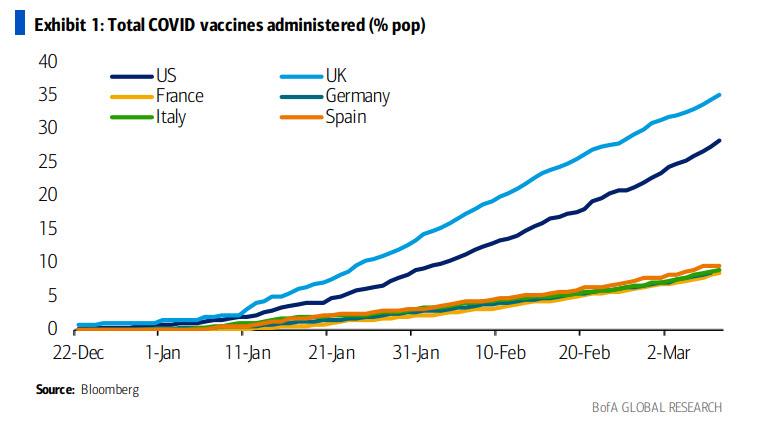
As shown in the chart below, vaccines administered around the globe continues to rise with BofA calculating that the US administered 15 million vaccines over the past week, increasing the total to 90.4 million; Europe administered 13 million doses this past week, for a total of 73.8m (and according to preliminary data from a study conducted at the University of Oxford, the Covid-19 vaccine developed by AstraZeneca/Oxford to be effective against the Brazilian variant of the virus).

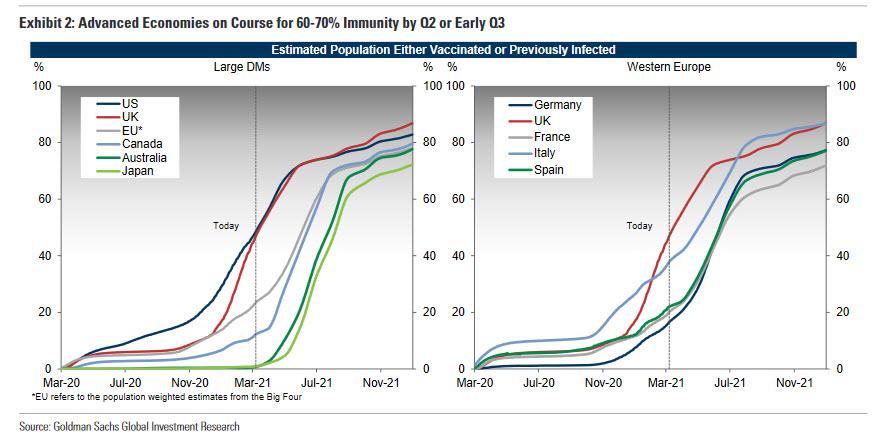
Putting this all together, Goldman now estimates that most advanced economies should cross the point at which 60-70% of the population are immune by Q2 or early Q3, with continental Europe a few months behind the US and UK. In other words, regardless of the CDC's attempt to provoke a low-burning panic over new virus variants, Goldman believes that herd immunity will be hit in the next 3-4 months.

Keep all this in mind as various authorities do everything in their power to cling on to lockdown measures which are increasingly a political tool to perpetuate an overarching government presence in every aspect of daily lives, instead of a means to improving people's lives.

It was none other than Billionaire Paul Singer, unafraid of being steamrolled by "cancel culture" who said it best: the recovery will be stymied by virus variants and policies “that sometimes seem governed by short-term political pressures rather than what is best for society, short and long term.”

https://www.zerohedge.com/markets/goldman-now-sees-most-advanced-economies-reaching-herd-immunity-3-months

Merck: Positive Phase 1 Data for Islatravir Subdermal Implant for HIV-1 Prevention

 Merck & Co. on Monday reported positive results from a Phase 1 study evaluating the safety, tolerability and pharmacokinetics of its investigational islatravir subdermal implant for the prevention of HIV-1 infection.

The Kenilworth, N.J., drugmaker said the data support the potential for a once-yearly dosing regimen for islatravir using a subdermal implant for pre-exposure prophylaxis, or "PrEP," of HIV-1 infection.

Merck said the implant achieved active drug concentrations above the pre-specified threshold at 12 weeks across the three doses of islatravir studied and is projected to provide drug concentrations likely above threshold for one year at the highest dose.

Based on the findings, Merck said it plans to launch a Phase 2 trial to further explore the potential of a subdermal implant containing islatravir as a long-acting option for PrEP for up to 12 months.

The company is studying islatravir across a variety of doses, formulations and frequencies for both the treatment of HIV-1 infection in combination with other antiretroviral agents and for the prevention of HIV-1 infection as a single agent.

https://www.marketscreener.com/quote/stock/MERCK-CO-INC-13611/news/Merck-nbsp-Positive-Phase-1-Data-for-Islatravir-Subdermal-Implant-for-HIV-1-Prevention-32634163/

'Fully vaccinated people can gather with others': CDC

 The U.S. Centers for Disease Control and Prevention (CDC) said on Monday that individuals inoculated against COVID-19 can meet in small groups with other vaccinated people without masks, but that they should keep wearing them outside the home.

CDC Director Rochelle Walensky said during a briefing that fully vaccinated individuals can visit with unvaccinated, low-risk people from one other household without masks.

The public health guidelines are designed to help increasing numbers of vaccinated people safely resume some more normal activities and contacts with those outside their households while the coronavirus is still widely circulating.

The recommendations come as about 30 million people, or 9.2% of the U.S. population, have been fully inoculated with COVID-19 vaccines made by Pfizer Inc/ BioNTech, Moderna Inc and Johnson & Johnson, according to CDC data.

Nearly 18% of the U.S. population, or 58.9 million adults had received at least one dose of a COVID-19 vaccine.

The Pfizer/BioNTech and Moderna vaccines require two shots a few weeks apart. The more recently authorized J&J option is a one-shot vaccine.

https://www.reuters.com/article/us-health-coronavirus-whitehouse/u-s-says-fully-vaccinated-people-can-gather-with-others-idUSKBN2B01WQ

Exelixis in license pact with WuXi to grow oncology biologics pipeline

 Exelixis, Inc. (Nasdaq: EXEL) and WuXi Biologics (“WuXi Bio”) (2269.HK) today announced the companies have entered into an exclusive license agreement to support the continued expansion of Exelixis’ oncology biologics pipeline. The agreement is the latest in a series of biologics-focused transactions for Exelixis as the company builds out its pipeline behind CABOMETYX® (cabozantinib), its flagship product and global oncology franchise, which received its fourth approval from the U.S. Food and Drug Administration in January.

Under the terms of the agreement, Exelixis will make a modest upfront payment to WuXi Bio in exchange for an exclusive license to a panel of monoclonal antibodies to a preclinically validated target, discovered based on WuXi Bio’s integrated technology platforms, for the development of antibody-drug conjugate, bispecific, and certain other novel tumor-targeting biologics applications. WuXi Bio will be eligible for development and commercialization milestones, as well as tiered royalties on net sales of any potential products commercialized from the panel.

https://www.businesswire.com/news/home/20210308005465/en/Exelixis-Enters-into-Exclusive-License-Agreement-with-WuXi-Biologics-to-Support-Further-Expansion-of-its-Growing-Oncology-Biologics-Pipeline