Search This Blog

Thursday, May 20, 2021

Asco 2021 – Guardant shoots for the moon

 Yesterday brought a compound win for Guardant Health. Data presented at Asco reaffirmed the performance of its Lunar-2 liquid biopsy, which it is developing as a screen for colorectal cancer, and at the same time screening guidelines changed, potentially increasing the market for this very test.

It will be some time before Guardant can take advantage of this guideline change, though, since Lunar-2 is still at least a year away from US approval. The same development will more immediately aid Exact Sciences, since its colorectal cancer screen, Cologuard, is already on sale – and on top of that, the guidelines recommend more frequent testing with this type of diagnostic. 

Guardant’s Asco data concern 434 patients with a colorectal cancer diagnosis, the largest early-stage patient cohort that has yet been assessed with Lunar-2. They reveal overall sensitivity of 91%, including 88% sensitivity in early stages I and II. Specificity was 94%. 

Among the 139 asymptomatic patients, representing the crucial population for a screen, sensitivity was 88%. It was 91% among the 233 symptomatic patients.

Lunar-2 Asco data
  Sensitivity
CRC stageI / II88%
III93%
Presentation at CRC diagnosisAsymptomatic88%
Symptomatic91%
Unknown94%
Location of primary tumourRight-sided93%
Left-sided90%
Transverse82%
Note: Specificity across the whole study was 94%. Source: Asco 2021 abstract #3536.

Analysts from Stifel write that this solid performance should bolster confidence in Eclipse, a 10,000-patient prospective trial due to report early next year, and will back a US approval application for Lunar-2. The crucial bar for Eclipse to hit is specificity of 90% and sensitivity of 74%, since this is the threshold set by the Centers for Medicare and Medicaid to allow reimbursement of colorectal cancer screening tests.

Wide screen

It is other recommendations that could provide a different fillip for Guardant. The US Preventive Services Task Force has finalised a change it had drafted late last year, lowering the minimum age from which the US population ought to be screened for colorectal disease from 50 to 45. The alteration means that insurance companies have to cover screening of this age group under the Affordable Care Act.

These guidelines make no mention of liquid biopsy testing for colorectal cancer, because no such test is yet on the market. Should Lunar-2 gain approval it will likely be used for the 45-plus age group, however. 

Unfortunately for Guardant, another group will already be occupying this niche. Exact Sciences’ Cologuard can immediately expand into this lower age group.

And it gets even better for Exact. The USPSTF now recommends that people be screened with stool DNA-faecal immunochemical testing every one to three years, rather than every three. Cologuard is the only such test on the US market. 

The USPSTF recommends other forms of screening too, and the gold standard for diagnosing colorectal cancer remains colonoscopy. But the non-invasive nature of Cologuard lies behind its high sales – the test made Exact $815m last year and sales are forecast to reach a jaw-dropping $3.5bn by 2026, according to Evaluate Medtech’s sellside consensus. 

Liquid biopsy is non-invasive too. The availability of Lunar-2, should this come to pass, could cut into Exact’s sales. 

https://www.evaluate.com/vantage/articles/news/trial-results/asco-2021-guardant-shoots-moon

Google gears up to launch its first medical device

 It is perhaps surprising that it has taken this long for Google to get in on the telemedicine boom. The company has just obtained a CE mark for its first medical device – a web-based application that can help triage skin complaints. 

The Derm Assist software uses artificial intelligence to assess images a person takes of their skin concern, such as a mole or a rash. Data suggest the app is reasonably accurate, but with Google intending to offer the software free of charge it is not clear how the company expects to profit from it, and privacy concerns regarding patients’ data have been raised. 

Google stipulates that Derm Assist is not a diagnostic. After the user uploads the images, they answer a few questions about skin type, how long the issue has persisted and other symptoms to help the tool narrow down the possibilities. The app then gives a list of possible matching conditions, along with information and similar matching images from the web. It is then up to the user whether to follow up with a doctor. The company has made a point of stating that the app works on a wide range of skin tones.

In a sense this is a version of what people often do already – that is, Google their symptoms to try to find out what might be wrong with them. Indeed, Google says there are almost ten billion Google searches related to skin, nail and hair issues each year. But Derm Assist has the stamp of a regulator, being CE marked as a class I medical device in the EU.

Adjust your settings

To Google’s credit, data on the app have been published in peer-reviewed journals. But this does not concern the setting in which Derm Assist will be launched, instead looking at its utility in helping healthcare professionals make diagnoses.

A study published in Nature Medicine a year ago suggested that the app was as good as dermatologists at identifying 26 common skin conditions, including melanoma, basal cell carcinoma and squamous cell carcinoma. 

Specifically, on a dataset of 963 validation cases, the software was non-inferior to six dermatologists and superior to six primary care physicians and six nurse practitioners. The top-1 accuracy – the proportion of samples where the top choice of diagnosis matched the true diagnosis – was 0.66 for Derm Assist, 0.63 for the dermatologists, 0.44 for the primary care doctors and 0.40 for the nurses.

Newer research, published in Jama this month, ploughs a similar furrow, showing that use of the technology by non-specialist healthcare workers was significantly associated with higher agreement with reference diagnoses. For GPs, the increase in diagnostic agreement was 10%, from 48% to 58%; for nurse practitioners, the increase was 12%, from 46% to 58%.

Digital stealth

A pilot launch of Derm Assist in the EU is pencilled in for the end of this year. The software will be available free, prompting some to wonder whether Google will attempt to monetise users’ data. 

Google has denied this, stating that the information and photos provided are private and encrypted, and will not be used to target advertising. It would save images in order to further train the Derm Assist algorithm, but only if users give explicit permission.

The uncertainties with this technology go beyond whether, or how, Google will make money from it. Given that the clinical data on Derm Assist do not assess it in its approved setting, the crucial point is that it remains unproven that the programme will actually improve care.

https://www.evaluate.com/vantage/articles/news/policy-and-regulation/google-gears-launch-its-first-medical-device

Japan to approve more COVID-19 vaccines as state of emergency set to widen

 Japan is expected to expand a state of emergency to cover the island of Okinawa on Friday, and it is also set to approve Moderna Inc and AstraZeneca PLC COVID-19 vaccines after health regulators' green light a day earlier.

Japan kicked off its vaccination campaign in mid-February using Pfizer Inc's vaccine but has so far inoculated just 3.9% of its population - the slowest rate among the world's larger, rich countries.

Media reported on Friday that despite the expected approval of the two additional vaccines, the government was likely to wait on using AstraZeneca's shots for the time being due to concerns over blood clots. Japan has arranged to buy 120 million doses of the British-Swedish drugmaker's vaccine, enough for 60 million people.

In contrast to some other Group of Seven (G7) countries that are beginning to end coronavirus-led lockdowns, much of Japan remains under emergency curbs amid a fourth wave of the pandemic.

On Friday, medical experts approved the government's proposal to add the southern prefecture of Okinawa to the emergency state, which now covers nine prefectures including Tokyo, host of the Olympic Games starting in about two months.

The state of emergency for Okinawa, expected to be formalised later on Friday, would run for about a month from Sunday through June 20, Economy Minister Yasutoshi Nishimura said, beyond the May 31 for the other nine. It would mark the third straight week that Japan has expanded the state of emergency.

Japan has so far recorded about 695,000 coronavirus infections and 12,000 COVID-19 deaths - much fewer than many countries - but its medical system is increasingly strained by a spike in more infectious variants of the virus.

With the Olympics starting on July 23, Tokyo is under particular pressure to bring infections and strain on the medical system down from the most dire "Stage Four" level and emerge from a state of emergency as scheduled this month.

https://www.marketscreener.com/quote/stock/TAKEDA-PHARMACEUTICAL-COM-6491073/news/Japan-to-approve-more-COVID-19-vaccines-as-state-of-emergency-set-to-widen-33316852/

Biden Hollows Out Trump-Era COVID Protections At The Border

 by Joseph Simonson via The Washington Free Beacon (emphasis ours),

The Biden administration is preparing to gut COVID-19 safety restrictions on illegal immigrants and asylum seekers and essentially reverse the Trump administration’s pandemic health protections without public notice, according to documents circulating within U.S. Customs and Border Protection.

While the Trump administration took a hardline approach to turning away immigrants to avoid "a serious danger of introduction of [a communicable] disease," at the start of the COVID-19 pandemic, Customs and Border Protection is now quietly walking much of that guidance back. A May memo, reviewed by the Washington Free Beacon, highlighted a potential work-around of the safety measures. The memo, authored by senior staff at CBP, emphasizes the ability of "customs officers [to] determine [who] should be allowed into the United States."

Customs and Border Protection officials say the Biden administration is looking to liberally interpret that provision, which was initially meant for migrants with extenuating circumstances related to humanitarian concerns or political repression. Broadening the humanitarian exemption would constitute a de facto reversal of the Trump administration’s guidance on limiting migration into the country. The shift in policy would come as border patrol agents encountered 178,622 migrants in April, among the highest-trafficked months on record.

"They’re keeping in place Trump’s order while broadening it enough to please left-wing activists," a senior Customs and Border Protection official told the Free Beacon. "If they rescind Title 42, they can’t deport single men."

The memo says the federal officials "will be relying" on immigrant-related, nongovernmental organizations "to identify undocumented individuals potentially amenable to be exempted on humanitarian grounds." Customs and Border Protection officials say essentially outsourcing immigration processing to NGOs could flood the country with migrants, many of whom never attend their immigration court hearings. Critics say activists from border organizations like the United Nations Refugee Agency and the Hebrew Immigrant Aid Society coach migrants on how to gain asylum status, rather than seek out the most vulnerable.

Trump invoked Title 42, a little known provision that enables the executive branch to curtail border crossings during a public health crisis, in a March 2020 executive order. Left-wing advocacy groups call Title 42 a violation of international human rights treaties and have demanded the Biden administration reverse his predecessor’s invocation of it. The Biden administration claims the "streamlined" process of admitting immigrants will combat COVID-19 by reducing "the amount of time undocumented individuals spend in congregate settings, thereby reducing the risk of COVID-19."

Using an expansive view of the pandemic exemptions and partnering with NGOs will ensure that more illegal immigrants and asylum seekers will enter the country, according to the senior CBP official.

"What the Biden administration is doing is giving them the ability to play both sides," the official said.

President Biden fulfilled a campaign promise by publicly instituting Title 42 exemptions for all migrant children, a decision many have blamed for the surge of unaccompanied minors at the southern border. Border agents could soon face a secondary surge—broad humanitarian exemptions would allow most families and children to claim asylum, regardless of whether they test positive for COVID-19 or other diseases. Single men, Customs and Border Protection officials say, would likely still face deportation unless they say they fear for their safety in their home country.

The release of the memo comes as border patrol agents increasingly see what the New York Times dubbed "pandemic refugees" from countries as far away as India on the southern border. April numbers released by the government showed 30 percent of families found on the border came from countries other than Mexico, Guatemala, Honduras, and El Salvador—a 22.5 percent increase from April 2019.

https://www.zerohedge.com/political/biden-hollows-out-trump-era-covid-protections-border

Biotech Firm Launches SPAC To Buy Back SPAC At Massive Premium

 There's no question that the SPAC frenzy has slowed substantially from its frenzied peak late last year, but even as the pace of dealmaking has slowed (giving weary junior investment-banking analysts a rest), there's little question that the SPAC trend has changed the nature of dealmaking, especially for Private Equity firms, as Institutional Investor pointed out. PE firms are sponsoring a growing percentage of SPACs, as these firms take advantage of the power of public markets to generate capital - even as their LPs will always be better positioned thanks to the benefits bestowed on SPAC sponsors (including generous warrants and free stakes).

But as the trend continues to snowball, one company caught the attention of Bloomberg reporters when it announced plans to launch a SPAC specifically to buy back a former subsidiary business that it spun off with a SPAC ln late 2019. So basically, they're launching a SPAC to take over another SPAC. It's a SPAC inside a SPAC for investors who really like SPACs.

But we digress: The scenario revolves around a drugmaker called Roivant Sciences, which wants to merge with a SPAC then take over a SPAC that acquired Immunovant from Roivant.

For those who aren't familiar with its business Roivant is a kind of incubator: it uses its subsidiaries to develop drugs, then takes some of them public.

But here's the key to the whole deal: Roivant says it knows something that everyone else doesn’t about its former unit, and that this special sauce is why it's willing to pay a massive premium for the shares (perhaps as much as 70%).

Those who have closely watched the space say they can't remember seeing a deal like this: "In the years I’ve been analyzing SPACs, I’ve never seen a transaction like this," said Neil Danics, founder of SPAC Analytics in Toronto and who has been providing research on the industry since 2007.

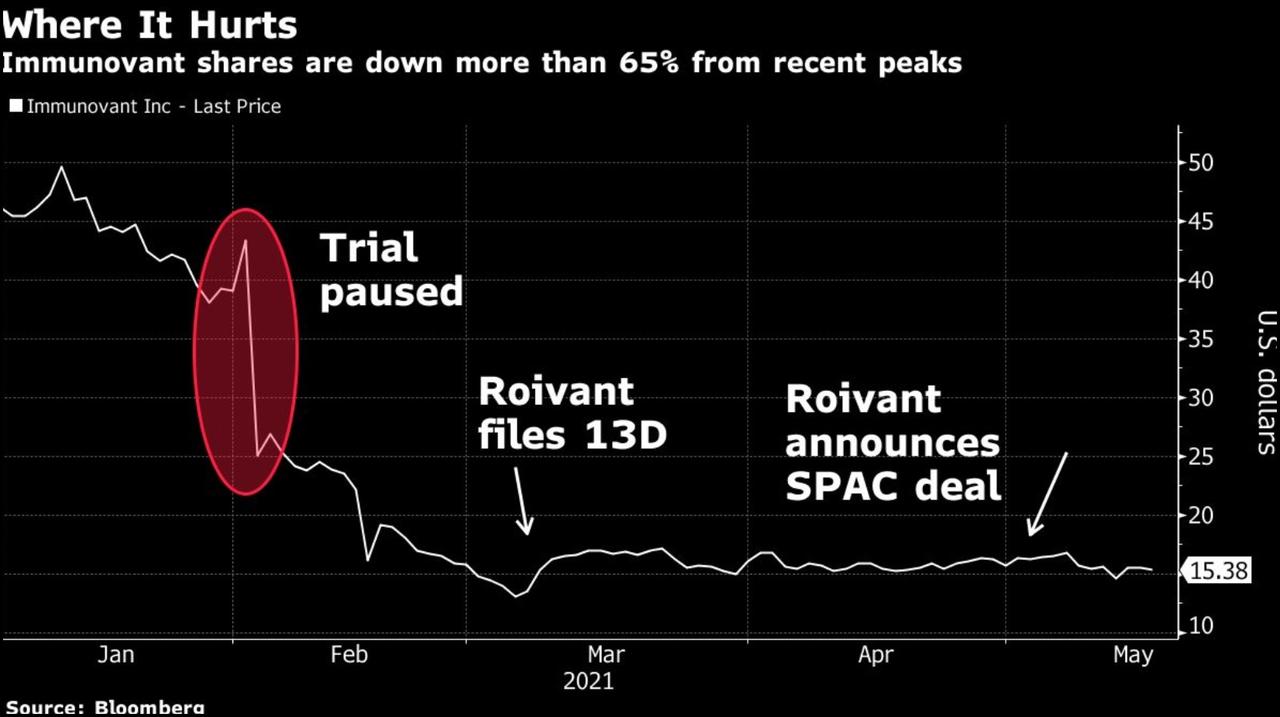
Source: Bloomberg

Adding another layer of drama, Immunovant has few obvious opportunities. Human trials on Immunovant’s main prospect, a monoclonal antibody injection aimed at ailments such as myasthenia gravis and thyroid eye disease, were halted in February because of safety concerns. But

Managers at Roivant are pushing ahead anyway, saying that as the parent company with a 57.5% stake, they’ve received “non-public” information about Immunovant. Roivant representatives declined to comment on the transaction. Completion of Roivant’s deal with Montes is expected in the third quarter, and more data about Immunovant’s drug may come out by then.

“The market would be happy with a premium transaction,” Baird’s Brian Skorney said about Immunovant, whose shares trade about 11% higher than when it merged with Health Sciences. “There’s been some ambiguity -- concerns about safety problems that cut the stock in half from highs. Maybe Roivant knows it’s a moderate issue.”

Roivant itself shows a paper gain of about 117% on Immunovant, with more than half coming from “earnouts” that granted Roivant more shares when milestones were met. They were worth a lot more back in February, before Immunovant plunged from more than $43 after pausing a trial of its IMVT-1401 for thyroid eye disease, citing elevated total cholesterol and low-density lipoprotein or LDL.

Immunovant's shares have plunged since then. And Roivant's pitch sounds tailored to investors who prefer risky biotech plays. And as Bloomberg points out, while Roivant's pitch is certainly enticing, it apparently wasn't enough to convince institutional money to stick around.

Some holders didn’t wait to see how it all turns out. Adage Capital Partners sold its entire stake in Immunovant during the first quarter. RTW Investments LP -- which is providing bridge financing for Roivant’s SPAC deal with Montes -- cut its holdings by 16% to 6.36 million shares, leaving it with a 6.5% stake. Representatives for Adage and RTW didn’t respond to messages.

So, with deals still coming to market despite SPACs having collectively lost a quarter of their market value YTD, it's pretty clear that Roivant is offering the deal to retail bagholders because, well, it's the company's only real option.

https://www.zerohedge.com/geopolitical/biotech-firm-launches-spac-buy-back-spac-massive-premium

BioNTech CEO says vaccine 70-75% effective for India variant

 BioNTech SE Chief Executive Ugur Sahin said on Thursday the vaccine it developed with Pfizer Inc is expected to be 70% to 75% effective in protecting against infections of the COVID-19 variant first detected in India.

“So far we’ve had the chance to test our vaccine against more than 30 variants of the virus. It has proven effective against mutations so far,” Sahin, a German scientist with Turkish parents, said, speaking Turkish in televised comments.

Tests this week have focused on the India variant, he said. “We expect (our vaccine) to protect against infections by 70-75%,” he said after virtually attending the Turkish government’s science council meeting.

The World Health Organization’s regional director said on Thursday COVID-19 vaccines being deployed in Europe, including that of Pfizer-BioNTech, appear able to protect against all variants that are circulating and causing concern.

Sahin was speaking in a televised conversation with Turkish Health Minister Fehrettin Koca, who separately said the country recorded less than 10,000 daily new coronavirus cases for the first time since March 1.

https://whbl.com/2021/05/20/biontech-ceo-says-vaccine-70-75-effective-for-india-variant/

JPMorgan dives back into fixing health care with new venture

 JPMorgan Chase will take another crack at fixing health care after a push with two other corporate giants dissolved earlier this year.

The bank said Thursday that it formed a new business focused on improving care provided for about 285,000 people through its employer-sponsored health plan. Morgan Health will start with $250 million for investments and a health policy veteran as its CEO, former Clinton administration official Dan Mendelson.

The announcement comes a few months after a similar venture backed by JP Morgan shut down. The bank, retail giant Amazon and Warren Buffett’s Berkshire Hathaway had formed an independent company called Haven in 2018 because health care costs and quality had become such a persistent problem for corporate America.

Haven tinkered with ways to improve primary care and also identified areas for cutting prescription drug costs before announcing its end in January. Amazon said then that Haven worked well for devising ideas, but it made more sense to implement those ideas independently.

Morgan Health leaders plan to build on what they learned through Haven and hope to make models for care improvements that other employers can follow.

But their focus initially will be making care better for the people covered under their own plan.

“That will be the lens through which we look at everything,” said Vice Chairman Peter Scher, who will oversee the new unit.

Aside from primary care, the new business also will study mental health care and ways to improve the treatment of people with chronic conditions like diabetes. Health equity will be another big focus.

Mendelson noted that all employees have the same benefits, but the company wants to address why health care outcomes can differ.

“The goal here is to ensure that health outcomes improve for minority populations,” he said.

Employers have struggled for years managing the cost of a health benefit many companies need to offer to attract and keep workers.

Employer-sponsored health insurance covers roughly 157 million people or nearly half the U.S. population, and the cost of that coverage routinely increases faster than wages and inflation.

Many companies have already tried fixing primary care, which is seen as a gateway to the health care system for patients and an important tool for keeping them engaged in their health.

Employers have built their own doctor networks, set up clinics on worksites or pushed care connections through telemedicine. Amazon, for instance, developed a virtual care program that also sends providers like nurses to patients if they need in-person care.

Health economist Paul Keckley said that if JPMorgan CEO Jamie Dimon wants to “create a better mouse trap there, he’s got a lot of catching up to do.”

Keckley also noted that it’s tough for just one employer — even a company as big as JPMorgan — to have a meaningful impact on health care costs, which vary tremendously around the country.

He said large employers need to band together in a single market in order to gain enough leverage to influence costs.

“It’s just hard for these companies to change physician behavior or hospital cost structure unless they get scale,” he said.

https://apnews.com/article/nyc-state-wire-health-business-93942154bbe3bf7bea70faf7746a65a1