Search This Blog

Sunday, July 25, 2021

UW System to offer vaccinated students $7K scholarships

 The University of Wisconsin System plans to offer nearly $500,000 in scholarships this fall to students who have been vaccinated against the coronavirus.

System President Tommy Thompson said all vaccinated students at regional four- and two-year campuses that get at least 70% of their students vaccinated by Oct. 15 will be eligible for a drawing for a $7,000 scholarship. Seventy students will win, with more winners coming from campuses with larger enrollments.

UW-Madison students won’t be eligible, Thompson said, because Chancellor Rebecca Blank is working on her own vaccination incentive programs. Asked for details on Blank’s plans, UW-Madison spokesman John Lucas said the flagship university is “on a path” to reach 80% vaccination among students and is “considering incentives” but had nothing to announce.

Thompson has called for campuses to offer at least three-quarters of their courses in-person this fall. He said he set the vaccination threshold at 70% for the scholarship drawing because that’s generally considered the minimum for herd immunity.

“If we can arrive at 70% we’re going to have a very safe year,” Thompson said during a conference call with reporters on Friday. “That’s why I’m pushing so hard.”

Several campuses across the country have launched similar tuition reduction incentives to encourage student vaccinations rather than issue mandates. Purdue in May offered 10 lottery winners free tuition for a year. Rowan University in New Jersey in May offered tuition and housing discounts. Officials in New York state last month launched a drawing in which anyone between the ages of 12 and 17 who got vaccinated could win full tuition and housing to any state school. UW-Oshkosh plans to award 10 $1,000 scholarships to vaccinated students in a drawing this fall.

A $7,000 scholarship would defray a huge chunk of tuition for students at the system’s regional campuses.

Resident tuition at UW-Eau Claire last year was about $8,870. Resident tuition at UW-Green Bay was about $7,873. At UW-Oshkosh it was about $7,700 and at UW-La Crosse it was $9,159. Regents earlier this month adopted a 2021-22 budget that keeps tuition frozen.

https://apnews.com/article/health-coronavirus-pandemic-scholarships-49e4fe02c40ebb1394e15cce421c8a93

Fauci: CDC may back wearing face masks more

 Dr. Anthony Fauci says the U.S. Centers for Disease Control and Prevention are weighing revising their COVID-19 guidelines to recommend that even fully vaccinated individuals wear masks in public.

Fauci, the nation’s top government infectious disease official, told CNN’s “State of the Union” TV show that he’s taken part in conversations about altering the guidelines, something he described as being “under active consideration.”

He noted that some local areas where infection rates are surging are already urging individuals to wear masks in public regardless of their vaccination status. Fauci said those local rules are not incompatible with the CDC’s recommendation that the vaccinated don’t need to wear masks in public.

https://apnews.com/article/lifestyle-middle-east-business-health-travel-6dca46af8fb9b611697d39cac1f97197

German politicians criticize warning to unvaccinated people

 German politicians across the political spectrum on Sunday criticized a warning by Chancellor Angela Merkel’s chief of staff that restrictions for unvaccinated people may be necessary if COVID-19 infection numbers reach new heights in the coming months.

Chief of staff Helge Braun told the newspaper Bild am Sonntag that he doesn’t expect another coronavirus-related lockdown in Germany.

But Braun said that unvaccinated people may be barred from entering venues like restaurants, movie theaters and stadiums “because the residual risk is too high.”

Braun said getting vaccinated is important to protect against severe disease and because “vaccinated people will definitely have more freedoms than unvaccinated people.”

Braun said that such policies would be legal because “the state has the responsibility to protect the health of its citizens.”

His comments fueled an ongoing debate in German politics about potential vaccination requirements. The issue has proven divisive, even within Merkel’s own Christian Democrats party.

The candidate to replace Merkel, Armin Laschet, said he opposes any sort of formal or informal vaccine requirements for the time being.

“I don’t believe in compulsory vaccinations and I don’t believe we should put indirect pressure on people to get vaccinated,” he said in an interview with the German broadcaster ZDF airing Sunday night. “In a free country there are rights to freedom, not just for specific groups.”

If the vaccination rates remain too low this fall, it might be possible to consider other options, Laschet said: “But not now.”

With the highly transmissible delta variant spreading in Germany, politicians have debated the possibility of compulsory vaccination for specific professions, including medical workers. No such requirements have been implemented for now.

Germany’s vaccine efforts have slowed in recent weeks and that has led to discussions about how to encourage those who haven’t yet received a vaccine to do so. More than 60% of the German population has received at least one dose while over 49% are fully vaccinated.

During a recent visit to the Robert Koch Institute, the government run disease control agency, Merkel ruled out new vaccine requirements “at the moment.” The government would prefer to focus on encouraging vaccination for the time being, she said.

Still, she added, “I’m not ruling out that this might be talked about differently in a few months either.”

Other elected officials have struck a similar tone. Baden-Württemberg governor Winfried Kretschmann, a member of the Greens, noted Sunday that the delta variant and others that may emerge could make vaccine requirements more attractive down the line.

While there are no current plans to require people to get vaccinated, he told the German news agency DPA, “I can’t rule out compulsory vaccinations for all time.”

Politicians from across the spectrum immediately pushed back against Braun’s comments on Sunday. Some expressed skepticism about the effectiveness of such restrictions, while others warning against freedoms and rights based on one’s vaccination status.

“Of course we need incentives to reach the highest possible vaccination rate,” Marco Buschmann, parliamentary group leader for the pro-business Free Democrats, told the RedaktionsNetzwerk Deutschland newspaper group.

Still, he said, if it’s true that unvaccinated people who have been tested or recovered from the virus pose no greater danger than vaccinated people, to impose such restrictions on the unvaccinated “would be a violation of their basic rights.”

Rolf Mützenich, head of the center-left Social Democrats’ parliamentary group, said politicians should be focusing more on getting willing citizens vaccinated than penalizing the unvaccinated.

“We’re not going to sustainably change the vaccination behavior of individuals with threats,” he told RedaktionsNetzwerk Deutschland.

https://apnews.com/article/europe-business-health-government-and-politics-germany-a46d18ff239dcbc71973cd1052c3866b

Fauci says US headed in ‘wrong direction’ on coronavirus

 The United States is in an ``unnecessary predicament” of soaring COVID-19 cases fueled by unvaccinated Americans and the virulent delta variant, the nation’s top infectious diseases expert said Sunday.

``We’re going in the wrong direction,” said Dr. Anthony Fauci, describing himself as ``very frustrated.”

He said recommending that the vaccinated wear masks is ``under active consideration” by the government’s leading public health officials. Also, booster shots may be suggested for people with suppressed immune systems who have been vaccinated, Fauci said.

Fauci, who also serves President Joe Biden’s chief medical adviser, told CNN’s “State of the Union” that he has taken part in conversations about altering the mask guidelines.

He noted that some local jurisdictions where infection rates are surging, such as Los Angeles County, are already calling on individuals to wear masks in public regardless of vaccination status. Fauci said those local rules are compatible with the Centers for Disease Control and Prevention recommendation that the vaccinated do not need to wear masks in public.

Nearly 163 million people, or 49% of the eligible U.S. population, are vaccinated, according to CDC data.

“This is an issue predominantly among the unvaccinated, which is the reason why we’re out there, practically pleading with the unvaccinated people to go out and get vaccinated,” Fauci said.

Fauci said government experts are reviewing early data as they consider whether to recommend that vaccinated individuals to get booster shots. He suggested that some of the most vulnerable, such as organ transplant and cancer patients, are “likely” to be recommended for booster shots.

He also praised Republicans, including Govs. Asa Hutchinson of Arkansas and Ron DeSantis of Florida, and the second-ranking House leader, Rep. Steve Scalise of Louisiana, for encouraging their constituents to get vaccinated. Their states have among the lowest vaccination rates in the country.

“What I would really like to see is more and more of the leaders in those areas that are not vaccinating to get out and speak out and encourage people to get vaccinated,” Fauci said.

Hutchinson, also speaking on CNN, said he did not know whether he might have underestimated the hesitancy of people to get the vaccine, but acknowledged that “the resistance has hardened in certain elements and is simply false information. It is myths. As I go into these town hall meetings, someone said: `Don’t call it a vaccine. Call it a bioweapon.′ And they talk about mind control. Well, those are obviously erroneous. Other members of the community correct that.”

https://apnews.com/article/coronavirus-pandemic-anthony-fauci-masks-70585010748808ce2284cfc19b608e47

UK 'pingdemic' response chaotic, say food supply firms

 Government efforts to deal with the self-isolation "pingdemic" are "chaotic" and "too late", food supply industry bodies have said.

Supply firms are having to fight to keep supermarkets stocked with food, one industry body warned.

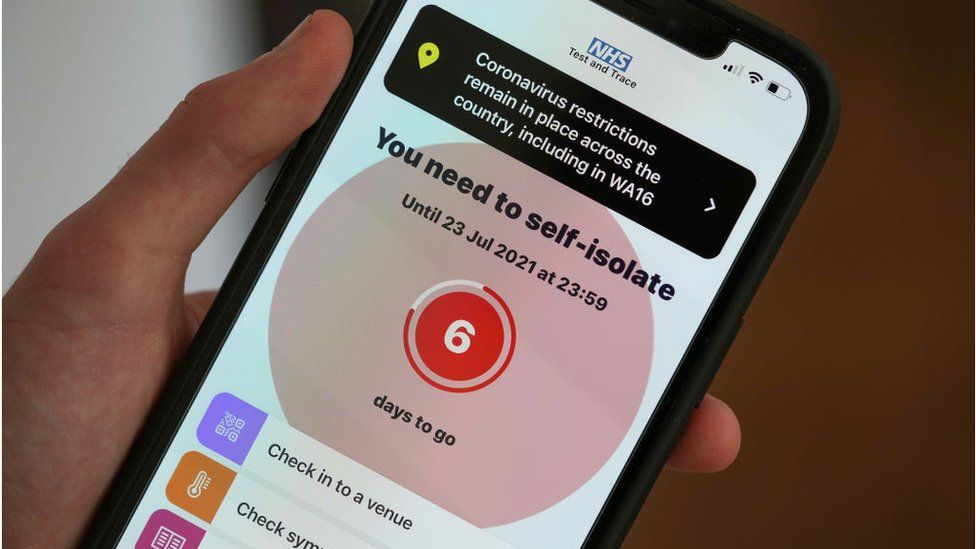
The government has been trying to ease the effects of workers having to self-isolate if they are "pinged" by the NHS Test and Trace app.

Health Secretary Sajid Javid said daily testing will help minimise disruption.

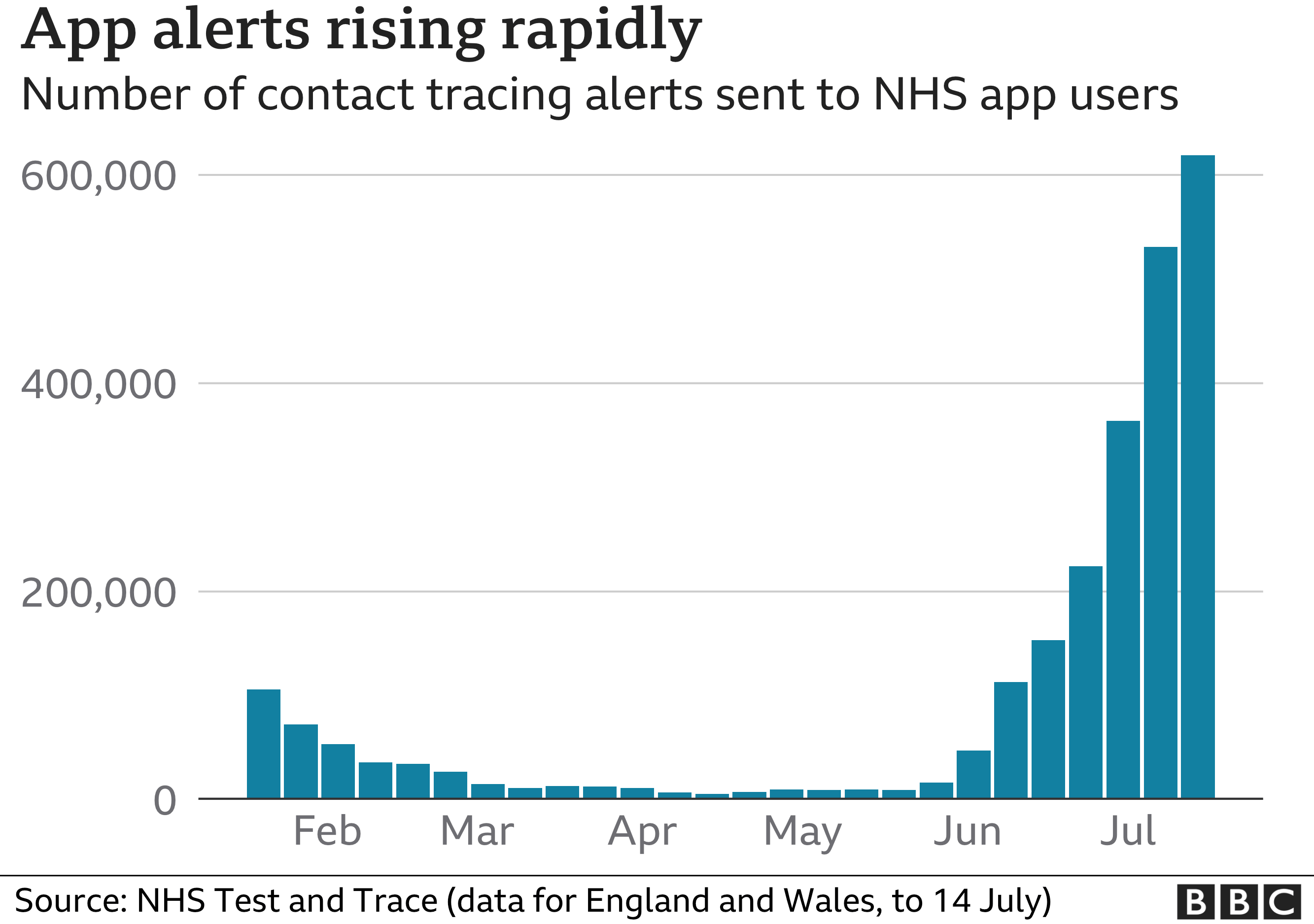
The number of people being sent NHS app alerts to self-isolate rapidly rose throughout July as infection rates soared, reaching a record 600,000 in the week to 14 July.

Many businesses struggled as staff members self-isolated.


'Chaos'

The government changed its stance last week and announced that some double-jabbed staff at some critical organisations would be allowed to take tests to keep coming to work, rather than self-isolating.

On Sunday, the Department for Environment, Food and Rural Affairs said it had now contacted 500 sites that had been identified for daily contact testing.

Testing is understood to be rolling-out to key manufacturing, food processing and wholesale sites across the food supply chain, which will be joining large supermarket depots as part of the initial phase of the testing programme.


The number of roles that are exempt from isolation is also understood to be have been widened to include roles such as forklift drivers and dispatchers.

But the government's response has been "very chaotic" and "too late", said James Bielby, chief executive of the Federation of Wholesale Distribution.

Chart showing app alerts rising rapidly

He said that a policy for exemptions was announced on Monday, but that there were no further details given until Thursday.

Many food businesses were still in the dark as to whether their staff could be included in the scheme, he added, with only 15 supermarket distribution centres with staff on the list on Friday.

"The process for getting on the list is entirely opaque," Mr Bielby said, adding that the government seemed to be making up the policy "on the hoof" in response to media reports.

NHS Test and Trace appIMAGE COPYRIGHTGETTY IMAGES

Putting in place testing instead of self-isolation would have been better three weeks ago, Mr Bielby said, but now it was "too late" - especially as self-isolation is supposed to ease in three weeks' time.

He added that the "pingdemic" had been "really bad" for the food supply chain, as entire production lines in factories and entire driver fleets had been "taken out".

There was already a shortage of lorry drivers because of a combination of factors including Brexit, the Covid pandemic and changes to self-employment taxation, he added.

'Bigger challenge than Covid'

Shane Brennan, chief executive of the Cold Chain Federation, said the "pingdemic" had been a greater challenge for businesses than Covid itself.

"You can deal with problems as long as you have people working," Mr Brennan said. "The problem with the 'pingdemic' is that it takes lots of people out of the workforce."

Some supermarket shelvesIMAGE COPYRIGHTGETTY IMAGES
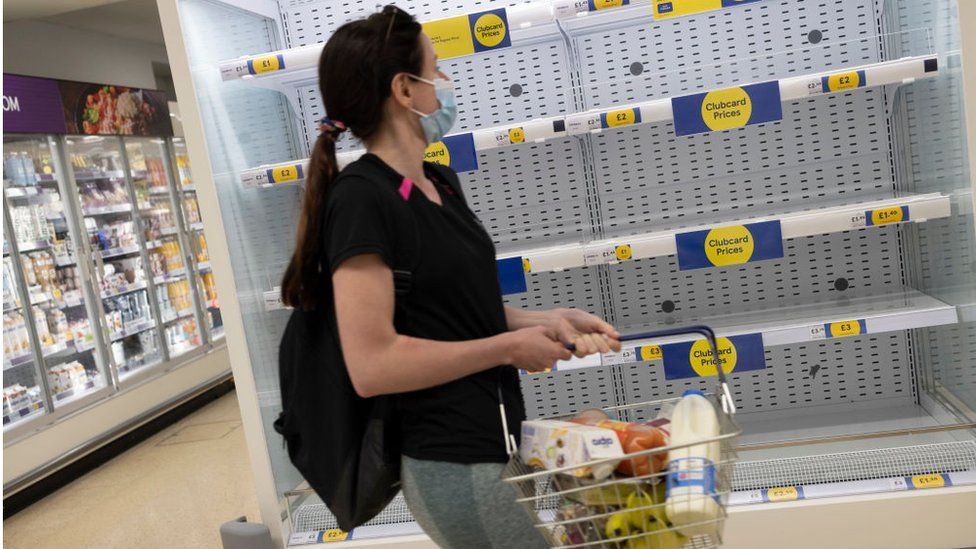
image captionSupermarkets have been dealing with rolling shortages of some stock as lorry driver numbers remain low

There are already rolling shortages of stock in supermarkets, and supply businesses are "fighting to keep food on the shelves", he said.

However, the application process for getting staff exemptions for self-isolation was "way too complicated" and came too late.

In addition, government departments did not appear to be working in a unified way.

"It's quite obvious that the government is having an argument with itself [over self-isolation]," he said.

Train delays

Although the daily number of people testing positive for coronavirus has fallen over the past week to fewer than 32,000 per day, critical businesses have reported struggling with staff absences.

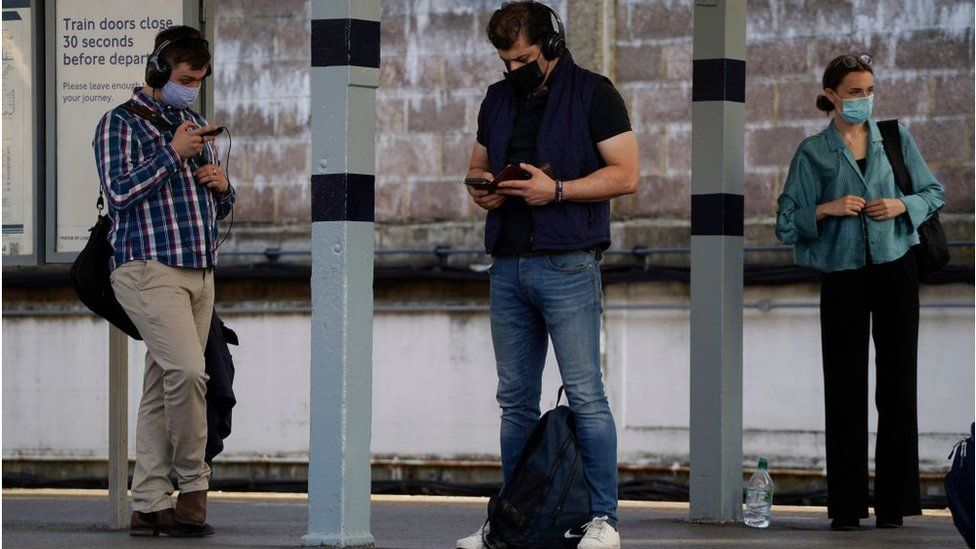
The Rail Delivery Group, which represents train companies, said that there could be disruption to services in the coming weeks.

CommutersIMAGE COPYRIGHTGETTY IMAGES
image captionTrains may be delayed, the Rail Delivery Group said

"While train companies are doing everything they can to minimise any disruption, there may be an impact on services so we are asking people to check before they travel using app alerts," a spokesperson said.

On Saturday, Govia Thameslink Railway (GTR), which runs Thameslink and Southern trains, said it would introduce a reduced timetable from Monday 26 July.

Non-essential businesses, including pubs and restaurants, have also struggled with staff getting pinged.

Emma McClarkin, chief executive of the British Beer & Pub Association, said: "Pubs are closing or greatly reducing their opening hours due to staff shortages caused by app pings - despite staff testing negative on lateral flow tests."

She said 43% of pub staff were aged 18 to 25 and would not have their second jab for months.

"We urge the government to work with us to find a sensible solution to this that still ensures staff and customer safety," she added.

Daily testing

However, Health Secretary Sajid Javid said: "As we learn to live with the virus, we must do everything we can to break chains of transmission and stop the spread of the virus.

"Daily contact testing of workers in these critical sectors will help to minimise any disruption caused by rising cases in the coming weeks, while ensuring staff are not put at risk."

A spokesperson said that as a first step, daily contact testing was being rolled out to critical workplaces in the food supply chain and that many sites would be operational from Monday 26 July.


https://www.bbc.com/news/business-57936883

What's This About Delta Being 1,000 Times More Infectious?

 You've been hearing it a lot lately: the Delta variant is 1,000 times more infectious than the original version of SARS-CoV-2.

So where does that figure come from?

It's from a study by the Guangdong CDC in China -- published earlier this month as a preprint on both medRxiv and virological.org -- that experts are touting for its solid science.

Baisheng Li, MD, and colleagues studied 62 people and their close contacts who were infected in the initial Delta outbreak in Guangzhou from May 21 to June 18. These close contacts were tested daily via PCR, and data were compared with similar sampling from 63 people infected with an earlier version of the virus from the first wave in 2020.

Ultimately, they found that the viral load for the first positive test was 1,260 times higher for Delta compared with the variant in the initial wave of infections -- hence, the "1,000 times" higher estimate going around social and other media.

Indeed, the PCR cycle threshold value for the first detected infection was just 24 with Delta, compared with 34 for the earlier variant, they reported.

The time from exposure to the first positive PCR test was also shorter with Delta, at 4 days compared with 6 days.

This all suggests a faster replication rate, a reduced incubation period, and greater viral shedding -- all factors that contribute to Delta's increased infectiousness and transmissibility, said Angela Rasmussen, PhD, of the Vaccine and Infectious Disease Organization at the University of Saskatchewan in Canada, in a twitter thread.

"If people are shedding 1000X more virus, the probability that a close contact will be exposed to an infectious dose is much higher," Rasmussen tweeted. "If people become contagious more quickly after exposure, they can have more opportunity to infect others."

She noted that she's seen more "Delta is more airborne!" commentary, which is "neither helpful nor accurate. ... I'm not even sure what that means," as a virus must still obey the laws of physics, she said.

"Delta hasn't learned how to fly or morphed into an ACE2-seeking virus missile," she tweeted. "It's not 'more airborne.'"

She said the study suggests that the mechanism behind Delta's increased transmissibility "is just that there's a lot more of it, sooner. If there's more virus around, it's going to be easier to spread."

The increased transmissibility for Delta is also supported by epidemiological evidence from the U.K., which found Delta to be about 64% more transmissible than the Alpha variant (B.1.1.7). Alpha was already estimated to be 50% more transmissible than the wild-type virus, or the D614G strain -- making Delta about twice as transmissible as wild-type virus.

Rasmussen said the findings from Li's group only make the need to get vaccinated more urgent, since the fully vaccinated "have high titers of neutralizing antibodies and mature memory B and T cell responses. It's a lot harder for Delta to overwhelm these defenses by just throwing more virus at them."

https://www.medpagetoday.com/special-reports/exclusives/93717

AstraZeneca's newly acquired Soliris is overpriced in myasthenia gravis: ICER

 Now that Alexion’s Soliris is in AstraZeneca's hands, the drugmaker is counting on the C5 inhibitor to help push it toward billions in sales in just a few years. But a prominent drug pricing watchdog is raising a red flag over its costs for patients with a rare neuromuscular disorder. 

The Institute for Clinical and Economic Review (ICER) on Friday released its report examining the cost-effectiveness of Soliris, also known as eculizumab, as well as up-and-comer efgartigimod for patients with the myasthenia gravis. 

Soliris, first approved for generalized myasthenia gravis (gMG) in 2017, carries a list price of about $470,000 annually. But to ICER, that cost is “well beyond typical thresholds.”

Soliris would need a “substantial discount” to reach a more appropriate price, according to its report. Using the widely leveraged measure for disease burden known as quality-adjusted life year (QALY), ICER calculated a range of $6,900 to achieve $50,000 per QALY to $25,700 to hit $200,000 per QALY.


The group, after examining Soliris’ late-stage trial data, determined they’re highly certain it produces a small benefit to patients who are positive for anti-AChR antibodies, while there’s a “moderate certainty of a small or substantial net health benefit.” 

As for argenx’s efgartigimod, that drug hasn’t scored an FDA nod yet and its eventual cost-effectiveness will depend on its price. 

Representatives for AstraZeneca and argenx weren't immediately available for comment. 

Given ICER's uncertainty regarding efgartigimod’s dosing and long-term benefits, the group said it’s moderately certain the drug can produce a “comparable, small or substantial net health benefit” in that same group of MG patients. Except current data is insufficient to determine its benefit in patients who are negative for anti-AChR antibodies.

ICER’s researchers used a two-year treatment horizon in their model but noted that it’s unclear how long patients are supposed to remain on these treatments. The model may not fully capture the challenges the disease presents to patients, ICER acknowledged. 


MG is a “serious, lifelong disease with life-threatening manifestations, and most patients do not achieve treatment goals with conventional therapy,” the report said. 

With the closing of AstraZeneca’s mega $39 billion buyout of Alexion Pharmaceuticals this week, the U.K. pharma has officially picked up Soliris and its successor, Ultomiris. Alexion has been working to push Ultomiris through additional indications ahead of Soliris’ expected loss of exclusivity in 2025. 

AstraZeneca’s deal, the largest struck last year, is all part of CEO Pascal Soriot's mission to hit $40 billion in global sales by 2023. The company will see an immediate $6 billion bump to its topline thanks to Alexion’s C5 inhibitors, used to treat rare diseases like paroxysmal nocturnal hemoglobinuria. 

https://www.fiercepharma.com/pharma/astrazeneca-s-newly-acquired-soliris-needs-substantial-discount-myasthenia-gravis-cost