Search This Blog

Saturday, December 4, 2021

Immune system-stimulating nanoparticle could lead to more powerful vaccines

 A common strategy to make vaccines more powerful is to deliver them along with an adjuvant -- a compound that stimulates the immune system to produce a stronger response.

Researchers from MIT, the La Jolla Institute for Immunology, and other institutions have now designed a new nanoparticle adjuvant that may be more potent than others now in use. Studies in mice showed that it significantly improved antibody production following vaccination against HIV, diphtheria, and influenza.

"We started looking at this particular formulation and found that it was incredibly potent, better than almost anything else we had tried," says Darrell Irvine, the Underwood-Prescott Professor with appointments in MIT's departments of Biological Engineering and Materials Science and Engineering; an associate director of MIT's Koch Institute for Integrative Cancer Research; and a member of the Ragon Institute of MGH, MIT, and Harvard.

The researchers now hope to incorporate the adjuvant into an HIV vaccine that is currently being tested in clinical trials, in hopes of improving its performance.

Irvine and Shane Crotty, a professor at the Center for Infectious Disease and Vaccine Research at the La Jolla Institute for Immunology, are the senior authors of the study, which appears today in Science Immunology. The lead authors of the paper are Murillo Silva, a former MIT postdoc, and Yu Kato, a staff scientist at the La Jolla Institute.

More powerful vaccines

Although the idea of using adjuvants to boost vaccine effectiveness has been around for decades, there are only a handful of FDA-approved vaccine adjuvants. One is aluminum hydroxide, an aluminum salt that induces inflammation, and another is an oil and water emulsion that is used in flu vaccines. A few years ago, the FDA approved an adjuvant based on saponin, a compound derived from the bark of the Chilean soapbark tree.

Saponin formulated in liposomes is now used as an adjuvant in the shingles vaccine, and saponins are also being used in a cage-like nanoparticle called an immunostimulatory complex (ISCOM) in a Covid-19 vaccine that is currently in clinical trials.

Researchers have shown that saponins promote inflammatory immune responses and stimulate antibody production, but how they do that is unclear. In the new study, the MIT and La Jolla team wanted to figure out how the adjuvant exerts its effects, and to see if they could make it more potent.

They designed a new type of adjuvant that is similar to the ISCOM adjuvant but also incorporates a molecule called MPLA, which is a toll-like receptor agonist. When these molecules bind to toll-like receptors on immune cells, they promote inflammation. The researchers call their new adjuvant SMNP (saponin/MPLA nanoparticles).

"We expected that this could be interesting because saponin and toll-like receptor agonists are both adjuvants that have been studied separately and shown to be very effective," Irvine says.

The researchers tested the adjuvant by injecting it into mice along with a few different antigens, or fragments of viral proteins. These included two HIV antigens, as well as diphtheria and influenza antigens. They compared the adjuvant to several other approved adjuvants and found that the new saponin-based nanoparticle elicited a stronger antibody response than any of the others.

One of the HIV antigens that they used is an HIV envelope protein nanoparticle, which presents many copies of the gp120 antigen that is present on the HIV viral surface. This antigen recently completed initial testing in phase 1 clinical trials. Irvine and Crotty are part of the Consortium for HIV/AIDS Vaccine Development at the Scripps Research Institute, which ran that trial. The researchers now hope to develop a way to manufacture the new adjuvant at large scale so it can be tested along with an HIV envelope trimer in another clinical trial beginning next year. Clinical trials that combine envelope trimers with the traditional vaccine adjuvant aluminum hydroxide are also underway.

"Aluminum hydroxide is safe but not particularly potent, so we hope that (the new adjuvant) would be an interesting alternative to elicit neutralizing antibody responses in people," Irvine says.

Rapid flow

When vaccines are injected into the arm, they travel through lymph vessels to the lymph nodes, where they encounter and activate B cells. The research team found that the new adjuvant speeds up the flow of lymph to the nodes, helping the antigen to get there before it starts to break down. It does this in part by stimulating immune cells called mast cells, which previously were not known to be involved in vaccine responses.

"Getting to the lymph nodes quickly is useful because once you inject the antigen, it starts slowly breaking down. The sooner a B cell can see that antigen, the more likely it's fully intact, so that B cells are targeting the structure as it will be present on the native virus," Irvine says.

Additionally, once the vaccine reaches the lymph nodes, the adjuvant causes a layer of cells called macrophages, which act as a barrier, to die off quickly, making it easier for the antigen to get into the nodes.

Another way that the adjuvant helps boost immune responses is by activating inflammatory cytokines that drive a stronger response. The TLR agonist that the researchers included in the adjuvant is believed to amplify that cytokine response, but the exact mechanism for that is not known yet.

This kind of adjuvant could also be useful for any other kind of subunit vaccine, which consists of fragments of viral proteins or other molecules. In addition to their work on HIV vaccines, the researchers are also working on a potential Covid-19 vaccine, along with J. Christopher Love's lab at the Koch Institute. The new adjuvant also appears to help stimulate T cell activity, which could make it useful as a component of cancer vaccines, which aim to stimulate the body's own T cells to attack tumors.

The research was funded by the National Institute of Allergy and Infectious Diseases, the Koch Institute's Marble Center for Cancer Nanomedicine, the U.S. Army Research Office through the Institute for Soldier Nanotechnologies at MIT, the Koch Institute Support (core) Grant from the National Cancer Institute, the International AIDS Vaccine Initiative, and the Ragon Institute.


Story Source:

Materials provided by Massachusetts Institute of Technology. Original written by Anne Trafton. Note: Content may be edited for style and length.


Journal Reference:

  1. Murillo Silva, Yu Kato, Mariane B. Melo, Ivy Phung, Brian L. Freeman, Zhongming Li, Kangsan Roh, Jan W. Van Wijnbergen, Hannah Watkins, Chiamaka A. Enemuo, Brittany L. Hartwell, Jason Y. H. Chang, Shuhao Xiao, Kristen A. Rodrigues, Kimberly M. Cirelli, Na Li, Sonya Haupt, Aereas Aung, Benjamin Cossette, Wuhbet Abraham, Swati Kataria, Raiza Bastidas, Jinal Bhiman, Caitlyn Linde, Nathaniel I. Bloom, Bettina Groschel, Erik Georgeson, Nicole Phelps, Ayush Thomas, Julia Bals, Diane G. Carnathan, Daniel Lingwood, Dennis R. Burton, Galit Alter, Timothy P. Padera, Angela M. Belcher, William R. Schief, Guido Silvestri, Ruth M. Ruprecht, Shane Crotty, Darrell J. Irvine. A particulate saponin/TLR agonist vaccine adjuvant alters lymph flow and modulates adaptive immunityScience Immunology, 2021; 6 (66) DOI: 10.1126/sciimmunol.abf1152

Daytime meals may reduce health risks linked to night shift work

 A small clinical trial supported by the National Institutes of Health has found that eating during the nighttime -- like many shift workers do -- can increase glucose levels, while eating only during the daytime might prevent the higher glucose levels now linked with a nocturnal work life. The findings, the study authors said, could lead to novel behavioral interventions aimed at improving the health of shift workers -- grocery stockers, hotel workers, truck drivers, first responders, and others -- who past studies show may be at an increased risk for diabetes, heart disease, and obesity.

The new study, which the researchers noted is the first to demonstrate the beneficial effect of this type of meal timing intervention in humans, appears online in the journal Science Advances. It was funded primarily by the National Heart, Lung, and Blood Institute (NHLBI), part of NIH.

"This is a rigorous and highly controlled laboratory study that demonstrates a potential intervention for the adverse metabolic effects associated with shift work, which is a known public health concern," said Marishka Brown, Ph.D., director of the NHLBI's National Center on Sleep Disorders Research. "We look forward to additional studies that confirm the results and begin to untangle the biological underpinnings of these findings."

For the study, the researchers enrolled 19 healthy young participants (seven women and 12 men). After a preconditioning routine, the participants were randomly assigned to a 14-day controlled laboratory protocol involving simulated night work conditions with one of two meal schedules. One group ate during the nighttime to mimic a meal schedule typical among night workers, and one group ate during the daytime.

The researchers then evaluated the effects of these meal schedules on their internal circadian rhythms. That's the internal process that regulates not just the sleep-wake cycle, but also the 24-hour cycle of virtually all aspects of your bodily functions, including metabolism.

The researchers found that nighttime eating boosted glucose levels -- a risk factor for diabetes -- while restricting meals to the daytime prevented this effect. Specifically, average glucose levels for those who ate at night increased by 6.4% during the simulated night work, while those who ate during the daytime showed no significant increases.

"This is the first study in humans to demonstrate the use of meal timing as a countermeasure against the combined negative effects of impaired glucose tolerance and disrupted alignment of circadian rhythms resulting from simulated night work," said study leader Frank A.J.L. Scheer, Ph.D., professor of medicine at Harvard Medical School and director of the Medical Chronobiology Program at Brigham & Women's Hospital in Boston.

The researchers said that the mechanisms behind the observed effects are complex. They believe that the nighttime eating effects on glucose levels during simulated night work are caused by circadian misalignment. That corresponds to the mistiming between the central circadian "clock" (located in the brain's hypothalamus) and behavioral sleep/wake, light/dark, and fasting/eating cycles, which can influence peripheral "clocks" throughout the body. The current study shows that, in particular, mistiming of the central circadian clock with the fasting/eating cycles plays a key role in boosting glucose levels. The work further suggests the beneficial effects of daytime eating on glucose levels during simulated night work may be driven by better alignment between these central and peripheral "clocks."

"This study reinforces the notion that when you eat matters for determining health outcomes such as blood sugar levels, which are relevant for night workers as they typically eat at night while on shift," said the study co-leader Sarah L. Chellappa, M.D., Ph.D., a researcher in the nuclear medicine department at the University of Cologne, Germany. Chellappa formerly worked with Scheer in Brigham & Women's Medical Chronobiology Program.

To translate these findings into practical and effective meal timing interventions, the researchers said more study is needed, including with real-life shift workers in their typical work environment.


Story Source:

Materials provided by NIH/National Heart, Lung and Blood InstituteNote: Content may be edited for style and length.


Journal Reference:

  1. Sarah L. Chellappa, Jingyi Qian, Nina Vujovic, Christopher J. Morris, Arlet Nedeltcheva, Hoa Nguyen, Nishath Rahman, Su Wei Heng, Lauren Kelly, Kayla Kerlin-Monteiro, Suhina Srivastav, Wei Wang, Daniel Aeschbach, Charles A. Czeisler, Steven A. Shea, Gail K. Adler, Marta Garaulet, Frank A. J. L. Scheer. Daytime eating prevents internal circadian misalignment and glucose intolerance in night workScience Advances, 2021; 7 (49) DOI: 10.1126/sciadv.abg9910


S.Africa official says symptoms are mild in children amid surge

 A South African official said Saturday that rising COVID-19 infections among children in the country are mild concerns about the rapidly spreading omicron variant in the country. 

South Africa has seen an increase in hospitalizations in young children and pregnant women, but it is too soon to tell if the increase is from the omicron variant that was first detected in the country, Reuters reported

Ntsakisi Maluleke, a public health specialist in the Gauteng province, told Reuters there were 113 children under the age of nine in the hospital with COVID-19 in the province, an uptick from past coronavirus waves. 

"We are comforted by clinicians' reports that the children have mild disease," she said, although there is not a definitive answer yet about why there has been an increase in child cases. 

In the past, children have fared better with the coronavirus, the disease has not affected kids in the way that it has impacted adults. However, some children infected with the disease have developed a rare inflammatory condition called multi-system inflammatory syndrome.  

Maluleke said scientists were investigating the reason for the increase with hopes answers will come within the next two weeks.

It is not clear the increase is driven from the omicron variant due to the small number of COVID-19 tests in South Africa that are sent for genomic sequencing, Reuters noted. 

"The public needs to be less fearful but vigilant," Maluleke said. 

Scientists are still working to determine how transmissible the omicron variant is, if it is more deadly than previous strains and how it will affect coronavirus vaccines. 

The variant was first announced in South Africa at the end of November and has spread to dozens of countries around the world.

The U.S. is reporting omicron cases in at least 12 states, with more states likely to announce cases of the new strain in the near future. 

https://thehill.com/policy/healthcare/584346-south-african-official-says-covid-19-infections-in-children-are-mild

Goldman Cuts GDP Forecast Due To Omicron, Sets Stage For More Central Banks Stimulus

 It was less than a month ago when bank after bank triumphantly revealed their extremely optimistic year-ahead growth forecasts, in which chief economists trumpeted 2022 GDP expectations in the mid- to high-single digits despite knowing well that these numbers are completely unattainable (as a reminder, the reason the forward swap yield curve just inverted is because even the market now understands that Powell is hiking into an imminent recession). An example of this is the following Nov 8 blurb from Goldman's Jan Hatzius:

Although the fastest pace of recovery now lies behind us, we expect strong global growth in coming quarters, thanks to continued medical improvements, a consumption boost from pent-up saving, and inventory rebuilding. For 2022 as a whole, global GDP is likely to rise 4½%, more than 1pp above potential.

At the time we made the decision to simply ignore these forecasts which came just as speculation was emerging of a new covid variant, and which we - correctly - predicted would lead to imminent outlook cuts.


Once again we were right, because one day after the IMF revealed the endgame with the latest "Omicron variant" farce, saying that it would downgrade global growth due to Omicron - despite nobody knowing what the full impact of omicron will be, and as a reminder some such as JPMorgan have even predicted it would be bullish - in the process greenlighting trillions more in fiscal and monetary stimulus just in time for the 2022 midterm elections (because with the world addicted to stimmies and Universal Basic Income there is no other way any more), overnight Goldman became the first Wall Street bank to admit that its full-year forecast published just a few weeks ago was garbage and the bank just cut its Q1 and Q2 GDP forecasts due to, wait for it, Omicron... even though, once again, nobody has any clue yet what the real impact of the newest covid variant will be.

Setting the stage for the next round of GDP cuts and hawkish forecast revisions, which eventually will culminate into a narrative that the US needs, nay demands trillions more in stimmies, Goldman's Hatzius writes that "the emergence of the Omicron variant increases the risks and uncertainty around the US economic outlook" and while even the chief economist admits that "many questions remain unanswered, we now think a moderate downside scenario where the virus spreads more quickly but immunity against severe disease is only slightly weakened is most likely."

In this scenario -  the one scenario which magically translates into a modest slowdown which requires more stimmies but does not lead to a recession or outright depression that would crush markets, Goldman sees three main effects on the US economy.

  • First, Omicron could slow economic reopening, but we expect only a modest drag on service spending because domestic virus-control policy and economic activity have become significantly less sensitive to virus spread.
  • Second, Omicron could exacerbate goods supply shortages if virus spread in other countries necessitates tight restrictions. This was a major problem during the Delta wave, but increases in vaccination rates in foreign trade partners since then should limit the scope for severe supply disruptions.
  • Third, Omicron could delay the timeline for some people feeling comfortable returning to work and cause worker shortages to linger somewhat longer.

Quantitatively this translates into Goldman's admission that its cheerful 2022 GDP outlook was crap, and as Hatzius writes today, "we have updated our GDP forecasts to incorporate our updated virus outlook as well as the latest GDP tracking data. These changes result in a +0.5pp (qoq ar) boost to our Q4 growth forecast based mostly on stronger inventory data, and a -1.5pp cut to growth in Q1 and -0.5pp cut in Q2 due to virus-related drags on reopening and goods supply."

In other words, Goldman now expects GDP growth of +6.5%/+3.0%/+3.5%/+3.0%/+2.0% in 2021Q4-2022Q4, which implies 2022 GDP growth of +3.8% (vs. 4.2% previously) on a full-year basis and +2.9% (vs. +3.3% previously) on a Q4/Q4 basis.

This, as we have warned previously, is just the first of many GDP cuts coming, and the banks will use any and every possible excuse to "glideslope" their 2022 GDP forecast to drop to around 1% if not lower by year end. That's the number that will be needed by the Fed to quietly forget all about its hiking plans.

But what about surging inflation? After all didn't Powell himself say that "transitory" has to be retired.

Well, here Goldman finds a loophole too, because with oil tumbling (for now, before exploding higher in 2022) and gas prices set to slide creating the impression that inflation is now gone, Goldman says that it sees mixed implications for inflation, to wit:

reduced demand for virus-sensitive services such as travel could have a disinflationary impact in the near term, but prior virus waves suggest that such pressures would be temporary and reverse as demand recovers. In contrast, further supply chain disruptions due to Omicron or further delays in the recovery of labor supply could have a somewhat more lasting inflationary impact.

And lest someone accuses us of being hypocritical and reading too much into this initial narrative shift, which is completely innocent and has no bearing on central bank plans, on Friday Bloomberg reported that uncertainty surrounding the omicron variant is making some Bank of Japan officials see increased risk in ending or scaling back a Covid funding program set to expire in March.

While credit conditions for big firms have improved along with the market for corporate bonds and commercial paper, it may be risky to announce a reduction in support now, the people said. The new variant has fueled concern over the economic outlook and shaken financial markets, they said.

If financial market hadn’t been roiled by the new variant, the BOJ would have had an easier time deciding to lower their limit on corporate debt purchases, as long as the Tankan showed big firms were comfortable in their ability to raise funds, the people said. 

Of course, there will always be something that "roils" markets, and if there is no external trigger then the very act of central banks unwinding their stimulus will be catalyst.

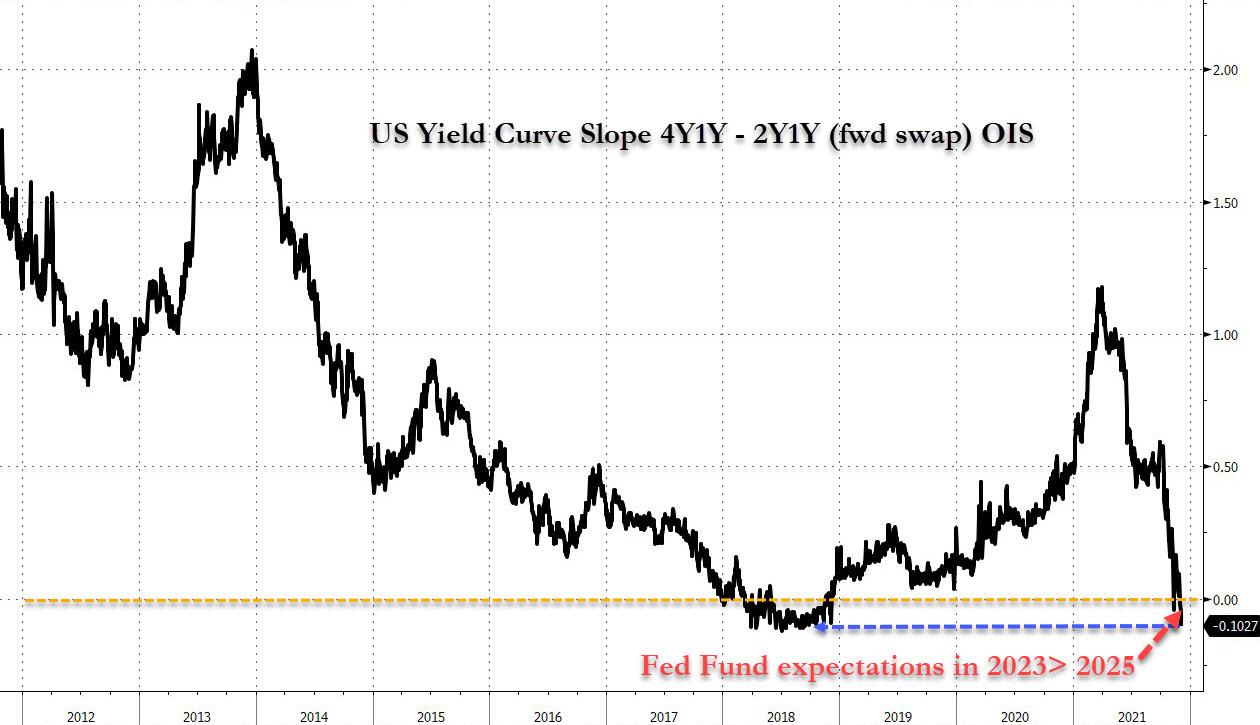
One final point: as we noted yesterday, the forward TSY curve slope as indicated by 4Y1Y less 2Y1Y fwd swap OIS, just inverted the most since late 2018. As a reminder, just a few weeks later, Powell was forced to abandon his tightening cycle as the Ghost of '37 struck, sending stocks into a painful but brief bear market on Dec 24, 2018. Fast forward to today when the market is again saying that the Fed will also be forced to abandon its plans for rate hikes in coming months... or else the market gets it.

Which is why now that the IMF has revealed the Omicron endgame, and banks like Goldman have begun effectuating it, we see the near-term as follows:

  • in a few weeks, banks will trim their hawkish forecasts.
  • In 1-2 months they will predict tapering is postponed
  • in 2-3 months rate hikes will be off the table.

And yes, all of that is just the pretext for central banks to take the needed measures to avoid another market crash.

https://www.zerohedge.com/markets/goldman-cuts-gdp-forecast-due-omicron-setting-stage-more-central-banks-stimulus

US drugstores squeezed by vaccine demand, staff shortages

 A rush of vaccine-seeking customers and staff shortages are squeezing drugstores around the U.S., leading to frazzled workers and temporary pharmacy closures.

Drugstores are normally busy this time of year with flu shots and other vaccines, but now pharmacists are doling out a growing number of COVID-19 shots and giving coronavirus tests.

The push for shots is expected to grow more intense as President Joe Biden urges vaccinated Americans to get booster shots to combat the emerging omicron variant. The White House said Thursday that more than two in three COVID-19 vaccinations are happening at local pharmacies.

And pharmacists worry another job might soon be added to their to-do list: If regulators approve antiviral pills from drugmakers Merck and Pfizer to treat COVID-19, pharmacists may be able to diagnose infections and then prescribe pills to customers.

“There’s crazy increased demand on pharmacies right now,” said Theresa Tolle, an independent pharmacist who has seen COVID-19 vaccine demand quadruple since the summer at her Sebastian, Florida, store.

Pharmacists say demand for COVID-19 vaccines started picking up over the summer as the delta variant spread rapidly. Booster shots and the expansion of vaccine eligibility to include children have since stoked it.

On top of that workload and routine prescriptions, many drugstores also have been asking pharmacists to counsel patients more generally on their health or about chronic conditions like diabetes and high blood pressure.

Pharmacies also have been handling more phone calls from customers with questions about vaccines or COVID-19 tests, noted Justin Wilson, who owns three independent pharmacies in Oklahoma.

“We’re all working a lot harder than we did before, but we’re doing everything we can to take care of people,” Wilson said, adding that he has not had to temporarily close any of his pharmacies or limit hours so far.

Tolle said she was lucky to hire a pharmacy resident just before the delta surge arrived. The new employee was supposed to focus mostly on diabetes programs but has largely been relegated to vaccine duty.

Tolle said her Bay Street Pharmacy is now giving about 80 COVID-19 vaccines a day, up from 20 before the delta wave.

"God’s timing worked out well for me,” she said. “We would not have gotten through without having that additional person here.”

Others haven’t been as fortunate. A CVS Health store on the northeast side of Indianapolis shuttered its pharmacy in the middle of the afternoon Thursday due to staffing issues. A sign taped to the metal gate over the closed pharmacy counter also told customers that the pharmacy will soon start closing for a half hour each afternoon so the pharmacist can have a lunch break.

Such temporary closures have ebbed and flowed in pockets around the country throughout the pandemic, but they have grown more acute in recent months, said Anne Burns, a vice president with the American Pharmacists Association.

Pharmacies all need minimum staffing to operate safely, and they sometimes have to close temporarily if they fall below those levels.

Burns said many pharmacies already had relatively thin staffing levels heading into the pandemic, and a wave of pharmacists and pharmacy technicians left after the virus hit.

“There is a lot of stress and burnout for individuals who have been going at this since March of 2020,” she said.

CVS Health spokesman T.J. Crawford said he couldn’t comment on the circumstances for one store. But he said his company continues “to manage through a workforce shortage that isn’t unique to CVS Health.”

Rival drugstore chain Walgreens also has adjusted pharmacy hours “in a limited number of stores,” spokesman Fraser Engerman said.

Both companies are hiring. CVS Health says it has hired 23,000 employees from a push it started in September. About half of that total was pharmacy technicians, who can deliver vaccines.

As companies scramble to hire or keep staff, Burns and Tolle worry about adding even more responsibilities like diagnosing and treating COVID-19.

Tolle noted that it is not clear yet how pharmacists will be reimbursed for the time they take to diagnose and prescribe. That will have to be clarified, especially if cases surge again and drugstores need to add even more workers to help.

“We want to be able to help our communities," she said. "I don't know how pharmacies are going to manage it.”

Sherri Brown, a city employee in Omaha, Nebraska, was searching for a vaccine booster dose, but two nearby pharmacies didn’t have appointments available and a third didn’t have the brand she wanted. She wound up getting a shot at a county-run clinic on Friday.

“I just wanted to protect myself,” said Brown, who suffered through two weeks of coughing, headaches and fatigue when she caught the virus in January, before she was vaccinated. “I guess I’m encouraged to see that people are taking this more seriously.”

https://finance.yahoo.com/news/us-drugstores-squeezed-vaccine-demand-144517588.html

4 states pay unemployment benefits to unvaccinated workers who were fired

  • The governors of Florida, Iowa, Kansas and Tennessee signed laws in recent weeks that allow workers to collect unemployment benefits if fired for refusing to comply with a Covid-19 vaccine mandate.
  • Lawmakers in other Republican-led statehouses may do the same next year.
  • The Biden administration’s national vaccine mandate for large employers is being challenged in court.
    • Some states are making it easier for Americans to collect unemployment benefits if they’re fired for being unvaccinated against Covid-19.
    • The governors of Florida, Iowa, Kansas and Tennessee signed laws in recent weeks that change eligibility rules for jobless benefits. Workers in these states who lose a job for refusing to comply with a workplace Covid-19 vaccine mandate now qualify for benefits.  

That runs counter to typical state rules, which generally disallow aid if workers are fired for failing to adhere to certain workplace policies, whether related to vaccine requirements or mandatory drug tests, for example, according to labor experts.

Three of the states (Florida, Iowa and Tennessee) are helmed by Republican governors. Kansas’ governor is a Democrat.

Republican lawmakers in other statehouses, including Arkansas, New York and Wisconsin, have introduced similar bills since September, according to a National Conference of State Legislatures database.

“I wouldn’t be surprised if other ones do it, especially when the legislatures get back in session [next year],” according to Andrew Stettner, a senior fellow at The Century Foundation, a progressive think tank.

The move comes as many U.S. employers are weighing a workplace vaccine mandate and as fears over the omicron virus variant grow.

About 57% of large businesses require or plan to require Covid-19 vaccinations for employees, according to a survey published Tuesday by Willis Towers Watson, a consulting firm. However, more than half of those will only move forward if a Biden administration vaccine rule takes effect.

The Biden administration rule requires businesses with at least 100 employees to ensure staff are vaccinated or submit a negative Covid test on a weekly basis. The Occupational Safety and Health Administration suspended enforcement and implementation of the measure after a federal appeals court ordered a pause pending a review.

The rule was meant to take effect Jan. 4. President Joe Biden asked businesses on Thursday to voluntarily proceed with the requirements.

“Simply put, delaying the standard would likely cost many lives per day, in addition to large numbers of hospitalizations, other serious health effects and tremendous expenses,” the Justice Department said in a court filing. “That is a confluence of harms of the highest order.”

Some Republican officials seeking to overturn the policy argue it infringes on personal liberties.

“I believe the vaccine is the best defense against Covid-19 and we’ve provided Iowans with the information they need to determine what’s best for themselves and their families, but no Iowan should be forced to lose their job or livelihood over the Covid-19 vaccine,” Iowa Gov. Kim Reynolds said Oct. 29 after signing the legislation amending unemployment rules.

Aside from loosening rules to collect benefits, the new state laws also generally make it easier for employees to qualify for certain exemptions from workplace vaccine mandates.

States generally require businesses to allow exemptions from certain workplace rules for medical or religious reasons.

Workers who qualify for an exemption have legal protection from being fired for noncompliance with a vaccine mandate.

Those who don’t qualify for an exemption and are fired are now eligible for income support via unemployment benefits.

The policy seems to run contrary to states’ actions over the summer relative to unemployment benefits, according to Alexa Tapia, the unemployment insurance campaign coordinator for the National Employment Law Project.

Florida, Iowa and Tennessee were among 26 states that moved to cut off federal unemployment benefits a few months ahead of their official Labor Day expiration. They argued the benefits were contributing to a labor shortage by offering an incentive for recipients not to look for work. (Data in subsequent months showed that largely wasn’t the case.)

The new unemployment laws are sending the opposite message, by offering a financial incentive to people who lose their jobs due to a vaccine requirement, Tapia said.

https://www.cnbc.com/2021/12/04/4-states-pay-unemployment-benefits-to-fired-unvaccinated-workers.html

WHO: Omicron In 38 Countries, No Deaths Reported

 by Jack Phillips via The Epoch Times,

The World Health Organization (WHO) on Friday said the COVID-19 omicron variant is now in 38 countries, up from 23 two days ago, suggesting that the variant may be more contagious than Delta.

Men wearing protective suits make their way at a bus stop at Narita international airport on the first day of closed borders to prevent the spread of the new Omicron variant amid the pandemic in Narita, east of Tokyo, Japan, Nov. 30, 2021. (Kim Kyung-Hoon/Reuters)

During a news conference, WHO official Maria Van Kerkhove said the U.N. health body has seen “an increasing growth rate,” and “we see increasing numbers of Omicron being detected.”

No deaths have been reported so far in connection to the COVID-19 strain, another WHO spokesperson told reporters Friday.

“There is a suggestion that there is increased transmissibility, what we need to understand is if it’s more or less transmissible compared to Delta,” Van Kerkhove said. The Delta variant is the dominant strain throughout the world, she said.

In the United States, at least six U.S. states have confirmed Omicron cases so far, including a fully vaccinated male who traveled from an anime convention in New York City to Minnesota this week, according to health officials, who said the individual had mild symptoms and recovered. The first American case was detected in California’s San Francisco Bay Area.

A previous update from WHO said Omicron has numerous mutations to its spike protein, which is what it uses to bind to human cells, which may lead to higher transmission rates. It’s not yet clear, however, officials have cautioned.

But whether the new strain causes more severe disease or not is unclear, Van Kerkhove said. Early reports from South Africa and Israel suggest many patients experience mild symptoms.

Van Kerkhove said that the first Omicron cases were based on a cluster of college students, noting that younger people tend to experience milder symptoms than older people. A top South African doctor this week told news outlets that the symptoms were unusual but “extremely mild.”

“There was initial reports that it tended to be more mild, but it’s really too soon,” Van Kerkhove said.

“Everybody who is infected with SARS-CoV-2 regardless of what variant will always start out with a mild disease. And so maybe it will stop there with mild, some people are asymptomatic of course, but it may stop with mild disease or it may take some time.”

In South Africa, where the variant was first detected, there has been an increase in hospitalizations, she said.  Officials haven’t seen an increase in deaths.

“If you’re traveling, you’re not sick or you shouldn’t be traveling if you’re sick,” Van Kerkhove stated. “So there’s a bias in terms of what is being detected at the moment, but that will change over time.”

https://www.zerohedge.com/covid-19/who-omicron-38-countries-no-deaths-reported