Search This Blog

Sunday, January 16, 2022

States Probe Surge In Mortality Rate In 18–49-Year-Olds, Majority Unrelated To COVID-19

 by Petr Svab via The Epoch Times (emphasis ours),

Health departments in several states confirmed to The Epoch Times that they are looking into a steep surge in the mortality rate for people aged 18 to 49 in 2021—a majority of which are not linked to COVID-19.

Deaths among people aged 18 to 49 increased more than 40 percent in the 12 months ending October 2021 compared to the same period in 2018–2019, before the pandemic, according to an analysis by The Epoch Times of death certificate data from the Centers for Disease Control and Prevention (CDC).

The surge differed greatly from state to state, with the most dramatic increase in young-to-middle age deaths in the South, Midwest, and the West Coast, while the northeastern states generally saw much milder spikes. Public health authorities in several states with some of the largest increases are examining the issue.

Texas saw the 18 to 49 age mortality jump 61 percent, the second-highest increase in the country. Of that, less than 58 percent was attributed to COVID-19.

“Our Center of Health Statistics is looking at the data,” said Chris Van Deusen, the head of Media Relations at the Texas Department of State Health Services, via email. “We’ll get back with you.”

Florida, which saw an increase of 51 percent, 48 percent of that attributed to COVID-19, is also probing the matter.

I am looking into it to see if there is some sort of correlation/causation,” said Jeremy Redfern, spokesman for the Florida Department of Health via email.

Nevada saw the highest increase, 65 percent, of which just 36 percent was attributed to COVID-19.

Shannon Litz, a public information officer at the Nevada Department of Health and Human Services, said via email she passed on questions regarding the mortality spike to the agency’s Office of Analytics “for review.”

The District of Columbia experienced an increase of 72 percent, none of it attributed to COVID-19.

Robert Mayfield, spokesman for D.C.’s health authority, referred The Epoch Times to the district’s Office of Chief Medical Examiner (OCME), which suggested it lacked the expertise to analyze the phenomenon.

“OCME does not currently have an epidemiologist (the position is being advertised) so it has no present ability to analyze the data,” said the office’s spokesman Rodney Adams via email.

Arizona recorded a 57 percent increase, 37 percent of which was attributed to COVID-19.

Arizona’s Department of Health Services couldn’t respond to questions regarding the issue because its data is “not yet finalized,” said Tom Herrmann, the agency’s public information officer, via email.

Other states with some of the highest increases were Tennessee (57 percent up, 33 percent attributed to COVID-19), California (55 percent up, 42 percent attributed to COVID-19), New Mexico (52 percent up, 33 percent attributed to COVID-19), and Louisiana (51 percent up, 32 percent attributed to COVID-19). None of their health authorities responded to requests for comment.

The mortality surge seemed to be significantly milder in the northeast. New Hampshire saw no increase, Massachusetts had only a 13 percent spike (24 percent of it attributed to COVID-19), and New York, one of the worst-hit by the pandemic in the region, was up 29 percent (30 percent of it attributed to COVID-19).

CDC data on the causes of those excess deaths aren’t yet available for 2021, aside from those involving COVID-19, pneumonia, and influenza. There were close to 6,000 excess pneumonia deaths that didn’t involve COVID-19 in the 18 to 49 age group in the 12 months ending October 2021. Influenza was only involved in 50 deaths in this age group, down from 550 in the same period pre-pandemic. The flu death count didn’t exclude those that also involved COVID-19 or pneumonia, the CDC noted.

A part of the surge could be likely blamed on drug overdoses, which increased to more than 101,000 in the 12 months ending June 2021 from about 72,000 in 2019, the CDC estimated. About two-thirds of those deaths involved synthetic opioids such as fentanyl that are often smuggled to the United States from China via Mexico.

For those aged 50 to 84, mortality increased more than 27 percent, representing more than 470,000 excess deaths. Some 77 percent of the deaths had COVID-19 marked on the death certificate as the cause or a contributing factor.

For those 85 or older, mortality increased about 12 percent with more than 100,000 excess deaths. There were more than 130,000 COVID-related deaths in this group, indicating these seniors were less likely to die of a non-COVID-related cause from November 2020 to October 2021 than during the same period of 2018–2019.

Comparing 2020 to 2019, mortality increased some 24 percent for those aged 18 to 49, with less than a third of those excess deaths involving COVID-19. For those aged 50 to 84, mortality increased less than 20 percent, with over 70 percent of that involving COVID-19. For those even older, mortality jumped about 16 percent, with nearly 90 percent of it involving COVID-19.

For those under 18, mortality decreased about 0.4 percent in 2020 compared to 2019. In the 12 months ending October 2021, it fell some 3.3 percent compared to the same period in 2018–2019.

Jha: Biden administration needs to have agencies on the 'same page' about COVID

 Ashish Jha, the dean of the Brown University School of Public Health, on Sunday advised the Biden administration to get its agencies on the "same page" when it came to COVID-19 messaging, saying a consistent message would be "enormously helpful."

Fox News anchor John Roberts asked Jha for his thoughts on the Biden administration's COVID-19 guidelines messaging, noting that Rochelle Walensky, director for the Centers for Disease Control and Prevention, and President Biden's chief medical adviser Anthony Fauci appeared to offer differing guidance when it came to measures like masking.

"Yes, so we have different agencies that have not been on the same page, John. And I think that part has been a real problem," Jha said, pointing changing COVID-19 norms, including using rapid antigen tests more often as opposed to PCR tests.

"And, so the science here is changing. I think the messages has not kept up," he said.

As Jha put it, although former President Trump often related incorrect information about the COVID-19 pandemic, there was a singular opposing message with correct information that did not conflict with itself.

"I think the White House needs to get its messaging discipline together, needs to make sure that people are speaking from the same page," said Jha. "My sense is that that has not been happening consistently. And it would be enormously helpful to the American people if that messaging was more consistent."

When asked by Roberts if the inconsistent messaging was creating problems, Jha acknowledged that it made it "harder" for people to understand what they should be doing.

During a Senate hearing last week, Walensky and Fauci faced critical questioning about the White House's confusing COVID-19 guidelines. Sen. Richard Burr (N.C.) slammed the White House for its reversals on certain guidelines, the rollout of coronavirus booster shots and the shortage of COVID-19 testing.

"I’m not questioning the science," Burr said to Walensky. "But I’m questioning your communication strategies. It’s no wonder the American people are confused."

https://thehill.com/policy/healthcare/589951-public-health-expert-biden-administration-needs-to-have-agencies-on-the

The Big Question

 There is a lot of liquidity out there. Andreesen Horowitz announced that they raised a fresh $9 billion to invest in their venture, growth, and bio funds. Today, FTX announced the launch of a $2 billion venture fund.

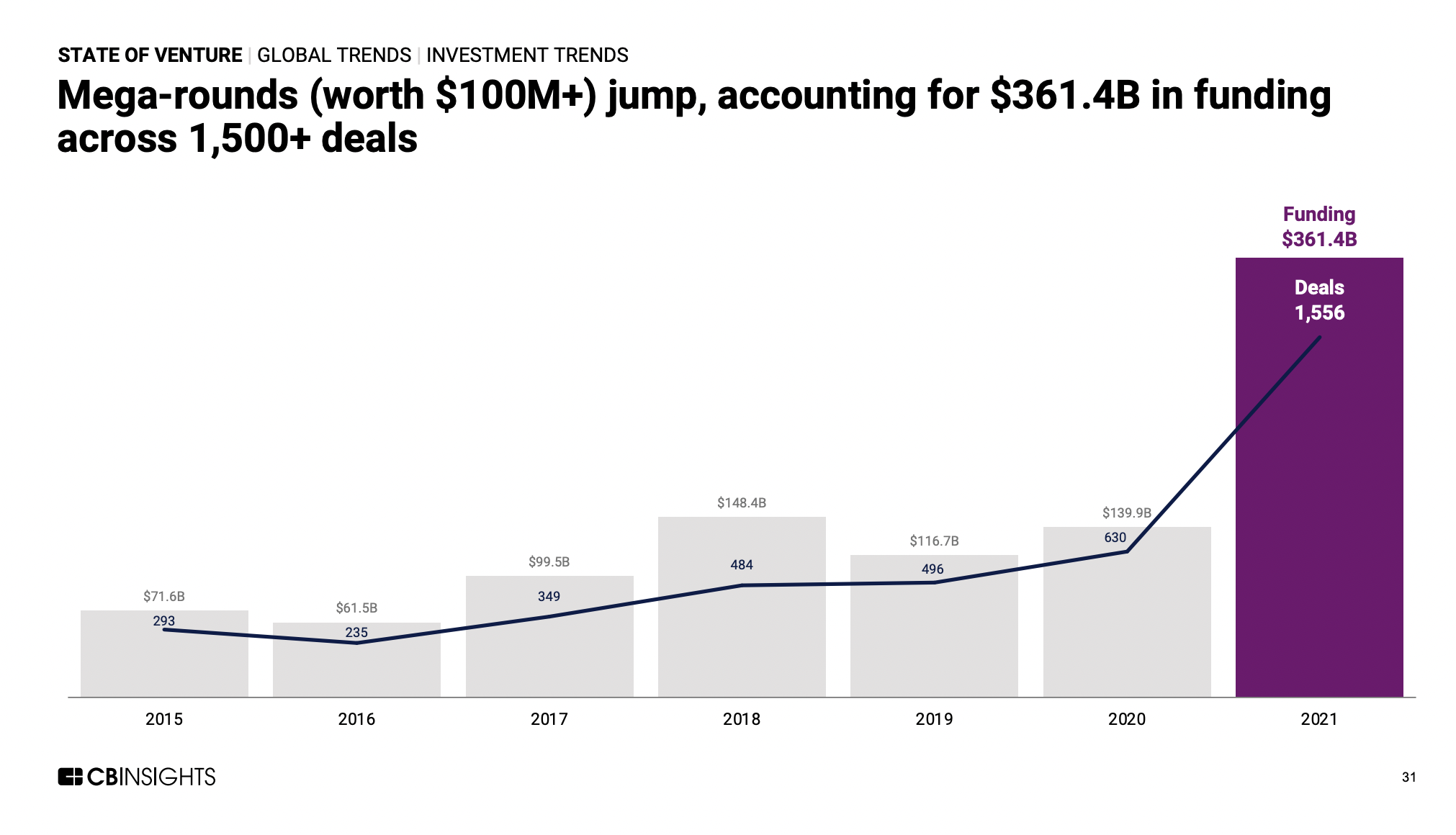
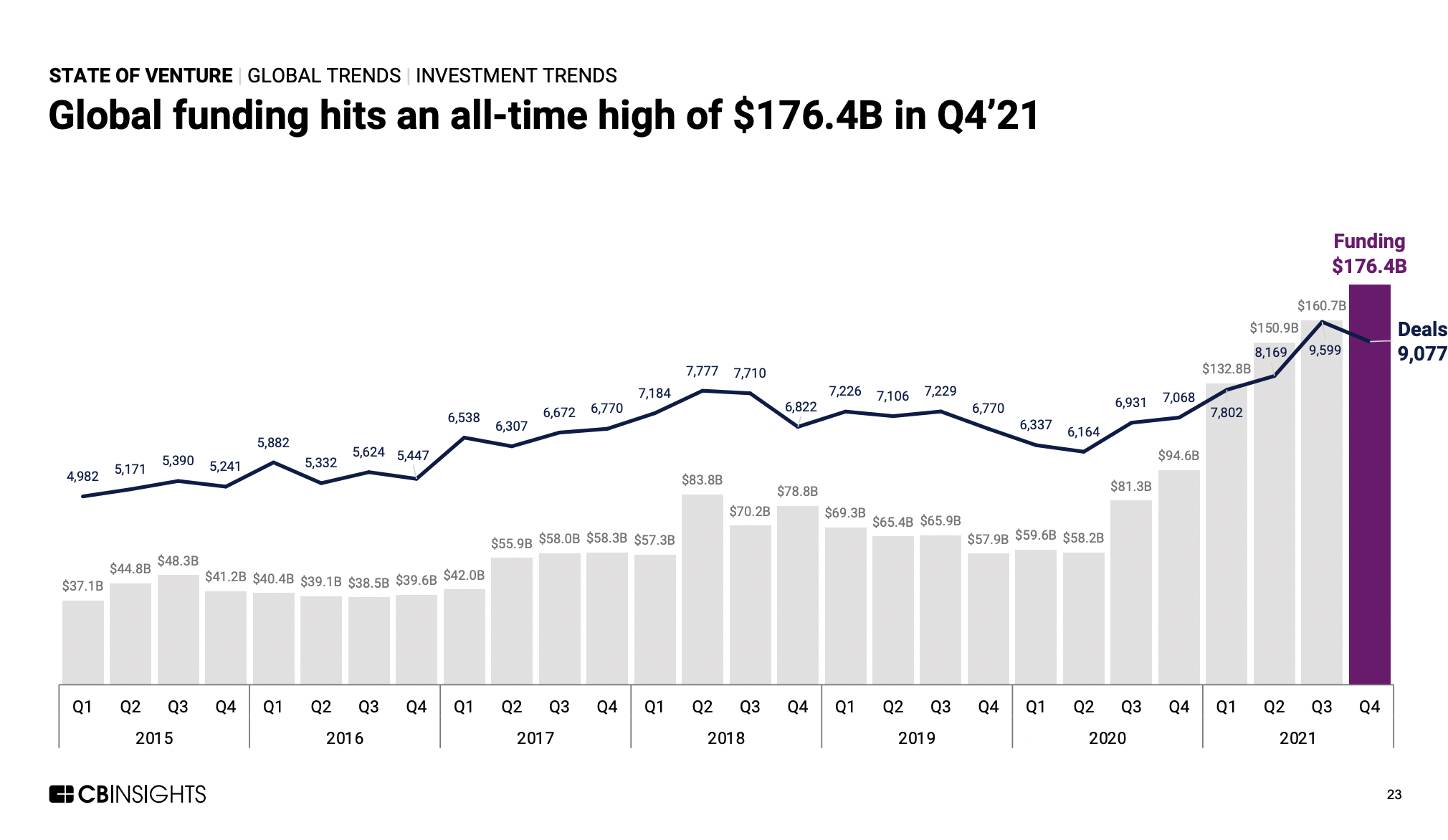
CB Insights just published their State of Venture 2021 report and all arrows point in the same direction higher.

Global funding hit an all-time high in the 1st, 2nd, 3rd, and 4th quarters of 2021.

As depth and liquidity continue to build in private markets, the deal sizes keep getting bigger.

There were more than twice as many mega-rounds in 2021 than there were in 2020. Funding for these behemoths clocked in at $361 billion last year, up 160% from 2020.

Companies are raising more money these days for many reasons, the biggest one being the speed at which they can go from zero to $1 billion. The average time from first funding to unicorn status is just 55 months. Companies are moving quicker than ever before, and so are their investors. Tiger Global basically did a deal a day last year.

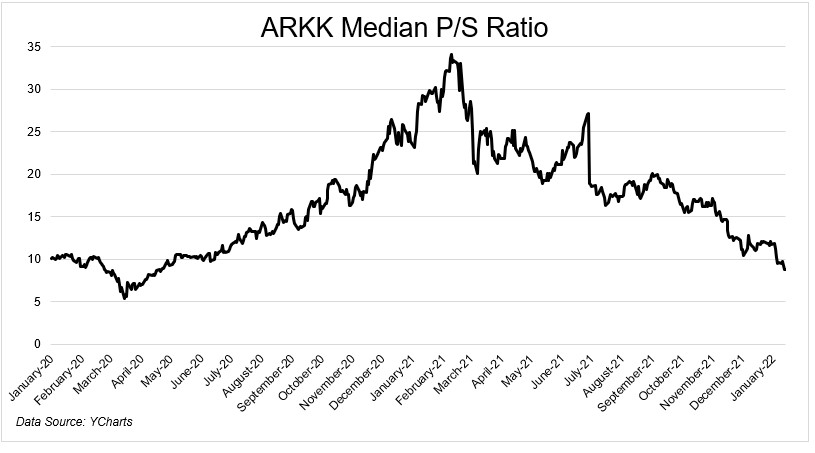
The big question I have now is, how long can private market multiples stay elevated while young public companies compress? The median ARKK holding traded for 33x sales in early ’21. Today it’s 9x.

As public market investors deal with inflation and brace for interest rate increases, they’re rethinking the amount they’re willing to pay per dollar of revenue. How long before this reaches private markets?

There is almost certainly a tipping point, but I think this dichotomy can last longer than most people think. There’s too much money chasing too few deals in private markets, and I’m not sure an interest rate hike or two will change that.*

*This might age really, really poorly

https://theirrelevantinvestor.com/2022/01/14/the-big-question/

Dems call on Biden to step up virus response

 The Biden administration is facing rising pressure from congressional Democrats to ramp up its efforts to fight the COVID-19 pandemic.

The White House this week announced a flurry of moves, including the purchase of an additional 500 million rapid COVID-19 tests, as well as saying a plan is coming next week to make high quality masks available to the public for free.  

But some Democrats and health experts are both pushing for more — and questioning why these actions were not taken months ago, before the current surge fueled by the omicron variant took hold.

Five Democratic senators led by Sen. Jacky Rosen (Nev.) released a letter to the White House on Friday expressing “grave concern” with the state of the pandemic response, saying it had too often been “reactive, rather than proactive.” 

“This Administration either knew or should have known that testing shortages were occurring across the country over the past several months, and with the full expectation that the virus would likely mutate into a new variant steps to increase testing access should have happened before the current wave hit, not several weeks into the surge, with resources still not available until later this month or beyond,” the senators wrote.

Meanwhile, Democratic Reps. Don Beyer (Va.), Dina Titus (Nev.), Joe Morelle (N.Y.), and KaialiÊ»i Kahele (Hawaii), introduced a bill to require the administration to purchase enough rapid tests so that every American can take two a week for a year.  

“The 500 [million tests] is a good start, but it’s only one and a half tests per person,” Beyer said in an interview.  

On masks, Sen. Bernie Sanders (I-Vt.) and more than 50 Democratic lawmakers introduced a bill this week to send three high quality N95 masks to every person in the U.S.  

“It is an absolute scandal that in the richest country in the history of the world, high-quality masks are not more readily available to frontline workers, health care workers, and all Americans,” Sanders said.  

The White House has been rolling out new measures amid the pressure, while also defending its efforts so far.  

new website will go live on Wednesday allowing people to order free rapid tests, though supplies are limited to four tests per residence. And beginning Saturday, insurers are required to cover the cost of rapid tests bought at retailers, though in some cases that will require consumers seeking reimbursement after the fact, which could be cumbersome. 

Asked why the administration did not take more testing actions earlier, White House press secretary Jen Psaki said Thursday that actions on testing have been a “building process” over time.  

The White House notes that it previously invested $3 billion to boost rapid testing and that the supply of rapid tests in the U.S. was more than 300 million in December, up from 24 million in August. It also has a new testing coordinator, Tom Inglesby, an expert from Johns Hopkins University.

Still, President Biden has acknowledged some shortcomings on testing.

"I wish I had thought about ordering half a billion [tests] two months ago," he told ABC News last month.  

Amid the highly transmissible omicron variant, experts have also been urging the public to use better masks like N95 or KN95’s, given that simple cloth masks provide far less protection.  

Biden said more details would be coming next week on how Americans can get high quality masks for free.  

“I know that for some Americans, a mask is not always affordable or convenient to get,” he said. 

Asked about being “late” to providing higher quality masks, Psaki said Friday that the administration had already provided 30 million across the country and stockpiled 750 million.  

Leana Wen, a public health professor at George Washington University, said the recent announcements are “steps in the right direction,” but agreed with Senate Democrats that the administration has been “reactive not proactive.” 

“We should have upped our mask game with the alpha variant more than a year ago,” she said.  

Jennifer Nuzzo, a senior scholar at the Johns Hopkins Center for Health Security, likewise said that last year “the delta surge should have been the warning shot” to get more tests.  

She also called for the administration to think about what steps are needed in the next phase of the virus. Once the omicron spike subsides, which could be as soon as next month, the country could be in a better place, given that people will have higher levels of immunity, though another variant always poses a risk.  

“Are we going to finally roll out the N95s when most of the country has gotten it?” she asked. 

https://thehill.com/policy/healthcare/589856-democrats-call-on-biden-to-step-up-virus-response

Beijing tightens rules for entering city

 Beijing will require travelers to get a COVID-19 test within 72 hours of arrival in the Chinese capital, state media announced Sunday, a day after the city reported its first Omicron case and as it readies to stage the Winter Olympics next month.

On Saturday, the city reported the first local infection of the highly transmissible Omicron variant, involving a person who had visited multiple malls and restaurants in the previous 14 days. The person had not left the city since the start of 2022.

The new rule, effective from January 22 to end-March, is aimed to help with early detection of Omicron, which is surging globally, and the control of epidemic risks, Beijing Daily said on its social media account.

Already, the capital city requires inbound travelers to take a COVID-19 test within 48 hours of departure for the city and have a green code on the city's health tracking app.

The city and Hebei Province will host the Olympics, which start on February 4, inside a "closed loop" separating athletes and other Games personnel from the general public.

Tianjin, a neighboring city that is battling a COVID-19 outbreak involving Omicron variant, found 59 COVID-19 cases in its third round of mass testing starting on Saturday, He Peng, a local government spokesman, told a press conference yesterday.

So far, local cases of the Omicron variant have been detected in at least eight regions, prompting cities to impose curbs to stop its spread and threatening to further undercut slowing economic growth.

China has not said how many Omicron cases it has detected in total.

"It is too soon to conclude that Omicron will swamp China's efforts to suppress COVID," said Mark Williams, chief Asia economist at Capital Economics, in a note issued on Friday.

About 13,000 people have been tested for COVID-19 in the Haidian District where the Beijing case was discovered, but none of the results came back positive, Beijing Daily cited official data as saying on Sunday.

https://www.shine.cn/news/nation/2201160845/

Avatar Robot Goes to School for Ill German Boy

 Joshua Martinangeli, 7, is too ill to go to school. But the German student can still interact with his teacher and classmates through an avatar robot that sits in class in his place and sends a blinking signal when he has something to say.

"The children talk to him, laugh with him and sometimes even chitchat with him during the lesson. Joshi can do that quite well, too," Ute Winterberg, headmistress at the Pusteblume-Grundschule in Berlin, told Reuters in an interview.

Joshua cannot attend classes because he wears a tube in his neck due to a severe lung disease, said his mother, Simone Martinangeli.

The project is a private initiative paid for by the local council in the Berlin district Marzahn-Hellersdorf.

"We are the only district in Berlin that has bought four avatars for its schools. The impetus was COVID-19, but I think this will be the future well beyond the pandemic," said district education councillor Torsten Kuehne.

"It does happen from time to time, for various reasons, that a child cannot go to class in person. Then, the avatar can give that child a chance to remain part of the school community," Kuehne said.

He added that he had already brought up the project in political discussions at a state level.

"I like it either way because I like the avatar," said student Noah Kuessner when asked if he is looking forward to seeing Joshua again.

"And I would like it better if Joshi could really come to school," said another classmate, Beritan Aslanglu.

https://gadgets.ndtv.com/science/news/avatar-robot-germany-school-joshua-martinangeli-berlin-pusteblume-grundschule-2709669

Omicron surge hits US small businesses

 Philip Howard sees a pile of black ski pants piled up on the counters of a winter sports shop as evidence of the hurdles still facing small business owners as the pandemic continues. I pointed.

The pants were expected to arrive at Troy’s ski lubbock shop in western Texas by August. This was well before the hot five-month season, which began in October. Instead, they came from China in the first week of January, delayed by supply chain failures.

“Delayed items really kill us,” Howard said this week, noting that several other items also arrived late and missed the pre-holiday sales season. “I’ve been in this business for nearly 20 years and have never come across anything like this.”

In the third year of the pandemic, many small businesses across the United States will be surrounded on three sides. Deepening supply chain problems. Regular shortage of personnel. In addition, fewer customers are appearing in some areas for fear of a surge in Omicron in COVID-19 cases.

This week, the Federal Reserve Board released a collection of the latest anecdotes about economic conditions from businesses, labor groups, and others across the country. This shows that the rapidly prevailing variants of Omicron exacerbate the problem of employment and inflation in particular.

According to the Commerce Department, US retail sales in December fell 1.9% amid a shortage of goods and a surge in infections.

With federal aid and an overall economic recovery, SME bankruptcy and bankruptcy rates are much lower than expected, but day-to-day management remains a challenge. According to a census conducted from the early days of the pandemic, there are concerns that there is a steady shift from reducing cash reserves and pursuing funding to the challenges of rising supply chains and costs.

“I’m placing orders for next year, and we’re seeing double-digit inflation,” Howard said. “Probably 10% overall for almost everything I have to order.”

‘UPSIDE DOWN AGAIN’

Due to a shortage of staff, Gage & Tollner, a 19th-century chop house in Brooklyn, New York, was closed for five days in late December.

Co-owner St. John Frizzell estimates that about 30% of the 60 people working in restaurants were infected with COVID-19 last month. The owner wanted the staff to have a negative coronavirus test before returning to work, which often meant waiting in line for employees to be wiped off.

“All you need is a test. You need a lot of tests,” he said.

He welcomed this month a proposal by New York Governor Kathy Hokul to permanently allow restaurants and bars to sell cocktails “takeaway.”

In the immediate vicinity of Junior’s Restaurant and Bakery, famous for its cheesecake, owner Alan Rosen said he was suffering from supply chain problems and staff shortages. He sometimes had to rope the entire section of his restaurant when there weren’t enough servers to go around.

“The cost of our products is over the roof, there is inflationary pressure, and the supply chain is disrupted,” Rosen said.

Amy Grossa moved cycling studio BYKlyn to a new outdoor facility in the summer of 2020 to keep Brooklyn’s business alive. However, Grossa said she and her 20 employees agreed that they couldn’t spend the winter outdoors, so they moved their business to a temporary indoor space on December 1.

Later, a variant of Omicron hit New York City hard, and about 40% of Jim’s 200 members said they wanted to cancel or suspend their membership.

“People are nervous about getting inside and sweating together,” Glosser said.

Randy Pears, chairman of the Brooklyn Chamber of Commerce, said he was worried that small businesses would be kicked out after the pandemic eviction moratorium in New York ended on Saturday. One-third said they were renting rent.

Pears said optimism increased from summer to early fall as the city’s high immunization rates and many restrictions were lifted. It continued throughout Thanksgiving.

“Then Omicron just threw everything upside down,” he said.

“Hold our breath”

State SMEs, whose COVID restrictions are much looser than New York, say they still have customers, but other pandemic issues continue to plague them.

Mark Pectol, who owns four Zesty Zzeeks Pizza & Wings shops in the Phoenix Metro area, said he never dreamed of his biggest nightmare as small business owners come in the form of supply chain issues.

“I don’t know if I’ll have a pizza box on the weekend,” he said. “If you don’t have a pizza box, you’re out of business. You’re just holding your breath.”

Even if he could get a box of pizza, Mr. Pektor said he had already been warned about the next possible flour shortage.

It’s cruel and ironic. In the first year of the pandemic, when the grocery store couldn’t put the flour on the shelves, Pectol said he could still buy it in bulk from his supplier. His store was closed under pandemic restrictions, but he continued to make money by selling £ 140,000 of flour to the public.

Now the whims of supply chain failure may be turning him on.

“My distributor said he had flour for a month, but this week they didn’t put in any flour,” he said. “Where can I get it if it’s not available from a major distributor?”

https://texasnewstoday.com/upside-down-again-omicron-surge-hits-us-small-businesses/607632/