Search This Blog

Friday, January 21, 2022

Why the race to develop more COVID antivirals

 The roll-out of COVID-19 vaccines at the beginning of 2021 marked a key turning point in the fight against the global pandemic. Another major milestone arrived at the end of the year, with the approval of two oral antiviral treatments — molnupiravir and Paxlovid — that promise to reduce the number of COVID-19 hospitalizations and deaths. But as these pills slowly make their way into pharmacies worldwide, researchers are already looking ahead to the drugs that could supersede them.

“These are our first-generation antivirals against coronaviruses,” says Sara Cherry, an immunologist at the Perelman School of Medicine at the University of Pennsylvania in Philadelphia. Our experience with antivirals against other diseases, like hepatitis C and HIV, proves that “we can do better and better over time”, she adds.

Clinical-trial data showed that molnupiravir, developed by the pharmaceutical firm Merck, based in Kenilworth, New Jersey, and the biotechnology company Ridgeback Biotherapeutics in Miami, Florida, cut hospitalizations and deaths by 30%, compared with people who took placebos. Meanwhile, Paxlovid (nirmatrelvir and ritonavir), made by Pfizer, based in New York City, cut hospitalizations and deaths by 89%. UK regulators approved molnupiravir in November and Paxlovid in December, and US regulators granted emergency authorizations for both drugs in December. Other countries have followed suit with their own approvals, and many are negotiating with the drug makers to buy courses of the drugs or to manufacture their own generic versions.

For now, the pills are in short supply. Drug makers are still scaling up production of the antivirals, which are in huge demand to treat the highly transmissible Omicron variant. But when they become more widely available — and if their clinical-trial data is borne out in the real world — the pills will become vital tools to prevent people from becoming seriously ill with COVID-19, says Cherry.

It’s too soon to tell whether SARS-CoV-2 is likely to develop any resistance to these first-generation antivirals, says Tim Sheahan, a coronavirologist at the University of North Carolina at Chapel Hill. Although its sky-high rate of replication is a breeding ground for mutations, he says, the virus also causes acute infections that offer relatively little time for resistance-causing mutations to accumulate.

But the threat of resistance is particularly severe for ‘monotherapies’ such as molnupiravir and Paxlovid that each target only one part of the virus. That’s why it’s imperative to develop new antivirals aimed at different targets, or ones that can be combined into a single treatment to attack the virus on multiple fronts, says Sheahan.

A race against resistance

Successful antivirals have typically targeted two key pieces of a virus’s biological machinery, a polymerase and a protease, both of which are essential for viral replication. The current COVID pills are no exception: Paxlovid inhibits SARS-CoV-2’s main protease, whereas molnupiravir tricks its RNA polymerase into incorporating part of the drug into the virus’s RNA, creating so many errors that it cannot survive. A third drug — remdesivir, developed by Gilead, based in Foster City, California — inhibits RNA polymerase, but treatment is expensive and currently requires intravenous infusions over three consecutive days, making it inaccessible to many people.

Unfortunately, molnupiravir’s mode of attack means that it might not be wise to include it in a combination therapy, says Luis Schang, a virologist at Cornell University in Ithaca, New York. If the treatment does not completely wipe out the virus in a patient, some of the RNA errors it creates might inadvertently give the virus resistance against the other drug in the combination. That’s why it’s a key priority for researchers to find an accessible drug that effectively blocks the virus’s RNA polymerase, he says, which could be used in partnership with a protease inhibitor such as Paxlovid. One option may be an oral version of remdesivir, which Gilead is currently testing.

Other antiviral drug candidates are slowly working their way through the clinical-trial pipeline, says Carl Dieffenbach, director of the division of AIDS at the US National Institute of Allergy and Infectious Diseases (NIAID). He says that one promising candidate is a protease inhibitor, developed by Shionogi & Company, based in Osaka, Japan, and Hokkaido University in Japan, that is currently in phase II/III clinical trials in Asia. The candidate targets the same protease as Paxlovid but would only require patients to take a single pill each day.

That simpler regimen could help to avert the rise of resistance, Cherry says. Unfinished treatments can hasten drug resistance by allowing the virus to develop defences against the drug while it continues multiplying and wreaking havoc in the body. Both molnupiravir and Paxlovid consist of several pills that must be taken twice a day for five consecutive days. “The second you have people taking something multiple times a day when they’re sick is when you have issues with compliance,” Cherry says.

Target practice

Researchers should also develop treatments that target other parts of the virus, Schang says. “This time we got lucky with a virus that encodes both a polymerase and a protease, and here we are two years later with only a suboptimal arsenal,” he says. “We really have to identify and validate new targets for antivirals so that when the next [pandemic] happens, we have a much broader pipeline to choose from.”

Other potential targets include a different protease in SARS-CoV-2 called PLpro, and an enzyme called methyltransferase that stabilizes the virus’s RNA, says Matt Hall, the director of the early translation branch at the US National Center for Advancing Translational Sciences (NCATS). Clear Creek Bio, a biotechnology firm based in Cambridge, Massachusetts, announced on 6 January that it will collaborate with NCATS to develop an oral drug targeting the PLpro enzyme.

Dieffenbach says that researchers would ideally like to identify targets that are common to entire families of viruses and inhibit them with a single drug. That would potentially allow public-health officials to rapidly deploy an effective antiviral the next time a novel virus with pandemic potential emerges.

Developing such broad-spectrum drugs will take significant public and private investment, and the cooperation of pharmaceutical companies, says Hall. Calls for such efforts were not heeded in the wake of the 2003 SARS-CoV outbreak, he adds, but the latest pandemic has underlined the need for action. Last year, the United States appropriated US$1.2 billion to NIAID to launch the Antiviral Drug Discovery Centers for Pathogens of Pandemic Concern, which will fund basic research on developing antivirals for seven virus families. Hall says this gives him hope that antiviral research will continue even as the COVID-19 pandemic wanes.

But all antivirals face an inherent limitation, says Dieffenbach: they must be taken within days of infection to stop a virus from proliferating. Antivirals are only effective if people acknowledge that they might be ill, and can access tests that provide a timely diagnosis. “We can build the best drugs in the world, but if people don’t understand that they have to get on board quickly, they’re not going to do any good,” says Dieffenbach. “Pills do not take themselves.”

doi: https://doi.org/10.1038/d41586-022-00112-8

https://www.nature.com/articles/d41586-022-00112-8

Washington State launches website to order free COVID tests

 Washington state has officially launched its website where people can order free, rapid coronavirus tests to be sent to their homes, the state Department of Health said Friday morning.

Washingtonians can order up to five tests per household at sayyescovidhometest.org, though supply will be limited at first, according to a DOH statement. The website, in English and Spanish, went live as the state continues to face high demand for tests.

“We anticipate people’s initial need in the test kits will exceed our current supply pretty quickly, but our focus is sharing what we have right now,” said Lacy Fehrenbach, the state’s deputy secretary for COVID-19 response. “We want to make sure the tests we have are in homes when our state needs testing the most — during this current surge.”

The Friday launch, funded by the state and in partnership with health care technology company CareEvolution and Amazon, is an expansion of a pilot program that has already delivered 800,000 tests in parts of Eastern Washington, the state said. The tests are approved under the Food and Drug Administration’s emergency-use authorization for those ages 2 and up.

The state expected to receive about 5.5 million more rapid tests during the most recent surge in omicron infections, Gov. Jay Inslee said at the beginning of the month. To date, DOH has distributed more than 1 million rapid tests to local health departments, schools and other community centers. About 3.5 million tests were put aside for residents to order through the new testing website.

“This is an important step toward making tests more widely available across the state,” said state Secretary of Health Dr. Umair A. Shah. “As we work with our federal partners, we look forward to seeing an increase in the number of tests flowing directly into people’s homes over the next several weeks.”

Kits should arrive about one to two weeks after ordering, according to the site. In some parts of the state, residents also have the option of picking up tests locally, but the site urges people to call their local health department first to check.

The tests are secured by CareEvolution, then shipped to Amazon, which processes them and ships them directly to homes, DOH spokesperson Frank Ameduri said in an email.

The tests instruct users to take a “quick swab” inside each nostril, then wait a few minutes for rapid results. Further instructions about how to test and see results should be included in each kit. 

DOH is also offering a “digital assistant” that walks users through the testing process and sends reminders. 

If you have COVID symptoms, test now, DOH says. If you’ve been exposed to the virus, wait three to five days after exposure to test. 

If results are positive, the digital assistant will remind you that you could be contagious and will recommend isolating, wearing a mask around others, avoiding sharing household items and washing anything you touch. 

Because hospitals throughout the state are stretched to capacity, local health care experts have asked people without serious COVID symptoms to isolate and recover at home, only going to the hospital for emergencies.

If results are negative, DOH recommends you keep up safe practices and continue testing at home — “testing negative does not mean you are less likely to be infected in the future,” the state cautions.

“These COVID-19 tests, just like pregnancy and flu tests, also have a small error rate or chance of giving a false negative result,” the website says.

Personal contact information, including name, address and phone number, will not be shared outside the program, the state said. Anyone with questions about ordering or has issues with receiving the tests can contact syct-orders@careevolution.com and include the order number provided with the test. 

Some residents reported on social media Friday afternoon that they had issues using the website — including seeing ZIP codes declared ineligible and not being able to get deliveries to apartments or P.O. boxes — which the state responded to by directing residents to its COVID hotline: 800-525-0127 (then press #).

DOH spokesperson Nikki Ostergaard said no part of the state is ineligible to receive the COVID tests, and P.O. boxes are eligible as well. She noted, though, the system could have trouble with addresses not recognized by the U.S. Postal Service.

“If a user doesn’t enter the address as USPS recognizes it, it could say it is not a valid address,” Ostergaard said in an email.

Washingtonians can also get coronavirus test kits through the federal government at, covidtests.gov, at local pharmacies or at a local testing site.

https://www.seattletimes.com/seattle-news/health/washington-state-launches-website-to-order-free-at-home-covid-19-tests/

1 week after approval, fake versions of Molnupiravir already circulate in Mexico

 Mexico is already seeing black-market or fake versions of Molnupiravir circulating for sale, just one week after authorities approved the drug to treat those at risk of severe COVID-19.

The real medication is produced by the U.S. pharmaceutical company Merck.

But Mexico’s health regulatory agency found versions labeled Molnupiravir for sale from an array of companies like “Merit,” “Molaz” and “Azista.”

The agency said on Friday, January 14th, that it had no record of any permits for import or sales of those companies’ drugs and considered them a health risk.

Mexico’s government approved Molnupiravir from Merck for use last week.

With information from INFOBAE

https://mexicodailypost.com/2022/01/17/one-week-after-approval-fake-versions-of-molnupiravir-already-circulate-in-mexico/

Kemp sues Biden administration over Medicaid work requirements

 Georgia Gov. Brian Kemp (R) is suing the Biden administration to force the reinstatement of the state's Medicaid waiver.

The plan, which was approved in the final days of the Trump administration but had not yet taken effect, would have imposed work requirements and premiums while covering some additional people.

The Biden administration rejected those parts of the plan last month, saying the policies would hurt, rather than help, people gain access to coverage, which is especially important during the coronavirus pandemic.

“Simply put, the Biden administration is obstructing our ability to implement innovative healthcare solutions for more than 50,000 hardworking Georgia families rather than rely on a one-size-fits-none broken system,” Kemp said in a statement Friday. 

“They have attempted an unlawful regulatory bait and switch, and it is clear that their decision is not being driven by policy – rather politics – as they attempt to force their top-down agenda on the American people," Kemp added.

The original plan stopped short of the full-scale Medicaid expansion supported by Democrats, which would have covered thousands more low-income adults regardless of their employment status. 

Kemp's plan, called "Pathways to Coverage," would have covered about 50,000 adults who met the work requirements and who earned no more than 100 percent of the federal poverty level, just under $12,900.

Most individuals who earned between 50 percent and 100 percent of the poverty level would also have been required to pay monthly premiums.

However, the Centers for Medicare and Medicaid Services only rejected the state's work requirement and premiums; the coverage expansion to 100 percent of the poverty level was left in place.

Kemp's office said without premiums and work requirements, the only thing left is "significant Medicaid expansion in Georgia without condition," which was "not what Georgia signed up for and represents an egregious regulatory bait and switch on the core terms of a massive federal-state program."

But the coverage portion alone without the work requirements and premiums plan would be much more expensive than fully expanding Medicaid under ObamaCare.

According to the Georgia Budget and Policy Institute, the cost per person for fully expanding Medicaid is five times lower than Georgia’s Medicaid waiver, because the federal government pays 90 percent of the costs for full expansion and only 67 percent of costs for partial expansion. 

No state work requirements have been approved under the current administration, and courts have struck down previous attempts in other states that were approved by the Trump administration.

https://thehill.com/policy/healthcare/590842-kemp-sues-biden-administration-over-medicaid-work-requirements

Arizona sues Biden administration over threat to claw back COVID-19 funds

 Arizona Gov. Doug Ducey (R) on Friday sued the Biden administration after it threatened to claw back its COVID-19 funding unless the state stops sending it to schools without mask mandates. 

Last week, the Treasury Department in a letter warned the state that it would move to recoup COVID-19 relief that had been issued to the state if Arizona did not properly direct the funding. 

The Biden administration had said that programs or services that include conditions counter to curbing COVID-19 spread could not use federal funding. 

In Arizona, up to $7,000 can be provided per student to parents whose children go to schools that impose “unnecessary closures and school mandates,” thereby creating educational and financial barriers. In addition to that $10 million Educational Recovery Benefit Program, the state also has a Plus-Up Grant Program where only schools who do not impose mask mandates can receive funds. 

“Treasury’s actions far exceed the statutory authority granted to it under” the American Rescue Plan Act, Ducey’s lawsuit against the Biden administration said.

“Nothing in that underlying statute authorizes Treasury to condition the use of [Coronavirus State and Local Fiscal Recovery Fund] monies on following measures that, in the view of Treasury, stop the spread of COVID-19,” it added. “If Congress had truly intended to give Treasury the power to dictate public health edicts to the States, and recoup or withhold SLFRF monies based on an alleged lack of compliance with such edicts, it would have spoken clearly on the matter. It did not.”

The lawsuit claimed that even if the Treasury had been given broad authority over setting conditions to COVID-19 relief aid, it would have violated the Constitution’s spending clause and a non-delegation doctrine.

“This Court should declare the Final Rule invalid, declare that Treasury has acted arbitrarily and capriciously and has abused its discretion, and enjoin Treasury’s legislative overreach,” the lawsuit said, which was filed in the U.S. District Court for the District of Arizona.

The lawsuit comes as the Biden administration grapples with a series of lawsuits waged by mostly Republican state officials over COVID-19 protocols, particularly vaccine mandates. Several Republican governors, including Ducey, have spoken out against mask mandates though health officials have argued it will help further spread of the virus. 

The Hill has reached out to the Treasury Department for comment.

https://thehill.com/regulation/court-battles/590883-arizona-sues-biden-administration-over-threat-to-claw-back-covid-19

Citi asks NYC-area workers to return to the office in February

It’s back-to-the-office for workers at Citi in the New York City area.

The Wall Street giant is asking all tri-state area employees to return to the office Feb. 7 as cases of coronavirus gradually subside. 

Elsewhere in the U.S., the bank is keeping a close eye on local health data before making any policy changes. In London, employees were called back to the office earlier this month. 

Citibank’s change marks a sharp reversal from just last month when it encouraged staffers in New York City and New Jersey offices to work from home through the holidays amid a surge in coronavirus cases. 

Citigroup has been one of the most flexible banks on Wall Street in terms of allowing employees to work from home.

But it appears even Citi management is getting some Zoom fatigue.

Citigroup requires all employees to be fully vaccinated against COVID-19 — and, according to reports, is firing those who do not comply.

https://nypost.com/2022/01/21/citi-asks-nyc-area-workers-to-return-to-the-office-in-february/

Scientists Instrumental To COVID-19 'Natural Origins' Narrative Received Over $50 Million In NIAID Funding In 2020-2021

 by Jeff Carlson and Hans Mahncke via The Epoch Times (emphasis ours),

Four prominent scientists who played key roles in shaping the public narrative around the origin of COVID-19 received substantial increases in grant money from the National Institute of Allergy and Infectious Diseases (NIAID), headed by Dr. Anthony Fauci, in the subsequent two years, a review of funding data by The Epoch Times has found.

Three of these scientists—Kristian Andersen, Robert Garry, and Michael Farzan—were advisers to a teleconference organized by Fauci held on Feb. 1, 2020, in response to increasing public questions about the origin of the virus.

The scientists were also instrumental in the publication of Proximal Origin, a highly influential paper that promoted a natural origins theory for SARS-CoV-2, the virus that causes COVID-19, and has been frequently cited by the government and media.

Emails released under Freedom of Information Act requests, showed that the scientists had told the senior members of Fauci’s teleconference that they were 60 to 80 percent sure that COVID-19 had come out of a lab.

Notably, despite their private concerns about the origin of the virus, the first draft of Proximal Origin was completed on the same day as the teleconference. Andersen and Garry were co-authors of Proximal Origin and Farzan was acknowledged in the Nature version of Proximal Origin for his participatory discussions in the article’s creation.

Additionally, Fauci’s NIAID provided a substantial increase in funding to EcoHealth’s Peter Daszak, through whom NIAID had funded controversial gain-of-function coronavirus research at the Wuhan Institute of Virology in China.

Some of these funding amounts have continued through 2021—and one of the newest grants will continue through at least 2025.

A significant portion of the funding increase for Daszak, as well as for Andersen and Garry, was provided through NIAID’s creation of the Centers for Research in Emerging Infectious Diseases (CREID).

The program, which was originally referred to as Emerging Infectious Diseases Research Centers (EIDRCs) during the early planning stages in 2019, was formally announced under a new name on Aug. 27, 2020. It is not known why the program was initially delayed or why it was renamed.

The new initiative, described as a global network that involves “multidisciplinary investigations into how and where viruses and other pathogens emerge from wildlife and spillover to cause disease in people,” provided eleven new grants totaling $17 million of new funding in the first year and $82 million in total funding across five years.

Andersen and Garry were the co-recipients of a new $8.9 million 5-year grant made under the CREID initiative that established the West African Research Network for Infectious Diseases (WARN-ID). Daszak was the recipient of a new $7.5 million, 5-year CREID grant that established the Emerging Infectious Diseases: South East Asia Research Collaboration Hub (EID-SEARCH). The other participants of the NIAID CREID program can be found here.

Notably, although the creation of CREID was not publicly announced until Aug. 27, 2020, the Award Notice Date for the grants to Andersen and Garry are listed as May 21, 2020. The CREID grant to Daszak lists an Award Notice Date of June 17, 2020. The timing of Daszak’s grant is particularly noteworthy as it came shortly after President Donald Trump had revoked Daszak’s previous grant from Fauci’s NIAID in April 2020 due to Daszak’s entanglements with the Wuhan Institute of Virology.

Andersen, who had privately told Fauci on Jan. 31, 2020, that the virus “looked engineered,” but later helped spearhead Fauci’s efforts to promote a natural origins narrative, received a total of $7.4 million in funding in 2020 as compared to $4.5 million in grant proceeds in 2019. Andersen’s total grant funding increased to nearly $9 million in 2021. The new CREID grants (co-awarded with Garry) accounted for approximately $1.9 million of his 2020 grant proceeds and $2 million of his grant proceeds in 2021. Included in Andersen’s 2021 figure is a $266,250 CREID grant that was made to Andersen but did not include Garry as a co-recipient.

While it is not known at this point whether there was a connection between the increased funding and the scientists’ involvement in shaping the public natural origins narrative, these new revelations raise an obvious question: How is it that among the thousands of scientists eligible to participate in the much-desired funding from the eleven grants provided by Fauci’s new $82 million CREID initiative, three of those chosen happened to be the same individuals who had led the way in promoting Fauci’s natural origins narrative—despite their private concerns that the virus had been created in a lab.

During the Feb. 1, 2020, teleconference, Andersen claimed to be “60 to 70 percent sure the virus came from a laboratory.” One of Andersen’s Proximal Origin co-authors, Edward Holmes, put that figure even higher, at “80 percent.”

Garry, who told the senior members of Fauci’s teleconference group that he “really can’t think of a plausible natural scenario where you get from the bat virus” to SARS-CoV-2, received $7 million in NIAID grants in 2020 as compared to $5.7 million in 2019. Garry also received $6.6 million in grants in 2021. The new CREID grant (co-awarded with Andersen) accounted for approximately $1.9 million of his 2020 grant proceeds and $1.8 million of his grant proceeds in 2021.

During the Feb. 1, 2020, teleconference, Garry cited the remarkable sequences of mutations that would have to occur for SARS-CoV-2 to arise naturally, telling the group, “I just can’t figure out how this gets accomplished in nature.” However, Garry noted that a lab-created virus would easily explain the virus data he was seeing, telling Fauci’s group that “in the lab, it would be easy to generate the perfect 12 base insert that you wanted.”

Notably, Garry recently admitted in written correspondence with The Intercept that he had been advised not to discuss a lab leak in the Proximal Origin paper, stating, “The major feedback we got from the Feb 1 teleconference was: 1. Don’t try to write a paper at all—it’s unnecessary or 2. If you do write it, don’t mention a lab origin as that will just add fuel to the conspiracists.”

Garry—along with Andersen—must have heeded that directive because on Feb. 1, 2020, the same day as Fauci’s teleconference, both men had helped to complete the first draft of Proximal Origin promoting the idea that the virus had originated in nature. That paper became the media’s and the public health establishment’s go-to evidence for a natural origin for the virus.

The choice of Andersen as a lead author for Proximal Origin is particularly curious as Andersen had no material experience in researching coronaviruses. His stated focus was related to the Zika virus, Ebola virus, West Nile virus, and Lassa virus. It wasn’t until sometime after the Feb. 1 teleconference that he changed his biography to incorporate SARS-CoV-2.

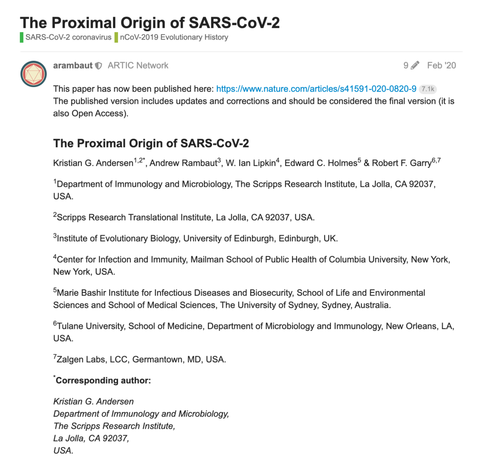
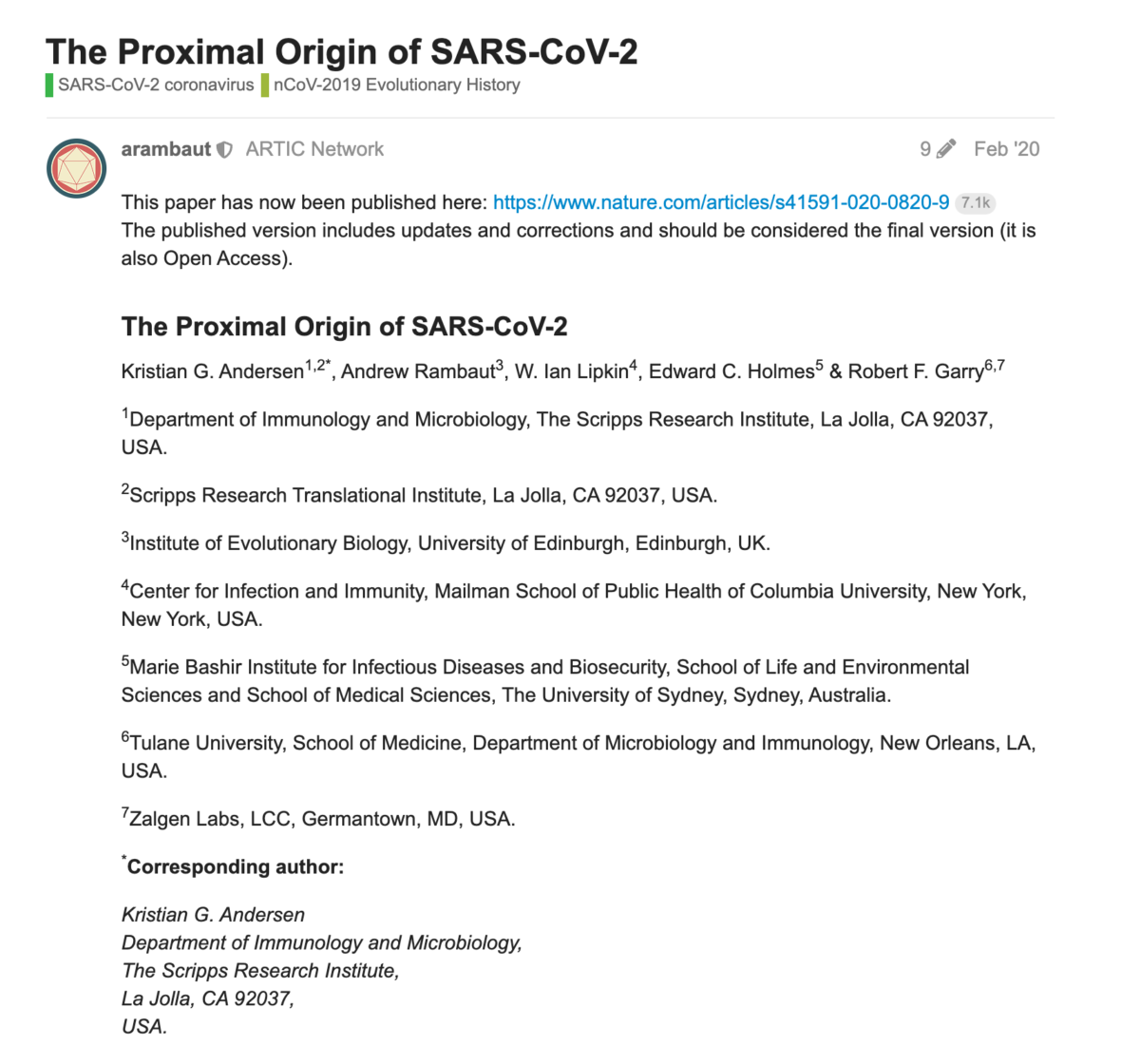
A screenshot of the Proximal Origin paper. (Screenshot/Virological)

Proximal Origin was published online on Feb. 16, 2020, and sought to exclude the possibility of a lab leak. The article would prove to be highly influential and has been extensively used by Fauci and media organizations in their promotion of the natural origins narrative.

Another recipient of funding under the CREID initiative was EcoHealth president Peter Daszak, who received a total of $1.5 million in both 2020 and 2021. Unlike either Andersen or Garry, proceeds from his CREID grant make up the entirety of his listed NIAID grants in both years. By way of comparison, Daszak had received approximately $662,000 in NIAID grant money in 2019. Put another way, Daszak’s post-pandemic funding increased by approximately 130 percent.

Daszak, who heavily promoted the natural origins narrative, was personally involved in gain-of-function work with the Wuhan Institute of Virology, which continued until at least April 2020. Most prominently, Daszak authored a 2018 research proposal which details the creation of a virus in a lab that bears a remarkable similarity to the defining features of COVID-19.

That proposal, dated March 27, 2018, details EcoHealth’s plans, in conjunction with the Wuhan Institute, to create entirely new coronaviruses through the synthetic combination of preexisting virus backbones. It describes how those viruses were going to be made more virulent in humans by the insertion of a furin cleavage site, a feature that distinguishes COVID-19 from all other SARS-related coronaviruses.

Another scientist who advised the Feb. 1, 2020, teleconference, Michael Farzan, received $9.9 million in grants from Fauci’s NIAID in 2020, followed by another $7.9 million in 2021 and an additional $919,000 at the start of 2022. By comparison, Farzan had received $3.8 million in grant money from NIAID in 2019. Although Farzan received substantial increases in grant funding, none of that money appears to have come under grants provided by the CREID initiative.

Farzan, an immunologist who in 2005 discovered the receptor of the original severe acute respiratory syndrome (SARS) virus, had told the senior members of Fauci’s teleconference group in emails that the pandemic likely originated from a lab in which live coronaviruses were passed repeatedly through human-like tissue, accelerating virus mutations with the end result being that one of the mutated viruses may have leaked from the lab. Farzan told Fauci’s group that he placed the likelihood of a leak from a Wuhan lab at 60 to 70 percent.

But in an Oct. 5, 2021, paper, Farzan appeared to agree with conclusions put forth in Proximal Origin, when he claimed that a “comparison of the S protein sequences indicates SARS-CoV-2 may have emerged from the recombination between bat and pangolin coronaviruses.” Farzan, like Andersen, works at the Scripps laboratory.

https://www.zerohedge.com/covid-19/scientists-instrumental-covid-19-natural-origins-narrative-received-over-50-million-niaid