Search This Blog

Sunday, January 23, 2022

Biotech week ahead, Jan. 24

Biotech stocks pulled back yet again during the week ending Jan. 21, with the sector retreating along with the broader market. The news flow tapered off following the frenetic pace of the week that encompassed the JPM Healthcare conference.

On the M&A front, rare disease biopharma Zogenix, Inc. 

 (Get Free Alerts for ZGNX) agreed to be acquired by Belgium's UCB SA 

 (Get Free Alerts for UCBJY) for about $1.8 billion.

Here are the key catalytic events biotech investors can look forward to in the unfolding week:

Conferences

B. Riley Virtual Oncology Conference: Jan. 27-28

PDUFA Dates

The Food and Drug Administration is scheduled to announce by Saturday, Jan. 29, its verdict on Azurity's new drug application for zonisamide oral suspension for the treatment of partial seizures in patients with epilepsy. Azurity had purchased zonisamide oral suspension from Eton Pharmaceuticals, Inc.

.

Roche Holding AG (PNK: RHHBY) awaits approval for its biologic license application for faricimab as a treatment option for wet age-related macular degeneration and diabetic macular edema. The decision is expected by late January.

Clinical Readouts/Presentations

Deciphera Pharmaceuticals, Inc. 

 will present at the American Society of Clinical Oncology Plenary Series Session on Tuesday, results of the Phase 3 INTRIGUE study of Qinlock in second-line gastrointestinal stromal tumor. Zai Lab Limited 

 has in-licensed the investigational asset for the Greater China region.

Cue Biopharma, Inc. 

 will provide on Wednesday an update from its ongoing clinical trials with CUE-101, its lead and representative IL-2 based drug product candidate from the CUE-100 series. CUE-101 is currently in a Phase 1b clinical trial for the treatment of HPV+ recurrent/metastatic head and neck squamous cell carcinoma.


Earnings

Johnson & Johnson 

 (Tuesday, before the market open)
Abbott Laboratories 

 (Wednesday, before the market open)
Vertex Pharmaceuticals Incorporated 

 (Wednesday, after the close)
Edwards Lifesciences Corporation 

 (Wednesday, after the close)
ResMed Inc. 

 (Thursday, after the close)

IPOs

IPO Pricing

New Jersey-based Samsara Vision, Inc. NASDAQSMSA has filed a preliminary prospectus with the SEC related to its proposed initial public offering of 4.17 million shares. The medical device that focuses on treatments for late-stage conditions of the retina expects the shares to be priced between $5 and $7. It has applied for listing its common stock on the Nasdaq under the ticker symbol SMSA.

https://www.benzinga.com/general/biotech/22/01/25176010/the-week-ahead-in-biotech-jan-23-29-roche-azurity-fda-decisions-j-j-vertex-earnings-samsara-visio

Plan for free N95 masks could save domestic mask makers — or kill them

 The Biden administration’s plan to distribute 400 million high-quality N95 respirators (N95 masks) at thousands of pharmacies, free of charge, is a great way to encourage people to step up to a much higher level of protection against COVID-19. These masks will come from the government’s Strategic National Stockpile.

If we can get the American public to pick them up and use them, it will help to decrease transmission of omicron and other future variants. But we should ask what this will mean for domestic mask manufacturers. After all, competing with “free” is tough even in good times. But if the plan is to replenish the stockpile by sourcing from domestic manufacturers, that is an opportunity to correct some mistakes we made earlier in the pandemic.

N95 masks provide the highest level of filtration. They excel in both fit and filtration capabilities. According to the American Conference of Governmental Industrial Hygienists (ACGIH) Pandemic Response Task Force, it takes 25 hours for an infectious dose of COVID-19 viruses to transmit between two people wearing non-fit-tested N95 masks. If the masks are well-fitted (meaning tightly sealed to the face), the wearers have 2,500 hours of protection. This compares to one hour of protection for two people wearing disposable surgical masks, 27 minutes for two people wearing cloth masks, or 15 minutes for two people who are not wearing masks at all.

Hey leaders in Washington, cloth masks really are not good enough — at all. So we need to see you set a good example at press briefings and on C-SPAN!

When the pandemic first hit the U.S. in March of 2020, the country was caught short because of the skyrocketing demand from frontline health care workers. We discouraged other people from using them because we didn’t want to strain the supply chain; we wanted priority to go to those who needed them the most. The shortages even forced many health care workers to reuse masks for much longer than they were intended, or to attempt to recondition them for reuse. We should not forget those desperate days.

Public and private sector leaders pleaded with domestic companies to begin production, and many of them stepped up. But as I and my colleagues have pointed out, much of the supply and capability base that would facilitate the start-up of automated production of masks left this country some time ago. By the time domestic sources ramped up for large volumes, Chinese manufacturers flooded the market with a wide range of masks and personal protective equipment (PPE), often priced below the cost of the raw materials paid by American firms.

Many of the masks and PPE consumed in this country destined for the health care market are purchased and distributed by group purchasing organizations (GPOs). They are often sourced from large health care supply manufacturers who negotiate supply agreements with them. Capitalizing on the severe shortages, the large manufacturers were in a good position to sign long-term contracts, and they did. As a buyer, if you were faced with shortages, you would probably leap at the opportunity. Government procurements followed the same path.

This left the consumer market to the small domestic manufacturers who had gotten into the business in response to the urgent calls for help. Many of them started direct to consumer sales to stay alive. But they struggled as Centers for Disease Control and Prevention (CDC) guidance continued to steer consumers away from N95 masks, while FacebookGoogle and Amazon followed CDC guidance to block online advertising of N95’s to the general public. Imagine trying to sell online and not being able to advertise online. Hmmm … Doesn’t sound like a winning proposition. Meanwhile, Chinese-made KN95 masks flooded the market.

Many of these domestic companies have been struggling for survival and laid off most of their employees or closed their doors entirely. Some ramped back up to supply renewed demand with the emergence of the omicron variant, just as shortages again developed.

Will “free” masks shut down these sales? Early signs are not good. Armbrust USA in Texas saw its sales drop almost 50 percent overnight after the free-mask announcement, and Shawmut Advanced Materials in Massachusetts saw a 60 to 70 percent sales decline over the last two days. Even Premier, one of the largest GPOs has expressed concerns about the free mask program.

The U.S. Department of Health and Human Services (HHS) has been developing a plan to contract for surge capacity (120-day response) of 141 million N95’s per month. These would be structured as 10-year deals that would commit to purchase some percentage on a steady basis to ensure that they would be available for the next crisis. That’s a great idea.

However, one supplier I spoke with said HHS only wanted to work with two or three companies for high-volume proposals. They told me that their company would be able to produce over 200 million N95 masks over the next 12 months — but that apparently was not enough, so they were cut. HHS appears to have reconsidered, so the company hasn’t given up.

Since supply chain resilience is what we really need in this country, here are a few things we should do. First, we should diversify the supply base, encouraging more manufacturers, especially ones who have domestic sourcing for their raw materials. Stamping out masks from foreign-sourced material won’t make us more resilient during the next crisis. This probably also means more than two or three big suppliers, as a larger base will produce more innovation. Maybe we should look for all the sites that mayors, governors, or congressional leaders called asking for help or visited to dedicate new mask-making lines, and see if we can direct some business to those companies. After all, they stepped up during our time of need, and many of them invested their own money with little or no federal assistance.

Second, we should make long-term commitments to these suppliers. U.S. companies will have higher costs than overseas competitors and buying from them for the stockpile is a good way to ensure that they can have stable demand. The large manufacturers already have a stable base and making stockpile purchases from the small producers will foster supply diversity and improved resilience. Stable demand helps them to maximize efficiency and keep people employed. In the early phase of the pandemic, we asked these companies to be swing producers. But we can’t expect them to stay in business as swing producers — only called on when they are needed — not if we want them to stay in business.

Finally, we should find ways to help smaller domestic suppliers work their way through government procurement regulations. We should find ways to help them, and to say “yes” to them, rather than simply “no.”

Giving away masks to the American public will be a truly great initiative for improving public health, and rebuilding the Strategic National Stockpile is a good way to grow a resilient, domestic supply chain. It’s also a chance to thank the firms who stepped up earlier in the pandemic. Let’s not miss this opportunity.

Willy C. Shih is the Robert and Jane Cizik professor of management practice at the Harvard Business School. His research focuses on global manufacturing and supply chains.

https://thehill.com/opinion/white-house/590968-plan-for-free-n95-masks-could-save-domestic-mask-makers-or-kill-them

Gottlieb says he stands by prediction of return to offices in February

 Former FDA commissioner Scott Gottlieb said on Sunday that he stands by his prediction that businesses will allow employees to return to offices by February. 

During an appearance on CBS’s “Face The Nation,” Gottlieb told host Margaret Brennan that most businesses will reopen offices by March 1, citing declining COVID-19 cases in the eastern U.S. 

“Yeah, I think that's timeline still intact, you're seeing a lot of businesses make decisions to do, return to work March 1st because I think they want to give themselves a cushion, especially having been surprised before,” Gottlieb told Brennan. 

Gottlieb noted that away from the Northeast and Mid-Atlantic, other regions of the country are still experiencing a rise in virus cases, adding it would likely be one to two weeks until cases hit a peak. 

“Across the United States, there's still states that are probably in the thick of this. They have another week, maybe two weeks to go until they peak and start to come down,” Gottlieb told Brennan. 

“But in places like New York, New Jersey, Connecticut, Washington, D.C., you're seeing cases decline very rapidly. And I think that thesis around a February return is intact.”

The U.S. is currently reporting more than 700,000 new COVID-19 cases a day, on average, below more than 800,000 earlier this month but still far above previous waves of the virus. 

The seven-day average of daily deaths due to COVID-19 is above 2,100 a day, on par with the initial surge of the virus in early 2020, but below the winter wave in 2021, when average daily deaths topped 3,000. 

https://thehill.com/homenews/sunday-talk-shows/590975-gottlieb-says-he-stands-by-prediction-of-return-to-offices-in

Blinken: State Dept tracking US Embassy personnel in Kyiv 'very, very closely'

 Secretary of State Antony Blinken on Sunday said the State Department is tracking U.S. Embassy personnel in Kyiv “very, very closely” as concerns grow regarding a potential Russian invasion.

Asked by moderator Chuck Todd on NBC’s “Meet the Press” if the State Department has approved a reported request by the U.S. Embassy in Ukraine to send non-essential personnel home, Blinken said, “This is something that we look at every single day.”

He said any decrease in personnel will be done “based on security needs.”

“I have no higher responsibility than the safety and well-being of the folks who work for the State Department and who are under my care, in a sense. So we're tracking this very, very closely. We're looking at it on really a daily basis,” Blinken said.

“And if we need to make a determination that we should draw down some of the folks at the embassy, we'll do that based on the security need,” he added.

Pressed by Todd on if he feels that Kyiv appears to be safe in at least the near term, Blinken said, “This is something, again, we're tracking intensely hour by hour and certainly day by day.”

Blinken’s comments come as the U.S. and European allies are becoming increasingly concerned that Russia is preparing to launch a military offensive against Ukraine. More than 100,000 Russian troops are amassed on the Ukrainian border, but Moscow has maintained that it is not planning an incursion.

The State Department has issued a Level 4: Do Not Travel advisory for Ukraine, pointing to COVID-19 and “increased threats from Russia.”

The department said Americans "should be aware of reports that Russia is planning for significant military action against Ukraine. U.S. citizens are also reminded the security conditions, particularly along Ukraine’s borders, in Russia-occupied Crimea, and in Russia-controlled eastern Ukraine, are unpredictable and can deteriorate with little notice."

State Department spokesman Ned Price announced in a statement on Tuesday that Blinken, during a trip to Kyiv that week, was scheduled to “meet with the employees and families of the U.S. Embassy to communicate the Department’s efforts to plan for contingencies, should Russia choose to escalate further.”

Multiple sources familiar with the matter, however, told CNN that the U.S. Embassy in Kyiv has already asked that the State Department allow all nonessential staff and their families to depart.

CNN reported on Saturday, citing a source close to the Ukrainian government, that the U.S. has told Kyiv it is "likely to start evacuations as early as next week," beginning with families of diplomats. Ukrainian President Volodymyr Zelensky has reportedly communicated with Blinken about the situation, arguing that such a move would be an “overreaction.”

Asked about the reported authorization request on Sunday, a State Department spokesperson told The Hill in a statement, “We have nothing to announce at this time.”

“If there is a decision to change our posture with respect to American diplomats and their families, American citizens should not anticipate that there will be U.S. government-sponsored evacuations,” the spokesman said, noting that commercial flights are currently available for departures.

“We conduct rigorous contingency planning, as we always do, in the event the security situation deteriorates,” the spokesperson added.

https://thehill.com/homenews/sunday-talk-shows/590982-blinken-state-dept-tracking-us-embassy-in-kyiv-very-very-closely

Thousands descend on DC for anti-vaccine mandate rally

 Thousands of demonstrators protesting vaccine mandates descended onto Washington, D.C. on Sunday, mostly maskless, with some sporting far-right and pro-Trump memorabilia and others drawing comparisons between the vaccine and the Holocaust.  

The Metropolitan Police Department told The Hill there have been no arrests or police reports as a result of the gathering around the Washington Monument and Lincoln Memorial as of late Sunday afternoon. But some locals worried the crowd could devolve into chaos with some recalling the recent anniversary of the deadly Jan. 6 Capitol attack, which was preceded by a rally of pro-Trump supporters protesting the certification of the 2020 election, according to WUSA.

Rally organizers predicted that roughly 20,000 people would attend the event, however The Washington Post reported that a seemingly smaller crowd of a few thousand had gathered by Sunday afternoon.

According to the Post, many of the attendees sported right-wing, pro-Trump apparel. Others were reportedly screaming at people to remove their masks.

On social media, signs and imagery could be seen decrying federal health officials and prominent public figures who have pushed vaccinations.  In a video posted on Twitter, a bus could be seen with pictures of CDC Director Rochelle WalenskyPresident Biden's chief medical adviser Anthony Fauci and Microsoft founder Bill Gates plastered on the side with the word "WANTED" written above their faces.

Some signs appeared to call for violence against others, with one sign reading "Shoot those who try to kidnap & vaccinate your child." Many signs referenced biblical passages and Christian figures in their protest of vaccinations.

Videos of the rally show a woman who was seen carrying a large yellow star, which was worn by Jews in Nazi-occupied Europe to identify them, while other images captured signs such as "I am not a lab rat" and "Stop the vaccine Holocaust."

The protest takes place as most of the U.S. is currently experiencing a new wave in COVID-19 cases, fueled by the highly-transmissible omicron variant. According to health data from the Centers for Disease Control and Prevention (CDC), the U.S. currently has a seven-day average of over 716,000 new COVID-19 cases.

The current seven-day average for COVID-19 related deaths in the U.S. has already surpassed the peak in average deaths that was seen during the delta variant surge, though it is lower than the peak in deaths that was seen before vaccines were made widely available.

This week, D.C implemented a new rule that requires multiple types of businesses to check that patrons over the age of 12 had received at least one dose of a COVID-19 vaccine. This mandate applied to restaurants, bars, gyms, entertainment venues nightclubs. 

A host of anti-vaccine activists spoke at the Lincoln Memorial, including Robert F. Kennedy Jr., who has been banned from some social media platforms including Instagram for spreading false claims about vaccination.  

Robert Malone, an anti-vaccine scientist, told the crowd that it was "irrelevant" whether or not it "made sense" that vaccinations protected the "elderly and frail," and pushed the false claim that vaccinations do not work against the virus.

https://thehill.com/homenews/state-watch/590984-thousands-descend-on-dc-for-anti-vaccine-rally

Morgan Stanley: 'Winter Is Here, And Slowing Growth Will Overtake The Fed As The Primary Concern'

 By Michael Wilson, chief US equity strategist at Morgan Stanley

Growing up in the Midwest in the 1970s, I remember much colder and snowier winters that started earlier and lasted seemingly forever. With global warming, the winters are milder, start later and end earlier. However, one thing has not changed – winter always comes. This year has been no different despite a late start; the thermometer outside my window currently says minus 10 degrees Farenheit!

In the markets, investors have become fixated on the Fed’s every move. That makes sense with the Fed pivoting so aggressively on policy over the past few months. It also fits nicely with the first part of our well-established 'fire and ice' narrative and our view that equity valuations are vulnerable. The reason for the Fed’s sharp pivot is obvious as inflation has overshot its goals, leading to problems for the real economy and the White House. When the Fed first announced its inflation-targeting policy in summer 2020, it was appropriate given the deflationary effects of the pandemic. Therefore, it’s now just as appropriate for the Fed to tighten at an accelerated pace to fight the inflation overshoot. This is a big change for a Fed that has been fighting the risk of deflation for 20+ years.

Importantly, consumers are truly starting to feel the impact of inflation, with the University of Michigan confidence survey currently at levels typically observed only in recessions. Small businesses are also feeling the pain, as demonstrated by their difficulty finding employees and the prices they are paying for supply and logistics. These problems have been reflected in small cap stocks’ dramatic underperformance over the past 10 months. In short, the Fed is serious about fighting inflation, and it’s unlikely that it will be turning dovish any time soon given the seriousness of these economic threats and the political cover to take action [ZH: we disagree].

The good news is that markets have been digesting this tightening for months. Despite the fact that the major US large cap equity indices are down only 5-10% from their highs, the damage under the surface has been enormous and even catastrophic for many individual stocks. Expensive, unprofitable names – i.e., the most speculative parts of the equity market – have been hit the hardest, down 30-50%. This is appropriate in our view, not just because the Fed is pivoting but because these kinds of valuations don’t make sense in any investment environment. In short, the froth is coming out of an equity market that simply got too extended on valuation.

But attention should now turn to the ice part of our narrative – slowing growth. As we’ve been writing for months, we view the current deceleration in growth as more about the natural ebbing of the cycle than the latest variant of Covid. Indeed, there are reasons to be optimistic that Omicron will prove to be the final wave of this pandemic. However, that also means the end of extraordinary stimulus, both monetary and fiscal. It also means looser supply chains as restrictions ease and people fully return to work. Better supply is good for fighting inflation but may also reveal the degree to which demand has been supported and overstated by double ordering. Weaker PMIs are already leading stocks in this regard (Exhibit 1).

This would fit nicely with the 1940s analogy that we detailed in our outlook and our This Cycle Could Run Hotter but Shorter note almost a year ago. In brief, the end of World War II freed pent-up savings and unleashed demand into an economy unable to supply it. Double-digit inflation ensued, which led to the first Fed rate hike in over a decade and the beginning of the end of financial repression. Sounds familiar? Shortly thereafter, inflation plummeted as demand normalized, but the Fed never returned to the zero bound. Instead, we began a new era of shorter booms and busts as the world adjusted to the higher levels of demand as well as cost of capital and labor. The end of secular stagnation and financial repression has arrived, but it won’t be a smooth ride.

In the near term, hunker down for a few more months of winter as slowing growth overtakes the Fed as the primary concern. In such a world, we continue to favor value over growth but with a defensive rather than cyclical bias – i.e., hibernate until winter is over.

https://www.zerohedge.com/markets/morgan-stanley-winter-here-and-slowing-growth-will-overtake-fed-primary-concern

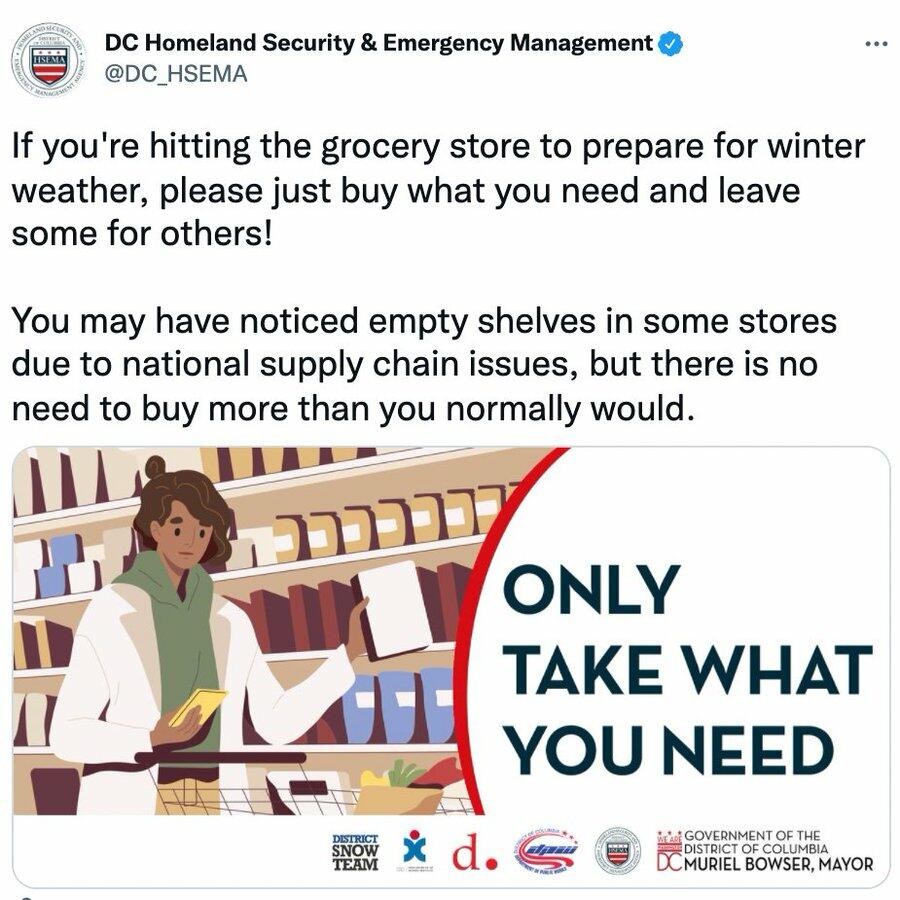
'Take Only What You Need:' DC Asks People To Limit Supermarket Purchases As Empty Shelves Persist

 "If you're hitting the grocery store to prepare for winter weather, please just buy what you need and leave some for others! You may have noticed empty shelves in some stores due to national supply chain issues, but there is no need to buy more than you normally would." 

Above is a recent tweet from the DC Homeland Security and Emergency Management Agency (DC HSEMA) completely contradicting what President Biden told the nation last Wednesday that images of empty store shelves in supermarkets are fake news. 

Biden, talking about his Build Back Better legislation, said, "First fix the supply chain... We heard dire warnings about how these supply chain problems could create a real crisis around the holidays. So we acted."

The president preceded to tell the nation, "eighty-nine percent" of supermarkets "are full, which is only a few points below what it was before the pandemic." 

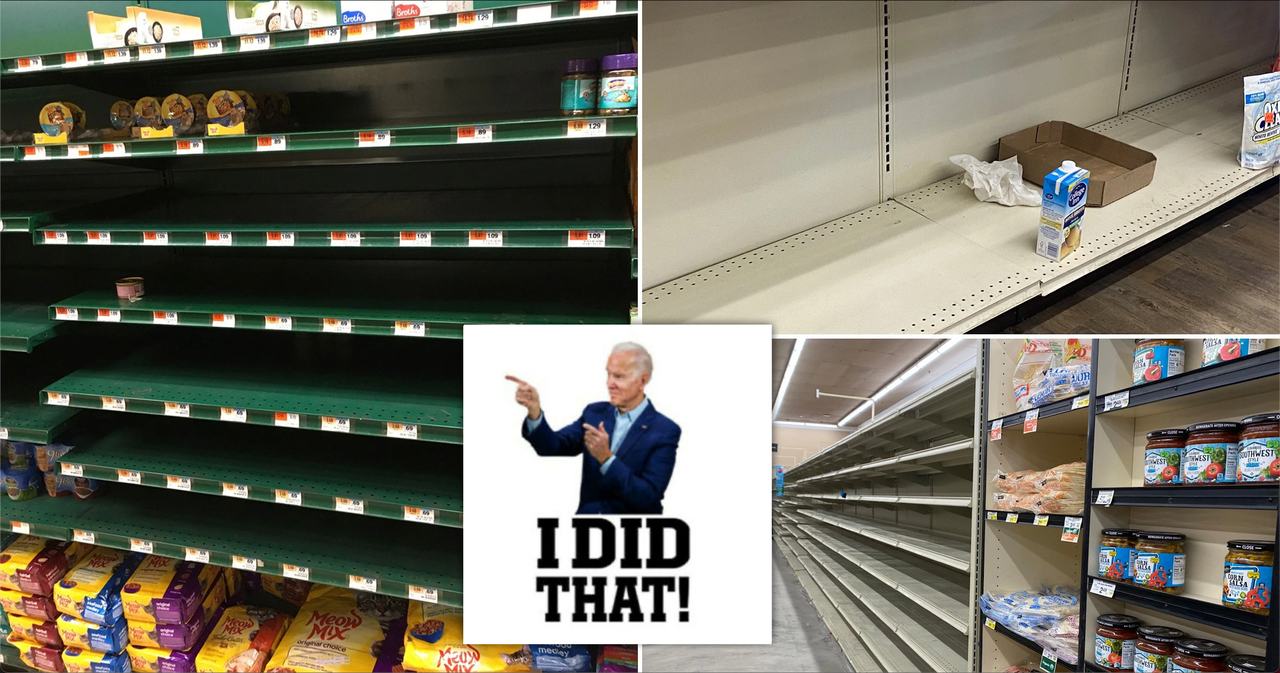
He said the images Americans see on television of empty shelves are misleading. 

Suppose supermarket shelves aren't empty, as Biden explains. Why would DC HSEMA issue a notice to area residents about empty store shelves and ask people not to panic hoard ahead and during adverse weather conditions this winter? 

Something is amiss here, and it seems the delusional 79yo president might be a little out of touch with reality. 

For a dose of reality, the internet has been washed with social media users pointing out bare shelves at supermarkets around the country. 

Last week, Phil Lempert, an editor of the website SupermarketGuru.com, told NPR that supermarket shelves are bare again. He called it a "perfect storm." 

Industry experts, such as Conagra Brands' CEO Sean Connolly warned its US plants could be constrained for at least the next month due to Omicron-related absences

Another expert, the CEO of Albertsons, is anticipating continued supply chain woes "over the next four to six weeks." 

So if the nation's food supply is under stress and store shelves are going bare as DC HSEMA tells residents not to panic hoard, then why in the heck is the president misleading the public about how everything is okay? 

Ah, yes, the midterms are coming up. 

https://www.zerohedge.com/political/take-only-what-you-need-dc-asks-people-limit-supermarket-purchases-empty-shelves-persist