Search This Blog

Wednesday, February 16, 2022

How The CDC Abandoned Science

 by Vinay Prasad via TabletMag.com,

Mass youth hospitalizations, COVID-induced diabetes, and other myths from the brave new world of science as political propaganda...

The main federal agency guiding America’s pandemic policy is the U.S. Centers for Disease Control, which sets widely adopted policies on masking, vaccination, distancing, and other mitigation efforts to slow the spread of COVID and ensure the virus is less morbid when it leads to infection. The CDC is, in part, a scientific agency—they use facts and principles of science to guide policy—but they are also fundamentally a political agency: The director is appointed by the president of the United States, and the CDC’s guidance often balances public health and welfare with other priorities of the executive branch.

Throughout this pandemic, the CDC has been a poor steward of that balance, pushing a series of scientific results that are severely deficient. This research is plagued with classic errors and biases, and does not support the press-released conclusions that often follow. In all cases, the papers are uniquely timed to further political goals and objectives; as such, these papers appear more as propaganda than as science. The CDC’s use of this technique has severely damaged their reputation and helped lead to a growing divide in trust in science by political party. Science now risks entering a death spiral in which it will increasingly fragment into subsidiary verticals of political parties. As a society, we cannot afford to allow this to occur. Impartial, honest appraisal is needed now more than ever, but it is unclear how we can achieve it.

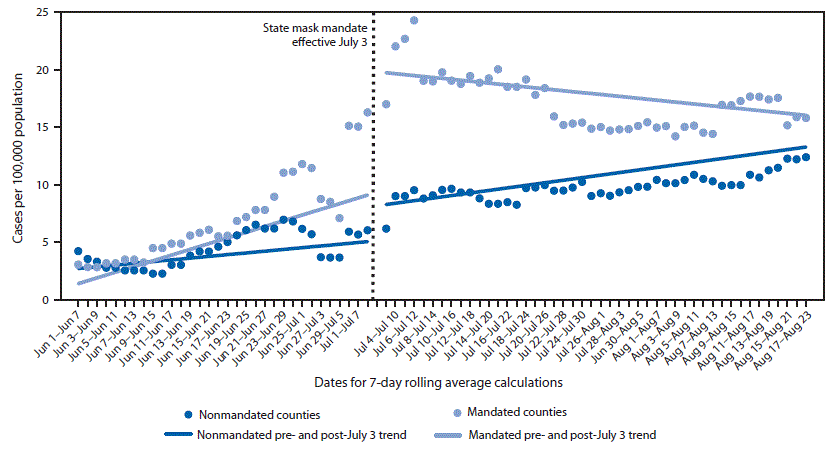
In November 2020, a CDC study sought to prove that mask mandates slowed the spread of the coronavirus. The study found that counties in Kansas which implemented mask mandates saw COVID case rates start to fall (light blue below), while counties that did not saw rates continue to climb (dark blue):
CDC.GOV

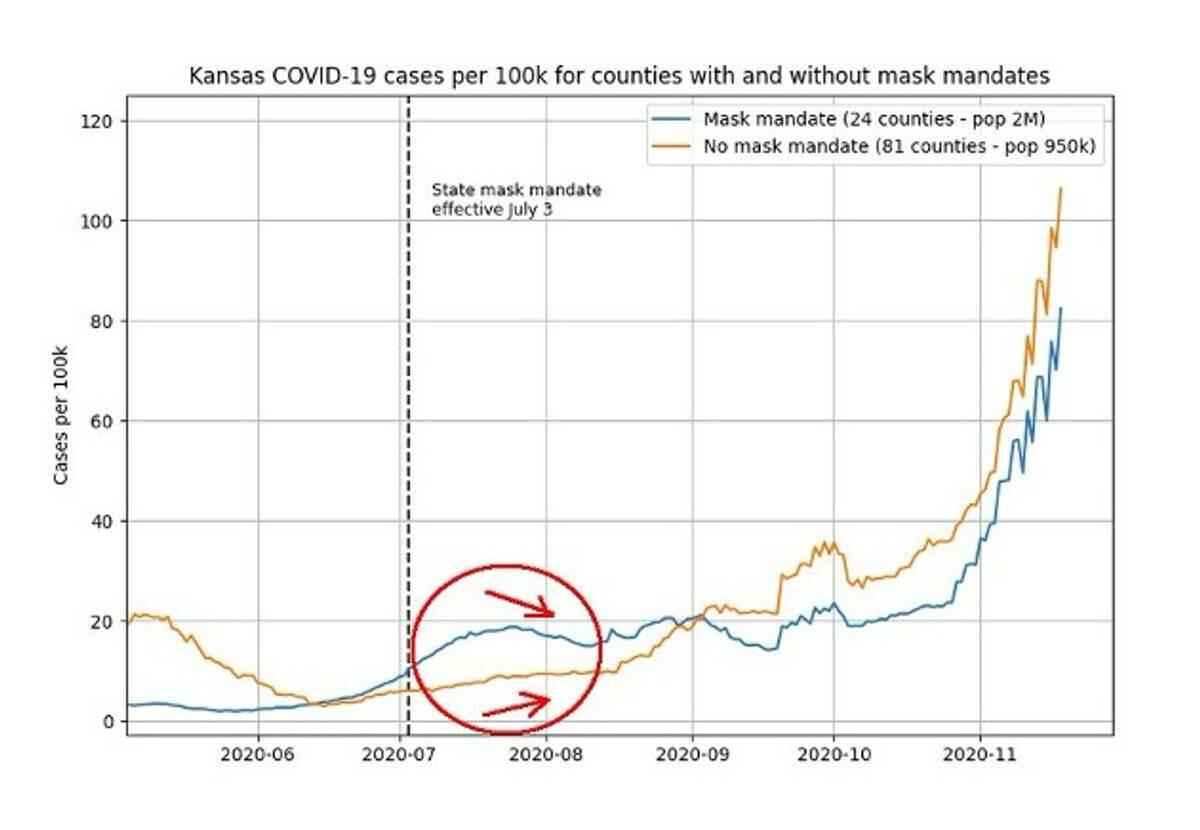
The data scientist Youyang Gu immediately noted that locales with more rapid rise would be more likely to implement a mandate, and thus one would expect cases to fall more in such locations independent of masking, as people’s behavior naturally changes when risk escalates. Gu zoomed out on the same data and considered a longer horizon, and the results were enlightening: It appeared as if all counties did the same whether they masked or not:
YOUYANG GU

The CDC had merely shown a tiny favorable section, depicted in the red circle above, but the subsequent pandemic waves dwarf their results.

In short, the CDC’s study was not capable of proving anything and was highly misleading, but it served the policy goal of encouraging cloth mask mandates.

When it comes to promoting mask mandates in school, in October 2021 the CDC famously offered a comparison of masked and unmasked schools in Arizona’s Pima and Maricopa counties in their own journal, Morbidity and Mortality Weekly Report (MMWR). The analysis claimed that schools with no mask requirement were 3.5 times more likely to experience a COVID outbreak when compared with schools that mandated masking. But the analysis did not adjust for rates of vaccination among either teachers or students. The paper also looked at two counties in Arizona with different political preferences, and thus did not separate mask mandates from other patterns of behavior that fall within partisan lines. Democratic voters, for example, are much more likely to embrace mask mandates and are more likely to otherwise curtail their behavior as they report greater overall concern about COVID. Elementary schoolchildren generally do better with COVID than high school kids, but the CDC’s analysis lumped all ages together, and might have been biased by the fact that mask mandates were more common at ages when outbreak detection occurs less often.

These were only a few of the CDC paper’s problems. When the reporter David Zweig investigated it for The Atlantic, he found that the exposure times varied: The mask mandate schools were open for fewer hours per day, with less time for outbreaks to occur. Zweig also found that the number of schools included did not add up. He hypothesized that some schools conducting remote learning might have been wrongly included, but when he asked the paper’s authors to provide him a list of the schools, they didn’t. In short, the more one examined this study, the more it fell apart.

Masking is not the only matter in which the CDC’s stated policy goal has coincided with very poor-quality science that was, coincidentally, published in their own journal. Consider the case of vaccination for kids between the ages of 5 and 11. COVID vaccination in this age group has stalled, which runs counter to the CDC’s goal of maximum vaccination. Interestingly, vaccinating kids between 5 and 11 is disputed globally; Sweden recently elected not to vaccinate healthy kids in this age group, and some public health experts believe that it would be preferable for kids to gain immunity from natural exposure instead. Stalling U.S. uptake therefore reflects a legitimate and open scientific debate, regardless of whether the CDC’s policy goal would like to consider it closed.

Enter the CDC’s new study. Widely covered in news outlets, the January 2022 study claims that kids below the age of 18 who get diagnosed with COVID are 2.5 times more likely to be diagnosed with diabetes. “These findings underscore the importance of COVID-19 prevention among all age groups,” the authors write, “including vaccination for all eligible children and adolescents.” But a closer examination of the study again reveals problems.

First, it does not adjust for body mass index. Higher BMI is a risk factor for COVID, prompting hospitalization and diabetes, and yet the CDC analysis does not adjust for weight at all. Second, the absolute risks the study finds are incredibly low. Even if the authors’ finding is true, it demonstrates an increase in diabetes of up to 6 in 10,000 COVID survivors. Third, the CDC’s analysis uses billing record diagnoses as a surrogate for COVID cases, but many kids had and recovered from COVID without seeking medical care. Without a true denominator that conveys the actual number of COVID cases, the entire analysis might be artifact. As the former dean of Harvard Medical School Jeffrey Flier told The New York Times, “The CDC erred in taking a preliminary and potentially erroneous association and tweeting it to specifically create alarm in parents.” Some might view it as a mistake, but after observing these matters for almost two years, I believe it was the entire point of the study: Alarm might boost flagging vaccine uptake in kids.

(Already, a better study out of the United Kingdom finds no causal link between COVID and diabetes in kids.)

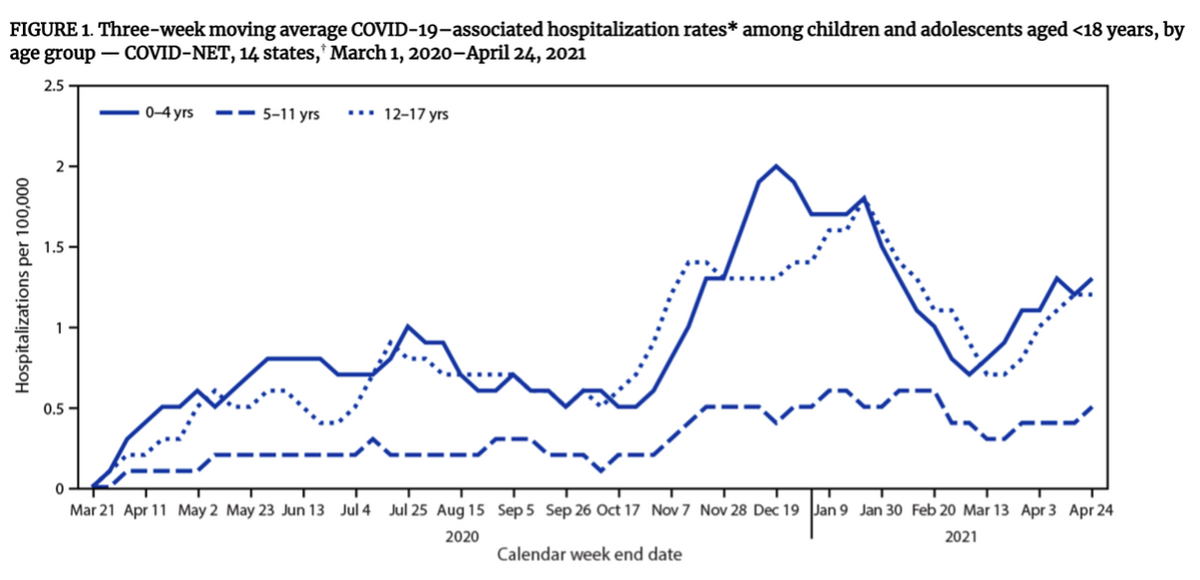
Manufacturing alarm at the very moment an age or other demographic cohort is targeted for vaccination has become a pattern for the CDC. On May 10, 2021, the FDA granted Emergency Use Authorization for the 12- to 15-year-old cohort to receive the Pfizer vaccine. On June 11, the CDC published a study in MMWR claiming to demonstrate rising hospitalization among this age group; widespread media coverage of the study quickly followed. But the absolute rates for this age group were, in reality, amazingly low: Less than 1.5 per 100,000, which was lower than they had been in the previous December. Meanwhile, a safety signal was being investigated—myocarditis, or inflammation of the heart muscle—which was more common after the second dose, and reported to be as frequent as 1 in 3,000-6,000, according to the Israeli Ministry of Health. Other countries became reluctant to push two doses within the standard 21- to 28-day timeline for these ages. By July, the U.K. had decided against pushing vaccines for this cohort, a decision that was walked back only slowly.
CDC.GOV

The CDC was undeterred, and in recent weeks the agency’s director has started to push for more doses at these ages. Against the advice of an FDA advisory committee, Rochelle Walensky has moved forward with recommending boosters for 12- to 15-year-olds. This view differs from WHO guidance and that of other countries, including Canada, which is not authorizing boosters for healthy adolescents aged 12-17. But when it comes to vaccination, the CDC has a single policy: All Americans should get three doses, regardless of age or medical conditions. This is not science as such, but science as political propaganda.

If that sounds like an exaggeration, consider a final example: the CDC’s near-total dismissal of natural immunity. Many other countries consider recovery from prior infection as a vaccination equivalent or better, an assumption that makes both medical and intuitive sense, but the CDC has steadfastly maintained that everyone needs the same number of vaccinations whether they have recovered from a COVID infection or not. This view is countered by data showing that vaccinating people who have recovered from COVID results in more severe adverse events than vaccinating people who have not had COVID.

In order to bolster the claim that people who have recovered from COVID benefit from vaccination as much as those who never had it, the CDC published a fatally flawed Kentucky-based analysis. The August 2021 study compared people who had contracted COVID twice against those who had it just once, and concluded that those who had it once were more likely to have had vaccination. But the study could have easily missed people who had two documented cases of COVID but might have had severe underlying medical conditions—such as immunosuppression—that predisposed them to multiple bouts of infection in a short period. In addition, people who had COVID once and then got vaccinated might not have sought further testing, believing themselves invulnerable to the virus. The study did not adequately address these biases. Months later, the CDC published a stronger, cohort study showing clearly that natural immunity was more robust than vaccine-induced immunity in preventing future COVID hospitalizations, and moreover, that people who survived infection were massively protected whether vaccinated or not.

But to listen to Walensky tell it, none of these complications even exist. On Dec. 10, 2021, she told ABC News that the CDC had seen no adverse events among vaccine recipients, and denied seeing any cases of myocarditis among vaccinated kids between 5 and 11. On that same day, however, data from her own agency showed the CDC was aware of at least eight cases of myocarditis within that age group, making her statement demonstrably false.

So why does the supposedly impartial CDC push weak or flawed studies to support the administration’s pandemic policy goals? The cynical answer is that the agency is not in fact impartial (and thus not sufficiently scientific), but captured by the country’s national political system. That answer has become harder to avoid. This is a precarious situation, as it undermines trust in federal agencies and naturally leads to a trust vacuum, in which Americans feel forced to cast about in a confused search for alternative sources of information.

Once that trust is broken, it’s not easily regained. One way out would be to reduce the CDC’s role in deciding policy, even during a pandemic. Expecting the executive agency tasked with conducting the science itself to also help formulate national policy—which must balance both scientific and political concerns and preferences—has proven a failure, because the temptation to produce flawed or misleading analysis is simply too great. In order to firewall policymaking from science, perhaps scientific agency directors shouldn’t be political appointees at all.

Ultimately, science is not a political sport. It is a method to ascertain truth in a chaotic, uncertain universe. Science itself is transcendent, and will outlast our current challenges no matter what we choose to believe. But the more it becomes subordinate to politics—the more it becomes a slogan rather than a method of discovery and understanding—the more impoverished we all become. The next decade will be critical as we face an increasingly existential question: Is science autonomous and sacred, or a branch of politics? I hope we choose wisely, but I fear the die is already cast.

*  *  *

Vinay Prasad is a hematologist-oncologist, associate professor of epidemiology and biostatistics at the University of California, San Francisco, and author of Malignant: How Bad Policy and Bad Evidence Harm People with Cancer.

https://www.zerohedge.com/covid-19/how-cdc-abandoned-science

A THIRD of British children consume at least one energy drink a week: Government-funded study

 One in three British children are consuming caffeinated energy drinks at least once a week, research suggests.   

A Government-funded trial looked at the drinking habits of thousands of youngsters between 2013 and 2021. 

Those who consumed the ultra-caffeinated drinks weekly were more likely to suffer headaches, stomach cramps and sleep problems. They were also more likely to use alcohol or smoke and were more prone to irritability and being excluded from school.

On average, caffeinated energy drinks like Red Bull and Monster Energy contain the same amount of caffeine as a double shot of espresso.  

The latest review, by experts at the University of York and University College London, is the result of a 2018 Government consultation on banning the sale of energy drinks to children.

With only two UK studies on the topic available, further research was asked for. 

While the authors of the new study said their findings should be treated with caution, they said the data supports the current policy of banning the sale of energy drinks to children under 16.

They added that better education on the drinks and more prominent warning labels could also help reduce consumption among young people. 

However, the British Soft Drinks Association insists the industry is doing enough to discourage children from buying the drinks through current warning labels. 

In the new study, published in BMJ Open, the experts looked at dozens of child behavioural studies published between 2013 and July 2021.

They found that between 3 and 32 per cent of children consumed energy drinks on at least one day per week in the UK.

In one large UK study, about a quarter of teenagers aged 13 and 14 had one or more caffeinated drink per week, rising to between a quarter and a third of children aged 15 to 16. 

Another study from Wales found children who had energy drinks once a week or more were significantly more likely to report physical symptoms, such as trouble sleeping, headaches and stomach problems, than those who drank none.

The NHS advises that that energy drinks should not be consumed by young children. 

In comparison to the the UK, international studies indicated that between 13 to 67 per cent of children worldwide had consumed energy drinks in the past year. 

The overall results also showed that having the drinks of five or more days per week was associated with low psychological, physical, educational, and overall wellbeing.

Evidence also suggested boys drank more than girls. 

Lead author of the new review, York's Claire Khouja, said: 'While more research is needed to track the effects of energy drinks on children who drink them, our research has uncovered consistent evidence of links between the regular consumption of these drinks and harmful effects on children's overall wellbeing.

'These findings offer support for a government policy banning the sale of energy drinks to children.

'Our study also indicates that children who are better informed about the contents of energy drinks, drink less, suggesting that an education campaign and/or more prominent warnings on packaging could reduce consumption."

Energy drinks are marketed as a way of getting a boost and contain caffeine as well as other ingredients such as vitamins, sugar, guarana and ginseng root.

Last year, medics writing in the British Medical Journal (BMJ) warned of the dangers of energy drinks after a student who drank too many developed heart failure.

The 21-year-old university student spent 58 days in hospital after consuming four 500ml energy drinks every day for two years.

He was admitted to intensive care and was so ill that doctors were considering whether he needed an organ transplant.

In the latest study, the researchers said their findings rely on surveys and so cannot prove that energy drinks cause problems for children.

They said the overall evidence was weak, but it was consistent, and further studies could be needed.

The British Soft Drinks Association's director general, Gavin Partington, said: 'Our members do not market or promote energy drinks to under-16s, nor do they sample products with this age group.

'In addition, energy drinks carry an advisory note stating 'not recommended for children'.

'The BSDA Code of Practice on energy drinks was introduced by and for our members in 2010 and contains a number of stringent points on responsible marketing. We remain committed to supporting the responsible sale of energy drinks.'

ENERGY DRINKS - ARE THEY SAFE? 

There has been a stark rise in Britons’ thirst for caffeinated drinks – at least 600 million litres are drunk every year, 200 million more than ten years ago.

Figures from the British Soft Drinks Association reveal that the volume of energy drinks consumed in the UK increased from 463 million litres in 2010 to 679 million litres in 2017, with the UK market now worth £2billion a year.

Some 55 per cent of those aged between 12 and 24 years old suffer everything from vomiting and chest pains to even seizures from the drinks, despite most consuming less than the recommended one-to-two beverages a day, a Canadian study found. 

Previous research has linked energy drinks, such as Red Bull, to obesity, heart abnormalities and even sudden death due to their high-sugar and caffeine content.

Most energy-drink consumers are unaware of the products' main ingredients, health implications or appropriate serving sizes, experts have said.

How much caffeine do they contain?  

A 250ml serving of a typical energy drink - half the standard bottle or can size - contains 80mg of caffeine per litre – twice as much as a regular cola drink, but the same as a 60ml espresso.

Experts have warned that caffeine-packed energy drinks could be fuelling a record rise in diagnoses of irregular heartbeats, one of Britain’s biggest killers.

Just one energy drink daily could trigger arrhythmia, an abnormal heart rhythm which increases the risk of stroke five-fold.  

It is thought that this is because excessive caffeine consumption dramatically increases the amount of calcium released within the heart’s cells, disrupting the electrical rhythm.

Experts also warn the addition of high quantities of sugar in energy drinks could be a reason for their potency. 

How much sugar do they contain? 

Campaigns, such as Action on Sugar have called for a complete ban on the products for under 16s.

Their study in December 2017 found the average sugar content was more than an adult's entire maximum daily recommendation for sugar intake in the UK.

Likewise, 78 per cent of products exceeded the maximum daily recommendation for sugar intake for a child aged seven to ten 10 years - 24 g or six teaspoons. 

Certain manufacturers reformulated before the Soft Drinks Industry Levy in April 2018 in the UK. 

It would mean that one 250ml Red Bull energy drink containing 27g of sugar (five-and-a-half teaspoons), now costs an extra 6p. 

Before reformulation in 2017, the Punched Energy and Tropical Guava Flavour products from Rockstar, contained a staggering 78g, or 20 teaspoons, of sugar per 500ml serving - more than three times the daily recommendation of 25g for women and 38g for men.

Now, these drinks contain 24g of sugar per 500ml, the equivalent of six teaspoons per 500ml.

https://www.dailymail.co.uk/health/article-10486019/A-British-children-consume-one-energy-drink-week-Govt-study.html

Tuesday, February 15, 2022

First woman cured of HIV thanks to stem cells from newborns

 The first woman — and third person ever — has reportedly been cured of HIV after receiving a breakthrough treatment involving a “magical” umbilical cord blood transplant.

Researchers at New York-Presbyterian Weill Cornell Medical Center in New York led the study, and shared their findings during the Conference on Retroviruses and Opportunistic Infections in Denver the New York Times reported Tuesday. Their case study, from New York, bears significance for a number of reasons.

The “past middle-aged” woman, who chose not to be identified in the interest of privacy, was among the first to receive a novel transplant method using umbilical cord blood, fortified with a mutation that blocks HIV from entering her cells. She also received partially matched blood stem cells from a first-degree relative — a parent, offspring or sibling — while the cord blood treatment worked its way through her rejiggered immune system.

Now, just 14 months after her transplant, her blood shows no trace of the virus. The successful therapy also led to remission from leukemia that she developed in March 2017 due to HIV infection.

Scientists believe the fact that cord blood comes from newborns might suggest they’re “more adaptable” than adult stem cells, Dr. Koen van Besien, transplant service director at Weill Cornell Medicine, told the Times.

Dr. Steven Deeks, AIDS lecturer at the University of California, San Francisco, who was not involved in the study, called them an “attractive option.”

“There’s something magical about these cells and something magical perhaps about the cord blood in general that provides an extra benefit,” Deeks told the Times.

Compared to transplants using typical adult stem cells — which previously cured two men of HIV following a drastic recovery, according to NBC News — cord blood cells are also far more accessible to more patients, especially people of color.

Unlike traditional bone marrow transplants, those using cord blood — also called a haplo-cord transplant — allow patients who are only partial blood-type matches to receive the transplant.

More than half of the 38 million HIV cases globally are women, yet only 11% are represented in clinical trials for a cure.

An estimated 73% of HIV cases are taking traditional HIV treatment, predominantly antiretroviral drugs, which has helped some patients achieve remission. In rare and extreme cases, however, bone marrow transplants are an option, but an expensive and invasive one that presents major risks all its own.

The first and second patients dubbed cured of HIV — “The Berlin Patient” Timothy Ray Brown, who died of cancer in 2020 after beating HIV 12 years ago, and Adam Castillejo, who went public with his cure in 2019 — both received bone marrow transplants from adult donors who carried a mutation that blocks HIV infection. Besides eventually eradicating the disease, the procedure came with severe trade-offs. Brown nearly died when the donor marrow cells attacked his body, called graft versus host disease, while Castillejo suffered hearing loss and battled multiple infections before he was in the clear.

The first woman had an altogether different journey with cord blood treatment. She left the hospital on post-op day 17 and has not developed severe infection, according to her physicians at Weill Cornell.

“We estimate that there are approximately 50 patients per year in the US who could benefit from this procedure,” van Besien told NBC News. However, “the ability to use partially matched umbilical cord blood grafts greatly increases the likelihood of finding suitable donors for such patients.”

https://nypost.com/2022/02/15/first-woman-cured-of-hiv-thanks-to-stem-cells-from-newborns/

Coachella and Stagecoach Festivals Drop All COVID-Related Restrictions, Including Negative Tests and Masks

 After revealing last fall that vaccinations would not be required for entry, the Coachella and Stagecoach festivals have further revealed that there will no longer be any COVID-related barriers to entry at all, not even negative tests. Nor will a requirement to wear masks figure into the picture when millions of selfies go out from the desert this April.

A tweet from the Stagecoach account told the story. “Festival Admission Update: As we prepare to spend an incredible weekend in the desert together we are announcing that there will be no vaccination, testing or masking requirements at Stagecoach 2022, in accordance with local guidelines,” it read.

No similar tweet has come from the Coachella account, but the policy is the same for both Goldenvoice-promoted festivals. Coachella was revealed to have also relaxed its policies in the fine print of its “Health & Safety” rules page.

Publicizing the lack of restrictions may be more important in pacifying the audience for Stagecoach, a festival targeted at the country audience, which demographically leans more conservative and has been a hotbed of anti-vaccine and anti-mask sentiment among a number of artists as well as much of the base.


The California Department of Public Health issued new guidelines that go into effect Wednesday, saying vaccination proof will no longer be required for large outdoor events. But the festivals had already indicated last fall that they wouldn’t be requiring vaccine cards. Back in October, the festivals indicated that either proof of vaccination or a negative test would be sufficient for entry.

It’s been widely understood that, in the current political climate, it would be close to impossible to pull off a country music festival with COVID restrictions that much of the demographic finds onerous, with many chafing even at a requirement for negative tests. It’s also been assumed that Stagecoach would not be able to loosen any such restrictions without its sister festival adopting the same guidelines, or lack of them. But both festivals may have also just lucked out in their timing, with omicron cases apparently waning and even once pro-masking officials and celebrities being seen mingling without masks at events like the Super Bowl.

With less public fanfare than Stagecoach’s tweet, Coachella’s safety page declares an “update” which says, “In accordance with local guidelines, there will be no vaccination, testing or masking requirements at Coachella 2022.” A bullet point adds: “However, the event shall be presented in accordance with applicable public health conditions as of the date of the event and which may change at any time as determined by federal, state or local government agencies or instrumentalities, artists or the promoter; such requirements may include, without limitation, changes to capacity, attendance procedures and entry requirements, such as proof of vaccination and/or negative COVID-19 test, and other protective measures such as requiring attendees to wear face coverings.”

That fine print on Coachella’s page is followed by a warning that “COVID-19 is an extremely contagious disease that can lead to severe illness and death. There is an inherent and elevated risk of exposure to COVID-19 in any public place or place where people are present and there is no guarantee, express or implied, that those attending the festival will not be exposed to COVID-19.”

Coachella will take place over two successive weekends, April 15-17 and 22-24, and  and will have as headliners Harry Styles, Billie Eilish and Kanye West (if the latter artist was not bluffing when he said he would “need” to get an apology from Eilish before he would make good on his contract). The headliners for Stagecoach April 29 through May 1 are Luke Combs, Carrie Underwood and Thomas Rhett.

The pandemic is hardly over, of course, with reports still widespread in the area surrounding the festivals as well as statewide and nationwide. The Desert Sun reported Monday that among the Coachella Valley’s nine cities, 15,390 new COVID-19 cases had been reported in the preceding seven days. The number of deaths attributed to COVID is less grim than it once was, with 10 being reported in the area during the same period.

https://variety.com/2022/music/news/coachella-and-stagecoach-festivals-drop-all-covid-related-restrictions-including-negative-tests-and-masks-1235182727/

Half of state mask mandates have ended in the past 3 weeks

 Seven states have dropped business mask mandates since late January as declining Covid-19 cases have shifted political winds.

Of those states — California, Connecticut, Delaware, Maryland, Nevada, New York and Rhode Island — all but Nevada still require masks in schools, according to an NBC News survey of state mask requirements.

The changes come despite the Centers for Disease Control and Prevention’s continuing recommendation that masks be used indoors in most of the country.

Few mask restrictions remain. On Jan. 28, 12 states required masks in some or all settings, but as of Tuesday only five, plus Puerto Rico and Washington, D.C., still have any restrictions in place. Of these states, several have announced plans to lift them by the end of February or beginning of March.

The end of restrictions comes with some caveats. For example, in New York, masks must still be worn in public transportation, nursing homes, correctional facilities and homeless shelters.

Washington state plans to lift its outdoor mask mandate Feb. 18 and still requires masking indoors. And for many, school restrictions will remain for at least the coming weeks.

Nevada is taking another approach. On Thursday, the state’s governor, Democrat Steve Sisolak, opted to lift mask requirements in schools, medical settings and businesses.

Experts say masking provides some protection even when those around you are not wearing one. However, many people who are immunocompromised have said lifting restrictions would make it difficult to safely do basic activities, such as going to the grocery store.

Covid cases continue declining across most states, and the nationwide case average declined to about 157,000 as of end of day Monday, a figure close to the delta surge’s mid-September peak of nearly 167,000. The country has averaged more than 2,000 reported deaths a day for almost four weeks.

https://www.nbcnews.com/a/a-n1289093

CDC eases warnings for cruises as new COVID infections fall

 The U.S. Centers for Disease Control and Prevention (CDC) on Tuesday eased its warnings for cruise ships by a notch from the highest level, seven weeks after it advised Americans against going on cruises.

The health agency made the decision to reduce the warning to level three from four in response to a decline in onboard COVID-19 cases, but still recommended that people who were not up to date with vaccines avoid cruises.

The CDC in December increased the warning to level four due to the rapid spread of the Omicron variant that also forced cruise operators to cancel sailings.

COVID-19 infections are decreasing in the United States, with 168,485 new infections reported on average each day, or about 21% of the peak, with the highest daily average reported on Jan. 14.

Trade association Cruise Lines International Association said the CDC's latest decision was "a step in the right direction".

Royal Caribbean Group, which also owns Celebrity Cruises, earlier this month said it had carried nearly 1.3 million guests since mid-2021, with around 2,500 guests testing positive for COVID-19.

"We believe we are past COVID-19 in terms of the overall impact on our business," Royal Caribbean Group Chief Executive Officer Jason Liberty said in the beginning of February.

https://www.marketscreener.com/news/latest/U-S-CDC-eases-warnings-for-cruises-as-new-COVID-infections-fall--39482311/

Arizona Senate passes 15-week abortion ban

 The Republican-led Arizona Senate has passed legislation that prohibits doctors from aborting a fetus after 15 weeks of pregnancy, Tucson.com reported.  

The state’s legislature approved the proposed legislation in a 16-13 vote on Tuesday. 

According to Senate Bill 1164, medical officials who conduct abortions after the 15th week of pregnancy could face a year in prison and lose their medical licenses.

State Sen. Raquel Teran (D) argued after the initial party-line vote occurred that the proposed legislation doesn’t have any exceptions in cases of rape or incest, according to Tucson.com

One of the bill’s co-sponsors, state Sen. Nancy Barto (R), said she doesn’t see any problem with the new bill. 

"The baby inside of a woman is a separate life and needs to be protected," she said in a statement. "All life is sacred."

Arizona’s new abortion ban is modeled after the Mississippi bill currently being considered by the Supreme Court. 

Barto said she is counting on the Supreme Court’s challenge of the Mississippi law to overturn those precedents, which could lead the question to which abortion is legal up to individual states, Tuscon.com reported. 

“A ruling in that case is expected in June. This measure makes Arizona ready to enforce that law if and when that decision is made,” Barto said. 

“Arizona politicians are banking on the Supreme Court upholding Mississippi’s 15-week abortion ban so they can quickly strip Arizonians of their rights and begin enforcement,” Planned Parenthood Arizona CEO Brittany Fonteno said in a statement. “It’s a cowardly path to a cruel end — denying Arizonians the right to make their own health care decisions.”

https://thehill.com/homenews/state-watch/594436-arizona-senate-passes-15-week-abortion-ban