Search This Blog

Saturday, March 5, 2022

DC area bracing for trucker convoy protests as nearly 1,000 vehicles hit Maryland town

 Long lines of 18-wheelers and other trucks crowded the roads of Hagerstown, Maryland early Saturday as the Washington, DC-area prepared for protests over COVID-19 mandates.

While other similar US trucker convoys have fizzled, this one started gaining steam Friday evening. Roughly 1,000 vehicles arriving from all directions converged on Hagerstown Speedway, clogging traffic, the Washington Post reported.

As of 8 p.m., a two-mile-long line of cars and trucks could be seen stuck in traffic on Route 40 trying to get into the location, WUSA-9 TV reported.

Some truckers participating in the “People’s Convoy” said they planned to head to the DC Beltway area Saturday, but others said they were awaiting instructions.

When asked Friday night about the group’s plans, People’s Convoy organizer Mike Landis told the Washington Post, “We’re going to keep annoying D.C. … Just make them wonder a little bit.”

Vehicles are parked as part of a rally at Hagerstown Speedway,
Roughly 1,000 vehicles arriving from all directions have converged on Hagerstown Speedway.
REUTERS/Stephanie Keith

“Look, we’re truck drivers; we’re very spontaneous.” he added.

Brian Brase, another organizer for the convoy, on Friday was more specific. Brase told the newspaper protestors would no longer be targeting the Beltway area as previously planned — and could be staying in Hagerstown through Saturday.

He said the convoy would likely rally there Saturday night before probably heading to another location “only two miles from the Beltway” where some US senators and other representatives would be there to meet with them.  

Trucks belonging to participants of the Peoples Convoy
This convoy started gaining steam Friday evening.
STEFANI REYNOLDS/AFP via Getty Images

However, the People’s Convoy as of Saturday morning had not updated its website to reflect such a route change.

As a precaution, the National Guard has been called to help with DC-area traffic control through at least Monday, WUSA-9 reported. The Metropolitan Police Department’s Civil Disturbance Unit has also been activated through March 13.

The convoy is rolling along even as municipalities across the country — including New York City — have dropped many of its COVID-19-related mandates in response to infection rates dropping.

Signs are displayed on a truck participating in the Peoples Convoy at the Hagerstown Speedway

The National Guard has been called to help with DC-area traffic control through at least Monday.
STEFANI REYNOLDS/AFP via Getty Images

It is following the lead of Canada’s larger “Freedom Convoy,” which included protestors spending three weeks demonstrating against COVID-19 mandates and blocking US border crossings into Ottawa. More than 100 people were arrested.

Meanwhile, several similar, smaller scale, convoys are expected to take place in New Jersey over this weekend, according to Patch.com

Organizers of the event have said it will be a nonpartisan demonstration.

Vehicles are parked as part of a rally at Hagerstown Speedway
Some truckers participating in the “People’s Convoy” said they planned to head to the DC Beltway area on Saturday, but others said they were awaiting instructions.
REUTERS/Stephanie Keithhttps://nypost.com/2022/03/05/dc-area-bracing-for-convoy-protests-as-nearly-1000-vehicles-hit-nearby-town/

NYC principals to cash-in on millions in OT for extra COVID cases work

 They’re cashing in on COVID cases.

The city Department of Education has agreed to pay five hours of overtime to school administrators for every COVID-19 case that required extra work to track and inform infected students and staff — a payout that will run into the millions, The Post has learned.

The Council of Supervisors & Administrators, CSA, filed a grievance last year, complaining principals and assistant principals had to field night and weekend calls from the DOE’s COVID-19 “Situation Room” — and then had to work hours on end to determine which classrooms had to close and which students or staff had to be quarantined and notified.

The payout will come under an unprecedented agreement hammered out between the principals’ union and the DOE in November. It will be at least partially funded with federal COVID-19 aid.

The administrators will see the pay bump for each “actionable” case — meaning those that triggered partial or full classroom closures or quarantines — retroactive nearly a year-and-a-half to Sept. 14, 2020, when the Situation Room launched.

“They were contacting principals at all hours of the day and night,” a Brooklyn school chief told The Post. “We’d get calls at 10, 11 p.m.” about a classroom or building closure the next day.

Yung Wing School P.S. 124
Since the current school year started on Sept. 13, 2021, the DOE’s Situation Room has tallied 176,156 positive COVID tests.
Michael Loccisano/Getty Images

“It was a very daunting task,” the principal said. “In the beginning we had to quarantine all close contacts. If a staff member was the computer teacher and that teacher saw five classes during the day, you had to notify all those close contacts.”

This school year, the rules on whether to close classrooms and who to quarantine kept changing. Variables included whether the students or staff members were within three feet of each other and for how long, whether students faced each other in the cafeteria, whether the contact was outdoors, whether the kids wore masks, and finally whether they were vaccinated.

“It became a whole mess of trying to figure this out,” the principal said. “Trying to keep track of this was another job.”

Each school will get a list of COVID cases deemed “actionable” by the DOE. The administrators will then divvy up the funds, based on who handled the cases.

DOE principals start at a salary of about $170,000.

Peter Warren, director of research at the government watchdog Empire Center, said top managers shouldn’t get overtime payouts.

Principal Jodie Cohen hands a student a mask at James Madison High School
This school year, the rules on whether to close classrooms and who to quarantine kept changing.
Michael M. Santiago/Getty Images

“With highly-paid professional managers of any organization, it’s virtually unheard of to be paid overtime,” he said. “Whatever funds are used to do this are not in any way furthering students’ education. I’m sort of at a loss for words, other than that. It’s something that seems extremely hard to justify.”

Since the current school year started on Sept. 13, 2021, the DOE’s Situation Room has tallied 176,156 positive COVID tests, including 135,805 students and 40,351 staffers.

In response, the DOE fully closed 4,931 classrooms, and partially quarantined 20,665 classrooms.

But it’s unclear how many such cases will qualify for OT.

The hourly “per session,” or overtime rate for principals, assistant principals, and other supervisors is now $56.50 or $57.18.

The DOE last fall allocated $6.4 million for the OT expense but that’s only for the 2020-21 school year.

CSA president Mark Cannizzaro said in a statement: “Throughout much of the pandemic, school leaders worked around the clock because the de Blasio administration struggled to establish a comprehensive process to contact trace and identify positive cases within schools and quickly communicate results to families. Though there is no way to adequately compensate them for the additional time they have spent and the sacrifices they have made to keep their communities safe, we are glad that the DOE has agreed to acknowledge their immense efforts and dedication.”

The DOE would not say how many COVID cases would generate the extra compensation or what it would cost.

Spokeswoman Sarah Casasnovas said, “Our principals and administrators have gone above and beyond to keep their school communities safe during this pandemic. They are receiving this compensation based on an agreement from 2021 for their work contact tracing and communicating real-time updates to families. We’ve shared information with principals for processing payments, as well as their actionable cases, and have allocated funding to schools so that staff are compensated accordingly.”

https://nypost.com/2022/03/05/nyc-principals-to-collect-millions-in-ot-for-work-covid-cases/

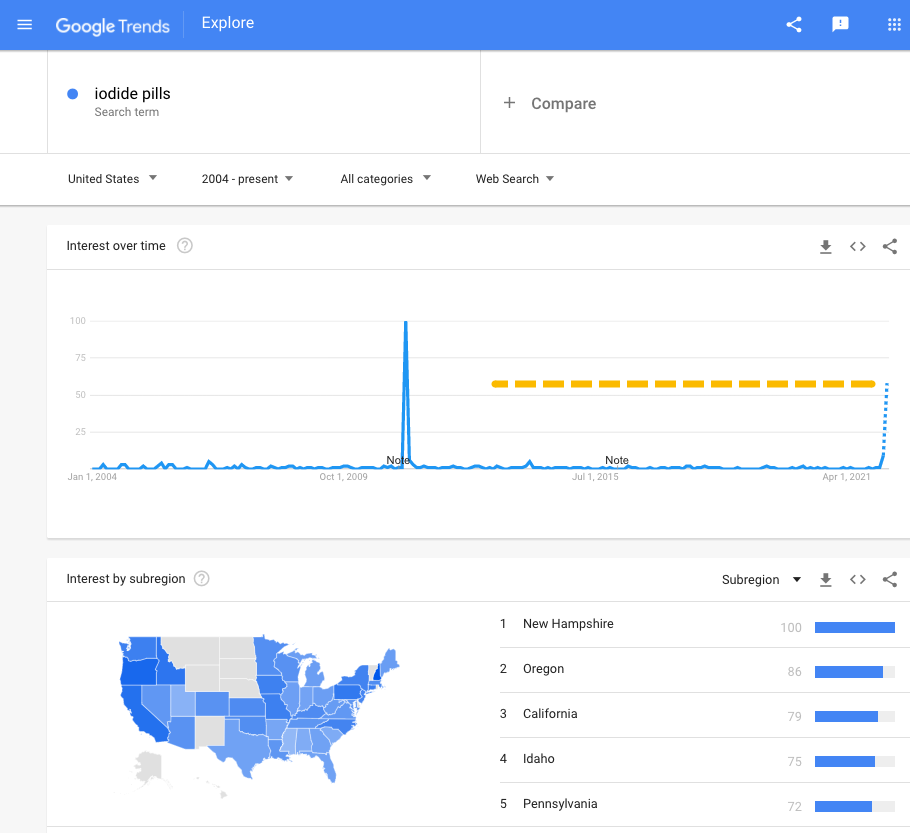
Google Searches For 'Iodine Pills' Skyrocket

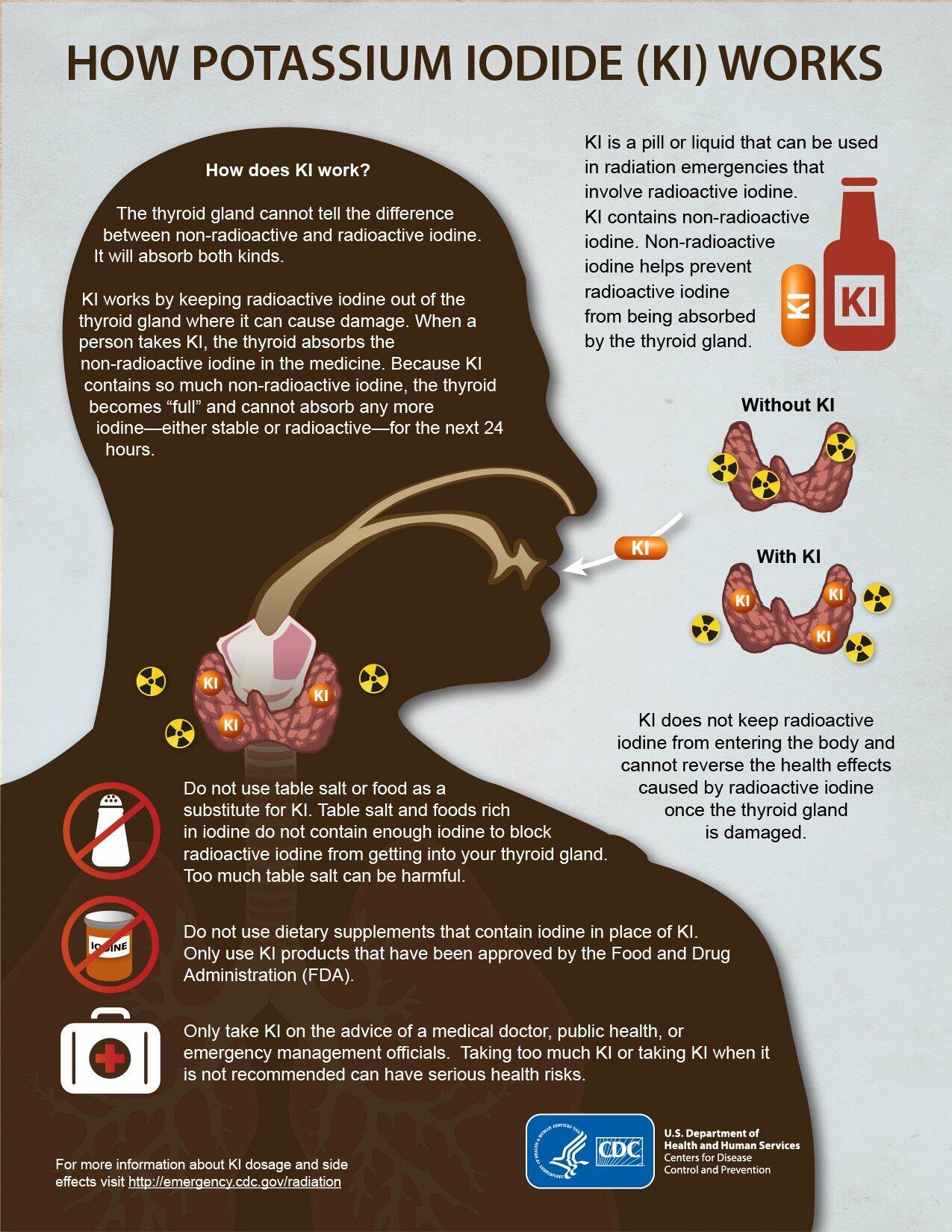
 Russia's invasion of Ukraine and President Putin ordering nuclear deterrent forces to be placed on "special" alert has scared the bejesus out of many in the western world who are now panic searching where to buy potassium iodide in case of nuclear war. 

Potassium iodide can help block radioactive iodine from being absorbed by the thyroid gland, therefore protecting the gland from radiation injury during a nuclear incident. 

Like the U.S. and NATO, Russia has thousands of nuclear warheads and maintains a nuclear deterrent attack force. As Russian incursions show no signs of slowing down, Putin announced Saturday that he would declare war on any country that imposes a no-fly zone on Ukraine. 

On Thursday night, there were reports Russia shelled Europe's largest nuclear power plant and damaged a reactor, but those claims turned out to be false. The International Atomic Energy Agency confirmed no reactors at the Zaporozhskaya Nuclear Power Plant in Energodar, southwestern Ukraine, were damaged except for an education and training building. Still, the news sparked concern about Moscow's warfare which raised international alarm. 

There are already indications people are panic hoarding in Central Europe. Brussels Times reported 30,000 residents flocked to pharmacies for free potassium iodide pills post-invasion. Pharmacies in Bulgaria are already out of stock.

"In the past six days, Bulgarian pharmacies have sold as much [iodine] as they sell for a year," said Nikolay Kostov, chair of the Pharmacies Union, according to Reuters.

 "We have ordered new quantities, but I am afraid they will not last very long," Kostov said. 

Administering the tablets should occur within hours of radiation exposure and can help protect the thyroid gland for approximately 48 hours. 

https://www.zerohedge.com/geopolitical/google-searches-iodide-pills-hits-fukushima-level-putins-nuclear-threat-sparks-chaos

ABCV Biopharma Rallies Active Herbal Ingredients Against Cancer, MDD & ADHD

 Botanical medicines – plants – have formed the bulwark of medicine since time immemorial, but took a back seat to faster-acting, more robust synthesized compounds during the late 19th and 20th centuries. Botanicals are still used by much of the world, however, and are the basis of many new and emerging therapeutics.

ABVC Biopharma, based in California, has programs in Phase II trials to treat major depressive disorder (MDD), adult attention deficit hyperactivity disorder (ADHD) and myelodysplastic syndrome (MDS) using active herbal ingredients derived from traditional Chinese medicines. BioSpace caught up with ABVC Biopharma’s CEO, Howard Doong, M.D., Ph.D., to discuss the company’s work in botanicals.

BioSpace (BSp)Why are botanicals experiencing a resurgence of interest?

Howard Doong (HD): During the past several decades, western researchers have gradually begun to look east to find new medicines to effectively address some of our most intractable diseases.

Very often, researchers experiment with botanical drugs because they are generally biocompatible and biodegradable, very safe to use, and patients usually do not develop drug resistance, which happens with many synthetic drugs. For example, chloroquine phosphate is one of the most commonly used synthetic antimalarial drugs. What if a patient develops resistance to this synthetic drug? Try another synthetic compound? No, researchers have found that when botanical drugs derived from the dried leaves of the artemesia plant were given to malaria patients who failed standard drug therapy, all fully recovered after five days.

Researchers also have learned in the past several decades that a single compound of a synthesized drug sometimes may not be effective in treating certain diseases if it just acts alone. Botanical drugs, on the other hand, are already complex mixtures and may work together to generate a synergistic effect.

Presently, there are more than 500 pending applications at the FDA for medicines derived from plants. The interest stems from their better safety profile, fewer side-effects and lengthy human experience, as wel as a desire to address the strong Asia market, where herbal medicines remain widely used.

BSpHow are biologics different from traditional Chinese medicine?

HD: Traditional Chinese medicine (TCM) usually involves minimal alteration of the roots, flowers, stems and leaves of the plant, which are then combined with a tea or broth for consumption. Today’s botanical medicines use active pharmaceutical ingredients that are extracted and concentrated from plants. Any unwanted ingredients or compounds in the plants are removed during the production process.

BSp: What’s in your pipeline?

HD: Our product pipeline consists of a medical device, central nervous system (CNS) drugs and oncology drugs:

  • Vitargus® (ABV-1701) is an injectable, in situ-forming hydrogel designed to be used to treat retinal detachment after retina repair surgery. It is defined as a medical device, not a therapeutic drug. After retinal reattachment, the patient does not require face-down positioning.

First in human trials showed an immediate improvement in visual acuity after surgery. It allowed patients to have unrestricted movement and required no post-operative fluid removal because Vitargus is completely biodegradable. A Phase II clinical trial will start in early 2022 with sites in Australia and Thailand.

In December 2021, Vitargus® received the National Innovation and Renewal of Diligence award from the Institute for Biotechnology and Medicine Industry of Taiwan.

  • In CNS, ABV-1504 is a single-herb botanical drug that is extracted from the dry root of Polygala tenuifolia Willd. Known as yuanzhi, this is a traditional Chinese medicine for the treatment for major depressive disorder (MDD).

At six weeks, a Phase II trial showed a 52% response rate versus 35% for placebo and a 13.2-point mean change from baseline using the Montgomery-Ã…sberg Depression Rating Scale (MADRS). In contrast, fluoxetine (Prozac®) caused an 8.8-point mean change from baseline. Administered in capsule form, ABV-1504 is stable at room temperature for at least 36 months.

We recently completed a draft of the Phase III study protocol and will be entering into licensing discussions with big pharma companies that have been following the progress of ABV-1504. We expect a Phase III trial will be conducted as a collaboration between ABVC and our license partner(s). The timetable will be determined as a result of those discussions.

  • ABV-1505 is being developed to treat attention deficit hyperactivity disorder (ADHD), also using the active ingredient found in P. Tenuifolia Willd. It works as a selective norepinephrine reupdate inhibitor (NET) and has completed a Phase II trial.

Simply speaking, norepinephrine is a neurotransmitter. The more neurotransmitters are retained in the nervous system, the more nerve impulses can be transmitted. More nerve impulses have been shown to improve attention deficit and hyperactive symptoms, and permit more focus on a specific task.

  • BV-1601, a Phase I clinical study for treating MDD in cancer is expected to be completed by the end of 2022. end of 2022.
  • For oncology, we are developing ABV-1501 for triple negative breast cancer, ABV-1703 for pancreatic cancer and ABV-1702 for myelodysplastic syndrome. Each is in a Phase II clinical study.

The compounds are based upon Maitake BLEX-404, a botanical drug that is extracted from the fruit body of maitake mushrooms (Grifola frondose, also called Hen of the Woods). It is grown in northeastern Japan and in northeastern America.

A Phase I/II trial involving 34 breast cancer patients showed the patients were free of disease at the end of the trial and that the compound exhibited no dose-limiting effects. It appeared immunologically stimulatory, and measurable inhibitory effects were seen.

BSp: What’s next for ABVC Biopharma?

HD: This year ABVC will seek a Phase III partner to advance ABV-1504 for MDD. We also will start a self-funded pivotal trial Phase for Vitargus®, with a U.S. Food & Drug Administration premarket approval application (PMA) targeted for 2024. We expect funding to support additional Phase II trials for oncology and ADHD medications, as well as to add new indications to our pipeline.

https://www.biospace.com/article/abcv-biopharma-rallies-active-ingredients-in-herbal-medicine-against-cancer-mdd-and-adhd/

Simone Gold Reaches Plea Deal on Capitol Insurrection Charge

 Simone Gold, MD, JD, founder of the right-wing, anti-vaccine group known as America's Frontline Doctors, pleaded guilty today to one of the five criminal counts against her, a class A misdemeanor, in connection with her participation in the January 6, 2021, insurrection and speech in the nation's Capitol building.

U.S. District Court Judge Christopher R. Cooper said her sentencing will be set in June, and she could be ordered to serve up to 6 months. Gold's plea deal includes her agreement to pay a $500 fine.

She had been facing a felony charge of obstructing a proceeding of Congress during the Electoral College ballot counts that certified President Joe Biden's election.

Gold, who was trained as an emergency physician and previously practiced in California, is one of more than 600 defendants charged by the U.S. District Attorney for the District of Columbia for Capitol breach crimes.

She pleaded guilty to count 2, that she "Did unlawfully and knowingly enter and remain in a restricted building and grounds, that is, any posted, cordoned-off, or otherwise restricted area within the United States Capitol and its grounds, during a time when the Vice President was in the building without lawful authority to do so."

According to her attorney, Kira Anne West, Gold pleaded guilty to standing "with a crowd outside the East Rotunda door, where she eventually entered shortly after about 2:27 p.m. along with her co-defendant John Strand. She remained inside the Capitol for about a little over half an hour. Around 2:55 p.m. she gave a speech at Statuary Hall stating her opposition to COVID-19 vaccine mandates and government-imposed lockdowns."

West also acknowledged that "multiple law enforcement officers had to intervene before she (Gold) stopped giving her speech and left Statuary Hall."

Gold's plea deal includes her agreement to cooperate with additional investigations regarding her actions on January 6 and to be interviewed prior to her sentencing.

The other four criminal counts of which Gold was accused but did not enter a plea were that she:

  • "Attempted to, and did, corruptly obstruct, influence, and impede an official proceeding, that is, a proceeding before Congress, by entering and remaining in the United States Capitol without authority and committing an act of civil disorder and engaging in disorderly and disruptive conduct."
  • "Did knowingly and with intent to impede and disrupt the orderly conduct of Government business and official functions, engage in disorderly and disruptive conduct in and within such proximity to, a restricted building and grounds, that is, any posted, cordoned-off, or otherwise restricted area within the United States Capitol and its grounds, where the Vice President [and Vice President-elect] were temporarily visiting, when and so that such conduct did in fact impede and disrupt the orderly conduct of Government business and official functions."
  • "Willfully and knowingly engaged in disorderly and disruptive conduct in any of the Capitol Buildings with the intent to impede, disrupt, and disturb the orderly conduct of a session of Congress and either House of Congress, and the orderly conduct in that building of a hearing before or any deliberation of, a committee of Congress or either House of Congress."
  • "Willfully and knowingly paraded, demonstrated, and picketed in any United States Capitol Building."

In documents filed this week, the court approved an unopposed prosecutors' request to amend this count and the following count to remove the reference to the then Vice President-elect Kamala Harris being in the Capitol at the time of Gold's alleged disruption, since she had left the Capitol by the time of Gold's presence. The new language restricts both count 2 and 3 to her presence at the Capitol during the afternoon, when then Vice President Mike Pence was there.

At one point during the 17-minute hearing as the judge asked "Ms. Gold" if she had used any alcohol or drugs in the last 48 hours that would impair her ability to understand the proceedings, Gold interrupted the judge, saying, "Your honor, I don't mean to -- I never go by Miss Gold. I always go by Dr. Gold, if that's okay with you."

"Okay," the judge replied. "Dr. Gold."

In pleading guilty, Gold told the court that she was giving up certain rights, such as a trial by jury, and if convicted, the right to an appeal, and depending on state laws, certain civil rights such as the right to hold public office or serve on a jury.

The federal complaint and affidavit against Gold also named John Herbert Strand, who is not a physician, as a co-defendant. MedPage Today could not determine the status of the related charges against him, and his attorney did not return calls requesting comment. According to the court calendar, a hearing is scheduled on his case for March 11.

Gold acknowledged to The Washington Post last year that she was the person depicted in photos and videos of the riots that the FBI had posted in calling those who breached the Capitol "wanted" individuals, but she said she didn't know that what she had done was illegal. She said, "I do regret being there."

Her organization, America's Frontline Doctors, is under investigation by the House Select Subcommittee on the Coronavirus Crisis, which alleges these doctors have been profiting from peddling controversial COVID-19 treatments and spreading misinformation about the value of vaccines.

Meanwhile, several hospital organizations where Gold previously worked have disassociated themselves from Gold, including Cedars-Sinai Medical Center in Los Angeles, where she worked briefly in a network of urgent care clinics in 2015. "Dr. Gold is not authorized to represent or speak about any information on behalf of Cedars-Sinai," the hospital said in a statement last year.

https://www.medpagetoday.com/special-reports/exclusives/97482

End to Public Health Emergency Is Bad News for Millions on Medicaid

 Medicaid enrollment spiked during the pandemic; but when the public health emergency (PHE) ends, certain pandemic era protections -- including a freeze on involuntary disenrollment -- will go with it.

Public policy experts concerned over the potential for not only huge coverage losses -- for perhaps 15 million individuals, including at least 6.7 million children -- but also disruptions in care, stressed the importance of states taking a thoughtful approach to redetermining Medicaid eligibility for beneficiaries.

However, when the public health emergency ends -- although no one knows when that will be -- states will resume the process of redeterminations, deciding who will remain eligible for the program. Some experts fear the program will revert to the pre-pandemic status quo.

Because Medicaid rolls have grown steadily over the last 2 years, "we could see the largest migration of people away from Medicaid ever, and appropriately so," said Matt Salo, executive director for the National Association of Medicaid Directors, given that millions of people will no longer meet eligibility criteria and will have to decide on a different form of coverage.

"Trying to make sure that this is done carefully, thoughtfully, humanely, but also efficiently is really important," Salo said.

He told MedPage Today that state Medicaid directors are keeping these concerns front-of-mind. "The end of the continuous coverage requirements is clearly the number one priority for our members across the country."

The Numbers

Approximately 9 million Americans enrolled in Medicaid from February 2020 to January 2021, according to a September 2021 report from the Urban Institute. Medicaid and the Children's Health Insurance Program (CHIP) together grew to 83.6 million, an increase of 12.4 million, from February 2020 to July 2021, according to the Kaiser Family Foundation.

These increases were spurred in part by pandemic-related job losses, the majority of which occurred from March to June 2020, and by a continuous coverage provision in the Families First Coronavirus Response Act. That Act banned states from disenrolling people involuntarily from Medicaid and also temporarily increased the federal government's share of Medicaid spending or federal medical assistance percentage, noted the Urban Institute.

Policy experts found that the continuous coverage protections helped enrollees avoid the coverage gaps and "churn" that have long been a feature of the program. The U.S. Department of Health and Human Services Assistant Secretary for Planning and Evaluation stressed in one report that disruptions in coverage can lead to "periods of uninsurance, delayed care and less preventive care for beneficiaries."

The Urban Institute projects that Medicaid rolls could decline by about 15 million after the PHE expires.

The historic rise in enrollment in Medicaid during the pandemic has been particularly beneficial for children, said Joan Alker, executive director and co-founder of the Center for Children and Families and a research professor at the Georgetown University McCourt School of Public Policy in Washington, D.C. Currently, half of the children in the country are covered by Medicaid.

Like Collins, Alker is very concerned about the potential for coverage losses. Her "conservative estimate" is that about 6.7 million children are at risk of losing coverage during this process, she told MedPage Today.

And children are especially at risk in certain states, including Delaware, Florida, Georgia, Missouri, Nevada, and Texas, according to Alker and Georgetown colleague Trish Brooks, MBA.

'Going to Be Complicated'

For Sara Collins, PhD, vice president of healthcare coverage and access at the Commonwealth Fund, "what's really important is that states take a longer period of time to do this and don't do it abruptly," she said.

Pre-pandemic, the average enrollee spent only about 10 months in the program. Some states look to redetermine eligibility every 12 months, but others do more frequent checks of fluctuations in income among enrollees, she said.

Collins expressed concern that, as states resume the redetermination processes, some will be "more aggressive" than others. The anticipated decline in the federal matching funds may incentivize them to speed up the process, which could mean more mistakes.

If so, many people will lose coverage or experience gaps in coverage, either for procedural reasons, such as not submitting paperwork quickly enough, or because their incomes are too high and they aren't able to enroll in another plan through the marketplace or their employer quickly enough, she noted.

A letter may be lost in the mail or an enrollee may have moved and not updated their address with the state, resulting in renewal paperwork that isn't completed and subsequent disenrollment, noted Alker.

For context, one large managed care organization (MCO), Molina Healthcare, said that it currently lacks contact information for about 40% of its members, Alker noted. These organizations contract with state Medicaid agencies and operate on a capitated, or per-member, per-month delivery system.

"Obtaining contact information is critical to get ahead of these problems," she said.

Salo agreed that there will be financial pressure for states to "right-size" their programs quickly but said he believes that Medicaid programs are "leaning into" a more "thoughtful" and slower approach, given the high stakes.

"This is going to be complicated. This is going to be hard, but this is really important," he said.

There are two clear goals: "Making sure that people who are still eligible remain on the program with as little turmoil [and] as little bureaucracy as possible, but then also making sure that for people who are no longer eligible ... we transition them off the program in the proper way," he said

In the majority of states that leverage managed care, Medicaid programs are working with MCOs as well as community-based organizations and provider groups to ensure that the process goes as smoothly as possible, Salo said.

States must consider different ways to reach enrollees who may have moved -- by direct mail, phone, text, or other means -- and find ways to makes sure enrollees provide the right information to state programs to complete the process.

Of course, the other wrinkle to this is the uncertainty around when the PHE will end.

The PHE is slated to extend until mid-April. But the Biden administration has not yet given the promised 60 days notice of termination, so Alker anticipates that the PHE will be extended another 90 days until at least July. Still, no one knows for sure.

A Little Help Please, Providers

Whenever that notice is given and the PHE does expire, Alker anticipates clinicians will be the first to notice it.

"They're going to be be on the front lines of this, because a lot of people aren't going to know they've been disenrolled. And so they're going to bring their child to the doctor, and the child's not going to have any coverage," she said.

Healthcare teams, for their part, can help by communicating the importance of maintaining coverage to their patients, Collins said. They must warn patients that they will, at some point, be asked to submit information about their income to gauge whether they are still eligible to participate in Medicaid, and they must stress the importance of submitting that information quickly.

For those participants whose incomes are too high to remain in the program, it's important to point them to the Affordable Care Act's marketplaces and to patient navigators, who can help them choose plans through either state-run websites or the federal website, healthcare.gov, Collins said.

CMS guidance allows states a full 12 months to complete the redetermination process; whether states choose to adopt a shorter time frame is up to individual states.

Federal policy changes that aim to guard against coverage losses are in the works but have not been signed into law yet, Collins noted.

One provision of the House-passed Build Back Better legislation could help by slowly phasing out the 6.2% bump in federal matching dollars as well as establishing disenrollment standards, under which states could only redetermine eligibility for one-twelfth of participants each month. The Senate version of the bill would also similarly phase-down enrollment, Collins said.

Another component of the Build Back Better Act would make people in so-called non-expansion states (states that did not expand their Medicaid programs to include coverage for people whose incomes are 138% of the federal poverty level or below) eligible for coverage on the healthcare marketplaces if their incomes are below 100% of the federal poverty level.

However, none of these protections will go into effect unless the legislation is passed, and the bill's prospects look dim of late.

Some 13 states provide continuous eligibility for children, regardless of changes in their families' circumstances, Collins noted.

Real-time sharing of state-level data will be important to tracking how the redetermination process plays out, said Alker.

Some states provide "reason codes" that explain why people are disenrolling. If a lot of children are disenrolling for procedural reasons rather than aging out of the program, for example, that raises flags. Some states also track call center statistics for their help lines.

"If the wait times are getting long, that's a clear canary in the coal mine that there's not enough help for people trying to get through this process," Alker said.

If a lot of children and families are losing coverage, states have the option to "press the pause button," on this process, she said. "It's really in the governor's lap."

https://www.medpagetoday.com/publichealthpolicy/medicaid/97487