Dr. Anthony Fauci, director of the National Institute of Allergy and Infectious Diseases, said on Wednesday that he thinks there will be an uptick incases of Covid-19over the next few weeks and that it is likely that there could be a surge in the fall.
"I think we should expect, David, that over the next couple of weeks, we are going to see an uptick in cases -- and hopefully there is enough background immunity so that we don't wind up with a lot of hospitalizations," Fauci said when asked by Bloomberg TV's David Westin about the prospect of another wave of Covid-19 from BA.2 or another variant, given the level of immunity believed to exist in the US today.
Fauci reiterated that the US often follows other countries, offering the UK, which also has the BA.2 variant, as an example. He said that as well as a pullback on many mask mandates and restrictions for indoor settings, there has been a waning of immunity.
"Those conditions are also present in the United States," he said. "So, I would not be surprised if we see an uptick in cases. Whether that uptick becomes a surge where there are a lot more cases is difficult to predict."
Asked later whether it should be expected that this fall will look like the past two -- and if people should be bracing for something around October -- Fauci said that he thinks "it is likely that we will see a surge in the fall."
He noted that "these are uncharted waters for us with this virus" and that with other viruses, such as flu -- which people have decades of experience with -- predictions about what might happen can be made with some degree of accuracy.
"I would think that we should expect that we are going to see some increase in cases as you get to the colder weather in the fall," he said. "That's the reason why the [Food and Drug Administration] and their advisory committee are meeting right now to plan a strategy, and we at the [National Institutes of Health] are doing studies now to determine what the best boost would be."
Overseas airlines are having to cancel hundreds of flights as they grapple withcoronavirus-related staffing shortages weeks after they ditched rules requiring passengers and staff to mask up in the air.
The disruptions also come as the CEOs of leading U.S. airlinesurge the Biden administrationto roll back a federal rulerequiring that masks be worn in the sky.
Masks have not been required on flights operated by budget-friendly, Swiss airline EasyJet since March 27, the airline said in a statement. The move came after the UK removed all travel restrictions earlier in March.
"This welcome move by the UK Government marks a return to truly restriction-free flying to and from the UK, giving an extra boost to travel this Easter. We are looking ahead to what we expect to be a strong summer for EasyJet, with plans to return to near 2019 levels of flying. We can't wait to welcome more customers back on board," EasyJet CEO Johan Lundgren said in a statement at the time.
Between March 28 and April 3, EasyJet cancelled 202 of its 3,517 flights scheduled to depart from the UK, according to data provided to CBS MoneyWatch from Cirium, an aviation analytics company. By comparison, the carrier cancelled zero flights departing from the UK during the same period in 2019, before the pandemic.
An EasyJet spokesperson attributed the increase in cancelled flights to "higher than usual staff sickness levels" due to a recent surge in COVID-19 cases across Europe.
"As a result, we have made pre-emptive cancellations so customers can be notified in advance of travel and are able to move easily onto alternative flights," the spokesperson said in a statement to CBS MoneyWatch.
According to Dr. Eric Feigl-Ding, an epidemiologist and health economist at Harvard Chan School of Public Health, such flight cancellations were all but guaranteed once passengers and crew members took off their masks.
"So damn predictable — UK govt drops restrictions, airlines like @easyJet drops masks ... and less than 2 weeks later ... huge spike in pilots and flight attendants out sick with #COVID19 unable to work, and 120 flights cancelled! Airline CEOs asked for this," he said on Twitter.
SO DAMN PREDICTABLE—UK 🇬🇧 govt drops restrictions, airlines like @easyJet drops masks… and less than 2 weeks later… huge spike in pilots and flight attendants out sick with #COVID19 unable to work, and 120 flights cancelled! Airline CEOs asked for this. https://t.co/zVOc2g2KzSpic.twitter.com/YWD7XIOodl
A similar move by U.S. airlines "would backfire in many ways," Feigl-Ding told CBS MoneyWatch. He thinks more passengers would hesitate to fly if airlines ditch mask rules. "If there are no masks, that actually makes people more worried about taking the trip. It might make more people stay home and bite the airlines," he said.
United Airlines — which scrapped hundreds of flights in December due to an overwhelming number of crew members contracting COVID-19 during a holiday surge of the Omicron variant — said it is not currently experiencing any disruptions related to crew members being infected with COVID-19.
Still, airlines in the U.S. are bracing for the same surge in COVID-19 cases that Europe is experiencing and could see major schedule disruptions if the virus wipes out significant numbers of crew members in the coming weeks.
"There is risk we may see some of that in North America and it's all dependent on case rates," said Rob Morris, head of Ascend by Cirium, an airline analytics and consulting agency. "But it will be relatively short-term because airlines will adjust their capacity to manage demand and protect their network integrity."
Although staffing shortages related to rising COVID-19 rates in Europe are disrupting other sectors, they're particularly acute in the airline industry.
"It's very clear that the airline industry is particularly vulnerable, and this creates a cascading effect on society more than, say, a restaurant closing would," Feigl-Ding said. "This is critical infrastructure and these are essential employees, and we're endangering our economy. Stopping COVID is good for our economy, 'letting it rip' is the exact opposite."
Other airlines that have dropped mask rules are also cancelling more flights than usual. On flights operated by London, England-based airline British Airways, masks have been optional for staff and passengers since March 16. The airline made the announcement on Twitter by sharing a video of a flight attendant enthusiastically tearing off a surgical mask.
Between March 28 and April 3, British Airways cancelled 393 of 2,405 flights scheduled to depart from the UK, according to Cirium.
From 16 March, our face mask policy is changing.
Where we’re clear the destination you’re travelling to doesn’t require a face mask on board, it will become optional 😷 ✈️
A British Airways spokesperson said that only a small share of its recently cancelled flights were scrapped because of COVID-19. The spokesperson said the airline on Tuesday cancelled three flights at the last minute due to personnel testing positive for the disease, adding that some of the cancellations stemmed from issues related to rebuilding "operations while managing the continuing impact of COVID."
"So while the vast majority of our flights continue to operate as planned, as a precaution we've slightly reduced our schedule between now and the end of May as we ramp back up," the spokesperson said.
As the situation in Shanghai continues to deteriorate, residents have been pushing back against the CCP's authority in ways that are rarely seen in China. Since the start of the pandemic, and the CCP's decision to adopta "war like" position to enforce its "zero COVID" policy, has rarely elicited much resistence. Until now.
Yesterday, videos of Shanghaiers taking to their balconies to sing in protest of the local authorities' decision to order an 'indefinite' lockdown went viral in the West (they were quickly censored on Weibo).
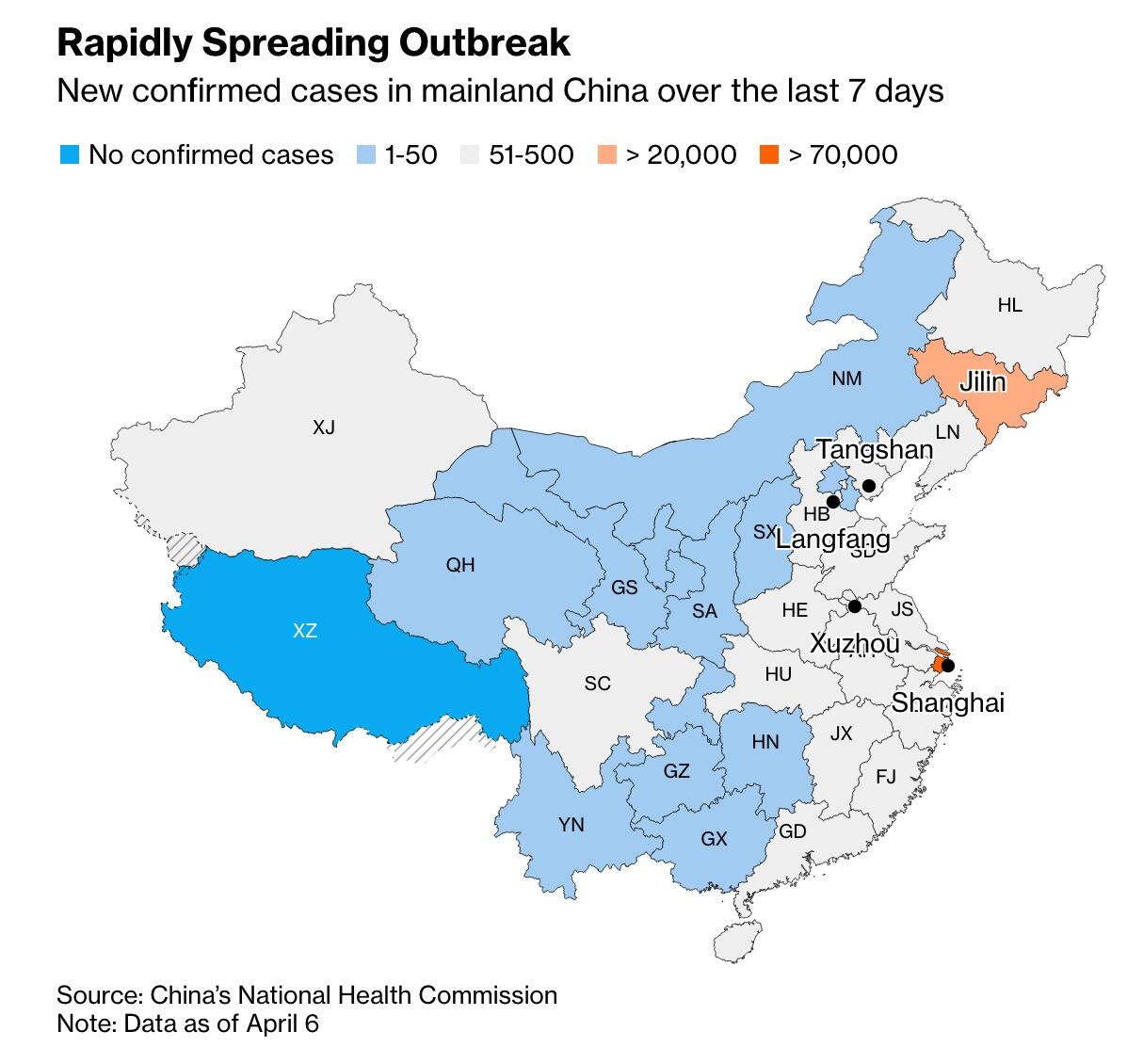
Authorities counted nearly 20K cases in Shanghai alone on Wednesday, nearly matching the number for all of China from the day before. It marked the sixth daily record for the city, according to the SCMP. Symptomatic cases climbed to 322, up from 311 a day earlier, while the vast majority of the cases showed no symptoms. Local authorities have counted more than 70K cases since March 1.
We noted a few days ago that the situation in Shanghai has evolved to become more than just a public health crisis. Instead, it has become a political test for the CCP, as it fights to protect the legitimacy of its "zero COVID" approach. In that sense, the battle for Shanghai has become "too big to fail."
As the coronavirus races through Shanghai, in the city’s worst outbreak since the pandemic began, the authorities have deployed their usual hard-nosed playbook to try and stamp out transmission, no matter the cost. What has been different is the response: an outpouring of public dissatisfaction rarely seen in China since the chaotic early days of the pandemic, in Wuhan.
The crisis in Shanghai is shaping up to be more than just a public health challenge. It is also a political test of the zero tolerance approach at large, on which the Communist Party has staked its legitimacy.
For much of the past two years, the Chinese government has stifled most domestic criticism of its zero tolerance Covid strategy, through a mixture of censorship, arrests and success at keeping caseloads low. But in Shanghai, which has recorded more than 70,000 cases since March 1, that is proving more difficult.
Shanghai is China’s most populous metropolis, its shimmering commercial heart. It is home to a vibrant middle class and many of China’s business, cultural and academic elite. A large share of foreign-educated Chinese live in Shanghai, and residents’ per capita disposable income is the highest in the country. Even in a country where dissent is dangerous, many there have long found ways to demand government responsiveness and have a say over their own lives.
"I’m just too angry, too sad,” said Kristine Wu, a 28-year-old employee of a tech company who was visited at home by two police officers after she criticized the city’s Communist Party leader on social media. She recorded her defiant confrontation with them, in which she asked why they were wasting time harassing her, when they could be helping people in need of care. She then shared a photo of the encounter on social media, despite the officers’ warnings against doing so. (It was later censored.)
"I thought, whatever, I’ll just go for it," said Ms. Wu, who had not considered herself political before the lockdown. "I used to live pretty comfortably, and before anything had happened, everyone was very polite, very rule abiding. Now all that has just crumbled."
The CCP is caught in a difficult dilemma. Public health experts are keenly aware of the fact that China is unprepared to live with the coronavirus: just over half the of Chinese age 80 and over are fully vaccinated as of late March. And Chinese vaccines have been shown to be less effective than their western counterparts.
Already, the people of Shanghai are struggling with crippling food shortages as they're forced to rely on the government for essential supplies, according to the AP.
Residents of Shanghai are struggling to get meat, rice and other food supplies under anti-coronavirus controls that confine most of its 25 million people in their homes, fueling frustration as the government tries to contain a spreading outbreak.
People in China’s business capital complain that online grocers often are sold out. Some received government food packages of meat and vegetables for a few days. But with no word on when they will be allowed out, anxiety is rising.
Zhang Yu, 33, said her household of eight eats three meals a day but has cut back to noodles for lunch. They received no government supplies.
"It’s not easy to keep this up," said Zhang, who starts shopping online at 7 a.m.
"We read on the news there is (food), but we just can’t buy it," she said. "As soon as you go to the grocery shopping app, it says today’s orders are filled."
As the food shortage worsens, containers full of frozen food and chemicals are piling up at Shanghai's biggest port as the lock down of the city and virus testing prevents workers from getting to the docks to pick up boxes, according to Bloomberg.
Of course, Shanghai isn't the only part of China struggling with an outbreak. The Province of Jilin is still facing a surge (and the attendent restrictions) even after authorities technically lifted a weeks-long lockdown
Going even further than its rival the NYT, the Washington Post on Thursday declared the situation in Shanghai to be a "powder keg" that could call the entire CCP authoritarian system into question.
But Shanghai looks like a powder keg for China, where the party-state justifies its rule by casting itself as guardian of the people’s health and welfare. Shanghai’s residents are growing desperate. People are complaining on social media that they are unable to get food and water delivered. When some began shouting protests out their windows, demanding supplies in one Shanghai neighborhood, a drone flew by and warned them to stop, and to please "control the soul’s desire for freedom."
Now, it is authoritarian China’s turn to face questions about whether its system, based on tight controls, is really better at controlling the pandemic. China would be well advised to learn lessons from the West and pivot to more flexibility. Mr. Xi should admit he needs a new strategy. But can he?
While no more videos of protesting locals have made it to western social media over the last day, one video of riot police being dispatched to prepare for any more 'unrest' did catch the public's attention.
A 9-year-old boy is being denied a life-saving kidney transplant because his father is not vaccinated against COVID-19.
Dane Donaldson was found to be a perfect match for his son Tanner back in early 2018 by the Cleveland Clinic Children’s Hospital before the outbreak of the pandemic.
The family decided to wait a little longer before having Tanner undergo the transplant since transplanted kidneys from a live donor only lasted about 20 years.
Then COVID-19 hit and put a freeze on the procedure.
Now the hospital is refusing to perform the life-saving father-to-son kidney transplant it agreed to do nearly four years ago over the senior Donaldson’s unvaccinated status.
In a statement released to The Epoch Times, the Cleveland Clinic cited a 2021 policy it adopted requiring all donors and candidates for organ transplants to be fully vaccinated against the virus.
“Individuals who are actively infected with COVID-19 have a much higher rate of complications during and after surgery, even if the infection is asymptomatic,” the hospital stated.
Donaldson, who is in the insurance business, told The Epoch Times he is opposed to the COVID-19 vaccine for religious reasons, but also because he has seen a rising number of clients get critically ill after receiving it.
He believes the hospital is contradicting itself by requiring a living donor to be vaccinated, but not a deceased one.
“I asked them in that car accident victim, would you vaccinate him on the way to the hospital to rip his kidney out and they said ‘no’,” Donaldson told The Epoch Times.
Donaldson said he even offered to sign a waiver freeing the hospital from any liability should either himself or his son develop COVID-19. At the same time, the hospital has refused to agree to take any responsibility for any side effects that he or his son experienced from the vaccine.
The hospital, he said, is blowing the chance of a lifetime for his son.
“A live donor is the best donor for kidneys,” said Donaldson, “but they’ll take a kidney from a deceased person not vaccinated, it makes no sense.”
The Cleveland hospital agreed that live donors are the best source for kidney transplant recipients, but emphasized that they were “not without risks”—noting that there is medication kidney transplant patients must take that compromises the immune system.
“We continually strive to minimize risk to our living donors, and vaccination is an important component to ensure the safest approach and optimal outcomes for donors,” it stated.
Donaldson said he and his wife Jenn are now in the process of finding another hospital to perform the transplant. They had wanted to stay with the children’s hospital because it has been treating his son since birth.
Tanner was born with compromised kidneys due to a rare birth defect that caused irreversible kidney damage in utero and resulted in stage 4 chronic kidney disease as well as bladder and urinary dysfunctions.
He now has only 18 percent function left of his kidneys, according to Donaldson.
The Donaldsons join a number of other publicized cases of U.S. hospitals that have refused to perform organ transplants because either the donor or recipient was not vaccinated.
Last month, The Epoch Times covered the story of an Air Force veteran who was denied a kidney transplant because he was refusing the vaccine.
Chad Carswell had only 4 percent kidney function left when the Atrium Health Wake Forest Baptist Medical Center in Winston-Salem, North Carolina, refused to keep him on their candidate list for a donated kidney.
Fortunately, after his story went public the Medical City Fort Worth Transplant Institute in Texas offered to put Carswell on their recipient list for a kidney. His attorney Adam Draper said that as of April 3, Carswell was still in need of a match for the transplant.
In January, attorneys for the conservative organization Informed Consent Action Network (ICAN) wrote a seven-page letter to the Cleveland Center requesting it reconsider the decision, and also the science behind it.
“Presently, it appears the hospital is operating under a psychosis of flawed morality in choosing to sacrifice the health and wellness of its 9-year-old patient in exchange for what it perceives to be the ‘greater good,'” ICAN’s lawyers Aaron Siri and Elizabeth Brehm wrote.
ICAN also called the hospital irrational because the entire family, including Tanner and his older brother, all had COVID-19 and recovered from it, meaning they have natural immunity.
In its letter to the hospital, ICAN cited a number of international studies that showed that re-infection of COVID-19 after recovering from the virus was rare.
Of the studies it cited was one performed by Cleveland Clinic itself.
In the study, the hospital looked at SARS-CoV-2 (the virus that causes COVID-19) infections in 52,238 vaccinated and unvaccinated health care workers over a five-month period.
It found that none of the previously infected healthcare workers who remained unvaccinated contracted SARS-CoV-2 over the course of the research despite a high background rate of COVID-19 in the hospital.
Though the entertainment industry has seen challenges—set shutdowns because of COVID, the Writers Guild leaving agencies over packaging, audiences disappearing from theaters—none are as devastating as what it’s facing now: a shortage of Adderall. Scripts will be coming in so late that there could be several years between The Fast and the Furious movies.
“All of my patients who go to CVS have trouble getting their Adderall,” says Stephanie Zisook, a psychiatrist in Westwood who treats adults with mood and anxiety disorders. “It’s so weird. I’m not seeing that people are having a hard time getting benzos at CVS.”
While we’ve focused on the opioid epidemic, so many people have gotten hooked on Adderall that it’s now nearly all gone. Since September 2019, the FDA has reported that the drugs in Adderall—amphetamine salts—are “currently in shortage” due to “demand increase in the drug.” Before the pandemic, America was already gobbling up 83.1 percent of the global supply. But in December 2020, prescriptions for Adderall skyrocketed. After hovering at around 3 million a month, they climbed to nearly 3.5 million and have stayed there, according to IQVIA, the biggest healthcare data company in the U.S.
As it turns out, a huge chunk of those prescriptions are being filled for middle and high school students. “There are parents coming in wanting their kids to get it, especially in West L.A., because they know the other kids are taking it and they don’t want them having an advantage,” says Zisook. “Parents are crazy.”
Elizabeth Berkley and Mario Lopez discover drugs in Saved by the Bell, 1990. (PEACOCK.COM)
None of that is new. Parents have always been crazy. And kids have been using speed to get better grades for decades. There are New York Times and Time magazine articles from 1937 about college kids using amphetamines to improve their grades. A 1983 episode of Family Ties had Michael J. Fox’s character hopped up for a test. A 1990 episode of Saved by the Bell had Elizabeth Berkley’s character doing the same.
But the pandemic made crazy L.A. parents even crazier. “Parents were not used to being with their kids all the time,” says Leslie Lotano-Saba, vice president of pharmacy solutions at the global management consulting firm AArete. “Kids were staying home without a routine. It was easier to call a pediatrician and say, ‘Joey can’t focus on the computer with remote learning. Can you help?’ ”
In a 1983 episode of Family Ties, Alex turns to amphetamines to get through exams. (PARAMOUNTPLUS.COM)
Adderall is prescribed for ADHD, which was once diagnosed only in the prepubescent. Now adults are discovering they have ADHD. Or occasional ADHD. Or work-at-home ADHD. “If you were normally going to an office in a structured environment and now you’re working from home and have to focus, you’ve got a reason to be taking it,” says Lotano-Saba. And if you’re also dealing with bored kids interrupting your Slack chats and Zoom meetings, you’ve got even more reason to seek a potion to help you focus.
Twenty years ago, it was tough to find a job that was both simultaneously boring and focus-demanding. Professional baseball comes to mind. And those guys took so many “greenies” that clubhouses offered two pots of coffee—a regular one marked “unleaded” and a “leaded” one with amphetamines. But today, even some Los Angeles staffers admit to having popped pills to compete: Fashion writer Merle Ginsberg, who was a judge on the first two seasons of RuPaul’s Drag Race, went to a psychiatrist to treat her depression. He put her on antidepressants but, to her surprise, also suggested throwing in Adderall.
“I was shocked at how well it worked,” she says. “As I got older, I noticed my focus was gone. A lot of people in my age group are taking it because we were used to being crazy workaholics and we don’t want to give up on that.”
Stephen Elliott, author of The Adderall Diaries, in 2009. (AMAZON.COM)
The only reason Ginsberg doesn’t have pills in her medicine cabinet anymore is that it got too expensive. Adderall, especially in this new shortage, is the Domaine du Romanée-Conti of prescription medication. Not only do you have to shell out for whatever your insurance doesn’t cover, but you also have to pay for a session with a psychiatrist every three months to get a new prescription. And during COVID, those aren’t easy appointments to book. So Adderall has become a privilege of the L.A. elite.
Because, remember: at the same time demand is up, there’s less out there. Like a Soviet ministry, the Drug Enforcement Administration decides how much can be sold for the entire country. And the DEA has dropped its allowed quotas. In 2016, it allowed 50,000 kilograms to be sold; but for 2022, it has lowered the amount to 41,200 kilograms. In October, the DEA issued a notice that said, “The diversion of ADHD medications for the purposes of recreational abuse or performance enhancement is common, with approximately 5-10 percent of high school students and 5-35 percent of college students, depending on the study, misusing and diverting stimulants prescribed for ADHD.” I don’t know how you can be expected to read writing like that without Adderall.
Then, in June, one of the five global manufacturers stopped making amphetamine salts. Another is getting out of the business once it sells its current supply. And the remaining ingredients might be stuck on a container ship in Long Beach, waiting for truck drivers. Also, maybe, like inflation or something.
All of which is leading some people to buy illegal Adderall, which goes by the street name of “Adderall.” Sometimes they find dealers on Snapchat, where messages disappear. Some wind up with fentanyl-laced Adderall.
When I told a psychiatrist that I was late with this article and was thinking about trying Adderall to help me finish, he said incredulously, “You’ve never done Adderall?!” When I asked if I should lose my Adderall virginity, the respected psychiatrist paused and said, “Off the record? Definitely.”
Cynthia Nixon and James Franco star in the 2015 film adaptation of Elliott’s book. ( A.F. ARCHIVE/FILM COMPANY ARROW FILMS)
But before I scored some pills, I called my friend Stephen Elliott, whose memoir, The Adderall Diaries, was turned into a movie. In addition to taking Adderall, he has snorted and mainlined methamphetamines. Stephen said that a little Adderall would indeed help me with this article, as it has helped so many people in creative fields. When he was teaching writing at Stanford, he was shocked at how common it was among students. Those students have now grown up to be writers who are taking Adderall—writers who are my competition.
But then Stephen scared me straight. “Adderall is just amphetamine. We package it and say it’s Adderall because it has these salts, so it has time release. If they called it ‘amphetamines,’ we’d say, ‘It’s a crisis! All the kids are into amphetamines!’ Instead, doctors are saying, ‘Give them this special pill, and they’ll do better at school.’ Of course they will—it’s speed,” Stephen said. “Calling it Adderall and not amphetamine is mainstreaming it.”
He pulled a Jewish mom and said he’d feel responsible if he in any way led to my using Adderall. “It’s a Pandora’s box. Once you give yourself this option, it’s hard to take it away,” he said. Stephen still takes Vyvanse, another ADHD drug. “I’m afraid to stop taking it because I have these massive depressions if I stop. I’m stuck.”
As we talked longer, and I got more nervous about the clock ticking down to my deadline, Stephen appealed to my ego. “And to be 50 and be the one person who hasn’t done this—you should hold on to that. It’s awesome,” he said.
I promised him I wouldn’t take it. So if you didn’t like this article or are annoyed because it came in long after deadline, please blame him.
Food and Drug Administration (FDA) officials have proposed a future model for developing new COVID-19 vaccines that would be built on the approach to creating influenza vaccines.
Accumulating data suggest the current COVID-19 vaccines, based on a virus strain that is now generations old, “may need to be updated at some point to ensure the high level of efficacy demonstrated in the early vaccine clinical trials,” the FDA said.
One concern is how new strains of SARS-CoV-2 keep emerging, some of which bypass protection bestowed by the vaccines better than others.
The vaccines provide virtually no protection against infection from Omicron, the strain that is dominant in the United States at present, though they have held up better against severe disease.
U.S. regulators say an orderly and transparent process should be outlined for changing the composition of the COVID-19 vaccines, with the process ideally being adopted by countries around the world in addition to the World Health Organization (WHO).
The model in place for annually updating influenza vaccines can inform the process, officials say.
“The strain selection process for determining the composition of seasonal influenza vaccines may provide a general outline for the approach needed for updating the composition of COVID-19 vaccines to address current and emerging SARS-CoV-2 variants,” the FDA said.
The influenza vaccine model is based on predicting which variants will be circulating in the future. WHO leads the effort, voting on the composition of the vaccines to be deployed in the northern hemisphere five to six months later and the southern hemisphere three to four months in the future.
U.S. authorities often adopt the WHO’s recommended composition, though the FDA, in consultation with its expert advisory panel on vaccines, occasionally diverge from the advice.
While the flu model could be used as a foundation for future COVID-19 vaccines, there are unique issues for COVID-19 that will need to be addressed, FDA officials say, including how the seasonal pattern for SARS-CoV-2 surges has yet to be identified; how the COVID-19 vaccines are built across different platforms, such as messenger RNA; and how the experience with those vaccines to date wouldn’t be sufficient to get authorization or approval without clinical trial data.
Further, even the best-matched flu vaccines end up being around 60 percent effective, a figure some vaccine manufacturers have described as poor.
The proposed shift to a flu-like model contains “a lot of assumptions,” John Moore, a professor of immunology at Weill Cornell Medicine, told The Epoch Times.
Clinical trials of Omicron-specific shots are ongoing, with data on human subjects not out yet. Data from animal studies, though, which are “usually pretty predictive, do not support the use of that specific vaccine as a boost,” Moore said. “So if that’s going to be the case in the humans, why go through the complexity of introducing a new vaccine if it’s not needed?”
The new model was proposed in a briefing document published ahead of an April 6 meeting. During the meeting, which The Epoch Times will stream live, FDA officials will discuss with the agency’s expert advisers various matters relating to COVID-19 vaccines, including optimal use of additional COVID-19 shots in the future.
The FDA recently cleared fourth doses for millions of Americans without consulting the advisers, part of a growing pattern of minimizing their role.
Among those presenting will be Dr. Kanta Subbarao, a WHO official, on COVID-19 vaccine composition, and Robert Johnson, a government official on the development of variant-specific vaccines.
An Israeli study found that a fourth dose of the Pfizer COVID-19 vaccine doesn’t offer long-lived protection against the Omicron variant of the CCP virus.
Using Ministry of Health data on more than 1.2 million people, researchers found that a second booster dose of the BioNTech-Pfizer vaccine offered protection against significant COVID-19 infections for six weeks. But protection against all virus infections started to drop quickly after four weeks and nearly disappeared after eight weeks, according to the study, which was published in the New England Journal of Medicine.
The researchers, however, said that there appears to be some benefit conferred by a second booster, or fourth dose, of the Pfizer vaccine.
“Overall, these analyses provided evidence for the effectiveness of a fourth vaccine dose against severe illness caused by the omicron variant, as compared with a third dose administered more than 4 months earlier. For confirmed infection, a fourth dose appeared to provide only short-term protection and a modest absolute benefit,” the study’s authors wrote.
They made note of reports indicating that the “protection against hospital admission conferred by a third dose given more than 3 months earlier is substantially lower against the omicron variant than the protection of a fresh third dose against hospital admission for illness caused by the B.1.617.2 (Delta) variant.”
“In our study, a fourth dose appeared to increase the protection against severe illness relative to three doses that were administered more than 4 months earlier,” they added.
The authors further stipulated that because the study only covered a two-month period, it’s not clear if the vaccine’s protection against severe illness faded after eight weeks. More studies and follow-up research is needed to make a clear determination, the study said.
The study also focused on adults aged 60 and older. It did not provide data on the second booster’s efficacy on younger groups.
Their findings come as policymakers publicly debate if Americans need additional booster shots. The U.S. Food and Drug Administration (FDA) held a panel of advisers on Wednesday on the extra COVID-19 vaccine shots.
In March, the FDA issued an emergency use authorization for second boosters of the Pfizer and Moderna shots for individuals aged 50 and older as well as immunocompromised people aged 12 and up. The drug regulator also authorized giving an mRNA vaccine booster for those who received the Johnson & Johnson COVID-19 vaccine, which uses an adenovirus.
Several weeks ago, Israeli researchers found in a separate preprint study that the protection from a second Pfizer booster quickly diminished.
Protection against infection rose initially after the fourth dose, reaching 64 percent during the third week, but it rapidly declined to 29 percent by 10 weeks, they found.
“It appears that effectiveness of the fourth dose wanes sooner, similarly to the fact that the third dose wants sooner than the second dose,” the study said.