Novavax has achieved more than sceptical investors ever thought possible considering that pre-pandemic it had been more associated with setbacks than success. But despite winning the nod for its Covid vaccine in Europe, Canada and several other countries, the final frontier of US approval remains elusive. The FDA’s decision on Novavax’s emergency use authorisation might be delayed, CNBC reported today; a green light had been widely expected in the coming weeks after an advisory committee earlier this week voted almost unanimously in favour of authorisation. Whether this matters much is unclear. Novavax is already very late to a market that is already tiring of Covid, with demand for booster shots flagging in the US and globally. Moderna, meanwhile, is also struggling to convince investors about the longevity of its vaccine offering. Yesterday it released data on an Omicron-directed project that it is pitching as a booster, though sceptical analysts at SVB Securities described the release as a “theatrical farce”. On June 28 another FDA panel will consider whether the viral strains in Covid vaccines need updating, and a vote in favour will perhaps support Moderna’s strategy. For Novavax this would be another knock to its US ambitions.
Thursday, June 9, 2022
Novavax and Moderna continue the fight for Covid relevance

Alnylam risks being an IgAN also-ran
Today’s mid-stage data on Alnylam’s immunoglobulin A nephropathy (IgAN) candidate cemdisiran make for uneasy reading when put into context. The group said that in a phase 2 study in 31 patients with IgAN, cemdisiran reduced 24-hour proteinuria by 37% relative to placebo. True, this does appear to be better than the 29% placebo-adjusted figure posted by Calliditas’s Tarpayo in its pivotal trial back in 2020, though the usual caution should be exercised when comparing data from different trials. But Tarpayo is a pill, whereas cemdisiran, a small interfering RNA, is injected subcutaneously once a month. Moreover, other projects, also oral, from Travere and Chinook might well outdo cemdisiran. Unfortunately it is hard to tell. Alnylam gave only the placebo-adjusted figure for proteinuria, whereas Travere used irbesartan, not placebo, as control, and Chinook's study was uncontrolled. Alnylam cautioned that its trial was descriptive only, and did not include statistical hypothesis testing – both Calliditas and Tarpayo were able to show statistical significance versus control in their much larger trials. Despite this Alnylam, along with partner Regeneron, is planning to take cemdisiran into phase 3.
| Cross-trial comparison of selected IgAN projects | ||||||
|---|---|---|---|---|---|---|
| Drug | Company | Trial | N | Route | Time point | Reduction in proteinuria |
| Tarpayo/ Kinpeygo | Calliditas | Ph3 Nefigard (NCT03643965) | 365 | Once-daily pill | 9mth | 34% (29% pbo-adjusted*) |
| Sparsentan | Travere | Ph3 Protect (NCT03762850) | 380 | Once-daily pill | 36wk | 50% (38% adjusted for irbesartan control*) |
| Atrasentan | Chinook | Interim data from Ph2 Affinity (NCT04573920) | 20 | Once-daily pill | 24wk | 59% (no control arm) |
| Cemdisiran | Alnylam | Ph2 (NCT03841448) | 31 | Once monthly sc injection | 32wk | 37% pbo-adjusted |
| *Statistically significant. Source: clinicaltrials.gov, company releases. https://www.evaluate.com/vantage/articles/news/trial-results-snippets/alnylam-risks-being-igan-also-ran | ||||||
Amphastar hit after insiders sell
Amphastar Pharmaceuticals, Inc. (NASDAQ:AMPH - Get Rating)'s share price dropped 6.5% on Wednesday after an insider sold shares in the company. The stock traded as low as $38.63 and last traded at $38.70. Approximately 13,849 shares changed hands during trading, a decline of 97% from the average daily volume of 530,090 shares. The stock had previously closed at $41.41.Specifically, Director Howard Lee sold 10,291 shares of the stock in a transaction dated Monday, June 6th. The shares were sold at an average price of $37.79, for a total value of $388,896.89. Following the completion of the sale, the director now owns 138,776 shares in the company, valued at $5,244,345.04. The sale was disclosed in a filing with the SEC, which is accessible through the SEC website. Also, CEO Jack Y. Zhang sold 67,046 shares of the stock in a transaction dated Wednesday, May 18th. The shares were sold at an average price of $34.14, for a total transaction of $2,288,950.44. Following the transaction, the chief executive officer now owns 2,156,523 shares of the company's stock, valued at approximately $73,623,695.22. The disclosure for this sale can be found here. Over the last ninety days, insiders sold 126,747 shares of company stock worth $4,398,003. Insiders own 27.80% of the company's stock.
https://www.marketbeat.com/instant-alerts/nasdaq-amph-percent-decline-2022-06/
Millions of COVID-19 shots ordered for youngest
Millions of COVID-19 vaccine doses have been ordered for small children in anticipation of possible federal authorization next week, White House officials say.
The government allowed pharmacies and states to start placing orders last week, with 5 million doses initially available — half of them shots made by Pfizer and the other half the vaccine produced by Moderna, senior administration officials said.
As of this week, about 1.45 million of the 2.5 million available doses of Pfizer have been ordered, and about 850,000 of available Moderna shots have been ordered, officials said. More orders are expected in the coming days.
Young children are the last group of Americans who have not been recommended to get COVID-19 vaccinations. Up to about 20 million U.S. children under 5 would become eligible for vaccination if the government authorizes one or both shots.
It’s not clear how popular the shots will be. A recent survey suggests only 1 in 5 parents of young children would get their kids vaccinated right away.
And public health officials have been disappointed at how many older U.S. children, who have been eligible for shots for months, have yet to be vaccinated: Less than one-third of kids ages 5 to 11 have gotten the two recommended doses, according to government figures.
“As we go down in the age groups, we see lower and lower uptake” of vaccines, said Dr. Lucia Abascal of the California Department of Public Health.
Pfizer has asked FDA to authorize three doses of its COVID-19 vaccine for children ages 6 month to 4 years. Each dose is one-tenth of the amount adults receive.
Moderna has asked FDA to authorize two shots for kids ages 6 months to 5 years, each containing a quarter of the dose given to adults.
The Food and Drug Administration authorizes the use of vaccines, while the Centers for Disease Control and Prevention issues recommendations to doctors and the public about using them.
An FDA advisory committee is scheduled to meet Tuesday and Wednesday to review data from the two companies. Officials say they expect a FDA decision shortly after that meeting.
A CDC advisory committee is scheduled for next Friday and Saturday, with a CDC decision expected soon after.
Vaccinations should begin in earnest as early as June 21, White House COVID-19 coordinator Dr. Ashish Jha told reporters last week.
Activists Plan To Block Entrances, 'Shut Down' Supreme Court To Prevent Expected Roe Ruling
by Jackson Elliott via The Epoch Times (emphasis ours),
Protest organizing group Shut Down D.C. plans to block access to the Supreme Court in Washington on June 13.
In online meeting footage obtained by The Epoch Times, the group announced that it planned to seal off all three vehicle entrances to the court so justices wouldn’t be able to get in and announce a decision that might overturn Roe v. Wade.
“Goal is to create a decision dilemma, presenting the court, Congress, and law enforcement (and the political leaders that oversee them) with three unacceptable (to them) options,” a video slide made by the activists reads.
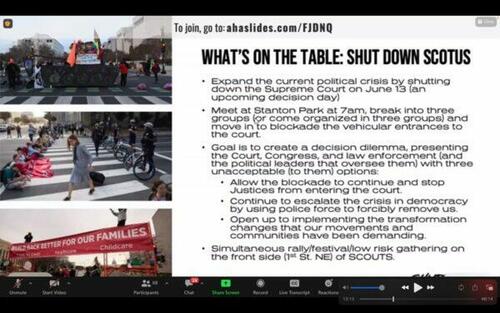
The group’s presentation says it would either stop Supreme Court justices from entering the court, “continue to escalate the crisis in democracy” by making police remove the demonstrators by force, or make the government implement its demands.
The protests are in response to a leaked Supreme Court Dobbs v. Jackson draft opinion that suggests the court may overturn Roe v. Wade. This new opinion could allow states to make their own laws on abortion.
The leaked opinion sparked the ire of many. For weeks, protesters have demonstrated outside the Supreme Court.

Then protesters changed tactics.
Activist group Ruth Sent Us published the home addresses of the Supreme Court justices and asked people to protest there. Many walked by the homes of the six conservative justices, yelling obscenities at them and their families.
Protesters in the Shut Down D.C. meeting also suggested that their actions might not be constitutionally protected.
“We may talk about some action ideas that stretch the bounds of constitutionally protected speech,” one activist said on the video call.
Another activist advised protesters to be careful in what they said.
“There can be people on any big call who might not have great intentions, so if there is something that you might not want seen on Fox News or any of the conservative news channels, you might not want to say it on this call,” she said.
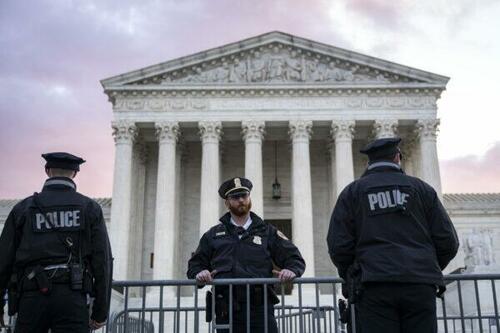
The planned protest next week will continue the escalation by opponents to a change in Roe v. Wade.
If the online planning meeting’s attendance was any indication, at least 60 people will take part in the court blockade.
Activists at the online meeting suggested ways to block the court’s three entrances. These included mass sit-ins, “big art,” a “lock down,” a dance party, a “people’s assembly” in the street, and a rally.
Votes in the group suggested that most preferred conducting a sit-in.

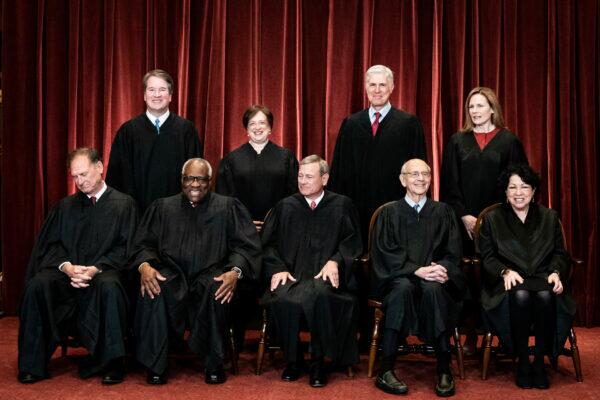
On May 31, Shut Down DC confirmed that it planned to “blockade the streets around the Supreme Court to rise up for the transformative change that our communities need.”
ObamaCare premium hikes are making Democrats sick
Many Democrats seem to get sick in the fall during election years from a chronic disease known as premium increase-itis. That’s when Affordable Care Act (i.e., ObamaCare) premiums are announced for the next year. And it appears that 2022 will see one of the worst outbreaks in years.
As The Hill’s Peter Sullivan explains: “The American Rescue Plan signed by President Biden last year temporarily increased financial assistance under ObamaCare, but that increase is set to expire at the end of this year, causing an increase in [2023] premiums for enrollees in the health law unless Congress acts.
“Notices about the premium increases would be sent out shortly before the midterm elections, adding political pain for Democrats in addition to the higher premiums for consumers.”
So, on top of all the inflation pain consumers are already experiencing with food, rent, medicine and especially gasoline, several million Americans will receive a notice that their ObamaCare premiums are going up significantly. And while taxpayers will still be subsidizing those premiums, the subsidies won’t be as generous as they have been.
The Kaiser Family Foundation estimates that without additional American Rescue Plan subsidies, the 14.5 million people in the ACA Marketplace – 13 million of whom receive taxpayer-supplied subsidies – will see an average 53 percent increase in their 2023 premiums. Ouch!
That’s almost exactly the same increase (55 percent) in the price of a gallon of gas from 12 months ago. And you know how consumers are responding to that increase.
Let’s just say Democrats had different expectations when they passed, with no Republican support, the Affordable Care Act in 2010. They believed – or at least said they believed – President Obama’s promise that premiums would go down once the federal government was managing health coverage. Democrats thought voters would see how affordable their ObamaCare premiums would be right before going to the polls in election years, and would show their appreciation by voting for Democrats.
That dream ended about nine months after Democrats passed the law. The November 2010 elections saw a record number of Republicans defeating incumbent House Democrats.
In fact, so many Democrats are worried about voter pushback that 26 of them have sent a letter to House Speaker Nancy Pelosi (D-Calif.) and Senate Majority Leader Chuck Schumer (D-N.Y.) “strongly urging” them to reinstate the allegedly “temporary” enhanced ObamaCare premium subsidies. “Our constituents elected us to lower their health care costs — and through the American Rescue Plan Act, we did just that,” they write.
But let’s be clear about one thing: ObamaCare has never lowered health care costs. Health insurance premiums began rising immediately when ObamaCare coverage went into effect in 2014.
What Democrats did was use taxpayer money to subsidize ObamaCare premiums, thereby masking the actual cost of coverage. And then they used the American Rescue Plan to double down on that masking. Now they fear consumer sticker shock and backlash when part of that masking is removed.
Yes, average ObamaCare premiums generally stabilized over the past three or four years. That stabilization was the result of several factors, but two are important. Health insurers made significant adjustments to their coverage over the years to minimize premium increases. For example, shifting to so-called “skinny” or “narrow networks” where very few health care providers participate because the reimbursement rates are so low. And insurers jacked up deductibles to between $6,000 and $7,000 per individual in ObamaCare’s bronze plans — and often double that for a family.
With deductibles that high, lower-income people tend to put off getting care because they don’t have out-of-pocket money to spend. Health actuaries have always known that high deductible plans reduce health care utilization. And outrageously high deductibles, like those in ObamaCare’s bronze plans, effectively discourage getting care among working families.
Now those very people are likely to see their premiums rise by 50 percent.
The Democrats who signed the letter are urging their leaders to extend the enhanced ObamaCare subsidies by tacking on a provision to a budget reconciliation bill, which can bypass a Senate filibuster and so needs only 50 Senate votes, plus the vice president to break the tie. In other words, no Republican support once again.
But even if that ploy is successful, it doesn’t solve the problem. It doesn’t cure the disease. Like aspirin, it only masks the pain for a little longer.
Premium increase-itis may be making Democrats sick now. But what they really fear is that it will spread to voters — right before the November midterm elections.
Merrill Matthews is a resident scholar with the Institute for Policy Innovation in Dallas, Texas.
https://thehill.com/opinion/healthcare/3513817-obamacare-premium-hikes-are-making-democrats-sick/