Search This Blog

Saturday, June 18, 2022

Billionaire Family Pushing Synthetic Sex Identities (SSI)

 One of the most powerful yet unremarked-upon drivers of our current wars over definitions of gender is a concerted push by members of one of the richest families in the United States to transition Americans from a dimorphic definition of sex to the broad acceptance and propagation of synthetic sex identities (SSI). Over the past decade, the Pritzkers of Illinois, who helped put Barack Obama in the White House and include among their number former U.S. Secretary of Commerce Penny Pritzker, current Illinois Gov. J.B. Pritzker, and philanthropist Jennifer Pritzker, appear to have used a family philanthropic apparatus to drive an ideology and practice of disembodiment into our medical, legal, cultural, and educational institutions.

I first wrote about the Pritzkers, whose fortune originated in the Hyatt hotel chain, and their philanthropy directed toward normalizing what people call “transgenderism” in 2018. I have since stopped using the word “transgenderism” as it has no clear boundaries, which makes it useless for communication, and have instead opted for the term SSI, which more clearly defines what some of the Pritzkers and their allies are funding—even as it ignores the biological reality of “male” and “female” and “gay” and “straight.”

The creation and normalization of SSI speaks much more directly to what is happening in American culture, and elsewhere, under an umbrella of human rights. With the introduction of SSI, the current incarnation of the LGBTQ+ network—as distinct from the prior movement that fought for equal rights for gay and lesbian Americans, and which ended in 2020 with Bostock v. Clayton County, finding that LGBTQ+ is a protected class for discrimination purposes—is working closely with the techno-medical complexbig banksinternational law firmspharma giants, and corporate power to solidify the idea that humans are not a sexually dimorphic species—which contradicts reality and the fundamental premises not only of “traditional” religions but of the gay and lesbian civil rights movements and much of the feminist movement, for which sexual dimorphism and resulting gender differences are foundational premises.

Through investments in the techno-medical complex, where new highly medicalized sex identities are being conjured, Pritzkers and other elite donors are attempting to normalize the idea that human reproductive sex exists on a spectrum. These investments go toward creating new SSI using surgeries and drugs, and by instituting rapid language reforms to prop up these new identities and induce institutions and individuals to normalize them. In 2018, for example, at the Ronald Reagan Medical Center at the University of California Los Angeles (where the Pritzkers are major donors and hold various titles), the Department of Obstetrics and Gynecology advertised several options for young females who think they can be men to have their reproductive organs removed, a procedure termed “gender-affirming care.”

The Pritzkers became the first American family to have a medical school bear its name in recognition of a private donation when it gave $12 million to the University of Chicago School of Medicine in 1968. In June 2002, the family announced an additional gift of $30 million to be invested in the University of Chicago’s Biological Sciences Division and School of Medicine. These investments provided the family with a bridgehead into the world of academic medicine, which it has since expanded in pursuit of a well-defined agenda centered around SSI. Also in 2002, Jennifer Pritzker founded the Tawani Foundation, which has since provided funding to Howard Brown Health and Rush Memorial Medical Center in Chicago, the University of Arkansas for Medical Sciences Foundation Fund, and the University of Minnesota’s Institute for Sexual and Gender Health, all of which provide some version of “gender care.” In the case of the latter, “clients” include “gender creative children as well as transgender and gender non-conforming adolescents ...”

In 2012, J.B. Pritzker and his wife, M.K. Pritzker, worked with The Bridgespan Group—a management consultant to nonprofits and philanthropists—to develop a long-term strategy for the J.B and M.K. Pritzker Family Foundation. Their work together included conducting research on developments in the field of early childhood education, to which the foundation committed $25 million.

Ever since, a motivating and driving force behind the Pritzkers’ familywide commitment to SSI has been J.B.’s cousin Jennifer (born James) Pritzker—a retired lieutenant colonel in the Illinois Army National Guard and the father of three children. In 2013, around the time gender ideology reached the level of mainstream American culture, Jennifer Pritzker announced a transition to womanhood. Since then, Pritzker has used the Tawani Foundation to help fund various institutions that support the concept of a spectrum of human sexes, including the Human Rights Campaign Foundation, the Williams Institute UCLA School of Law, the National Center for Transgender Equality, the Transgender Legal Defense and Education Fund, the American Civil Liberties Union, the Palm Military Center, the World Professional Association of Transgender Health (WPATH), and many others. Tawani Enterprises, the private investment counterpart to the philanthropic foundation, invests in and partners with Squadron Capital LLC, a Chicago-based private investment vehicle that acquires a number of medical device companies that manufacture instruments, implants, cutting tools, and injection molded plastic products for use in surgeries. As in the case of Jon Stryker, founder of the LGBT mega-NGO Arcus Foundation, it is hard to avoid the impression of complementarity between Jennifer Pritzker’s for-profit medical investments and philanthropic support for SSI.

Pritzker also helps fund the University of Minnesota National Center for Gender Spectrum Health, which claims “the gender spectrum is inclusive of the wide array of gender identities beyond binary definitions of gender—inclusive of cisgender and transgender identities, gender queer, and nonbinary identities as a normal part of the natural expression of gender. Gender spectrum health is the healthy, affirmed, positive development of a gender identity and expression that is congruent with the individual’s sense of self.” The university, where Pritzker has served on the Leadership Council for the Program in Human Sexuality, provides “young adult gender services” in the medical school’s Institute for Sexual and Gender Health.

Pritzker’s philanthropy is also active in Canada, where Jennifer has helped fund the University of Toronto’s Bonham Centre for Sexual Diversity Studies, a teaching institution invested in the deconstruction of human sex. An instructor in the Bonham Centre and the curator of its Sexual Representation Collection—“Canada’s largest archival collection of pornography”—is transgender studies professor Nicholas Matte, who denies categorically that sexual dimorphism exists. Pritzker also created the first chair in transgender studies at the University of Victoria in British Columbia. The current chair, Aaron Devor, founded an annual conference called Moving Trans History Forward, whose keynote speaker in 2016 was the renowned transhumanist, Martine Rothblatt, who was mentored by the transhumanist Ray Kurzweil of Google. Rothblatt lectured there on the value of creating an organization such as WPATH to serve “tech transgenders” in the cultivation of “tech transhumanists.” (Rothblatt’s ideology of disembodiment and technological religion seems to be having nearly as much influence on American culture as Sirius satellite radio, which Rothblatt co-founded.) Rothblatt is an integral presence at Out Leadership, a business networking arm of the LGBTQ+ movement, and appears to believe that “we are making God as we are implementing technology that is ever more all-knowing, ever-present, all-powerful, and beneficent.”

For-profit medical corporations and nonprofit institutions that intersect with the goliath LGBT NGO infrastructure, many of which receive Pritzker funding, have created a political scaffolding to engineer the institutionalization of SSI ideology and medical practice in the United States—solidifying the concept of people being born in wrongly sexed bodies or wrongly being born in sexed bodies at all. At least two clinics in California are now providing nonbinary surgeries and nullification surgeries for individuals who feel both male and female, or like neither.

The Gender Multispeciality Service (GeMS) at Boston Children’s Hospital, “the first major program in the U.S. to focus on gender-diverse and transgender adolescents,” was founded in 2007. “Since that time,” says the GeMS website, “we have expanded our program to welcome patients from ages 3 to 25.” The first such clinic for children in the Midwest, the Gender & Sex Development Program at Lurie Children’s Hospital, opened in Chicago in 2013 with a $500,000-$1 million gift pledge from Pritzker. (The husband of Jean “Gigi” Pritzker, another cousin, sits on Lurie’s board of directors.) The Gender Mapping Project estimates that there are now thousands of similar “gender clinics” around the world, and over 400 that offer to medically manipulate the sex of children.

Like Stryker’s Arcus Foundation, the Pritzkers have forged a close relationship with the psychiatric establishment. The Pritzker Department of Psychiatry and Behavioral Health at Lurie was launched with a $15 million gift from the Pritzker Foundation in 2019, and received another $6.45 million in 2022 to address “concerns about mental health consequences for children and adolescents arising from the COVID pandemic.” Illinois Gov. J.B. Pritzker, Jennifer’s cousin, signed into law SB 2085, Coverage of the Psychiatric Collaborative Care Model (CoCM)—the American Psychiatric Association’s model legislation requiring private insurers and Medicaid in Illinois to cover CPT codes for CoCM, which “requires a primary care (or other) physician or clinician to lead a team that includes a behavioral health care manager who checks in with patients at least once a month and an off-site psychiatric consultant who regularly reviews patients’ progress and offers advice.”

Jeanne Pritzker, married to J.B.’s brother Anthony, who is Jennifer’s cousin, is a training psychologist at UCLA where she and her husband established the Anthony and Jeanne Pritzker Family Scholarship to support medical students at UCLA’s David Geffen School of Medicine. Mrs. Pritzker is a member of the Board of Visitors at the Geffen School, which is affiliated with a children’s hospital named after Mattel—the multinational toy company that debuted a “transgender Barbie” recently made in the likeness of the actor Laverne Cox.

On June 30, 2019, Gov. Pritzker issued Executive Order 19-11, titled Strengthening Our Commitment to Affirming and Inclusive Schools, to welcome and support children with manufactured sex identities. A task force was established to outline statewide criteria for schools and teachers that recommended districts amend their school board policies “to strengthen protections for transgender, nonbinary, and gender nonconforming students.”

In August 2021, Gov. Pritzker signed into law a new sex education bill for all public schools in Illinois, the first of its kind designed in accordance with the second edition of the National Sex Education Standards (NSES) to update sex ed curricula in K-12 schools. Bill SB0 818 will be implemented on or before Aug. 1, 2022. Though the bill includes a written opt-out for parents (but not an alternative if they do opt-out), many are concerned with the material being brought into children’s schools under the auspices of teaching them sexual health—namely gender identity ideology and other related material.

FROM THE NATIONAL SEX EDUCATION STANDARDS

The NSES manual was crafted by The Future of Sex Education Initiative (FoSE) and funded by the Grove Foundation, which in turn has also worked with the David and Lucile Packard Foundation (of Hewlett-Packard fortune) and Ford Foundation to institute Working to Institutionalize Sex Education (WISE)—“A national initiative that supports school districts in implementing sex education”—throughout the country. The Bridgespan Group, which assisted the Pritzkers with their philanthropic trajectory in 2012, was retained by the Packard Foundation to review its collaborative efforts across its investment portfolio and to report on a series of case studies, including the WISE initiative.

FoSE is a collaboration between three other organizations: The Sexuality Information and Education Council of the United States (Siecus), “a national, nonprofit organization dedicated to affirming that sexuality is a natural and healthy part of life”; Advocates for Youth, “partnering with youth leaders, adult allies, and youth-serving organizations to advocate for policies and champion programs that recognize young people’s rights to honest sexual health information”; and Answer, “which provides and promotes unfettered access to comprehensive sexuality education for young people.” Each of these is also funded by the Grove Foundation, whose fortune comes from the now-deceased Andrew Grove, former CEO of Intel Corporation.

FoSE has created a “scaffolding approach” to teaching kids about sex in public schools and teaching them very young. Its credo is that “not only are younger children able to discuss sexuality-related issues but that the early grades may, in fact, be the best time to introduce topics related to sexual orientation, gender identity and expression, gender equality, and social justice related to the LGBTQ community before hetero- and cisnormative values and assumptions become more deeply ingrained and less mutable.”

Critics of the NSES standards created by the FoSE collaborative and now being implemented in Illinois under Gov. Pritzker may have concerns about a 72-page manual in which the term “anal sex” comes up 10 times and the word “intimacy” only half as often. The word “gender,” for what it’s worth, is used 270 times.

While many Americans are still trying to understand why women are being erased in language and law, and why children are being taught they can choose their sex, the Pritzker cousins and others may be well on their way to engineering a new way to be human. But what could possibly explain the abrupt drive of wealthy elites to deconstruct who and what we are and to manipulate children’s sex characteristics in clinics now spanning the globe while claiming new rights for those being deconstructed? Perhaps it is profit. Perhaps it is the pleasure of seeing one’s own personal obsessions writ large. Perhaps it is the human temptation to play God. No matter what the answer is, it seems clear that SSI will be an enduring part of America’s future.

Jennifer Bilek is an investigative journalist living in New York City. She writes at The 11th Hour Blog and tweets @bjportraits.


https://www.tabletmag.com/sections/news/articles/billionaire-family-pushing-synthetic-sex-identities-ssi-pritzkers

The Pandemic Drop in Undergraduate Enrollment


The Issue:

Undergraduate enrollment at U.S. postsecondary education institutions declined 4.7% in spring 2022 relative to the same time a year earlier, according to the National Student Clearinghouse Research Center. While the rate of decline was somewhat smaller than the 4.9% annual reduction seen in spring 2021, the 2022 decline was worse than many expected given vaccine availability and trends toward more normal college operations — changes that some hoped marked the beginning of pandemic recovery. The spring 2022 data show that enrollment weakness continued to be particularly pronounced among two-year programs. However, traditional-age and male enrollments held up better than those of older students and women, reversing patterns seen earlier in the pandemic. The continued drop in undergraduate enrollment compounds challenges already facing many postsecondary institutions due to reduced birth rates and shifting demographics.

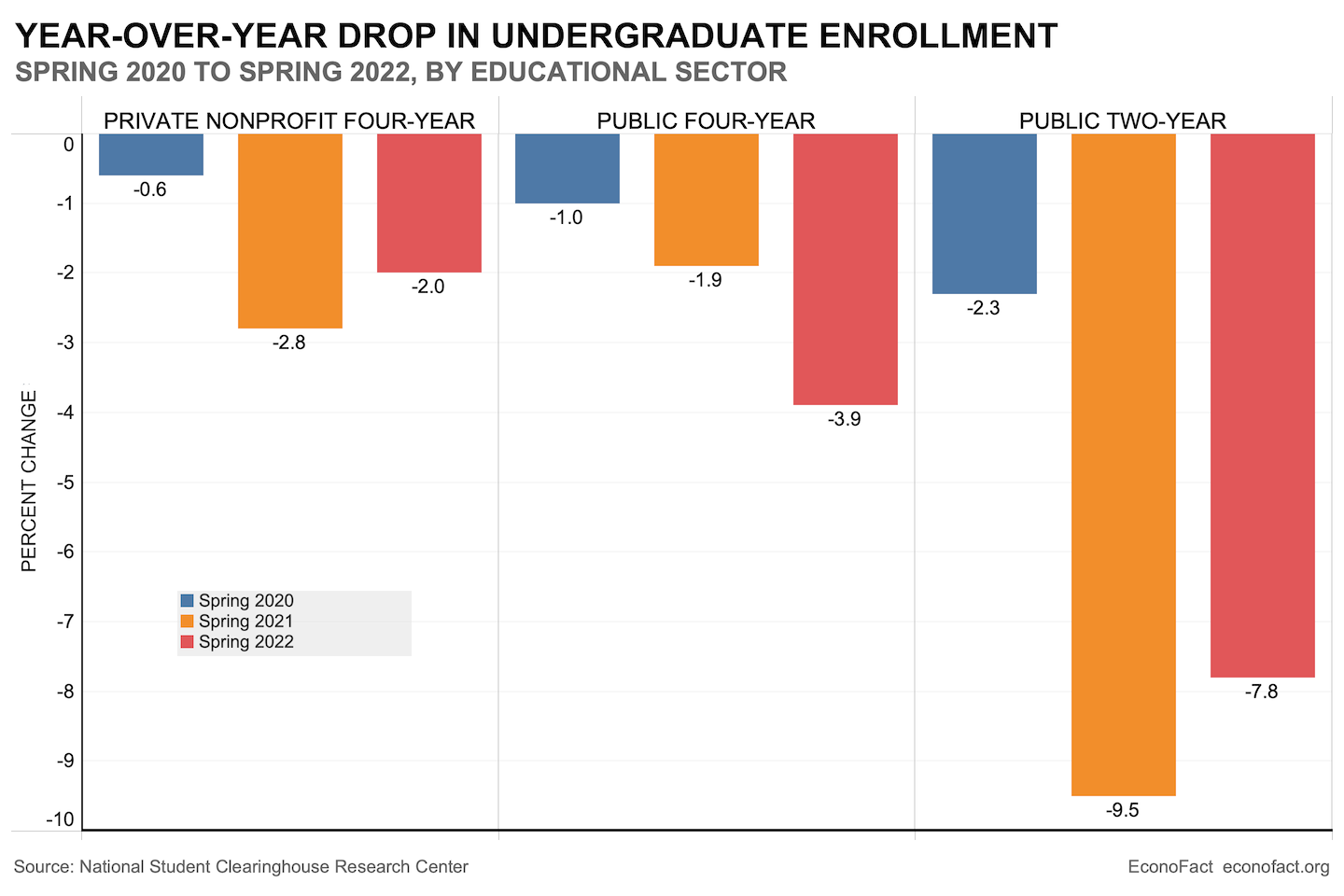
Enrollment losses over the two pandemic years have led to vastly different outcomes, with public two-year colleges bearing the largest drop. 

The Facts:

  • Undergraduate enrollment in spring 2022 was disappointingly weak, though some segments of the postsecondary education market experienced greater losses than others. Notably, the number of associate degree-seeking students fell 8.3% while the rate of loss in the bachelor’s degree-seeking market was only one third as large. Given this change in student pursuits, public two-year institutions bore a disproportionate share of the enrollment decline (7.8%) while private nonprofit four-year colleges and universities, which grant few associate degrees, saw a loss of only 2% (see chart). 
  • These patterns reinforce those seen throughout the pandemic leading to vastly different cumulative effects by sector. While the pandemic made itself felt in March 2020, spring 2020 enrollment decisions had already been made by that point. Pandemic-induced enrollment losses appeared in the 2020–21 academic year, and spring 2021 undergraduate enrollments stood 4.9% lower than prior-year levels. In that first year of pandemic response, losses were greatest in the two-year sector which saw enrollment declines of 9.5%. In the same year, undergraduate enrollments fell 1.9% and 2.8% at public and private nonprofit four-year institutions. The buildup in losses over the two pandemic years has led to vastly different outcomes. Between spring 2020 and spring 2022, enrollments at public two-year colleges are off 16.6% as compared to losses of just 5.8% and 4.7% at public and private nonprofit four-year peers.  
  • Weakness in spring 2022 enrollment was particularly evident among “non-traditional” students (those 25 years old and older), reversing the pattern seen in the prior year. Enrollments (undergraduate and graduate) among those 25 years old and older fell 5.8% between spring 2021 and spring 2022 — almost twice the rate of decline seen among those 24 years old and younger. This pattern of relative weakness in the non-traditional market was reported by all subsectors of higher education. A year before, the pattern was exactly reversed with non-traditional student enrollments falling only 1.2% as compared to a 4.7% loss among traditional-aged students. When the two years are combined, losses in both groups have been within one percentage point of each other since the start of the pandemic in spring 2020. The reasons for the different patterns between 2021 and 2022 remain subjects for future research. It may be that labor shortages and corresponding strong wages have pulled older students out of school. Alternatively, it may be that younger students susceptible to withdrawal from higher education had already left in 2021 such that what we see in 2022 is simply older students catching up to the same choices as seen in younger cohorts.
  • Declining enrollments reported in spring 2022 were particularly evident among women, also a reversal of enrollment patterns of the prior year. Spring 2022 enrollments (undergraduate and graduate) were 4.6% lower among women as compared to a 3.3% decline among men. This result stands in contrast to the enrollment outcomes in spring 2021 when women saw a decline of just 2.0%, less than half of the 5.5% loss experienced among men. Again, research has not identified causes for these gender differences. A few clues seem important. First, employment losses were greater among women than men in the early months of the recession — possibly an influence on spring 2021 enrollments. Second, the relative decline of women in spring 2022 is entirely accounted for by enrollments at public two-year institutions; enrollments by men and women at four-year institutions both fell by 2.8%. Both of these facts suggest relative ebbs and flows in labor markets may explain enrollment impacts. In total, the pandemic has reduced male enrollments more than female, with much of this effect driven by two-year college experiences. Economists Diane Schanzenbach and Sarah Turner estimate that nearly all of the gender disparity in two-year college enrollment between the fall of 2019 and the fall of 2020 is explained by disproportionate enrollment among men in degree programs that involve “’hands on’ experiential learning”, such as welding or automotive repair and maintenance — which were heavily affected by pandemic mitigation policies such as reduced capacity in instructional spaces due to social distancing requirements and frequent deep cleaning of shared spaces.
  • Application data offer hope for an enrollment rally in fall 2022. Applications for federal financial aid (FAFSA) rebounded this spring to equal those seen prior to the 2019–20 academic year. FAFSA application growth has been particularly strong in school districts with lower incomes and higher shares of students of color—groups which had seen larger enrollment declines earlier in the pandemic. This federal aid application data is consistent with patterns reported by the Common App (an application service used by almost 1,000 public and private colleges and universities from throughout the United States). Through mid-March 2022, the number of unique first-year Common App applicants was up 7.5% over the prior year with disproportionate gains among applicants who are under-represented minorities, first-generation, or application fee-waiver recipients.

What this Means:

Despite more than $75B in federal pandemic relief, higher education did not pass through the pandemic unscathed. Inflation-adjusted tuition and fees have fallen in the past two years, and with inflation rates exceeding 8% per year, it seems likely these trends will continue. Depressed fees in combination with continued enrollment weakness threaten tuition and fee revenues which make up the largest source of revenue for public and private nonprofit four-year institutions. The urgency of pandemic recovery is made greater by two ongoing trends: declining fertility since the Great Recession which will soon shrink prospective student pools and a decline in matriculation among international students (a trend which was amplified by the pandemic but began in 2016–17). With additional pandemic aid to higher education unlikely at this point, colleges and universities will suffer financial hardship if enrollment declines don’t reverse in the 2022–23 academic year.

Nathan Grawe

CARLETON COLLEGE. Professor of Economics. Research focuses on how family background shapes educational and employment outcomes.


Cognitive Endurance as Human Capital

 A favorite topic of mine:

Schooling may build human capital not only by teaching academic skills, but by expanding the capacity for cognition itself. We focus specifically on cognitive endurance: the ability to sustain effortful mental activity over a continuous stretch of time. As motivation, we document that globally and in the US, the poor exhibit cognitive fatigue more quickly than the rich across field settings; they also attend schools that offer fewer opportunities to practice thinking for continuous stretches. Using a field experiment with 1,600 Indian primary school students, we randomly increase the amount of time students spend in sustained cognitive activity during the school day—using either math problems (mimicking good schooling) or non-academic games (providing a pure test of our mechanism). Each approach markedly improves cognitive endurance: students show 22% less decline in performance over time when engaged in intellectual activities—listening comprehension, academic problems, or IQ tests. They also exhibit increased attentiveness in the classroom and score higher on psychological measures of sustained attention. Moreover, each treatment improves students’ school performance by 0.09 standard deviations. This indicates that the experience of effortful thinking itself—even when devoid of any subject content—increases the ability to accumulate traditional human capital. Finally, we complement these results with quasi-experimental variation indicating that an additional year of schooling improves cognitive endurance, but only in higher-quality schools. Our findings suggest that schooling disparities may further disadvantage poor children by hampering the development of a core mental capacity.

Here is the full paper by Christina L. BrownSupreet KaurGeeta Kingdon & Heather Schofield. What are you doing to improve your cognitive durability?

https://marginalrevolution.com/marginalrevolution/2022/06/cognitive-endurance-as-human-capital.html

Newest Omicron Covid-19 lineages gaining ground in US

We’re still in the Age of Omicron, but the face of it keeps changing.

The United States appears to be in the midst of another biological baton pass between Covid-19 variants. The Omicron lineage BA.2 and its spinoff, BA.2.12.1, drove cases this spring, building into waves of infections in places like the Northeast and parts of California. Now, two other forms of Omicron, BA.4 and BA.5, are eating into the BA.2 group’s dominance.

More than 1 in 5 Covid-19 infections last week were caused by BA.4 and BA.5, according to updated estimates posted Tuesday by the Centers for Disease Control and Prevention. That’s up from 13% the week prior. The rest of the cases are from the BA.2 lineages.

BA.4 and BA.5 are picking up speed because they’re able to evade the body’s antibody response even more so than other variants, meaning they’re very good at establishing infections in people who have some level of protection. “Overall, this raises concerns about more frequent BA.4/BA.5 vaccine breakthrough infections than for BA.1/BA.2, and for Omicron reinfections,” the European Centre for Disease Prevention and Control wrote in an update this week. People who were infected by an earlier Omicron version could be susceptible to an infection from BA.4 or BA.5 not long after they recover, scientists have found, though the combination of vaccination and an earlier Omicron infection provides more durable protection than an infection alone.

But even as the body’s ability to block infection is weakened in the face of the newer variants, protection against more serious outcomes continues to be maintained for most people who’ve been vaccinated or had prior infections. As of now, BA.4 and BA.5 do not seem to cause more severe disease on average compared to other forms of Omicron.

The newer lineages are emerging in the United States as the country’s average daily infection count seems to have plateaued at just over 100,000 (which, with at-home tests, rolled-back testing programs, and people forgoing tests because their infections are so mild, is a major undercount).

So how will BA.4 and BA.5 affect the landscape? Better transmitting variants, as we all know by now, add weight to the side of the scale that promotes increased spread. But factors on the other side of the scale can act as a drag on transmission — all the recent infections that people have had, for example, and perhaps a seasonal boost in parts of the country where people are spending more time outside.

The toll of the variants could look different based on region. The Northeast is past the peak of its BA.2.12.1 spike, but “we’re at the beginning of seeing the impact of BA.4/5,” Jacob Lemieux, an infectious diseases physician at Massachusetts General Hospital, told reporters last week. Perhaps the ascendance of the two latest subvariants will just slow down the pace of the region’s decline in infections. But other places, particularly areas of the country that didn’t have substantial BA.2 waves, could be more ripe for spikes in infections.

Already, transmission has been picking up in areas including parts of Florida and New Mexico. The South experienced devastating infection waves the past two summers, likely in part because people headed indoors to escape the heat, and experts are watching to see if the region again sees a summertime surge.

According to the latest CDC data, the region with the highest prevalence of BA.4 and BA.5 at this point — at more than 30% — is the one including Texas, New Mexico, Arkansas, Oklahoma, and Louisiana.

Of course, thanks to the levels of population immunity, the danger of Covid cases has changed over time, with infections far less likely to lead to hospitalizations and deaths. But while the individual risk is lower, experts argue that total infections still matter — particularly when they’re numbering in the hundreds of thousands a day.

Mild cases can still be disruptive to people’s lives. Even vaccinated people seem vulnerable to long Covid, if at lower rates than unvaccinated people. And some of those infections will still lead to hospitalizations and deaths, whether it was someone who was unvaccinated or — perhaps because they’re older, have other health conditions, or haven’t kept up with boosters — who did not get as robust protection from the shots. As it is, some 300 people in the United States are still dying from Covid a day.

Experts trying to gauge what BA.4 and BA.5 could do in the United States have been looking at other countries’ experiences with the lineages. South Africa had a sizable wave of infections driven by BA.4 and BA.5, though a much smaller one than its initial Omicron wave (which was caused by a subvariant called BA.1). While deaths in South Africa increased, it was to a much smaller extent.

But in Portugal, where BA.5 is dominant, deaths are now on par with where they were during its initial Omicron wave (though deaths are much lower than during the country’s waves during the pre-vaccine era). The increase in hospitalizations in Portugal has occurred mainly in people 60 and over, according to the ECDC.

“The growth advantage reported for BA.4 and BA.5 suggest that these variants will become dominant” in Europe, the agency wrote, “probably resulting in an increase in Covid-19 cases in the coming weeks.”

https://www.statnews.com/2022/06/14/newest-omicron-covid-19-lineages-gaining-ground-in-united-states/