Search This Blog

Monday, June 20, 2022

Willingness to give away money among older adults linked to cognitive profile of early Alzheimer's

 To help protect older adults from financial exploitation, researchers are working to understand who is most at risk. New findings from the Keck School of Medicine of USC, published this week in the Journal of Alzheimer's Disease, suggest that willingness to give away money could be linked to the earliest stages of Alzheimer's disease.

Sixty-seven older adults who did not have dementia or cognitive impairment completed a laboratory task where they decided whether to give money to an anonymous person or keep it for themselves. They also completed a series of cognitive tests, such as word and story recall. Those who gave away more money performed worse on the cognitive assessments known to be sensitive to Alzheimer's .

"Our goal is to understand why some older adults might be more susceptible than others to scam, fraud or financial exploitation," said the study's senior author, Duke Han, Ph.D., director of neuropsychology in the Department of Family Medicine and a professor of family medicine, neurology, psychology and gerontology at the Keck School of Medicine. "Trouble handling money is thought to be one of the early signs of Alzheimer's disease, and this finding supports that notion."

Earlier research that tested the link between altruism and cognition relied on self-report measures, such as asking older adults whether they would be willing to give money in certain scenarios. The present study used real money to examine the link.

"To our knowledge, this is the first study to explore the relationship using a behavioral economics paradigm, meaning a scenario where participants had to make decisions about giving or keeping actual money," said Gali H. Weissberger, Ph.D., a senior lecturer in the Interdisciplinary Department of Social Sciences at Bar-Ilan University in Israel and first author of the study.

Giving and cognition

The researchers recruited 67 adults for the study, with an average age of 69. They collected data about participant demographics and controlled for the effects of age, sex and education level in the final analysis. Participants were excluded from the study if they met criteria for dementia or .

In the lab, each participant was told they had been paired with an anonymous person who was completing the study online. They were then given $10 and instructed to allocate it however they wished, in $1 increments, between themselves and the anonymous person.

The older adults in the study also completed a series of neuropsychological tests, including several that are commonly used to help diagnose Alzheimer's disease in its early stages. The tests included story and word recall tasks where participants are asked to remember information after a short delay; a category fluency test that involves listing words on a specific topic; and several other cognitive assessments.

Participants who gave more away scored significantly lower on the neuropsychological tests known to be sensitive to early Alzheimer's disease. There were no significant performance differences on other neuropsychological tests.

Clarifying the link

More research is needed to confirm the nature of the relationship between financial altruism and cognitive health in older adults, including with larger and more representative samples. Future studies could also collect both behavioral and self-report data on financial altruism to better understand participants' motivations for giving.

Han, Weissberger and their colleagues are now collecting data for a  using the same giving task, which could help determine whether some older adults are becoming more altruistic over time.

"If a person is experiencing some kind of change in their altruistic behavior, that might indicate that changes are also happening in the brain," Weissberger said.

Clarifying these details about the link between altruism and cognition could ultimately improve screening for Alzheimer's disease and help people protect their loved ones from . It can also help researchers distinguish between what represents healthy giving behavior versus something that could signify underlying problems.

"The last thing we would want is for people to think that financial altruism among  is a bad thing," Han said. "It can certainly be a deliberate and positive use of a person's ."


Explore further

Social dissatisfaction predicts vulnerability to financial exploitation in older adults

More information: Gali H. Weissberger et al, Increased Financial Altruism is Associated with Alzheimer's Disease Neurocognitive Profile in Older Adults, Journal of Alzheimer's Disease (2022). In press. www.j-alz.com/vol88-3
https://medicalxpress.com/news/2022-06-willingness-money-older-adults-linked.html

Eyes a haven for Ebola and other viruses

 A specific cell within our retina, the light-sensitive part of our eyes responsible for sending visual information to our brain, appears to be particularly good at housing Ebola and other viruses, new research has found.

A highly infectious and lethal viral disease, Ebola was first observed 1976 and has since impacted thousands of humans and animals, primarily in Central Africa.

"Inflammation of the eye, known as uveitis, is very common following infection with Ebola and we know the cells within the iris, at the front of the eye, as well as the retina have the capacity to play a major role in uveitis and act as hosts for microorganisms," says study senior author Professor Justine Smith, Strategic Professor in Eye & Vision Health at Flinders University.

"However, what we didn't know was which out of the two was most responsible in the case of Ebola."

The study, published in the journal Frontiers in Virology and led by Flinders University and CSIRO's Australian Center for Disease Preparedness, used cells from  donated from the SA Eye Bank to investigate the ability of iris and retinal pigment  to be infected by Ebola.

Cells were infected with Ebola virus, Reston virus (a type of ebolavirus that does not cause disease in humans) or Zika virus (another type of virus, but one that also can cause uveitis), while some were left uninfected for the duration of the trial.

While both types of cells seemed to allow the Ebola virus to replicate, it was the  that showed much higher levels of infection.

"We also found similar results when looking at the cells infected with Reston virus and Zika virus," said Professor Smith.

"Patients with Ebola eye disease have characteristic retinal scars, suggesting the  is involved in the disease, so this finding is consistent with what eye doctors are seeing in the clinic.

"These retinal cells are good at eating things—called phagocytosis—and they play an essential part in the visual cycle by recycling our photoreceptors, so it makes sense that these cells would be a receptive haven for Ebola, as well as other viruses."

The researchers say the study demonstrates an important target cell for Ebola infection in the eye and suggests the potential for these cells to be monitored during acute viral infection to identify patients at highest risk of uveitis.

"Amongst other issues, including pain and blurred vision, uveitis can ultimately lead to , so it's important we find ways to diagnose it as early as possible to enable swift treatment," says Professor Smith.

"Ebola virus differentially infects human iris and retinal pigment epithelial cells" is published in the journal Frontiers in Virology.


Explore further

Super cell to contain deadly Ebola virus discovered in Australia

More information: Shawn Todd et al, Brief Research Report: Ebola Virus Differentially Infects Human Iris and Retinal Pigment Epithelial Cells, Frontiers in Virology (2022). DOI: 10.3389/fviro.2022.892394
https://medicalxpress.com/news/2022-06-eyes-haven-ebola-viruses.html

Light-activated 'photoimmunotherapy' could enhance brain cancer treatment

 An innovative light-activated therapy developed at The Institute of Cancer Research, London, could help detect and treat an aggressive brain cancer type, a new study shows.

The "photoimmunotherapy" combines a special fluorescent dye with a cancer-targeting compound, which together boosts the body's immune response.

In studies in mice, the combination was shown to improve the visibility of  during  and, when activated by near-infrared light, to trigger an anti-tumor effect.

The treatment, studied by an international team of researchers from the ICR and the Medical University of Silesia, Poland, could ultimately help surgeons to remove brain cancers like glioblastoma more effectively, and boost the body's response to cancer cells that remain after surgery.

Lighting-up brain cancer

Glioblastoma multiforme, also known as GBM, is one of the most common and aggressive types of brain cancer. New ways to improve surgery could help patients live for longer.

Surgeons often use a technique called Fluorescence Guided Surgery to treat diseases like glioblastoma and other brain cancers, which uses dyes to help identify the tumor mass to be removed during surgery.

But due to these tumors growing in sensitive areas of the brain like the , which is involved in the planning and control of voluntary movements, glioblastoma surgery can leave behind residual tumor cells that can be very hard to treat—and which mean the disease can come back more aggressively later.

The new research, published in the journal BMC Medicine, builds on Fluorescence Guided Surgery using a novel technique called photoimmunotherapy (PIT).

This treatment uses synthetic molecules called "affibodies"—small proteins engineered in the lab to bind with a specific target with high precision.

In this study, the researchers combined an "affibody" created to recognize a protein called EGFR—which is mutated in many cases of glioblastoma—with a fluorescent molecule called IR700, which is used in surgery.

Shining light on these compounds causes the fluorescent dye to glow, highlighting microscopic regions of tumors left in the brain, while switching to near-infrared light triggers anti-tumor activity that kills tumor cells.

Offering new hope for brain cancer

The researchers tested this combined molecule, or "conjugate"—known scientifically as ZEGFR:03115-IR700—in mice with glioblastoma. They could see the cancer-targeting compound fluorescing in the brain tumors during surgery, just one hour after administration.

Shining near-infrared light on the tumor cells then activated the anti-tumor effect of the compound, killing cancer cells: scans of mice treated with the compound showed distinct signs of tumor cell death compared with untreated mice.

Photoimmunotherapy also triggered immune responses in the body that could prime the immune system to target cancer cells, so the treatment could help prevent glioblastoma cells from coming back after surgery.

As well as being a possible future treatment for glioblastoma, the approach used for ZEGFR:03115-IR700 could also be adapted against other targets in other forms of cancer, using new affibody molecules.

Researchers at the ICR are now also studying the treatment in the childhood cancer neuroblastoma.

Study leader Dr. Gabriela Kramer-Marek, Team Leader in Preclinical Molecular Imaging at the ICR, said: "Brain cancers like glioblastoma can be hard to treat and sadly, there are too few treatment options for patients. Surgery is challenging due to the location of the tumors, and so new ways to see tumor cells to be removed during surgery, and to treat residual  cells that remain afterwards, could be of great benefit.

"Our study shows that a novel photoimmunotherapy treatment using a combination of a fluorescent marker, 'affibody' protein and near- can both identify and treat leftover glioblastoma cells in mice. In the future, we hope this approach can be used to treat human glioblastoma and potentially other cancers too."

Professor Axel Behrens, Scientific Director of the Cancer Research U.K. Convergence Science Center at the ICR and Imperial College London, and Leader of the Cancer Stem Cell Team at the ICR, said: "Multidisciplinary working is critical to finding innovative solutions to address the challenges we face in , diagnosis and treatment—and this study is a great example of how researchers at our center are working across traditional discipline boundaries. This research demonstrates a novel approach to identifying and treating   in the brain using light to turn an immunosuppressive environment into an immune-vulnerable one, and which has exciting potential as a therapy against this aggressive type of  tumor."


Explore further

Treatment that 'switches off' cancer cells and limits growth could make aggressive brain tumor easier to treat

More information: Justyna Mączyńska et al, Triggering anti-GBM immune response with EGFR-mediated photoimmunotherapy, BMC Medicine (2022). DOI: 10.1186/s12916-021-02213-z
https://medicalxpress.com/news/2022-06-light-activated-photoimmunotherapy-brain-cancer-treatment.html

US death rate from alcoholic liver cirrhosis triples over two decades

 Americans may have a collective drinking problem, made worse by the obesity epidemic, new research suggests. The new study found that deaths from alcoholic cirrhosis have more than tripled in 20 years.

In 1999, alcoholic cirrhosis—an advanced form of alcohol-related liver disease—killed just over 6,000 Americans (a rate of 3 per 100,000). By 2019, deaths from the condition had soared to nearly 24,000 (a rate of 11 per 100,000).

"The hypothesis is that people are drinking more and starting earlier in life," said lead researcher Dr. Charles Hennekens, the First Sir Richard Doll Professor & Senior Academic Adviser to the Dean at the Charles E. Schmidt College of Medicine at Florida Atlantic University in Boca Raton.

But there may be other factors at work, Hennekens added, including a dramatic increase in obesity, along with more sedentary lifestyles.

"That leads to ," Hennekens said. "The same kind of thing that alcohol does. My hypothesis is that the reason we're seeing more of liver disease earlier is not just that people are drinking more, but that they're eating more and exercising less, so the damage to the liver is accelerating."

Obesity and lack of exercise are also at the root of the epidemic of diabetes, as well as , stroke and some cancers. "The risk factors are the same," he noted.

Hennekens said that as far as drinking goes, people should limit the amount of alcohol they drink to no more than two drinks a day for men and no more than one for women.

Doctors should counsel their patients that those who consume lots of alcohol have the highest death rates from both cirrhosis and heart disease, he added.

Alcoholic cirrhosis accounts for one-third of all liver transplants in the United States, the study authors noted.

"While the data indicate that those who have one to two drinks daily have lower risks of cardiovascular disease than nondrinkers, it is also true that the difference between drinking smaller and larger amounts of alcohol means the difference between preventing and causing ," Hennekens said.

For the study, Hennekens and his colleagues used data from the U.S. Centers for Disease Control and Prevention to look at trends in  from alcoholic  from 1999 to 2019.

The investigators found that during those two decades there were statistically significant increases in deaths from  in every age group from 25 and up. The largest increase was sevenfold among those aged 24 to 35 and the steepest increase was seen among those aged 65 to 74.

The report was published online recently the American Journal of Medicine.

Dr. Tiffany Wu, a gastroenterologist at the Mayo Clinic in Rochester, Minn., said that alcohol-associated liver disease is one of the leading causes of liver-related deaths in the United States.

"The rising prevalence of high-risk  and  has fueled these trends in the development of chronic  and its complications," she said. "Although effective treatments are available for alcohol use disorder, they are currently underutilized."

Barriers to care include other medical conditions, the stigma around addiction and limited access to care, Wu said.

"Existing care delivery models have been further restricted due to challenges related to the pandemic," she said. "Thus, there is an urgent need to improve methods of identifying individuals with high risk for developing disease, and also to utilize novel digital platforms and technology to personalize treatment and prevention."


Explore further

How too much drinking harms the liver

More information: For more on liver disease, head to the U.S. National Institute of Diabetes and Digestive and Kidney Diseases.

Orly Termeie et al, Alarming Trends: Mortality from Alcoholic Cirrhosis in the United States, The American Journal of Medicine (2022). DOI: 10.1016/j.amjmed.2022.05.015


https://medicalxpress.com/news/2022-06-death-alcoholic-liver-cirrhosis-triples.html

Who benefits from brain training and why? Study shows 'near transfer' predicts 'far transfer'

 If you are skilled at playing puzzles on your smartphone or tablet, what does it say about how fast you learn new puzzles, or, more broadly, how well you can focus, say, in school or at work? Or, in the language of psychologists, does "near transfer" predict "far transfer"?

A team of psychologists at UC Riverside and UC Irvine reports in Nature Human Behavior that people who show near transfer are more likely to show far transfer. For a person skilled at playing a game, such as Wordle, near transfer refers to being skilled at similar games, such as a crossword puzzle. An example of far transfer for this person is better focus in daily living activities.

"Some people do very well in , such as playing a , but they don't show near transfer perhaps because they are using highly specific strategies," said first author Anja Pahor, an assistant research psychologist at UCR and a project scientist in the Department of Psychology at the University of Maribor in Slovenia. "For these people, far transfer is unlikely. By better understanding why this type of memory training or 'intervention' works for some people but not others, we can move forward with a new generation of working memory training games or use approaches that are more tailored to individuals' needs."

The researchers conducted three randomized control trials involving nearly 500 participants and replicated the same finding: The extent to which people improve on untrained tasks, that is, tasks they are not familiar with (near transfer), determines whether far transfer to an abstract reasoning task is successful. By analogy, if a person running on a treadmill in the gym (training or intervention) proceeds to be able to run faster outdoors (near transfer), then this improvement predicts whether this person would be better prepared to engage in other physical activities (far transfer), such as cycling or playing a sport.

Whether and the degree to which working memory training improves performance on untrained tasks, as in "fluid intelligence," the ability to think and reason abstractly and solve problems, remains a highly debated topic. Some  show a small but significant positive effect on fluid intelligence; others argue no evidence exists that training generalizes to fluid intelligence.

"What working memory researchers get most excited about is whether there is transfer to fluid intelligence," said coauthor Aaron Seitz, a professor of psychology at UCR and the director of the UCR Brain Game Center for Mental Fitness and Well-Being. "What we say in our paper is simple: If you get near transfer, it is very likely that you also get far transfer.

"But not everybody gets near transfer for a variety of reasons, such as participants disengaging during training or because that particular training is ineffective for them. These people appear not to get far transfer."

Who benefits from brain training and why?
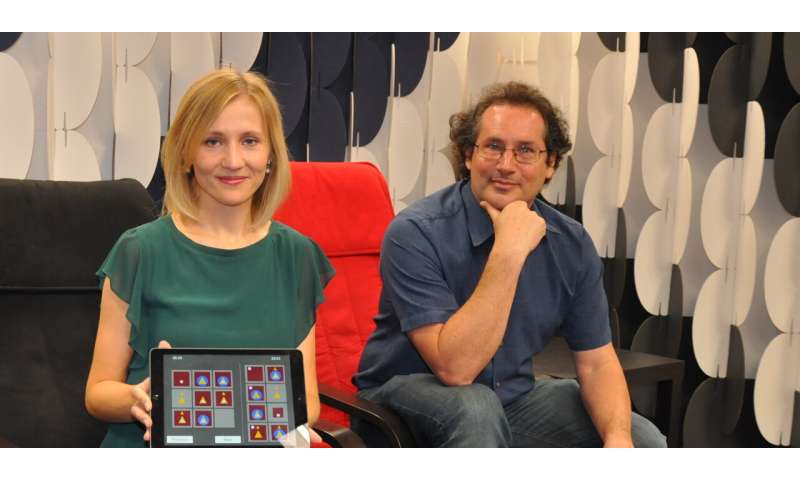
Anja Pahor (left) is sen here with Aaron Seitz. Credit: I. Pittalwala, UC Riverside.

Seitz noted that people are constantly being sold brain training games.

"Some studies claim these games work; other studies claim the opposite, making it difficult to interpret the interventions," he said. "Further, some of these studies have lumped together people who show near transfer with people who show no near transfer. Our paper clarifies some of this confusion."

To further explore those issues, the team has launched a large-scale citizen science project that will engage 30,000 participants in various forms of brain training. The researchers welcome anyone over 18 to participate by signing up or learn more about their ongoing work.

Susanne Jaeggi, a professor of education at UCI and director of the UCI Working Memory and Plasticity Lab and a coauthor on the , cautioned that companies' claims that their games improve core cognitive functions need to be carefully evaluated.

"Almost everyone has access to an app or plays a  on a computer and it is easy to get seduced by the claims of some companies," she said. "If we can understand how and for whom brain training apps work, we can improve them to get more out of them than just fun. Such improved apps would be especially meaningful for  and certain patient groups."

The research was funded by a grant to UCR and UCI from the National Institute of Mental Health of the National Institutes of Health.

The title of the paper is "Near transfer to an unrelated N-back task mediates the effect of N- back working memory training on matrix reasoning."


Explore further

Brain training with neurofeedback shows enhanced benefits on cognitive functions

More information: Anja Pahor, Near transfer to an unrelated N-back task mediates the effect of N-back working memory training on matrix reasoning, Nature Human Behaviour (2022). DOI: 10.1038/s41562-022-01384-wwww.nature.com/articles/s41562-022-01384-w
https://medicalxpress.com/news/2022-06-benefits-brain.html

Robotic surgery may lower risk for hip replacement complications

 As robotic surgical systems continue to evolve and assist surgeons with improving surgical precision, a Henry Ford Health study finds that robotic-assisted surgery for hip replacement has lower rates of complications than the traditional method.

The findings, published in The Journal of Arthroplasty, are believed to be the first from a large series of patients with several years of follow-up to evaluate post-surgical complications between the two surgical options, adding to the growing body of research in the hip replacement field.

Researchers said the dislocation rate for  was nearly four times less than the traditional method. A dislocation is a common post-surgical complication that occurs when the new implant comes out of the socket during the healing process. In addition, they said the risk for hip instability when the procedure was performed robotically was 3.5 times less than the traditional method when controlling for gender, race, age, prior spine surgery and other accepted factors that can contribute to instability.

Jason Davis, M.D., a Henry Ford joint replacement surgeon and the study's senior author, cautioned patients not to interpret the results as robotic surgery being superior to the tried-and-true traditional method. Current research comparing outcomes between the two procedures is limited.

"Patients, in consultation with their joint replacement surgeon, should decide which surgical option is best for them," Dr. Davis said. "Robotic surgery for hip replacement surgery continues to evolve and more larger studies are needed to better define the advantages."

According to the Agency for Healthcare Research and Quality, more than 450,000 total hip replacements are performed each year in the United States. Hip replacement surgery has shown to be a safe and effective procedure for relieving pain, increasing motion and returning patients to their normal activities.

In their retrospective study, researchers analyzed data of 2,247 patients who underwent hip replacement surgery between January 2014 and June 2020 for several years after surgery. They sought to evaluate and compare dislocation rates and other complications post-surgery between the two procedures.

Dr. Davis said a  may occur when the implant is not placed in the best position among other causes, leading to instability. Most dislocations occur within first few months of surgery and often are caused when a patient falls or engages in extreme ranges of motion like twisting or bending.

The robotic approach can benefit patients with their recovery. The robotic arm allows for more control with the surgical tools and a TV screen allows surgeons to see the bone anatomy and preparation in real time. Dr. Davis relates a common example of technological assistance to that of parking sensors on new vehicles. With distance sensors and rear-view cameras now available in most cars, drivers can more accurately park their vehicles without errors. Like surgery, most parking situations go well, but performed many times a year, this technology enables drivers better quality control.

Dr. Davis said robotic technology allows the surgeon to control and move surgical instruments precisely and has been shown to improve the accuracy for  the implant. The approach uses 3D imaging prior to surgery to pinpoint important markers in the hip for prepping the bone for the implant. Using a robotic surgical arm and the 3D technology, it assists the surgeon guiding the  into place after shaping the bone and balancing the ligaments to ensure an ideal fit.

Dr. Davis said the most patients who have  surgery do well regardless of the surgical method. If instability does develop, it typically happens in the first few months after surgery.


Explore further

Orthopedic surgeons have another tool for knee replacement: Augmented reality

More information: Jonathan H. Shaw et al, Comparison of Postoperative Instability and Acetabular Cup Positioning in Robotic-Assisted Versus Traditional Total Hip Arthroplasty, The Journal of Arthroplasty (2022). DOI: 10.1016/j.arth.2022.02.002
https://medicalxpress.com/news/2022-06-robotic-surgery-hip-complications.html

Muscle biopsy test for biomarker could lead to earlier diagnosis of ALS

 Amyotrophic lateral sclerosis (ALS) is a progressive disease of the nervous system. It affects nerve cells in the brain and spinal cord called motor neurons. Motor neurons control muscle movement and ALS causes them to deteriorate and eventually die. The motor neurons lose the ability to send messages to the muscles in the body, affecting voluntary muscle movements. There have been recent advances in treating ALS, but current treatments can only slow disease progression. That is why it is important to diagnose ALS as early as possible.

ALS is difficult to diagnose because, currently, there is no single test that can confirm the disease. Doctors look for  such as  and upper and lower motor neuron symptoms. They will also do  to rule out other conditions like cervical spondylosis. A diagnostic test that could confirm ALS would help people get a diagnosis earlier and start treatment as soon as possible.

In a paper published on May 23 in JAMA Neurology, researchers outline preliminary research that could pave the way for a future test to diagnose ALS.

"It is difficult to diagnose ALS in its early stages because there is not a known biomarker," said researcher Hirofumi Maruyama, a professor at the Graduate School of Biomedical and Health Sciences at Hiroshima University in Hiroshima, Japan. "Muscle is possible to biopsy, and transactive response DNA-binding protein 43 (TDP-43) accumulates in the  inside muscle. TDP-43 is a protein that plays a key role on , and accumulation of TDP-43 may be a biomarker for early diagnosis of ALS."

Previous research in mice has revealed a crucial function of TDP-43 in axons, the part of the neuron that sends signals to other neurons. This is important for ALS, because  causes the lower motor neuron problems that can be a symptom of ALS. Researchers hypothesized that TDP-43 accumulation in muscular nerve bundles could be an early predictor of ALS.

To test this theory, researchers first examined the muscle tissue of 10 individuals who had confirmed cases of ALS at the time of their death and 12 who did not. All 10 ALS patients had TDP-43 accumulations in their intramuscular nerve bundles, while 12 non-ALS controls had no TDP-43 accumulation.

Next, researchers targeted 114 patients who underwent a muscle biopsy and did not have a family history of ALS or another muscle or neuromuscular diagnosis. Of these, 71 had evidence of intramuscular nerve bundles and 43 did not. Among the 71 patients, axonal TDP-43 accumulations in their nerve bundles were confirmed in 33. These 33 patients with axonal TDP-43 accumulations were all later diagnosed with ALS. Among the 43 patients without nerve bundles, three were later diagnosed with ALS.

"Results of this dual case-control and cohort study suggest that axonal TDP-43 accumulations may be characteristic for patients with ALS, and consequently may be a novel diagnostic biomarker for ALS," said Maruyama. "Early diagnosis enables patients to initiate prompt treatment. We aim to prevent the progression of ALS and will continue research into developing new medication."


Explore further

Researchers identify the biological mechanism causing nerve destruction in the motor neuron disease ALS

More information: Takashi Kurashige et al, TDP-43 Accumulation Within Intramuscular Nerve Bundles of Patients With Amyotrophic Lateral Sclerosis, JAMA Neurology (2022). DOI: 10.1001/jamaneurol.2022.1113
https://medicalxpress.com/news/2022-06-muscle-biopsy-biomarker-earlier-diagnosis.html