Search This Blog

Wednesday, June 22, 2022

Bipartisan Senate Bill Aims to Lower Insulin Costs

 A bipartisan bill introduced by the leaders of the Senate Diabetes Caucus aims to curb the pricing of life-saving insulin by capping monthly co-pays for diabetics who use both commercial insurance plans, as well as the government-backed Medicare.

Sens. Susan Collins, a Maine Republican, and Jeanne Shaheen, a New Hampshire Democrat, unveiled a bill that aims to lower insulin prices to the 2021 net Medicare rates. The bill, dubbed the “Improving Needed Safeguards for Users of Lifesaving Insulin Now Act’’ or the “INSULIN Act” accomplishes this by blocking pharmacy benefits managers (PBMs) from accepting drug rebates or other discounts, Roll Call reported. The rebates and discounts received by pharmacy benefits managers, a percentage of list prices, have been blamed for higher drug prices. Additionally, the bipartisan bill will cap insulin prices at $35 or 25 percent of the list price per month in commercial and Medicare Part D plans, according to the report.

Capping insulin prices is a major healthcare initiative from the White House. In his State of the Union Address earlier this year, President Joe Biden called for a $35 cap on insulin costs that are provided by insurance programs. The U.S. House of Representatives responded to the president’s call and passed the “Affordable Insulin Now Act,” which requires private groups and individual insurance plans to cap insulin costs at $35 per month. Additionally, the legislation calls for the insurance programs to cover at least one of the dosage forms, either vial or pen, and insulin type, rapid-acting, short-acting, intermediate-acting and long-acting for that price.

Insulin is one of the most expensive categories of drugs purchased by private and government health care payers, the senators said. The price has only continued to rise. According to a 2020 report from the U.S. Department of Health, the average gross manufacturer price for a standard unit of insulin in 2018 was more than 10 times the price of insulin in 32 other countries and around eight times higher than all other countries. Citing a different report from the Health Care Cost Institute, the senators said an average 40-day supply of insulin rose from $344 in 2012 to $666 in 2016. 

Some insulin producers have cut prices for their life-saving medications. Two years ago, Eli Lilly and Sanofi, two of the largest insulin manufacturers in the world, created assistance programs that help patients afford their medications. NovoNordisk, another top global insulin producer, also offers financial assistance programs for patients.

“Access to insulin is a life-or-death concern for many of the millions of Americans living with diabetes. Lowering skyrocketing costs to ensure this critical medicine is never out of reach is an urgent need and a crucial bipartisan priority in Congress. We’ve been working for years to find common ground to get this done and we now have an opportunity to get bipartisan legislation over the finish line and ensure that patients with diabetes and their families are no longer burdened with insurmountable costs for this critical, life-saving medication,” Shaheen and Collins said in a joint statement.

The pharmaceutical industry and its powerful lobbying organization PhRMA has typically pointed the finger at the insurance industry and PBMs for the high costs of drugs. This month, the Federal Trade Commission unanimously agreed to keep a close eye on PBMs and how they price drugs, including insulin. When the FTC announced its plan, the commission particularly honed in on the rising insulin prices, which have forced many diabetes patients to ration their medications. The FTC said the list price for a year’s supply of insulin has risen to nearly $6,000. Out-of-pocket costs averaged $1,288 for uninsured patients and $613 for insured patients, as of 2017, the commission said.

Collins and Shaheen are calling on Senate leaders to bring their bill to the floor as quickly as possible for debate and a vote. However, Roll Call noted that the two senators are still working with the Congressional Budget Office to determine the projected cost of the bill.

If the bill is brought to the floor sooner, rather than later, with Congressional elections set for the fall, it is unknown how many Republicans will back the legislation. Roll Call noted that the House bill received minimal support from the GOP.

https://www.biospace.com/article/bipartisan-senate-bill-aims-to-lower-insulin-costs/

Wave Life Sciences insider buying

 Genetic medicines company Wave Life Sciences Ltd. (NASDAQ: WVE) recently revealed in a filing with the Securities Exchange Commission (SEC) that a top shareholder of the company has bought substantial shares of the company.

A top shareholder is one who owns a stake of more than 10% in the company.

Ra Capital Management, LLC is the top shareholder who has made the significant purchase.

Shares of the company were upbeat as it gained almost 4.6% to close at $2.06 in yesterday’s trading session.

On June 16, Ra Capital Management bought 9,480,052 shares at an average price of $2.15, imputing a value of about $20.4 million.

Following the acquisition, Ra Capital Management now owns 17,202,009 shares of Wave Life Sciences.

Notably, apart from being a top shareholder, Ra Capital Management also occupies a position of Director in the company.

https://www.tipranks.com/news/key-insider-bought-shares-of-wave-life-sciences-what-now/

Cigna upped to Overweight from Equal Weight by Morgan Stanley

 Target to $296 from $283

https://finviz.com/quote.ashx?t=CI&ty=c&ta=1&p=d

Mustang Bio gets orphan drug tag for blood cancer cell therapy

 Mustang Bio, Inc. (“Mustang”) (NASDAQ: MBIO), a clinical-stage biopharmaceutical company focused on translating today’s medical breakthroughs in cell and gene therapies into potential cures for hematologic cancers, solid tumors and rare genetic diseases, today announced that the U.S. Food and Drug Administration (“FDA”) has granted Orphan Drug Designation to MB-106, Mustang’s CD20-targeted, autologous CAR T cell therapy for the treatment of Waldenstrom macroglobulinemia (“WM” or “Waldenstrom”), a rare type of B-cell non-Hodgkin lymphoma (“B-NHL”). MB-106 is being developed in a collaboration between Mustang and Fred Hutchinson Cancer Center (“Fred Hutch”) to treat patients with relapsed or refractory B-NHLs and chronic lymphocytic leukemia (“CLL”).

https://finance.yahoo.com/news/mustang-bio-announces-orphan-drug-120000131.html

Aveo, Lilly Partner to Evaluate Ficlatuzumab and Cetuximab in head, neck carcinoma

 This agreement follows AVEO’s entry into a similar agreement with Merck KGaA, Darmstadt, Germany to provide cetuximab clinical drug supply outside of the U.S. and Canada -

- AVEO Currently Manufacturing Ficlatuzumab Clinical Supply; Potential Phase 3 Registrational Clinical Trial in HPV Negative R/M HNSCC Expected in 1H 2023 -

https://finance.yahoo.com/news/aveo-oncology-announces-clinical-trial-120000607.html

FDA To Order Juul E-Cigarettes Off US Markets

 One day after the Biden administration said it would develop a rule requiring tobacco companies to reduce nicotine levels in cigarettes, a new report via WSJ said the Food and Drug Administration (FDA) is preparing to order Juul Labs Inc. to take its e-cigarettes off the U.S. market.

WSJ cites people familiar with the matter who said the FDA decision could come as soon as today. 

"The marketing denial order would follow a nearly two-year review of data presented by the vaping company, which sought authorization for its tobacco- and menthol-flavored products to stay on the U.S. market," WSJ notes. 

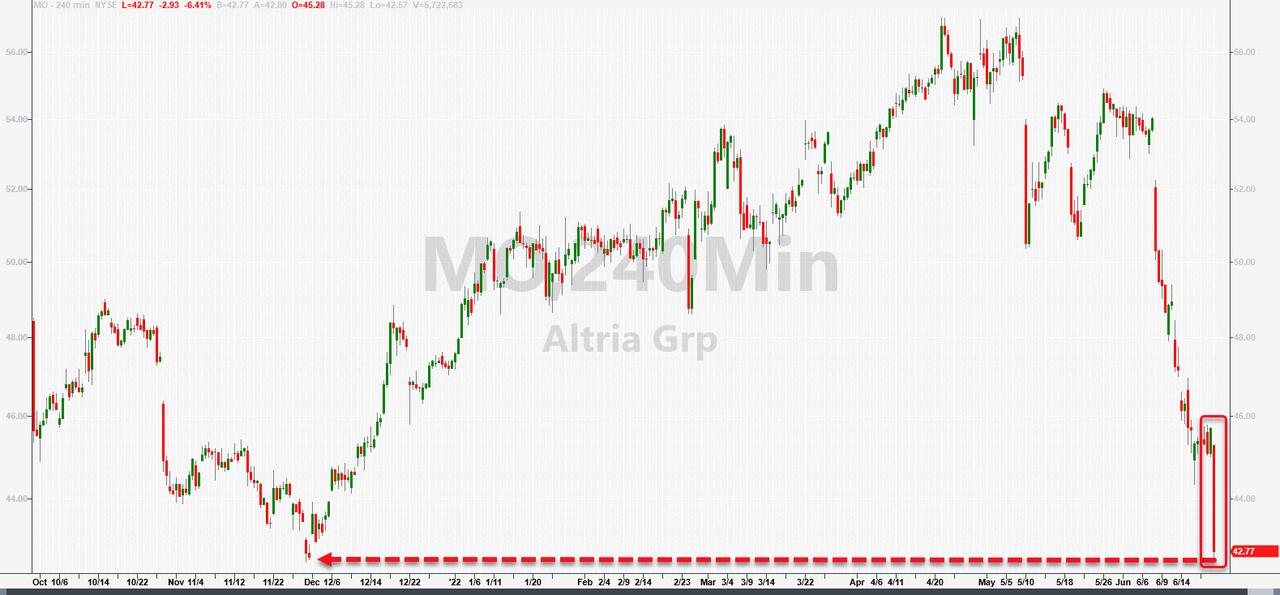
Altria (formerly Philip Morris Companies) acquired a 35% stake in Juul for $12.8 billion. Shares in Altria are down 7%, the lowest since December 2021. 

*Developing... 

https://www.zerohedge.com/markets/fda-order-juul-e-cigarettes-us-markets

Dudley on the Fed and Wile E. Coyote

 Former president of the Federal Reserve Bank of New York, and vice-chair of The Fed Bill Dudley has not been shy to express his real thoughts since he left the hallowed halls of groupthink.

In August 2019, he urged Fed Chair Powell to prevent Trump's re-election.

In June 2020, Dudley admitted The Fed's massive intervention during the COVID crash had created "a little bit of moral hazard in the sense you’re encouraging people to take on more debt."

In October 2020, the former FRBNY boss admitted The Fed was powerless and only Congress could save Americans now.

In November 2021, Dudley warned The Fed that "hope and pray" that inflation abates is not a strategy, warning, "if it waits, the economy could significantly overheat, requiring the Fed to jam on the brakes, precipitating an early recession."

Then lastly, in April 2022, the retired groupthinker admitted that "Financial conditions need to tighten. If this doesn’t happen on its own (which seems unlikely), the Fed will have to shock markets to achieve the desired response."

Which appears to be what they have done, and now, confirming what we have been saying since December, Dudley explains in his latest Bloomberg Op-Ed that The Fed is cornered and a hard landing for the economy is inevitable.

"While the Fed’s forecasts have become more plausible over time, I see several reasons to expect a much harder landing."

And after laying out those reasons, his conclusion is ominous...

"Much like Wile E. Coyote heading off a cliff, the US economy has plenty of momentum but rapidly disappearing support. Falling back to earth will not be a pleasant experience."

Read the full op-ed below: (emphasis ours)

If you’re still holding out hope that the Federal Reserve will be able to engineer a soft landing in the US economy, abandon it.  A recession is inevitable within the next 12 to 18 months.

In their latest set of projections, Fed officials laid out a benign scenario, in which the economy keeps growing at a moderate pace and unemployment increases only slightly, even as the central bank raises interest rates significantly to get inflation under control. While the Fed’s forecasts have become more plausible over time, I see several reasons to expect a much harder landing.

First, persistent price increases have forced the Fed to shift its focus from supporting economic activity to pushing inflation back down to its 2% objective. The central bank’s employment mandate is now subservient to its inflation mandate. This can be seen both in Chair Jerome Powell’s performance at last week’s press conference and in the June FOMC statement, which removed language that the labor market would “remain strong.” 

Second, the new focus on price stability will be relentless. Fed officials recognize that failing to bring inflation back down would be disastrous: Inflation expectations would likely become unanchored, necessitating an even bigger recession later. From a risk management perspective, better to act now, whatever the cost in terms of jobs and growth. Powell does not want to repeat the mistakes of the late 1960s and the 1970s.

Third, the current economic expansion is uniquely vulnerable to a sudden stop. In the short term, payroll growth, economic reopening and healthy balance sheets (supported by the vast fiscal stimulus of 2020 and 2021) should support demand, which in several sectors exceeds supply. For example, the two-year cumulative supply shortage in the motor vehicle sector likely amounts to several million units. As a result, it’ll take time and a considerable monetary policy tightening to reduce demand and for that to translate fully into weaker production of goods and services.

But when that time comes, the production adjustment is likely to be abrupt, due to tight financial conditions, restrictive fiscal policy and tapped-out household savings. The broad US equity market is down more than 20%, mortgage rates are up more than 2 percentage points and the dollar is up about 10% against a broad basket of foreign currencies (constraining U.S. exports). The Hutchins Center at the Brookings Institution estimates that fiscal policy shaved more than 3 percentage points off annualized US economic growth in the first three months of 2022 — a drag that is expected to persist through 2023. As inflation outstrips wage growth, the personal savings rate has plummeted, from 26.6% in March 2021 to 4.4% this April, significantly below its long-run average. No wonder consumer sentiment has fallen to levels last reached in the aftermath of the 2008 financial crisis, and Google searches for the word “recession” are hitting new records.

Finally, economic history points to a hard landing. The Fed has never tightened enough to push up the unemployment rate by 0.5 percentage point or more without triggering a recession. According to the Sahm rule, when this trigger is reached the next stop is a deeper slump, in which unemployment increases by at least 2 percentage points.

Much like Wile E. Coyote heading off a cliff, the US economy has plenty of momentum but rapidly disappearing support. Falling back to earth will not be a pleasant experience.

Given all that, we wonder what Mr Powell will say at this morning's Humphrey Hawkins testimony.

Remember, the weekend's talking points from Washington were that "recession is not inevitable."

https://www.zerohedge.com/economics/former-ny-fed-chief-welcome-recession