Search This Blog

Saturday, September 3, 2022

Think Biden’s student loan write-offs are unfair? Just take a look at the fine print

 President Joe Biden’s plan to instantly write off up to $20,000 in individual loans is bad enough, costing the taxpayers north of $300 billion — but the rest of his idea is even worse: He wants to the public to eat most all future student debt, too.

Yes, “Part 1” is horrifically unfair: Folks who chose not to take out such loans, or got them paid off, or never went to college at all, will be picking up the tab for college-educated borrowers with excellent incomes. Yet the rest of the scheme would make this injustice permanent.

Biden would roll back borrowers’ maximum monthly payment on undergrad loans to just 5% of “discretionary” income — and cut the amount of earnings considered “discretionary.” Then he’d wipe out all remaining debt after just 10 years for many borrowers.

The payment limit by itself is huge: The White House boasts it means “no borrower earning under 225% of the federal poverty level … will have to make a monthly payment” at all. And even those earning more than $50,000 right after graduating would face trivial payments — barely denting the principal before Biden sticks taxpayers with the bill.

In short, this is a recipe for nearly free “loans” for an ever-increasing number of people, courtesy of the general public. Until the public goes broke, that is. The Penn Wharton Budget Model estimates the full plan could drive total future costs toward $1 trillion.

Here’s the key problem, as Reason’s Robby Soave explains: The arrangement gives both universities and students an incentive to “screw the taxpayers.” Students wouldn’t care how much they borrowed, since they wouldn’t have to pay back more than 5% of their “discretionary” income for just 10 years, no matter how high the balance. Universities could then jack up tuition, knowing students could simply borrow more to cover the upcharge, and incur no additional cost to themselves. That’s crazy.

One possible way to contain the damage: cap tuition. Taxpayers would still wind up paying a fortune, but the system might not go haywire so quickly. Alas, Biden’s plan barely pays lip service to this idea: “Colleges have [a moral] obligation to keep prices reasonable and ensure borrowers get value for their investments” is all the White House says.

What a knee-slapper: As the fact sheet notes, inflation-adjusted tuitions have tripled over the past 40 years, and that’s largely because of government aid: With Uncle Sam chipping in, universities simply jacked up prices.

As for borrowers getting “value for their investment” — ha! Instead, many just get liberal mush that fails to win them jobs paying enough to repay their loans.

It’s works great for the left: Schools full of liberal faculty and staff rake in ever more cash while brainwashing kids to think like leftists, all with taxpayers footing the bill. Their only problem: It’s unsustainable.

And when it all comes crashing down, everyone suffers.

https://nypost.com/2022/09/03/think-bidens-student-loan-write-offs-are-unfair-just-take-a-look-at-the-fine-print/

FTC wants more information on Amazon's One Medical purchase

 The first Amazon deal made under new CEO Andy Jassy is getting Federal Trade Commission scrutiny.

In question is Amazon’s $3.9 billion acquisition of the primary health organization One Medical.

The investigation could delay the completion of the deal.

A request for additional information was received by both One Medical and Amazon on Friday in connection with an FTC review of the merger, according to a filing made with securities regulators by One Medical's parent, San Francisco-based 1Life Healthcare Inc.

In recent years, Amazon has been making a push into health care.

It purchased acquisition of the online pharmacy PillPack for $750 million in 2018.

Amazon announced plans in late July to buy One Medical, a concierge-type medical service with roughly 190 medical offices in 25 markets. 

Last week, the e-commerce giant said it would shut down its own hybrid virtual in-home care service called Amazon Care, a One Medical competitor, because it wasn’t meeting customers' needs.

TickerSecurityLastChangeChange %
AMZNAMAZON.COM INC.127.51-0.31-0.24%

Groups calling for stricter antitrust regulations quickly urged the FTC to block the One Medical merger, arguing it would further expand the company’s massive market power.

The FTC has already been investigating the sign-up and cancellation practices of Amazon Prime and has issued civil subpoenas in that case.

https://www.foxbusiness.com/markets/ftc-wants-binformation-amazons-one-medical-purchase

Newsom Reaped $10.6 M In Campaign Cash From 979 State Vendors Who Pocketed $6.2 B

 By Adam Andrzejewski, author of OpenTheBooks substack

California Governor Gavin Newsom has quietly solicited millions of dollars in campaign donations from state vendors, key people, employees, or their affiliated corporate political action committees.

While progressives decry corporate money in politics, Governor Gavin Newsom has embraced the highly unethical practice of soliciting campaign cash from state contractors.

Our auditors at OpenTheBooks.com found 979 state vendors who gave $10,561,828 in political donations to Newsom during his 2010, 2018, recall election, and 2022 election cycles. Meanwhile, these companies reaped $6,201,978,173 in state payments.
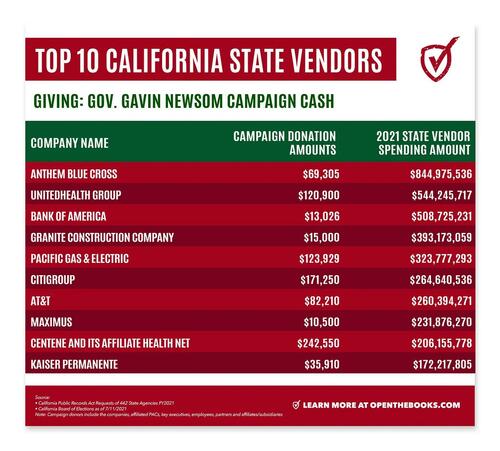
These donations represented the equivalent of more than 40-percent of the current cash on hand – $24 million – in the governor’s campaign committee as of 08/01/2022, according to disclosures.

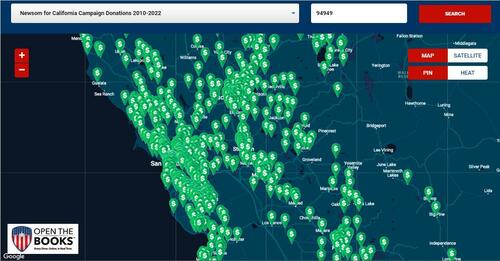
We created an interactive map displaying by ZIP Code all of the governor’s campaign contributions—by name and employer, amount donated, when, and where located – across America. Just click a pin (ZIP Code) and scroll down to see the results that render in the chart beneath the map.

Mapping campaign donations: Newsom For California Governor 2010, 2018, 2022:
We reached out to Newsom and his press secretary Daniel Lopez requesting comment — giving the governor a chance to defend his fundraising practice. We will update the piece if the Newsom responds on the record.

Since 1940, however, individuals and entities negotiating or working under federal contracts have been prohibited from giving political cash to federal candidates, parties, or committees. In California, however, this political patronage is perfectly legal (at least for now).

Here are some of the companies who gave campaign cash to Gov. Newsom and separately received state payments. In all these examples, the donations came from the organization itself or its executives, employees, subsidiaries, partners, or political action committees during Newsom’s 2010, 2018 and 2022 election cycles.

I. MAJOR HEALTH CARE COMPANIES – Gave $691,615 in campaign donations and received $1.9 billion in state payments.

  • Anthem Blue Cross (health insurance provider) received $844,875,535 in state payments while donating $69,305 during Newsom’s 2018 and 2022 elections— $40,000 of that was during the 2022 cycle.

  • UnitedHealth Group (managed health care and insurance provider) received $544,245,717 in state payments while donating $120,900 between the 2018 and 2022 cycles — $62,000 was donated in the 2022 cycle. Even the Chief Compliance Officer Joy Hia donated $500 to the 2022 campaign.

  • Centene Corporation (Fortune 500 managed care company) and Health Net, LLC, a major subsidiary, which provides health plans for those with Medicare and Medicaid, received $206,155,778 in state payments while donating $242,550. The company itself donated $121,800 while then-CEO Michael Neidorff gave $120,400 between 2018 and 2022. Not included is an additional $120,400 from wife Noemi Neidorff. Michael Neidorff passed away on April 7, 2022.

  • Kaiser Permanente received $172,217,805 while employees donated $35,910 including the vice president of government relations, Gary Cohen ($5,000 | 2018 election). Blue Shield of California received $74,283,100 in state payments while donating $102,550 including $70,200 from the company and $32,350 from key executives and employees. Masimo Corporation, a health-tech company, received $3,820,654 in state payments and gave $120,400 to Newsom’s 2018 and 2022 races – half of the donations came in 2022.

II. MAJOR UTILITY COMPANIES – Gave $405,601 in campaign donations and received $430,416,420 in state payments

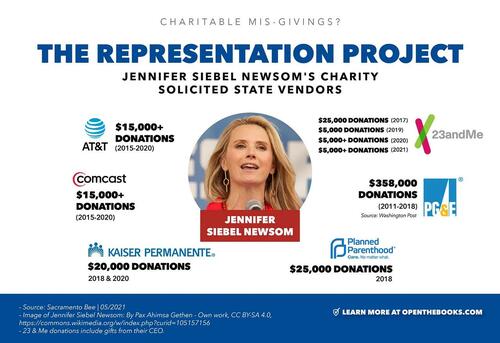
  • Pacific Gas & Electric Company (PG&E) based in San Francisco heavily criticized for its role in the California wildfires and recently came out of bankruptcy. The company received $323,777,292 in state payments (FY2021) and gave $123,929 in donations for the 2018 election. These donations included five and six figure gifts from five C-suite execs including CEO Geisha Williams ($10,000). Due to continuing scandals, Newsom stopped taking donations from PG&E after his election in 2018. The company also gave $358,000 between 2011-2018 to Newsom’s wife, Jennifer Siebel Newsom’s charity.

  • Edison International, with subsidiaries Southern California Edison and consultancy, Edison Energy, LLC, received $100,575,389 in state payments and gave $67,850 in campaign donations through the company, key employees, and staff. Additionally, the company’s trade association, Edison Electric Institute, donated $15,000 to Newsom’s 2018 race.

  • Calpine Corporation, the largest generator of electricity from natural gas and geothermal sources in the United States with 33 facilities in California received $3,134,154 in state payments and gave $109,822 in campaign donations. CEO Thad Hill gave $10,000 and other top execs gave $12,500 to Newsom.

  • California Water Service Company (Cal Water) received $2,121,724 in state payments and gave $94,000 between Newsom’s 2018 and 2022 campaigns.

  • California American Water Company, a subsidiary of American Water – the largest publicly-traded water and wastewater utility in the U.S. – received $807,861 in state payments and gave $10,000 through their employees PAC in the 2018 election. American Water also gave at least $5,000 to the governor’s wife’s charity in 2019.  

III. MAJOR TELECOM COMPANIES – Gave $241,959 in campaign donations and received $420.3 million in state payments

  • AT&T received $260,394,271 in state payments and donated $82,210 to Newsom’s 2018 campaign. Public affairs executive Ken McNeely donated $17,000 between the 2010 and 2018 campaigns and also co-chaired the 2019 Flip The Script Gala for The Representation Project, a non-profit founded by Gavin Newsom’s wife Jennifer Siebel Newsom.

  • Verizon received $130,184,875 in state payments and donated $46,700 with the majority of the donations ($45,000) through the company itself.

  • Telrite Holdings (Life Wireless) received $9,102,033 in state payments and donated $10,000 to the 2018 campaign. California operates its LifeLine, the free phone program for low-income residents.

  • Comcast received $20,627,409 in state payments and donated $103,049. The company itself gave $29,200. Employees gave $73,849 including senior executive vice president David Cohen, based in Philadelphia, who gave $29,200 to the 2018 election. The company also gave at least $15,000 to The Representation Project (Newsom’s wife’s charity).

IV. BIG LAW – top nine firms gave $198,142 in campaign donations and received $28.6 million in state payments

We found nine law firms that reaped $28,615,984 in state payments and gave $198,142 in campaign cash to the governor. These donations came the law firms, principals, partners, key employees, or staff.

Top donors included Nixon Peabody who gave $94,272 and received nearly $2.2 million in payments; Perkins Coie who gave $36,400 and received $1.4 million in payments; and Orrick Herrington & Sutcliffe donated $31,710 to Newsom and received $4.3 million in state payments. Others prominent firms backing the governor and receiving millions of dollars in state payments included: Loeb and Loeb ($11,850) and Munger Tolles & Olson ($5,750).

V. BIG BANKS – Gave $186,836 in campaign donations and received $781 million in state payments.

  • Bank of America received $508,725,231 in state payments while donating $13,026. $10,000 came through their state and federal political action committee in 2018 while $3,026 was donated by employees.
  • Citigroup received $264,640,535 in state payments while donating $147,050. CEO William Mills donated $24,600 to Newsom’s 2018 race. The Citigroup state political action committee donated $110,600 between the 2018 and 2022 races.
  • Wells Fargo received $7,578,648 in state payments while donating $26,760 to Newsom’s 2018 race – staff gave $21,760 and the bank’s PAC donated $5,000.

OTHERS

Two railway companies with quasi-marketplace monopolies reaped nearly $47,505,454 in state payments during fiscal year 2021 and gave $112,400 in campaign donations to Newsom since 2010. BNSF Railway Company received $40,411,142 in state payments and gave $26,200 between the 2018 and 2022 campaigns. Union Pacific Railway Company received $7,094,312 in state payments and gave $86,200 in the 2018 and 2022 elections.

Ten California based Native American tribes donated over $841,800 to Newsom’s campaign fund and their benefits are harder to quantify. Although those tribes received $8,753,578 in state payments (FY2021), their casinos are a highly regulated state business (in addition to many other interests before the state).
Jennifer Siebel Newsom’s non-profit loophole

While the governor was soliciting state vendors for campaign donations, Mrs. Newsom, the first partner, Jennifer Siebel Newsom, solicited state vendors for donations to her charity, The Representation Project.

Major corporations with state contracts or business before the state gave the charity five and six figure gifts. The Sacramento Bee and Washington Post previously identified the companies and today we know just how much those corporations reaped in state agency payments. (23 and Me is the only donor that wasn’t on the state vendor list, however, they had an interest in 2021 state legislation regulating the use of consumer genetic data.)

IRS 990 informational returns for The Representation Project show that Siebel-Newsom took $1.5 million in salary from 2013-2021 and another $1.6 million in payments to her private company, Girls Club Entertainment since 2012.

Summary

In all the examples identified above, no quid-pro-quo is alleged or implied; however, the patterns are troubling. In fact, the individual transactions are legal at arm’s length.

But that’s precisely the problem. Politicians preside over, in essence, a legalized money-recycling scheme aimed at monetizing incumbent political power.

Newsom didn’t answer our question as to whether soliciting state contractors for campaign cash was ethical. Meanwhile, California residents are left with skyrocketing taxes and an increasingly bleak future.

We can blame Governor Newsom, but he is just a reflection of today’s broken culture of public service.  

MethodologyWe matched companies donating to Newsom For California 2010, 2018, 2022, as disclosed by the California State Board of Elections, to state payment transactions from fiscal year 2021– which we compiled through 442 California Public Record Act requests. To the extent that the information contains government errors, our report will reproduce those errors. No quid pro quo or illegal activity by any elected official, company or individual referenced in this piece is implied or intended. Gavin Newsom was elected governor in 2019.

We have requested comment from the governor and The Representation Project, the first partner’s public charity.

ADDITIONAL READING

Over 50 Biden Admin Employees, 12 US Agencies In Social Media Censorship Push: Documents

 by Zachary Stieber via The Epoch Times (emphasis ours),

More than 50 officials in President Joe Biden’s administration across a dozen agencies have been involved with efforts to pressure Big Tech companies to crack down on alleged misinformation, according to documents released on Aug. 31.

Senior officials in the U.S. government, including White House lawyer Dana Remus, deputy assistant to the president Rob Flaherty, and onetime White House senior COVID-19 adviser Andy Slavitt, have been in touch with one or more major social media companies to try to get the companies to tighten rules on allegedly false and misleading information on COVID-19, and take action against users who violate the rules, the documents show.

In July 2021, for instance, after Biden said that Facebook was “killing people” by not combating misinformation effectively, an executive at Meta reached out to Surgeon General Vivek Murthy, a Biden appointee, to say that government and Meta teams met after the remarks “to better understand the scope of what the White House expects from us on misinformation going forward.”

The same executive later wrote to Murthy saying, “I wanted to make sure you saw the steps we took just this past week to adjust policies on what we are removing with respect to misinformation, as well as steps taken to further address the ‘disinfo dozen,'” including removing pages linked to the group.

The White House publicly pressured social media companies to take action against a group that officials dubbed the “disinformation dozen,” which a nonprofit claimed were producing the bulk of “anti-vaccine misinformation” on the platforms. Also in July 2021, Murthy said Facebook hadn’t done enough to combat misinformation.

Flaherty, director of digital strategy for the White House, told Slavitt and others in April 2021 that White House staff would be briefed by Twitter “on vaccine misinfo,” with the meeting including “ways the White House (and our COVID experts) can partner in product work,” according to one of the messages.

In another exchange that year, a Department of Treasury official working on “mis, dis, and mal-information” told Meta workers that the deputy Treasury secretary wanted to talk about “potential influence operations.”

In a text in February 2021, meanwhile, U.S. Cybersecurity and Infrastructure Security Agency (CISA) Director Jen Easterly wrote to another agency official that she was “trying to get us in a place where Fed can work with platforms to better understand the mis/dis trends so relevant agencies can try to prebunk/debunk as useful.”

The documents were part of a preliminary production in a lawsuit levied against the government by the attorneys general of Missouri and Louisiana, later joined by experts maligned by federal officials.

“If there was ever any doubt the federal government was behind censorship of Americans who dared to dissent from official Covid messaging, that doubt has been erased,” Jenin Younes, a lawyer with the New Civil Liberties Alliance who is representing some of the plaintiffs in the case, said in a statement. “The shocking extent of the government’s involvement in silencing Americans, through coercing social-media companies, has now been revealed.”

‘Censorship Enterprise’

Plaintiffs said the massive pressure campaign amounted to a “Censorship Enterprise” because it involved so many officials and agencies.

Government lawyers only identified 45 officials at five agencies—the Department of Homeland Security, CISA, the Centers for Disease Control and Prevention (CDC), the National Institute of Allergy and Infectious Diseases, and Murthy’s office—who communicated with social media companies on misinformation, although documents they produced showed others were involved, including officials at the Census Bureau and the Departments of Treasury and State.

Responses from the Big Tech companies also revealed more officials involved with the effort.

Meta has disclosed that at least 32 federal officials, including top officials at the White House and the Food and Drug Administration, were in communication with it about content moderation. Many of the officials weren’t identified in the response by the government.

YouTube disclosed 11 officials not divulged by the government and Twitter identified nine, including senior officials at the State Department.

The discovery provided so far demonstrates that this Censorship Enterprise is extremely broad,” plaintiffs said, adding later that “it rises to the highest levels of the U.S. Government, including numerous White House officials.”

Additionally, the FBI wasn’t identified even though the agency recently said, after Meta CEO Mark Zuckerberg revealed that the bureau reached out before the 2020 election, that it routinely issues communications to social media companies.

https://www.zerohedge.com/political/over-50-biden-administration-employees-12-us-agencies-involved-social-media-censorship

Monkeypox Vaccines: Q&A With the CDC's Agam Rao, MD

 Two vaccines are available for monkeypox. Vaccine expert Agam Rao, MD, medical officer in CDC's Poxvirus and Rabies Branch, answers questions about their effectiveness and dosing.

How effective is the smallpox vaccine against monkeypox, and how was it identified as potentially protective against monkeypox?

Smallpox is the illness that is caused by variola virus, a member of the genus Orthopoxvirus. Monkeypox virus is in that same genus. For viruses within the same genus, we expect that a vaccine against one will be effective against the other.

There are actually several different vaccines worldwide that are used for smallpox and other similar viruses. In the United States, we have two vaccines that are licensed for the prevention of smallpox: ACAM2000 and JYNNEOS. JYNNEOS happens to be licensed by the US Food and Drug Administration (FDA) for prevention of monkeypox as well.

We don't have any reason to believe that either of these vaccines would differ in effectiveness for monkeypox vs smallpox because the two viruses are related.

Do you have any data on how effective ACAM2000 and JYNNEOS are in preventing smallpox?

JYNNEOS is a new vaccine and therefore was not used during the eradication campaign for smallpox, so we don't have any real-world data on how effective it would be in preventing smallpox.

In terms of ACAM2000, its precursor, a drug called Dryvax, was used during the eradication campaign, and data indicated that it was 85% effective at preventing smallpox if it was given as postexposure prophylaxis within 4 days of an exposure. Even beyond that, if the drug was given up to 14 days after an exposure, it would then at least lessen the symptoms.

We don't have data about the real-world effectiveness of these vaccines to prevent monkeypox, particularly in this outbreak.

Have there been monkeypox cases in older individuals who had been given the smallpox vaccine?

There have been cases of people who have gotten monkeypox despite being vaccinated as children or being vaccinated in the past. Vaccine effectiveness probably wanes over time.

We are also aware of monkeypox cases in people who had received the JYNNEOS or ACAM2000 vaccine as part of the current outbreak. There's really no vaccine that's 100% effective. There are always going to be people who don't mount an appropriate immune response, either because they're immunocompromised or for any other reason.

What data did the FDA look at to approve JYNNEOS for the prevention of smallpox and monkeypox?

In addition to the FDA approving the vaccine, the Advisory Committee on Immunization Practices, which is a group of vaccine experts who assemble to provide guidance to the CDC director for national vaccine recommendations, also recommended the JYNNEOS vaccine for the prevention of Orthopoxvirus infection for people with occupational risk. This was in November of last year and was unrelated to the current outbreak.

They reviewed data that indicate that JYNNEOS was noninferior to ACAM2000 when it comes to the immune response that healthy people had after they received it. The safety considerations were also favorable in comparison to ACAM2000.

What is the CDC doing to determine how effectively the JYNNEOS vaccine protects against monkeypox?

We are rolling out a lot of vaccine effectiveness studies in various stages. The team that has been leading that effort has been proposing studies to various health departments. We're also thinking of ways to interview vaccine recipients to understand whether people who got the vaccine are getting the infection. This would be individuals who have received both doses of the JYNNEOS vaccine.

Have these interviews already started?

Not yet. It takes some time to figure out the methodology: what questions would make sense, the number of people included, and where would be a good place to conduct these interviews. They've been pitched to some specific areas and those places are very interested. We're taking it step by step. We hope to be able to have data within a month.

How can the smallpox vaccine help to abate monkeypox, and can it eradicate monkeypox as it once did smallpox?

Smallpox and monkeypox are different infections for a few reasons. Monkeypox is a zoonotic disease. What that means is that the virus lives in other animals and moves to humans. Variola virus, which causes smallpox, is really only spread from person to person, and it doesn't really live in another animal. With smallpox, we basically had to eradicate the illness in only humans. It took a lot of effort, a lot of planning, and just amazing work. It is really an amazing success story.

The challenge with monkeypox virus is that there are animals, probably small mammals in certain countries in central and west Africa, that are reservoirs — constant sources — of this virus. That makes it a lot harder to eliminate. We don't know which animals are the reservoirs, despite a lot of testing.

Is there any evidence that monkeypox has been transferred to any animals outside of Africa during the current outbreak?

There was a report in The Lancet in the past month of possible spread to a dog in France. This is the first known case in a dog and it's unknown if the dog could further spread the infection.

We have guidance on our CDC website about how to prevent spread to people's pets and spread to people's family members. The fewer people and animals infected, the better — and the less chance of it being a problem.

What is the evidence in the literature for using the intradermal dosing strategy recently approved by the FDA?

There's a publication by Dr Sharon Frey in the journal Vaccine that describes the immune response in people who've received the intradermal JYNNEOS vaccine compared with people who received the subcutaneous dose. In that study, patients had a similar immune response whether the dose was given intradermally or subcutaneously. Also, the scientific community has experience with other intradermal administration of vaccines. It's not a technique that is commonly used in the United States, but internationally there are several different vaccines that are administered intradermally. There are data about intradermal use resulting in an equally robust or possibly even a more robust response than a subcutaneous vaccine. So the data are certainly there for intradermal vaccines. The challenge is that it's not a common route of vaccination in the United States, so it requires a steep learning curve.

How long would it take to develop a monkeypox-specific vaccine, and is there anyone working on that?

The actual virus used in vaccines to protect against orthopoxviruses is called vaccinia virus. There's nothing specific to smallpox about that virus. It's just another virus in the Orthopoxvirus genus that can be turned into a vaccine. The vaccina virus vaccine should be effective against any virus in the group, including monkeypox.

https://www.medscape.com/viewarticle/980134

Keytruda Plus T-VEC Falls Short in Unresectable Melanoma

 Pembrolizumab (Keytruda) plus intratumoral talimogene laherparepvec (T-VEC, Imlygic) did not significantly improve survival in unresectable melanoma as compared with pembrolizumab alone, an international phase III trial showed.

Although the combination improved median progression-free survival (PFS) by almost 6 months (14.3 vs 8.5 months), the difference did not achieve statistical significance (P=0.13). Median overall survival (OS) had yet to be reached in the combination arm as compared with a median of 49.2 months with pembrolizumab and placebo (P=0.74).

Analyses involving three prespecified subgroups -- U.S. patients, patients with lower baseline lactate dehydrogenase (LDH), and those with smaller baseline tumor volume -- all favored the combination, Jason A. Chesney, MD, PhD, of the University of Louisville Brown Cancer Center in Kentucky, and colleagues wrote in the Journal of Clinical Oncology.

"Although the combination of T-VEC-pembrolizumab did not result in OS benefit compared with placebo-pembrolizumab in the frontline treatment of advanced melanoma, this combination is still under active investigation in patients who are refractory to anti-PD-1 inhibitor therapy for melanoma and other tumor types," the authors noted in their concluding comments.

The MASTERKEY-265 trial included a phase Ib single-arm study that evaluated the pembrolizumab-T-VEC combination in 21 patients with advanced melanoma. The results showed an objective response rate (ORR) of 62%, including complete responses (CRs) in 43% of the patients. The results supported the decision to proceed with a phase III randomized trial to compare pembrolizumab plus T-VEC versus pembrolizumab and placebo.

MASTERKEY-265 probably provided a patient population more similar to real-world clinical practice, said Jeffrey Weber, MD, PhD, of NYU Langone Health in New York City, who wasn't involved with the study.

"As they say in the U.K., 'there's been many a slip twixt cup and lip,' and the phase III population was a better assessment of a real world population, in which there was likely a higher disease burden and thus less chance for an inflamed tumor to have an impact on the remaining disease," Weber told MedPage Today via email.

The finding that lower-risk patients -- lower baseline LDH and disease burden -- benefited more from the combination support that viewpoint, he added.

The phase III trial limited enrollment to patients with previously untreated histologically confirmed stage IIIB-IV M1c unresectable melanoma. Investigators in 21 countries randomized 692 patients 1:1 to the two treatment arms, which had well-balanced baseline characteristics.

The trial had dual primary endpoints of PFS and OS. Median follow-up to the primary PFS analysis was 25.58 months and 31 months for the primary OS analysis.

The 5.8-month difference in median PFS in favor of the combination represented a 14% reduction in the risk for progression or death (95% CI 0.71-1.04).

About 23% of patients were enrolled in the U.S. A prespecified analysis of that subgroup revealed a 41% reduction in the hazard in favor of the combination (95% CI 0.37-0.92). Results also favored the combination for patients with baseline LDH at or below the upper limit of normal (HR 0.76, 95% CI 0.59-0.99) and patients with baseline sum of the longest diameters (SLD) of target lesions at or below the median value (HR 0.70, 95% CI 0.51-0.96).

The OS analysis yielded a hazard ratio of 0.96 for the combination versus placebo (95% CI 0.76-1.22). In contrast to the PFS results, analysis of the prespecified subgroups did not show improvement in OS with the combination.

Tumor response to treatment was a secondary endpoint. The ORR, CR, and durable response rate were 48.6%, 17.9%, and 42.2% with the combination, respectively, and 41.3%, 11.6%, and 34.1% with pembrolizumab-placebo.

Adverse events were consistent with the know side effects of T-VEC and pembrolizumab. Grade ≥3 adverse events occurred in 20.7% of patients in the combination arm and 19.5% of patients in the placebo group.

In their discussion, the authors reviewed several possible explanations for the lack of significant benefit with pembrolizumab-T-VEC. They suggested that the pivotal trial that led to FDA approval of T-VEC probably included patients with less aggressive disease characteristics. Additionally, the administration schedule for T-VEC was modified in MASTERKEY-265 to align with pembrolizumab dosing.

The difference in PFS among U.S.-enrolled patients probably reflected the larger number of U.S. patients with LDH ≤ the upper limit of normal and lower SLD as compared with non-U.S. patients.

MASTERKEY-265 had a low incidence of pseudoprogression as compared with the pivotal trial that led to T-VEC approval. The lower rate of pseudoprogression approximated the rate observed with single-agent pembrolizumab.

The authors also noted that the control arm performed better as compared with historical data with single-agent pembrolizumab. For example, the 2-year OS for pembrolizumab-placebo was 66% as compared with 58% and 60%, respectively, in the KEYNOTE-006 and KEYNOTE-001 trials.

The results of MASTERKEY-265 should be sufficient to end the evaluation of T-VEC with immune checkpoint inhibitors, said Weber.

"I thought it was a well done study. They definitively answered the question of whether T-VEC added to the benefit of PD-1 blockade," he said. "Not that it's a limitation, but pembro is a very effective drug, so doing better set a high bar."


Disclosures

The study was supported by Amgen and Merck.

Chesney disclosed relationships with Amgen, Replimune, Iovance Biotherapeutics, and Bristol Myers Squibb. Other co-authors also reporter disclosures.

Link between COVID-19 and serotonin cells in the gut discovered

 New findings from Flinders University have demonstrated a molecular link between COVID-19 and serotonin cells in the gut.

The research could help provide further clues to what could be driving COVID-19 infection and disease severity and supports previous evidence that antidepressants, known as selective serotonin reuptake inhibitors (SSRIs), could reduce the severity of COVID symptoms.

COVID-19 displays an array of symptoms, which can regularly include gastrointestinal issues such as diarrhoea. Recent research has indicated that these gut symptoms in COVID-19 patients worsen with the severity of the disease, and this is linked to heightened gut-derived serotonin, released to cause gut dysfunction, increasing the body's immune response and potentially worsening patient outcomes.

Published in the world's leading gastrointestinal research journal Gut, this new collaborative study involved three Flinders research teams, including teams led by ARC DECRA Fellow Dr Alyce Martin and FAME Director of Bioinformatics and Human-Microbe Interactions, Professor Robert Edwards.

"Our study endeavoured to understand whether the gut could be a site of disease transmission and what genes might be associated with the virus entering the cells lining the gut wall," says study senior author Professor Damien Keating, Deputy Director of the Flinders Health and Medical Research Institute and Head of the Gut Sensory Systems research group.

The researchers looked at gene expression amongst the different cell types that line the gut wall, analysing whole genome sequences from thousands of individual cells from within the intestine.

They found specialised cells within the gut that synthesised and released serotonin had a highly enriched expression of a particular SARS-CoV-2 receptor and were the only type of cell that expressed all the genes associated with COVID-19.

"Many genes linked to COVID-19 were found expressed in the different cell types lining the gut wall but only serotonin cells expressed all three receptors for the virus," says Professor Keating.

"Expression of all three SARS-CoV-2 receptors triples the rate of cell infectivity, compared to expression of only two receptors."

With the exact sites of infection and the primary drivers of COVID-19 disease severity not yet fully understood, the authors say this study provides important information on the gut's role in the virus.

"Our study adds further evidence that COVID-19 is far more likely to infect cells in the gut and increase serotonin levels through direct effects on specific gut cells, potentially worsening disease outcomes," says Professor Keating.

"It also provides further support to emerging clinical evidence that antidepressant drugs, which block serotonin transport around the body, may serve as a beneficial treatment.

"As COVID-19 continues to circulate, further research will be required to advance our understanding of the gut's role in this virus and continue to find treatment options to work alongside vaccinations."

The paper 'Single-cell gene expression links SARS-CoV-2 infection and gut serotonin' by Alyce M Martin, Michael Roach, Lauren A Jones, Daniel Thorpe, Rosemary A Coleman, Caitlin Allman, Robert Edwards and Damien J Keating is published in the journal Gut. The research was supported by grants from the Australian Research Council.


Story Source:

Materials provided by Flinders UniversityNote: Content may be edited for style and length.


Journal Reference:

  1. Alyce M Martin, Michael Roach, Lauren A Jones, Daniel Thorpe, Rosemary A Coleman, Caitlin Allman, Robert Edwards, Damien J Keating. Single-cell gene expression links SARS-CoV-2 infection and gut serotoninGut, 2022; gutjnl-2022-328262 DOI: 10.1136/gutjnl-2022-328262