Search This Blog

Saturday, October 8, 2022

Positive Trial Sets the Alzheimer’s World Abuzz. I'm Not Convinced

 You may have heard: AN ALZHEIMER’S DRUG ACTUALLY HAD A POSITIVE TRIAL!!! The news on Biogen/Eisai’s lecanemab was “exciting,” “shocking,” or at least “promising,” depending on your media outlet of choice. However, just because we set the bar almost impossibly low after the train wreck of the FDA’s approval for Biogen’s similar Alzheimer’s med, Aduhelm, I don’t think we should be pumping up the hype machine for this modestly positive outcome with lecanemab. I very much doubt your grandma will ever end up benefiting from this medication.

I am not alone with my concerns; many have pointed out the questions swirling around this trial (note — I am neither confirming nor denying that this picture was taken of me this morning after my wife’s alarm went off at 5:15AM):

The biggest question involves whether the modest improvement seen in the 1,800-patient trial is clinically meaningful. Yes, it was statistically significant; the trial was large and adequately powered to find a small difference between the lecanemab group and placebo. However, I could probably dream up a modestly effective blood pressure medication that requires an IV infusion every two weeks, test it on 1,800 people with high blood pressure, and find that it reduces mean systolic blood pressure by 3 points, with a confidence interval from 2.5 to 3.5 — but that doesn’t mean the juice would be worth the squeeze.

All we have to go on at this point are Biogen’s “topline” results. A press release is not the best way to absorb medical trial data; think skimming the cream off the “top” of a trial’s data and not worrying about all that sour buttermilk left behind. It’s a means to pump up regulators, shareholders, and future partners (i.e., physicians and their patients) before we get to comb through the rest of the messy data later, and set positive expectations early. So, to remind everyone: the modest 27% improvement reported is Biogen’s best shot at promoting their product. What about linked secondary outcomes like cognitive scores and brain scans which were only disclosed to be statistically significant without further details? I am going out on a limb to guess that when the Big Reveal comes next month at the Clinical Trials on Alzheimer's Congress, they are going to be even less exciting, shocking, and promising.

Given that perspective, just how “promising” were these results? The study employed the catchily-termed Clinical Dementia Rating - Sum of Boxes (“CDR-SB”) as their measurement tool for the primary study outcome. This is not a “hard” outcome like blood pressure or tumor size which can be objectively measured; it is a sum of subjective ratings based on a clinician interviewing a patient (and their family members). While not a tool I use in my clinical practice, there seems to be fairly broad agreement amongst neurologists that a drop of 1-2 points has practical significance, and a relative improvement of 0.5-1 points implies clinical utility. This score declined about 1.7 points for the placebo group over the 18 months of the study; in other words, their dementia worsened to a significant degree. Those receiving lecanemab? They dropped about 1.25 points, so their dementia also worsened significantly, just by 0.45 points less. Yes, two IV infusions at grandma’s friendly neighborhood infusion center every month — 36 trips over a year and a half — all for the questionable benefit of a not-quite-clinically-significant reduced loss of cognitive function.

Raise your hand if you’ve ever had to take a demented relative to the doctor or hospital. Fun stuff for everyone, right? Twice a month is rather a lot; twice as much as Aduhelm promised, in fact. And each visit has the added adventure of not just your average trip to the doctor, but includes an IV start, and keeping grandma still until the infusion is over — no picking at that catheter allowed!

For this periodic unpleasantness, we also get some serious safety concerns. Aduhelm had a far worse safety profile, but lecanemab is not clear of worry. Data on tolerability was not released, but the known class effect of these anti-amyloid medicines is something called Amyloid Related Imaging Abnormalities, either involving brain edema (“ARIA-E”) or small hemorrhages (“ARIA-H”). ARIA-E and ARIA-H are thought to be related to breakdown of the blood-brain barrier from this class of medications. The press release told us this:

Uh, okay. Over 20% of participants receiving lecanemab had this adverse event detected — but no worries, since it “was within expectations!”

While the majority of those affected lacked symptoms like headache, dizziness, or confusion, left unanswered is what these radiologic findings would lead to over a prolonged course of time. Given that microhemorrhages from a disease like cerebral amyloid angiopathy are strongly associated with dementia, the long-term outcome for the asymptomatic majority might not be great, either.

We’re also left with the dilemma of what to do with this information for those affected. Here is the protocol described from the Aduhelm trials for managing these findings, which, again, affected over 20% of those receiving lecanemab:
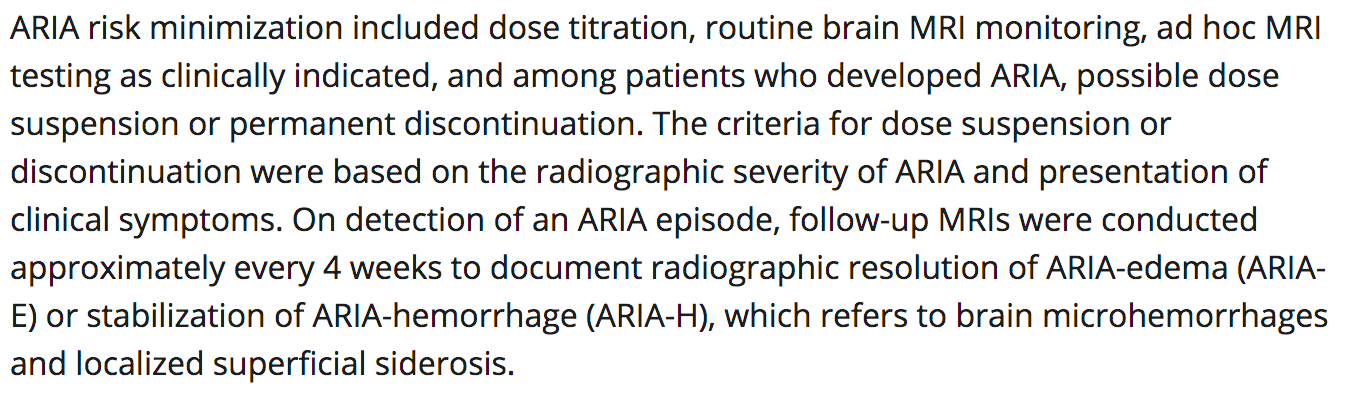
Monthly brain MRIs until resolution? A brain MRI involves lying very still in an enclosed scanner for over half an hour. More relaxing down time for grandma. They also cost north of $1000 in my neck of the woods.

Which brings us to one last problem with all this professed enthusiasm for lecanemab. Cost. The numbers being bandied about are well lower than originally pronounced, likely due to Medicare’s unwillingness to shell out for Aduhelm after the FDA’s inexplicable approval of that anti-amyloid medication. However, $10,000-$35,000 per year is a massive potential expenditure when one considers that over 6 million Americans are thought to be living with dementia. Broad adaption of lecanemab could add a number with a lot of zeroes after it to our Medicare budget.

Of course, my skepticism could end up being misplaced. We don’t have the data, but it’s possible that humble divergence between placebo and lecanemab groups was growing at 18 months, and might continue to grow at 3 or 5 years and amount to a real difference. If people are treated early in their disease course, when CDR-SB scores are lower, and small changes are more meaningful, lecanamab’s impact would be greater. It’s also possible that targeting, or excluding, patients with the known Alzheimer’s genetic risk factor, APOE ε4, might improve results (although APOE ε4 carriers also are most prone to ARIA when treated, so that could get complicated). These things are possible, and lecanemab could end up being a moderately useful drug when the dust clears.

However, I don’t think that’s likely. It’s more likely these results will be the best we will ever see, much like Aduhelm had one positive study, with nearly identical results to lecanemab’s, before the next trial flopped. If patients were able to detect whether they got the active medication through side effects, or certainly if they were told they had imaging abnormalities, their perceptions and those of the clinicians interviewing them might have changed enough to skew their (subjective) CDR-SB scores that small amount.

It’s important to remember that the reason why everyone voiced terms like “shocking” and “unexpected” for these results was that this whole approach to Alzheimer’s has been in question given a decades-long track record of failure to record clinical wins. Some are describing this trial as “proof” of the “amyloid hypothesis” — that amyloid plaques are the primary pathology behind Alzheimer’s dementia. However, it remains quite possible that this trial was a one-off anomaly, and trying to reduce the burden of amyloid plaques will never lead us to the Promised Land of curing Alzheimer’s. I’ll add that my confidence in this field was certainly not enhanced by the recent allegations that a whole subset of research on the amyloid hypothesis had actually been faked.

The big picture is that Alzheimer’s dementia is most likely a highly complex and individually variable inter-related mix, including genetic influences, metabolic and cardiovascular disease, psychologic health, and neuroinflammation. Beta-amyloid proteins folding up into plaques probably fits in there somewhere. Harnessing antibodies to erase amyloid plaques long after their creation is probably not the Holy Grail medicine seeks.

Dr. Dale Bredesen, Director of the Alzheimer's Disease Research Center at UCLA, rightfully has taken a lot of heat for his confident (and expensive) program for treating Alzheimer’s dementia naturally. Presenting small studies without control groups and asserting that nearly all participants actually improve their cognitive status by following his mostly common-sensical regimen of improving sleep and diet, exercising regularly, correcting thyroid and B-12 imbalances, etc. is a country mile from real science. That said, could changes of that nature be implemented with less effort than dragging a demented parent to an infusion center 36 times in 18 months, at a fraction of the $200,000+ price tag of lecanemab? Absolutely. Might those people have declined modestly less than the placebo group, too?

I’d bet on it. And, stock price be damned, I’d bet against lecanemab.


https://doctorbuzz.substack.com/p/a-positive-trial-sets-the-alzheimers

How Insurers Exploited Medicare for Billions

 The health system Kaiser Permanente called doctors in during lunch and after work and urged them to add additional illnesses to the medical records of patients they hadn’t seen in weeks. Doctors who found enough new diagnoses could earn bottles of Champagne or a bonus in their paycheck.

Anthem, a large insurer now called Elevance Health, paid more to doctors who said their patients were sicker. And executives at UnitedHealth Group, the country’s largest insurer, told their workers to mine old medical records for more illnesses — and when they couldn’t find enough, sent them back to try again.

Each of the strategies — which were described by the Justice Department in lawsuits against the companies — led to diagnoses of serious diseases that might have never existed. But the diagnoses had a lucrative side effect: They let the insurers collect more money from the federal government’s Medicare Advantage program.

Medicare Advantage, a private-sector alternative to traditional Medicare, was designed by Congress two decades ago to encourage health insurers to find innovative ways to provide better care at lower cost. If trends hold, by next year, more than half of Medicare recipients will be in a private plan.

But a New York Times review of dozens of fraud lawsuits, inspector general audits and investigations by watchdogs shows how major health insurers exploited the program to inflate their profits by billions of dollars.

The government pays Medicare Advantage insurers a set amount for each person who enrolls, with higher rates for sicker patients. And the insurers, among the largest and most prosperous American companies, have developed elaborate systems to make their patients appear as sick as possible, often without providing additional treatment, according to the lawsuits.

As a result, a program devised to help lower health care spending has instead become substantially more costly than the traditional government program it was meant to improve.

Eight of the 10 biggest Medicare Advantage insurers — representing more than two-thirds of the market — have submitted inflated bills, according to the federal audits. And four of the five largest players — UnitedHealth, Humana, Elevance and Kaiser — have faced federal lawsuits alleging that efforts to overdiagnose their customers crossed the line into fraud.

The fifth company, CVS Health, which owns Aetna, told investors its practices were being investigated by the Department of Justice.

In statements, most of the insurers disputed the allegations in the lawsuits and said the federal audits were flawed. They said their aim in documenting more conditions was to improve care by accurately describing their patients’ health.

Many of the accusations reflect missing documentation rather than any willful attempt to inflate diagnoses, said Mark Hamelburg, an executive at AHIP, an industry trade group. “Professionals can look at the same medical record in different ways,” he said.

The increased privatization has come as Medicare’s finances have been strained by the aging of baby boomers. But for insurers that already dominate health care for workers, the program is strikingly lucrative: A study from the Kaiser Family Foundation, a research group unaffiliated with the insurer Kaiser, found the companies typically earn twice as much gross profit from their Medicare Advantage plans as from other types of insurance.

For people choosing between traditional Medicare and Medicare Advantage, there are trade-offs. Medicare Advantage plans can limit patients’ choice of doctors, and sometimes require jumping through more hoops before getting certain types of expensive care.

But they often have lower premiums or perks such as dental benefits — extras that draw beneficiaries to the programs. The more the plans are overpaid by Medicare, the more generous to customers they can afford to be.

“Medicare Advantage is an important option for America’s seniors, but as Medicare Advantage adds more patients and spends billions of dollars of taxpayer money, aggressive oversight is needed,” said Sen. Charles Grassley, R-Iowa, who has investigated the industry. The efforts to make patients look sicker and other abuses of the program have “resulted in billions of dollars in improper payments,” he said.

Many of the fraud lawsuits were initially brought by former employees under a federal whistleblower law that allows them to get a percentage of any money repaid to the government if their suits prevail. But most have been joined by the Justice Department, a step the government takes only if it believes the fraud allegations have merit. Last year, the department’s civil division listed Medicare Advantage as one of its top areas of fraud recovery.

In contrast, regulators overseeing the plans at the Centers for Medicare and Medicaid Services, or CMS, have been less aggressive, even as the overpayments have been described in inspector general investigations, academic research, Government Accountability Office studies, MedPAC reports and numerous news articles, over the course of four presidential administrations.

Congress gave the agency the power to reduce the insurers’ rates in response to evidence of systematic overbilling, but CMS has never chosen to do so. A regulation proposed in the Trump administration to force the plans to refund the government for more of the incorrect payments has not been finalized four years later. Several top officials have swapped jobs between the industry and the agency.

CMS officials declined interview requests. In a statement, the CMS administrator, Chiquita Brooks-LaSure, said the agency recently sought feedback on how to improve the program.

Some critics say the lack of oversight has encouraged the industry to compete over who can most effectively game the system rather than who can provide the best care.

“Even when they’re playing the game legally, we are lining the pockets of very wealthy corporations that are not improving patient care,” said Dr. Donald Berwick, a CMS administrator under the Obama administration, who recently published a series of blog posts on the industry. “When you skate to the edge of the ice, sometimes you’re going to fall in.”

The program’s promise

Congress’ first attempt to design a privatized Medicare plan paid insurers the same amount for every patient with similar demographic characteristics.

In theory, if the insurers could do better than traditional Medicare — by better managing patients’ care, or otherwise improving their health — their patients would cost less and the insurers would make more money.

But some insurers engaged in strategies — such as locating their enrollment offices upstairs or offering gym memberships — to entice only the healthiest seniors, who would require less care, to join. To deter such tactics, Congress decided to pay more for sicker patients.

Almost immediately, companies saw ways to exploit that system. The traditional Medicare program provided no financial incentive to doctors to document every diagnosis, so many records were incomplete. Under the new program, insurers began rigorously documenting all of a patient’s health conditions — say, depression or a long-ago stroke — even when they had nothing to do with the patient’s current medical care.

Kaiser, which both runs a health plan and provides medical care, is often seen as a model system. But its control over providers gave it additional leverage to demand additional diagnoses from the doctors themselves, according to the lawsuit.

“The cash monster was insatiable,” said Dr. James Taylor, a former coding expert at Kaiser who is one of 10 whistleblowers to accuse the organization of fraud.

At meetings with supervisors, he was instructed to find additional conditions worth tens of millions of dollars. “It was an actual agenda item and how could we get this,” Taylor said.

Inaction at Medicare

Even before the first lawsuits were filed, regulators and government watchdogs could see the number of profitable diagnoses escalating. But Medicare has done little to tamp down overcharging.

Several experts, including Medicare’s advisory commission, have recommended reducing all the plans’ payments. Congress has ordered several rounds of cuts and gave CMS the power to make additional reductions if the plans continued to overbill. The agency has not exercised that power.

The agency does periodically audit insurers by looking at a few hundred of their customers’ cases. But insurers are fined for billing mistakes found only in those specific patients. A rule proposed during the Trump administration to extrapolate the fines to the rest of the plan’s customers has not been finalized.

Few analysts expect major legislative or regulatory changes to the program.

“Medicare Advantage overpayments are a political third rail,” said Dr. Richard Gilfillan, a former hospital and insurance executive and a former top regulator at Medicare, in an email. “The big health care plans know it’s wrong, and they know how to fix it, but they’re making too much money to stop. Their CEOs should come to the table with Medicare as they did for the Affordable Care Act, end the coding frenzy, and let providers focus on better care, not more dollars for plans.”

https://www.yahoo.com/news/cash-monster-insatiable-insurers-exploited-162553795.html

Would Lecanemab Be Right for My Alzheimer's Patient?

 Two patients were on my mind in geriatric consult clinic when I read a news release sharing the preliminary clinical trial results for lecanemab, a new monoclonal antibody against amyloid protein. Mrs. B is an 80-year-old retired librarian with hypertension, diet-controlled diabetes, and a history of stroke, whom I diagnosed with Alzheimer's dementia with possible vascular contributions. In contrast, Mr. S is a 64-year-old civil engineer who stopped working as he could not problem-solve like he did in the past. After unremarkable labs and brain MRI, I diagnosed him with most likely early-onset Alzheimer's disease.

If FDA approved, who should get lecanemab? Mr. S or Mrs. B? Both? Or neither?

Clinical Trial Results

Lecanemab targets the abnormal protein called amyloid, which according to the amyloid hypothesis, is at least one of the mechanisms causing Alzheimer's disease. The lecanemab phase III clinical trial, known as Clarity AD, enrolled 1,906 people living with mild cognitive impairment or mild Alzheimer's dementia. Of its participants, 25% are Black or Hispanic. It met its primary outcome in that compared to placebo, those randomized to the lecanemab arm had a 0.45-point difference on an 18-point scale called the Clinical Dementia Rating Scale-Sum of Boxes (CDR-SB). For context, a CDR-SB of 0.5 might mean that someone is having a little bit of cognitive impairment, but they are still able to maintain their daily functions. A CDR-SB of 1 might mean that someone is starting to need assistance with some of the more difficult instrumental activities of daily living, such as managing their medications or finances, but they're still able to do most of their daily activities.

Main side effects of amyloid-related imaging abnormalities (ARIAs) were 21.3% in the lecanemab group versus 9.3% in the placebo group. The trial was blinded at multiple levels: the participants, the people conducting the study, and the people who measured outcomes, none of them knew which arm the participant was assigned to. Full results are still pending for release in the next few months.

The Broader Context

In order to understand lecanemab, which is being developed by Biogen and Eisai, we have to talk about the context of Alzheimer's drug development. A similar drug, aducanumab (Aduhelm) was developed by Biogen and FDA approved last year. Aducanumab is similarly a monoclonal antibody against amyloid, but with a slightly different mechanism compared to lecanemab. The FDA approval process was highly controversial. There is a congressional investigation into the relationship between Biogen and the FDA that is currently ongoing. Medicare decided to not pay for aducanumab outright, but will only pay for participants in additional CMS-approved studies. In addition, just last week, Biogen settled a lawsuit for $900 million after a whistleblower within Biogen said the company was paying kickbacks to induce physicians to prescribe the company's multiple sclerosis drugs.

Even after the full Clarity AD trial results are published, there will still be many questions to be answered before it can be approved and before clinicians can determine if and whom to prescribe it to. Let's break the questions down by category:

Eligibility

Who truly has amyloid in the brain?

Even dementia specialists are not always correct when they diagnose someone as having clinical Alzheimer's disease. Patients' history may suggest that it's a slow progressing disease that started out with short-term memory problems first, but their brains may not show amyloid pathology. The reverse is also true: atypical history and exam findings for Alzheimer's disease may have amyloid pathology. We think that amyloid builds up for decades before people start having symptoms, but amyloid is not the only possible pathway to the clinical presentation of Alzheimer's disease. In our typical older population, there is significant overlap with vascular disease, such as Mrs. B's case above. Right now, Medicare only pays for an amyloid PET scan under an approved clinical trial. If lecanemab is FDA approved and if it is covered by insurance, there also needs to be broader coverage of an amyloid biomarker test.

How broadly will lecanemab be applicable?

The Clarity AD clinical trial excluded people who have significant, vascular risk factors such as strokes or those with high risk of brain bleeds, those with significant psychiatric illness, and other possible alternatives for memory loss. Mrs. B would not be eligible based on the clinical trial enrollment criteria due to her history of strokes.

Treatment Monitoring and Side Effects

The main side effect of ARIA is basically two phenomena that are detected on brain MRI. ARIA-edema indicate small areas of swelling in the brain, while ARIA-hemorrhage indicate small areas of bleeding in the brain. Most of these ARIAs are asymptomatic, meaning that it's only seen on MRI, but it raises the question of how often doctors will actually need to scan people who are receiving lecanemab in the real world. While most ARIAs are asymptomatic, in some cases symptoms could range from minor (headaches or confusion) to severe (seizures or brain bleeds).

We know that amyloid protein can build up for decades in someone's brain before they have symptoms, but we don't know how long the drug can be given safely, and the trial lasted only 18 months. Lecanemab is an infusion that is given once every 2 weeks, but does that mean that someone like Mr. S, who is only 64, will need to be on lecanemab for the rest of his life?

Cost

We don't know how much Biogen/Eisai will charge for lecanemab. When aducanumab was approved by the FDA last year, the initial price was $56,000 per year. Interestingly, when few bought aducanumab, Biogen put it on a 50% off sale, pricing it at $28,000, which is still a significant amount.

What would broad Medicare coverage for lecanemab mean for our healthcare system? Medicare increased premiums in 2022 due to the possibility of paying for aducanumab (though then reduced premiums after CMS' coverage decision). What about families and people living with dementia who are beyond the mild stage of disease, when they most need support and guidance navigating through the healthcare system through comprehensive dementia care?

Lecanemab is an exciting new development, but the full results have yet to be released and the reality will be much more complicated when expanding lecanemab from a clinical trial to the larger population.

Mia Yang, MD, MS, is a geriatrician/internist at Atrium Health Wake Forest Baptist in Winston-Salem, North Carolina. She hosts a podcast called "Ask Dr. Mia: Conversations on Aging Well." The opinions expressed are the author's and do not represent those of any institution or company with which she is affiliated.

Disclosures

Yang receives funding from NIH and the Patient-Centered Outcomes Research Institute, unrelated to Alzheimer's disease drug therapies.


https://www.medpagetoday.com/opinion/second-opinions/101113

Survival No Better With Intensive Surveillance in Endometrial Cancer

 An intensive surveillance regimen for endometrial cancer did not improve overall survival (OS) over a minimalist regimen, even in high-risk patients, results from the randomized TOTEM trial showed.

After a median follow-up of 69 months, the 5-year OS rate was 90.6% with the intensive approach versus 91.9% with the minimalist approach, which mainly included physical examinations (HR 1.13, 95% CI 0.86-1.50, P=0.380), reported Elisa Piovano, MD, PhD, of AOU Città della Salute e della Scienza di Torino, Ospedale Sant'Anna in Torino, Italy, and colleagues.

When broken down into groups of low- and high-risk patients, the estimated 5-year OS rates with the intensive versus minimalist regimens for low-risk patients were 94.1% and 96.8% (HR 1.45, 95% CI 0.91-2.33, P=0.121), and 85.3% and 84.7%, respectively, for high-risk patients (HR 0.99, 95% CI 0.69-1.40, P=0.936), they noted in the Journal of Clinical Oncology.

"These results, on the basis of a large, pragmatic, multicenter trial, have a high degree of statistical robustness and transferability to clinical practice," Piovano and team wrote. "According to available evidence, there is no reason to routinely add vaginal cytology, laboratory, or imaging investigations to the minimalist regimens used in this trial."

As for secondary outcomes, the 5-year relapse-free survival rate was 90.7% in the intensive regimen arm and 93.7% in the minimalist arm (HR 1.17, 95% CI 0.92-1.48, P=0.194). The hazard ratios were 1.35 (95% CI 0.91-1.99) and 1.07 (95% CI 0.80-1.44) in the low- and high-risk groups, respectively.

In an editorial accompanying the study, Anna L. Beavis, MD, MPH, and Amanda N. Fader, MD, both of the Johns Hopkins School of Medicine in Baltimore, noted that the trial was slow to meet its "accrual goal of 2,300 patients needed to demonstrate an absolute improvement from 75% to 80% in 5-year survival in the overall study population with the intensive interventions."

"However, this is not surprising, as almost 60% of the study population (and the entire low-risk group) consisted of patients with stage IA, grade 1-2 disease," they wrote. They also pointed out that even within the high-risk group, 77.6% of patients had stage IB disease, while only 6% of enrolled patients had stage III or IV disease.

"Therefore, patients with advanced-stage disease and higher-risk histologies were severely under-represented in the study, making it difficult to conclude the optimal surveillance strategy for those patients," Beavis and Fader continued. "Ultimately, the TOTEM trial is a surveillance study of patients with early-stage, low-risk endometrioid cancers. Although this was a negative trial and conclusions regarding surveillance interventions could not be made for patients with advanced-stage or nonendometrioid disease, this study is impactful, as most patients are diagnosed with early-stage, low-risk disease."

TOTEM included 1,871 patients from 42 centers in Italy and France who were surgically treated for endometrial cancer and in complete clinical remission confirmed by imaging. They were randomly assigned 1:1 to intensive or minimalist hospital-based surveillance regimens. About 36% of patients were ages 55-64, and 32% were ages 65-74.

For patients who were considered low-risk (n=1,111), the minimalist follow-up regimen included 11 physical examinations (general and gynecological examinations) without serological, vaginal cytological, or imaging tests, while the intensive follow-up regimen consisted of 13 visits, annual vaginal cytology, and, in the first 2 years, annual chest, abdomen, and pelvis CT scans.

For high-risk patients (n=736), the minimalist approach included 13 visits and annual CT scans in the first 2 years, while the intensive approach included 14 visits with serum cancer antigen 125 (CA-125) dosage at every visit, abdomen and pelvis ultrasound examinations twice a year for 3 years, and then annual vaginal cytology and CT scans.

Piovano and colleagues found that adherence to follow-up schedules was slightly lower in the intensive arm (65.5%) than in the minimalist arm (69.5%), with similar differences in low- and high-risk groups. They suggested that this "suboptimal" adherence to scheduled visits and examinations within the intensive arm "is not only a limitation of the study but also an indicator of poor acceptability and feasibility of these intensive regimens."


Disclosures

This study was supported by the Regional Oncology Network of Piemonte e Valle d'Aosta.

Piovano reported no disclosures.

Co-authors reported relationships with AstraZeneca, Clovis Oncology, GSK, synDiag srl, Tesaro, and MSD.

Beavis reported relationships with Ethicon and Pfizer. Fader reported relationships with Eisai, Merck, and Onconova Therapeutics.