Search This Blog

Saturday, October 8, 2022

U.S. Reports Highly Lethal Bird Flu in Arkansas Chickens

 A highly lethal form of avian flu infected a commercial flock of breeding chickens in Arkansas, the U.S. Department of Agriculture said on Friday, widening an outbreak of the disease in the key southern producing region.

Nationwide, more than 47 million birds have been killed by avian flu or culled to control its spread this year in the nation's worst outbreak since a record 50 million birds were wiped out in 2015.

Top states for raising broiler chickens for meat, such as Georgia and Alabama, had largely escaped infections in commercial flocks before the case in Arkansas.

Arkansas produced more than 1 billion broiler chickens last year, making it the third biggest producing state, U.S. government data show.

The disease hit a commercial broiler breeder chicken flock in Madison County, Arkansas, in the northwest corner of the state, the USDA said. State officials quarantined the premises, and birds there will be culled, the agency said.

Europe has experienced its worst bird flu crisis ever this year, with nearly 50 million poultry culled. The persistence of the virus over the summer has raised the risk of widespread infections next season, the EU's Food Safety Agency said.

https://www.usnews.com/news/us/articles/2022-10-07/u-s-reports-highly-lethal-bird-flu-in-arkansas-chickens

CVS Health, Centene lead health insurers lower after 2023 Medicare ratings

 Shares of drugstore operator CVS Health fell as much as 10% and insurer Centene slumped 8%, leading declines in major U.S. health insurers after performance ratings for health insurance plans from a federal government program were released.

CVS' largest health insurance plan for Medicare recipients received a lower performance rating, the company said on Thursday, leading to more than $11.6 billion being wiped off its market value by 11:30 a.m. ET on Friday.

The company's shares have fallen more than 13% this year.

Centene, which has fallen more than 10% this year, also lost $3.5 billion of its market value by 11:30 a.m. ET.

Year-over-year declines in Star Ratings were expected due to expiry of the one-time COVID-specific disaster relief program, Oppenheimer analysts said, adding that CVS and Centene were among the biggest decliners.

"CVS will not reduce benefits to offset the impact, meaning the company will fully absorb the 5% margin hit from lost quality bonus payments," according to J.P. Morgan analysts.

Health insurers UnitedHealth Group, Cigna Corp, Elevance Health, Alignment Healthcare and Humana Inc also fell between 1% and 3%.

The downward shift in Star Ratings will present sector-wide revenue headwind in 2024, Stephens analysts said, adding that a sharp reduction in Centene and CVS members in 4+ Star plans for 2023 will lead to operational hurdles for both the companies.

https://finance.yahoo.com/news/cvs-health-plunges-lower-medicare-162130347.html

Senate GOP bill would repeal Dem drug pricing law

 Senate Republicans on Friday introduced a bill that would roll back the drug pricing reforms included in the sweeping Inflation Reduction Act, including the measures allowing Medicare to negotiate drug prices and capping annual drug expenses for many seniors.

Republican Sens. James Lankford (Okla.), Mike Lee (Utah), Cynthia Lummis (Wyo.) and Marco Rubio (Fla.) introduced the “Protecting Drug Innovation Act” on Friday, saying they wanted to pull back government authority over the prices of drugs covered by Medicare.

The Inflation Reduction Act was passed and signed into law in August with no Republicans voting for it.

The bill allows Medicare to negotiate drug prices for the first time in the program’s history. It also placed a $2,000 out-of-pocket cap on annual drug costs for seniors on Medicare, as well as a $35 monthly cop for insulin.

“Prescription drug prices are too high for many critical drugs, which demonstrates the need for more competition and more options for consumers,” Lankford, who sits on the Senate Finance Committee, said in a statement.

“Unfortunately, the Democrats’ new government drug price control in their so-called ‘Inflation Reduction Act’ creates even more barriers to effectively bringing down the cost of prescriptions, particularly for senior adults on Medicare,” added Lankford.

In his own statement, Lee argued that “price controls never work.”

“Instead, they exacerbate the problems they seek to resolve. Mandating fixed prescription drug prices will ultimately result in the shortening of American lives,” the Utah senator said.

If passed, the bill states it would make it so that the drug pricing measures in the Inflation Reduction Act “had never been enacted.”

https://thehill.com/homenews/senate/3678314-senate-republican-bill-would-repeal-dem-drug-pricing-law/

Ex-IRS: Was Hunter Biden 'competent' to 'intend crimes?'

 Apparently, someone in the FBI was frustrated enough that they leaked to the Washington Post that evidence supporting criminal prosecution of Hunter Biden, son of President Biden, has been submitted to the U.S. Attorney’s office in Delaware in support of prosecution and that it was done some time ago.

The leaked allegation includes a prosecution recommendation for federal tax fraud in addition to charges related to alleged false statements relative to Biden’s purchase of a gun.

According to the Washington Post, federal prosecutors are carefully reviewing and weighing the evidence before going ahead with a decision to prosecute or quite possibly decline prosecution. 

Is this normal and why is it taking so long? Is this a function of the political delicacy of possibly prosecuting the son of a sitting president?

A short review of the protocol for criminal tax prosecution recommendations might be informative. 

There is a mandated redundant review of all criminal tax prosecution recommendations both within the IRS and also at DOJ. After a special agent employed by the criminal investigation division gathers the evidence and makes a final recommendation to prosecute a purported tax evader in what is known as a Special Agent Report (SAR), the report which is a summary of the evidence gathered — along with the actual evidence — is scrutinized by a case reviewer and then multiple internal management levels before it is transmitted to IRS district counsel for their review. District counsel will take the perspective of looking for weaknesses in the evidence and/or the prosecution theory that might represent some hazard or risk should the case actually be litigated. District counsel employs lawyers who specialize in the tax law, and they play the role of devil’s advocate here and are the bane of many an agent and prosecutor with regard to their in-depth scrutiny. 

District counsel seeks to ensure that the tax law is enforced in a fair and equitable manner that promotes compliance with the tax law. Should the special agent’s prosecution report withstand scrutiny, the report and associated evidence will then be forwarded to the criminal tax section of DOJ for their review and approval before the case is ultimately forwarded to the prosecutor — in this case the U.S. Attorney in Delaware — for ultimate disposition.

The U.S. Attorney in Delaware likely called up a grand jury to present evidence obtained by federal agents from both the FBI and IRS for their review. Before he can ask the grand jury to vote for an indictment on federal tax charges, he must obtain authorization from the DOJ criminal tax division; once they green light prosecution, he can proceed. So, when federal agents claim they have provided the U.S. Attorney with evidence of tax fraud and did so back in the summer and don’t understand what the hold-up is, I would say those agents likely haven’t dealt with DOJ Crim Tax.

The attorneys employed by Crim Tax are responsible for ensuring that the tax law is enforced fairly and evenly across judicial districts, that case law precedent is followed and that no U.S. Attorney goes off half-cocked. They provide an additional layer of legal review to that conducted by the IRS district counsel. Should Crim Tax green light prosecution of the alleged tax evader, the prosecuting attorney will have the advantage of knowing and seeing two full-scale legal reviews of the evidence and the relevant case law that may apply in their case.

No matter how much prosecutors and agents complain about the process and the time involved, every prosecutor standing up to make closing argument and asking the jury for a conviction appreciates the comprehensiveness of the review process, knowing that the redundancy involved will almost certainly catch any legal error or shortcoming in the evidence.

So, what’s taking so long in the Hunter Biden matter? Isn’t this just politics as usual?The short answer is no.

There exists here a very difficult issue that I have no doubt the DOJ is struggling with — and it has nothing to do with politics.

Can an alcoholic drug addict possess the necessary mens rea to intentionally commit tax fraud over the course of several years?

James Comey made the phrase famous when referencing it during the Hillary Clinton email investigation and prosecution decision. Mens rea refers to the defendant’s state of mind or consciousness. Those reviewing the prosecution potential of an alleged tax evader must scrutinize the “intent” of the evader when it comes to determining whether or not he willfully and intentionally falsified his tax returns.

Can an alcoholic drug addict willfully and intentionally falsify his tax returns?

That’s a simply stated question, but the answer is very complex, and I suspect the DOJ is struggling with it because it not only has political ramifications, it has major tax compliance ramifications. How they deal with it will impact not only Hunter Biden but anyone who messes up their taxes who might suffer from the disease of addiction.

Addiction doesn’t care whether you are a Republican or a Democrat.

Neither does the IRS.

Taxes are the price we pay for a civilized society, according to Oliver Wendall Holmes. Tax compliance must be enforced fairly and equitably.

There was a time when Crim Tax would decline any tax fraud prosecution recommendation involving an alcoholic or drug addict — because it was not believed that an alcoholic drug addict could possess sufficient mens rea to intentionally violate the law.

That policy may be changing.

Reasonable people can differ reasonably on the issue

If a partner in a high-powered law firm who is alcoholic/addicted can function well enough on the job to complete sophisticated financial deals and earn the firm mega bucks, can that same individual not file accurate timely tax returns? How about engineers? Architects? Are not all of these professionally employed individuals capable of exhibiting a sufficient level of cunning necessary to intentionally falsify their tax returns?

It is well documented that Hunter Biden suffers from the disease of alcoholism and drug addiction; in fact, both sides in a projected future criminal trial might stipulate (agree) to those facts given the availability of the evidence. 

The evidence may well also reflect receipt of income by Hunter Biden that he did not report on his tax returns. 

The question — and the likely holdup because there exists no easy answer — is: “Does sufficient evidence of intent exist to overcome any defense put up by Biden that his alcoholism/drug addiction vitiates evidence of intent?”

It is a tough question, and I hope the DOJ lawyers take their time with a viable answer because civilized society is depending on it.

Martin J. Sheil is a retired supervisory agent for IRS Criminal Investigation with 30 years experience, including service as coordinator of the Organized Crime Drug Enforcement Task Force (OCDETF) for the Gulf Coast Region, Branch Chief for the North Texas District (Dallas), Special Agent in Charge for the South Texas District (San Antonio) and as Director of IRS CI Asset Forfeiture in Washington, D.C.

https://thehill.com/opinion/judiciary/3679343-whats-the-hold-up-in-prosecuting-hunter-biden/

Should Older Patients With Syncope Still Drive?

 Currently, 1% to 2% of people who go to the emergency department (ED) present with complaints of syncope -- transient, self-limited loss of consciousness [1with an inability to maintain postural tone that is followed by spontaneous recovery. It's a number that has been rising steadily in recent years. Of greater concern is syncope recurrence, which is seen in as many as 20% of cases. The patient can get hurt if an episode happens while they're engaging in everyday activities, such as going up and down stairs or swimming. And if syncope occurs while they're driving, an accident could injure others as well.

Researchers in Canada performed a retrospective study to examine whether patients visiting the ED with first-episode syncope have a higher subsequent motor vehicle crash (MVC) risk. The study compared 9223 individuals visiting the ED after first-episode syncope with a control group of 34,366 average ED patients (median age: 54 years).

The most common causes of syncope were vasovagal (68%) and orthostatic (12%). During the year after the index ED visit, a first vehicular accident occurred in 9% of the syncope group and in 10% of the control group — a nonsignificant difference. Also, the subsequent MVC risk was not higher during the first 30 days after the index ED visit in the syncope group, nor among subgroups at higher risk for adverse events after syncope (such as older patients and patients with cardiogenic syncope).

The findings suggest that patients visiting the ED with first-episode syncope have a risk for subsequent crash that is no different than that of the average ED patient, according to the researchers.

Are Restrictions Needed?

The Canadian study concluded that more stringent driving restrictions after syncope may not be warranted. Its results can be explained by the fact that the most common types of syncope were vasovagal and orthostatic, which are known to be more benign.

In the editor's note accompanying the publication, Cary P. Gross, MD, and Mark R. Rosekind, PhD, advise caution when interpreting the results. They point out that because there has not been enough research into the matter, no clear guidance can be given. Indeed, they cite data from prior work that suggest exactly the opposite of the Canadian study's conclusions: that syncope is associated with an increased risk of MVC. In addition, Gross and Rosekind criticize the study's methodology, such as its use of a control group of patients who went to the ED for a condition other than syncope and not taking into consideration other MVC risk factors (such as driving habits).

Clinical Implications

A significant aspect of the Canadian study is the low median age of the patients (54 years).

As I and others have noted, recurrent syncope is common, and its incidence depends on its etiology and the number of previous syncope episodes. In addition, recurrent syncope is a major predictor of death and major adverse cardiovascular events (MACE) if occurring within the first 8 to 12 months after the index event ("vulnerable phase"). Reflex syncope, a more benign condition, is common in younger individuals. But in older people, other types such as cardiac syncope seem to be the main causes of recurrence and poor prognosis.

As we get on in years, being able to get in our own car and drive becomes ever more important to maintaining a sense of independence and freedom. This is just one reason why a reasonable and practical approach should be taken when making decisions about driving restrictions.

Given the risks involved, I think that, while we seek to clarify the cause, we must have driving restrictions for older people with syncope — especially in that "vulnerable phase" of the first few months after the index event.

https://www.medscape.com/viewarticle/982074

Instagram: Most Cosmetic Procedure Posts Are From Non-Experts

 Instagram's lack of high-quality educational content on nonsurgical cosmetic procedures puts the onus on dermatologists and plastic surgeons to increase their social media presence, according to an analysis of related posts on the photo-sharing service.

"Given that there is little to no oversight on social networking sites, unqualified sources can widely disseminate misinformation resulting in misguided management or unnecessary procedures," Taryn N. Murray, MD, and associates said in Lasers in Surgery and Medicine.


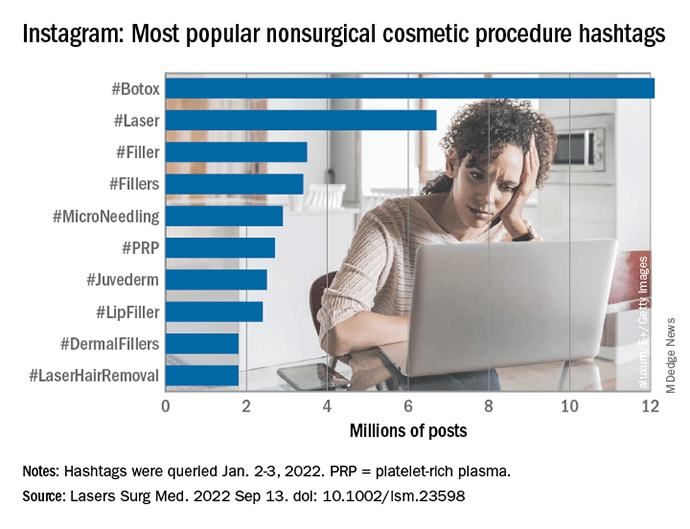
They generated a list of 25 hashtags related to nonsurgical cosmetic procedures, which were queried on Instagram on Jan. 2-3, 2022. The most popular was #Botox, with 12.1 million posts, followed by #Laser with 6.7 million, and #Filler with 3.5 million. Each of the 25 hashtags had at least 250,000 posts, they reported.

"Studies have shown that cosmetic patients and younger patients value social media when selecting a provider and patients often make treatment decisions based on social media," they noted.

The bulk of the study involved "the first 10 posts displayed under the 'Top' section for each hashtag, as sorted by Instagram's proprietary algorithm," explained Dr. Murray and associates at the Dermatology and Laser Surgery Center in Houston. The 250 posts eventually selected for inclusion each received scrutiny in terms of content type and creator credentials.

Physicians in core cosmetic specialties — dermatology, plastic surgery, facial plastic surgery, and oculoplastic surgery — created just 12% of those 250 posts, compared with 68% for nonphysician providers, 13% for consumers/others, and 8% for other physicians, they said.

Educational content made up the largest share (38%) of posts by core cosmetic physicians, with before-and-after next at 31%, self-promotional at 21%, and personal at 10%. Nonphysician providers were the most likely to create before-and-after (49% of their total) and self-promotional (28%) content, while consumers had the largest share of promotional posts (31%) and other physicians posted the most entertainment content (25%), the researchers said.

An overall look at the content shows that the largest proportion of all 250 posts included in the analysis involved before-and-after photos (45%), with self-promotion next at 23%. Education represented just 17% of the posting total for nonsurgical cosmetic procedures, with personal, entertainment, and promotional each at 5%, Dr. Murray and associates reported.

By recognizing "the role social media plays in patients' understanding of and desire to undergo nonsurgical cosmetic procedures" and "increasing their presence on Instagram, core cosmetic physicians can provide patient education, counteract misinformation, and raise awareness on training and qualifications," they wrote.

The study authors did not provide any disclosures regarding funding or financial conflicts.

https://www.medscape.com/viewarticle/982079

ACSH Debates 'Fat Acceptance' Advocates On Dr. Phil

 I recently appeared on "Dr. Phil" to discuss the fat-acceptance movement—a dangerous, misnamed "social justice" cause that needs to die an abrupt death. Let's break down the debate that ensued.

Has the body positivity movement gone too far? That's the question Dr. Phil posed to me and five other panelists during an incendiary debate about the health risks of obesity on his long-running daytime talk show. As someone who has lost a significant amount of weight, I've maintained that fat acceptance is a grave threat to public health. Its advocates downplay the dangers of excessive weight gain, pressure physicians not to weigh their patients, and even lobby TV shows to promote “fat liberation.” Anybody who challenges this misguided campaign is trying to “harm” fat people and may even be motivated by racism, the body-positive brigade claims.

Several of these themes permeated the discussion on Dr. Phil, so I was grateful for the opportunity to present a science-based critique of fat acceptance to a national audience, most of whom probably aren't regular ACSH readers. Let's recap the episode and analyze some of the issues that weren't fully addressed during the episode.

Dr. Phil: The science champion!

We have to give credit where it's due. Not only did Dr. Phil give me a platform to challenge the fat-acceptance narrative, he took a firm, evidence-based stance on the issue as well. The panel also featured a physician and a nutritionist, both of whom respectfully but forcefully argued that obesity is a risk factor for several serious diseases.

Dr. Howard Liebowitz, an Emergency and Trauma Physician for over 20 years at Cedars-Sinai Hospital, explained that it's often much more difficult to care for obese patients. Some of his patients were so big, a typical CT scan machine couldn't accommodate them. He also warned that obese individuals are more likely to suffer complications following surgery. Echoing our own Dr. Chuck Dinerstein, nutritionist Kelsey Koehler stressed that fat is a metabolically active organ; the more of it you carry, the more inflammation you experience, upping your risk for insulin resistance and metabolic disease.

YouTube personality John Glaude ("Obese to Beast"), who lost 180 pounds and now coaches others through their weight-loss journeys, joined the debate as well. Opposite the activists who claim they are shamed for being overweight, Glaude pointed out that he's routinely attacked as an “ex-fat” and a traitor. His message was simple: fat people don't need to be told they're obese; they know. That said, individuals who want to lose weight can and should do it—and they deserve the same amount of respect as anyone else in this discussion.

Body-positive activists push back

Plus-size model Lexi Nimmo and her husband Will took up the body-positivity cause in the debate. They were thoughtful and well-informed, making as good a case for fat acceptance as anybody could have. Ultimately, though, they were incorrect, and that clearly came through as the episode progressed. They asserted that research linking weight gain to adverse outcomes is outdated; more recent studies indicate that overweight people are often no worse off than their slimmer counterparts.

There is a body of literature that lends support to that argument, though even some of the researchers behind that work have acknowledged that obesity amplifies the risk of all-cause mortality. Then there are the studies documenting a clear link between weight loss and improved health outcomes. If obesity exerts little or no effect on metabolic health, these results are difficult to explain.

Middle-aged white men”

One of the issues we didn't explore in detail was Nimmo's assertion that “so many doctor's are middle-aged white men.” Presumably, the implication was that these healthcare providers are motivated by some degree of racial animus when they warn about the dangers of obesity. Dr. Phil diffused the tension with a self-deprecating joke. “Well, thank you for calling me middle-aged,” he quipped.

The audience would have seen my eyes roll if I was on camera at this point, because the medicine-is-racist trope is preposterous. For one thing, both Nimmo and her husband are white. Why weren't their opinions invalidated by their skin tone? Rules for thee, not me. Moreover, the physical attributes of any doctor are irrelevant to this discussion. Physicians are obligated to care for their patients; ignoring the risks posed by obesity would violate that obligation.

Fat acceptance isn't going anywhere, unfortunately. The push to reframe obesity as an identity instead of a health condition continues to generate headlines. The good news is that major media personalities like Bill Maher and Dr. Phil are drawing critical attention to the body positivity campaign. Hopefully, that will spark enough resistance to kill this foolish, dangerous cause before it does too much damage.


Cameron English

Director of Bio-Sciences

Cameron English is a writer, editor and co-host of the Science Facts and Fallacies Podcast. Before joining ACSH, he was managing editor at the Genetic Literacy Project, a nonprofit committed to aiding the public, media, and policymakers by promoting science literacy.

His work has been published by Forbes, RealClearScience, Priorities Magazine, Science 2.0 and Mic. Cameron’s writing has also been featured in textbooks published by McGraw-Hill and Pearson Education to teach critical thinking skills to high school students. Before pursuing a career in science journalism, he worked in the California State Assembly as an intern and campaign staffer.


https://www.acsh.org/news/2022/10/06/acsh-debates-fat-acceptance-advocates-dr-phil-16594