From Neutral
Monday, October 10, 2022

Cytokinetics to Continue ALS Trial Following First Interim Analysis
Phase 3 Clinical Trial to Proceed to Second Interim Analysis Expected to Occur in 2023
Cytokinetics, Incorporated (Nasdaq: CYTK) today announced that the Data Monitoring Committee (DMC) for COURAGE-ALS (Clinical Outcomes Using Reldesemtiv on ALSFRS-R in a Global Evaluation in ALS), recently convened to conduct the first planned interim analysis of this ongoing Phase 3 clinical trial which assessed for the potential of futility. The DMC reviewed unblinded data from COURAGE-ALS and recommended that conduct of the clinical trial of reldesemtiv continue. Reldesemtiv is a fast skeletal muscle troponin activator (FSTA) in clinical development for the potential treatment of amyotrophic lateral sclerosis (ALS).
The first interim analysis was triggered 12 weeks after approximately one-third or more of the intended number of patients were randomized to participate in COURAGE-ALS. A second interim analysis, which is anticipated to occur in the first half of next year, will also assess for potential futility and will also allow for a fixed increase in total enrollment, if deemed necessary, to augment the statistical power of the trial.
https://finance.yahoo.com/news/cytokinetics-announces-continuation-courage-als-113000012.html
Bernanke, 2 Others Win Nobel Prize In Economics For Crisis Research
The Nobel Memorial Prize in Economic Sciences was awarded to former Federal Reserve Chair Ben Bernanke and two others for their research in the 1980s on banks and financial crises.
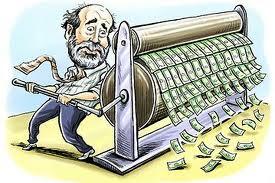
Bernanke served as chairman of the Fed between 2006-14 and famously unleashed a tidal wave of debt monetization by the central bank during the GFC over a decade ago to save the so-called 'too big to fail' banks. At the time, the Fed's balance sheet was approaching $2.5 trillion. Multiple rounds of money printing later and a massive expansion during the Covid crisis, the balance sheet stands at around $9 trillion today.
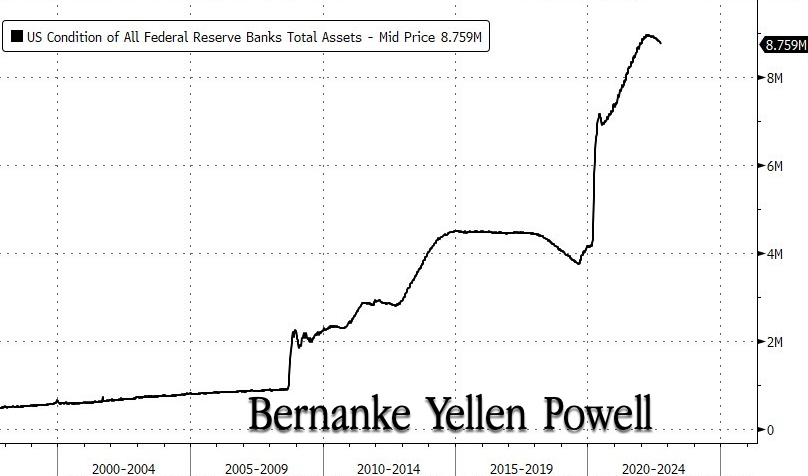
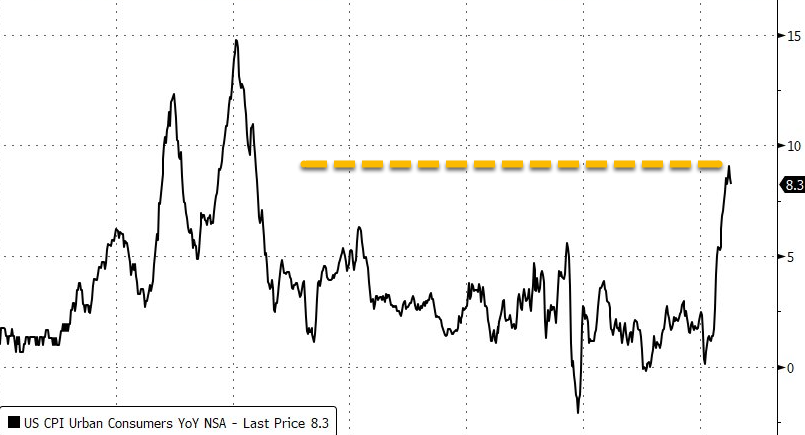
The side effects of former Fed chair Yellen and current Fed chair Powell keeping the money printers on full speed over the last decade since Bernanke is one of the main reasons for today's worst inflationary environment in decades. And why the Fed is in panic-tightening mode today.
Douglas W. Diamond, an economist at the University of Chicago, and Philip H. Dybvig at Washington University in St. Louis also won the 'prestigious' prize alongside the former Fed chairman.
Bernanke's analysis of the Great Depression in the 1930s showed how and why bank runs were a major reason the crisis was so long and severe. Diamond and Dybvig's work, meanwhile, looked at the socially important role banks play in smoothing the potential conflict between savers wanting access to their money and the economy needing savings to be put into investments; and how governments can help prevent bank runs by providing deposit insurance and acting as a lender of last resort. --CNBC
The Nobel committee said their work "significantly improved our understanding of the role of banks in the economy, particularly during financial crises, as well as how to regulate financial markets," adding their research "reduces the risk of financial crises developing into long-term depressions with severe consequences for society, which is of the greatest benefit to us all."
The committee noted that their research was "invaluable" during the GFC and Covid crises.
"The laureates have provided a foundation for our modern understanding of why banks are needed, why they're vulnerable, and what to do about it," said John Hassler, an economist at the Institute for International Economic Studies at Stockholm University and a member of the prize committee.
While a decade of money printing may have avoided a "long-term depression" (for now), it certainly has had adverse side effects, such as triggering the worst inflationary environment in forty years.
Many on Twitter thought Bernanke's award was a 'joke'.
Give it ten years or so...
Powell should also get for being the best inflation forecaster
— Alok (@thegametheorist) October 10, 2022
And we must remind readers Bernanke famously told the American people 'there was no housing bubble' in late 2005 -- only a few years later, well, all know what happened...
Here's Bernanke, leading up to the GFC, showing just how wrong he was about the coming crisis.
But somehow, he still won a Nobel prize a decade later...
Sunday, October 9, 2022
Lockdown Worries Return to Shanghai as China Covid Tally Climbs
China is stepping up efforts to contain Covid-19 outbreaks ahead of the Party Congress, with national cases climbing to the highest in almost two months and concerns about widening lockdowns rippling across the financial hub of Shanghai.
The country reported 1,878 cases for Sunday, the highest since Aug. 20, as the week-long National Day holiday saw cases flare among returning travelers. Shanghai posted 34 new local infections, the most in almost three months, with two infections found outside of its quarantine system. The uptick has seen neighborhoods locked down and buildings barricaded with the green fences that were a feature of the financial hub’s extended shutdown earlier.
The Hazards of Specialized Medicine
The division of labor, which Adam Smith described as “the greatest improvement in the productive powers of labor, and the greatest part of skill, dexterity, and judgment with which it is anywhere directed,” is not an unmixed blessing. Smith avers as much when, anticipating the effects of assembly-line labor, he writes that the man whose life is spent in repetitively performing a few simple operations “has no occasion to exert his understanding,” rendering him “as stupid and ignorant as it is possible for a human creature to become” and saddled with a “torpor of mind” incapable of conceiving any “generous, noble, or tender sentiment.”
This is true in my own profession of medicine, where medical students, staff, and faculty have seen their specialized spheres of concern contract progressively over time. Consider the medical student on the pulmonary service who, having convinced himself that a patient’s difficulty breathing is cardiac in nature, abruptly leaves the patient’s room, declaring that the problem is no longer his concern. Or the staff member who, having suffered a patient death, urges the family not to discuss it until the grief counselor arrives. Or the orthopedist who, so pleased by her own handiwork in setting a complex fracture, evinces no recognition of the fact that her patient is struggling with a recent diagnosis of advanced cancer.
Similar hazards of increasingly divided and therefore specialized labor are even more apparent among non-patient-facing healthcare workers. Consider the health insurance company clerk charged with ensuring that pre-approval for treatment is never granted if physician requests do not conform to standard protocols, and who therefore delays a cancer patient’s treatment to the point that the patient winds up in the intensive care unit on a ventilator. Or the hospital administrator who is so focused on proving that a new employee engagement program is producing the desired results that he ignores all evidence to the contrary, perhaps in part because his annual bonus depends on it.
There is no doubt that the division of labor can enhance productivity, including quality. To borrow from Smith’s famous example, a single pin maker may be able to produce only a few pins a day, but if the process of pin-making is divided up into each of its component steps and a different person is assigned to each one, output can be dramatically increased, often by multiples of hundreds or even thousands, with improved quality. Yet this approach can become especially hazardous when applied to the sort of work that nurses, doctors, and other health professionals do every day. If patient care is divided up into different specialties and each specialist attends to but part of the whole, then the care of the whole patient is likely to suffer.
The cardiologist understands the circulatory system, the neurosurgeon the brain and spinal cord, the dermatologist the skin, the gastroenterologist the digestive system, and the urologist the kidneys and bladder. But who knows the whole patient? Suppose the patient suffers from a disease that involves more than one system, or even many systems, such as long-haul COVID. Suppose the patient has multiple separate problems the treatment of which needs to be coordinated across systems, such as heart failure, chronic pulmonary disease, diabetes, kidney failure, and early-stage dementia. We have specialists to focus on each problem, but who minds the whole? In theory, a generalist, but our healthcare system often inclines toward specialism to the point that generalists are crowded out.
I know of an elderly patient who presented to the emergency department of a large academic medical center suffering from advanced cancer that was interfering with his breathing. The physician who saw him had recently been placed on an incentive plan designed to increase the number of patients receiving routine preventive care. One such recommendation for elderly patients was annual influenza immunization. Despite multiple attempts by the patient to steer the conversation back to his difficulty breathing, the physician fixated on the flu shot. The patient, who would die before the next flu season, left the hospital immunized but feeling that his presenting complaint had never been adequately addressed. An incentive system had narrowed the physician’s field of view in a way that compromised patient care.
Too often, hyper-specialized contemporary medicine resembles the parodies of bureaucracy found in Dickens and Kafka, which are populated by hollowed out human beings who think first and always of themselves and the rules they are required to follow to keep their jobs.
The specialization born of divided labor produces a narrow field of view, one confined to the description of a tightly circumscribed job. Over time, as Smith indicates, such a perspective can contract progressively to the point that workers see only their specific responsibilities and not those of their colleagues or the broader needs of those their work exists to serve. When a concern arises outside such narrow boundaries, health professionals may respond that it is not their job to address it, instead referring patients to others. “What you have is an elbow problem, but I only deal with wrists,” or “you seem to be suffering from a kidney problem, while I treat only livers.” Physicians and hospitals can get so focused on disciplinary boundaries, metrics, and profits that they cease to see the whole person they exist to serve.
When this happens, specialization ceases to be a means of improving the quality of care and functions instead as an excuse for shirking responsibility. People can wash their hands of a problem simply by saying that it is not part of their job description. We forget that our categories—whether occupational, diagnostic, or financial – exist not so that we can fit every patient into one, but so that we can ensure patients are well cared for. Under no circumstances is deflecting or rejecting patients a sign of medical excellence. At best, it does no harm while allowing patients to be well cared for, but at worst it can leave needs unmet and patients feeling lost, abandoned, and neglected.
Patients do not come to the office or the hospital seeking a category assignment. To be sure, they want to know if something is wrong with them, and if so, what it might be and what ought to be done about it. But what patients want above all is to be attended to and to draw a health professional’s attention at least until their care can be smoothly transferred to a colleague. Too often, hyper-specialized contemporary medicine resembles the parodies of bureaucracy found in Dickens and Kafka, which are populated by hollowed-out human beings who think first and always of themselves and the rules they are required to follow to keep their jobs.
Consider Dickens’ portrait of the Circumlocution Office in “Little Dorrit,” the “most important office under government.” It was there that the one sublime principle in governing a country had first been revealed to statesmen:
It had been foremost to study that bright revelation and to carry its shining influence through the whole of the official proceedings. Whatever was required to be done, the Circumlocution Office was beforehand with all the public departments in the art of perceiving – HOW NOT TO DO IT. Through this delicate perception, through the tact with which it invariably seized it, and through the genius with which it always acted on it, the Circumlocution Office had risen to overtop all the public departments; and the public condition had risen to be—what it was.
The division of labor does not only produce a narrower and narrower field of view and corresponding narrowing in the mind that beholds it. It can also produce a progressive atrophy in the faculties of compassion and responsibility, such that workers become both less and less inclined to see the situation from the vantage point of those we are meant to serve and increasingly disinclined to be moved to do anything about it. “I understand that you are in pain, perhaps even dying, but by virtue of the boundaries of my job description your predicament cannot be my concern,” says the specialized physician or nurse. “You will need to be seen by the palliative care service, hospice personnel, or the chaplains.”
In fact, suffering and death, compassion and responsibility, are not primarily professional matters but human matters. They summon us not based on our CVs, business cards, or licenses, but based on our shared humanity. To be sure, concerns about lack of expertise, credentialing, and inexperience may supervene in some cases, but this should be the exception and not the rule. As human beings, we all have hands that can hold, arms to support, and shoulders to cry on. Division of labor and specialization should represent not limitations on our humanity but opportunities to enhance and express it. A health professional may not be qualified to treat a particular patient, but all are equipped to care for every human being.
Awash in specialization, we need to recall that our word health comes from a root meaning whole. Health is wholeness, and its preservation and restoration are a health professional’s primary mission. After all, we are not merely primarily patients or health professionals, but fellow citizens, neighbors, friends, and family members. Underneath every white coat and stethoscope is a person cut from the same cloth as those clad in hospital gowns. While we may focus on some part of the patient, we must never neglect to keep the whole person in view. It is not only self-interest but the patient’s welfare that requires us to shun the way of Smith’s pin-maker, whose narrow focus transforms him into a pinhead.
Richard Gunderman, MD, PhD, is Chancellor's Professor of Radiology, Pediatrics, Medical Education, Philosophy, Liberal Arts, Philanthropy, and Medical Humanities and Health Studies at Indiana University. His most recent books are Marie Curie and Contagion.
Jeffrey Sachs: Biden Needs To Tell Ukraine To Stop Bombing The Zaporizhzhia Nuclear Power Plant
Jeffrey Sachs, the president of the United Nations Sustainable Development Solutions Network, told The Grayzone that President Biden is right when he warns that the war in Ukraine could lead to "Armageddon" and the best thing the U.S. could do to end the war would be to tell our allies in Kiev to stop bombing the Zaporizhzhia nuclear power plant and blaming it on Russia.
About the disputed bombings of the nuclear plant, Sachs said: "Our media says they don't know who is shelling the plant. And they can't put one and one together to say that if Russia is in control of the plant, maybe they're not shelling their own plant. Maybe it's Ukraine who is shelling the plant."
"It is almost surely Ukraine shelling the power plant and we can't bring ourselves to express a simple truth and that hurts because they continue to shell the power plant with impunity."
About the disputed bombings of the nuclear plant, Sachs said: "Our media says they don't know who is shelling the plant. And they can't put one and one together to say that if Russia is in control of the plant, maybe they're not shelling their own plant. Maybe it's Ukraine who is shelling the plant."
"It is almost surely Ukraine shelling the power plant and we can't bring ourselves to express a simple truth and that hurts because they continue to shell the power plant with impunity."
"We don't know ever with our government what is really going on because they don't tell the truth," he stated. "That just goes with the business of government, the way that it is viewed in Washington."
"This country is a war machine. And the main job of the president of the United States is to stop the war machine from making wars. And we are now in an escalation, heading towards Armageddon, according to the president. That's not a spectator sport, that's his job to keep us away from Armageddon," Sachs added.
"This country is a war machine. And the main job of the president of the United States is to stop the war machine from making wars. And we are now in an escalation, heading towards Armageddon, according to the president. That's not a spectator sport, that's his job to keep us away from Armageddon," Sachs added.
JEFFREY SACHS: I am actually a little relieved in a way that Biden said this [war could be the end of the world] because I have felt this all along. I felt that the U.S. policy was on a path of escalation and they didn't have an offramp in their minds.
By the way, there is an obvious offramp, and this is the whole point of this war if you really know something about it from the beginning. The offramp is NATO saying they're not going to enlarge to Ukraine, period. That was the offramp that would have prevented the war. That was the offramp that would have stopped this war in March when Russia and Ukraine, under the mediation of Turkey, exchanged documents and said publicly, as well as the Turkish mediators, we're close to an agreement.
Many of us think the U.S. rushed in and said not to do that. We don't know ever with our government what is really going on because they don't tell the truth. That just goes with the business of government, the way that it is viewed in Washington.
But my feeling is that there are a lot of signs the U.S. has been against a negotiated end to this war. Because my interpretation is this issue of NATO enlargement is a deeply held objective of the U.S. going back to the early 1990s. It is as deeply rejected by Russia since that time, I've watched it on both sides. That is why we have a collision course that continues to escalate and why we should take damn seriously this nuclear threat.
But why? Biden should ask himself what is the offramp. I'll give him this suggestion. We should never have suggested NATO enlarge into Ukraine and we should stop now because Putin was very clear at the end of 2021.
...
By the way, you can't have Zelensky negotiating with Putin. This is a war between the U.S. and Russia. And we need to have the president of the United States and the president of Russia talking with each other and avoiding Armageddon.
...
I've studied the Cuban missile crisis all my professional life. I wrote a book about the aftermath of the Cuban missile crisis. I've looked at this issue in great detail. We came close to nuclear Armageddon exactly 60 years ago this month. And during that period, one of the provocations was Castro saying, "Fire, fire!" Telling Khrushchev to do a preemptive strike. Just what Zelensky is doing right now. You could kind of understand it, but you know what Khrushchev said when Castro said to do a preemptive strike.
Khrushchev said, "My God, this is supposedly our ally who would end the world? We'd better speed up the negotiations because this is not stable."
When Zelensky says these things, I'm horrified. And yeah, they walked it back. But he didn't say sanctions, he said preemptive strike. And they talk recklessly, maybe understandably given their circumstance, I don't think so, but I think it shows how unstable this is.
By the way, during this whole period of this proxy war that is really a confrontation between the U.S. and Russia we have pretended that it is a confrontation only between Russia and Ukraine. And we have said constantly whatever Ukraine says is the right thing. So we're kind of giving carte blanche to the most extravagant, dangerous, provocative statements.
Another example: We don't know for 100%, but let me do a little quiz. Russia is in control right now of the Zaporizhzhia nuclear power plant. It is being shelled. We hear that is very dangerous, which it is, you shouldn't shell nuclear power plants. Now one side controls the plant. So who is actually shelling the plant? Well, our media says they don't know who is shelling the plant. And they can't put one and one together to say that if Russia is in control of the plant, maybe they're not shelling their own plant. Maybe it's Ukraine who is shelling the plant.
I can tell you, I speak to a lot of people, it is almost surely Ukraine shelling the power plant and we can't bring ourselves to express a simple truth and that hurts because they continue to shell the power plant with impunity.
And we should say stop shelling the power plant. Yes, it would be good if the U.N. controlled the power plant, but don't shell a nuclear power plant. But we can't even find those words. That's the problem.
Because we're kind of faking the whole thing as if this isn't a U.S.-Russia thing, and we say do it, go, defeat Putin, that's what we want. Defeat the guy with 1,600 active nuclear warheads and several more in reserve. Go ahead, go do it, as if this isn't our Armageddon that we're heading to.
One thing I've learned, and I'm 67 years old, I've been through a lot of U.S. wars -- Vietnam, Laos, Cambodia, Nicaragua, Iraq, Syria, Afghanistan, Liya, Afghanistan, and more. It is the job of the president of the United States to put on the brakes. Because this country is a war machine at the top. We don't see it, we don't know it exactly. Eisenhower told us about it with the military-industrial complex speech. This country is a war machine.
The main job of the president of the United States is to stop the war machine from making wars. And we are now in an escalation, heading towards Armageddon, according to the president. That's not a spectator sport, that's his job to keep us away from Armageddon.
Hochul hunts for marijuana DWI test as NY opens cannabis shops
New York is putting the doobie before traffic safety, law enforcement officials charge — and it’s forcing Albany to give the issue high priority.
Gov. Kathy Hochul’s administration is scrambling to develop a way to measure when motorists are driving while under the influence of cannabis since there’s no current standard or valid testing, the Post has learned.
The move comes ahead of the expected issuance of of up to 175 retail licenses to sell marijuana in the coming weeks — jacking up pot access and usage that could potentially put more weed-whacked motorists on the road.
“With the legalization of adult-use cannabis, there are concerns of increased incidences of driving while impaired after cannabis use,” the state Department of Health said in a proposal seeking solutions to detect motorists driving high on pot.
“Identifying drivers impaired by cannabis use is of critical importance…..However, unlike alcohol, there are currently no evidence-based methods to detect cannabis-impaired driving,” health officials said in the pitch to potential bidders.
The DOH is looking for the latest academic research related to cannabis testing — like blood, saliva, or breath — and if pot intoxication can be linked to motor vehicle crashes.
A recent study conducted by the Insurance Institute for Highway Safety found in states with legal marijuana, the rate of car crashes with injuries spiked by nearly 6% and fatal crashes jumped by 4%. The analysis compared five states with legal pot for those over 21 (Colorado, Washington, Oregon, California and Nevada) with states without legal marijuana — Arizona, Idaho, Montana, New Mexico, Utah and Wyoming.
There were no increases in crashes in the states without legal marijuana, the researchers said.
“Our latest research makes it clear that legalizing marijuana for recreational use does increase overall crash rates,” said Institute for Highway Safety president David Harkey.
A separate survey found a third of drivers who drink alcohol and use marijuana at the same time report getting behind the wheel of a car within two hours of consumption — a worrisome finding since there’s evidence the alcohol and pot combo worsens driving performance more than either substance by itself, he added.
New York law enforcement groups opposed legal marijuana in large part because of the hurdles in proving drugged driving.
The Marijuana Regulation & Taxation Act was approved by ex-Gov. Andrew Cuomo and the legislature in March 2021 while Hochul was lieutenant governor.
When she took over as governor, Hochul moved to accelerate the process to regulate and sell cannabis in New York after pro-pot advocates accused Cuomo of slow-walking implementation of the law.
Cannabis remains in a person’s system longer than alcohol, making it harder to link usage to DWI, officials said — and there’s no test like an alcohol breathalyzer to prove intoxication. The cannabis law required DOH to issue a proposal to investigate ways to validly test for pot intoxication.
“This is reckless. We needed to solve the DWI problems before we legalized cannabis,” said Patrick Phelan, executive director of the New York State Association of Chiefs of Police.
The New York State District Attorneys Association also slammed policy makers for putting marijuana legalization ahead of public safety.
“Research into ways to keep our roadways safe and enforce New York State’s drugged driving laws related to marijuana should have begun in earnest way before the start of recreational sales. In the meantime, there will be more marijuana impaired motorists on our roads,” said association president Anthony Jordan, the upstate Washington County DA.
Nassau County DA Anne Donnelly said legal pot chas already become a traffic safety problem.
“Everywhere you go – on highways or side streets – the smell of marijuana coming from a moving vehicle is commonplace,” Donnelly said.
For now, Donnelly said roadside saliva tests have “shown promise” in helping determine recent marijuana use.
Nineteen U.S. states have legalized marijuana for recreational use — including the New York border states of New Jersey, Connecticut, Massachusetts and Vermont.
Sen. Liz Krueger (D-Manhattan), one of the architects of the cannabis law, said policy makers made it a point to include funding from weed-related taxes to train more state and local police on how to evaluate drivers intoxicated from cannabis and other drugs and to “implement cannabis testing upon driving `stops’ when proven models came on the market.”
“Revenue from our legalized system will be used to pay these ongoing costs, so no unfunded costs for the state,” she said.
Hochul’s traffic safety committee — which includes the departments of motor vehicles, health and state police — insisted it’s beefing up observational training and enforcement for DWI in the wake of legalized marijuana sales and use.
In April, the administration launched an ad campaign with a “don’t drive high” warning to pot users.
“Driving under the influence of cannabis remains illegal, and the Governor’s Traffic Safety Committee is committed to ensuring safety on our roadways. GTSC regularly trains officers to become Drug Recognition Experts… so that they can observe and document signs and indicators of impairment within each of seven drug categories including cannabis,” traffic committee spokesman Walter McClure said in a statement.
According to GTSC, the state currently has almost 400 officers trained to be “drug recognition experts” and is training thousands of officers in roadside impaired driving enforcement.
“GTSC works annually with law enforcement on impaired driving education and enforcement campaigns,” McClure said.
A DOH spokesman added that officers are “well trained” to detect motorists impaired by marijuana and other drugs and the new proposal is aimed at finding “if there are other methods and technologies in development that will create even more tools, akin to the breathalyzers used in alcohol field sobriety tests, that can aid this important work.”
https://nypost.com/2022/10/09/ny-hunts-for-marijuana-dwi-test-as-cannabis-shops-open/
Subscribe to:
Posts (Atom)