Search This Blog

Saturday, October 15, 2022

What’s the Worst Case Scenario For Stocks?

 A reader asks:

Ben comes off as a relatively optimistic person when it comes to the markets. Can he give us his most bearish or worst-case scenario for the stock market right now? I’m worried the worst is yet to come.

This is a fair assessment.

I am a glass-is-half-full kind of person by disposition.

I can’t prove this but I do think optimism or pessimism is something you’re kind of just born with. I happened to be born a more optimistic person who mostly looks on the bright side of things.1

But when it comes to investing, you also have to balance being optimistic with being realistic. For me that means being a long-term rational optimist with the understanding that things can and will get really bad in the short-term on occasion.

That’s just how things work. Like now, for instance. Things seem pretty bad financially speaking.

You could come up with something like hyperinflation or a collapse of the dollar of an alien invasion but let’s stick to the more realistic scenarios for the current market environment.

The biggest risk right now is a policy error by the Fed or other central banks. This one also has the highest probability of occurring in my estimation.

My worry here is not based on a misreading of the economic data or anything like that from Jerome Powell and company. It’s more of the human element involved in their decision-making process.

Outside factors can impact our decisions whether we are aware of them or not.

Researchers last decade studied over 1,000 parole decisions by 8 Israeli judges. When looking at the timing of the decisions, the authors of the study noticed a pattern developing in terms of when these convicted felons came before the judges.

Two-thirds of parole requests were granted if they sat before a judge first thing in the morning. But those numbers dropped off big-time right before lunch.

Then miraculously, after lunch, the number of people who were granted parole went right back to 65% or so.

But by the end of the day, almost no one was granted parole.

They figured parolees were somewhere between two and six times as likely to be released if they were one of the first three prisoners of the day to see a judge versus the last three prisoners of the day.

I’m sure there are a lot of factors at play here but they concluded the judges were more ornery right before lunch because they were hungry. Once they were fed, they were in a much better mood. And by the end of the day they were in a bad mood again after working all day and getting hungry once again for dinner.

We’re all human and so are Fed members.

They’ve been getting slammed by the financial media and economic pundits for months now about how they missed the boat on the inflationary spike and didn’t do something about it sooner.

So I think there’s a real possibility they overcorrect in the opposite direction and go too hard now to try and prove their credibility.

You don’t think we’ll send the economy into a recession to prove a point?! We’ll show you!

Plus I think we’ve learned the Fed is very good at stimulating the economy and keeping the financial system afloat when things are really bad but there is no evidence that they know what they are doing when it comes to hitting the brakes and slowing things down.

Something that goes hand and hand with a policy error would be if interest rates and inflation keep rising or inflation simply stays elevated.

The inflation print today came in stronger than expected.

My research shows, all else equal, the stock market tends to see above-average returns when inflation is low and/or falling and below-average returns when inflation is high and/or rising.

Sticky high inflation would likely be a bad thing because that would mean the Fed would want to hike interest rates more aggressively.

The other risk here is something out of left field spooks investors.

During a bull market they say stocks climb a wall of worry. It’s much easier to shake things off when stocks are already going up and people aren’t panicking.

But in the midst of a bear market, investors are on edge just looking for another reason to sell. It doesn’t take much to make investors panic in the midst of a panic.

Consider the 2000-2002 bear market.

The 1990s bull market came to an end in early-2000 after tech stocks took us to nosebleed valuation levels.

From that point through just before 9/11, the S&P 500 was down more than 28% from the highs:
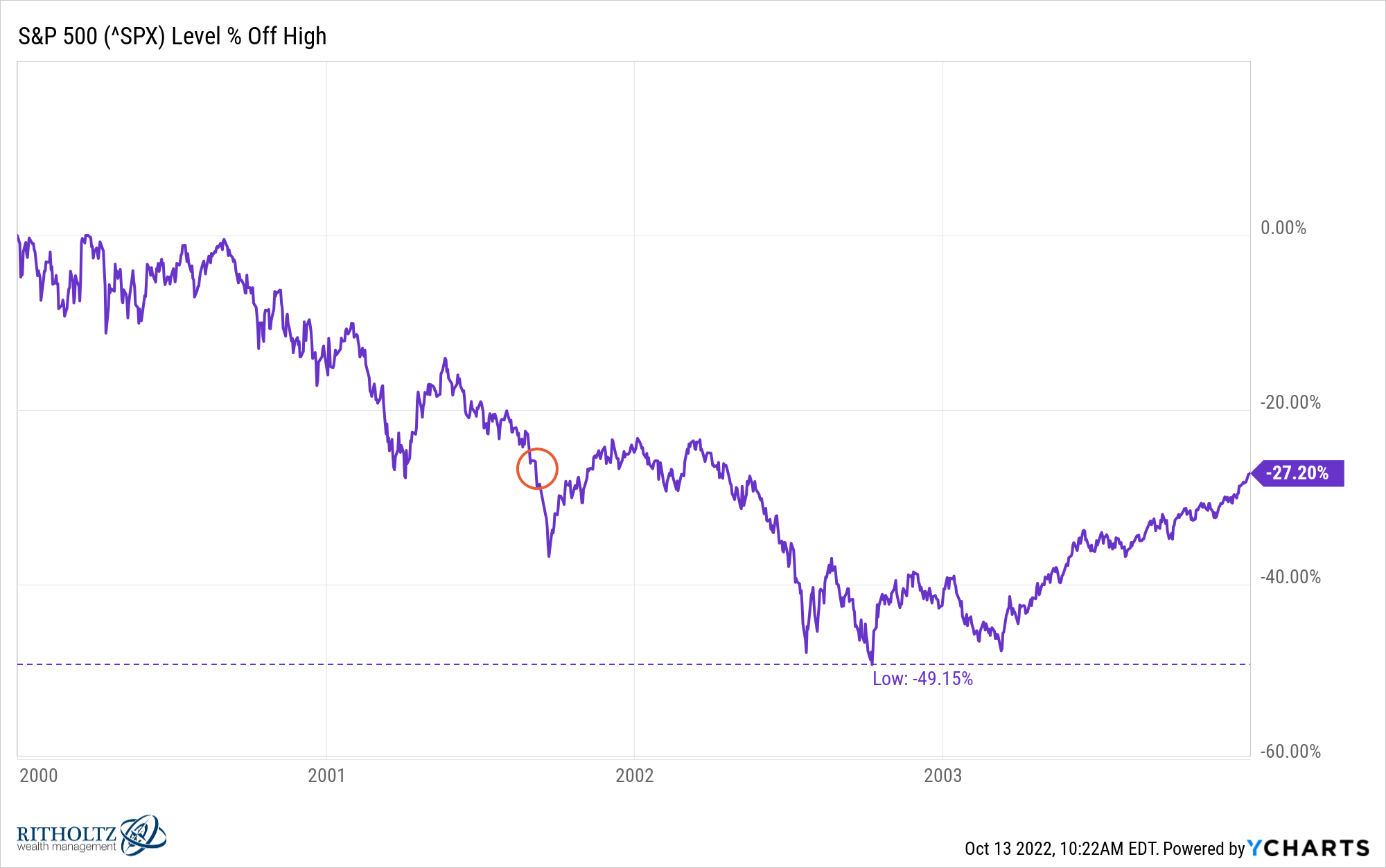
You can see stocks had a lot more downside from there, falling an additional 33% from 9/11 until the bottom in late-2002.

To be fair stocks got hammered right after 9/11 and staged a vicious bear market rally in the months that followed. But you also had the WorldCom and Enron scandals plus a minor recession in 2001.

The point is, it wasn’t just high valuations that did the market in. Stocks were in a downtrend and then came more bad news. Adding even more panic or uncertainty to an already panicky market can make things even worse.

I guess you could say the war in Ukraine was that outside event that made things worse here but anything else out of the ordinary happening from a geopolitical or financial system standpoint probably wouldn’t be great right now.

On the other hand…
…people always assume a Black Swan has to be a negative event.

What if we get some sort of positive black swan that makes things better than expected?

What if inflation falls faster than people think from current levels?

This was the inflation rate the last time the Fed was trying to throw the U.S. economy into a recession the 1980s:
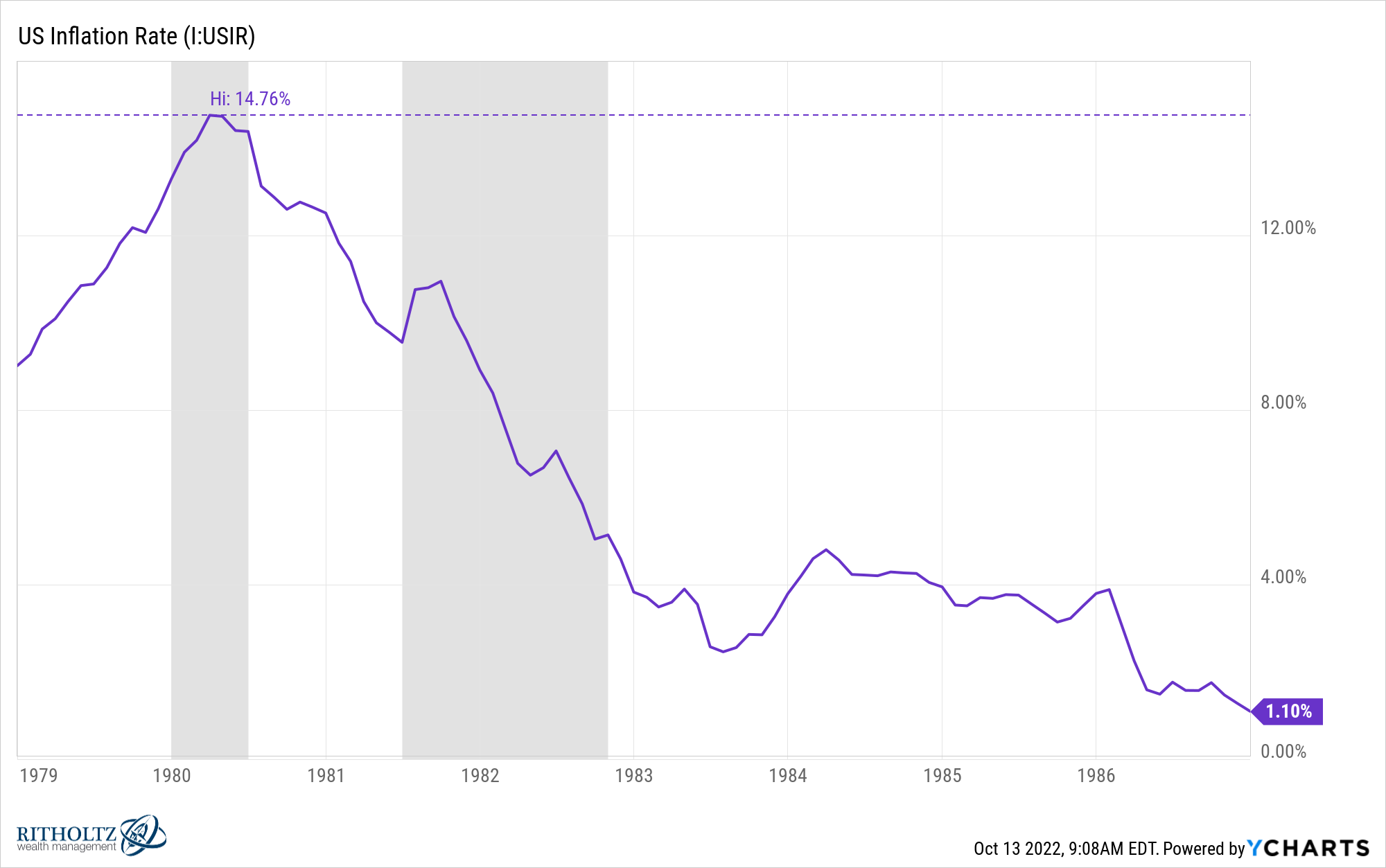
After inflation peaked at 14.8% in March of 1980 the next four monthly prints were 14.7%, 14.4% and 14.4%. Inflation remained stubbornly high for a number of months before it finally gapped down.

Sometimes the economy doesn’t do what you want it to do right away. It’s more like turning a battleship.

Other positive black swan events could be:

  • What if somehow the Fed is able to thread the needle and orchestrates a soft landing if the labor market remains strong?
  • What if earnings don’t fall as much as you would assume in an economic slowdown?
  • What if the war abruptly comes to an end?

It’s not just good news that causes bear markets to come to an end but better-than-expected news that is simply less bad.

See you knew I had to bring it back around to being glass-is-half-full even when it feels like the glass is empty right now.

https://awealthofcommonsense.com/2022/10/whats-the-worst-case-scenario-for-stocks/


Less-Crowded Covid Wards Can Keep Boosting Insurers

 While a distressingly high number of Americans are still being hospitalized daily for Covid-19, the number has dropped off significantly in recent months. That has helped drive a 28% increase in profits for the nation’s largest health insurer in the third quarter, and there are other factors boosting growth too.

From a financial standpoint, fewer hospitalizations have benefited margins for UnitedHealth GroupUNH 0.63% The healthcare and insurance giant raised its profit outlook for the year Friday after posting a 12% increase in third-quarter revenue and handily beating analysts’ consensus estimates. Its shares rose moderately Friday during a very weak session for stocks overall.

Management at other large insurers such as CVS Healthwhich includes Aetna, and humana have likewise signaled utilization might be trending favorably in the second half of the year, which could “translate into EPS upside for managed care,” wrote JPMorgan‘s Lisa Gill.

Hospitals are where healthcare costs are highest, and nearly 100,000 Americans were hospitalized at the peak of the Delta variant wave in the summer of 2021. That number peaked this January at about 150,000 during the Omicron wave, but has since stabilized at around 20,000 to 40,000 for much of the year.

A closely watched metric known as the medical loss ratio, or MLR, came in at 81.6% for UnitedHealth UNH 0.63% —better than what analysts had expected and lower than the 83% figure in the same quarter last year. The lower the MLR figure, the better for profits because it represents the share of total healthcare premiums spent on such things as medical claims.

Not every big-picture trend is helpful. During a call with investors Friday, UnitedHealth Chief Executive Andrew Witty stressed that medical costs will increase at a higher pace next year as hospitals pass on some of their higher staffing costs to insurers. But the insurance market is relatively concentrated, giving companies pricing power to pass much of that on in the form of higher commercial premiums. Employer health benefit premium rates are set to rise by about 6.5% in 2023 compared with a 3.9% increase this year, according to Scott Fidel, a longtime healthcare analyst at Stephens Inc.

UnitedHealth, meanwhile, is fairly recession-proof. It has outperformed its peers in grabbing market share in the Medicare Advantage space while also rapidly scaling up its Optum Health unit, which is benefiting from the growth in value-based care, During the call, Mr. Witty noted that the share of seniors enrolled in Medicare Advantage has grown from 25% a decade ago to 50% today. Tim Noel, chief executive of UnitedHealthcare’s Medicare & Retirement division, told analysts that he still likes his “chances to outperform the industry in 2023.”

The catch for investors is that UnitedHealth already trades at a large premium to peers and stocks generally, fetching 21 times forward earnings, compared with 15.9 times for the S&P 500. Julie Utterback, an analyst at Morningstar, said investors seeking to profit from managed- care growth might be able to find better value with UnitedHealth peers such as cignaCVS, CenteneElevance and humanaPeace of mind doesn’t come cheap for customers or investors.

https://thenewssow.com/less-crowded-covid-wards-can-keep-boosting-insurers/


Low-price grocers like Aldi are winning as consumers trade down

 With grocery prices soaring, consumers are changing the way they shop for food. That’s great news for discount grocers like bare-bones supermarket Aldi.

Aldi, which requires a 25-cent deposit to use grocery carts, sells mostly store brands and doesn’t waste time on elaborate displays, might not be for everyone.

But more than one million new households shopped at Aldi in the year through September, helping rack up double-digit sales growth in that period. Foot traffic across most of its 2,200 US stores jumped about 10.5% year over year, according to Placer.ai — even as grocery sector visits were about flat.

Aldi’s explosive growth is part of a wider trend, experts say.

“We’ve seen a pretty definitive shift in consumers starting to shop at the discounters like Aldi and Trader Joe’s and Lidl,” said RJ Hottovy, head of analytical research at Placer.ai, which uses location data from mobile devices to estimate visits. Given that grocery prices are expected to stay elevated for some time, “I suspect that we’re going to continue to see visitation trends favor these discounters,” Hottovy said.

Stubbornly high inflation, rising grocery costs and shifts in consumer buying patterns are creating a sea change in the industry, said Joan Driggs, VP of thought leadership for IRI, a market research firm.

“This is an absolute pivotal moment,” Driggs said. “Mainstream grocery stores are losing share right now.”

Discount chain Grocery Outlet (GO), who has also enjoyed increased sales in recent months, alluded to that during a recent earnings call: “We’re likely seeing some benefit of the customers shifting from, I’d say, more conventional, more expensive alternatives to the value model or to value shopping,” said CEO Eric Lindberg in August.

High grocery bills are reconfiguring shopping habits in multiple ways.

“Most consumers typically shop at the store closest to home,” said Brittany Steiger, senior retail and eCommerce analyst at market research company Mintel. “Discount retailers are benefiting as consumers branch out more from their neighborhood grocer in pursuit of lower prices.”

More affluent households in particular are driving these changes. The majority of Aldi’s new shoppers over the past year have been middle- and high-income households — those who earn $50,000-$100,000 a year and $100,000-plus annually, respectively.

“I think they’re discovering value,” said Scott Patton, vice president of national buying and customer interaction at Aldi. “This is a time of consumers looking for solutions,” he added. “Inflation is hitting everyone.”

More consumers are additionally switching over to store brands, also called “private label,” which are often comparable in quality and lower in price. At Aldi, about 90% of packaged goods are private-label.

Aldi nudges shoppers toward its label in multiple ways: Customers who aren’t satisfied with a product get a refund and a replacement as part of the chain’s “Twice as Nice” guarantee. And it often displays its own brands right next to the national brands it carries in stores, putting price differences in stark relief.

“I don’t think you can underestimate the strength of all these private label offerings,” said Heather Lalley, editor in chief of Winsight Grocery Business, a trade publication. “Now we’re seeing other retailers trying to emulate them.”

In September, for example, Kroger (KR) announced a new budget private label brand called Smartway, which consolidates some of its other private label brands under one umbrella. Smartway “features the products families need to put an even more affordable meal on their table,” said Juan de Paoli, VP of Kroger (KR)’s Our Brands division, in a statement announcing the launch.

Still, if discount grocers want to keep their new customers coming back after inflation moderates, they’ll have to make a lasting impression.

Aldi, for one, is rolling out a new tagline to explain what it’s all about: It’s An Aldi Thing. The tagline, which is already live in some channels, and will launch officially this quarter, is meant to sum up what might surprise customers — like Aldi’s displaying items in cartons rather than stacking them on shelves. (It saves money on labor, which Aldi says allows it to keep prices low.)

“The most important thing we can do to attract and keep new customers is to simply introduce them to Aldi,” said Patton. “Once they shop at our stores, experience our products and see how low their grocery bill can be, we are confident they’ll be back. No matter what the economic climate looks like, we know customers will still want to save time and money.”

The company also is testing an online shopping service with a select group of customers, and hopes to roll it out more broadly in the future. For now, people who want to shop online at Aldi can do so via Instacart.

Even before inflation began soaring, Aldi had ardent fans including a Facebook group with 1.4 million members who share finds and product reviews. Several recent posts show dogs in Aldi pet hoodies and costumes, and Aldi’s wine-themed advent calendar has also made a splash.

As companies like Aldi work to keep up momentum, their mainstream competitors will have to figure out their own ways to make themselves attractive to shoppers, said IRI’s Driggs.

“This is a dynamic industry with very low margins,” she said. Mainstream “retailers have to rethink their point of differentiation.”

https://www.cnn.com/2022/10/08/business/aldi-discount-grocery-inflation/index.html


Boston Marathon winner Diana Kipyokei could lose title for doping

 Diana Kipyokei of Kenya crosses the finish line to win the women's division of the 125th Boston Marathon in Boston, Massachusetts, U.S., October 11, 2021.

Boston Marathon winner Diana Kipyokei was suspended Friday after testing positive for doping at the 2021 race and could be stripped of her title.

The Athletics Integrity Unit announced that Kipyokei failed a drug test that was collected after she won the 2021 marathon.

She tested positive for triamcinolone acetonide, a therapeutic drug prohibited in competition when administered via oral, rectal and all injectable routes because of clear evidence it acts as a performance enhancer, the AIU said.

Athletes are allowed to test positive for the drug if they prove it was administered through another route that was not orally, rectally or by injection.

Kipyokei allegedly tried to tamper with the doping investigation by providing false documentation about her drug use.

If the Kenyan long-distance runner is proven to have taken the prohibited drug, she will be disqualified as the 125th Boston Marathon winner, the AIU said, and the $150,000 prize money. Kipyokei also faces at least a four-year ban from the sport.

The Boston Athletic Association said in a statement it would readjust the race rankings and provide prize award adjustments to top finishers of the 2021 marathon, pending the sanctioning.

Diana Kipyokei, of Kenya, holds a Boston Marathon championship trophy following a news conference, on Oct. 12, 2021, in Boston.
Diana Kipyokei holds a Boston Marathon championship trophy after her 2021 win.
AP

Kipyokei won the Boston women’s race in 2 hours, 24 minutes, 45 seconds. She finished 24 seconds ahead of her Kenyan compatriot Edna Kiplagat, who won the Boston Marathon in 2017. If Kipyokei is disqualified, Kiplagat will claim her second Boston Marathon title.

“Kipyokei’s result in the 2021 Boston Marathon will be disqualified, pending the completion of relevant athlete appeals processes,” the BAA said. “The Boston Athletic Association supports strict anti-doping measures to ensure fair competition and clean sport.”

Another Kenyan runner, Betty Wilson Lempus, was also suspended Friday after testing positive for the same drug after winning the 2021 Harmonie Mutuelle Semi de Paris. Lempus was also charged with tampering with the AIU investigation by providing false documentation.

Thursday, the AIU banned Kenyan runner Mark Kangogo for the presence of triamcinolone acetonide in his sample.

“The cases announced today are part of a recent trend in Kenyan athletics regarding

triamcinolone acetonide, with ten Kenyan athletes testing positive for that prohibited
substance between 2021 and 2022,” the AIU said in a statement.

https://nypost.com/2022/10/15/boston-marathon-winner-diana-kipyokei-suspended-for-doping/


Friday, October 14, 2022

Borrowers can apply for student loan forgiveness through Biden admin beta app

 The Biden administration launched a beta version of its student loan forgiveness application on Friday that borrowers can use to apply for their loan forgiveness. 

“We’re accepting applications to help us refine our processes ahead of the official form launch. If you submit an application, it will be processed, and you won’t need to resubmit,” the Department of Education’s Federal Student Aid office said on the website.

The beta version looks the same as the teaser of the application shown by the White House earlier this week, with borrowers only needing to give the department their name, social security, phone number, date of birth and email. 

After borrowers fill out the application, the government provides “next steps” for them. The government says the application will be process, borrowers will be contacted if additional information is needed and the department will let them know when they have been approved.

The government can ask for additional information such as documents to prove their income or status when they were students.

After a borrower is successfully approved, their loan service provider will let them know the relief is applied.

A spokesperson for the department said there is no advantage for borrowers who fill out the application during the beta testing stage versus after the official launch. 

“This testing period will allow the Department to monitor site performance through real-world use, test the site ahead of the official application launch, refine processes, and uncover any possible bugs prior to official launch,” the spokesperson said. 

The beta application will be paused at various points for assessments by the department, it said. Individuals who are unable to access the application are encouraged to check back to see if it is back online at a later point or once the application is officially launched. 

The administration still has not given a date for the official launch of the applications, which borrowers have been anxiously waiting for since President Biden announced the program over the summer. 

Individuals who make less than $125,000 a year and couples who make less than $250,000 a year and have federal student loans not held by a private entity qualify to fill out the application. 

In the application, borrowers have to “certify under penalty of perjury” that the information they input is correct, with potential legal repercussions if information is falsified.

https://thehill.com/homenews/administration/3689237-borrowers-can-apply-for-student-loan-forgiveness-through-biden-administrations-beta-application/

Kaiser Permanente Sued For Wrongful Death After Remdesivir Treatment Fails

 by Juliette Fairley via The Epoch Times (emphasis ours),

Before Rodney Briones’ physicians at Kaiser Permanente Riverside Medical Center in California treated him with Remdesivir, they allegedly did not disclose the risks to him or to his wife, Christina, and did not obtain informed consent, according to a complaint filed by the Briones family.

The couple had gone to the managed care consortium for help after Rodney developed COVID-19 symptoms and tested positive twice for SARS-CoV-2.

A five-day course of treatment with the controversial drug and other allegedly contraindicated, high-risk medications allegedly led to kidney failure for the 50-year-old Briones, who was subsequently placed on a ventilator. During this time, Kaiser Riverside reportedly refused to allow the man’s wife or family to see him. He died on Sept. 12.

My husband was murdered because of government [expletive],” Christina Briones told The Epoch Times. “I never thought this could happen.”

Kaiser Permanente and Gilead Sciences, the maker of Remdesivir, did not respond to requests for comment.

The grieving wife sued Kaiser in Riverside Superior Court alleging the wrongful death of her husband due to hospital protocol that included administering Remdesvir, which, according to the lawsuit, is a failed Ebola drug that was found to be terminally toxic to the kidneys. The drug was pulled from an Ebola study because more than 53 percent of Remdesivir recipients died, the lawsuit states.

The Kaiser Riverside physician did not disclose the availability of highly effective Safe Multi-Drug Early Treatment (SMDET) to Rodney when both Rodney and a reasonable patient in Rodney’s position would have wanted the disclosure,” wrote the Briones family attorney Matthew Tyson in the Sept. 7 complaint. “This was constructive fraud.”

The Briones family seeks survivor action general damages as well as wrongful death general and special damages.

“We pioneered Remdesivir wrongful death litigation using a constructive fraud theory, and we filed the very first Remdesivir wrongful death lawsuit in the country, back in June, for Evangeline Ortega,” said Tyson, who is working with Attorney Brian Garrie on multiple Remdesivir lawsuits.

https://www.zerohedge.com/covid-19/kaiser-permanente-sued-wrongful-death-after-california-husbands-remdesivir-treatment-fails

New omicron subvariant largely evades neutralizing antibodies

 A study at Karolinska Institutet shows that the coronavirus variant BA.2.75.2, an omicron sublineage, largely evades neutralizing antibodies in the blood and is resistant to several monoclonal antibody antiviral treatments. The findings, published in the journal The Lancet Infectious Diseases, suggest a risk of increased SARS-CoV-2 infections this winter, unless the new updated bivalent vaccines help to boost immunity in the population.

"While antibody immunity is not completely gone, BA.2.75.2 exhibited far more dramatic resistance than variants we've previously studied, largely driven by two mutations in the receptor binding domain of the spike protein," says the study's corresponding author Ben Murrell, assistant professor at the Department of Microbiology, Tumor and Cell Biology, Karolinska Institutet.

The study shows that antibodies in random serum samples from 75  in Stockholm were approximately only one-sixth as effective at neutralizing BA.2.75.2 compared with the now-dominant variant BA.5. The serum samples were collected at three time points: In November last year before the emergence of omicron, in April after a large wave of infections in the country, and at the end of August to early September after the BA.5 variant became dominant.

Only one of the clinically available monoclonal antibody treatments that were tested, bebtelovimab, was able to potently neutralize the new variant, according to the study. Monoclonal  are used as antiviral treatments for people at high risk of developing severe COVID-19.

BA.2.75.2 is a mutated version of another omicron variant, BA.2.75. Since it was first discovered earlier this fall, it has spread to several countries but so far represents only a minority of registered cases.

Risk of increased infections

"We now know that this is just one of a constellation of emerging variants with similar mutations that will likely come to dominate in the near future," Ben Murrell says, adding "we should expect infections to increase this winter."

Some questions remain. It is unclear whether these new variants will drive an increase in hospitalization rates. Also, while current vaccines have, in general, had a protective effect against  for omicron infections, there is not yet data showing the degree to which the updated COVID vaccines provide protection from these new variants. "We expect them to be beneficial, but we don't yet know by how much," Ben Murrell says.


Explore further

Recent findings suggest new omicron BA.2.75 is as susceptible to antibodies as the currently dominant variant

More information: Daniel J Sheward et al, Omicron sublineage BA.2.75.2 exhibits extensive escape from neutralising antibodies, The Lancet Infectious Diseases (2022). DOI: 10.1016/S1473-3099(22)00663-6
https://medicalxpress.com/news/2022-10-omicron-subvariant-largely-evades-neutralizing.html