Search This Blog

Sunday, October 16, 2022

Weight Loss Gadgets: Data to Help Achieve Diet Goals, but Still Won’t Be Easy

 I felt a special kind of awe, then panic, watching my glucose levels skyrocket for the first time after relishing a cold beer on a sweltering summer evening. It was a biological push notification from the fluid just beneath my skin that the carbohydrate-packed beverage was interfering with efforts to maintain my health and weight.

For years, people with Type 1 diabetes have worn continuous glucose monitors, or CGMs, to track blood sugar spikes and make sure they’re getting enough insulin. CGMs are small patches with tiny needles for sensors that prick the skin and are generally worn on the stomach or back of the arm.

Now, a wave of tech companies are selling CGMs to the public. That made me curious: Would this work for me? What would I learn?

The devices, linked to apps with personalized analytics and meal planning advice, are being touted as a behavior-changing path to better health and athletic performance, consistent energy, and overcoming the dreaded weight-loss-weight-gain cycle once and for all.

For people without diabetes, tracking the glycemic response to meals can pinpoint which foods significantly spike blood sugar, leading to a subsequent blood sugar crash and then lethargy. That excess insulin and glucose in the blood stream can also signal to the body to put the surplus sugar in storage, causing weight gain.

The new-age, health-monitoring ecosystem sprawls well beyond CGMs, leaving traditional step counters in the dust. A tracker in the form of a sleek, titanium ring made by Ultrahuman monitors movement and sleep — and can be paired with a glucose-monitoring patch. Whoop’s wearable technology, which tracks respiratory rate, blood oxygen, and other health metrics, can embed in a sports bra. Another device, the Lumen, analyzes breath to determine whether the user is burning carbs or fat.
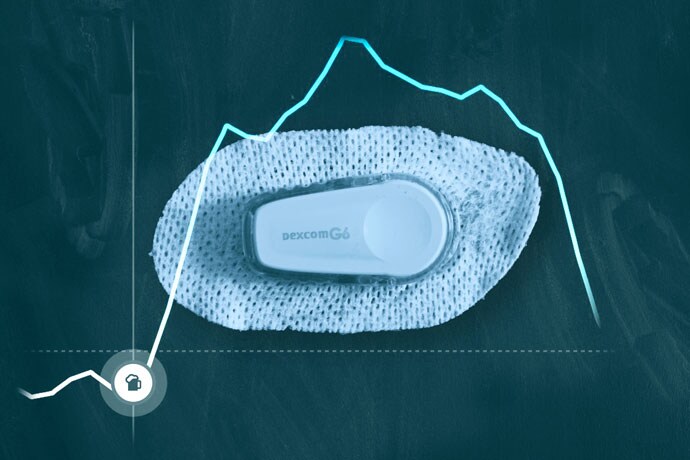
The Dexcom G6 continuous glucose monitor. CGMs are available over-the-counter in Europe, so companies are betting that the FDA will approve them to be available on drugstore shelves in the US.

The market for this technology is huge, from Olympic athletes to office workers looking to avoid the post-lunch lull. The nation has long been in the throes of what is often referred to as an obesity epidemic. From 2017 through 2021, 26% of Americans, on average, said they were "seriously trying to lose weight," and more than half said they would like to, according to Gallup surveys. And about 96 million U.S. adults have prediabetes, increasing their risk of developing chronic diseases like Type 2 diabetes and heart disease, according to the Centers for Disease Control and Prevention. Prediabetes affects people who are both lean and overweight, though obesity does elevate diabetes risk.

Investors are taking note. Nearly $3.5 billion poured into U.S. weight loss digital health startups from 2020 through the first half of 2022, according to an analysis by venture fund Rock Health for KHN. CGM startups LevelsNutriSenseSignos, and January have raised more than $140 million in funding collectively, according to company funding database Crunchbase.

There’s plenty of hype about all the data they deliver.

Ads online and in podcasts often feature active 20-somethings. They promise unique insights into how individual bodies react to food, exercise, and sleep in real time by homing in on metabolic health and how well users keep their glucose levels in check. "We’re taking on weight loss by giving every body a voice," says CGM-based company Signos. A promo for Lumen shares: "You hold in your lungs the secret to sustainable weight loss."

But even as people in the field have seen "significant" results from incorporating these tools into weight loss programs, they acknowledge that no single approach seems able to do it all. For instance, Eric Kusher, a doctor of chiropractic who runs an intensive weight loss program at Compass Fat Loss, said he still relies on the human element, too, falling back on his staff’s dietary advice, not the meal guidance provided by apps.

The reality layer is also important, said Dr. Nirav Shah, a senior scholar at Stanford University’s Clinical Excellence Research Center. "If you’re a harried mother trying to care for three kids and hold down a job, you’re not going to have time to monitor and create the perfect green shake," he said. "You’re going to buy the dollar meal because that’s easier and cheaper for your kids — and then you’re going to eat whatever they don’t eat."

For weight loss and inflammation flare-ups, Sarah Schacht, a 42-year-old government innovation consultant from Seattle, has tried all kinds of health tech, including Levels and Lumen. The generalized "eat less, move more" — flawed advice for many — wasn’t working for her. The Levels app lets the user log meals, exercise, and other notable events; combines the information with CGM data; and then offers insights and advice on how users can foster gentler glucose curves. Since starting Levels a year and a half ago, she has lost 5 pounds, her weight has stabilized, and the inflammatory responses have gone down. But her body has not dramatically changed, she said.

"I get the feeling that the few success stories I’ve seen, people who have radically changed their bodies, spend a lot of time on their eating strategy," Schacht said. "Not everyone has that mental capacity, time, or budget."

These devices aren’t covered by insurance, so, with related subscriptions for the data, costs can be hundreds of dollars annually. There is also scant research on CGMs’ effectiveness in improving the health of people without diabetes, let alone prompting weight loss. Without firm results, many health care providers are skeptical. Some experts also worry that the constant stream of data could prompt disordered eating.

Dr. Caroline Apovian, co-director of the Center for Weight Management and Wellness at Brigham and Women’s Hospital in Boston, said she does not see the use of an expensive CGM for someone who doesn’t have diabetes, especially with new weight loss drugs within reach. Those drugs, of course, will also carry a hefty price tag.

"It’s hard work losing 10 pounds," Apovian said. "A CGM is going to wipe out your money so you can’t join a gym."
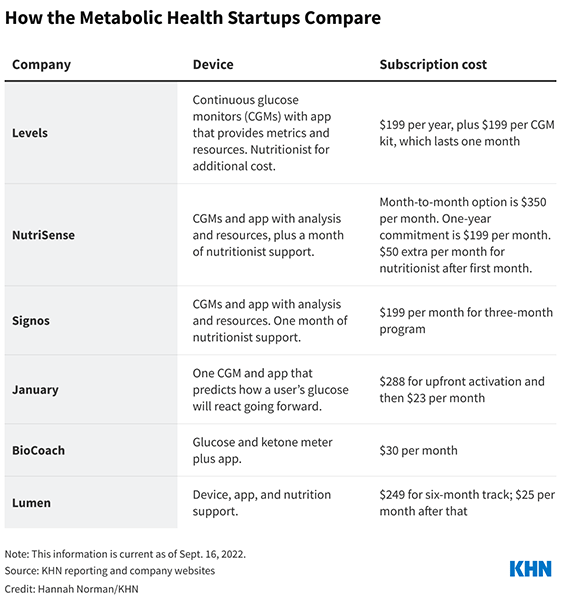
 

Most of the people who have insulin resistance and metabolic disease tend to be lower income and minorities who can’t afford CGMs, said Logan Delgado, co-owner of BioCoach. BioCoach has FDA clearance for its glucose and ketone meter, which checks glucose levels and tests for ketones in the blood — a sign the body is burning fat for energy. Its more traditional finger-prick technology keeps the subscription price down to $30 a month while still letting people without diabetes learn about their metabolic health, though not with continuous data. The company has amassed a large following on TikTok, where Delgado and others raise awareness about sugary foods and diabetes.

The CGM startups generally offer one of two CGMs: Abbott’s FreeStyle Libre, which is cheaper and requires a manual scan of the sensor by a smartphone, or the Bluetooth-connected Dexcom G6, which updates to a smartphone automatically. The monitors are provided to people without diabetes through "off-label" prescriptions because the FDA has not yet approved the tools for the general population.

CGMs are available over-the-counter in Europe, so companies are betting that the FDA will approve them to be available on drugstore shelves in the U.S. That should drive down the prices of the sensors, which can cost hundreds of dollars.

But already January says it can use artificial intelligence to predict a person’s glucose levels after a user wears a CGM for two weeks. The algorithm, backed by published research and a library of food nutrition data, can then predict the person’s glucose response to thousands of foods before the user decides what to eat, not after. This brings the cost down, essentially creating a virtual CGM, said Noosheen Hashemi, CEO of January. The company is rolling out a new version of its app this fall.

Across the board, the startups are largely working through the kinks, some still conducting the research to back up their marketed claims and taking different approaches to using the technology. A common theme for the startups, though, is going direct-to-consumer first — aiming for people who can afford the concept — before eventually seeking coverage from insurers, said Bill Evans, founder and general partner of Rock Health Capital.

The companies are also trying to add novel twists to how their apps use the data to reach health and weight-loss goals, each with libraries of informational blogs, lessons, and activities. They range in cost from hundreds of dollars annually to more than a thousand, with charges covering the price of the hardware, the subscription for wraparound services, and in some cases nutritionist support. The companies are banking on the idea that customers will sign on for the long term.

Taking a more wraparound approach, NutriSense has leaned heavily into building out an 80-person nutrition team that works closely with customers, according to Kara Collier, the company’s vice president of health.

Signos, which focuses on weight loss, uses artificial intelligence to set a "weight loss range" for customers depending on their general glucose ranges and level of fitness.Out of curiosity, this reporter stuck a CGM on the back of her arm for 10 days and signed up for the Levels app. At first, the metrics were jarring. As a person without diabetes, I had never reckoned with my glucose levels before.

Then I started recognizing patterns that made sense: Drinking beer always spiked my glucose, but a bagel after a long morning walk kept my blood sugar relatively stable. Avocado toast or eggs for breakfast were better alternatives, though. And a salad with chickpeas, tomatoes, and turkey for lunch earned top marks.

Digesting data alongside every meal certainly made me think harder about what I ate and when I exercised. But it also felt like a lot of extra homework.

https://www.medscape.com/viewarticle/982476

Bayer to challenge $275 million U.S. jury verdict over PCB injury claims


Germany's Bayer said on Friday it plans to legally challenge a jury verdict awarding $275 million to a group of people claiming they suffered from exposure to PCB, a chemical that Bayer's Monsanto business produced until 1977.

Bloomberg and other media outlets on Thursday reported the verdict before the King County Superior Court in the U.S. state of Washington in favour of 13 plaintiffs who blame their illnesses on exposure to polychlorinated biphenyls, or PCBs, at the Sky Valley School in Monroe County.

"We respectfully disagree with the divided jury verdict reached in this 13-plaintiff case and plan to pursue post-trial motions and appeals based on multiple errors and the lack of proof at trial," Germany's Bayer said in a statement.

"The undisputed evidence in this case does not support the conclusions that plaintiffs were exposed to unsafe levels of PCBs at the Sky Valley Education Center or that these exposures are responsible for their alleged health issues" it added.

Bayer shares were down 0.9% at 0738 GMT while Germany's blue chip index DAX was up 0.7%.

While Monsanto's weedkiller Roundup has been a far larger litigation burden for Bayer, the diversified healthcare and agriculture company has also been trying to resolve lawsuits related to PCBs. The chemical was used in commercial products until Monsanto voluntarily ended production in 1977.

Bayer has since 2020 resolved a majority of cases in litigation with municipalities over waste water contaminated with PCB for $650 million but several other claims remained pending.

In August, it set aside 694 million euros for an expected settlement with the State of Oregon over PCB in waste water.

The group of substances was once used in electrical equipment, carbonless copy paper, caulking, floor finish and paint. It was outlawed by the U.S. government in 1979 after being linked to cancer.

https://www.marketscreener.com/quote/stock/BAYER-AG-436063/news/Bayer-to-challenge-275-million-U-S-jury-verdict-over-PCB-injury-claims-42005735/

How to store data for 1,000 years

 "You know you're a nerd when you store DNA in your fridge."

At her home in Paris, Dina Zielinski, a senior scientist in human genomics at the French National Institute of Health and Medical Research, holds up a tiny vial to her laptop camera for me to see on our video call. It's hard to make out, but she tells me that I should be able to see a mostly clear, light film on the bottom of the vial – this is the DNA.

But this DNA is special. It does not store the code from a human genome, nor does it come from any animal or virus. Instead, it stores a digital representation of a museum. "That will last easily tens of years, maybe hundreds," says Zielinski.

Research into how we could store digital data inside strands of DNA has exploded over the past decade, in the wake of efforts to sequence the human genomesynthesise DNA and develop gene therapies. Scientists have already encoded films, books and computer operating systems into DNA. Netflix has even used it to store an episode of its 2020 thriller series Biohackers.

The information stored in DNA defines what it is to be human (or any other species for that matter). But many experts argue it offers an incredibly compact, durable and long-lasting form of storage that could replace the many forms of unreliable digital media available, which regularly become defunct and require huge amounts of energy to store. Meanwhile, some researchers are exploring other ways we could store data effectively forever, such as etching information onto incredibly durable glass beads, a modern take on cave drawings.

But how long could this data really last, and can we really rely on it to store the reams of data now being produced by humanity for posterity?

***

As we move towards a more and more digitised world, our reliance on data is skyrocketing. Films, photographs, webpages, business documents, critical security records – everything we use is digitalised, and we are using increasingly more of it.

Most of the reams of data we have produced is stored as 1s and 0s on magnetic tapes such as hard drives, but this is far from an ideal solution. For one thing, demagnetisation is a huge issue – permanent magnets gradually lose their magnetic field over time, so to keep data reliably it's important to rewrite hard drives every few years. "It lasts on average maybe 10 to 20 years, maybe 50 if you're lucky and the conditions are perfect," says Zielinski.

In 2018, SpaceX launched a Tesla roadster into space with an etched copy of Isaac Isamov’s Foundation series onboard (Credit: Getty Images)

In 2018, SpaceX launched a Tesla roadster into space with an etched copy of Isaac Isamov’s Foundation series onboard (Credit: Getty Images)

Storing data also requires huge data centres which use large amounts of energy to keep things cool – not ideal in a world prone to energy crises. The problem is seen as significant – the US government's molecular information storage (Mist) programme, launched in 2019, aims to find an alternative to today's huge data storage facilities, for example.

"We're actually running out of hardware. I think that industry can't really keep up with generating enough hard disks and servers to store all this data on," says Zielinski.

But do we really need to keep all this data, and preserve it for so long?

People want to store data for the long term for a huge variety of reasons. One is science – researchers are generating unprecedented amounts of data, and the more they have, the better. Radio telescopes and particle accelerators like the Large Hadron Collider (LHC) at the European Organization for Nuclear Research (known as Cern) on the border of France and Switzerland, for example, generate reams of data, and scientists want to keep all of it, says Latchesar Ionkov, a computer scientist working on DNA storage at Los Alamos National Laboratory. The LHC alone produces 90 petabytes (90 million gigabytes) per year.

Marke Bathe, a professor of biological engineering at Massachusetts Institute of Technology,  co-founded the start-up Cache DNA to make biomolecules widely accessible and useful. The global threats facing humanity compel us to preserve both human-made information, such as art and science, and the DNA of all living things on the planet, says Bathe. "That way, if life were to either be recreated here or otherwise transferred or imported from other planets and so forth, there would be records of what we did, and what we had," he says.

Many DNA storage researchers believe they have hit on the perfect storage medium for both widespread and incredibly long-term storage. We typically view DNA as a way to store genomic information, but many researchers are now excited about the possibility of storing the vast quantities of digital data currently choking up data centres across the world.

DNA is a natural choice here, says Bathe. "Nature has used DNA for many millennia to store information in the form of genomes," he says. "It's been around [for billions of years], it's something that you can kind of bank on. As long as that's the fundamental information storage medium of a species, like humans, then it's going to be something that we know what to do with."

The world's particle accelerators generate hundreds of petabytes of data every year (Credit: Getty Images)

The world's particle accelerators generate hundreds of petabytes of data every year (Credit: Getty Images)

Compare the fact that DNA has been optimised over the last 3.7 billion years or so to the information age, which really began in the 1950s, says Zielinski. "We've come pretty far in man-made technology, but it doesn't get much better than DNA in terms of efficiency – when we start as one cell, all the instructions are there to direct every single cell until you reach the nearly 30 trillion cells that make up a human."

What's more, the fact we can recover DNA fragments from million-year-old animals such as woolly mammoths that deliver meaningful data about their genomes shows DNA is incredibly durable, says Zielinski. The half-life of DNA – the time it takes to degrade by half – is around 500 years in a well-preserved fossil, which means the DNA would cease to be at all readable after around 1.5 million years.

However, DNA is incredibly fragile, and the conditions that lead to fossilisation are extraordinarily rare. "There are tonnes of ways to destroy it," says Olgica Milenkovic, a professor of electrical and computer engineering at the University of Illinois at Urbana–Champaign. Humidity, acids, and radiation all damage DNA. "But if it's kept cold and dry, it's good for hundreds of years."

You might also like:

Even better, DNA can be protected by encapsulating it inside other materials such as glass beads – mimicking how genetic material is protected within ancient fossils. Robert Grass, a researcher at ETH Zurich, Switzerland, and his team have shown these beads protect the DNA from both chemicals and heat.

Further protection could come from locating it in a physically safe place. Storing data critical for humanity in encapsulated DNA in an ice vault could mean "it can last forever, pretty much", says Milenkovic.

Another huge perk of DNA is that it is incredibly dense store of information, to an extent unmatched by any other man-made device. The estimated 33 zettabytes of data that humans will have produced by 2025 (that's 3.3 followed by 22 zeroes) could be squeezed into the size of a ping-pong ball with DNA storage, according to Ionkov. He believes storing this much information in DNA could be mere decades away.

Before the DNA double helix was discovered in 1953, many scientists believed its structure would be too simple to store much information – but they were wrong (Credit: Alamy)

Before the DNA double helix was discovered in 1953, many scientists believed its structure would be too simple to store much information – but they were wrong (Credit: Alamy)

DNA storage is also unlikely to ever become obsolete, unlike other man-made storage media – "which one of us still uses floppy disk?" asks Milenkovic. With DNA, we should always be able to read it. "With every man-made technology, you need a new device to read it," says Zielinski. "If DNA is obsolete, then we have other problems to worry about."


There are other perks to DNA storage, too. It has already piggybacked on research in medical science, such as gene therapy and synthetic biology, notes Milenkovic, and this will continue as that research advances. It would also use next to no energy to store.

Of course, there are huge challenges. As one 2018 paper put it, while DNA has "an enormous potential as a data storage device of the future, multiple bottlenecks such as exorbitant costs, excruciatingly slow writing and reading mechanisms, and vulnerability to mutations or errors need to be resolved".

***

The process of converting digital data into DNA basically consists of turning it into a DNA alphabet. DNA is made up of four molecules known as nucleotides or bases: adenine (A), cytosine (C), guanine (G), and thymine (T), joined together in different sequences in a long string. The most common way to turn digital information into DNA code simply requires converting the 0s and 1s of digital code into these four letters, then synthesising the DNA to match. 

"You can use A to represent, for example, 00; T to represent 01; G to represent 10 and C, 11," says Milenkovic. "Then you can take any digital content that exists classically on a disk or a tape or a flash, and convert it into a four-letter alphabet."

DNA synthesis was the method used by the two breakthrough papers published in 2012 and 2013 which each stored around 700kB of data in DNA (the previous record was less than 1kB). In a 2017 paper, Zielinksi (then a researcher at the New York Genome Center) and her colleagues stored a scientific paper, one-minute film, computer operating system, computer virus and Amazon gift card – totalling around 2MB – on DNA using this method.

The huge barrier to storing lots of data on DNA, of course, is the cost, which is far higher than storing data on servers or hard disks. It cost Zielinksi $7,500 (£6,729) to store those five digital items.

The cost of DNA storage is "a bit of a moving target", adds Zielinski, as it depends on the synthesis method as well as the encoding scheme and how it is decoded. A reasonable estimate is around a few thousand dollars per megabyte (MB) to both encode and decode by sequencing, she says.

The US President Abraham Lincoln’s Gettysburg Address has been stored on modified DNA from E. coli bacteria (Credit: Alamy)

The US President Abraham Lincoln’s Gettysburg Address has been stored on modified DNA from E. coli bacteria (Credit: Alamy)

To convert this article and its pictures into DNA, for example, would mean initially compressing the data from roughly 20MB to around 500kB, applying an encoding scheme, then sending this off to a lab to synthesise it at a rough cost of $1,000 (£897). The lab would complete the laborious process of making it for me using a technique which adds one nucleotide at a time to each string of DNA. "The biggest bottleneck is actually synthesising that DNA," says Zielinski. "That's the biggest focus, reducing synthesis costs."

However, the resulting strands don't need to be perfect. If you're using it for data storage rather than medical procedures – which is what DNA synthesis was originally developed for – there could be a higher tolerance for errors. So the door is open for faster, less precise methods of synthesis. "You can handle errors in the data and still recover your files. And so we can handle a much messier synthesis," says Zielinski.

To be competitive with common digital media, says Bathe, the cost of DNA storage would have to come down by a factor of around a million. This is a long way off, but scientists are already working to increase how many DNA molecules can be written at the same time. "If you look at the electronics industry, they have seen that reduction in cost," adds Bathe. And the cost of DNA synthesis has already fallen significantly, he says.

Another option that avoid synthesis altogether is the possibility of storing data in naturally occurring DNA that has simply been edited. In 2020, Milenkovic's group edited DNA from the bacteria E. coli to store US President Abraham Lincoln's Gettysburg Address and an image of the Lincoln Memorial by creating a punch-card system to create holes (actually little nicks out of the nucleotides using gene editing systems such as Crispr and other nicking enzymes) in the bacteria's genetic sequence. This could end up being far cheaper than making totally new DNA molecules.

"It's a completely different paradigm – you don't store information in the sequence content in the composition of ATGCs, you store information in the presence of structural changes in the double helix," says Milenkovic. The original bacteria becomes the reference point for the code, and no synthesis is needed, which means the process should be cheaper and avoid the toxic byproducts associated with synthesising DNA, she says.

However, the price paid here is in the density of data that can be stored on a given strand of DNA. "We estimated roughly a 50-fold loss in density [compared to the DNA synthesis technique]."

Scientists know that DNA can store data for millennia, because they have already decoded the genomes of many long-extinct animals (Credit: Getty Images)

Scientists know that DNA can store data for millennia, because they have already decoded the genomes of many long-extinct animals (Credit: Getty Images)

Another experimental method for storing data in DNA, reported by Harvard scientists in 2017, involves feeding fragments of nucleotides to an already existing DNA strand in a living cell, which incorporates the DNA fragments as an immune defence mechanism. The team inserted Eadweard Muybridge's 1878 film clip of a galloping horse into a bacterium. "The trace is left in a living organism," says Milenkovic. As long as that organism exists, including its offspring, the information is stored – although it may become mutated over time, altering the information.

***

Because we can extract data from fossils, says Ionkov, we're pretty sure that DNA storage can last a long time. "So an interesting question is actually not how long the media, the DNA molecules will last, but are we going to be able to read the data in 1,000 years."

Ionkov's organisation is part of a group called DNA Data Storage Alliance, which is looking at how we can ensure we'll be able to decode the data in future centuries. One of its working groups, the Rosetta Stone Group, is looking at how to create a universal guide for how to read their DNA storage archive.

There are several challenges with reading DNA today. First, you need to sequence it. This involves using the common molecular technique PCR to make trillions of copies of the stretch of DNA you'd like to decode. Unfortunately, this can introduce mistakes. "Many of these errors can easily be handled in the decoding, when you decode that DNA back to your data," says Zielinski.

Next comes the sequencing itself, and there's a snag here too. Currently, sequencing is done in table-top machines which typically take several hours to run. So this form of data storage is not exactly a quick-access system.

One thing that would improve these waiting times is "random access" – the ability to dip in and out of the data to retrieve what you are looking for, so you don't have to sequence the whole lot. This has been demonstrated with DNA storage systems by adding a "barcode" to the end of the DNA strands.

However, the current DNA molecules being produced are fairly short – 150 or 200 base pairs – so using part of this space to simply identify the DNA strand via a barcode leaves even less space for writing the data you want to store, says Ionkov. "It's a pretty serious problem. But once the technology gets much better and we can write very long molecules with thousands or tens of thousands of nucleotides [base pairs], that problem will start disappearing."

There are concerns that synthetic DNA could one day be used to mislead forensic investigations (Credit: Getty Images)

There are concerns that synthetic DNA could one day be used to mislead forensic investigations (Credit: Getty Images)

In another method to improve random access, Bathe's team encapsulated DNA strands in silica beads labelled using short strands of nucleotides on the surface of the bead. "The same way you barcode products at a supermarket to be able to identify them uniquely, we barcode these little capsules of DNA, using nucleic acids," says Bathe.

It's not yet clear how we might integrate information stored in DNA into working computers. Bathe's team has experimented with creating a file system for the DNA. "That kind of converts the liquid or solid state of DNA information into something that is more akin to a computer hard-drive where you have the ability also to search through it with something like a search engine like Google," says Bathe. Even Microsoft is exploring how it could incorporate biomolecules into computer design.

***

However, widespread DNA synthesis would come with risks. People could try to use it to store other things than data. In theory, people could synthesise viruses or bacteria, says Zielinski – or even create someone's DNA and leave it at a crime scene. "There are actually checks in many of these pipelines that generate data that they will cross check it against known genomes to make sure there's nothing real in there, nothing harmful, like a sequence for pathogens," she says.

Bathe agrees that there are "enormous" privacy issues and risks. He notes that many companies are seeking to catalogue the DNA of everyone on the planet. Others have pointed out how frightening it is to imagine someone being able to hold the DNA sequences of billions of humans in a small data storage system. "We need to build technologies around it, because if we don't, we won't be able to mitigate those risks or understand them; it'll be a very unknown and uncontrolled entity," says Bathe.

Considering this, it's worth thinking about the alternatives to DNA data storage. Peter Kazansky, a professor in optoelectronics at the University of Southampton, has created an optical storage technology that he believes is a worthy contender – it can last for millions or even billions of years, he says.

The team works with femtosecond (one millionth of one billionth of a second) laser writing – etching information onto durable silica glass disks using a laser similar to the type used in eye surgery. The intense, short laser pulses are focused in a particular way to create a micro-explosion which makes a tiny hole in the glass. "We discovered that in these conditions very tiny nano-structures could be formed," says Kazansky. "And we use these structures to encode information."

The process is similar to how CD and DVDs are burned using laser light polymers or dye – but here the structures are tiny and incredibly stable, surviving temperatures up to at least 1,000C (1832F) and undamaged by radiation, says Kazansky. "One advantage of [our] storage, the main one, is durability; it can last almost forever," he says.

The technology produces information in five dimensions – on top of the usual three dimensions created by a hole, the orientation and shape of the hole can also be controlled, allowing denser data storage. This density could never approach that of DNA, but by increasing the number of layers in the etching it is slowly rising.

DNA is capable of storing vast quantities of data within a microscopic area (Credit: Getty Images)

DNA is capable of storing vast quantities of data within a microscopic area (Credit: Getty Images)

So far, documents including the Universal Declaration of Human Rights, Magna Carta, the King James Bible – and The Hitchhiker's Guide to the Galaxy – have all been stored using the technology. In 2018, Elon Musk sent an etching of Isaac Asimov's science fiction series Foundation into space aboard the Falcon Heavy rocket, while Microsoft has stored the entire 1978 Superman film in glass. The artist Mika Tajima has even stored "human emotion" data using this method – she collected and stored all the tweets posted in Japan in 2020.

"We use a process similar to what ancient people used – they made marks on stone with tools," says Kazansky. "It's a mechanical or physical change of material. So this kind of physical change or making holes in material is a very ancient way of securing information." 

Similar to DNA storage, one of the main caveats to storing data in this way is writing speed. Kazansky says his team can now write at 500kB per second, up from at most 0.1kB per second in the initial experiment a decade ago. "To make it practical, you need a write speed of a million bytes (1,000kB) per second, at least," he says. Another barrier is reading the data, which currently needs to be done manually using an optical microscope. "To make it practical, you need to make a machine which will just take the sample, focus, move and read."

The device used to do the etching also currently fills a room, and uses a £100,000 ($112,000) laser, although Kazansky believes the size and cost could be brought down. And while very durable to temperature and radiation, encapsulating the glass in something strong may still be a good idea for anyone wanting to ensure its longevity – the glass itself could simply be broken with a stone.

"I think the etching is much less sensitive to any environmental conditions," says Zielinski. "So it's not as dense [as DNA], but it's still a very, very efficient way to store critical data, and you can certainly worry much less about it. Every storage device has its opportunities and advantages and disadvantages. And I think DNA could be complementary." 

Other researchers are pursuing molecular options for encoding data that don't involve DNA, such as those using chains of other kinds of synthetic molecules which are easier and cheaper to synthesise. For example, a code can be created simply by controlling the mass of individual molecules, with different masses representing different combinations of 0s and 1s. 

We already have the ability to encode digital data into DNA, encapsulate it and protect it for hundreds or potentially thousands of years. The real caveat here is choosing which data to do this with – or how to overcome the bottleneck of DNA synthesis to allow far larger amounts of data to be stored than we have so far. "I'm pretty excited about the DNA being used for storing data, [but] I think we need 20 more years," says Ionkov, although he notes that some companies believe that they will have a viable product in five years.

Zielinski believes humans will start using DNA in the next five to 10 years to store cold data that don't need to be accessed often, such as critical financial records or historical data. I ask her if one day we could be printing our own DNA on devices at home. "Absolutely, I think that will happen at some point."

https://www.bbc.com/future/article/20221007-how-to-store-data-for-1000-years

Major companies race to buy back stocks ahead of new corporate tax

 Major corporations are scrambling to repurchase their own shares before a new tax on stock buybacks passed as part of Democrats’ major spending bill over the summer goes into effect, an effort that may sap one of the bill’s main sources of revenue.

Stock buybacks occur when a company buys its own shares, taking them out of the marketplace, which increases the value of the earnings-per-share and makes each outstanding share worth more money.  

A basic arithmetic trick, buybacks were illegal until 1982 and have long been blasted by critics as a legal form of market manipulation and a way for executives to pay themselves more.

“I hate stock buybacks,” Senate Majority Leader Charles Schumer (D-N.Y.) said in August upon striking a deal with Sen. Joe Manchin (D-W Va.) that would become the Inflation Reduction Act (IRA). The IRA, signed into law by President Biden, enacted the 1-percent buyback tax after an initial proposal to tax the personal income of hedge fund managers was blocked by Sen. Kyrsten Sinema (D-Ariz.).

“I think [buybacks] are one of the most self-serving things that corporate America does,” Schumer said. “Instead of investing in workers and in training and in research and in equipment, they simply – they don’t do a thing to make their company better, and they artificially raise the stock price by just reducing the number of shares. They’re despicable. I’d like to abolish them.” 

Major U.S. corporations, including T-Mobile US Inc., Johnson & Johnson and Comcast announced new buyback initiatives in September ahead of the Dec. 31 effective date of the IRA’s new tax.

T-Mobile’s board authorized a repurchase program for $14 billion of the company’s common stock on Sept. 8 that would extend through 2023.  

“Repurchases are expected to be made from available cash on hand and proceeds of one or more debt issuances,” the company said in a Securities and Exchange Commission (SEC) filing, indicating that it may borrow money in order to buy back the stocks if it can find a favorable rate.

Comcast also announced in mid-September that its board “increased its share repurchase program authorization to a total of $20.0 billion, effective as of September 13, 2022.” Comcast has already repurchased $9.0 billion of its Class A common stock this year, and SEC filings show that it’s been ramping up its buybacks relative to last year.

“For the six months ended June 30, 2022, Comcast paid dividends totaling $2.4 billion and repurchased 133.4 million of its common shares for $6.0 billion, resulting in a total return of capital to shareholders of $8.4 billion, compared to $2.7 billion in 2021,” Comcast’s second quarter earnings report says.

Johnson & Johnson announced its own $5 billion stock buyback initiative in September.

“With continued confidence in our business and pipeline, the Board of Directors and management team believe that company shares are an attractive investment opportunity,” Joaquin Duato, Johnson & Johnson CEO, said in a statement last month. 

Companies have also been hiring investment banks to expedite their buybacks ahead of the new IRA tax in a method known as an “accelerated share repurchase” program. Using investment banks to buy back stocks allows companies “to immediately purchase a large number of common shares,” according to an analysis of the technique by accounting firm Price Waterhouse Coopers.

Two days after President Biden signed the IRA into law, publicly traded department store chain Kohl’s “entered into an accelerated share repurchase agreement (ASR), pursuant to its previously announced share repurchase program, to repurchase approximately $500 million of the Company’s common stock,” an SEC filing shows.

Electronics software company and S&P 500 index member Synopsys also began an accelerated buyback program in August with Bank of America worth $240 million. Under their agreement, the company will take back around 535,000 of its own shares to be settled in November.

“Stock repurchases have been an element of our capital return policy for many years, and we have regularly used ASRs as a way to return capital to our shareholders, including substantial ASRs every year since 2014,” Synopsys said in a statement to The Hill.

A tally by liberal advocacy group Accountable US found five publicly traded companies that had started expedited buyback programs in August, all within about two weeks of the IRA’s new corporate buyback tax.

The repurchase programs totaled $1.5 billion in stock and amounted to about $15 million in avoided taxes, according to the tally.  

“Every dollar that a wealthy corporation dodges in taxes with loopholes like offshore tax havens or accelerated share repurchase programs is a dollar taken away from deficit reduction or priorities that help save consumers money,” Accountable US spokesperson Liz Zelnick said in a statement. “Policy makers should build on the Inflation Reduction Act’s impact to rein in greedy behavior that’s costing average families dearly and ensure those who profiteer are paying their fair share in taxes, which helps reduce inflation.”

Buybacks have faced bipartisan resistance in the past, with both Democrats and Republicans advancing proposals to rein them in.

Sen. Marco Rubio (R-Fla.) put forward a plan to make buybacks less lucrative for corporations in 2019, though it was criticized by some of his Republican colleagues, including Sens. Pat Toomey (R-Pa.) and Rick Scott (R-Fla.).

“Rubio calls for government policies that disincentivize selfish corporate decision-making, such as imposing taxes on share buybacks, while rewarding investment in domestic manufacturing and new research,” a 2019 press release on the senator’s website reads.

Senate Banking Committee and Finance Committee Chairmen Sherrod Brown (Ohio) and Ron Wyden (Ore.), both Democrats, introduced legislation in 2021 for a 2-percent excise tax on buybacks — double what’s in the IRA.

“A few decades ago, a majority of Wall Street capital funded the real economy – wages, machinery, research, new construction. Today, much of that capital is funneled back to wealthy executives in the form of stock buybacks – which used to be illegal market manipulation – and only about 15 percent goes to the real economy,” Brown said in a statement unveiling his bill.

Despite the new excise tax in the IRA, buybacks are likely to remain attractive to corporate managers due to the tax advantages they have over other ways of repaying investors, such as dividends.

“Buybacks often receive preferential tax treatment compared to dividends in certain jurisdictions. In these jurisdictions, buybacks are taxed as capital gains while dividends are taxed as ordinary income, meaning investors could prefer to receive buybacks over dividends,” financial firm FCLTGlobal CEO Sarah Keohane Williamson wrote in a post on the Harvard Law School Forum on Corporate Governance website.

https://thehill.com/policy/3688459-major-companies-race-to-buy-back-stocks-ahead-of-new-corporate-tax/