Search This Blog

Thursday, January 5, 2023

NIH launches pilot COVID telehealth program


The U.S. National Institutes of Health (NIH) on Thursday launched a virtual program aimed at making antiviral treatments for COVID-19 available at home for those who test positive.

Local and state officials from Berks County in Pennsylvania will be the first to pilot the program, known as Home Test to Treat, later this month, with up to 8,000 residents expected to participate, the NIH said.

eMed, a privately-owned at-home health services firm, will host the official Home Test to Treat website, where individuals can sign up to receive antiviral treatment delivery as well as to coordinate telehealth-enabled test kits.

The public health agency has also engaged the UMass Chan Medical School in Worcester, Massachusetts, to collaborate with eMed on analyzing the data collected from the telehealth program such as the impact of a home-based process on testing and treatment.

The program, which was first announced in September by the White House, is aimed at increasing access for people in rural and high-risk communities.

https://www.marketscreener.com/quote/stock/NATIONAL-INTERNATIONAL-HO-20701675/news/NIH-launches-pilot-COVID-telehealth-program-42668871/

Dawn-to-dusk dry fasting leads to health benefits in the study of immune cells

 Researchers at Baylor College of Medicine have found more evidence that dry fasting (fasting without food or liquid intake) from dawn to dusk can play an important role in overall health. In a new study published in Metabolism Open, researchers found that fasting from dawn to dusk for four weeks has an anti-atherosclerotic, anti-inflammatory and anti-tumorigenic effect on the proteins in a type of immune cell called a peripheral blood mononuclear cell (PBMC).

"We know that disruptions of the circadian rhythm are associated with cancer and metabolic syndrome. This type of fasting can potentially act as a reset to normal for the circadian rhythm," said Dr. Ayse Leyla Mindikoglu, corresponding author of the study and associate professor in the Margaret M. and Albert B. Alkek Department of Medicine, Section of Gastroenterology and Hepatology and the Michael E. DeBakey Department of Surgery, Division of Abdominal Transplantation at Baylor. "After fasting, our participants lost weight, and their  and insulin resistance improved."

The researchers previously found similar results in . The current study used samples from the previous study examining 14 people with metabolic syndrome, a group of conditions including obesity,  (elevated ), elevated blood pressure, high triglycerides (a type of blood fat) and low high-density lipoprotein cholesterol (good cholesterol). These conditions can lead to an increased risk of cardiovascular disease and cancer. The participants were observing the month of Ramadan, which consists of fasting for four consecutive weeks without eating or drinking from dawn to sunset. Outside of fasting, participants were allowed to eat whatever they preferred and were not required to follow any exercise regimen or weight loss measures.

Participants gave  before the fasting period began, at the conclusion of fasting and one week after fasting was completed. The research team used mass spectrometry techniques to examine the proteome of PBMCs in the blood. They found that proteins associated with atherosclerosis, heart disease and cancer promotion were decreased, while proteins associated with cancer and inflammation suppression were increased. They found that apolipoprotein B, which is a more accurate risk predictor for developing atherosclerotic  than low-density lipoprotein (LDL) cholesterol, was significantly decreased at the end of four-week dawn-to-dusk dry fasting compared with its level before fasting, and its decrease persisted even one week after the fasting period.

"The findings of this study are important because we were able to confirm the favorable effect of dawn-to-dusk dry fasting at the cellular level," Mindikoglu said. "This is the first time that this type of investigation into the proteome of immune cells has been done in subjects with metabolic syndrome who fasted from dawn to dusk."

Next, Mindikoglu and her colleagues hope to perform randomized, controlled  to compare the impact of dawn-to-dusk dry fasting with regular eating habits in people with chronic metabolic diseases and -induced cancers.

More information: Ayse L. Mindikoglu et al, Dawn-to-dusk dry fasting induces anti-atherosclerotic, anti-inflammatory, and anti-tumorigenic proteome in peripheral blood mononuclear cells in subjects with metabolic syndrome, Metabolism Open (2022). DOI: 10.1016/j.metop.2022.100214
https://medicalxpress.com/news/2023-01-dawn-to-dusk-dry-fasting-health-benefits.html

Treatment for combat-related PTSD advances with method shown to be fast, effective

 Study findings out today in JAMA Network Open show an important step forward in treating the psychological injuries of war.

Researchers report that treatment for combat-related post-traumatic stress disorder (PTSD), which affects hundreds of thousands of U.S. military personnel and veterans, can be both fast and effective for a majority of patients. Their study showed clinically significant reductions in PTSD symptoms in more than 60 percent of patients and long-term remission of the diagnosis in more than 50 percent after three weeks of outpatient Prolonged Exposure therapy. Study participants similarly showed significant improvements in related disability and daily functioning.

Results were comparable whether patients received traditional Prolonged Exposure, also called PE, condensed into three weeks of daily treatment or an intensive outpatient format including several enhancements to address specific challenges of PTSD in war fighters.

The research team, led by Alan Peterson, Ph.D., of The University of Texas Health Science Center at San Antonio (UT Health San Antonio), conducted the randomized clinical trial with 234 military personnel and veterans recruited from four locations in South and Central Texas. The effort was part of the work of the Consortium to Alleviate PTSD (CAP), a national network jointly funded by the U.S. Departments of Defense and Veterans Affairs.

Dr. Peterson, professor of psychiatry and behavioral sciences at UT Health San Antonio and director of the CAP and the STRONG STAR Consortium, said the findings advance the group's previous research and significantly improve upon earlier outcomes.

Improving outcomes for our war fighters

"We're excited to see a more than 10-point increase in PTSD remission rates compared to a previous PE study we conducted, when we initiated the first ever clinical trials evaluating PTSD treatments in active-duty military populations," said Dr. Peterson.

That first study tested the standard PE protocol, with 10 sessions of 90 minutes each over the course of eight weeks, as well as a massed format, with daily 90-minute sessions over two weeks. The two delivery formats proved equally effective in reducing symptoms and leading to a loss of diagnosis, with remission rates under 50 percent initially after treatment, and treatment gains maintained by about 40 percent of patients six months later. The massed format had much lower dropout rates.

"Those initial results were encouraging, indicating that PE is effective for combat-related PTSD," said Dr. Peterson. "But with much lower success rates than in civilians treated with this therapy, we wanted to make and test treatment adaptations potentially to address unique aspects of combat-related PTSD and improve outcomes," he said. That is what the current study did.

Design and rationale of the current study

Prolonged Exposure includes patients' repeated retelling of their trauma stories along with homework assignments to engage in activities patients otherwise avoid because they trigger traumatic memories or anxious feelings. The goal is to help patients process thoughts about their trauma, calm the anxiety the memories provoke, and regain control of their lives.

It was thought that, in the original study—particularly with the massed format—patients may not have had adequate time to complete homework assignments and may also have faced a number of distractions. So, for both arms of the current study, patients took leave from work or other daily responsibilities to devote themselves full-time to treatment and recovery.

Also with the current study, treatment time in both arms was expanded from two weeks to three, with the consideration that combat-related PTSD is more difficult to treat, and patients may need additional time to process traumatic memories.

The comparison arm, called Massed-PE, had these treatment delivery changes only. The other arm, called Intensive Outpatient or IOP-PE, had several additional enhancements that researchers hypothesized would improve treatment outcomes with combat-related PTSD.

Dr. Peterson explained one example. "Oftentimes, a civilian trauma involves a one-time traumatic event, such as an accident, or a repeated trauma of a certain type, such as abuse," he said. "In the course of one or more combat deployments, service members may experience hundreds of traumatic events involving different types of traumas. They also may have experienced other types of trauma outside the combat environment. And so we wanted to adapt the traditional PE protocol, in which a patient focuses only on one primary trauma during treatment, and allow patients in this study to work with therapists on their three top traumas."

He said the treatment involved starting with the least distressing of those three traumas to gain confidence in the therapy, then working up to the most distressing trauma. Some of the other modifications included team-based treatment, with more than one clinician supporting a patient's care; clinic-based completion of homework assignments to decrease avoidance; brief therapist feedback sessions during the day for added support and increased opportunities for processing; involvement of a family member or friend during educational sessions to help improve social support; and post-treatment booster sessions to help maintain treatment gains.

Findings, implications and next steps

Outcomes differed from researchers' expectations in that both arms showed similar levels of reductions in PTSD symptoms and related disability, as well as similar increases in PTSD remission rates and improved psychosocial functioning over time. With some measures, Massed-PE led to greater improvements initially that decreased by the six-month follow-up. IOP-PE patients were more likely to maintain their improvements six months after treatment.

Since long-term outcomes did not differ significantly, researchers say the additional investment of resources needed for the IOP-PE format may not be warranted, but the overall study findings are highly positive.

"With about two thirds of participants reporting clinically meaningful symptom improvement and more than half losing their PTSD diagnosis, this study provides important new evidence that combat-related PTSD can be effectively treated—in as little as three weeks," said Dr. Peterson.

He and his colleagues stated that, while condensed treatments may not be feasible for everyone, "results show that compressed formats adapted to the military context resulted in significant, meaningful and lasting improvements in PTSD, disability and functional impairments for most participants."

They say this makes condensed treatments an important option for U.S. service members and veterans after two decades of military operations in Iraq and Afghanistan. These treatments also could gain attention now as the war in Ukraine has raised international concerns about the risk of PTSD in  and civilians.

Moving forward, the study team notes that their findings show room for continued improvement in treating combat-related PTSD. They add that the compressed  formats evaluated in this study are well suited for the evaluation of new, alternative modes of therapy combining cognitive-behavioral treatments with medications and medical devices. "We have those types of studies already underway," said Dr. Peterson.

Collaboration on this important study was extensive, involving study team members from The University of Texas Health Science Center at San Antonio, South Texas Veterans Health Care System, Central Texas Veterans Health Care System, Brooke Army Medical Center at JBSA-Fort Sam Houston, C.R. Darnall Army Medical Center at Fort Hood, University of Pennsylvania, Stanford University, Duke University, Boston University, the VA's National Center for PTSD, and VA Health Care Systems in Boston, Mass.; Durham, N.C.; and Menlo Park, Calif.

More information: Massed vs intensive outpatient prolonged exposure for combat-related posttraumatic stress disorder, JAMA Network Open (2023). DOI: 10.1001/jamanetworkopen.2022.49422
https://medicalxpress.com/news/2023-01-treatment-combat-related-ptsd-advances-method.html

Sugar's role in common kidney disease

 A study of kidney organoids in a novel lab environment might have downstream implications for the treatment of polycystic kidney disease (PKD), an incurable condition that affects more than 12 million people worldwide.

One key discovery of the study: Sugar appears to play a role in the formation of fluid-filled cysts that are PKD's hallmark. In people, these cysts grow big enough to impair  and ultimately cause the organs to fail, necessitating dialysis therapy or transplant.

The findings were published in Nature Communications. The co-lead authors are Sienna Li and Ramila Gulieva, research scientists in the lab of Benjamin Freedman, a nephrology investigator at the University of Washington School of Medicine.

"Sugar uptake is something that kidneys do all the time," said Freedman, a co-senior author. "We found that increasing the levels of sugar in the dish cultures caused cysts to swell. And when we employed drugs known to block sugar absorption in the kidneys, it blocked this swelling. But I think it relates less to blood sugar level and more to how  take in sugar—which in this process seemed to go rogue and give rise to cysts."

For years Freedman has studied PKD in organoids grown from . Organoids resemble miniature kidneys: They contain filtering  connected to tubes and can respond to infection and therapeutics in ways that parallel the responses of kidneys in people.

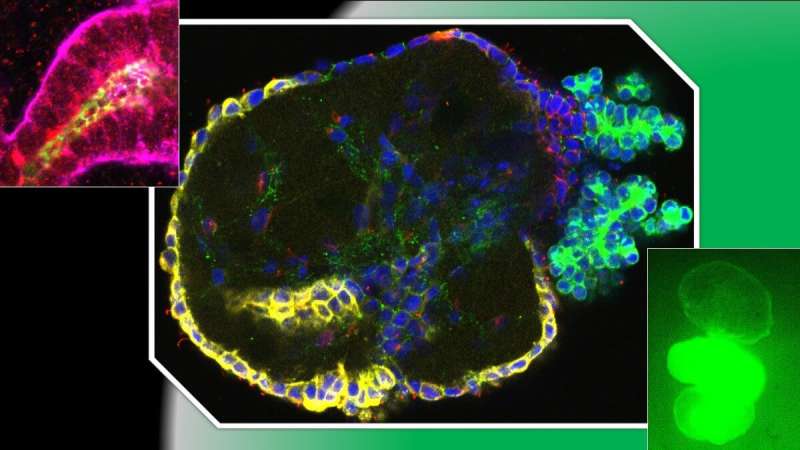
Study illuminates sugar's role in common kidney disease
Mini-kidney tube structures have sugar receptors (red, upper left) and form outward-facing PKD cysts (center), which swell by taking in sugar (green, lower right). Credit: Benjamin Freedman Lab / University of Washington School of Medicine

Although his team can grow organoids that give rise to PKD cysts, the mechanisms of those cysts' formation are not yet understood. In this investigation, the researchers focused on how the flow of fluid within the kidney contributes to PKD.

To do so, they invented a new tool that merged a   with a microfluidic chip. This allowed a combination of water, sugar,  and other nutrients to flow over organoids that had been gene-edited to mimic PKD

"We were expecting the PKD cysts in the organoids to get worse under flow because the disease is associated with the physiological flow rates that we were exploring," Freedman explained. "The surprising part was that the process of cyst-swelling involved absorption: the intake of fluid inward through cells from outside the cyst. That's the opposite of what is commonly thought, which is that cysts form by pushing fluid outward through cells. It's a whole new way of thinking about cyst formation."

In the chips, the researchers observed that the cells lining the walls of the PKD cysts faced outward as they stretched and swelled, such that the tops of the cells were on the outside of the cysts. This inverted arrangement—these cells would be facing inward in living kidneys—suggests that cysts grow by pulling in sugar-rich fluid, not by secreting the liquid.

The observation gives researchers more information about how cysts form in organoids, a finding that will have to be tested further in vivo. As well, the fact that sugar levels drive cyst development points to new potential therapeutic options.

"The results of the experiment are significant because there is a whole class of molecules that block  uptake in the kidneys and are attractive therapeutics for a number of conditions," Freedman said. "They haven't been tested yet, but we view this as a proof-of-concept that these drugs could potentially help PKD patients."

More information: Sienna R. Li et al, Glucose absorption drives cystogenesis in a human organoid-on-chip model of polycystic kidney disease, Nature Communications (2022). DOI: 10.1038/s41467-022-35537-2
https://medicalxpress.com/news/2023-01-illuminates-sugar-role-common-kidney.html

Stimulating axon regrowth after spinal cord injury

 A new study by Burke Neurological Institute (BNI), Weill Cornell Medicine, finds that activation of MAP2K signaling by genetic engineering or non-invasive repetitive transcranial magnetic stimulation (rTMS) promotes corticospinal tract (CST) axon sprouting and functional regeneration after spinal cord injury (SCI) in mice.

rTMS is a noninvasive technique that evokes an electrical field in  via electromagnetic induction. While an increasing body of evidence suggests that rTMS applied over motor cortex may be beneficial for functional recovery in SCI patients, the molecular and cellular mechanisms that underlie rTMS' beneficial effects remains unclear.

A new study published in Science Translation Medicine showed that high-frequency rTMS (HF-rTMS) activated MAP2K signaling and enhanced axonal regeneration and functional recovery, suggesting that rTMS might be a valuable treatment option for SCI individuals.

Facilitating  in the injured central nervous system (CNS) remains a challenging task. The failure of mature CNS neurons to activate cell-intrinsic growth mechanisms and regenerate injured axons severely hinders the development of effective new therapies after a traumatic brain or spinal cord injury.

The RAF–Mitogen-activated protein kinase kinase (MAP2K, also known as MEK) signaling cascade mediates long distance axon outgrowth in developing PNS and CNS neurons. Based on their previous findings, researchers from BNI hypothesized that RAF signaling regulates an intrinsic axon growth program and that its activation could enable re-growth of adult mammalian CNS axons after SCI. They found that conditional expression of a constitutively kinase-activated BRAF in mature corticospinal neurons (CSNs) elicited the expression of a set of transcription factors previously implicated in the regeneration of zebrafish retinal ganglion cell axons.

In addition, conditional BRAF activation in CSNs enabled CST axon sprouting and regeneration in different experimental models of SCI in mice. According to Xiaofei Guan, MD, Ph.D., a postdoctoral research fellow at BNI who conducted the experiments, newly sprouting CST axons formed synapses with local spinal circuits and further resulted in improved motor functional recovery.

rTMS has been emerging as a promising strategy to enhance recovery in patients with spinal cord or brain injury, but the underlying plasticity mechanisms and the full therapeutic potential of these approaches remain unknown. The BNI research team found that a course of daily high-frequency rTMS sessions activated MAP2K signaling and modulated the expression of a set of regeneration-related transcription factors in the same way as genetic BRAF activation. Endogenous MAP2K activity was required for enhanced CST sprouting, regeneration and functional recovery in HF-rTMS treated SCI model mice.

The researchers believe these results collectively demonstrate a central role of MAP2K signaling in augmenting the growth capacity of mature CSNs, and suggest that HF-rTMS might have potential for treating spinal cord injury by modulating MAP2K signaling. The BNI team has begun  testing the HF-rTMS protocol on able-bodied individuals and SCI patients. If successful, HF-rTMS could emerge as a non-invasive, low risk treatment option to facilitate axon regeneration, alone or in combination with other additional interventions, for SCI or other individuals who may benefit from CNS circuitry repair.

More information: Francesco Boato et al, Activation of MAP2K signaling by genetic engineering or HF-rTMS promotes corticospinal axon sprouting and functional regeneration, Science Translational Medicine (2023). DOI: 10.1126/scitranslmed.abq6885
https://medicalxpress.com/news/2023-01-axon-regrowth-spinal-cord-injury.html

Certain T cells could help in fight against autoimmune disease and fungal infection

 Certain T cells can secrete cytokines that are normally part of the innate immune system, as researchers from the Leibniz Institute for Natural Product Research and Infection Biology (Leibniz-HKI) and an international research team discovered. They have thus revealed several previously unknown properties of these immune cells that are relevant regarding both autoimmune diseases as well as fighting fungal infections. The study was published in Nature Immunology.

T  belong to the adaptive immune system, which recognizes foreign antigens and specifically fights pathogens. Different T cells perform different functions in this process. So-called T helper cells secrete cytokines that attract other  to the site of  and trigger inflammation there. However, T helper cells can also counteract inflammation. Better understanding these mechanisms helps in the development of therapeutics against pathogens or autoimmune diseases.

"We found a cytokine in a subset of T helper cells, the Th17 cells, that was previously known to be part of the innate immune system," explains study leader Christina Zielinski. She heads the Department of Infection Immunology at Leibniz-HKI and is a professor at Friedrich Schiller University in Jena. The cytokine, called IL-1α, is strongly pro-inflammatory. "It is a signal molecule for danger. Even the smallest amounts are enough to trigger fever," Zielinski said. It is thought to be involved in  such as rheumatoid arthritis in children.

Unusual pathway

"We didn't know how IL-1α is made in T cells and how it gets out of the cells," says first author Ying-Yin Chao. The research was part of her doctoral thesis, and she now works at an international biotechnology company in Munich, Germany, developing T cell therapies.

Through numerous experiments, the researchers eventually found that IL-1α, unlike other cytokines, is produced by a multiprotein complex known as the inflammasome in T cells. This  has very different roles in other cells. "Until now, it was unknown that human T cells had such an inflammasome and that it could be repurposed to produce IL-1α," Zielinski said.

Equally unexpected was the transport pathway out of the cells. "We found via knockout experiments that gasdermin E is responsible for this," explained Alisa Puhach, second author of the study. This molecule forms pores in cell membranes. Such a mechanism for the export of inflammatory mediators from T cells was previously unknown.

Specialization in fungal infections?

The release of the cytokine IL-1α appears to be restricted to a subset of Th17 cells; other T helper cell types do not produce it. "Th17 cells play an important role in ," Zielinski said. The team therefore investigated whether IL-1α is also involved and was able to show that mainly Th17 cells with antigen specificity for the infectious yeast Candida albicans secrete the cytokine. This subset of Th17 cells is therefore likely to be relevant for the defense against infections with the common yeast fungus.

In further studies, the researchers now want to find out in which other diseases the pore-forming gasdermin E plays a role in T cells.

More information: Ying-Yin Chao et al, Human TH17 cells engage gasdermin E pores to release IL-1α on NLRP3 inflammasome activation, Nature Immunology (2023). DOI: 10.1038/s41590-022-01386-w
https://medicalxpress.com/news/2023-01-previously-unknown-function-cells-autoimmune.html

Emergent BioSolutions: $379.6 M DoD Contract for Skin Decontamination Lotion Kit

 Emergent BioSolutions Inc. (NYSE:EBS) today announced that it has signed an indefinite-delivery, indefinite-quantity procurement contract with a maximum value up to $379.6 million to supply RSDL® (Reactive Skin Decontamination Lotion Kit) for use by all branches of the U.S. military. Emergent’s Canadian Subsidiary will serve as the sole subcontractor to deploy RSDL® to the U.S. Department of Defense (DoD) through a new contract award to the Canadian Commercial Corporation (CCC). The new contract has a base year, which began in December 2022, and four single year option renewals.

https://finance.yahoo.com/news/emergent-biosolutions-awarded-379-6-223000799.html