The New Brunswick, N.J., pharmaceutical company in recent months terminated manufacturing agreements with companies that helped produce the shot during the pandemic such as Catalent Inc. and Sanofi SA.
What's this?Rep. Adam Schiff (D-CA) and staff repeatedly pushed Twitter to remove perfectly legal content that they found offensive, according to Friday's installment of "The Twitter Files."
When Twitter pushed back, Schiff staffer Jeff Lowenstein pulled out the 'slippery slope' argument.
Twitter also refused requests to ban content about Schiff and his staff, telling the congressman's office that this would not be "conceivable."
Hilariously though, Schiff's office was concerned that if tweets were "deamplified" that law enforcement may have a harder time tracking the offending users.
The latest Twitter Files release shows how prominent Democrats knowingly pushed a false Russiagate-related narrative about “Russian bots” promoting a key House Intelligence Committee memo that detailed efforts to spy on the Trump campaign, despite the lawmakers being told by Twitter executives that it wasn’t true.
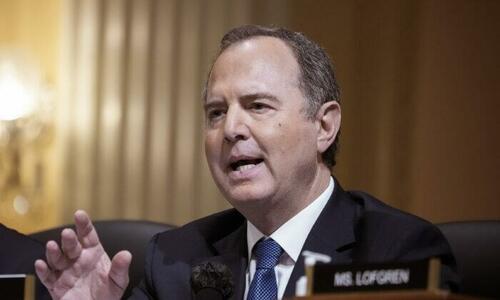
Rep. Adam Schiff (D-Calif.) delivers remarks during a hearing in Washington, on Oct. 13, 2022. (Drew Angerer/Getty Images)
The 14th instalment of the Twitter Files was released on Jan. 12 by journalist Matt Taibbi, who explained in a series of posts that, at a key moment in the Trump-Russia investigation, Democrats alleged that “Russian bots” were spreading an explosive report from then-Chairman of the House Intelligence Committee Rep. Devin Nunes (R-Calif.).
“At a crucial moment in a years-long furor,” Taibbi explained in one of the posts, “Democrats denounced a report about flaws in the Trump-Russia investigation, saying it was boosted by Russian ‘bots’ and ‘trolls.’”
“Twitter officials were aghast, finding no evidence of Russian influence,” Taibbi continued.
In support of this take, Taibbi shared screenshots of correspondence from Twitter executives to several Congressional Democrats, including Rep. Adam Schiff (D-Calif.) and Sen. Dianne Feinstein (D-Calif.), confirming that they had “not identified any significant activity connected to Russia with respect to Tweets posting original content to this [#ReleaseTheMemo] hashtag.”
The #ReleaseTheMemo hashtag spread like wildfire on Twitter, topped its trending list starting on Jan. 18, 2018 and reflecting the widespread call to publicly release a then-classified memo submitted by Nunes, who at the time was the chairman of the House Intelligence Committee.
Widely referred to as the Nunes memo (pdf), it was later declassified under then-President Donald Trump’s order on Feb. 2, 2018.
The memo showed how the FBI under the Obama administration used unverified opposition research—the infamous “Steele Dossier” funded by Hillary Clinton’s presidential campaign and the Democratic National Committee—to obtain a FISA warrant to spy on Trump campaign volunteer Carter Page as part of an investigation into alleged Russian interference in the 2016 presidential election.
The claims made in the Nunes memo were confirmed by Justice Department Inspector-General Michael Horowitz in his report, released on Dec. 9, 2019.
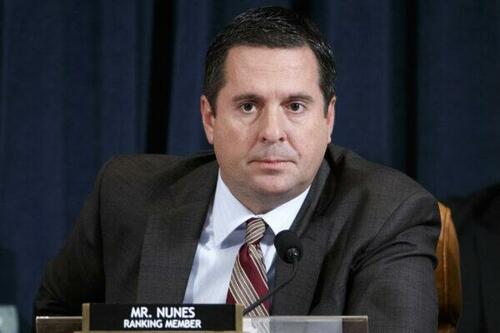
Ranking member of the House Intelligence Committee Rep. Devin Nunes (R-Calif.) on Capitol Hill in Washington on Nov. 19, 2019. (Shawn Thew-Pool/Getty Images)
Push From Democrats, Media Outlets
Rep. Matt Gaetz (R-Fla.) and Rep. Steve King (R-Iowa) had introduced the #ReleaseTheMemo hashtag on Jan. 18, 2018, and on the following day, joined a group of 65 House Republicans calling for the declassification of the memo. Many of the lawmakers, who collectively represent millions of voters, also sent out the hashtag on Twitter.
Just days later, on Jan. 23, 2018, Democrat lawmakers, including Feinstein and Schiff, wrote an open letterto then-Twitter CEO Jack Dorsey and Facebook CEO Mark Zuckerberg to investigate allegations of “Russian bots and trolls surrounding the #ReleaseTheMemo online campaign.”
The letter from Feinstein and Schiff led Sen. Richard Blumenthal (D-Conn.) to himself issue a letter (pdf) that also alleged the hashtag was a part of Russian disinformation campaigns.
“We find it reprehensible that Russian agents have so eagerly manipulated innocent Americans,” he wrote in a letter issued later that day—even though before the letter’s issuance, Twitter’s staff told the senator’s staffers they did not believe Russian bots were behind the hashtag, Taibbi reported.
Multiple legacy outlets also did the same, claiming Russian bots and trolls were behind the effort. All had cited the same source—the Hamilton 68 dashboard, a project with the Alliance for Securing Democracy (ASD), an organization that tracks 600 Twitter accounts it claims are linked to the Russian government or repeat its news.
According to Taibbi, executives inside Twitter at the time complained that “Hamilton 68 seemed to be everyone’s only source, and no one was checking with Twitter” to verify the claims.
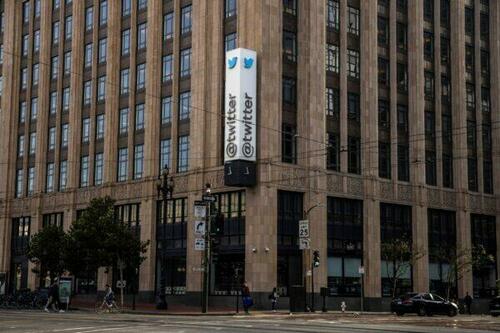
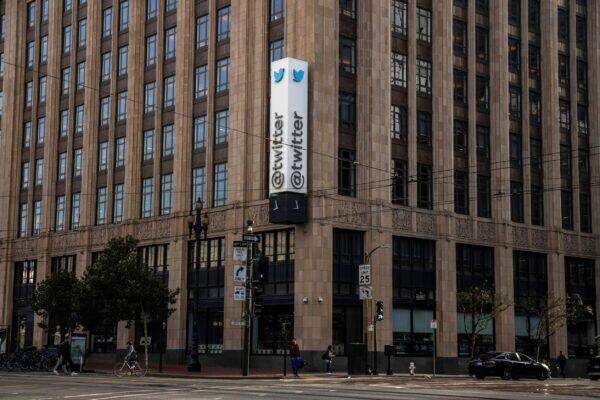
The headquarters for the social media company Twitter in San Francisco, on Nov. 11, 2022. (Stephen Lam/San Francisco Chronicle via AP)
Twitter Internally Disputed ‘Russian Bots’ Claims
Taibbi shared an email from Emily Horne, who was at the time the global policy communications director of Twitter. The email, shared internally on Jan. 23, said that “it is extraordinarily difficult for outside researchers, who do not have access to our full API and internal account signals, to say with any degree of certainty that they believe an account is behaving suspiciously is 1) automated and 2) Russian.”
Yoel Roth, who was Twitter’s trust and safety chief at the time, reportedly told colleagues: “I just reviewed the accounts that posted the first 50 tweets with #releasethememo and … none of them show any signs of affiliation to Russia.”
Taibbi reported that “outside counsel from DC-connected firms like Debevoise and Plimpton” had advised Twitter to respond to lawmakers by using language like: “With respect to particular hashtags, we take seriously any activity that may represent an abuse of our platform.”
According to an email screenshot shared by Taibbi, Twitter was also advised to say something to the effect of: “Our initial assessment indicates that these [hashtag] trends are driven primarily by organic, non-automated activity [if true], but we are continuing to analyze the data and … will inform Congress about what we find.”
“Despite universal internal conviction that there were no Russians in the story, Twitter went on to follow a slavish pattern of not challenging Russia claims on the record,” Taibbi wrote.
Absent any such challenge, “[a]s a result, reporters from the AP to Politico to NBC to Rolling Stone continued to hammer the ‘Russian bots’ theme, despite a total lack of evidence,” he reported.
“Russians weren’t just blamed for #ReleaseTheMemo but #SchumerShutdown, #ParklandShooting, even #GunControlNow—to ‘widen the divide,’ according to the New York Times,” Taibbi added.
Meanwhile, inside Twitter, staffers acknowledged that both the #SchumerShutdown and #ReleaseTheMemo hashtags “appear to be organically trending.”
The Federal Aviation Administration's Notice to Air Missions (NOTAM) system, which alerts pilots and other personnel about airborne issues and delays at airports nationwide, experienced a massive outage on Wednesday that resulted in travel chaos of over 10,000 delayed flights and more than 1,000 canceled.
The White House quickly squashed speculation of a potential cyber attack. President Biden's Transportation Secretary, Pete Buttigieg, has since ordered an investigation of NOTAM's outage.
Bloomberg reports that a person familiar with the FAA investigation might already know what caused headaches for tens of thousands of travelers -- just weeks after the Southwest Airlines debacle.
The person said unspecified "personnel" corrupted a file on the NOTAM system, resulting in a nationwide outage.
The preliminary indications are that two people working for a contractor introduced errors into the core data used on the system known as Notice to Air Missions, or Notam, according to a person familiar with the FAA review. The person asked not to be identified speaking about the sensitive, ongoing issue.
Like other computer systems that are critical to operating flights, the FAA has imposed procedures to ensure data aren't damaged by technicians working on them, said the person. The file or files were altered in spite of rules that prohibit those kind of changes on a live system. --Bloomberg
The question many are asking is if there was any wrongdoing:
Agency officials are attempting to determine whether the two people made the changes accidentally or intentionally, and if there was any malicious intent, the person said. --Bloomberg
The NOTAM system is more than three decades old. Perhaps Buttigieg should refocus his efforts on upgrading the FAA's system instead of making it 'more inclusive.'
People living with type 2 diabetes can now take Rybelsus®, the first and only oral glucagon-like peptide-1 (GLP-1) analog, along with diet and exercise, as initial therapy to help lower their A1C1,2
Since its approval, Rybelsus® has been prescribed to hundreds of thousands of patients to help improve glycemic control along with diet and exercise
Billionaire entrepreneur Mark Cuban's pharmaceuticals startup has tied up with pharmacy benefits manager RxPreferred Benefits, the companies said on Wednesday, in a move to offer lower priced drugs through some employer-backed health insurance plans.
Mark Cuban Cost Plus Drugs provides generic drugs through direct contracts with manufacturers and charges a standard markup on every drug it sells.
Under the partnership, RxPreferred Benefits' customers will have the option to use Mark Cuban Cost Plus Drugs as part of their health insurance plans.
"Our partnership with RxPreferred is another step in the direction of bringing transparency to healthcare and lowering drug costs for individuals and families across the country" Cuban said in a statement.
Mark Cuban Cost Plus Drugs in December partnered with EmsanaRx, which was launched by a nonprofit coalition of nearly 40 companies including U.S. retailers Walmart and Costco, that operates a PBM service for employers.
PBMs serve as intermediaries between drug manufacturers, health insurance plans and pharmacies to negotiate prescription drug prices.
straZeneca has signed a cooperation agreement with China's Genertec Meheco for COVID-19 antibody drug Evusheld, it said on Friday.
Genertec Meheco, a unit of Shanghai-listed China Meheco Group Co, will be responsible for the import and distribution of Evusheld in mainland China once the drug is approved to enter the Chinese market with conditions or for emergency use.
Drugmakers are prioritizing complex biotech medicines over treatments that can be given as pills because recent U.S. legislation gives biologics a longer runway before becoming subject to government price limits, top industry executives said this week.
The Inflation Reduction Act (IRA), which Democrats passed last August, for the first time allows the government's Medicare health plan for people age 65 and over to negotiate the prices it is willing to pay for certain medications.
The pharmaceutical industry, whose members gathered in the thousands this week in San Francisco for the annual JP Morgan Healthcare conference, opposed the legislation and has begun implementing strategies to mitigate its impact.
Such a shift in focus could result in the availability of far fewer cheap, generic pills in the long run.
All other developed nations negotiate drug prices, making the United States the most lucrative market for the industry. The Congressional Budget Office estimates that the IRA's drug pricing provisions will reduce the federal deficit by $237 billion over the next decade.
Medicare will select the first 10 drugs for the program this year. The number of medications subject to price negotiation will increase over time, but newer drugs are not included.
The law sets a nine-year exemption period for "small-molecule" drugs, which are mainly pills, while "large molecule" biologics, generally injections or infusions, are protected from negotiation for 13 years.
"The difference between a nine- and 13-year product line is about 50 or 60% of the value," Eli Lilly Chief Executive Officer Dave Ricks said in an interview. "In 10 years, we'll have far fewer small molecules being developed than we do today."
He questioned the benefit of "rules that really just disincentivize investment in what ends up being convenient drugs, drugs for tough conditions like cancer and drugs that get really cheap when they go generic."