Search This Blog

Saturday, January 14, 2023

Inside the sky-high world of drug-smuggling flight attendants

 Terese White, 41, was meant to fly to Boston. Instead, she landed in police custody.

Last October, White was a Mesa Airlines flight attendant traveling from Dallas to San Diego. Between flights, she exited the SoCal airport and returned later that day to go from San Diego to Boston. As is the habit of flight attendants, according to her plea agreement, White, a Dallas resident, “attempted to utilize the Known Crew Member queue” — a TSA security line that lets airline employees sail through with reduced screening.

“You have a KCM card. You scan the card, show your company ID and driver’s license and walk right through,” a former Mesa Airlines flight attendant told The Post. “But, sometimes, you get a ‘random.’ That’s when you are randomly chosen to go through the security that everybody else goes through.”

Unfortunately for White, this was the day she was selected.

Mesa Airlines flight attendant Terese White recently pleaded guilty to possession with intent to distribute fentanyl after attempting to go through security with drugs strapped to her.
SOPA Images/LightRocket via Getty Images

She’s now awaiting sentencing after pleading guilty to one account of possession with intent to distribute fentanyl. White is just the latest flight attendant to use what the US Attorney’s Office in the Southern District of California called “privileges as a flight attendant” as a tool for smuggling drugs.

Like the title character of the Quentin Tarantino movie “Jackie Brown,” crooked flight attendants find frequent travel plus lax security a tempting combination. Paid off by drug dealers, some of them turn their privilege into a side hustle: acting as convenient mules to move contraband around the United States.

“It stands to reason that this [smuggling by flight attendants] is commonly done,” attorney Dennis Ring, who represented convicted flight attendant Marsha Gay Reynolds, told The Post. “I would think this is quite common but they don’t get caught frequently.”

Former beauty queen Marsha Gay Reynolds was busted attempting to transport nearly 70 pounds of cocaine — nearly $2 million worth — while working as a flight attendant for JetBlue.
Former beauty queen Marsha Gay Reynolds was busted attempting to transport nearly 70 pounds of cocaine — almost $2 million worth — while working as a flight attendant for JetBlue.
Tyronne Payton/Splash News

The random screenings, he pointed out, “are an uncommon occurrence.”

The former flight attendant source recalled an industry colleague who “used to go to Mexico and bring back Ritalin, Xanax and Adderall. She did not have prescriptions, she would come back with boxes and sell [the drugs] here.”

As recounted in the United States District Court complaint, White appeared hesitant to enter the the “advanced imaging technology machine” — the full-body scanner that travelers step into for low-energy X-ray. Once inside, as per the complaint, White began shaking.

Flight crews tend to be pre-approved for more lenient airport security.
Bloomberg via Getty Images

She had good reason to be nervous. The machine quickly recognized something rigged to her mid-section.

Taken into a private room for screening, White removed what is described as “a large mass wrapped around her abdomen” — but she insisted that it was “not what you think.”

She told screeners that the material was a “mercury pack” designed for weight loss. Los Angeles-based weight-loss physician Dr. Abe Malkin told The Post: “I’ve never heard of a ‘mercury pack’ for weight loss. As far as I know, it doesn’t exist.”

A test of the pack revealed the truth, though: The complaint alleges that White was attempting to smuggle and transport more than three pounds of fentanyl.

Mesa’s White was caught in October with three pounds of fentanyl on her body.
DEA

According to a statement from the United States Attorney’s Office, White pleaded guilty this past December and admitted that she “attempted to use her status as a flight attendant, a position of trust, to facilitate the offense.”

She is scheduled to be sentenced on March 24. Her attorney did not return calls for comment. Mesa Airlines did not comment.

The former flight attendant source attributed the unraveling of White’s drug smuggling scheme to bad luck and bad planning. “She probably would have avoided getting busted if not for the random. Also, if [the drug pack] was in her suitcase instead being attached to her body, I don’t know that she would have gotten caught.”

White attempted to get through the crew member line at security but was pulled aside for a random check.
Getty Images

What she does know is that fellow flight attendants are ticked off at White because her crime has screwed up a good thing for the rest of them.

“Everyone is kind of annoyed. Going through KCM, [they’re] getting randomed all the time now. One person ruins it for everybody else,” the source said. “Doing something like [what White did] is pretty f–king ballsy .. and f–king stupid. You lose your job and the ability to see the world. I would never risk doing that.”

Though White went quietly for her random screening, other airline employees are more brazen. Such was the case, at least initially, with beauty queen turned JetBlue flight attendant Marsha Gay Reynolds. As The Post reported in 2016, when the then 34-year-old was stopped for screening at LAX in Los Angeles, she kicked off her Gucci heels, dropped her bags and bolted.

When flight attendant Reynolds was stopped at a security check point in LAX, she bolted, leaving the 70 pounds of cocaine in her luggage.

Inside her luggage: 70 pounds of cocaine, with a street value of $2 million.

Somehow, Reynolds reportedly managed to board a flight to New York and, upon landing, hole up in a Hilton Hotel near JFK before turning herself in.

According to the United Sates Department of Justice, Reynolds had been enlisted in her misdeeds by a Jamaican man named Gaston Brown. The DOJ stated that that the two had collaborated to smuggle illicit substances on six different occasions. Last year, Brown was sentenced to 165 months in federal prison for charges that include two counts of conspiracy to possess and distribute cocaine.

In November, flight attendant Marcelo Chaves was arrested for “possession and transportation of narcotics.”
Miami-Dade County Jail

This past November, Delta flight attendant Marcelo Chaves and his boyfriend, were arrested while exiting a Brazil to Miami flight. According to Miami’s channel 10 news, Robert Brisley of US Customs and Border Protection said that they were busted for “possession and transportation of narcotics.”

Aa per the report, the two were allegedly carrying drugs, including methamphetamine and ketamine, stored in plastic bottles. Chaves and his beau admitted to “doing drugs in Brazil” but expressed no knowledge of the illicit goods in their suitcase. They are now contending with felony drug trafficking charges.

The lawyer for Chaves did not comment. A Delta spokesperson told The Post, “Delta continually cooperates with law enforcement entities and the off-duty flight attendant in question has been suspended pending outcome of an investigation.”

Flight attendant Rohan Myers was arrested during a screening trying to smuggle nearly seven pounds of cocaine under his clothes.
Rohan Myers Broward Sheriff's Office

Some flight attendants are slicker than others. Rohan Myers, once a high-flyer for Caribbean Airlines, had an elaborate set-up under his pants. According to a criminal complaint filed in 2015, while on the job, he wore “spandex type compression garments” under his clothes, containing molded inserts that contained nearly seven pounds of cocaine.

Like White, Myers was done in by an unexpected search. Once he started “sweating profusely and answering questions with his head lowered,” customs officials became suspicious. Myers admitted to being promised $10,000, upon delivery of the drugs, by a man he called Bigga NFI.

Myers’ attorney and Caribbean Airlines did not offer comment.

“Flight attendants are easy pickings if you’re a calculating drug smuggler,” said Reynolds’ attorney Dennis Ring. “The flight attendants are not wise to the world. I suspect that half the time these people are not aware of the severity of what they are doing. People don’t even realize that this is a federal offense. They don’t ask a lot of questions.”

https://nypost.com/2023/01/14/inside-the-sky-high-world-of-drug-smuggling-flight-attendants/

Dem spending and wacky economic views mean we're in age of the new abnormal

Did it used to be that the Democratic Party was about economic growth, lower taxes and smaller government? Here’s what their platforms said starting with JFK:

"Our economy can and must grow at an average rate of 5% annually, almost twice as fast as our average annual rate since 1953. We shall expand the economy itself." -- 1960 Democratic Party Platform  

"Maintain steady economic growth by helping through tax reduction to stimulate the economy when it is sluggish." – 1968 Democratic Party Platform  

"We reject the big government theory that says we can tax and spend our way to prosperity. We honor business as a noble endeavor." -- 1992 Democratic Party Platform  

"Today's Democratic Party knows that the era of big government is over. Big bureaucracies and Washington solutions are not the real answers to today's challenges. We need a smaller government." – 1996 Democratic Party Platform  

"We have ended the era of big government. Democrats believe in supporting the startups, the small businesses, and the entrepreneurs that are making the New Economy go."-- 2000 Democratic Party Platform  

"We promise to cut taxes for 98% of Americans. We believe the private sector, not government, is the engine of economic growth and job creation."  -- 2004 Democratic Party Platform  

"The American people do not want government to solve all our problems. We will shine a light on government spending." -- 2008 Democratic Party Platform  

Those were the Democrat party platforms from JFK through 2008 when President Obama won his first term.  

JFK’s tax cuts and smaller government. Bill Clinton’s "the era of Big Government is over," Al Gore’s "reinventing and downsizing the government" campaign.  You can’t tax and spend your way to prosperity. Unleash the private sector for job creation and growth. Words like tax cuts, smaller government and growth in their platforms.  

So, were JFK, Bill Clinton, Al Gore, Barack Obama radical? Extreme? Tea Partiers?  

But something happened after 2008.  

By President Obama’s second term, Democrats began to prioritize redistribution for income inequality at the expense of growth and ended up getting neither.  

This cannot be blamed on the 2008 financial crisis. There were massive bailouts and still lukewarm growth.  From June 2009 and through 2016, GDP grew an average of just 2.1 percent annually, the lowest rate among expansion periods since 1949.  

Today, Democrats demand every American report $600 phone app transactions to the IRS after Congress passed a $1.7 trillion omnibus package without fully reading the bill.  

This is the era of misbegotten media and Democrat attacks on any good faith effort to rein in blockbuster government spending.  

What’s alarming D.C. watchers is the fact that Congress has whooped through even more government debt spending with little oversight. Since the pandemic, the U.S. Congress has approved debt spending that is the equivalent of the GDP of Germany, France and Italy combined.

FDR’s New Deal spending is loose change under the sofa cushions compared to what’s happening now.  

Do you see now how easy it was to slide into the era of the New Abnormal under former House Speaker Nancy Pelosi and Senate Majority Leader Chuck Schumer?  

The two leaders did it by passing trillion-dollar spending packages at the 11th hour with no hearings, no debate.  

placeholder

Sources tell "The Evening Edit," that Pelosi reportedly pushed her caucus into submission, with threats of withholding committee assignments, campaign funds, and appropriations for lawmakers’ districts.  

And then there’s this: Democrats and the media also call the new GOP House Rules package to curtail government spending "radical" and "extreme" because it now has requirements like a 72-hour rule to read legislation before it is passed.

Plus, House GOP has abolished Congress voting via proxy, where they could vote remotely without being present in the chamber. It was meant to stop COVID infections, but was still in place three years after the pandemic. At one point 80% of House Democrats voted via proxy, not showing up for their jobs, says the Brookings Institution.

Do Democrats call that "extreme"?  And who can accurately review and fact-check 4,000 pages in 72 hours?  

No one. And no one did. That’s likely why this spending flew under the radar and included  the ‘Monuments to Me,’ goodies. There’s the new "Speaker Nancy Pelosi Federal Building" in San Francisco, the new "Nancy Pelosi Fellowship Program" at the State Department." There’s also the "Senator Patrick Leahy Lake Champlain Basin Program" in Vermont, and the "Senator Richard Shelby FBI Training Center" in Alabama.  

Also crammed into the bill were personal drivers for government employees. It turns out that dozens of government agencies got taxpayers to pay for their own limo drivers. "Personal drivers for hire" (Ubers?) for even the Office of Government Ethics, the IRS commissioner, the Treasury inspector general for tax administration, the FTC, the CFTC, the SBA, one and on, even for something called the National Cemetery Administration – perhaps where Congressional oversight is entombed and goes to die?   

And the mere talk of a southern border security plan is called "radical." That’s in an administration with a president who signed more than 300 executive actions and policy changes on the border. Biden revoked Trump’s orders and collapsed things to the point where the equivalent of the population of nearly three Nebraskas has been caught trying to cross our border if we include the "gotaways."  

Since Biden’s border policies took effect, there have been nearly a million gotaways, 98 terrorists on the FBI watch list have been apprehended along with all the MS-13 and gang members caught crossing. There were more than 380 encounters with terrorists at our southern border last fiscal year, which includes multiple contacts. Just a generation after 9/11.  

Full disclosure: A family member, a New York City fireman, was killed in the 9/11 Twin Tower terror attacks. Still hurts.  

My family, like so many, wants to serve and help. We’re not special. We just connect with families who’ve lost loved ones. That’s all.  

Like so many families, we’ve got loved ones who fought in virtually every war since the Civil War, for the Union Army.  

My mother never knew her father, he died when she was just one year old from mustard gas attacks in WWI. Never knew her uncle, also a New York City Fire Department (FDNY) firefighter who died from pneumonia a year later.  

My great-grandfather who ran the New York City Fire Department (FDNY) lost two sons in a year during the Great Depression (he was friends with the Roebling family who built the Brooklyn Bridge, we can only hope they were a comfort for him). Again, not special. Just know the pain.  

Bitcoin Rally To $21K Prompts Analysts To Ask Where BTC Price Will Go Next

 After Bitcoin BTC  hit a yearly high of $21,095 on Jan. 13, reversing the entire FTX crash...

... where is it headed next? As CoinTelegraph writes, Bitcoin is currently witnessing an uptick in bullish momentum after the positively perceived CPI report was followed by a strong rally across the crypto market.

The recent rally in Bitcoin is creating increased volume levels and higher social engagement on whether the price is in a breakout of fakeout mode.

Is the Bitcoin bear market over?

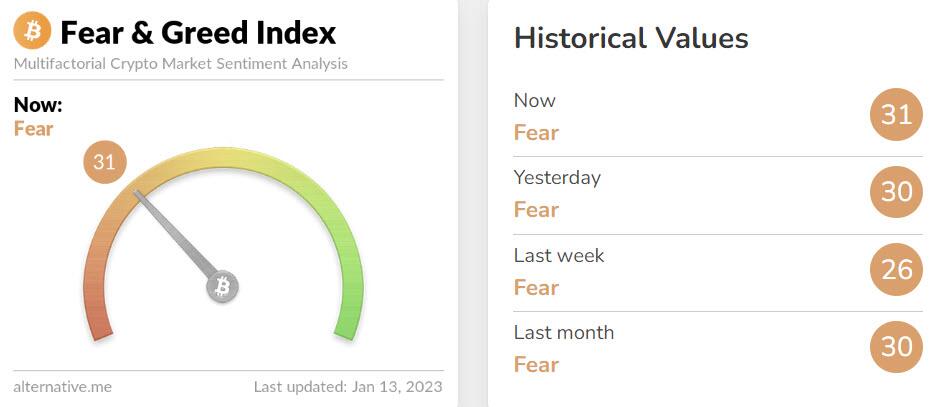
While the market is still technically in a bear market compared to last week, investor sentiment is improving. According to the Fear and Greed Index, a crypto-specific metric that measures sentiment using five weighted sources, investors’ feelings about the market hit a monthly high.

Bitcoin price is now above the psychologically important $21,000 level and many analysts and traders are issuing their thoughts on where BTC price could head next.

Let’s explore a few of these perspectives.

Bitcoin trading volumes remain a concern

Bitcoin just barely recovered from its pre-FTX levels, rising above $21,000 on Jan. 13 for the first time since Nov. 8, 2022. Despite the strength of the recent rally, some analysts believe BTC price needs to remain above the $21,000 support before the current bullish trend can be sustained.

According to Glassnode analysis:

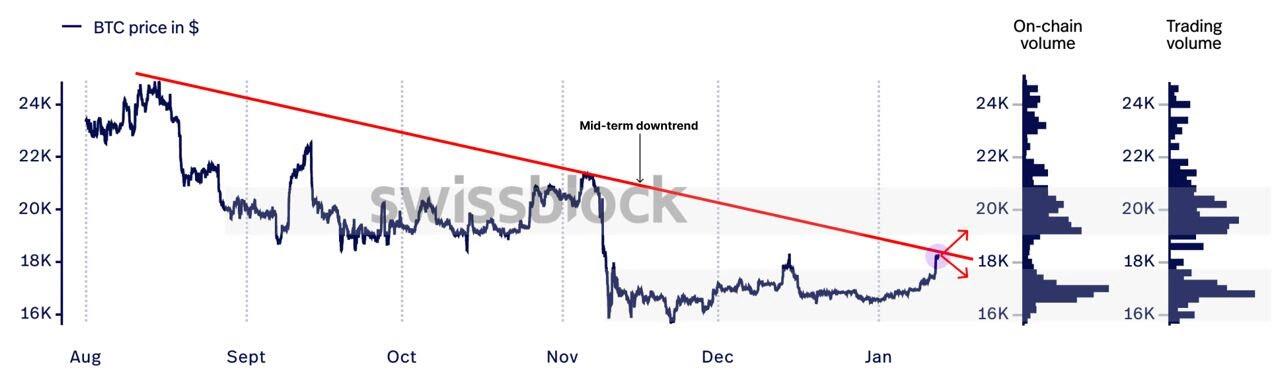
“A renewed bullish trend that started on January 1st drove bitcoin to the $18.6 - $18.9k level, yet a cross over to $19k is necessary to claim a new trading channel around $19-$21k. Resistance is expected around these levels as bitcoin faces a mid-term downward trend. If the price fails to break over the trend line, we expect a retrace toward the $16-$17k area.”

The lack of trading volume of around $18,000 shows the weakness in the current on-chain and centralized exchange (CEX) activity. The largest volumes and overall activity seem to surround the $16,000 level, suggesting that is a more solid floor than the current price range. With less volume surrounding levels higher than $21,000, Bitcoin’s rally could be capped at $21,095.

Is it just a bear market rally?

Bitcoin is still facing headwinds including massive exchange layoffs in a tightening macro economy, Gemini and Genesis legal issues and the potential establishment of a U.S. House crypto-focused subcommittee.

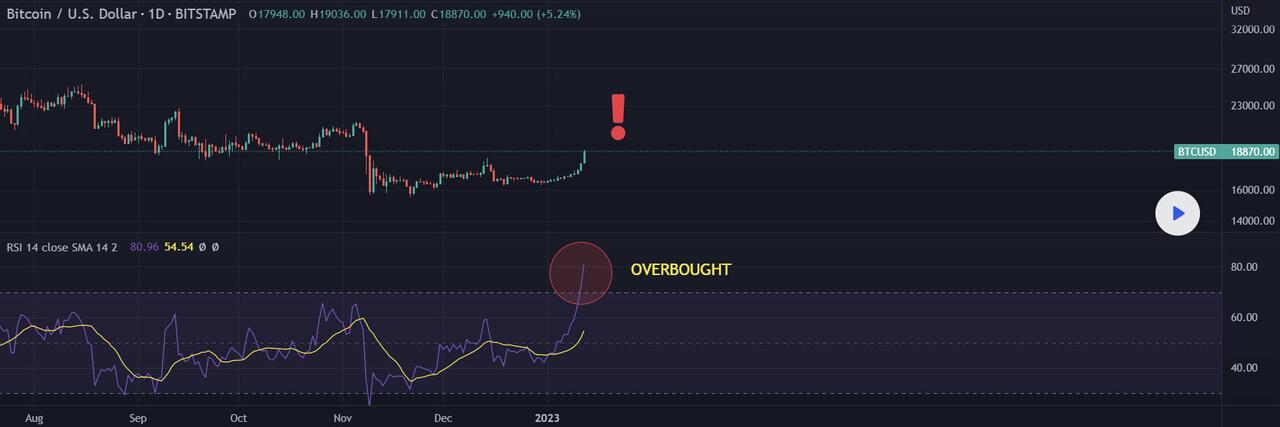
In addition, Bitcoin’s relative strength index (RSI) is currently showing BTC as overbought. According to RSI analysis, a sharp downtrend may form as the price corrects.

The macro markets are also at major resistance levels. The United States Dollar index (DXY) is at key support which means risk assets like Bitcoin may start to see a sell-off if the index recovers. Bitcoin remains correlated to equities and the SPX mini futures index is also showing signs of a pullback.

TraderSZ explains below:

With Bitcoin investors taking profits as suggested by TraderSZ, it may be tough for BTC to reach higher levels.

Historical analysis points to a new Bitcoin bottom

Bitcoin is currently below its 200-week moving average and according to Rekt Capital, Bitcoin price may have already hit its macro bottom according to historical data. Historically the “Death Cross” level shows a $23,500 bottom.

While traders and technical analysts are not known for accurately predicting how long a bull or bear market might last, independent market analyst HornHairs cited historical data from 2015 to estimate how long it will take for Bitcoin to hit a new all-time high.

The bull market from 2015 to 2017 lasted for 1064 days, matching with the 2018 to 2021 bull market which lasted the same number of days. If traders match the bear market that followed between 2017 to 2018 and 2021 to the current market, it would take 1,001 days until Bitcoin reaches a new all-time high.

Despite the current conditions and the strength of the current price breakout, Bitcoin has proven many technical analysts wrong in the past. Risk-averse traders might consider keeping an eye out for increased trading volume at higher prices as an indicator of whether Bitcoin is finally back in a bull market.

https://www.zerohedge.com/crypto/bitcoin-rally-21k-prompts-analysts-ask-where-btc-price-will-go-next

Novartis’ Kesimpta, ECTRIMS 2022, and relapsing multiple sclerosis

 Having presented new data at last year’s European Committee for Treatment and Research in Multiple Sclerosis (ECTRIMS) Annual Meeting – where the safety and efficacy of Novartis’ Kesimpta (ofatumumab), when used as an early intervention treatment option in relapsing multiple sclerosis (RMS), was highlighted – director of research for the Cleveland Clinic’s Mellen Center for Multiple Sclerosis, Dr Jeffrey Cohen spoke with pharmaphorum about the findings.

The new data presented by Novartis at ECTRIMS 2022 highlighted the safety and efficacy of Kesimpta and supported its use as an early intervention treatment option, as well as demonstrating high compliance rates among people living with RMS, also known as relapsing-remitting MS (RRMS).

According to the MS Society, in RRMS people have attacks of new and old symptoms, i.e. a relapse. RRMS is the most common type of multiple sclerosis, with other types being primary progressive MS and secondary progressive MS. Relapses occur when the immune system attacks the protective covering (called myelin) around nerves in the brain and spinal cord, damaging the myelin and causing MS symptoms.

Around 85% of people with MS are diagnosed with RRMS initially but taking a disease-modifying drug (DMD) could mean fewer relapses and slow down the progression of the disease. Kesimpta is such a drug, taken as an injection under the skin once a month. According to the MS Trust, it reduces the number of relapses by about two-thirds (70%).

Safety, efficacy, and adherence

Although the safety of Kesimpta hadn’t been Dr Cohen’s own focus in his role within the study, he supported the use of Kesimpta for RRMS, as continuous treatment for up to four years had shown sustained safety and efficacy.

“Novartis presented five Kesimpta abstracts at [ECTRIMS],” Dr Cohen explained, “including two late-breaker abstracts. Highlights included a Phase 3 ALITHIOS open-label extension study subgroup analysis in recently diagnosed treatment-naïve patients continuously treated with Kesimpta for up to four years [which] showed continued efficacy on relapses, MRI lesions, and risk of disability worsening.”

“These results were consistent with the overall study population and, when compared to efficacy results of those patients who switched to Kesimpta later, highlight the value of earlier initiation of high efficacy therapy,” he added.

Additionally, a further ALITHIOS analysis had shown that, when switching to Kesimpta from teriflunomide, younger patients (40 years of age or under), as well as those treated with fewer DMDs at baseline, appeared to experience the greatest benefit – further emphasising the importance of earlier treatment initiation.

Discussions, however, also centred around the issue of treatment compliance, as the method of delivery of such – whether the medication is orally administered, by infusion or intravenously, or via subcutaneous injection – is an issue with this disease.

“Poor adherence to disease-modifying drug treatment in multiple sclerosis remains a challenge in clinical practice and has an adverse impact on prognosis,” Dr Cohen said.

Yet, there was high patient compliance with Kesimpta treatment over the four years, with persistence remaining high over the long term.

“A final separate analysis,” Dr Cohen explained, “showed that, over the course of ALITHIOS, approximately 95% of patients were 80% or more compliant with their treatment, indicating adherence with the Kesimpta 20 mg subcutaneous monthly regimen.”

Dr Cohen also explained how the general theme at ECTRIMS had been to expand upon previously reported results and – taken together with previously shown continued effectiveness of Kesimpta over four years – these findings certainly seem to add to the body of evidence that supports a benefit-risk profile for Kesimpta in patients with early RRMS.

New data, new hope

Kesimpta was approved in August 2020 as an injection for subcutaneous use for the treatment of relapsing forms of multiple sclerosis (RMS), including clinically isolated syndrome, relapsing-remitting disease, and active secondary progressive disease in adults.

“[This new] data adds to the previously presented efficacy data from the Phase 3 ASCLEPIOS I/II trials and the ALITHIOS open-label extension that showed continuous treatment with Kesimpta for up to four years was associated with fewer relapses, as well as reduced risk of three-month and six-month confirmed disability worsening and less lesion activity,” Dr Cohen explained. “[This was] versus those who switched later from teriflunomide.”

“The differences in relapses,” he continued, “[in] MRI lesion activity, and the risk of disability worsening observed in the continuous versus the switch group highlight the value of earlier initiation of therapies like Kesimpta and support its use as first-line therapy at an early stage of the MS disease course,” Dr Cohen reiterated.

Returning to the general ethos of ECTRIMS overall, Dr Cohen believed the data from Novartis’ recent study fit well within the data setting of other presented findings and that within three more years there would be a noticeable sign of progression within treatment of this terrible illness.

“Overall, the conference covered a broad range of topics among which [was] additional data on disease therapies with regulatory approval, such as Kesimpta,” Dr Cohen said. “[That] additional data supplements the information provided by the phase 3 pivotal trials that led to approval. The study I presented indicated that long-term treatment with Kesimpta remains effective and well tolerated,” he concluded.

About the interviewee

Jeff CohenDr Jeffrey Cohen has worked at Cleveland Clinic’s Mellen Center for Multiple Sclerosis Treatment and Research since 1994 and became director in 2014. Dr Cohen has a large clinical practice devoted primarily to the care of patients with multiple sclerosis and related disorders. In addition, he is director of the Experimental Therapeutics Program, a professor at the Cleveland Clinic Lerner College of Medicine, and has been involved in various capacities in a large number of clinical trials developing new therapies for multiple sclerosis.

https://pharmaphorum.com/views-and-analysis/novartis-kesimpta-ectrims-2022-and-relapsing-multiple-sclerosis/

JPM2023: Breakthroughs await, but so do roadblocks

 After my customary cross-country redeye, I’ve officially traded the relentless rain of San Francisco for the gentle snowfall of my native Boston. And as I look out the window at that snow, my travel-addled brain can’t help but see it as a metaphor for pharma in 2023: a crisp white, wide canvas laden with possibilities, but also one that’s going to require a lot of immediate, hard work from me if I want to be a responsible homeowner.

Alright, throw me in metaphor jail. I deserve it. But that was the tension at JPM 2023 – a tension between the incredible potential and possibility of new treatment modalities, technologies, and processes, and the incredibly daunting challenge of realising that potential amidst a cooling funding climate, regulatory and payment uncertainty, workforce instability, manufacturing challenges, and more. Just as I can’t have my picturesque New England snowfall without my pain-in-the-neck New England snow shovelling, these opportunities and challenges go hand in hand.

But enough vagaries. Let’s talk trends.

1. Cell and gene therapies – big opportunities, big challenges

This is the area where I think this tension is the most obvious. Everyone agrees that cell and gene therapies are poised for an explosion, with far more drugs in the pipeline than are currently approved, and the FDA predicts it will clear 10 to 20 per year by 2025.

“I’m going to make a statement that could come back and bite me, but I think T-Cell therapies are going to be bigger than monoclonal antibodies,” AdaptImmune CEO Adrian Rawcliffe said at one session.

These therapies have incredible potential to fight cancer and other diseases using the patient’s own immune system. This could mean avoiding the side effects associated with radiation therapies, even targeted ones. The treatments also have the potential for long-term remission. As such, big and small pharma alike are investing in this area and the hype around it at JPM was strong.

But the challenges are also severe. Whether autologous or allogeneic, manufacturing a cell therapy is much more complicated than manufacturing a small molecule. There’s so much precision required, and so much possibility for introducing error at this stage, that even small companies are investing in internal manufacturing operations. And they have to do it early because regulators are just as interested in their chemistry, manufacturing, and control (CMC) as their efficacy data.

And there are big questions about how these therapies will be paid for, particularly those that turn out to be essentially curative in a payment system that’s set up to treat cancer as a chronic disease.

Ultimately, we are going to see these therapies proliferate and the industry figure out how to execute them efficiently. But because of the cost and risk associated with them, they’re likely to be the strongest in areas where no other, more traditional, alternatives exist.

2. The year of neuro

If I had a dollar for every time I heard that the major R&D trend of 2023 was going to be increased interest and investment in central nervous system (CNS) and neurological diseases, I would at least have enough money to replace the multiple umbrellas I lost this week.

But why, exactly, this is the year for neuro and CNS was a question that produced a variety of answers.

For one thing, high-profile approvals of Biogen’s Aduhelm and Eisai’s lecanemab, despite some concerns about side effects and mismanagement, have really planted a flag and demonstrated the potential of both the mechanism of action of targeting amyloid clusters and monoclonal antibodies as a form factor.

Yet another, possibly more interesting, factor has to do with biomarkers. Simply put, for a long time it’s been very hard to identify patients with Parkinson’s and Alzheimer’s at a stage where drugs would be useful, and it’s been hard to track and quantify disease progression in a subjective, granular way that would result in useful data.

I did a pretty deep dive into this back in July. While there is still a lot to be done, new biomarkers, lower-cost scanning, and, in the case of Parkinson’s, innovations in sensors and real-world evidence have started to make a difference.

At a Sunday pre-event, Eli Lilly and Company VP for Search and Evaluation for Neuro, Jenny Lair said that just a few years ago Lilly was having problems with people enrolled in trials who were diagnosed with Alzheimer’s, but didn’t actually have it.

“We were trying to remove amyloids from people who didn’t have amyloids,” she said. “So, we’ve come a long way — a better understanding of Alzheimer’s and biomarkers has helped improve accurate recruitment.”

3. Ups and downs of government – IRA

If you’ll forgive a slightly US-centric section, a lot of breath this week was spent griping about the US legislative branch. I’m of course talking about the Inflation Reduction Act, which is, if you believe the hype, poised to drastically lower the profitability of small molecule drugs, or at least drastically change how pharma approves and markets them.

The Act gives the US strong-armed negotiating power on Medicare and Medicaid drug costs after just nine years of exclusivity. How this will be implemented and exactly what effect it will have remains to be seen – as is how much of pharma’s “the sky is falling” attitude about the law is just fearmongering.

Pharma is responding by getting creative, possibly in ways that are not going to accomplish the goals of the law. Some will simply raise drug prices to get more money out of new drugs while they can; others are planning to phase in new indications in order to “reset the clock” as many times as they can.

But to address the root cause and not just the symptoms, pharma will have to take a long hard look in the mirror at how they got here – what their role is in drug prices and how that is disconnected from the public’s perception.

“We need to fix this fast, or else there is going to be more legislation that is going to target us. And it’s the wrong target,” said Philippe Lopes-Fernandes, executive VP and chief business officer at Ipsen.

4. Ups and downs of government – FDA

On the other hand, the executive branch in the form of the FDA receives a more mixed review. Many in pharma applaud the FDA’s willingness to accelerate pathways for new therapies, but too much acceleration, or acceleration poorly executed, has its problems.

FDA Commissioner Robert Califf spent his Monday evening being grilled by STAT’s Matthew Herper about the regulator’s allegedly over-cosy relationship with Biogen and the recent Congressional report that detailed it. But Califf didn’t flinch.

“Almost everything in the report, I’m not arguing with the content. The details are pretty straightforward,” he said, noting that he doesn’t pay much heed to “inflammatory” language. “There can be opinions about the decision, but there was nothing about the report that changed the data.”

And a few different folks noted a rather pertinent problem with the model of approving an experimental therapy and asking for the phase 3 after the fact, something the FDA is dabbling in. Namely, who wants to be in a clinical trial for a drug that’s already in the market? That’s akin to choosing a 50% chance of receiving a life-saving treatment when you could have a 100% chance instead.

So, if this is going to work as a pathway, it’s going to require some smoothing over from AI-driven synthetic controls, real-world evidence, or some combination thereof.

The other big concern about the FDA goes back to the biomarker discussion above – the industry can come up with new and better biomarkers until the cows come home, but if the FDA won’t accept them as an endpoint, their usefulness is severely limited. And of course, the FDA is wont to be a bit more conservative and slow-moving.

5. Massive disruption to clinical trials

Expect more on this topic from me in a larger piece soon, but suffice it to say that clinical trials are being disrupted from all sides, and most seem to agree we haven’t even seen their final form.

First there’s decentralisation, a process innovation that was kicking along in very low gear until COVID-19 came along and launched it into the stratosphere. Unlike telehealth, which has experienced somewhat of a reversion to the mean, decentralised clinical trials (DCTs) are here to stay. The big difference? While telehealth’s effect on the bottom line is questionable at best and dependent on reimbursement changes, DCTs are showing clear savings and efficiency gains (though they are not without their growing pains).

Second, we’re in the middle stages of an industry-wide reckoning with the bigoted history of clinical trials and there’s a massive corrective effort underway to make sure that clinical trials reflect the disease populations they’re studying. DCTs can be a part of this solution, but not the whole of it: it seems clear that having community-based trial sites run by trusted members of minority communities is the path forward to sustainable trial diversity.

Third, while pharma is rebuilding the clinical trial in response to those two trends, tomorrow’s innovators are looking to radically reimagine trials in a world of artificial intelligence and sophisticated remote patient monitoring. Can we use AI to eliminate human placebo groups, making trials easier and cheaper to run? Can we replace short-term, specific data collection with long-term generalised data collection using bespoke and off-the-shelf wearables, apps, and sensors?

Some of these changes are happening now, some are more on the horizon, but if ChatGPT has taught us anything it’s that we’re probably underestimating AI timelines at this point.

Conclusion

Hopefully this provides a good cross-section of some of the biggest, most interesting conversations at JP Morgan this year. And that’s without even getting into digital medicines and digital therapeutics, mRNA vaccines and lessons from COVID, investment trends, or talent and workforce challenges.

If you want to dive deeper, you can peruse our JPM liveblog, take a listen to our wrap-up podcast, check our news section for show news, or stay tuned for a tonne of videos from the ground that we’ll be publishing in the coming weeks.

https://pharmaphorum.com/views-and-analysis/jpm2023-breakthroughs-await-but-so-do-roadblocks/