Search This Blog

Saturday, January 14, 2023

FDA Adviser Says Young And Healthy People Shouldn’t Get Latest COVID Boosters

 by Jack Phillips via The Epoch Times (emphasis ours),

A vaccine adviser to the Food and Drug Administration is questioning whether young, healthy people should get new COVID-19 boosters, arguing those shots should be used for older individuals.

I believe we should stop trying to prevent all symptomatic infections in healthy, young people by boosting them with vaccines containing mRNA from strains that might disappear a few months later,” wrote Dr. Paul A. Offit, an FDA vaccine panel adviser and professor of pediatrics at the Children’s Hospital of Philadelphia, in New England Journal of Medicine on Jan. 11.

In his article, Offit cited two studies suggesting that bivalent boosters, which target the original COVID-19 strain and two Omicron subvariants BA.4 and BA. 5, do not “elicit superior immune responses.”

Why did the strategy for significantly increasing BA.4 and BA.5 neutralizing antibodies using a bivalent vaccine fail?” he asked. “The most likely explanation is imprinting. The immune systems of people immunized with the bivalent vaccine, all of whom had previously been vaccinated, were primed to respond to the ancestral strain of SARS-CoV-2. They therefore probably responded to epitopes shared by BA.4 and BA.5 and the ancestral strain, rather than to new epitopes on BA.4 and BA.5.”

Offit noted that based on those studies, “boosting with a bivalent vaccine is likely to have a similar effect as boosting with a monovalent vaccine” but stressed that “booster dosing is probably best reserved for the people most likely to need protection against severe disease.”

Another doctor appeared to agree with Offit’s conclusions regarding “imprinting.” Dr. Amesh Adalja, a senior scholar with the Johns Hopkins Center for Health Security, told U.S. News that “it may be that people’s immune systems are so primed to respond to the ancestral strain spike protein that a reformulated booster is unable to fully stimulate the immune system because it has been ‘imprinted’ by the original version of the virus.”

More Details

Data and studies have shown that older adults and people who have compromised immune systems are most at risk of developing severe COVID-19 symptoms, hospitalization, and death. Children, meanwhile, have long been shown to have the lowest chance of death, hospitalization, or developing severe symptoms since the pandemic started.

Both the Centers for Disease Control and Prevention (CDC) and FDA said that everyone over the age of 6 months get updated boosters at least two months after their last doses of the vaccine. The bivalent boosters were authorized under emergency use for children aged 6 months to 4 years on Dec. 9.

Meanwhile, a small number of Americans have received the updated boostersaccording to the CDC. As of Jan. 4, some 15 percent of individuals aged 5 and older received the bivalent shots, while about 38 percent of adults aged 65 and older have gotten them.

That same CDC data also shows that about 80.9 percent of all Americans received at least one dose of a COVID-19 vaccine since they were rolled out two years ago, while 69 percent have completed their initial, “primary series.”

An FDA spokesperson Abigail Capobianco responded to Offit’s article this week, telling NBC News that Offit allegedly used “selective” data to reach his conclusions and that “we strongly believe that the totality of the available evidence continues to support the use of these vaccines in all age groups.”

https://www.zerohedge.com/political/fda-adviser-says-young-and-healthy-people-shouldnt-get-latest-covid-boosters

Nurse ‘laundered’ cash from $1.5M COVID vaccine fraud to pay off her mortgage: DA


The Suffolk County District Attorney’s Office is seeking to seize $236,980 it says Julie DeVuono used to satisfy the mortgage on their Amityville, L.I., home, a court filing obtained by The Post shows.

The scandal has implicated scores of New  York city employees – including teachers and assistant principals – suspected of buying fraudulent vax cards from Julie DeVuono’s Wild Child Pediatric Healthcare to comply with the mayor’s vaccine mandate.

 DeVuono, the clinic’s owner and CEO, was busted in January on charges she reaped $1.5 million by selling the bogus vaccine proof for hundreds of adults and children, and falsely registering shots with the state Health Department.

Julie DeVuono's fake COVID-19 vaccination cards allegedly brought in over $1.5 million.
Julie DeVuono’s fake COVID-19 vaccination cards allegedly brought in over $1.5 million.
Marissa Urraro
Marissa Urraro is accused of taking patients into a room and feigning giving vaccines.

Derin DeVuono, an NYPD pilot, was stripped of his gun and badge and removed from active duty after her arrest. Last month, he filed a lawsuit seeking reinstatement.

A civil forfeiture lawsuit filed by Suffolk DA Raymond Tierney makes several new allegations. Among them:

–Julie DeVuono obtained shipments of vaccine through a May 2021 agreement with the federal Centers for Disease Control to administer to patients for free. Instead, she and two co-defendants regularly “wasted” unused doses — dumping them in the trash..

–DeVuono created a code for homeopathic treatments to signal patients who would not get vaccinated. Customers were charged $85 per kid, and $220 per adult for each false entry on a vaccine card ($440 for two) before Jan. 1, 2022; and $350 per bogus entry after that date. No such treatment existed, the suit says.

That refutes what several DOE teachers told the Post. They insisted they got the shots, and paid the steep fees only for “detox” to offset any adverse reaction.

–Nurse Marissa Urarro took patients into a room and “feigned” giving nearly all the vaccinations. She “occasionally gave actual COVID-19 vaccinations.”

–DeVuono stashed cash payments in a safe, and regularly took money from it.

–Police recovered $869,000 in cash, stacked in a room in her house that her husband also had access to. He was at home when she was arrested.

DeVuono’s lawyer denied any wrongdoing.

“All money earned by Ms. DeVuono in her practice was lawfully gained,” said Steven Gaitman of Gaitman & Russo in Garden City. “For many years she had a successful pediatric practice.  Any funds alleged to have been used by Ms. DeVuono as a result of ill gotten gains is simply and unequivocally false.” 

The new allegations come as Brooklyn Supreme Court judge Gina Abadi on Dec. 30 ordered the DOE to send tenured teachers who filed a suit because they were removed without due process back to their jobs. They will start returning on Tuesday, said Betsy Combier, a paralegal working for the teachers.

Meanwhile, the city has not yet decided whether to appeal Abadi’s ruling, said Law Department spokesman Nicholas Paolucci.

https://nypost.com/2023/01/14/nurse-laundered-cash-from-1-5m-covid-vaccine-fraud-to-pay-off-her-mortgage-da/

Roomba Robot Vacuum Testers Find "Intimate" Photos Of Themselves On The Web

 Well, it looks like you can score one for all of the "conspiracy theorists" who have said they don't like "smart" appliances in their home because they feel like they were being spied on.

And you can tell those writing off these concerns that intimate photos of some Roomba tester vacuums have magically turned up on Facebook after being ascertained by Venezuelan gig workers.

One woman even found photographs of herself on the toilet, taken by her robot vacuum. What a time to be alive!

Breitbart reported last week that gig workers had posted pictures online where they were discussing "work-related matters". One photo was a woman sitting on a toilet seat with her shorts pulled down to her mid thighs - it was taken by her Roomba J7 series robot vacuum, the report says.

The photos were sent to iRobot by Scale AI, a startup that contracts workers to label AI data used to train artificial intelligence, the report says. Users had agreed to "participate in the data collection" as part of a testing. They signed consent forms but now say they feel "misled" about the true nature of the consent. 

Albert Fox Cahn, executive director of the Surveillance Technology Oversight Project, told Brietbart: “There is a real concern about whether the company is being deceptive if people are signing up for this sort of highly invasive type of surveillance and never fully understand… what they’re agreeing to.”

The MIT Technology Review conducted an investigation and determined it to be gig workers in Venezuela. There were also photos of a child and a woman using the restroom, the report says. iRobot has terminated its agreement with ScaleAI in response to the investigation.

https://www.zerohedge.com/markets/roomba-robot-vacuum-testers-find-intimate-photos-themselves-web

XB what? BQ huh? Do you need to keep up with Omicron’s ever-expanding offspring?

 It’s like clockwork now. Every few months, we’re warned that the Omicron variant of the SARS-CoV-2 virus has spawned yet another subvariant, this one even more transmissible than the ones it is fast overtaking.

The new entity is given a name, an unwieldy string of letters and numbers separated by periods. There’s discussion — some of it breathless — on Twitter and in the media about the threat the new subvariant poses. People who are still following Covid-19 news worry. People who are determined to ignore Covid pay no attention.

Rinse and repeat.

The cycle has some experts wondering about how useful these discussions are. We aren’t, after all, obsessing about which strain of H3N2 flu has been causing most of the illness that has cycled through the United States in this abnormally early flu season. That’s because new strains of existing flu viruses may make us more vulnerable to infection, but they don’t render us defenseless against influenza. The same is true with SARS-2 subvariants — but that sometimes gets lost in the back and forth.

“This keeps happening every couple of months. I sort of feel like it’s Groundhog Day, except with ‘scariants,’” said Angela Rasmussen, a coronavirus virologist at the University of Saskatchewan’s Vaccine and Infectious Disease Organization, using a term coined by Eric Topol.

(For the record, Topol, founder and director of the Scripps Research Translational Institute, disagrees vehemently with the notion that people don’t need to pay much attention to which variant or subvariant is currently circulating, arguing among other things that the public discussion could encourage more people to get the latest booster shots.)

Rasmussen has spent a lot of time recently dealing with interview requests from journalists keen to explore the significance of XBB.1.5. She’s not clear that the public is getting information that they can do much with.

If a new variant of concern were to materialize, a version of the virus that fundamentally eroded our immune systems’ ability to fend off SARS-2 requiring a rapid updating of Covid vaccines, the public would need to take note, Rasmussen said. But in the absence of that, “then it’s really hard for me to see how it is actionable, or it’s useful, really, to anybody to know that oh, well, XBB.1.5 is taking over when we thought it might be BQ.1.1.”

Rasmussen is quick to stress she is not suggesting that Covid is no longer a problem, or that the world should stop tracking the evolution of SARS-2. “We should,” she insisted. “But does the public really need to be on the edge of their seat about that? I don’t think they are, actually. And I think that … this just kind of confuses people.”

The actions people should take to fend off XBB.1.5 are the same as the actions they should be taking to fend off its predecessors, Rasmussen said. Stay up to date on vaccinations; get boosters when they are advised. Consider wearing a high quality mask in public settings. Take steps to try to avoid being infected.

“I just don’t see how knowing which variants we’re talking about changes the advice that we would give to the public for the people who are going to listen,” she said.

Andrew Pollard, director of the Oxford Vaccine Group, and a professor of infection and immunity at the University of Oxford, actually likes that people — some people anyway  — are paying attention to SARS-2’s viral evolution. He thinks it is increasing public understanding of how complex respiratory pathogens are and how difficult it is to control them through vaccination.

But he does not approve of the tenor of the coverage of the subvariants, saying some of it casts these developments in far too ominous a light.

“[T]he hyped framing of the news stories misinforms about the significance of each new variant to public health,” he wrote in an email. “In highly vaccinated and Covid-19-experienced populations, such as the U.K. and the U.S.A., pandemic levels of death from Covid-19 will not return as a result of viral evolution because of the wall of immunity across the population, but the crisis narrative in the media suggests the worse.”

Pollard has a point. But it’s not the media that starts ringing the alarm bells every time a new subvariant hits the radar. Some scientists head for the public square — a.k.a. Twitter — to swap information on what’s known about the new strain. Some of the discussion is measured. Some of it is less so. Reporters pick up on the concerns aired.

Jonathan Ball, a professor of virology at Britain’s University of Nottingham, is frustrated with scientists whose conjecture about how immune-evasive new variants and subvariants will be is based on studies that measure how well a single component of our immune response, called neutralizing antibodies, recognizes the new strain. Those are the easiest studies to do, and the quickest to emerge when a new strain is spotted. But neutralizing antibodies are only one type of immune system weapon we have against the virus; focusing on them alone ignores the fact that our arsenals contain other important firepower we bring to the fight.

“I think what it doesn’t really encompass is the subtlety and the eloquence, as it were, of your immune system and its ability to also evolve and respond to virus evolution,” Ball said.

He didn’t let the media off the hook, though. “I suspect that journalists have cottoned on to the fact that if you mention a variant, people’s ears do prick up,” he said. “Because there’s very little else new about SARS-CoV-2.”

The upshot of this kind of coverage? People are either turned off or scared, Rasmussen said. “And neither of those two outcomes encourages the thing that we need to happen, which is people going to get their bivalent boosters, and maybe in places of high transmission considering taking other precautions as well.”

Some of these discussions ignore the basics of biology. When people start to develop immunity to a virus, it must evolve to be able to continue to infect people. Three years into our coexistence with SARS-2, most people on the planet have either been infected (in some cases several times) or vaccinated (in some cases multiple times) or some combination of the two. The virus must employ new tricks to get around our mounting defenses.

“It is important to explain that variants will continue to emerge as the very survival of the virus depends on it,” Pollard explained. “We can expect new variants for the rest of our collective lifetimes, but we might anticipate less frequent waves in the future as immunity across the population continues to build.”

Maria Van Kerkhove, the World Health Organization’s point person for Covid-19, confessed she’s surprised that she is still quoted saying this subvariant or that subvariant is more transmissible than the ones that came before. “I say that every time,” she said. Each new variant or subvariant must be more transmissible than its predecessor, or it would die out. “That’s what viruses do,” Van Kerkhove said.

She is uncomfortable with the idea of telling people they don’t need to pay attention to the details of each successful version of the virus, preferring to stress that people should understand that the WHO and national public health agencies, scientists, and governments around the globe are monitoring the viral evolution of SARS-2 and constantly assessing whether vaccines still work or need to be updated, whether public health advice should change.

“I don’t want people to be like, ‘Hey, there’s nothing to worry about.’ But I also don’t want to be like ‘The sky is falling,’” Van Kerkhove said. “And frankly, the people who want to listen to us, do. The people who don’t, really, really don’t.”

Topol, as mentioned earlier, is not a fan of the suggestion that average individuals don’t need to pay close attention to each new subvariant. He took umbrage at the notion that this is not information people can act on, suggesting public discussion of XBB.1.5 might prompt more people in this country to get a bivalent booster.

According to the latest data from the Centers for Disease Control and Prevention, only 15.4% of people over the age of 5 in the U.S. have received the updated booster. Even among people aged 65 and older — those at the highest risk of dying from Covid — less than 40% have gotten the new booster, which targets both the original strain of SARS-2 and an Omicron strain. Topol called that uptake rate “pitiful.”

“And we’re seeing the effects of that in people 65 and older, where the hospitalization rates are alarmingly high. And most of them are preventable,” he said.

https://www.statnews.com/2023/01/12/covid19-do-you-need-to-keep-up-with-omicrons-ever-expanding-offspring/

A lesson from JPM: Too many digital front doors in health care lead to nowhere

 Top health care leaders braved rain, hail, and flash flood warnings at this year’s J.P. Morgan Healthcare Conference in San Francisco. The other thing they’re navigating? The downpour of new-entrant retailers in health care. Announcements at JPM and the recent CES 2023 conference in Las Vegas have confirmed the desire of folks including Amazon, Best Buy, CVS, and even Samsung to try to make health care simpler.

CVS is making a play to extend its arm into primary care and behavioral health. Walgreens is entering new markets, acquiring Summit Health. And Amazon’s recent acquisition of One Medical seems set to go through approvals.

All these investments, deals, and partnerships tout convenience. It’s the right impulse. But in 2023, convenience is not enough. If a solution is not transformational, addressing the U.S. health care system’s big and small problems at scale, there’s no room for it.

they lunge to enter the many new digital front doors. But too many of those doors lead to tiny, dead-end foyers with no real connection to — or understanding of — their health histories, insurance benefits, unique needs, or preferences.

This disconnect creates convenience without connectivity and more confusion, which is a frustratingly familiar scenario for people seeking care. The pressing need for anyone seeking health services is for something far more comprehensive, valuable, and long-lasting, something that goes beyond making health care convenient to making it foundationally better. For everyone.

I believe that integration is the innovation that counts now.

Successful long-term players in health care will take the steps needed to rethink the whole system and nail the problems they can uniquely solve, in the channels where they can drive the most impact. That’s certainly the focus of Included Health, the company I lead. We feel we can make the biggest difference by connecting people to the right care at the right time, whether virtual or in-person, in a way that is fully informed by their insurance coverage, health history, preferences, identity, and needs.

Here’s the thing: Too many shiny new offerings further fracture the health care experience. Anything less than a combination of clinical leadership, care delivery, technological expertise, and consumer-oriented service, all measured by a healthy dose of patient-reported outcomes, won’t work. It won’t overcome the out of control costs, inaccessibility, inequity, and just plain poor experiences that too many people face.

To drive true cross-industry and cross-country change, innovators in health care need to avoid distractions and focus on the actual antidote to complexity, fragmentation, and individual isolation: an experience for people that encompasses their whole health and whole life. Half of Americans are confused by their health insurance benefits and, even if they could understand them, 84 million live in places with primary care shortages.

New retailers looking to enter health care may mean well, promising personal health care delivered to one’s phone, watch, or doorstep. But people need so much more than that. They need guidance. This means advocacy, accurate and empathetic care interactions, and one-on-one support for navigating it all: the everyday, the urgent, and the more complex. People are tired of having to connect the dots. To fill in their primary care physician, if they have one, about their experience at urgent care or about the text conversation they had with a therapist through their workplace health benefits. Done right, integration will have an enormous impact: better health at lower cost. Included Health recently compiled data showing that this kind of approach can reduce health care costs by 6% to 10%.

Digital solutions alone are not enough to reinvent health care. Electronic health records have created chaos. First-generation telehealth has failed to reduce the burden on health care providers, creating more barriers for patients trying to access their own health information. Early personal health tracking devices did not lead to promised health improvements. Any solution that fails to leverage data and connectedness, to predictively and personally deliver care, is a well-meaning short-term play. It may be good for short-term revenue, but it’s bad for health.

So let’s think long-term. This is bigger than convenience. People need health care designed, and proven, to treat them better.

Owen Tripp is the co-founder and CEO of Included Health, an integrated navigation and virtual care company.

Mindfulness, Exercise Strike Out in Memory Trial

 Welcome to Impact Factor, your weekly dose of commentary on a new medical study. I'm Dr F. Perry Wilson of the Yale School of Medicine.

We are coming to the end of the year, which always makes me think about getting older. Despite the fact that aging is, definitionally, inexorable, we continue to search for ways to avoid the losses that come with age, whether that is strength, beauty, or our cognitive powers. Much like the search for the fountain of youth, many promising leads have ultimately led to dead ends. And yet, I had high hopes for a trial that focused on two cornerstones of wellness — exercise and mindfulness — to address the subjective loss of memory that comes with aging. Alas, meditation and exercise do not appear to be the fountain of youth.

I'm talking about this study, appearing in JAMA, known as the MEDEX trial.

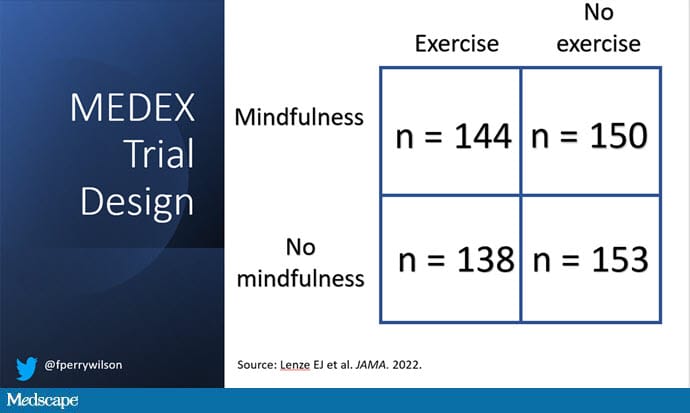
It's a clever design: a 2 x 2 factorial randomized trial where participants could be randomized to a mindfulness intervention, an exercise intervention, both, or neither.


In this manner, you can test multiple hypotheses exploiting a shared control group. Or as a mentor of mine used to say, you get two trials for the price of one and a half.

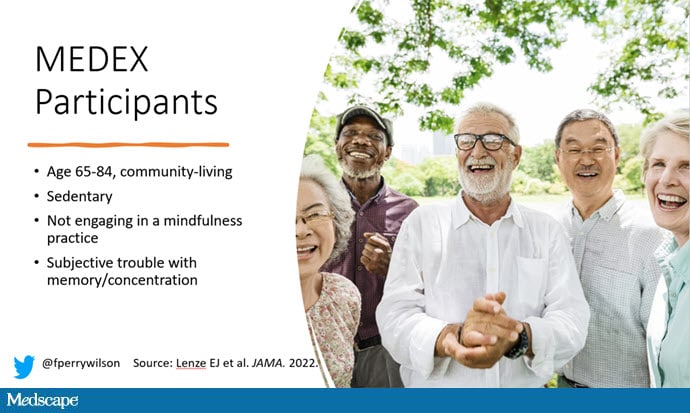
The participants were older adults, aged 65-84, living in the community. They had to be relatively sedentary at baseline and not engaging in mindfulness practices. They had to subjectively report some memory or concentration issues but had to be cognitively intact, based on a standard dementia screening test. In other words, these are your average older people who are worried that they aren't as sharp as they used to be.


The interventions themselves were fairly intense. The exercise group had instructor-led sessions for 90 minutes twice a week for the first 6 months of the study, once a week thereafter. And participants were encouraged to exercise at home such that they had a total of 300 minutes of weekly exercise.

The mindfulness program was characterized by 8 weekly classes of 2.5 hours each as well as a half-day retreat to teach the tenets of mindfulness and meditation, with monthly refreshers thereafter. Participants were instructed to meditate for 60 minutes a day in addition to the classes.

For the 144 people who were randomized to both meditation and exercise, this trial amounted to something of a part-time job. So you might think that adherence to the interventions was low, but apparently that's not the case. Attendance to the mindfulness classes was over 90%, and over 80% for the exercise classes. And diary-based reporting of home efforts was also pretty good.

The control group wasn't left to their own devices. Recognizing that the community aspect of exercise or mindfulness classes might convey a benefit independent of the actual exercise or mindfulness, the control group met on a similar schedule to discuss health education, but no mention of exercise or mindfulness occurred in that setting.

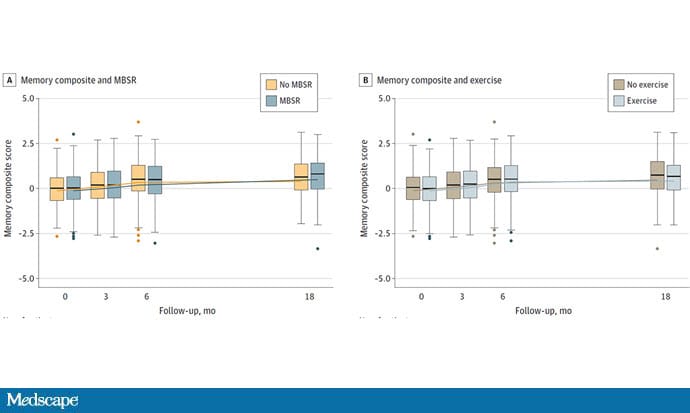
The primary outcome was change in memory and executive function scores across a battery of neuropsychologic testing, but the story is told in just a few pictures.

Memory scores improved in all three groups — mindfulness, exercise, and health education — over time. Cognitive composite score improved in all three groups similarly. There was no synergistic effect of mindfulness and exercise either. Basically, everyone got a bit better.


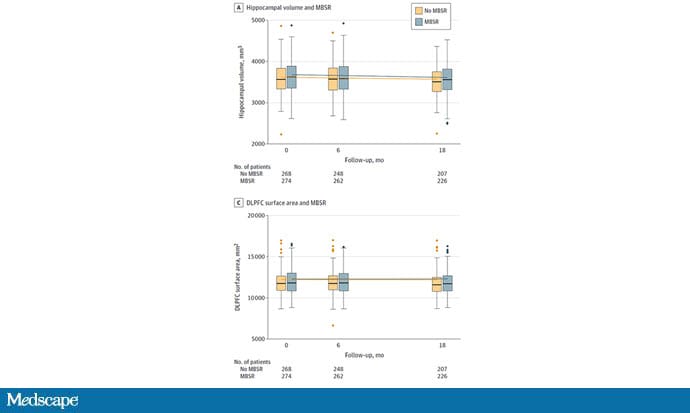
But the study did way more than look at scores on tests. Researchers used MRI to measure brain anatomic outcomes as well. And the surprising thing is that virtually none of these outcomes were different between the groups either.


Hippocampal volume decreased a bit in all the groups. Dorsolateral prefrontal cortex volume was flat. There was no change in scores measuring tasks of daily living.

When you see negative results like this, right away you worry that the intervention wasn't properly delivered. Were these people really exercising and meditating? Well, the authors showed that individuals randomized to exercise, at least, had less sleep latency, greater aerobic fitness, and greater strength. So we know something was happening.

They then asked, would the people in the exercise group with the greatest changes in those physiologic parameters show some improvement in cognitive parameters? In other words, we know you were exercising because you got stronger and are sleeping better; is your memory better? The answer? Surprisingly, still no. Even in that honestly somewhat cherry-picked group, the interventions had no effect.

Could it be that the control was inappropriate, that the "health education" intervention was actually so helpful that it obscured the benefits of exercise and meditation? After all, cognitive scores did improve in all groups. The authors doubt it. They say they think the improvement in cognitive scores reflects the fact that patients had learned a bit about how to take the tests. This is pretty common in the neuropsychiatric literature.

So here we are and I just want to say, well, shoot. This is not the result I wanted. And I think the reason I'm so disappointed is because aging and the loss of cognitive faculties that comes with aging are just sort of scary. We are all looking for some control over that fear, and how nice it would be to be able to tell ourselves not to worry — that we won't have those problems as we get older because we exercise, or meditate, or drink red wine, or don't drink wine, or whatever. And while I have no doubt that staying healthier physically will keep you healthier mentally, it may take more than one simple thing to move the needle.

F. Perry Wilson, MD, MSCE, is an associate professor of medicine and director of Yale's Clinical and Translational Research Accelerator. His science communication work can be found in the Huffington Post, on NPR, and here on Medscape. He tweets @fperrywilson and his new book, How Medicine Works and When It Doesn't

https://www.medscape.com/viewarticle/985406

Unfulfilled Promise of Cannabis for Cancer-Related Symptoms

 There is a stark contrast between the excitement and promise surrounding the therapeutic use of cannabis -- defined here as any product derived from the plant Cannabis sativa, such as tetrahydrocannabinol (THC) or cannabidiol (CBD) or others -- and its clinical application for cancer patients seeking relief from their symptoms.

Pain, nausea, anxiety, lack of appetite, fatigue, or poor sleep plague many patientsopens in a new tab or window; they often overlap, and frequently persist. As a result, there is an enormous need and interest in finding new and effective ways to treat the symptoms. The available pharmaceutical therapies can help, but many have side effects and are poorly tolerated by some patients.

Many cancer patients (and their clinicians) hoped that medical cannabis

opens in a new tab or window would fill that gap. But the results, so far, have been (mostly) disappointing -- both in the published literature and in clinical practice.

This disappointment is especially apparent for the patients with incurable cancer. A few reasons stand out. First, the current process -- a result of persisting dichotomy between the state and federal laws -- practically limits clinicians' involvement in medical cannabis management to only the issuance of medical certifications. It mostly leaves the specific product, dose, and often the route of administration to the dispensaries and patients (there are some differences between states, but this is true for most).

As one of my patients put it (half-jokingly): "You may have this thing around your neck," he said, pointing to my stethoscope, "...but when I go to the dispensary, I am the doc!"

He is one of the few who have been using cannabis for decades and is familiar with its effects. But most patients with advanced cancer are not. Many are elderly and frail, take multiple medications, and receive toxic chemotherapy. They are often overwhelmed by challenges related to a life-threatening illness, and do not have the resilience and patience necessary to navigate a system that is not patient-centered.

Medical cannabis may have the "medical" in its name, but it is far removed from the standards of medical practice. A common clinical scenario is patients trying various cannabis-derived products, usually as an add-on to their established pharmacological regimens, at varying doses for multiple symptoms and usually for brief periods, with minimal supervision or medical advice.

Leaving the process of selecting, dosing, and taking medical cannabis almost entirely in the hands of patients is not fair to them or their caregivers.

"I tried it once, but it didn't work."

"I took it, felt 'out of it,' and stopped."

"My anxiety got worse."

"It might have helped a little, but I cannot afford it."

This is what I hear most often from patients during follow-up visits.

And yet, the underlying irony is that most patients who stopped using it could still potentially benefit from medical cannabis with proper guidance and a process that makes the application of medical cannabis more patient-centered.

The education gap is another reason the current process needs to be revised. For example, in this survey

opens in a new tab or window, only 30% of oncologists said they were comfortable advising patients about cannabis. Yet, two-thirds felt cannabis was helpful as an additional treatment for pain or lack of appetite. Dispensaries are obligated to have a pharmacist or a clinician on staff. Yet, even the most knowledgeable pharmacists can only provide limited guidance as they cannot access the patient's records (except the principal diagnosis) or an accurate list of medications.

Despite many published studies related to the therapeutic application of cannabis, there are only a few that can guide clinicians in practice. This studyopens in a new tab or window is an example of research examining the effects of CBD on a range of symptoms in patients with cancer receiving specialist palliative care. CBD was chosen as it is widely available, does not have the psychomimetic effects of THC, and has shown therapeutic potentialopens in a new tab or window, making it an attractive agent for patients with advanced cancer. And yet, the study failed to showopens in a new tab or window any significant difference between the placebo and CBD groups after 14 days.

Surprising?

As with any clinical trial, one needs to consider the context of the study. For example, the patients included in the study were receiving specialist palliative care (i.e., already getting pain medications, anti-anxiety medications, antidepressants, anti-nausea, and other specific therapeutics). How likely is it that adding CBD daily on top of all these other medications would be powerful enough to show the difference in 2 weeks?

CBD's pharmacology is very complex. In contrast to THC, CBD does not work through the cannabinoid receptors but rather through multiple molecular targets. This likely requires time. It may also be true that CBD could be effective as an alternative to, for example, anti-anxiety medications, but this study was not set up to answer this question. Alternatively, another explanation is that CBD's role for patients with advanced disease and heavy symptom burden is indeed limited. Yet, based on this study, all a practicing physician can gather is that adding it for a short period in a cancer patient with multiple symptoms, who is receiving palliative care, is unlikely to help. We desperately need more well-conducted research that can inform clinical practice.

I believe that medical cannabis has the potential

opens in a new tab or window to help many cancer patients. However, for this to happen, a lot needs to change.

We need better education for clinicians, patients, and caregivers. The knowledge base related to medical cannabis is vast and growing. Cannabis can be helpful, but its use is not without risksopens in a new tab or window. We need standardized products that are carefully labeledopens in a new tab or window, high-quality, free of contaminants, and readily available to patients. In addition, we need robust research conducted in specific patient populations.

But mostly, we need to bring the discussions about cannabis use and benefits back to clinic rooms while forging new relationships with the industry that will allow us to think about medical cannabis in a new innovative way that is vastly different from its recreational applications. Only then can we find ways to incorporate it into the treatment of cancer-related symptoms effectively and safely.

Marcin Chwistek, MD,opens in a new tab or window is a supportive care and palliative medicine specialist at Fox Chase Cancer Center in Philadelphia.

https://www.medpagetoday.com/opinion/second-opinions/102630