House Republicans have introduced a bill that would command legions of federal employees to stop teleworking and return to the office.
The Stopping Home Office Work’s Unproductive Problems Act — or “SHOW UP Act” — was introduced by Kentucky Rep. James Comer, who chairs the House Committee on Oversight and Accountability.
"Americans have suffered from the federal government’s detrimental pandemic-era telework policies for federal bureaucrats," said Comer. "President Biden’s unnecessary expansion of telework crippled the ability of departments and agencies to fulfill their responsibilities and created cumbersome backlogs."
The bill gives federal employees who worked in person prior to the pandemic 30 days to get back to the office. A November Federal News Network survey found that 60% of feds were working in a "hybrid" environment, with athird working entirely remotely.
Comer says Oversight Committee members have received whistleblower reports indicating thatGeneral Service Administration's (GSA) chief Robin Carnahan has spent the majority of her time away from Washington, DC.
The SHOW UP Act would also direct federal agencies to study the impact of tele-work on their missions and report their findings to Congress. "The federal government’s expansion of telework during the pandemic has delayed critical assistance to veterans, tax refunds, passport applications, and other basic services," said Comer's office.
Agencies would also have to provide data on locality pay received by federal employees -- who may not actually be spending much time in that locality at all.
Locality pay is a substantial layer of compensation that's added to federal employees' base pay. As the name implies, it varies depending on where the job is located. The 2022 default locality pay for areas of the country without a customized percentage was 16.5% of base pay.
However, in Washington DC, it's a whopping 32.49% of base pay. For 2003, employees in the DC locality received one of the largest locality-pay hikes: 4.86%.
The SHOW UP Act alludes to an important question: How many purported Washington DC federal employees are receiving enormous locality pay while living somewhere else and phoning it in? That question isn't only relevant for DC: The same dynamic would apply federal employees in other localities who've left the big city to go live cheap somewhere else and only visit the office when required.
In 2021, the federal Office of Personnel Management said employees in "remote work" arrangements -- a permanent arrangement with no expectation of coming to the office -- should receive locality pay based on their remote location.
Things get murkier, though, where flexible "telework" is concerned. Telework usually requires reporting in-person twice every two weeks...unless that requirement is waived. Teleworking feds' locality pay is determined by the office location, not their home.
To that point, the SHOW UP Act says agencies must analyze costs attributable to "paying higher rates of locality pay to teleworking employees as a result of incorrectly classifying such employees as teleworkers rather than remote workers."
It isn't just Republicans who are itching to get federal employees out of their pajamas and back to work. Earlier this month, DC Mayor Muriel Bowserurged President Biden to kill the liberal telework policies that have left many office buildings nearly vacant, with corresponding impacts on the city economy. Otherwise, she wants government offices repurposed.
The SHOW UP Act, which has no future in a Democrat-controlled Senate, would bolster her case: It commands agencies to assess the cost of"owning, leasing or maintaining under-utilized real property."
The discovery of afourth set of classified documents, at the Biden residence in Delaware, has further undermined the White House’s virtual mantra that the president “takes classified documents very seriously.”
Putting aside the repeated movement of highly classified documents over six years, one curious element has emerged in this scandal: the use of private counsel.
Not only did President Joe Biden enlist lawyers to clear out his private Washington office; he then used them — rather than security officers or the FBI — to search for additional classified documents.
The initial use of lawyers is notable. While it seems a fairly pricey moving crew, Biden could argue a trove of documents might require a judgment on where they should be sent and whether they belong to Biden, the Penn Biden Center or the government.
But why was a legal team sent in six years after Biden took the documents on leaving as vice president? Were the lawyers specifically selected because they had clearances, an acknowledgment there might be classified material unlawfully housed in the office?
After the fourth batch of documents was discovered this week (the third found in Delaware), Richard Sauber, referred to as the “special counsel to the president,” stressed that he has a clearance. Sauber admits the lawyers who found the first batch at the residence didn’t have clearances but says he found the later documents.
House Republicans demanded the White House turn over all information related to its searches that have uncovered classified documents at Biden’s home.AP/Jon Elswick
It remains unclear which lawyers were involved in which discoveries, whether they had clearances and (if so) at what level. In fact, it seems to suggest Biden continued to use uncleared lawyers after his team found highly classified documents Nov. 2 in the Penn Biden office closet in Washington.
That itself could be viewed as gross mishandling of classified information.
It’s strange Biden did not use security officers or the FBI to conduct further searches. The president has a host of people who regularly handle classified material. So why use the lawyers?
The answer appears the same as in the case of Hillary Clinton’s emails: control. Using private counsel allows Biden to raise attorney-client privilege. Trump also used counsel, but eventually the FBI raided his home to search and remove not just classified material but documents found in boxes with that material.
While that attorney-client privilege can be overcome under a “crime/fraud exception,” it adds a level of initial protection. It also allowed Biden to control the discovery and initial record of the discovery of classified information.
The key to any investigation will be the chain of custody extending back to the documents’ removal in 2017 when Biden left office. How these documents appeared in their discovered locations is known only to his lawyers. It’s a link in the chain of custody that Biden effectively controls.
With Mar-a-Lago, the FBI was criticized for staging documents to be shown in the storage room. The photos were then leaked to an eager media. There will be no staged photos of documents alongside Time magazine covers for Biden.
Nor were documents he housed with classified documents removed. Indeed, it’s not clear if the FBI will know what documents were stored in the same boxes.
What was potentially lost is significant. Classified documents are generally supposed to be in folders with a thick, colored border and large printed classification warnings. Were some of those folders observable before they were moved? If so, anyone could tell a pile contained classified material, including the president and passersby.
Likewise, the initial discovery could show the context of surrounding material. The FBI at Mar-a-Lago carefully photographed that context and its search. Here, we’re relying on counsel to have kept such a record when most lawyers would be reluctant to do so given the risk to their client.
The key is that unlike FBI agents, these lawyers are not acting on behalf of the public interest but for the president’s personal interests.
If there are criminal charges, the key witnesses will be lawyers representing the president as an individual. They are more likely to minimize incriminating or embarrassing elements.
And they are themselves under scrutiny. Since they may not have had sufficient clearances to do this work, it is in their interest to downplay any expectations or warnings of additional classified material scattered around Biden’s home or office.
Concern over the use of lawyers has only grown with time. Biden not only continued to have his lawyers search after the first discovery, but did so for months through subsequent discoveries.
Biden recently visited his Delaware home amid the investigation.AP/Patrick Semansky
After finding highly classified material in Biden’s garage Dec. 20, private counsel — not the FBI — found another document in an adjacent room Jan 11. Sauber found more classified documents the next day.
Those last two findings followed White House assurances that the “thorough” search was “completed.” It obviously wasn’t thorough enough.
They raised another question. It would seem unlikely a document with a proper classified cover could be missed. The folder has thick red or yellow borders running around the edges and large black classifications like “TOP SECRET” emblazoned across the top. If that was missed, the earlier searches were clearly negligent.
Alternatively, and more concerning, the internal documents might have been removed from the folders and stored without cover. That would indicate someone removed and reviewed them — an act showing knowledge of the classified status. If they were removed at Biden’s residence, he would be the chief suspect in such use.
It would utterly destroy the “inadvertence” defense.
Jonathan Turley is an attorney and professor at George Washington University Law School.
The Biden administration’s push to make some forms of opioid overdose reversal drugs available over the counter will likely have little impact on the people that need it most, public health advocates warn.
The Food and Drug Administration (FDA) late last year began encouraging drug companies to apply to switch some forms of the drug away from prescription only, a move that advocates have long been pressing for as a way to increase access to a lifesaving drug.
Naloxone is a medicine that can help reduce opioid overdose deaths and when administered timely, usually within minutes of the first signs of an opioid overdose, can counter the overdose effects.
Rahul Gupta, head of the White House Office of National Drug Control Policy, said at a press conference in December that 80,000 Americans died from opioid overdoses in the past year. With naloxone, many of those deaths would have been avoided.
The FDA’s notice provides a pathway to approval for naloxone products and calls for more information from drugmakers on how the medication would be sold.
But there are only two companies that have been granted fast-track priority review to sell naloxone over the counter, and harm reduction advocates say the cost is a major barrier. The FDA is likely to approve naloxone as a nasal spray, which costs significantly more for harm reduction groups than an injection kit.
“We’re really thrilled to have an OTC [over-the-counter] product on the horizon. But there’s a huge, enormous caveat,” said Maya Doe-Simkins, a co-director of the nonprofit group Remedy Alliance/For The People, which distributes generic naloxone to people in need. “The nasal sprays are just, you know, magnitudes of 10 or 100 more expensive than generic injectables.”
One of the companies granted priority review is Emergent BioSolutions, which manufactures the brand name Narcan nasal spray. The FDA told the company it expects to have a decision on its application by the end of March.
“Accidental overdoses can happen to anyone, anywhere, at any time, and by shifting to OTC status, increased access to NARCAN will help address patient needs as the opioid epidemic continues to evolve,” Emergent said in a statement.
A spokesman told The Hill the company has not yet set a price. A two-pack of Narcan costs about $140, but with discounts the price is about $40 a dose.
The other company with a fast-track application is the nonprofit Harm Reduction Therapeutics. Michael Hufford, co-founder and CEO, said his plan is to give away some doses for free and sell the rest at cost.
He understands the concerns from harm reduction groups, but contends that nasal sprays are easier for lay people to use.
“Glass vials and needles, man, that’s, that’s a big ask right to have people understand how to use a needle, how to draw it up, how to inject it. That’s just a lot tougher hurdle,” Hufford said.
But experts and advocates contend the people who will be using naloxone are already familiar with injecting needles.
“The people who are going to buy it [at the pharmacy] are going to be different from the people who are the most at risk,” said Nabarun Dasgupta, a senior scientist at the University of North Carolina who researches drugs and infectious diseases.
The goal is to “really focus in on getting this into the hands of people who are using drugs and are at risk of overdose. When you’re talking about that population, it’s not your average grandmas at the pharmacy,” Dasgupta said.
Naloxone is currently only available as a prescription, though all 50 states have found workarounds to make the drug available at the pharmacy without a prescription. Yet the people who need naloxone the most are also the least likely to go to a pharmacy and request it.
The cost of the medication, requirements to show ID, and the overall stigma of asking for naloxone are all barriers. Additionally, some pharmacists may not be aware that there is a standing order in their state and refuse to prescribe the drug altogether.
In addition, the workarounds states use to make the drug available to individuals don’t apply to harm reduction groups, which partner with manufacturers and distributors to buy naloxone at a discount.
Those “last mile” groups are one of the primary ways to get naloxone into the hands of the highest risk populations, but they are required to treat naloxone as a prescription drug, and need to abide by strict rules.
For example, an organization like Remedy Alliance/For The People must have a doctor sign for the order. The organization must also have an address that is not a private home to receive shipments, which poses a problem for groups in rural areas.
Granting federal over-the-counter status to naloxone would solve those problems, Doe-Simkins said, but without addressing the cost barrier, the government is only taking a partial step forward.
“We’re thrilled with OTC. It does not solve our problem, because what will come along with it is the cost. And so that leaves us with the only affordable naloxone being a generic injectable that is still prescription only,” Doe-Simkins said.
A Thursday tweet from the NY Post's Miranda Devine containing a background check for Hunter Biden has people asking questions.
"The now-52-year-old began listing the Wilmington home as his address following his 2017 divorce from ex-wife Kathleen Buhle — even falsely claiming he owned the property on a July 2018 background check form as part of a rental application," the Post reported.
Of note, this is the same house where classified documents were found.
Yet, upon closer inspection, Hunter lists the "Monthly Rent" as $49,910 - or roughly $550,000 for the 11 months he indicated he lived there?
A Zillow search reveals that the most expensive home currently for rent in Wilmington, Delaware is going for $6,000 per month.
According to Town & Country magazine, Biden's home is worth around $2 million.
Could Hunter, a crackhead, have accidentally listed the annual rent payment to his father for the house which contained classified documents? Sure. But why was his wealthy ex-VP dad charging him rent in the first place, when Hunter was allegedly broke?
Trending Politics asks the quiet part out loud; was this Hunter's way of funneling money to his father?
After Hunter’s divorce was finalized in May of 2017, he was included in an email from his business partner James Gilliar about a venture with Chinese state-funded energy company CEFC China Energy. The email stated that Hunter and his partners would receive 20% of the shares in the new business, with 10% going to Hunter’s uncle James Biden and the other 10% being “held by H for the big guy.”
Tony Bobulinski, another one of Hunter’s former business partners, claims that he had a meeting with Joe Biden regarding the CEFC venture on May 2, 2017, and that the president was the individual referred to as the “big guy” in Gilliar’s email. Additionally, Gilliar himself confirmed that Joe Biden was the “big guy” mentioned in a message found on the laptop.
And as the NY Post reports, "The following year, federal investigators began looking into whether Hunter and his business associates violated tax and money laundering laws during their dealings in China and other countries. Emails and other records related to the deals were found on the laptop, which Hunter dropped off at a Delaware repair shop in 2019 and never reclaimed."
"I hope you all can do what I did and pay for everything for this entire family for 30 years," Hunter told his daughter Naomi in January, 2019. "It’s really hard. But don’t worry, unlike pop, I won’t make you give me half your salary."
As the Post continues:
The laptop doesn’t contain any direct evidence of such money transfers but shows Hunter was routinely on the hook for household expenses — including repairs to the Wilmington home.
In December 2020, weeks after his father was elected president, Hunter Biden announced that his “tax affairs” were being investigated by federal authorities in Delaware, and said he was “confident that a professional and objective review of these matters will demonstrate that I handled my affairs legally and appropriately.”
Recent reports have indicated investigators believe they have enough evidence to charge the first son with tax crimes — as well as with lying about his drug abuse on a federal form so he could buy a gun in 2018.
So, was the $49,910 'monthly' rent a simple crackhead mistake when that was in fact the annual payment amount, or did Hunter create "Exhibit A" for any honest prosecutors to pursue? We aren't holding our breath on the latter.
As often happens in the first month of the new year, vast numbers of Americans are attempting a "Dry January" or even "Damp January — " a trendy challenge to abstain or moderate alcohol use. You can be sure that those who succeed will see an improvement in their health, as alcohol is not exactly known for its health benefits. But how profound will these changes be, and will they even be that significant? Indeed, while heavy drinkers might see quick shifts in mood and energy, moderate or light drinkers might be apt to wonder if much will be different in their lives at all.
Salon spoke to experts about the short-term health benefits of moderating one's alcohol consumption for a month. As it turns out, time actually does play a big role in determining health benefits.
"The long-term effects of Dry January depends on if the habit of not drinking or reduced alcohol consumption is maintained," Dr. Rami Hashish, an injury expert and founder of the National Biomechanics Institute, told Salon. "If somebody drinks relatively a lot, and then stops for a month, and then goes right back to that same habit, then you may not necessarily see so many great benefits. It sounds nice, but science doesn't really bear that out, that they're going to see these huge benefits long-term, if they just stop some sort of action for a given month."
In other words: alcohol abstinence is not unlike diet or exercise, in that finding a new routine for only a month probably won't trigger life-altering changes.
That said, the effects of quitting alcohol can become noticeable quite quickly. A recent study in the journal Alcohol and Alcoholism found that for two-thirds of patients, cognitive abilities returned 18 days after detoxing from alcohol. This was a small study with just 32 subjects and it examined severe alcohol use disorder. Patients were also given thiamine, which may have helped improvement. More moderate drinkers may not experience the same extreme changes, but it's still a window into how profound even a short stint without alcohol can be.
Ethanol, the technical term for the drug in booze, is a promiscuous molecule. That means it likes to interact with a lot of different receptors in the body; it sometimes likened to a shotgun blast that doesn't discriminate where it hits. Almost every organ system in the body is affected by alcohol, from digestion to immunity, but nothing is as influenced as the brain. And this has a cascading effect from the top down. "If something affects the brain, it affects every other part of the body," Hashish says.
When alcohol enters the brain, it can gum up the way neurons and other cells communicate. Braincells send messages using chemicals called neurotransmitters. Ethanol can trigger the release of neurotransmitters like serotonin and dopamine, which are associated with feelings of mood and reward. But the most noticeable effect ethanol has is on GABA receptors, which play a role in calming the nervous system. More GABA means a more sedating, relaxed effect.
"When one is drunk, the brain struggles to produce long-term memories, which account for blackouts," Dr. Sanam Hafeez, a neuropsychologist, founder and director of Comprehensive Consultation Psychological Services, told Salon in an email. "Alcohol also affects the temporal cortex, which is the area of the brain that makes new memories." In contrast, quitting drinking can improve memory.
The moment you take a sip of beer, wine or whatever, your body recognizes ethanol as a toxin and tries to flush it out. It's first absorbed through the stomach and small intestine, working its way through the bloodstream. An enzyme in the liver called ADH4, or alcohol dehydrogenase 4, breaks ethanol down, which eventually becomes carbon dioxide and water.
But there's an intermittent stage between ethanol and its harmless byproducts, when the liver produces acetaldehyde, a known carcinogen that can have many toxic effects on the body. The more you drink, the more this byproduct builds up. The liver can only break it down further so fast, at a rate of about one drink per hour. Acetaldehyde is often implicated as the cause of hangovers.
The more someone drinks, the more work their liver will have. This can lead to liver inflammation, also called hepatitis, which can result in scarring and a lower-functioning organ that can trigger more serious problems with the liver.
"The liver filters toxins in the body. Heavy drinking is toxic to your cells and can lead to cirrhosis, fatty liver disease and other issues," Hafeez says. "When you abstain from alcohol, the liver can repair itself, and in some cases, regenerate."
Of course, all of this depends on the frequency and volume of alcohol someone is consuming. Many people can responsibly manage the temporary side effects of alcohol and feel like the social and stress-relieving aspects outweigh the negative health effects. While a popular 2018 Lancet study concluded that there is "no safe level of alcohol consumption," a sentiment recently echoed by the World Health Organization, many have expressed criticism of such strict abstinence.
A 2019 article in JAMA Internal Medicine claimed the Lancet research miscalculated the harms associated with alcohol, using biased overestimates that overlooked underreported drinking. Problematic drinking gets far more medical attention, at least ideally, so the majority of people who drink and aren't experiencing harms may go uncounted.
Nonetheless, when you quit drinking for a while, it can have an immediate impact on your health — again, depending on how much alcohol is typically imbibed.
"Although a regular glass of red wine might be heart healthy, overindulging is bad for your heart and blood pressure," Hafeez says. "Quitting or cutting back may lower triglycerides, which reduces the chances of heart failure."
However, in severe alcohol use disorders, quitting cold turkey can be deadly, putting people at risk for fatal seizures. This is why Hafeez, Hashish and other experts recommend talking to a doctor about drinking habits and quitting. But if you do quit, it can change someone's health relatively quickly.
"People generally see a pretty immediate reduction within a month," Hashish says, "such as increased hydration, weight loss, reductions in blood pressure, better sleep... people may have better sex, they have greater immunity, so they may be able to heal better from injury or illness. So there's a lot of benefits."
Abstaining can also translate into increased energy, better concentration and memory and improved mood. It's worth emphasizing that there's nothing wrong with drinking alcohol. Humans do all kinds of activities that can be unhealthy, from eating sugar to sitting at a computer too long. The question here is one of moderation, assessing one's health and being informed about what is happening when ingesting certain drugs like alcohol.
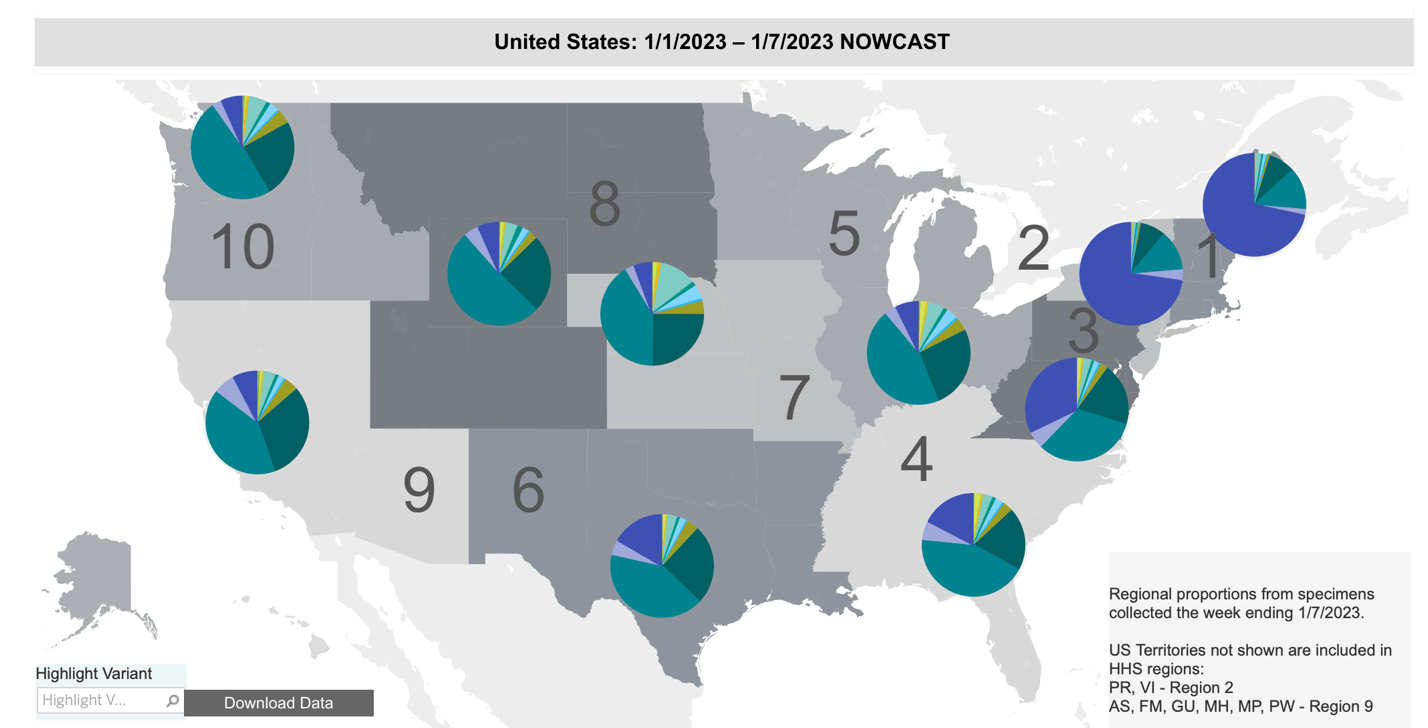
The SARS-CoV-2 virus is threatening to surge again. In the past few weeks alone, a recent version, XBB.1.5, has quickly spread in the United States. As of the most recent data from the Centers for Disease Control, this variant makes up about three-quarters of all cases in the Northeast and 27.6% nationwide.
“It is the most transmissible variant that has been detected yet,” said Maria Van Kerkhove, the Covid-19 technical lead at the World Health Organization. But transmissibility, or infectiousness, is only part of the story.
The progression of a pandemic depends on several factors, including: (1) the characteristics of the pathogenic organism, primarily its infectiousness and virulence; (2) the state of immunity in the population from either vaccination or previous infection; (3) our ability to treat the infection; and (4) the willingness of the population to behave in ways that prevent infection.
The current state of all these variables is worrisome. But I’m getting ahead of myself.
Are US COVID control policies deficient?
The patchwork of policies and what some have derided as ‘moving the goalposts’ to respond to new developments is not surprising nor an indication of a public health failure. New data constantly become available, and circumstances change, and therefor so must our responses. The situation is somewhat like the way that our automobile navigation systems work. When you start the journey, the device provides an estimated time of arrival and plots the route, but that can change according to various unplanned occurrences — if you stop for gas or encounter an open drawbridge, for example.
The operative concept for managing the pandemic, or any medical problem, for that matter, can be summarized in a single phrase: minimizing the probability of adverse outcomes. But we, as individuals, public health officials and political leaders, have widely differing tolerance for risk and inconvenience, and the risk-related circumstances vary widely in different states and localities. One size doesn’t fit all.
Managing probability means reducing the chances of being exposed to an amount of the SARS-CoV-2 virus sufficient to penetrate the body’s natural and vaccine-induced defenses and cause an infection. At the same time, we must not impose measures that cause diminishing returns. The cure should not be worse than the disease. It can be a difficult balancing act.
Barriers to infection
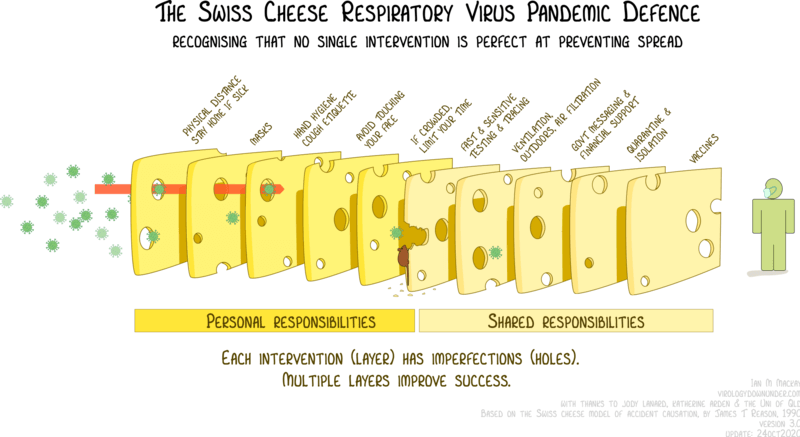
Some of the barriers to infection are illustrated nicely in this figure below, the original version of which was created by Australian virologist Ian Mackay:
Courtesy: Wikimedia
Each of these measures lowers the probability that an infectious dose of virus will find its way to your respiratory tract, and if it does, that it will cause an infection. Also, depending on the extent and effectiveness of vaccination, some of the other interventions could become superfluous, or at least less important. However, the protection afforded by vaccination wanes with time, especially as new SARS-CoV-2 variants arise that boast a higher degree of immune-escape.
Such strategies are the essence of preventive medicine. For example, many of us take drugs to lower our cholesterol levels or blood pressure to reduce the probability of cardiovascular disease, and get flu vaccine to prevent influenza, and workers with fiberglass wear masks to prevent inhalation of harmful small particles.
Survival of the fittest pathogen
Erecting barriers — biological, physical, and behavioral — to prevent infection is well understood. What is harder is predicting how the microorganism that causes the infection will evolve, and what responses will be required. There is a wide spectrum of possibilities, which are dependent upon … probabilities.
The SARS-CoV-2 virus has evolved constantly, and sometimes drastically, since its discovery. Every viral replication in every infection – of which there have now been billions – creates new mutants and new candidates for Darwinian evolution to evaluate them for “fitness.” The fittest survive and spread.
Understanding XBB.1.5
Just one month ago, the Omicron XBB.1.5, accounted for 1% of all US infections, meaning its penetration has increased some 27-fold. The trait that makes XBB.1.5 more infectious than its predecessors is that it is more “sticky” than its predecessors – that is, it binds more tightly to the site on host cells where it attaches and enters. It does not, however, appear to be more immune-evasive, which is good news.
There has been a sharp uptick of COVID hospitalizations in the U.S. since the beginning of December, offering a preview of what might be in store nationwide as XBB.1.5 continues to spread. Even before the dominance of XBB.1.5, COVID hospitalizations had begun to trend upward nationwide.
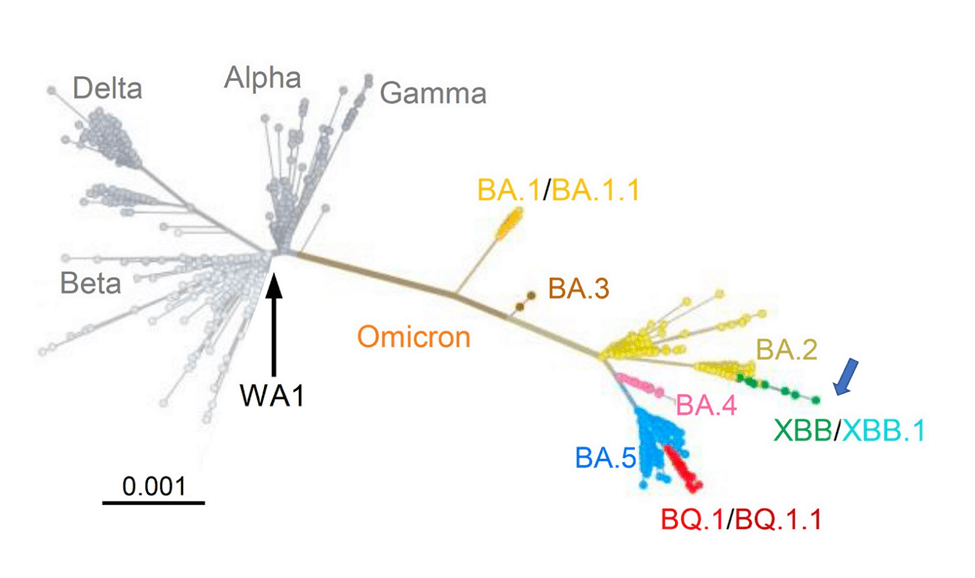
There’s an important lesson from the pedigree of XBB.1.5. It evolved from XBB.1, which had evolved from XBB, an Omicron subvariant that emerged in India last August and quickly became predominant there and then elsewhere in Asia. Here is a map of the SARS-CoV-2 variants and subvariants prior to the appearance of XBB.1.5:
From Wang et al
But the most striking thing is that XBB didn’t simply arise as the result of point mutations in the RNA; rather it is the result of a recombination of two descendants of the BA.2 variant. Swiss virologist Dr. Emma Hodcroft has made a useful diagram that illustrates what that means:
Credit: Emma Hodcroft
It might look complicated, but in the upper part of the figure we need only focus on the horizontal purple and red lines, which represent the RNAs that comprise the genome of two discrete subvariants of the BA.2 variant before recombination occurred. The bottom part of the figure depicts the genome of the new virus, XBB, that resulted from recombination (that is, breakage and reattachment, or what Dr. Hodcroft calls “template switching”). XBB is comprised of genetic material from both of the “parents,” which is shown by the line being both purple and red, joined at the “breakpoint.”
When a virus copies itself, it can ‘template switch’ between different genomes floating around. If those are all the same, the end product isn’t different! But if distinct lineages are there at the same time, we can spot these ‘chimera’ children – recombinants!
This is somewhat similar to what happens when an animal is infected by two different flu viruses, and inside the animal they exchange RNA fragments to create a new, more dangerous virus which goes on to spread.
Lowering the probability
The important takeaway: For the recombination event to have occurred, the two parental viruses must both have infected a person and have been present in the same cell simultaneously for enzymes to have broken and reattached portions of the two genomes.
That scientific observation has important implications for public policy: To lower the likelihood of more dangerous subvariants arising in this way, we should strive to lower the probability of such co-infection events. We do that by decreasing the number of infections that occur, and we do that by applying the old 2020 rallying cry: “Flatten the curve.”
How? By judiciously applying the various “slices” of the Swiss Cheese Model above, of course — masks, vaccines, good indoor ventilation, avoiding high-risk situations, and so on — all of which are only being tepidly recommended by public health officials and have been largely abandoned in the U.S. There is hardly a mask to be seen on public transportation, in airports and airplanes, and in supermarkets and big-box stores. The bivalent booster vaccination rate for Americans five years of age and over is a dismal 15.4%.
As a result, hospitalizations, deaths, and long COVID are all trending upward. And the pandemic rages on…
Henry I. Miller, a physician and molecular biologist, was the founding director of the FDA’s Office of Biotechnology. He is the Glenn Swogger Distinguished Fellow at the American Council on Science and Health. Find Henry on Twitter @henryimiller