Travelers whose package tours were ruined by the imposition of restrictions to combat the COVID-19 pandemic may be entitled to at least a partial refund, the European Union’s highest court said Thursday.
The European Court of Justice weighed in after being asked for its opinion by a court in Germany.
The Munich court is considering the case of two people who bought a two-week package vacation for the Spanish island of Gran Canaria starting on March 13, 2020, just as the pandemic hit Europe. They are seeking a 70% reduction in the price because of restrictions that were imposed there two days later and their early return.
When the restrictions were imposed on March 15, beaches were closed, a curfew put in place and the plaintiffs were allowed to leave their hotel room only to eat, the EU court said. On March 18, they were told to be ready to leave at any moment, and two days after that they had to return to Germany.
The tour operator refused the requested reduction on the grounds that it couldn’t be held liable for a “general life risk.”
The EU court found that “a traveler is entitled to a reduction in the price of his or her package where a lack of conformity of the travel services included in the package is due to restrictions that have been imposed at the travel destination to fight the spread of an infectious disease, such as COVID-19.”
It said it doesn’t matter if similar restrictions are imposed at the traveler’s place of residence or in other countries.
The German court will now have to assess whether the restrictions in the specific case at issue “could constitute failures to perform or improper performances” of the contract by the tour organizer.
Florida will seek to provide consumers more flexibility in buying prescription drugs and more information about their costs under a legislative proposal that Republican Gov. Ron DeSantis said Thursday he will ask lawmakers to approve.
The proposal would further regulate prescription benefit managers, the go-betweens for health plans and consumers. The goal is to drive down prescription costs, DeSantis said.
Among other things, the proposal would bar prescription benefit managers from forcing consumers to use mail programs for prescription drugs.
“What we’re going to say is, ‘You’re free to use the mail-in pharmacy that they’re telling you to use, but you do not have to use that,” DeSantis said. “You have the ability to make your own decision if it’s best for you.’”
Prescription benefit managers will also have to provide more information when registering with the state, including any pharmacies they’re affiliated with and any other companies under their umbrella, DeSantis said.
The proposal would also require drug manufacturers to issue a report each year justifying price increases.
The state’s Legislature begins its annual 60-day session in March.
A progressive prosecutor in one of Virginia's largest counties says her office will no longer prosecute a number of misdemeanors, including reckless driving, petty theft, and hit-and-runs.
Loudoun County commonwealth's attorney Buta Biberaj (D.) announced on Thursday that starting next week, her office won't prosecute many low-level offenders, according to a memoobtainedby Fox 5.
Biberaj says her office is "inundated" with cases and claims the change will allow her team to focus on more serious crimes. Local leaders aren’t buying it.
"I don't believe the issue is anything else but her ability to manage her office," Loudoun County Board of Supervisors chairwoman Phyllis Randall, a Democrat, told Fox 5, adding that she "absolutely will not" support Biberaj’s reelection bid this year. "If she was running unopposed, I wouldn't support her."
Board members and the county sheriff's office said they were blindsided by Biberaj's announcement.
Biberaj's office did not respond to a request for comment. The sheriff's office told the Washington Free Beacon that it was "disappointed" Biberaj hadn't warned it of the change and "that law enforcement officers will no longer have assistance from a prosecutor in many general district court cases."
The left-wing prosecutor does not have the best track record on the serious felony charges on which she claims to be focusing. Last year, a series of mistakes led to the release of twomurder suspects within a matter of weeks. One is no longer facing charges; the other had to be hunted down later in Georgia.
The missteps have led former allies like Randall and fellow Democratic supervisor Kristen Umstattd to call for Biberaj's replacement, saying the commonwealth's attorney is "misleading the public." A county judge also kicked Biberaj off a case last year for playing fast and loose with evidence, writing in an order that Biberaj was "deliberately misleading the court and the public" to "sell" a plea deal.
Biberaj is one of three Northern Virginia prosecutors boosted into office by six-figure donations from George Soros. The liberal billionaire contributed nearly $1 million to her 2019 campaign. Along with Arlington County prosecutor Parisa Dehghani-Tafti (D.), Biberaj is facing a primary challenge for her incompetence.
Randall told Fox 5 that she hadn't heard Biberaj was ending misdemeanor prosecutions until she received "a picture of the memo" that was sent to the board on Thursday. In the memo, Biberaj admits her office has been unable to keep up with evidentiary burdens.
"As you may know, with the increase in the trials in Circuit Court and the introduction of body-worn camera and related recordings in each case, the [Office of the Commonwealth's Attorney] is inundated and left with insufficient time to prosecute every infraction and low-level offense that is charged," the memo states.
The board chairwoman also said Biberaj has struggled to retain prosecutors in her office, even though the county has increased funding to hire more attorneys.
Pursuant to Biberaj's memo, her office will not punish trespassing, some drug possession, and failures to appear in court.
Fairfax County commonwealth's attorney Steve Descano (D.), another Soros-backed prosecutor, back in 2020 similarly declined to prosecute many misdemeanors. He is also seeking reelection this fall amid widespread dissatisfaction over hismishandlingof dangerous offenders.
In the emergency department at MLK Community Hospital, masked patients lay in wheeled stretchers lining the hallways.
Others slumped in chairs where nurses attended to them. Amid the crush of people on a recent day in December, only the sickest or most severely injured got one of the 29 rooms.
The rise of flu, RSV, COVID and other winter viruses has exacerbated overcrowding that existed even before the pandemic, hospital officials said — the result of stark shortages in medical care in a low-income South Los Angeles neighborhood where most residents are Black or Latino.
Latoya Hawkins and her 4-month-old daughter, Aroyal Collier, receive care at MLK Community Hospital’s emergency department.
(Francine Orr / Los Angeles Times)
Patients come to MLK’s emergency department with minor ailments they haven’t been able to get treated elsewhere, or more serious conditions that have become dire in the absence of care to prevent or manage them, said Dr. Elaine Batchlor, chief executive of MLK Community Healthcare.
When it opened seven and a half years ago, MLK’s emergency department was expected to handle 110 patients a day, or roughly 40,000 patients annually. Last year, more than 400 patients arrived on especially hectic days, for an annual total of more than 112,000 patients.
Earlier in the pandemic, the crowds at the emergency department had dissipated as some people stayed away. But now, as fears of catching COVID have lessened, the number of people seeking care at the emergency department has surged again, exceeding pre-pandemic levels, Batchlor said.
As Batchlor walked through the emergency department, she gestured to an area full of chairs and cubicles. “This used to be the waiting room, but it is completely converted into treatment space,” she said.
Ruby Harvey was brought into the emergency department with COVID-19 pneumonia.
(Francine Orr / Los Angeles Times)
In all, MLK has carved out more than 200 areas for patients to be treated, including the 29 traditional rooms and an unconventional range of spots in chairs, gurneys and under tents. Beds occupy what was once the gift shop. Ambulance bays hold tents forassessing and treatingpatients.
“We kind of put patients everywhere we could,” Batchlor said.
Nurses try to keep their voices low when speaking to patients seated between dividers in an effort to respect privacy, competing with the sounds of crying children and coughing.
In a period of less than three weeks this winter, the hospital asked 101 times to divert emergency vehicles to other medical facilities because it was full, according to Gwen Driscoll, vice president of strategic communications at MLK Community Healthcare.
Ambulances line up outside MLK Community Hospital.
(Francine Orr / Los Angeles Times)
Many patients have chronic illnesses — such as diabetes and heart disease — that could be managed at a doctor’s office, but “there aren’t enough doctors and there isn’t enough access in the community,” Batchlor said.
About 40% of MLK’s emergency visits could have been handled in an outpatient clinic, the hospital has estimated.
Dr. Oscar Casillas, MLK’s medical director of emergency medicine, said a pregnant woman recently came in needing an ultrasound because the clinic she had visited couldn’t provide it. Others have an appointment scheduled elsewhere, but not for months, “for something that’s been bothering them for four or five weeks” already, Casillas said.
And some clinics send their patients to the ER for routine electrocardiograms to get cleared for surgery, he said.
A Los Angeles County sheriff’s deputy accompanied a patient to the emergency department at MLK Community Hospital. The medical staff works together to restrain the patient.
(Francine Orr / Los Angeles Times)
“You would never see that in areas that have more resources,” Casillas said.
South L.A. needs 1,400 more doctors, including both primary care physicians and specialists, the hospital estimated in a recent report. The area served by MLK has been designated by federal agencies as a “shortage area” for health professionals.
More than three-quarters of patients in MLK’s emergency department rely on Medi-Cal — the California Medicaid program — and roughly 10% are uninsured, according to hospital figures.
Medicaid programs reimburse doctors at lower rates than private insurers, which can “reduce the number of providers that are willing to participate,” said Nadereh Pourat, associate director of the UCLA Center for Health Policy Research.
Batchlor argues that those financial incentives are at the root of the problems that MLK patients face in getting day-to-day care. Medi-Cal recipients were more likely than people who get insurance through their employer to say that they have no usual source of care or that a doctor would not accept their insurance, according to a report from the UCLA Center for Health Policy Research.
Rod Berryman waits in the ambulance bay outside MLK Community Hospital.
(Francine Orr / Los Angeles Times)
Some patients turn up at the MLK emergency department in need of things as simple as a medication refill.
On a rainy Tuesday, Mary Johnson came to get medicine for pain and to help her with breathing — a visit she makes every few months, she said.
Johnson said she has no primary care doctor.
“It’s so difficult right now with all of the COVID,” said Johnson, 57, who is unhoused and has been sleeping in a car.
Besides, she loves MLK.
Sofia Siberian attempts to sleep in a cubicle as she waits for test results at MLK Community Hospital.
(Francine Orr / Los Angeles Times)
“Whatever issue, they always take care of me,” she said. “And I know they’re going to move me out of here so fast.”
Batchlor said that patients with less serious problems are “in and out very quickly.”
“And the way they do that is by seeing the patients wherever they are,” she said — be it in a chair or a gurney or under a tent set up outside.
The crowds at the emergency department show the extreme need in the community but are also a sign to hospital staff that they are doing things right.
An MLK patient rests with a blanket in a hallway of the emergency department.
(Francine Orr / Los Angeles Times)
“That’s the success of the work that we’re doing here,” said assistant nurse manager Jesse Lynwood. “That the community is showing up.”
Batchlor and Casillas have also grown concerned about psychiatric patients being brought to the emergency department from beyond South L.A. Hospital officials say that such patients have been dropped off by police departments serving areas as far away as Santa Monica, Whittier and Huntington Beach.
A report requested by L.A. County Supervisor Holly Mitchell found that of the psychiatric emergency patients transported by emergency medical services, only a small fraction bypassed a closer hospital for MLK. But the report did not include dropoffs by law enforcement.
At MLK’s emergency department, two tents have been set up for psychiatric patients. On an average day, a dozen patients are awaiting a bed or an evaluation under a short-term involuntary hold known as a 5150, attended by “sitters” assigned by the hospital to stay with them for their safety.
Daniel Meraz waits at MLK Community Hospital with a possible foot infection.
(Francine Orr / Los Angeles Times)
The hospital has no inpatient psychiatric beds, so patients stay in the emergency department, often for days, until staffers can find somewhere else for them to go. The average stay is nearly 35 hours for patients on 5150 holds. One psychiatric patient remained there for 35 days, hospital officials said.
Amid the high demand for its services, the MLK emergency department has been losing tens of millions of dollars annually,Batchlor said, because Medi-Cal reimbursements do not fully cover the costs of care.
In the last budget year, MLK had a net loss of nearly $43 million for patient care in the emergency department — a hole that would be deeper if not for the slim 4% of patients with private insurance, whose care netted more than $6 million in profit, according to figures shared by hospital staff.
A state bill that would have bolstered funding for the MLK emergency department was passed by state legislators but vetoed last year by Gov. Gavin Newsom, who said the money wasn’t included in the budget.
MLK officials said they are again seeking a financial infusion from the state this year. Meanwhile, they are dipping into reserve funds.
Mechanical vibrations could help improve our muscles and our balance control, according to research at Aston University.
Researchers in the College of Engineering and Physical Sciences have examined the effect of stimulation onmusclespindles which "speak" to thecentral nervous systemto help keep us upright and walk straight.
Their results provide new perspectives on whole-body vibration applications, paving the way for future research on the interaction between the central nervous system and the peripheral muscles.
The research could in the future be applied to improve balance in older people and help reduce falls, this could be applied through either wearable devices or with a daily session of stimulation. Hip fractures alone account for 1.8 million hospital bed days and £1.1 billion (approximately $1.3 billion) in hospital costs every year, excluding the high cost of social care.
Another potential benefit of the research is that this type of stimulation could be applied to athletes to decrease their muscle reaction times.
The goal of the study was to find out if mechanical vibrations can improve the way our bodies process and react to small body oscillations.
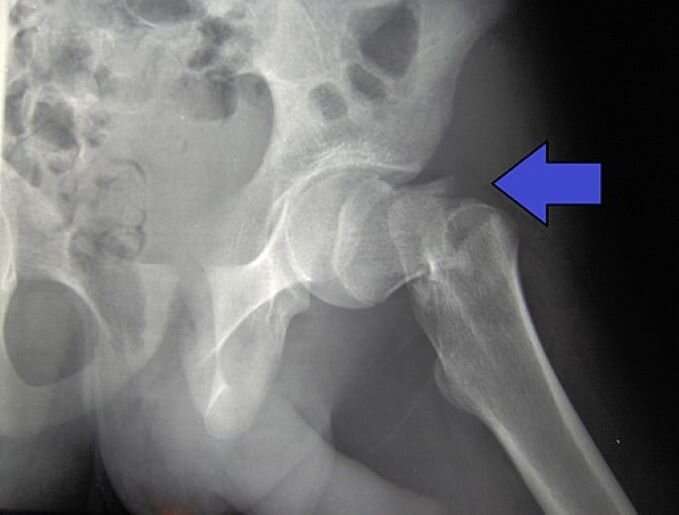
Cdm hip fracture 343. Credit: Booyabazooka/Wikimedia Commons, CC BY-SA 3.0
Seventeen young male and female adult volunteers aged between 20 and 28 years old stood individually on platforms, similar to vibrating plates found in gyms, which caused leg muscle contractions. Calf muscles were targeted as the muscles whose action contribute the most to maintaining a stable upright posture.
The researchers stimulated their calves with a frequency of 30Hz and recorded four one-minute trials of undisturbed balance to take a baseline measure and compared the readings to measurements taken after the stimulation. After conducting the experiment, they found that their balance seemed to have improved.
The research, "Sensorimotor recalibration of postural control strategies occurs after whole body vibration," was led by Dr. Antonio Fratini, senior lecturer in mechanical, biomedical & design engineering, and Ph.D. student Isotta Rigoni, and has been published in Scientific Reports.
Dr. Fratini said, "We're excited by our results as they could have a beneficial effect on the health and quality of life of a large number of people.
"Our results indicate that whole body vibration challenges balance at first, triggering a bigger effort to control the upright stance and shifting muscle modulation toward supraspinal control, resulting in a recalibration of muscle recruitment. The neuromuscular system seems to recover from such disruption and regain control over a longer time interval."
"Indeed, while muscle recruitment and cortical effort appear unaltered over the long term, the balance seems not only restored but also improved, besides the still clearly affected calf muscles."
More information: Isotta Rigoni et al, Sensorimotor recalibration of postural control strategies occurs after whole body vibration, Scientific Reports (2023). DOI: 10.1038/s41598-022-27117-7
A new study inAging Celldescribes how a key protein called Signal Transducer and Activator of Transcription 3 (STAT3) might turn back the clock on aging cartilage that leads to osteoarthritis.
"STAT3 performs an astonishing repertoire of roles in development and regeneration, as well as inflammatory disease and cancer. In this study, we found an innovative chemical approach for reversing aging of joint-forming cells in a clinically relevant manner, because this intervention is simple and fully controlled," said the study's co-corresponding author Denis Evseenko, who is a Professor of Orthopaedic Surgery, and Stem Cell Biology and Regenerative Medicine at USC, and holds the J. Harold and Edna LaBriola Chair in Genetic Orthopedic Research.
"We wanted to understand the role of STAT3 in cartilage cells during embryonic development as well as in the context of osteoarthritis," said co-corresponding author Steve Horvath, a Professor of Human Genetics and Biostatstics at UCLA.
To accomplish this, first authors Arijita Sarkar, Nancy Q. Liu and their colleagues at USC and UCLA performed a series of experiments to uncover how STAT3 turns genes on and off through a process known as epigenetic regulation. Specifically, the team identified patterns of epigenetic regulation that correlate with the age of cartilage cells. These correlations served as the basis for creating what the researchers dubbed an "epigenetic clock" for cartilage cells.
By using a molecule to activate STAT3, they were able to reverse the hands of the epigenetic clock—turning on many genes and creating an epigenetic pattern typical of younger cartilage cells. When they genetically inactivated STAT3, the epigenetic clock ticked faster—turning off many genes and promoting an epigenetic pattern observed in older cartilage cells.
The scientists then focused their attention on an important enzyme called DNA methyltransferase 3 beta (DNMT3B), which interacts with STAT3. When STAT3 was inactivated, DNMT3B kicked into high gear to add aging marks to the DNA molecule, and promoted the progression of knee osteoarthritis in injured mice.
In the arthritic knee cartilage of the mice, there was a significant population of cartilage cells that appeared to be turning back time and reverting to an immature state.
"These cells may be assuming more embryonic-like state as an attempt to enhance their capacity to develop new knee cartilage," said Sarkar, who is a postdoc in the Evseenko Lab.
Unfortunately, while these immature cells make cartilage that is youthfully regenerative during embryonic development or acute injury, they seemed to create cartilage that is dysfunctionally immature in the context of a chronic condition such as osteoarthritis.
"When present on a longer term basis, hyperactivation of the immature program in cartilage cells is likely to promote inflammation and, ultimately, degeneration and fibrosis," said Liu, a senior scientist in the Evseenko Lab.
In the future, the results of this study can inform the quest to develop treatments that harness STAT3's power to promote regeneration without tapping into its tendency to trigger inflammation.
More information: Arijita Sarkar et al, STAT3 promotes a youthful epigenetic state in articular chondrocytes, Aging Cell (2023). DOI: 10.1111/acel.13773
Doctors at Queen Mary University of London and Barts Hospital, and Cambridge University Hospital, have led research using a new type of CT scan to light up tiny nodules in a hormone gland and cure high blood pressure by their removal. The nodules are discovered in 1 in 20 people with high blood pressure.
Published today inNature Medicine, the research solves a 60-year problem of how to detect the hormone-producing nodules without a difficult catheter study that is available in only a handful of hospitals, and often fails. The research also found that, when combined with aurine test, the scan detects a group of patients who come off all their blood pressure medicines after treatment.
For the study, 128 people were scanned after doctors found that their hypertension (high blood pressure) was caused by the steroid hormone aldosterone. The scan found that in two thirds of patients with elevated aldosterone secretion, the hormone originated from a benign nodule in just one of the adrenal glands, which could be safely removed.
The scan uses a short-acting dose of metomidate, a radioactive dye that sticks only to the aldosterone-producing nodule. The scan was as accurate as the old catheter test, but quick, painless and technically successful in every patient. Until now, the catheter test was unable to predict which patients would be completely cured of hypertension by surgical removal of the gland. By contrast, the combination of a "hot nodule" on the scan and urine steroid test detected 18 of the 24 patients who achieved a normal blood pressure off all their drugs.
Professor Morris Brown, co-senior author of the study and Professor of Endocrine hypertension at Queen Mary University of London, said, "These aldosterone-producing nodules are very small and easily overlooked on a regular CT scan. When they glow for a few minutes after our injection, they are revealed as the obvious cause of hypertension, which can often then be cured. Until now, 99% are never diagnosed because of the difficulty and unavailability of tests. Hopefully this is about to change."
Professor William Drake, co-senior author of the study and Professor of Clinical Endocrinology at Queen Mary University of London, said, "This study was the result of years of hard work and collaboration between centers. across the UK. Much of the 'on the ground' energy and drive came from the talented research fellows who, in addition to doing this innovative work, gave selflessly of their time and energy during the national pandemic emergency. The future of research in this area is in very safe hands."
In most people with hypertension (high blood pressure), the cause is unknown, and the condition requires life-long treatment by drugs. Previous research by the group at Queen Mary University discovered that in 5% to 10% of people with hypertension, the cause is a gene mutation in the adrenal glands, which results in excessive production of the steroid hormone aldosterone. Aldosterone causes salt to be retained in the body, driving up the blood pressure. Patients with excessive aldosterone levels in the blood are resistant to treatment with the commonly used drugs for hypertension, and at increased risk of heart attacks and strokes.