Search This Blog

Thursday, February 16, 2023

RedHill: Positive UK Regulatory Meeting

 RedHill Announces Positive MHRA Meeting and Planned UK Marketing Authorisation Application of RHB-102 (BEKINDA®) for Oncology Support

UK MHRA scientific advice meeting deems RHB-102 (BEKINDA®) data supportive of submission for approval for chemotherapy and radiotherapy induced nausea and vomiting (CINV/RINV)

RHB-102 UK Marketing Authorisation Application (MAA) submission planned for 2H/23

If approved for marketing by the MHRA, RHB-102 could become the first oral 24hr extended-release 5-HT3 antiemetic drug in the UK indicated for the treatment of CINV/RINV

https://www.biospace.com/article/releases/redhill-biopharma-ltd-announces-redhill-s-rhb-102-positive-mhra-meeting-and-maa-plan/

Labcorp forecasts up to 90% fall in COVID testing sales in 2023

 Laboratory Corp of America Holdings on Thursday predicted that COVID testing sales could fall by up to 90% this year after nearly two years of a boost to its diagnostics unit during the pandemic.

The forecast echoes the fortune of other COVID product makers such as Abbott Laboratories and Quest Diagnostics, which have seen their revenues from tests slump with a decline in cases.

However, Labcorp's forecast is steeper than that of its closest rival Quest, which sees COVID sales declining by as much as 88% this year.

For the fourth quarter, the laboratory operator's sales declined about 9% to $3.67 billion and missed estimates of $3.74 billion, according to IBES data from Refinitiv.

However, it beat analysts' estimates for quarterly profit, helped by growth in sales in the company's base business, which excludes COVID-19 testing.

Excluding items, Labcorp reported a profit of $4.14 per share for the quarter ended Dec. 31, above analysts' estimates of $4.10.

The North Carolina-based company forecast an adjusted profit for 2023 in the range of $16 to $18 per share, compared with analysts' estimates of $17.65.

https://www.yahoo.com/lifestyle/labcorp-beats-quarterly-profit-estimates-120710249.html

Biden's physical exam 'straightforward,' White House says, as re-election bid looms

 U.S. President Joe Biden, 80, underwent a closely watched physical examination on Thursday morning ahead of an expected announcement that he is seeking a second four-year term.

Biden's three-hour session with doctors at Walter Reed National Military Medical Center in the Washington suburb of Bethesda, Maryland, was his second extensive exam since taking office in January 2021.

White House press secretary Karine Jean-Pierre told reporters that the exam was "straightforward" and the findings would be released later on Thursday.

Biden's last physical and colonoscopy, in November 2021, showed the president to be a "healthy, vigorous, 78-year-old male," his doctors said at the time. He had a polyp removed from his colon and his contact lens prescription updated, the doctors' six-page memo said.

Biden, the oldest person ever to serve as U.S. president, has waved off questions about his age. With Biden expected to launch his re-election campaign in the near future, polls indicate that voters have concerns about his ability to serve four more years if he wins in 2024.

Asked about the concerns on Biden's age, Jean-Pierre said: "This is a president that works day in and day out, you know, in a grueling fashion with a grueling schedule, and delivers."

About three-quarters of Americans - including more than half of Democrats and the vast majority of Republicans - say Biden is too old to work in government, according to a Reuters/Ipsos poll conducted Feb. 6-13. Most Democratic respondents said the president remains mentally sharp, but about half of them said he cannot handle the physical toll of the presidency.

Biden would be 86 by the end of a prospective second term, making him 13 years older than the average life expectancy of an American male, according to 2020 U.S. Centers for Disease Control and Prevention (CDC) data.

At his last exam, Biden's White House physician, Kevin O'Connor, declared him fit for duty and able to execute his responsibilities. O'Connor attributed Biden's stiff gait to spinal arthritis and "peripheral neuropathy," or some loss of sensation in the feet.

Biden's physical probably would include a neurological exam, as is typical with people in his age group who are more vulnerable to falls, Borna Bonakdarpour, an associate professor of neurology at Northwestern University's Feinberg School of Medicine, told Reuters.

Biden's eyes and hearing would also likely be checked, along with "anything else he may complain about," Bonakdarpour said. Biden's cognition seemed good during the recent State of the Union address, the doctor said.

Biden said during a PBS interview last week that any Americans concerned about his age should "watch me" perform the duties of the presidency.

https://www.yahoo.com/lifestyle/biden-80-closely-watched-physical-110141734.html

Crypto giant Binance moved $400 million from U.S. partner to firm managed by CEO Zhao

 Global cryptocurrency exchange Binance had secret access to a bank account belonging to its purportedly independent U.S. partner and transferred large sums of money from the account to a trading firm managed by Binance CEO Changpeng Zhao, banking records and company messages show.

Over the first three months of 2021, more than $400 million flowed from the Binance.US account at California-based Silvergate Bank to this trading firm, Merit Peak Ltd, according to records for the quarter, which were reviewed by Reuters. The Binance.US account was registered under the name of BAM Trading, the U.S. exchange's operating company, according to the records. Company messages show the transfers to Merit Peak began in late 2020.

Reuters couldn't determine the reason for the transfers or whether any of the money belonged to Binance.US customers. The exchange's public terms of use at the time said its customers' dollar deposits were held at Silvergate and a Nevada-based custodian firm called Prime Trust LLC. Prime Trust made $650 million in wire transfer deposits into the Binance.US account during the quarter, the bank records show.

A Binance.US spokesperson, Kimberly Soward, did not address Reuters' questions about the transfers detailed in the bank records. In a statement, she said Reuters' reporting used "outdated information" without elaborating further. She added: "Merit Peak is neither trading nor providing any kind of services on the Binance.US platform" and "only Binance.US employees have access" to the bank accounts of the U.S. company. Soward didn't specify when Merit Peak's activities ceased.

The Binance global exchange, Binance CEO Zhao and Prime Trust did not respond to detailed questions about the transfers. A Silvergate spokesperson said the bank does not comment on individual customers.

Binance.US's executives were concerned by the outflows because the transfers were taking place without their knowledge, according to messages reviewed by Reuters. The CEO of Binance.US at the time, Catherine Coley, wrote to a Binance finance executive in late 2020 asking for an explanation for the transfers, calling them "unexpected" and saying "no one mentioned them."

"Where are those funds coming from?" she wrote in one message.

In a response to Coley, seen by Reuters, the Binance executive, Susan Li, did not explain the transfers. Li wrote that Merit Peak was a "vendor that facilitated trading" on Binance.US and also provided loans and capital injections to the American exchange.

Coley, who left Binance.US later in 2021, didn't respond to questions sent via her legal representatives. Li also didn't respond.

Reuters was unable to trace what became of the $400 million. An unspecified portion of the money was subsequently sent to the Silvergate account of a Seychelles-incorporated firm called Key Vision Development Limited, according to a person with direct knowledge of the transfers. A 2021 corporate filing by another Binance unit identified CEO Zhao as a director of Key Vision. A former Silvergate executive confirmed that Key Vision held an account at Silvergate at the time.

Key Vision's local registered agent did not respond to requests for comment.

The money transfers suggest that the global Binance exchange, which is not licensed to operate in the United States, controlled the finances of Binance.US, despite maintaining that the American entity is entirely independent and operates as its "US partner." The Department of Justice and the Securities and Exchange Commission have sought information from Binance and Binance.US about their relationship as part of ongoing investigations into potential breaches of financial rules, including whether Binance is using the American exchange as cover for doing business in the U.S. The SEC and the Justice Department declined to comment for this article.

Reuters reported last year that Binance created Binance.US as a de facto subsidiary in 2019 in order to draw the scrutiny of U.S. regulators away from the global exchange. Binance.US's operator, California-based BAM Trading Services, is registered with the U.S. Treasury as a money services business, a category that includes foreign currency traders and money transmitters. BAM's beneficial owner is Zhao.

Binance.US's chief financial officer, Jasmine Lee, told the Wall Street Journal on Feb. 8 that "the extent of our relationship" with Binance.com is a shared name and a licensing agreement for technology. "We do not transfer our funds back and forth," Lee said.

Susan Li, the Binance finance executive, had access to the Binance.US Silvergate account, however, along with several senior Binance.US employees, according to the messages and the person with direct knowledge of the transfers. In one message, a Binance.US finance manager asked Li to give another Binance.US employee authority to approve payments from the account. A 2021 Binance.US document that described the American exchange's technology architecture identified Silvergate as a payment channel controlled at the time by Binance.com.

The Binance.US account records reviewed by Reuters detail each transaction between January and the end of March 2021. Reuters has not reviewed account records for other periods.

The transfers to Merit Peak took place on the bank's proprietary Silvergate Exchange Network (SEN), which Binance.US joined in November 2020 to serve its corporate clients. SEN allows these clients to transfer dollars between their accounts at the bank. Silvergate's investor prospectus says SEN transfers are "push only," which means they must be authorized by the account's controller.

The former Silvergate executive told Reuters the movement of funds from a company account without approval of that firm's management would be a breach of the bank's compliance rules. Silvergate's prospectus says "multiple steps are required to create, authorize and approve a SEN transfer." The Silvergate spokesperson didn't address the transfers in their response to Reuters.

Over the January-March 2021 quarter, the Binance.US account received $1.3 billion in SEN transfers from corporate clients trading on Binance.US, along with the $650 million in wire transfer deposits from Prime Trust.

BLACK BOX

The role of trading firms at crypto exchanges such as industry leader Binance has been under scrutiny since rival FTX collapsed in November. Trading firms often play a "market-making" role, typically buying and selling assets to deepen an exchange's trading volume and thus facilitate dealing. The market maker profits from the difference, or "spread," between the prices bid by buyers and asked by sellers.

The SEC has accused FTX founder Sam Bankman-Fried of secretly diverting billions of dollars in customer funds to his trading firm, Alameda Research, which functioned as a market maker on the exchange. Alameda received "undisclosed special treatment" on the FTX platform that concealed the flows, the SEC alleged in its December complaint against Bankman-Fried, who has pleaded not guilty.

The SEC's chair, Gary Gensler, told Bloomberg TV on Feb. 10 that crypto exchanges, in general, were "co-mingling customer funds with their businesses" by also operating as broker-dealers and hedge funds that were trading against their own clients. He didn't single out Binance or other exchanges in his comments, but said firms should expect more enforcement actions by the agency.

"We don't let the New York Stock Exchange also run a hedge fund and trade on the exchange. Why would we do it here?" Gensler said.

Among the dealers on Binance.US was Merit Peak, according to company messages, the trading firm managed by CEO Zhao.

Binance.US employees had little visibility into how Merit Peak was executing trades, the person with knowledge of the transfers said, because the software that matched customers' orders was managed by Binance as part of the technology licensing agreement between the two exchanges. The document that described Binance.US's technology architecture designated this software as "BlackBox" because, ex-staff said, Binance.US employees didn't know how it functioned.

Former regulators, along with former executives at Binance and Silvergate, told Reuters that Merit Peak's role on Binance.US created potential conflicts of interest between the exchange and its customers because Binance.US disclosed no information about Merit Peak's activities or its owner. The SEC described Merit Peak as a Binance entity when it sought information about the trading firm as part of a subpoena issued to Binance.US in December 2020.

"When you have that lack of transparency, you don't know if Binance customers are being disadvantaged," said Howard Fischer, a former senior SEC trial counsel and now a partner at U.S. law firm Moses Singer.

Merit Peak was incorporated in the British Virgin Islands in January 2019. That December, Zhao signed a purchase agreement for Merit Peak to invest $1 million into Binance.US operator BAM Trading's holding company in return for a portion of the holding company's preferred shares. The agreement identified Zhao as Merit Peak's "Manager."

The BVI corporate registry does not name Merit Peak's directors or shareholders, and only identifies its local registered agent. The agent did not respond to requests for comment about Merit Peak's ownership. Like Binance.US, Binance too has not provided any public information about Merit Peak, nor mentioned it in submissions to regulators and corporate registries that were reviewed by Reuters.

The 2021 document that described Binance.US's technology architecture noted that an unidentified "Market Maker" was under the control of Binance.com. In a Twitter Spaces event last November, Zhao said he was a shareholder in one unspecified market maker, but stressed that it did not earn profits and was "just providing liquidity in the market."

The SEC's subpoena, addressed to Coley, requested information on all of Binance.US's market makers, their owners, and their trading activity. The Wall Street Journal reported the subpoena last year. Reuters could not establish how Binance.US responded to the SEC.

Binance.US and Binance didn't respond to Reuters' questions about the SEC's case, but Binance's chief strategy officer, Patrick Hillmann, told the Wall Street Journal on Wednesday the company was "working with regulators to figure out what are the remediations" to resolve investigations. The Justice Department is also investigating Binance for suspected money laundering and sanctions violations, Reuters has previously reported.

Silvergate, the bank used by Binance and other crypto exchanges, is also drawing scrutiny. It is under investigation by the Justice Department's fraud section, which is examining Silvergate's hosting of accounts tied to Bankman-Fried's businesses. Silvergate didn't comment and the Justice Department declined to comment.

After this article published, Silvergate's shares extended losses, hitting a daily low of $17.35, and were last down around 22%. They have fallen 86% over the past year.

"STEADY CASH DRAIN"

Coley announced Binance.US had joined the Silvergate Exchange Network in November 2020, telling a crypto news outlet, "We've launched SEN for our corporate clients."

Merit Peak gave Binance.US $5 million to fund the "minimum balance" of the exchange's new SEN account, according to a message a senior Binance.US employee later sent to counterparts at Binance.com. The transfers to Merit Peak began soon after, the messages show.

Coley, on the morning of Dec. 23, flagged a "very large withdrawal" by Merit Peak of $7.5 million from the Binance.US account. Binance.US staff referred to the transfers to Merit Peak as "withdrawals," messages show, because Binance.com employees were initiating them.

"This transaction is unexpected," Coley wrote. As a result, she told Susan Li, who was named as team leader of Binance's finance department in a company employee list that year, that Binance.US's SEN account had hit its daily withdrawal limit of $10 million and she would lift the threshold to $20 million.

Coley asked Li to advise Binance.US staff in the future when the SEN account was close to hitting its limit. "Given we do not have portal access, can we have eyes and ears helping us," she messaged. She didn't identify the portal, but Silvergate says SEN accounts can be accessed via an "online banking portal."

Coley followed up with Li again later that day. "Can you explain more – maybe over the phone – about the flows that are happening via SEN? I want to understand them better as no one mentioned them until today when they got caught in our limit," Coley wrote.

"Who is directing this?" Coley asked, noting that other senior Binance.US employees were not aware of the transfers either.

Li replied in a message to Coley that Merit Peak's role was as an "OTC vendor." She didn't elaborate or directly address Coley's questions.

In OTC or over-the-counter trades, two parties agree on a price outside an exchange. Reuters could not establish what trades Merit Peak was involved in. But in a message to a colleague in early 2021, seen by Reuters, a senior Binance.US employee said Binance.com was sending crypto to Binance.US to sell to American traders, and then "withdrawing" the income via Merit Peak. This led to a "steady cash drain out of SEN," despite a booming crypto market, the employee wrote.

From January to March 2021, the account records show that Merit Peak received 89 transfers from the Binance.US SEN account totalling $404 million. Over that period, Merit Peak made four payments into the Binance.US account, for a total of around $160,000.

The transfers to Merit Peak were almost all for precise million-dollar figures, made at one- or two-day intervals. These transfers often immediately followed a deposit into the Binance.US account by Prime Trust, the crypto custodian firm for Binance.US client funds.

Merit Peak then transferred funds from its Silvergate account to the account belonging to Key Vision, the Seychelles firm, said the person with direct knowledge of the transfers.

Reuters was unable to determine why the money was moved around in this way.

That year, Binance.com was also directing international customers on its platform to deposit dollars into Key Vision's Silvergate account, according to screenshots of the instructions posted on a crypto blog. The Seychelles' business registry says Key Vision, which was incorporated the same day as Merit Peak, remains active and is in "Good Standing."

Binance.US in April 2021 unexpectedly announced it would replace Coley as CEO. She has not made any public statements since leaving.

https://news.yahoo.com/exclusive-crypto-giant-binance-moved-193359724.html

CDC Director Suggests It Will Never Change Child-Masking Policy

 by Steve Watson via Summit News,

CDC Director Rochelle Walensky suggested during congressional testimony Tuesday that the organisation will never change its policy on masking for children, despite multiple studies showing that the face coverings do nothing to stop the spread of COVID.

During a hearing in the House on the government’s response to the pandemic, Rep. Cathy McMorris Rodgers asked Walensky if the CDC is going to consider revising its guidance on masking in schools (which is still happening in many areas of the country) in the wake of perhaps the most extensive study yet confirming that masks are not effective.

The study, published in the peer-reviewed Cochrane Database of Systematic Reviews, is the strongest science to date refuting the basis for mask mandates worldwide.

Massive Peer-Reviewed Mask Study Shows ‘Little To No Difference’ In Preventing COVID, Flu Infection

The CDC still recommends masking in areas with “high” rates of transmission (fewer than 4% of US counties, as Just the News notes), along with indoor masking in areas with “medium” rates of transmission (27%).

Walensky effectively dismissed the Cochrane review, claiming the study “only includes randomised clinical trials,” and that those trials were “for other respiratory viruses, not COVID 19.”

She continued, “Our guidance for school-based masking is related to our COVID-19 community levels. Unfortunately, we’re in a place now in this country where most of our country is in green or yellow. Has low to moderate transmission communicable levels. And in those communities we don’t recommend masking. We recommend it for high level communities.”

Then came the kicker, as the CDC head stated “our masking guidance doesn’t really change with time. It changes with the disease.”

Given that COVID isn’t going to just go away, this appears to suggest that the CDC isn’t going to do away with masking… perhaps ever.

Author: Your Grandkids Will Still be Wearing Masks in 2050

https://www.zerohedge.com/covid-19/watch-cdc-director-suggests-it-will-never-change-child-masking-policy

East Palestine "Residents May Already Be Undergoing DNA Mutations," Class Action Lawsuit Alleges

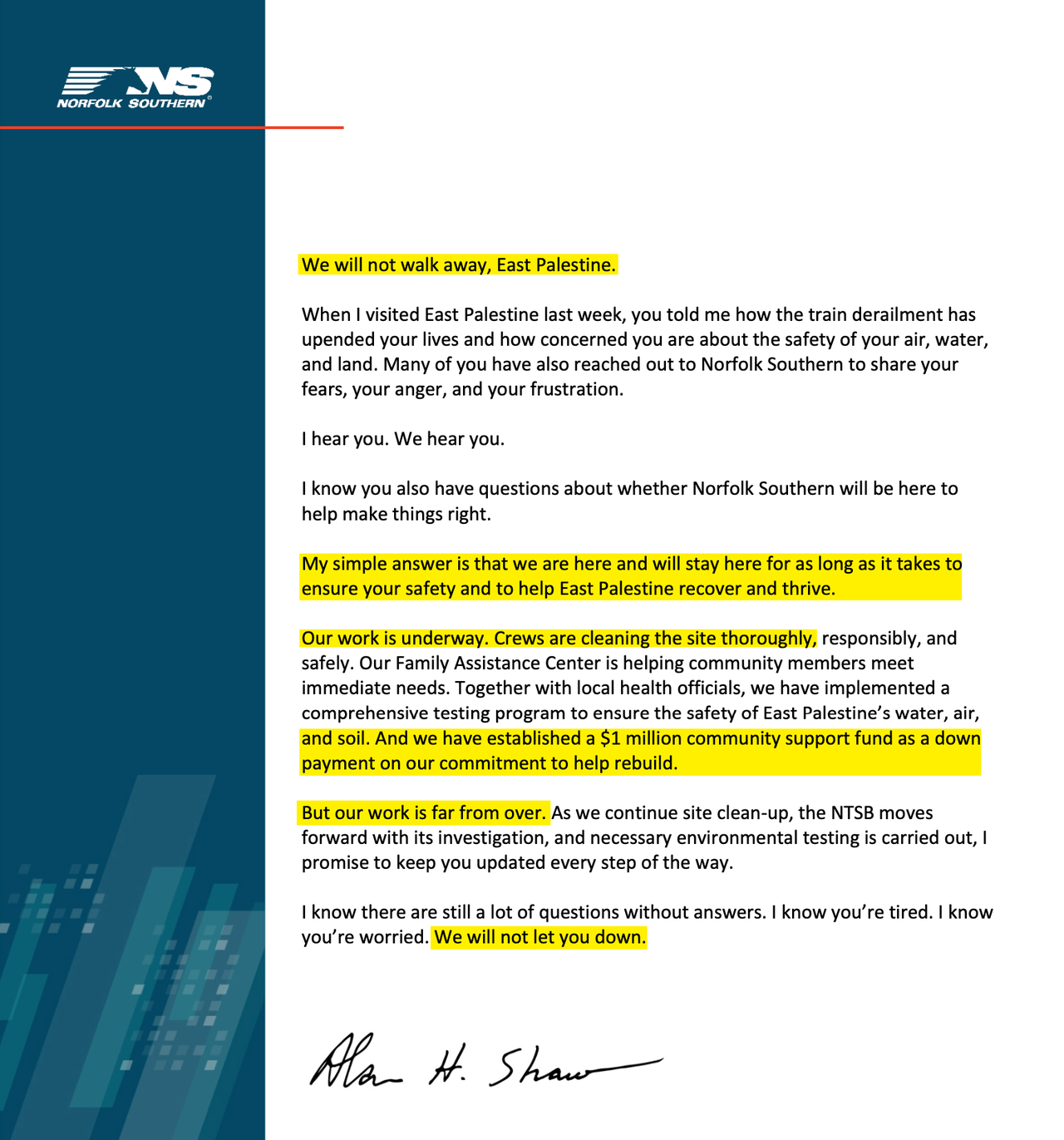
 Norfolk Southern Railway CEO Alan Shaw published a letter Thursday that read, "We will not walk away, East Palestine." 

But already, officials from Norfolk Southern ditched a meeting last night with worried East Palestine, Ohio, residents who were only searching for answers after a freight train with 150 cars (20 of which were carrying hazardous materials) derailed in the small town, resulting in a chemical disaster. 

Norfolk Southern is not off to a great start. There are increasing reports that residents are experiencing short-term health impacts after the derailment and controlled burn of toxic chemical vinyl chloride. Residents as far away as Pittsburgh are wondering about potential health impacts, according to local media, Pittsburgh Post-Gazette


Recall this model we shared yesterday. 

And here's another model. 

And then, there are long-term health implications with exposure to vinyl chloride, such as an increased risk of developing a rare form of liver cancer (hepatic angiosarcoma), liver cancer (hepatocellular carcinoma), brain and lung cancers, lymphoma, and leukemia. 

Here's Shaw's full letter to the residents of East Palestine.

Nearly two weeks after the derailment, Norfolk Southern still hasn't provided all information about what the train cars were carrying, New York Daily News pointed out. 

At the meeting last night, East Palestine resident Kathy Dyke asked local officials and members of federal agencies: 

"Why are they being hush-hush?"

"They're not out here supporting, they're not out here answering questions. For three days, we didn't even know what was on the train."

"I have three grandbabies," she continued. "Are they going to grow up here in five years and have cancer? So those are all factors that play on my mind."

Another woman questioned:

"If there's nothing in the air and nothing in the water, why are people still getting sick?"

One man exclaimed:

"This whole town's infected!"

Even the journalists covering the derailment are getting sick from the fumes. 

On Thursday, Democratic Senator Sherrod Brown wrote a letter to Governor Mike DeWine to declare a disaster in East Palestine. 

"This is an unprecedented situation.

"Hundreds of families were forced to flee their homes and are now rightfully concerned about the potential long-term health risks associated with exposure to the toxic chemicals released" Brown said, adding DeWine should declare a disaster to "ensure that the community has all the resources they need."

Meanwhile, a litigation wave has hit Norfolk Southern. The latest lawsuit alleges that efforts by the rail company and local and state authorities to burn off the dangerous chemicals made things worse and demanded punitive damages and medical monitoring.

"I'm not sure Norfolk Southern could have come up with a worse plan to address this disaster.

"Residents exposed to vinyl chloride may already be undergoing DNA mutations that could linger for years or even decades before manifesting as terrible and deadly cancers. The lawsuit alleges that Norfolk Southern made it worse by essentially blasting the town with chemicals as they focused on restoring train service and protecting their shareholders," attorney John Morgan said in a statement, who was cited by local media WFMJ

"At least five class action negligence lawsuits have now been filed by residents and business owners who were impacted by the fiery chemical train derailment," The Independent said. 

The photo above should've been on the front cover of every major newspaper nationwide -- but it wasn't. Wonder why? 

... and there's this. 

https://www.zerohedge.com/markets/east-palestine-residents-may-already-be-undergoing-dna-mutations-class-action-lawsuit

Half Of Americans Believe News Organizations Deceive The Public: Gallup

 by Connor O'Keeffe via The Mises Institute,

report from Gallup and the Knight Foundation released Wednesday highlights Americans' plummeting trust in the news media.

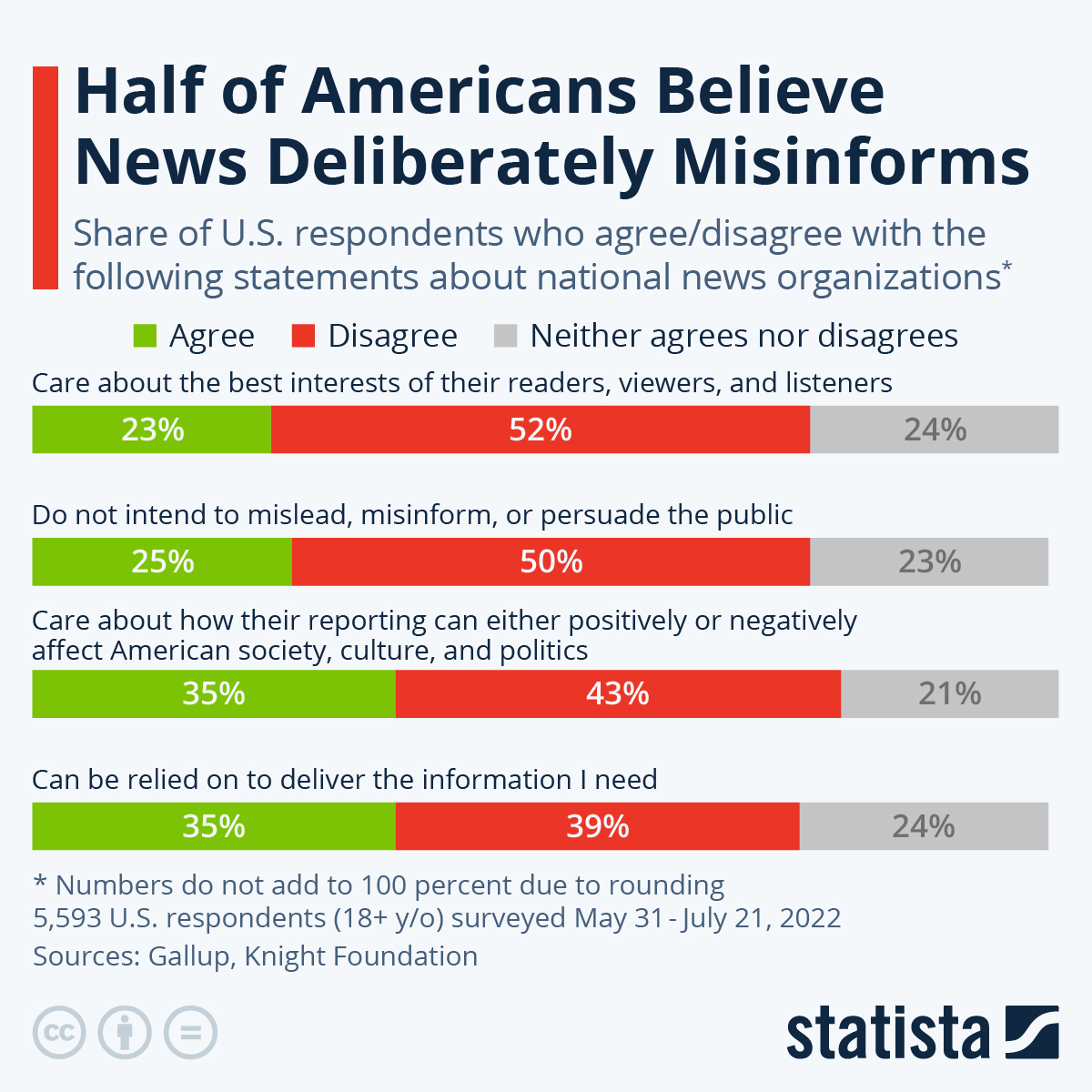
According to the poll, half of Americans believe the mass media intends to misinform with its reporting. It's evident in the data uncovered that Americans are trying to square an imaginary civic vision of the media with the realities of the industry.

Infographic: Half of Americans Believe News Deliberately Misleads | Statista


The Gallup/Knight survey found that only 26% of Americans hold a favorable view of the news media, the lowest figure recorded in the survey's five-year history. 53% have an expressly unfavorable view.

But the most notable figure is that 50% of Americans believe that "most national news organizations intend to mislead, misinform or persuade the public."

In other words, it's not that these Americans think the news media falls short of adequately informing consumers, they believe it is actively working to deceive the public.

This release was the second part of the Gallup/Knight study. Part one frames out what the survey authors and many Americans mistakenly see as the root of the problem—the tension between news as a business and news as a public good.

We're all taught from a young age that a free and independent press is instrumental to the democratic process.

That it's the job of journalists to keep the public up to speed on the issues so they can make informed and rational decisions when choosing a candidate or voting on a proposition.

Yet 76% of those surveyed admit that "news organizations are first and foremost businesses, motivated by their financial interests and goals."

In the report, the conclusion made clear in both the framing by the authors and the subjects' answers is that the incentives of business corrupt the higher purpose of journalism.

But the truth is the exact opposite. It's the aim for an impossible and undesirable democratic ideal that explains the rot in today's news media.

The ideal is impossible because the press cannot operate independently from government and private forces. Journalism must be funded somehow, and media organizations will therefore be bound by the wants of government officials, advertisers, donors, or news consumers. There is no escaping this.

And it is undesirable because, like democracy itself, this idealized vision of the press rests on the assumption that a population gets to collectively make decisions for both minority groups within that population and for certain foreign groups against their will.

The "public" does not have any such right. But by acting like it does, the government can exert force all over the world and then tell us that it's our responsibility to stay informed on all they're doing because we collectively steer the ship. In other words, the government takes a bunch of things that are not our business and makes them our business.

The message that good citizens are up to date on the news mixed with the politicization of everything acts, in effect, as a subsidy of the news media that companies gleefully take advantage of.

It also hands news organizations a tremendous amount of political power. And they use it to benefit themselves and their friends in government and industry.

Today's media is a rotten, crony mess, and this survey shows that about half of Americans are now picking up on it.

https://www.zerohedge.com/political/new-gallup-poll-shows-half-americans-believe-news-organizations-deceive-public