Search This Blog

Friday, February 17, 2023

Gilead: Trodelvy® Demonstrates Positive Efficacy in Urothelial Cancer

 Oral Presentation Highlights Trodelvy Efficacy of 13.5 Months Overall Survival in Patients with Platinum-Ineligible Metastatic UC After Checkpoint Inhibitor Therapy –

– Trodelvy Demonstrated 12.8 Months Overall Survival in Patients with Metastatic UC Whose Disease Progressed Rapidly Following Platinum-Based Chemotherapy –

Gilead Sciences, Inc. (Nasdaq: GILD) today announced new and updated positive results from three cohorts of the Phase 2 TROPHY-U-01 study of Trodelvy® (sacituzumab govitecan-hziy) for the treatment of metastatic urothelial cancer (mUC). These data demonstrate that Trodelvy produced both rapid and durable responses for patients across a range of hard-to-treat types of mUC including platinum-ineligible and rapidly progressing, post-platinum mUC. These findings will be featured in both an oral session (abstract #520) and in poster presentations (abstract #518, #526) during the 2023 American Society of Clinical Oncology Genitourinary Cancers Symposium (ASCO-GU) Annual Meeting February 16-18.

"The TROPHY-U-01 data show consistent benefit of Trodelvy across multiple types of metastatic urothelial cancer, including the most difficult-to-treat and, often times, frail patients where treatment options are still scarce," said Bill Grossman, MD, PhD, Senior Vice President, Therapeutic Area Head, Gilead Oncology. "Trodelvy has the potential to become a cornerstone treatment in metastatic urothelial cancer, and we are excited about the expected results from the ongoing Phase 3 TROPiCS-04 study that may serve to convert our U.S. accelerated approval to full approval for Trodelvy to treat patients with locally advanced or metastatic urothelial cancer following a platinum-containing chemotherapy and PD-1/PD-L1 inhibitor."

Longer-term follow-up across Cohorts 1, 2, and 3 of TROPHY-U-01 provides an increasing body of evidence supporting the potential benefit of treating mUC with Trodelvy across clinically relevant, hard-to-treat patient populations. :

SciSparc JV Reached First Milestone for Future Machine Learning System

 SciSparc Ltd. (Nasdaq: SPRC) (the “Company” or “SciSparc”), a specialty clinical-stage pharmaceutical company focusing on the development of therapies to treat disorders of the central nervous system, today announced that its MitoCareX Bio Ltd. (“MitoCareX Bio”) joint venture , which focuses on the discovery and development of potential drugs for cancer, rare diseases and other life-threatening conditions, has achieved its first milestone pursuant to the March 10, 2022 Founders and Investment Agreement with respect to MitoCare X Bio (the “MitoCareX Bio Agreement”).

The first milestone refers to the establishment of MitoCareX Bio's cloud-based computing infrastructure that is expected to allow its future expansion into machine learning system. The system is harnessed to investigating mitochondrial carriers that are crucial for cell viability.

As a result of MitoCareX Bio meeting this milestone, SciSparc will invest an additional $400,000 in MitoCareX Bio and increase its share ownership in MitoCareX Bio from 31.48% to 41.92%.

As mitochondrial carriers hold a significant role in transporting necessary metabolites for cell functioning and survival across the inner mitochondrial membranes, the Company believes that various life-threatening conditions, such as cancer and rare diseases, might be treated by regulating the function of mitochondrial carriers. In humans, the mitochondrial carrier family (Solute Carrier Family 25, SLC25) consists of 53 members and is the largest solute transporter family.

MitoCareX Bio is currently performing virtual screening activities as well as further developing its computationally based drug discovery platform to enable its planned machine learning capabilities. MitoCareX Bio's innovative research is partly based upon successful proof-of-concept experiments previously performed in the United Kingdom.


Why Meihua International Soared

 Shares of Chinese disposable medical device maker Meihua International Medical Technologies (MHUA 9.57%) were up 50.3% for the week as of Friday morning, according to to data provided by S&P Global Market Intelligence. The stock closed last week at $16.25 and reached a 52-week high on Friday when it hit $24.43 in early trading. The stock's 52-week low is $2.60 and it is up more than 185% over the past year.

NASDAQ: MHUA

Meihua International Medical Technologies
Today's Change
(9.57%) $2.08
Current Price
$23.81
 MHUA

KEY DATA POINTS

Market Cap
$520M
Day's Range
$21.00 - $24.90
52wk Range
$2.60 - $24.90
Volume
23,160
Avg Vol
48,008
Gross Margin
38.25%
Dividend Yield
N/A


The stock, already riding high after the company mentioned on Feb. 8 that it saw applications for ChatGPT to develop online health consultation services, gave investors another reason to be interested this week. On Wednesday, the company said it was building a team to develop a robotic surgical system, complete with the related hardware and software for such systems. The number of robotic-assisted surgeries (RASs) is low in China, so there's plenty of room for growth.


Bear in mind this healthcare company only began trading on the Nasdaq Stock Market after its initial public offering last year. Investors need to be wary with a company, particularly one in China, with such a short track record. The company cleaned out its C suite late last year, appointing a new CEO, CFO, and directors, so that could be another warning sign. On the positive side, the company appears to be profitable. In the company's unaudited first-half results, it reported revenue of $54.8 million, up 13% year over year, and net income of $6.6 million, down 28% over the same period last year.

Still, just saying it plans to develop an RAS system and actually bringing one to market are two different things. The company's specialty has been more mundane items. It produces 800 products, including 120 that it exports, from syringes to sponges to I.D. bracelets.

https://www.fool.com/investing/2023/02/17/why-shares-of-meihua-international-soared-this-wee/

GE HealthCare recalls certain nuclear medicine systems

  GE HealthCare is recalling its 600 and 800 Series nuclear medicine systems after identifying an issue with two safety mechanisms that could potentially lead to a "catastrophic fall" of a detector and potentially trap or crush patients.

The recall has been classified by the U.S. Food and Drug Administration (FDA) as Class I -- the most serious type of recall. Although eight complaints have been received, no injuries or deaths have been reported related to this issue, however.

The recalled systems include the following:

  • Brivo 615
  • Discovery NM 630
  • Optima 640
  • Discovery NM/CT: 670 DR, 670 ES, 670 Pro, 670 CZT
  • NM: 830, 830ES
  • NM/CT: 850, 850 ES, 860, 860 ES, 870 CZT, 870 DR, 870 ES

The two identified safety mechanisms are designed to prevent uncontrolled detector movement. First, a ball screw that serves as design mitigation for the suspended mass of the detector may fail, according to the FDA report. Also, some devices are missing a safety key that should prevent the detector from a catastrophic fall when the ball screw fails, the FDA said.

If the ball screw fails and the safety key is missing, the 1,212-lb (550-kg) detector could fall, potentially crushing or trapping a patient, according to the recall notice.

GE Healthcare in December 2022 sent customers an urgent medical device correction letter to inform them of the issue, recommending they stop using these nuclear medicine systems until an inspection is completed by company service technicians. They also requested that customers complete the letter's acknowledgment response form and send to Recall.40901@ge.com.

In January, the company said that customers would be contacted by a GE HealthCare representative to arrange for the inspection and any needed corrections. The safety key in the systems is not visible to or accessible by the patient or the technician who operates it.

Customers with questions about this recall should contact GE HealthCare Service at 1-800-437-1171 or their local Service Representative.

https://www.auntminnie.com/index.aspx

WHO Convenes 'Urgent' Meeting Over Marburg, One Of World’s Deadliest Viruses

 by Jack Phillips via The Epoch Times (emphasis ours),

The World Health Organization (WHO) convened an “urgent meeting” this week amid an outbreak of the Marburg virus, which causes one of the world’s deadliest diseases, in Africa.

Health officials say Marburg, first seen in the late 1960s, is related to Ebola. However, WHO officials say it’s far more deadly, killing upwards of 88 percent of people who contract it.

The virus has been detected in several African countries over the past several months, including recently in Equatorial Guinea. A small number of Marburg cases were found in Ghana late last year.

“WHO on Tuesday convened an urgent meeting of the Marburg virus vaccine consortium (MARVAC) to discuss the outbreak,” a news release from the United Nations-backed health agency said on Tuesday, adding that Equatorial Guinea has confirmed its first-ever case of the virus. WHO officials say the virus is responsible for nine deaths in the tiny African nation.

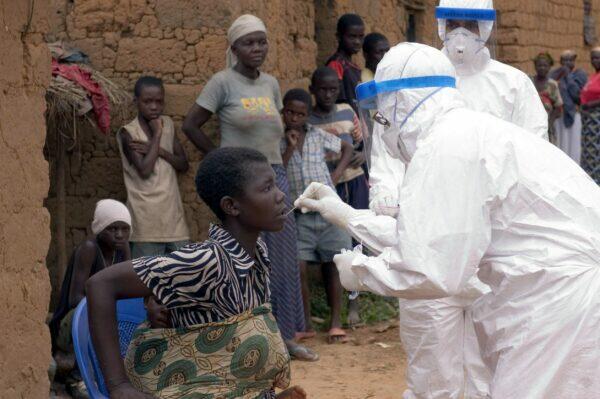
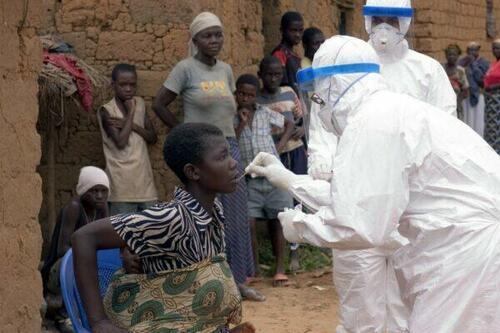
Doctor Mark Katz, a member of the World Health Organisation (WHO), takes an oral sample from patient Feliciana suspected of having Marburg hemorrhagic fever in Kinguangua, near Uige, on May 6, 2005. (Christopher Black/WHO/AFP via Getty Images)

The Marburg outbreak was centered around Kie Ntem Province, located in western Equatorial Guinea. The deaths occurred between Jan. 7 and Feb. 7, WHO said, citing reports.

“Surveillance in the field has been intensified,” George Ameh, WHO’s country representative in Equatorial Guinea, was quoted as saying by the Daily Mail during Tuesday’s meeting. “Contact tracing, as you know, is a cornerstone of the response. We have … redeployed the COVID-19 teams that were there for contact tracing and quickly retrofitted them to really help us out.”

In its release, WHO said it sent “advance teams” to impacted districts in the West African country to provide medical care and perform contract tracing. “Health authorities sent samples to the Institut Pasteur reference laboratory in Senegal, with support from WHO, to determine the cause,” Tuesday’s release added. “Eight samples were tested, one of which turned out positive.”

Cases of the virus, however, are considered rare. Annual global figures released by WHO indicate that cases tend to be in the single digits worldwide.

And although it remains “a very rare disease in people,” says the U.S. Centers for Disease Control and Prevention, “when it occurs, it has the potential to spread,” and can be highly deadly. “Health care staff and family members who care for the patient” infected with the hemorrhagic fever are most at risk, the CDC says (pdf) in a fact sheet.

https://www.zerohedge.com/medical/who-convenes-urgent-meeting-over-marburg-one-worlds-deadliest-viruses

Notorious Drug Trafficking Hub Used For Russian Oil Shipments

 by Michael Kern via OilPrice.com,

A Spanish city on the northern coast of Africa between the Mediterranean and the Atlantic Ocean, notorious for being a drug-trafficking hub, has become a major new hub of ship-to-ship transfers of Russian oil and illicit activities aimed at obscuring the origin of the crude, maritime consultancy Windward Ltd said in a report carried by Bloomberg.

Waters around the Spanish city of Ceuta in North Africa have become the scene of an increasing number of ship-to-ship transfers since the Russian invasion of Ukraine.

The activity is clearly linked to Russia, according to Windward.   

Russia is believed to be looking to mask tanker routes and locations amid the rising use of a vast “dark fleet” to evade Western sanctions and the price caps on Russian oil and products.

According to Windward, port calls in North Africa have seen a 147% jump in tankers, mostly crude oil tankers, from Russia. STS transshipment and dark activities in the Black Sea have also soared since the Russian invasion of Ukraine. The dark activities are mainly being carried out by tankers registered in countries such as Panama, Malta, Liberia, or Cameroon, Windward says.

An unusually large number of tankers have changed ownership in recent months in what analysts and shipping industry officials believe is a push from Russia to continue shipping large volumes of its crude and entities willing to profit from the Russian oil trade in a sanctions regime. The ‘dark’ or ‘shadow’ fleet of oil tankers is growing to now include tankers not only shipping sanctioned Iranian and Venezuelan oil, but also increasingly larger volumes of Russian oil and products.

Meanwhile, loadings of Russia’s flagship Urals crude using ship-to-ship (STS) transfers in the Mediterranean surged eight times in January from December to a record in the first full month in which the EU banned seaborne imports of Russian oil. STS loadings, used by traders to move the crude from smaller tankers onto larger ones to make the journey to Asia profitable, have soared since the EU ban came into effect on December 5, according to data from Refinitiv Eikon cited by Reuters earlier this month.

https://www.zerohedge.com/geopolitical/notorious-drug-trafficking-hub-used-russian-oil-shipments

China declares 'decisive victory' over COVID-19

 China's top leaders declared a "decisive victory" over COVID-19, claiming the world's lowest fatality rate, although experts have questioned Beijing's data as the coronovirus tore across the country after largely being kept at bay for three years.

China abruptly ended its zero-COVID policy in early December, with 80% of its 1.4 billion population becoming infected, a prominent government scientist said last month.

Though there were widespread reports of packed hospital wards and mortuaries, China recorded only about 80,000 COVID deaths in hospitals in the two months after dropping its curbs.

Some experts say the actual toll was far higher, as many patients die at home and doctors were widely reported to have been discouraged from reporting COVID as a cause of death.

"With continuous efforts to optimise COVID-19 prevention and control measures since November 2022, China's COVID-19 response has made a smooth transition in a relatively short time," China's Politburo Standing Committee (PSC) said in a meeting on Thursday.

"A major decisive victory in epidemic prevention and control has been achieved," it said, adding that China's efforts led to more than 200 million people getting medical treatment, including nearly 800,000 severe cases.

However, leaders cautioned that while the situation is improving, the virus is still spreading globally and continues to mutate, according to state media.

The meeting stressed that China will increase the vaccination rate for the elderly, and strengthen the supply and production of medical goods. The PSC, China's most powerful leadership body, urged all localities and departments to strengthen the medical service system, according to the report from the official Xinhua news agency.

The statement did not say how many had died from COVID, and comes weeks before China holds its annual parliamentary session and as policymakers look to revive an economy battered by three years of COVID restrictions.