In the aftermath of the Food and Drug Administration’s Aduhelm debacle, the agency’s neuroscience chief Billy Dunn has another controversial approval decision to make. It will once again test his willingness to apply the FDA’s doctrine of “regulatory flexibility” to a medicine with less-than-convincing clinical data.
Friday, February 17, 2023

El-Erian Says Fed Needs To Raise 2% Inflation Target Or It Will "Crush The Economy"
Recall back in September, when we wrote that "The "Scariest Paper Of 2022" Reveals The Terrifying Fate Of Biden's Economy: Millions Are About To Lose Their Job" we reminded readers of what we wrote last June, when we said that "at some point Fed will concede it has no control over supply. That's when we will start getting leaks of raising the inflation target"...
... and just a few months later that's precisely what happened because according to a growing number of economists, such as Obama's own top economic adviser from 2013-2017 and currently economic policy professor at Harvard, Jason Furman, "To bring price increases down to 2%, we may need to tolerate unemployment of 6.5% for two years" who added that to avoid a social crisis, "stabilizing at a 3% inflation rate is probably healthier for the economy than stabilizing at 2%—so while fighting inflation should be the central bank’s only focus today, at some point the Fed should reassess the meaning of victory in that struggle."
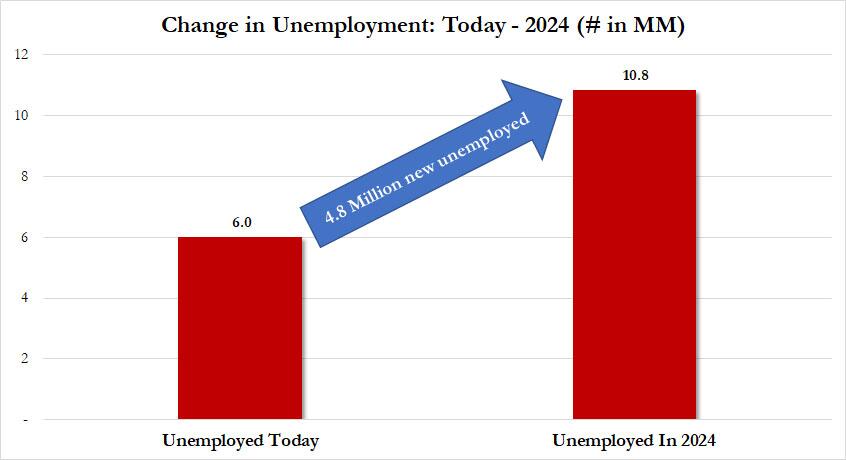
The point Furman - a lifelong democrat - was making was simple: if the Fed's inflation target does not rise from 2%, it would lead to (at least) a 6.5% unemployment rate in 2024 which would translate into no less than 10.8 million unemployed workers, an 80% increase from the 6 million today. Needless to say, this would be political suicide for any Democratic administration .
To be sure, there are huge implications to raising the inflation target, not least of which is - well - higher inflation, as well as sharply higher asset prices, and a catastrophic loss of credibility in the Fed. And yet, when the trade off is social unrest - which is inevitable if the Fed plans to keep rates at 5% or higher for several years - then the alternative is palatable. So palatable, in fact, that as we reported in November, Goldman and TS Lombard also got on board, with the former writing that "given that most would agree that a fast reduction in inflation to 2% is unlikely we can now have a debate whether raising the G10 inflation target to the 3-4% range is more optimal for reasons of maintaining employment levels or public debt sustainability than the 2% goal which would not be possible if inflation was sticky in the 6-10% range" while TS Lombard chief strategist Steven Blitz chimed in with the following:
In the end, a recession is pretty much baked in by what the Fed has done, signalled, and will do. The overall imbalance between the supply and demand for labor is too much of a driver of inflation, through wages and, in turn, services ex shelter, for the Fed to stop now and say they have done enough. Powell, in fact, was very clear there is much more to do. This does not negate the fact that the coming downcycle will greatly impact those that AIT [average inflation targeting] was seeking to protect and are only just getting closer to even in terms of employment. None of this changes the Fed’s coming actions, what this coming hit to employment does mean is that the political cycle for the Fed is about to get a lot hotter – from all sides. This is one reason why I have long believed, as have many others, that the Fed ultimately bails and raises the inflation target to 3%. Powell does not have the same license to keep unemployment high and real growth low for an extended period as did Volcker (more so in retrospect than at the time). My guess is, Powell knows that.
Fast forward to today when yet another financial icon has joined the "raise the inflation target" bandwagon, after Mohamed El-Erian told Bloomberg TV that the Fed won’t be able to get US inflation down to its 2% target without “crushing the economy,” even though he too conceded that the central bank is unlikely to officially change that goal post, instead the Fed will have to simply pretend it has a 2% inflation target even as it resets higher.
"You need a higher stable inflation rate. Call it 3 to 4%," El-Erian, the chairman of Gramercy Funds told Bloomberg Television. “I don’t think they can get CPI to 2% without crushing the economy, but that’s because 2% is not the right target.”
Calling the Fed “too data dependent,” El-Erian said supply-side developments, including an energy transition, the change in supply chains during the pandemic, a tight labor market and shifting geopolitical issues, necessitate the higher target inflation rate.
“It’s right to take data into account but you’ve got to have a view of where you’re going,” he said.
The problem now, El-Erian said, is that the Fed is stuck chasing an elusive 2% goal.
“You can’t change an inflation target when you’ve missed it in such a big way,” he said. He’s previously cautioned that changing the target would be a hit to the Fed’s credibility.
When asked on Friday if the Fed could “tolerate” higher inflation, El-Erian said that is “where I hope to go.”
El-Erian's appearance follows an op-ed he wrote for Project Syndicate last week in which he said that inflation has a 75% chance of rebounding, and the Fed could end up crushing the economy as it struggles to rein in soaring prices.
"Nearly two years into the current bout of inflation, the concept of 'transitory inflation' is making a comeback as the COVID-related supply shocks dissipate," Prices would then skyrocket to a 41-year-high, forcing Fed officials to walk back their words and aggressively hike interest rates in 2022 to cool off the economy.
He added the most likely scenario was inflation remaining sticky at 3%-4%, which El-Erian estimates has a 50% probability.
"This would force the Fed to choose between crushing the economy to get inflation down to its 2% target … or waiting to see whether the US can live with stable 3% to 4% inflation," he said, suggesting the Fed would need to keep interest rates high.
Of course, if Powell were to even hint at a soft inflation target rise, everything - from stocks, to cryptos, to kitchen sinks - would go limit up instantly.
Tesla drivers worry about wait times as Elon Musk opens up Supercharger network
Tesla Inc. has unnerved some of its customers with a decision to open up parts of its exclusive Supercharger network to other electric vehicles, with some fretting about future wait times to recharge their cars.
John Sergeant, a Tesla owner in Seattle, said Superchargers in his city are already overrun with demand and that opening up the network to others will compound the problem.
"That’s the one thing that concerns me—whether it might add to congestion," he said, adding that Seattle is home to many EVs. Even as things are, he said, "they really need to put more superchargers in."

A Tesla vehicle is charged at a Tesla supercharging station in Kettleman City, California, U.S., January 25, 2023. REUTERS/Mike Blake (Reuters Photos)
The White House on Wednesday said Elon Musk’s car company would open at least 3,500 new and existing 250-kilowatt fast-charging stations to qualify for a share of billions of federal dollars on offer to build a national network of electric-vehicle chargers. The infrastructure law President Biden signed in November 2021 allocated $7.5 billion for EV charging as part of an effort to build a network of 500,000 chargers across the country.
Tesla has a U.S. network of more than 17,700 fast chargers at over 1,650 locations that aren’t currently available to other vehicles.
| Ticker | Security | Last | Change | Change % |
|---|---|---|---|---|
| TSLA | TESLA INC. | 203.67 | +1.63 | +0.81% |
Powered By | ||||
Mr. Musk, who at times has taken aim at President Biden, responded to a tweet from the president about the Supercharger development on Wednesday: "Thank you, Tesla is happy to support other EVs via our Supercharger network," the Tesla chief executive said.
The company said it would more than double its U.S. Supercharger network by the end of next year to support the growth of its fleet and new EV customers. "Tesla Superchargers almost everywhere," Mr. Musk tweeted Wednesday.

Tesla didn’t immediately respond to a request for comment about customer concerns.
Still, some Tesla drivers say there could be hiccups in accessing the charging locations because other vehicles will be using them. Darren Morgan, a Tesla Model Y owner and member of Tesla Owners Club in the East Bay, said he is concerned about the fact that not all EVs have their charging ports in the same location of the vehicle, which could lead to congestion and longer wait times at charging stations if drivers of non-Tesla vehicles have to take up multiple spaces to access chargers.

Tesla automobile plugged in and charging a Supercharger rapid battery charging station for the electric vehicle company Tesla Motors, in the Silicon Valley town of Mountain View, California, August 24, 2016. (Smith Collection/Gado/Getty Images / Getty Images)
Tesla has said it is aware of congestion and longer wait times for chargers at certain locations. In some cases, the company deploys mobile Superchargers to add capacity or employs pricing strategies to encourage more off-peak use to mitigate wait times, the company has said.
Mr. Musk two years ago signaled the company would open its network to others. "We knew it was coming and it’s been really fun to have full access to a service that’s not completely utilized," Mr. Morgan said. Still, he expressed understanding for Tesla’s latest decision. "You can’t sustain this sort of accessibility and make it economically feasible," Mr. Morgan said.
The move to open its charging network comes as Tesla also is grappling with other issues. The National Highway Traffic Safety Administration, the top car-safety regulator in the U.S., this week said Tesla would recall about 362,800 vehicles equipped with its high-profile Full Self-Driving feature after the agency voiced concerns about how the system operated in some driving circumstances. The regulator said Tesla would institute a fix through a software update it can deploy remotely.
Tesla automobile plugged in and charging a Supercharger rapid battery charging station for the electric vehicle company Tesla Motors, in the Silicon Valley town of Mountain View, California, August 24, 2016. (Smith Collection/Gado/Getty Images / Getty Images)
The charging station decision comes with upside to Tesla and could generate hundreds of millions of dollars in additional revenue, said Toni Sacconaghi, an analyst for Bernstein. Tesla last month said that sales linked to supercharging contributed to record revenue and gross profit for its services segment as the company posted record quarterly profit.
However, Mr. Sacconaghi added, there is also a risk that some Tesla owners feel like the experience of buying those vehicles is being compromised.
For Karen Wolff, a Tesla Model Y owner living in San Jose, Calif., the charging station decision could affect future purchase decisions. "It has been such a joy when you’re on a road trip, charge while you’re having lunch and just be on your way. If we lose that, who cares if you have a Tesla or not?" she said. "If I can use a Kia there and I wasn’t able to use a Kia there before, I’m going to look at a Kia."
FEMA Denies East Palestine's Request For Federal Assistance
Submitted by 'BlueApples',
Given the minuscule size of East Palestine, Ohio and its neighboring towns, it's clear that an arduous road lies ahead as the communities affected by the chemical spill engulfing the area look to resolve what is becoming one of the world environmental disasters in US history. With just about 5,000 residents, it's clear that the town itself is not equipped with the resources needed to address a problem that would overwhelm even the nation's largest metropolises. While the situation has finally begun to garner some national attention from mainstream media that initially seemed to blacklist the crisis, the gravity of the situation is still apparently lost upon the Biden Administration. According to Ohio Governor Mike DeWine, the Federal Emergency Management Agency ("FEMA") has denied his state's request for federal assistance for the residents of East Palestine.
Governor DeWine spoke with White House officials on Thursday morning to apprise them of developments and concerns surrounding the release of chemicals into the air, soil, and water since the disaster occurred on February 3rd that was exacerbated by a controlled burn of the toxic material. According to a press release from DeWine's office “FEMA continues to tell Governor DeWine that Ohio is not eligible for assistance at this time." No one from New Orleans could be reached for comment.

"Governor DeWine will continue working with FEMA to determine what assistance can be provided.” Dan Tierney, a spokesman for DeWine's office said, expounding on the revelation by explaining that FEMA determined that the basis of the disaster laid outside of the qualifications for federal assistance from their agency. FEMA asserted that assistance from its agency pertains to "traditional" disasters like tornadoes, hurricanes, and the like. “You are eligible for FEMA assistance when you have problems that aren’t covered by third parties,” said Tierney. “The system is set up so taxpayers are the payers of last resort.” DeWine's office stated it also requested direct support from the US Department of Health and Human Services, Health and Emergency Response Team, and one of the great beacons of the interest of public health and well-being -- the CDC.
Nevertheless, the situation rapidly spiraling out of control has made it impossible for Biden's office to ignore in its entirety. White House Press Secretary Karine Jean-Pierre apparently actually answered questions when she confirmed that President Biden had spoken directly with Governor DeWine about the need for federal assistance to curtail the ongoing damage. Jean-Pierre did advise reporters that the US Environmental Protection Agency ("EPA") has been at the site of the chemical spill since February 4th, one day after the accident occurred. The press secretary assured the residents affecting by the disaster that EPA officials were working in concert with state and local officials leading the emergency response effort.
Despite vowing to provide the public with transparency into the federal response in that relief effort, EPA administrator Michael Regan offered curious remarks concerning the magnitude of the danger residents of the area face that conflicted with other assurances downplaying the risks. Regan explained that his agency categorized the disaster as a "fresh accident" that presented unsafe conditions on the ground that put EPA scientists and engineers in harms way. The EPA's reticence to offer a no-holds-barred response to the situation in East Palestine serves as a reminder of the lack of urgency that has been ascribed to federal institutions that the small town is depending on for resources in their handling of the emergency.
Regan's remarks on the agency's role concluded with him offering the reassurance that he wanted to be sure that their response would not be putting anyone at the EPA into harm's way, despite the absence of a full-scale relief effort doing just that to residents of East Palestine. The EPA's position is that it will continue to monitor the situation in East Palestine so that it can identify when to safely send appropriate emergency personnel to the site.
That lack of urgency and cognitive dissonance so succinctly demonstrated by the EPA is not limited to the federal government alone. When East Palestine residents gathered for their first town hall meeting since the controlled burn of carcinogenic chemicals launched a toxic miasma into the air, they were confronted with one notable absence. Despite operating the track which the train carrying the hazardous materials detailed from, Norfolk Southern Railway officials released a statement that they would not be attending the East Palestine Town Hall Meeting, citing safety concerns.
"Unfortunately, after consulting with community leaders, we have become increasingly concerned about the growing physical threat to our employees and members of the community around this event stemming from the increasing likelihood of the participation of outside parties. With that in mind, Norfolk Southern will not be in attendance this evening." the statement from Norfolk Southern read. Instead of meeting residents face-to-face, the railway provided a phone number for its Family Assistance Center for residents of East Palestine to call.
Despite the absence of accountability from the federal government and the railway alike, one elected official offered a potential way forward that he hoped would meet the gravity of the situation in East Palestine. Sherrod Brown, Ohio's Senior Senator, called upon Governor Mike DeWine to officially declare the chemical spill in East Palestine as a disaster. “A man-made disaster of this scale, scope, and significance necessitates a response and deployment of resources that are commensurate in scale and scope,” Brown wrote to DeWine. “Additional federal resources can and should play a critical role in helping our fellow Ohioans get back on their feet and ensure that their community is a safe place to live, work, and raise a family.” he compelled the Governor, highlighting how an official decree of a disaster could pave the way for much-needed federal assistance.
As officials at the state, local, and federal levels search for answers, their response to the disaster in East Palestine is underwritten by concerns surrounding their and Norfolk Southern Railway's collective responsibility for what caused the train derailment in the first place. According to the National Transportation Safety Board, potential mechanical failures of the train's wheel bearings, axles, and adjacent hotbox detectors designed to alert the crew were being examined to determine the cause of the accident. The NTSB stated a preliminary report on its findings would be released within 30 days. However, a statement made on Tuesday by the NTSB points to a wheel bearing failure as the likely cause of the derailment.
The over-arching concern about safety and the accountability of railway operators and their regulators has reverberated well-beyond the rural landscape of small-town Ohio. Train derailments have become en vogue all of a sudden with three high profile incidents occurring in Texas, South Carolina, and Michigan. On the day Governor DeWine's office informed the public that FEMA had denied his state's request for emergency assistance, a train carrying hazardous materials derailed in Van Buren Township, Michigan. Despite at least one car carrying hazardous materials, officials were able to confirm that the most recent derailment did not constitute a hazmat situation. Despite that, the EPA dispatched a team to the site of the incident to "ensure public safety" (read: save face) according to Rep. Debbie Dingrell, Representative of Michigan's 6th Congressional District.
Back on the Ohio-Pennsylvania border, FEMA is living up to the legacy it made in the aftermath of Hurricane Katrina longer than a decade ago. Given that context, the denial of emergency assistance to East Palestine should come as no surprise. With so much uncertainly surrounding the short and long term effects of the chemical disaster, one outcome residents of the affected area can see clearly is a continued disdain for government officials whose unchecked systematic failures created a circumstance for this crisis to occur to begin with. Unfortunately, no amount of federal assistance will ever be available to curtail the dangers that presents.
https://www.zerohedge.com/political/fema-denies-east-palestines-request-federal-assistance
Some Antipsychotics Still Overused After In-Hospital Delirium
Older patients prescribed an atypical antipsychotic for hospitalization-related delirium more often stayed on it past the recommended duration than if prescribed a typical antipsychotic, researchers reported.
Among nearly 6,000 patients 65 and older without prior psychiatric disorders, 13.5% were newly prescribed haloperidol and 86.5% initiated an atypical antipsychotic to treat delirium around an infection-related hospitalization, according to Kueiyu Joshua Lin, MD, of Brigham and Women's Hospital in Boston, and colleagues.
But treatment stopped within 30 days of initiation for more than half of haloperidol users compared with only about one in 10 of those taking an atypical antipsychotic (52.1% vs 11.4%, P<0.001).
By 180 days later, 93.7% of haloperidol users and 76.3% of atypical antipsychotic users discontinued the new meds.
"This is contrary to clinical recommendations to discontinue both types of antipsychotic medications [APMs] as soon as the delirious state or acute behavioral disturbance has resolved," wrote the researchers in JAMA Network Open.
"Clinicians may be reluctant to actively discontinue the ongoing treatment after the patient's condition is stabilized, which may explain the low rates of APM discontinuation after delirium onset," they added.
Lin's group also took note of some long-term trends over the study period from 2004 to 2022. During this timeframe, discontinuation rates for haloperidol users increased by 5% (95% CI 3%-7%) each year. However, discontinuation rates for atypical antipsychotics held steady from 2004 through 2022.
Rates of medication discontinuation were similar across all the atypical antipsychotics prescribed in the cohort: aripiprazole (Abilify), risperidone (Risperdal), quetiapine (Seroquel), and olanzapine (Zyprexa).
Older patients who were hospitalized longer than 30 days were significantly less likely to discontinue use compared with those who had an inpatient stay under 7 days long for either type of antipsychotic (adjusted HR 0.61 for haloperidol, 95% CI 0.45-0.84, and 0.86 for atypical antipsychotics, 95% CI 0.77-0.97).
Patients with dementia were also less likely to discontinue haloperidol or atypical antipsychotics than those without it (aHR 0.71, 95% CI 0.58-0.87, and aHR 0.80, 95% CI 0.74-0.86, respectively). Patients with diabetes were also less likely to discontinue haloperidol, while those with a history of stroke or ischemic heart disease were less likely to stop taking atypical antipsychotics.
On the other hand, patients with pneumonia, heart failure, or gastrointestinal bleeding were more likely to quit haloperidol, while there was a higher rate of atypical antipsychotic discontinuation among those with pneumonia, cancer, or osteomyelitis/septic arthritis.
The researchers said these findings underscored the need for more "proactive interventions to facilitate discontinuation of these potentially inappropriate medications in older adults."
Listing off a few suggestions, Lin's group highlighted the benefits of both patient and clinician education, use of tapering or deprescribing plans guided by healthcare professionals, and utilizing monitoring protocols.
"Specific strategies to support behavioral change include adding visual cues to the environment (e.g., deprescribing algorithms, medication checklists, etc) and building prompts into routine workflow (e.g., electronic health record alerts, reminder letters or messages, etc)," they recommended.
It's important to discontinue antipsychotics if no longer medically necessary, Lin's group explained, as both older and second-generation classes carry specific risks. They explained that although some studies have indicated a higher risk of death with typical antipsychotics, other data have suggested antipsychotic medications (APMs) carry just as high risks for serious adverse events like death and cardiac arrhythmias.
All antipsychotics currently carry a boxed warning
on their labels about the risk of mortality in elderly patients treated for dementia-related psychosis.
"Given multiple serious adverse reactions associated with APM use, our findings call for effective interventions to proactively discontinue APMs when they are no longer indicated," urged the researchers.
The average age in the retrospective cohort study was 81.5 among the 790 new haloperidol users and 79.8 among the 5,045 new atypical antipsychotic users. Data came from Optum's U.S.-based, deidentified Clinformatics Data Mart database of large commercial and Medicare Advantage health plans. All patients were 65 and older without a prior psychiatric disorder and dispensed a prescription for a new oral antipsychotic within 30 days after discharge from an infection-related hospitalization.
The database didn't have data on inpatient prescribing or on whether the post-discharge use was on an as-needed basis, which were limitations of the study.
"A prior study showed that new initiation of APMs in a hospital setting is a good proxy for the presence of delirium," the researchers noted. "Although delirium is undercoded in administrative databases, it constitutes a majority of indications for APM initiation in the hospital."
Some 30% of patients initiating an APM during hospitalization are discharged on one, and the discharging clinician typically prescribes it to ensure that patients have an adequate medication supply until the first postdischarge follow-up appointment, the researchers noted.
The study excluded patients with prior use of or chronic indications for APMs, including schizophrenia and other psychotic disorders, bipolar disorder, and depression at any time before cohort entry to reduce confounding.
The most common infection during hospitalization was urinary tract, followed by pneumonia, soft tissue, bacteremia, and COVID-19. More than half had dementia at baseline.
Haloperidol users tended to be older and were more likely to have bacteremia, cancer, heart failure, gastrointestinal bleeding, anemia, liver disease, or end-stage kidney disease. They were also less likely to be of Black or other race or ethnicity, be mildly frail, or have dementia or COVID-19.
Disclosures
The study was funded by a grant from the National Institutes of Health.
Lin and co-authors reported no disclosures.
Primary Source
JAMA Network Open
Source Reference: Zhang Y, et al "Antipsychotic medication use among older adults following infection-related hospitalization" JAMA Netw Open 2023; DOI: 10.1001/jamanetworkopen.2023.0063.
https://www.medpagetoday.com/geriatrics/generalgeriatrics/103157
Senators urge broad Medicare coverage of Alzheimer’s treatments
U.S. senators on Friday called for Medicare to offer broad coverage of Alzheimer’s treatments approved by the Food and Drug Administration, warning that current restrictions cost patients precious time as their disease progresses.
“Given the progressive nature of this terminal disease, we encourage you to take steps now to ensure patients have immediate access to FDA-approved treatments if the patient and clinician decide it is right for the patient,” the senators told Health and Human Services Secretary Xavier Becerra and Centers for Medicare and Medicaid Services Administrator Chiquita Brooks-LaSure in a letter.
The group included 18 Republicans and two Democrats, led by Sens. Susan Collins, R-Maine, and Shelley Moore Capito, R-W.V.
The 20 senators told CMS that Alzheimer’s will cost the nation $1 trillion by 2050 if the U.S. does not take decisive action. The population of seniors, who are most affected by the disease, is expected to increase more than 50% to 86 million over the next 30 years, according to the Census Bureau.
The population of seniors, who are most affected by the disease, is expected to nearly double to 83 million over the next 30 years.
Public pressure on Medicare has mounted since the FDA granted accelerated approval of Eisai and Biogen’s treatment Leqembi, an antibody that targets brain plaque associated with the disease. The product has shown promise in treating early Alzheimer’s, slowing cognitive decline by 27% in a phase three clinical trial. It also carries risks of brain swelling and bleeding.
CMS has severely limited coverage of Alzheimer’s treatments like Leqembi that receive accelerated approval. Medicare will only cover the drug, priced by Eisai at $26,500 per year, for people in clinical trials approved by the FDA and the National Institutes of Health.
But Eisai has already completed its phase three trial and is no longer enrolling participants. As a consequence, Medicare coverage for the expensive drug is basically nonexistent.
Ivan Cheung, the U.S. CEO of Eisai, told CNBC on Thursday that the company does not know of any seniors who have gotten the drug covered through Medicare.
The senators said delays in receiving treatment can cause massive harm for patients as Alzheimer’s progresses.
“Processes that may delay coverage decisions by several months can impose significant access delays, resulting in irreversible disease progression and added burdens for caregivers and loved one,” the senators told CMS.
The senators’ letter comes after more than 70 House lawmakers issued a similar call this month. The representatives said the current restrictions put people who live in rural communities at a disadvantage because trials are often in bigger cities.
“Patients, families, and caregivers living in rural and underserved areas should have the same opportunity for access to treatment,” the House lawmakers told Becerra and Brooks-LaSure. “It is an enormous physical and financial burden for Medicare beneficiaries to spend countless hours traveling to limited research institutions that host the trials.”
The Alzheimer’s Association wrote CMS in December calling for the agency to provide unrestricted Medicare coverage for Leqembi. The association’s letter was signed by more than 200 Alzheimer’s researchers and experts.
The American Academy of Neurology, the world’s largest association of neurologists, told Medicare in a letter earlier this month that its experts have concluded Eisai’s phase three clinical trial for Leqembi was well designed and the data was clinically and statistically significant. AAN’s President Dr. Orly Avitzur asked Medicare to provide broader access for Leqembi.
Eisai expects to receive full FDA approval for Leqembi as early as this summer. Under CMS policy, Medicare would then provide broader coverage for people participating in research studies backed by the agency.
“One of the things I would just emphasize is as you know, in this particular class, [we] really wanted to have more information as we learn what these products are going to do,” Medicare Administrator Brooks-LaSure said on Tuesday during a call with reporters. “But we continue to be open to hearing new data from manufacturers and advocates.”
Cheung said it’s possible Medicare could offer coverage with no restrictions if the agency determines there’s significant evidence supporting the treatments benefits.
“With a high level of evidence ... the restrictions should be very limited, or maybe even no restrictions and that is Eisai’s position,” Cheung said. “We believe Medicare beneficiaries should have unimpeded access, broad and simple access to Leqembi because the data fulfill those criteria.”
Medicare’s restrictive policy stems from controversy surrounding aduhelm, another antibody developed by Biogen and Eisai. The FDA gave aduhelm accelerated approval even though its independent advisors said the data didn’t demonstrate a benefit for patients. Three advisors resigned over the FDA approval of aduhelm.
https://www.cnbc.com/2023/02/17/senators-urge-medicare-to-cover-alzheimers-treatments.html
Musk says calling NHTSA Tesla action a recall ‘flat wrong’
Tesla CEO Elon Musk on Thursday criticized the National Highway Transportation Safety Administration (NHTSA) for labeling a recent Tesla software update as a recall.
“The word ‘recall’ for an over-the-air software update is anachronistic and just flat wrong!” Musk said on Twitter.
The NHTSA issued a notice on Wednesday that Tesla was recalling more than 360,000 cars that are equipped with or pending installation of its Full Self-Driving Beta software over a crash risk.
The software reportedly may not respond sufficiently to posted speed limits and may cause cars to drive through intersections in an “unlawful or unpredictable manner.”
The NHTSA noted that the software may cause Tesla owners to travel straight through an intersection in a turn-only lane, fail to come to a complete stop at a stop sign or drive through a yellow light “without due caution.”
Musk seemed to take exception to the “recall” label, given that Tesla is expected to release an over-the-air software update to address the issue.
However, the NHTSA noted on its website that a recall is issued when the agency or the manufacturer determine that “a vehicle, equipment, car seat, or tire creates an unreasonable safety risk or fails to meet minimum safety standards” and requires manufacturers to repurchase the vehicle from owners only in “rare cases.”
Instead, manufacturers typically are required to repair or replace the problem feature or offer a refund, according to the NHTSA website.
Subscribe to:
Posts (Atom)