Search This Blog

Monday, April 3, 2023

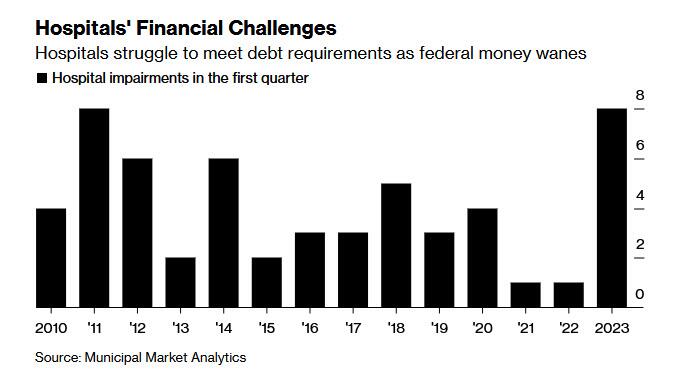
Hospitals See Most First Quarter Defaults Since 2011

 By Andrew Cass of Beckers Hospital Review

Bonds of eight hospitals lapsed in "impairment" - meaning they experienced covenant issues amounting to a technical or monetary default - in the first quarter of 2023, the highest number of hospitals disclosing default since 2011Bloomberg reported March 31. 

Only one hospital disclosed default in the first quarter of 2022, according to the report. 

The data comes from Municipal Market Analytics. Lisa Washburn, the organization's managing director, told Bloomberg that an unusual aspect of the impairments is some are coming from large, highly-rated systems. 

“Some of the unusual parts about the impairments that we’re seeing is that they are coming from sometimes large, highly-rated systems,” she said in an interview. “That’s actually something that struck us at the beginning of the year when it started to happen because you wouldn’t expect normally to see covenant breaches happening for an A-rated system.”

Ms. Washburn said that is due to a combination of negative investment returns in 2022, federal COVID-19 relief funds drying up and rising costs, particularly labor, according to the report. She added that a backlog of patients who need to move to nursing homes but cannot due to staffing shortages also have affected finances. 

"And now add to it that debt costs are higher," she told Bloomberg

Another source of pressure is competition for patients, Chris George, a senior managing director at FTI Consulting, told the publication

"You're seeing a very slow evolution of care moving to an ambulatory setting," he said. 

“A lot of local hospitals, their biggest challenge is access to capital,” George told Bloomberg in an interview. “It’s going to be a tough year this year.”

https://www.zerohedge.com/markets/hospitals-see-most-first-quarter-defaults-2011

Berenson: Fiercest Vaccine Advocates Starting To Admit The Truth About The mRNAs

by Alex Berenson via 'Unreported Truths' Substack,

Even the New York Times can’t hide reality about the mRNA jabs forever.

Last week, the Times published an article headlined, “Should You Get Another Covid Booster?”

The article’s subheadline noted “Britain and Canada have authorized another round of booster shots,” implying the United States has somehow been negligent in not doing so.

And the piece was written by Apoorva Mandavilli, among the worst Covid reporters. So I assumed the article would be filled with the usual nonsense, especially since the first person Mandavilli quoted was Dr. Celine Gounder, who has loudly pushed mRNA jabs.

After Gounder’s husband died of an aortic aneurysm, she lashed out in January at mRNA skeptics (including me) who questioned if the shots might be linked to his death - even though doctors have repeatedly reported cases of post-jab aneurysms.

In her January piece, Gounder even complained Congress’s repeal of the armed forces Covid vaccine mandate “threatens military readiness.” (Nonsense, of course. Frontline soldiers and Marines are young, fit, and healthy, putting them at far higher risk from mRNA-related myocarditis than Covid itself.)

So I was stunned that Gounder offered the most tepid possible recommendation for further mRNA doses to Mandavilli.

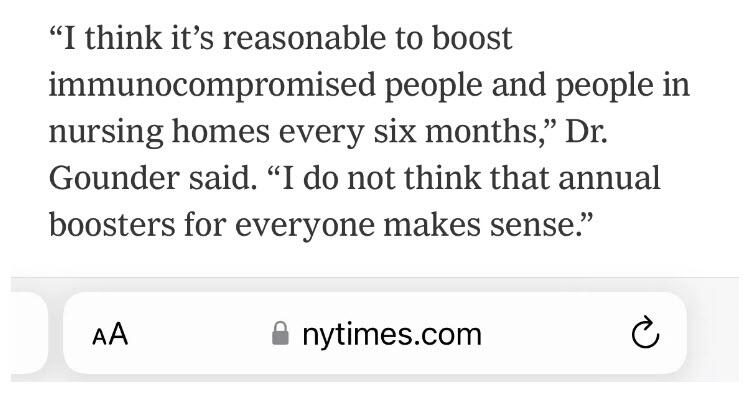
Most people should not have boosters, even once a year, she said. She endorsed regular shots only for “immunocompromised people and people in nursing homes.”

The real tell there is “nursing homes.”

In mentioning them, Gounder was not suggesting that everyone over 65 - or even 85 - should get more shots. Nursing homes are effectively hospices for most residents. About one-third of their residents die each year, a 2018 study found; a 2010 study had even grimmer findings, reporting a median survival of five months after admission.

What Gounder was saying that only the very frail - who likely have little risk or benefit from the shots (or, in reality, any medical intervention) - should still receive them regularly.

In contrast, in October, Gounder offered very different advice, recommending boosters for everyone over age 50 “as soon as possible.”

(Celine Gounder sees the light.)

Gounder’s rejection of annual boosters is particularly stunning because she and other public health specialists happily promote annual flu jabs despite their demonstrated uselessness. The theory seems to be that flu shots get old folks out of the house, or boost Walgreen’s profits, or something. Anyway they probably don’t do any harm even if they don’t do any good, so why not?

Yet Gounder is no longer applying the same logic to the mRNAs.

 I do not think that annual boosters for everyone makes sense.

Which implies either Covid is now even less dangerous than the flu (possible but unlikely), or the shots are even more useless (which would imply negative efficacy), or else… they’re actually more dangerous than inactivated virus flu jabs.

Which they are.

But Gounder was not the only vaccine advocate quoted in the Times piece. Mandavilli also talked to Dr. Paul Offit. No one will ever confuse Offit with Robert F. Kennedy Jr. - he is director of the Vaccine Education Center at Children’s Hospital of Philadelphia.

In April 2021, Offit had this to say about the mRNA jabs:

Certainly, no one would have predicted that these mRNA vaccines would have worked as well or been as safe as they are… I don’t think you could have devised a vaccine that appears to be more perfect.

Less than two years later, Offit rejected more doses of those “perfect” vaccines.

For everyone. Even the immunocompromised.

But even more stunning than Offit’s rejection were the words he used:

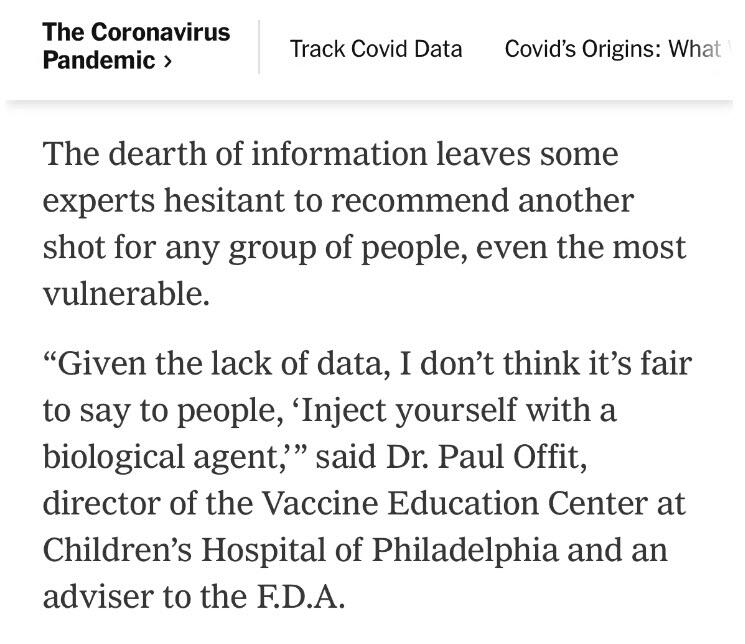
“Given the lack of data, I don’t think it’s fair to say to people, ‘Inject yourself with a biological agent,’” said Dr. Paul Offit.

(Perfection no more…)

Vaccine advocates strenuously avoid this kind of language, for obvious reasons.

Inject yourself with a biological agent? Yeah, I’ll pass.

But the failure of the mRNAs is now so obvious that Offit and his fellow vaccine advocates have no choice but to try to ring-fence it if they want to save other jabs.

https://www.zerohedge.com/covid-19/berenson-fiercest-vaccine-advocates-are-starting-admit-truth-about-mrnas

‘If we don’t, others will’: White House Covid adviser calls on doc to combat vacuum of med info

 The coordinator of the Biden administration’s Covid-19 response team called on doctors to take a leadership role with patients to battle medical misinformation and disinformation, linking the continuing death toll in part to such erroneous messaging.

Speaking to an audience of physicians at a conference near Boston Friday, Ashish Jha reminded them they are skilled at dealing with uncertainty, just as when they explain to a patient they don’t know whether what a medical scan shows will be terrible or not, but that they will guide them through it. The uncertainty of the pandemic is no different, he said, but since people have so many different sources of information to consult now, doctors need to step up.

“What we have seen is the widespread propagation of misinformation and disinformation. And the reason it has taken root is because there was an information vacuum,” Jha said to the group, convened by the Massachusetts Medical Society with support from the New England Journal of Medicine Group. “I come back to our role as physicians. It is critical that we fill that vacuum because if we don’t, others will.”

Over the last year in the White House, Jha has seen an average of 250 to 500 people dying of Covid every day, despite plentiful free vaccines and treatments.

“If you are up to date on your vaccines and you get treated with Paxlovid, if you get an infection, you just don’t die of this virus. Almost no one dies of this virus,” he said. “Almost every one of those deaths is preventable. And yet people are still dying. And that is the power of misinformation. That is the power of disinformation that we all have to work on countering.”

Jha also blamed misinformation and disinformation for death threats that require security teams to protect CDC Director Rochelle Walensky and former NIAID Director Anthony Fauci, perhaps the best-known examples of people in health and public health who’ve been targeted.

Jha also warned that a revisionist history of the early pandemic is taking hold. When the novel coronavirus was first spreading, the only tools at hand were countermeasures like social distancing and masking, followed by lessons learned in hospitals that led to administering dexamethasone, a better understanding of who needed a ventilator and who didn’t, and the role of proning to help patients breathe. “Our hospitals were overwhelmed. People were dying in extraordinary numbers,” he said. “We did not overdo it.”

Those tools bought us time, Jha said, from April 2020 when hospitalized patients had a 50% chance of dying to when a vaccine authorized in December 2020. Now the set of tools enabled by the Public Health Emergency will end. Two of the provisions he mentioned: allowing hospitals to set up beds in parking lots and changing rules around supervision so residents could do what only attending physicians were authorized to do before. “We no longer felt like that was critical at this moment in where we are with this pandemic,” he said. “Not to say that Covid is over.”

Jha also acknowledged that long Covid is not over for millions of Americans who are suffering or debilitated by it. It’s also “not totally surprising” because of other post-viral syndromes. But “we think that SARS-CoV-2 is probably worse. … And long Covid is not one condition.”

As horrendous as the pandemic has been, it has also created innovations worth sustaining, he said. Telehealth is an obvious one, along with home testing for Covid, flu, or other illnesses, and test-to-treat, a one-stop model of health care. Further behind is better building ventilation, which Jha calls a passion of his.

Improving air quality can reduce infection by 80%, he said, citing an Italian study that said influenza and RSV were lowered that much by changing the air. And it’s doable, “not super expensive,” and important for hospitals overwhelmed by infection-intensive winters, he said. “You’re not asking people to change behavior, right? You’re not saying everybody has to wear a mask indoors for the next four months.”

Speaking more broadly, Jha said the ongoing crisis has exposed the need for leadership. “We’re talking about the important role of political leaders, people who marshal resources and bring the country together. We have not always been blessed with such leaders, but we’ve had some great ones,” he said. “We’ve also needed a different type of leader. Physicians are particularly well-poised to play this role.”

https://www.statnews.com/2023/04/02/jha-covid-misinformation/

Why the early tests of ChatGPT in medicine miss the mark

 ChatGPT has rocketed into health care like a medical prodigy. The artificial intelligence tool correctly answered more than 80% of board exam questions, showing an impressive depth of knowledge in a field that takes even elite students years to master.

But in the hype-heavy days that followed, experts at Stanford University began to ask the AI questions drawn from real situations in medicine — and got much different results. Almost 60% of its answers either disagreed with human specialists or provided information that wasn’t clearly relevant.

The discordance was unsurprising since the specialists’ answers were based on a review of patients’ electronic health records — a data source ChatGPT, whose knowledge is derived from the internet, has never seen. However, the results pointed to a bigger problem: The early testing of the model only examined its textbook knowledge, and not its ability to help doctors make faster, better decisions in real-life situations.

“We’re evaluating these technologies the wrong way,” said Nigam Shah, a professor of biomedical informatics at Stanford University who led the research. “What we should be asking and evaluating is the hybrid construct of the human plus this technology.”

The latest version of OpenAI’s large language model, known as GPT-4, is undeniably powerful, and a considerable improvement over prior versions. But data scientists and clinicians are urging caution in the rollout of such tools, and calling for more independent testing of their ability to reliably perform specific tasks in medicine.

“We still need to figure out what the evidence bar is to decide where they are useful and where they are not,” said Philip Payne, director of the informatics institute at Washington University in St. Louis. “We’re going to have to reassess what the definition of intelligence is in terms of these models.”

For tasks that involve summarizing large bodies of research and information, GPT-4 has demonstrated a high degree of competence. But it is unclear whether it can engage in tasks that require deeper critical thinking and help clinicians deliver care in messier circumstances, when information is often incomplete. “I don’t think we’ve demonstrated these models are going to solve for that,” Payne said.

For now, most experimental uses being pursued by health systems and private companies are focused on automating documentation tasks, such as filling out medical records or summarizing instructions provided to patients when they are discharged from the hospital.

While those uses are lower risk than using GPT to provide advice about treating a cancer patient, mistakes can still lead to patient harms, such as inflated bills or missed follow-up care if a discharge note is summarized incorrectly.

“We shouldn’t feel reassured by claims that these tools are only intended to help physicians” with administrative tasks, said Mark Sendak, a clinical data scientist at the Duke University’s Institute for Health Innovation. He said GPT’s performance on “back of house” tasks for billing, communications, and hospital operations should also be carefully evaluated, but he is doubtful that such evaluations will be carried out consistently.

“One of the challenges is that the speed at which industry moves is faster than we can move to equip health systems,” Sendak said.

Stanford’s study was designed to evaluate the ability of GPT-4 and its predecessor model to deliver expert advice to doctors on questions that arose in the course of treating patients at Stanford Health Care. Researchers drilled the model with 64 clinical questions — such as differences in blood glucose levels following use of certain pain medicines — that had previously been assessed by a team of experts at Stanford. The AI model’s responses were then evaluated by 12 doctors who assessed whether its answers were safe and agreed with those provided by Stanford’s experts.

In more than 90% of the cases, GPT-4’s responses were deemed safe, meaning they were not so incorrect as to possibly cause harm. Some responses were deemed harmful because the AI hallucinated citations. Overall, about 40% of its answers agreed with the clinical experts, according to preliminary results that have not been peer-reviewed. For about a quarter of the AI’s responses, the information was too general or tangential to determine whether it was in line with what physicians would have said.

Despite its struggles, GPT-4 performed much better than its prior version, GPT-3.5, which only agreed with the team of experts in 20% of the cases. “That’s a serious improvement in the technology’s capability — I was blown away,” said Shah.

At the rate of its improvement, Shah said, the model will soon be able to replace services designed to aid clinicians by performing manual reviews of medical literature. That might eventually help doctors working in contexts like tumor boards, where physicians review records and literature to determine how to treat cancer patients. To get there, Shah said, GPT should be tested on exactly that task in a controlled experiment comparing a GPT-guided tumor board with one following a standard process.

“Then you track whether they reach consensus faster, does their throughput go up,” Shah said. “And if throughput goes up, does the quality of their decisions get better, worse, or the same?”

This story is part of a series examining the use of artificial intelligence in health care and practices for exchanging and analyzing patient data. It is supported with funding from the Gordon and Betty Moore Foundation.

https://www.statnews.com/2023/04/03/gpt-4-chatgpt-health-care-medical-exams/
Non-invasive brain stimulation can regulate autonomic responses, improve oxygen saturation in COVID

 Among the health problems developed or aggravated by COVID-19, those that affect neurological and respiratory functions draw special attention from specialists. Considering several studies that show the adverse effects of COVID-19 on human autonomic functions, which are those regulated by the autonomic nervous system (ANS), a recent study has demonstrated that the use of non-invasive brain stimulation was capable of regulating the ANS and increasing the oxygen saturation in patients with COVID-19 admitted to a semi-intensive care unit.

"The ANS is the part of our nervous system that continually adjusts the organism's activity to maintain the body's internal balance, also known as homeostasis. The ANS is responsible for maintaining our vital functions and regulates, without our awareness, fundamental aspects of our body, such as , body temperature, , the frequency we breathe, among others. An imbalance in this system can lead to changes in heart function, blood pressure control and has also been associated with increased inflammation in patients with COVID-19," explains Dr. Erika Rodrigues, IDOR neuroscientist and study coordinator.

Considering that unwanted changes in the ANS had already been observed in the short and long-term phases of the COVID-19 infection, there is a challenge in identifying treatments capable of regularizing the autonomic functions after the infection and establishing the possibility of preventing and reducing complications of the disease. Unfortunately, even after years since the pandemic's start, few therapeutic options can be combined with conventional treatments.

Recently published in the journal Brain Stimulation, a Brazilian study led by researchers from the D'Or Institute for Research and Education (IDOR) investigated  (tDCS) efficacy and safety as a procedure to regulate the ANS function in patients with COVID-19. One of the greatest benefits of tDCS is its non-invasive and non-painful brain  technique that uses a low-intensity electrical current to modulate neuronal activity in specific brain areas through surface electrodes positioned on the scalp.

To carry out the study, 40 patients hospitalized in semi-intensive care units due to COVID-19 with mild to moderate symptoms were recruited, half of whom received a single session of tDCS, while the other 20 underwent a sham stimulation. The tDCS was applied with an electrostimulator through two surface electrodes aiming to modulate the activity of the dorsolateral prefrontal cortex. The prefrontal cortex is an area in the front of the brain defined as a target by researchers due to evidence of its involvement in the ANS regulation. In the , the participants received a fictitious stimulation (tDCS-sham) to be perceived as real stimulation by the patients.

The two groups did not differ regarding pre-existing illnesses, hospital admission symptoms, medications used during hospitalization, or length of stay. The authors also evaluated the safety of the stimulation by checking vital signs and the patients' health conditions before and after the stimulation and by applying a questionnaire of adverse effects to each patient.

The researchers observed that in patients who received tDCS, there was a regulation of the ANS and an increase in their , a factor that did not occur in the control group. "This result is very relevant, given that 70% of patients hospitalized for COVID-19 need oxygen support at some point," emphasizes Dr. Rodrigues. Furthermore, there were no significant differences between groups in the reports about the incidence and intensity of adverse effects, and none reported the occurrence of skin lesions or clinical worsening.

"Our results showed the stimulation was safe and well tolerated by the COVID-19 patients. We also identified that the stimulated brain region, the prefrontal cortex, seems to have activated neuronal pathways of the , which play an important role in ," comments the study's first author and researcher at IDOR, Dr. Talita Pinto.

The researchers observed that the real stimulation induced an increase in parasympathetic activity and a reduction in the sympathetic activity of the ANS, which can be highly beneficial for rebalancing the autonomic nervous system in patients with COVID-19 or other diseases, preventing impairment in various body organs and helping to control inflammatory processes.

This research is the first to report changes in the ANS generated by a single tDCS session focusing on the neuromodulation of the  in patients hospitalized in the acute phase of COVID-19. Thereby tDCS presents itself as a promising, safe, and non-invasive method of additional therapy for treating complications generated by COVID-19 or similar diseases, such as autonomic and respiratory dysfunctions and exacerbated inflammatory processes.

"We believe that tDCS has a great potential for the prevention and recovery of complications from COVID-19 and similar diseases, as it is non-invasive, easy to apply, and has a relatively low cost," informs Dr. Talita Pinto, "And it can also be a treatment for patients in the acute phase or even for those with sequelae that remain for long periods after the coronavirus infection" adds Dr. Erika Rodrigues.

The scientists comment that additional studies with a complete assessment of autonomic function and inflammatory biomarkers are still needed before the broad application of treatments with tDCS to COVID-19 patients.

More information: Talita P. Pinto et al, Prefrontal tDCS modulates autonomic responses in COVID-19 inpatients, Brain Stimulation (2023). DOI: 10.1016/j.brs.2023.03.001


https://medicalxpress.com/news/2023-04-non-invasive-brain-autonomic-responses-oxygen.html

Implantable oxygen-eating batteries help kill cancer

 Despite decades of research and tens of billions of dollars for research and treatments worldwide, the battle against cancer continues.

Progress has been made through conventional treatments such as surgery, radiotherapy, chemotherapy and drugs. But these treatments, often painful and costly, can create troublesome side effects. Healthy body cells can be adversely affected and cancers vanquished in one spot may reappear elsewhere.

Newer technologies have allowed doctors to implant minuscule drug delivery systems into body tissue that more precisely target infected areas. But issues with biocompatibility and permeability remain challenges.

Now researchers at Fudan University in Shanghai say they may have a better approach to combating cancer. In a paper published last week in the journal Science Advances, Fan Zhang and Yongyao Xia reported that an implantable self-charging battery that consumes oxygen can zero in on cancer cells and help kill them.

Tumor cells generally have , a condition known as hypoxia. This has provided medicine with an attractive target and a clear goal: Design a drug-delivery system that seeks out a low-oxygen environment and supplement it with cancer-killing medication.

Previously, this approach had only limited success due to inadequate or uneven hypoxia levels in . But Zhang and Xia said their approach targets the environment of the cell rather than the cell itself.

"Using implantable devices to regulate  microenvironment 'in situ' may be a more effective way for ," they said.

The knew that if they could increase the degree of hypoxia, a tumor site would be more easily identifiable. So they designed a self-charging salt-water battery that can "persistently regulate oxygen content … in a ."

The battery is part of a two-stage approach to eradicating tumors. It increases and maintains the state of hypoxia while tumor-killing drugs designed to identify cancer cells in low-oxygen regions are deployed. By limiting  to the low-oxygen regions, there is little or no impact on healthy oxygen-rich cells.

In a small study, the battery/drug approach completely eliminated tumors in 80% of the mice.

According to Zhang, the battery can continuously consume oxygen within a tumor cell for more than 14 days.

"This work is a crossover study between battery technology and biotherapy," Xia said. "[It] not only provides a new treatment method for anti-tumor therapy, but also creates a precedent for batteries in biomedical applications."

The authors of the report say despite early impressive results, more research is needed. Although no  were noted in the mouse study, standards for humans are stricter. Compatibility with human tissue must still be confirmed. But the researchers say the technique holds great promise for application in other devices.

"The battery components are biocompatible, which minimized the harm of  implantation," they said. "Moreover [there is] great potential to develop other therapeutic devices, such as electrochemiluminescence, wearable devices, interventional therapies, inflammatory microenvironment regulation, and electric nerve stimulation."

More information: Jianhang Huang et al, A self-charging salt water battery for antitumor therapy, Science Advances (2023). DOI: 10.1126/sciadv.adf3992


https://medicalxpress.com/news/2023-04-implantable-oxygen-eating-batteries-cancer.html

VC Banking Collapse Shows The Worst Isn't Over For San Francisco

 If there's one thing San Francisco, which is in the midst of complete and total collapse as a functioning U.S. city due to looting, drugs, crime and homelessness (not to mention sky high taxes), didn't need, it was another problem to deal with.

But alas, along comes Silicon Valley Bank, and a historic bank run on regional banks led especially by banks who deal with VC, such as Silicon Valley but also First Republic Bank. 

And it looks as though these banking instabilities could be the straw that breaks the city's back, according to Bloomberg. Despite the problems plaguing the city for years on end, only now is San Fran "struggling to figure out its future", Bloomberg wrote this week. 

While it's laughable to think that San Francisco wasn't doomed prior to these bank runs, the situation does look to be getting even more dire. For example, Bloomberg writes that last week "city officials forecast a $780 million deficit for the next two fiscal years, more than $50 million worse than projected in January."

Meanwhile, in Q1, the city's office-vacancy rate soared to a record 29.5%. This number stood at just 4% prior to the pandemic. 

Michael Covarrubias, chief executive officer of local real estate developer TMG Partners and former head of the Bay Area Council, told Bloomberg: “We’ve never had this much vacancy in downtown San Francisco and a pandemic, followed by the work-from-home thing, followed by the banking thing started by Silicon Valley Bank and now sort of matriculating into the big banks, commercial loans and all that.”

Heidi Colin, a cashier at Dough and Little Griddle, a local luncheonette, said: “We used to have a morning rush, a lunch rush and a closing rush. Now it’s a mini rush, and we’re lucky if we even get it.”

Mayor London Breed, who famously encouraged defunding the city's police just several years ago before drastically reversing course, is trying to enact legislation to help the city bounce back. However, it sounds as though she has given up on the San Francisco of old: “People are trying to equate success to the number of people who return to the office in downtown San Francisco, and we are not going to be what we were before the pandemic. We're just going to be something different.”

Meanwhile, layoffs in tech numbering in the tens of thousands continue, with companies like Meta planning for another 10,000 layoffs globally. San Francisco Chief Economist Ted Egan added: “To lose this many jobs in three months is not something we’ve seen in the last few years. It’s definitely a warning sign.

Janice Jensen, CEO of Habitat for Humanity in the East Bay and Silicon Valley has banked with First Republic for more than 15 years and warns of what its loss could mean to the city: “To lose First Republic, that’d be terrible. It’s not just a bank. If it went away, it’d be a whole lot of tentacles into the community. That’s further stress on an already stressed area.”

And per commercial real estate experts, the worst in terms of vacancies could still be on their way. Colin Yasukochi, a researcher at CBRE Group Inc., said: “Usually in uncertain times, companies will delay decisions as long as possible,” he said. “Not moving is often cheaper than moving.”

https://www.zerohedge.com/markets/vc-banking-collapse-shows-worst-isnt-over-san-francisco