Search This Blog

Saturday, April 8, 2023

Supercentenarian and remarkable age records exhibit patterns indicative of clerical errors and pension fraud


Saul Justin Newman

Jan. 6 Rioters Fight To Await Trial At Home

 by Eric Felten via RealClear Wire,

If the government had had its way, Eric Munchel and his mother, Lisa Eisenhart, would already have been in jail for two years. Arrested in February 2021 for participating in the Jan. 6 riot at the Capitol, they finally are scheduled to go on trial next week in the Washington courtroom of U.S. District Court Judge Royce Lamberth.

It won’t be the first time Munchel and Eisenhart will find themselves before Lamberth. He is the judge who declared two years ago that they were far too dangerous to be allowed outside prison walls. Home confinement, enforced with ankle monitors and GPS tracking, Lamberth ruled, would not be sufficient to protect the public from the honky-tonk bartender and his traveling-nurse mother.

Their case, combined with hundreds of others in the Capitol breach, have led to an over-crowded docket, one groaning under the weight of what the Department of Justice has described as the largest criminal case in American history. And it’s only going to get more crowded. The courts may be prosecuting another 1,000 accused of crimes related to the Capitol riot.

Munchel and Eisenhart are an odd pair to be prominent players in the Capitol Hill action-dramedy. Munchel wore his iPhone as a body cam, documenting his actions. Aside from some shouting and some trespass, Eisenhart and Munchel didn’t seem to do much in the way of rioting. Mother and son entered the Capitol through an open door and strolled past police who didn’t tell them to get out. Mother and son wandered the halls of the Congress. They entered the abandoned Senate chamber where Munchel spied the body’s ceremonial gavel. “I want that f---ing gavel!” Munchel declared. But he did nothing to touch, let alone take, the Senate heirloom. The one thing Munchel did take were some white zip-ties that seemed to have been abandoned on a table.

They might be among the thousand yet to be prosecuted if it hadn’t been for a particular behavior that called attention to them and made them among the earliest targets for arrest. And that wasn’t their time spent in the Capitol, but their time spent talking to a reporter for the Sunday Times (of London). They were featured in the newspaper’s story about the fracas under the headline “Trump’s militias say they are armed and ready to defend their freedoms.” The sub-hed read, “Further violence, and even civil war, is threatened.”

The paper had a photo of Munchel leaping over a railing in the Senate chamber, a fistful of white zip-ties in his hand. Though there was no evidence that Munchel tied or assaulted anyone, the Times suggested the zip-ties showed just how dangerous he was: “These are the restraints typically used by police to detain individuals.” The Sunday Times didn’t claim to know what he was going to do with them, but also didn’t hesitate to imagine the worst: “The photograph led to speculation that the rioters were potentially planning to take hostages.”

Munchel and his mother, Eisenhart, didn’t do themselves any favors indulging in big talk and bravado. When asked by the British newspaper what they hoped to accomplish, Munchel bragged, “It was a kind of flexing of muscles. The point of getting inside the building is to show them that we can and will.”

“This country was founded on revolution,” Eisenhart declared to the reporter. “They’re going to take every legitimate means from us, and we can’t even express ourselves on the internet, we won’t even be able to speak freely, what is America for?” Eisenhart got herself worked up: “I’d rather die as a 57-year-old woman than live under oppression. I’d rather die and would rather fight.” Judge Lamberth would later call that statement “chilling,” and would use it to justify an order putting Eisenhart behind bars indefinitely while she awaited trial.

Munchel and Eisenhart left Washington the day after the riot and made their ways home – Munchel to Tennessee, Eisenhart to Georgia. With the help of the Sunday Times’ coverage and social media, it didn’t take long for them to realize they were prime targets of the massive investigation. In a gesture of cooperation, Eisenhart contacted the FBI and checked to see if police wanted her to surrender.

In February, Munchel and Eisenhart were arrested and brought before a federal magistrate judge in Nashville, Jeffery “Chip” Frensley. He was unpersuaded by the Department of Justice portrayal of mother-and-son rioters as an ongoing insurrectionist threat to the nation. It wasn’t clear to him what their motives and intent were. “The proof on these issues is inconsistent.”

The prosecutors’ intent was perfectly clear. They wanted Munchel and Eisenhart locked up indefinitely until they could be put on trial. The government argued there were no release conditions that would ensure Eisenhart and Munchel wouldn’t pose a danger to the community. Federal prosecutors insisted the two be placed in pretrial detention, which is to say, imprisoned before they were convicted. Nor would there be any limit to how long the defendants would be jailed as they waited for trial, the expectation of a speedy trial notwithstanding

Frensley was not nearly as breathless as the Justice Department’s team. The judge considered it sufficient for Munchel to wait at home for trial. The defendant would not be allowed to travel to Washington; would have to give up his guns, notwithstanding they were licensed; would be required to present himself once a week to “pre-trial services”; and would have an ankle monitor to enforce home detention.

And as for Eisenhart, the worst blot on her permanent record was a citation 20 years ago for driving with a suspended license. Frensley called for Eisenhart to be similarly confined, monitored, and surveilled at home until it was time for her trial. Frensley found that the government had failed to demonstrate either of the elements normally needed to justify holding defendants without bail. Prosecutors had proved neither that she was a threat to the community nor a flight risk.

Nor was Frensley ready to lock Munchel away. Though he had acted with “an absolute disrespect of law enforcement,” Frensley said the video from Munchel’s body cam also showed him “speaking with law enforcement in respectful ways.” The judge said he had “no reason to believe Mr. Munchel is part of an organized, collective action against the government.” In ruling that Munchel be released pending trial, Frensley concluded, “Mr. Munchel does not pose an obvious and clear danger to the safety of this community.”

The government’s lawyers warned that Munchel had become dangerously radicalized and that there was “no reason to think those views will diminish over time.” Indeed, they said, “they may get worse.” 

If it seems Judge Frensley was generous in his interpretation of Munchel and Eisenhart’s behavior, by contrast, the government sought at every turn to make the worst of the defendants’ actions. The video from Munchel’s iPhone shows him shouting at other rioters, “Don’t break sh-t,” and “No vandalizing sh-t …We ain’t no goddamn Antifa, motherf—ers.” He threatened his fellow rioters that he would “break” anyone who committed acts of vandalism.

Lamberth allowed that though Munchel's threats to “break” any vandals may have been beneficial, “These were not peaceful acts.” According to Lamberth, Munchel’s willingness to threaten violence against vandals “evinces violent behavior.”

But what about those zip-ties with which Munchel and Eisenhart were going to take hostages? Prosecutors admitted, in their brief for Judge Lamberth, that neither mother nor son had brought the zip-ties. They had found them abandoned on a table in a Capitol hallway, and had picked them up.

Munchel’s actions at the Capitol riots were thoroughly documented – by his own smart phone. In his opinion remanding Munchel and Eisenhart to pretrial confinement, Lamberth allowed that the video camera footage showed there was “no evidence indicating that, while inside the Capitol, Munchel or Eisenhart vandalized any property or physically harmed any person.”

The hearing in Judge Frensley’s court was on a Friday. Prosecutors urged the judge to hold the pair over the weekend. The Department of Justice wanted time to have Frensley overruled by the Washington-based judges who had been unsparing in their treatment of accused rioters. Frensley acquiesced. Come Monday, just before Munchel and Eisenhart were to be released, the chief judge of the U.S. District Court for the District of Columbia Beryl A. Howell stayed Judge Frensley’s order that Eisenhart and Munchel be released to home confinement. The case was assigned to Judge Royce Lamberth.

He found it particularly concerning that Eisenhart had used “language of insurrection.” By citing the American revolution, U.S. attorneys argued, Eisenhart had demonstrated “the danger she poses to the community if released.” Lamberth agreed: “As a self-avowed, would-be martyr, she poses a clear danger to our republic.” He took seriously that she was prepared to die for her cause, which made her a “danger to the community.” If she’s willing to die for the MAGA revolution,” Lamberth concluded, “the consequences for disobeying release conditions are unlikely to deter her.”

The judge made the extraordinary determination that there were “no release conditions” that could “ensure that Eisenhart would not pose a danger to the community.” Or at least it would have been extraordinary before it became the norm to keep behind bars those accused of charges related to Jan. 6.

That new norm led to overcrowding at the D.C. jail, where a COVID protocol was instituted in which social distancing was indistinguishable from solitary confinement.

These new norms of hardcore pre-trial jailing also fell afoul of the bedrock principle that one is innocent until proven guilty.

A three-judge appeals court panel sprung Munchel and Eisenhart two years ago in March and sent them home to be monitored in the fashion Judge Frensley had ordered in the first place. Circuit Judge Robert Wilkins wrote the opinion overruling Lamberth’s opinion ordering the mother and son be jailed while awaiting trial. Wilkins made the case not just for avoiding pre-trial detention, but for protecting principles of justice, even those involving – perhaps especially those involving – defendants disliked by the government. Wilkins quoted a legal precedent from a case, U.S. v. Salerno, involving organized crime: “In our society liberty is the norm, and detention prior to trial or without trial is the carefully limited exception.”

In a concurring opinion, Judge Gregory Katsas assessed the threat posed by Munchel and Eisenhart: “Their misconduct was serious, but it hardly threatened to topple the Republic. Nor, for that matter, did it reveal an unmitigable propensity for future violence.

Munchel and Eisenhart will be back in Washington next week. Tuesday morning, jury selection begins. Presiding will be a judge who has already made clear his apocalyptic views of the defendants and the events they participated in.

Eric Felten is an investigative correspondent for RealClearInvestigations, reporting on government corruption. He is a former columnist for the Wall Street Journal and previously a Kennedy Fellow at Harvard University. Felten has been published in Washingtonian, People, National Geographic Traveler, The Weekly Standard, Daily Beast, National Review, Spectator USA, and Reader’s Digest.

https://www.zerohedge.com/political/jan-6-rioters-fight-await-trial-home

G7 Nations To Emphasize Importance Of Nuclear Power In Upcoming Announcement

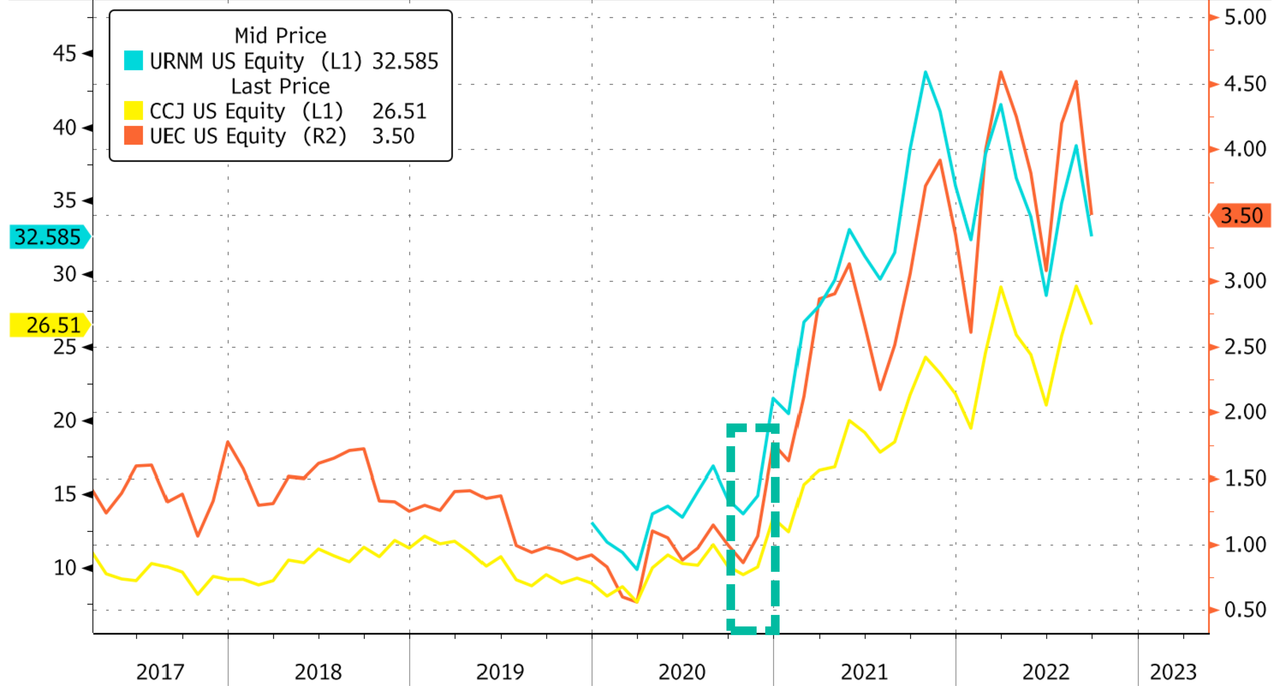
 The thesis we presented to readers in December 2020 recommended uranium stocks on the belief that nuclear energy would eventually be incorporated into the ESG (Environmental, Social, and Governance) framework, as highlighted in our article "Is This The Beginning Of The Next ESG Craze," is proving to be accurate. 

As per a draft statement cited by The Japan Times, energy and environment ministers of G7 nations are preparing to announce the importance of nuclear power for energy security amidst the global push towards decarbonization.  

The statement, seen Friday, is likely to note that G7 countries welcome Japan's plan to release treated water from the crippled Fukushima No. 1 nuclear power plant into the ocean in a transparent way and in close coordination with the International Atomic Energy Agency, according to the draft.

The announcement could come as soon as the G7 climate, energy, and environment ministers meet in Japan on April 15-16. 

The Times said multiple G7 countries are accelerating their push towards extending the life of nuclear power plants and constructing new ones.

Parliament is currently deliberating legislation that would extend the life of nuclear plants beyond 60 years as the government aims to ensure stable electricity supply and promote decarbonization at the same time.

Britain and France are accelerating construction of new nuclear plants, while the development of a small modular reactor is underway in the United States.

Germany, which is expected to complete the shutdown of all nuclear plants in the country this month, opposes highlighting the importance of nuclear power.

The draft statement also laid out a plan for advanced economies to build small modular reactors and next-generation reactors. 

At the time of our initial recommendation, the majority of uranium stocks were trading at a fraction of their price now. 

The case for nuclear energy becomes even stronger as governments aim to decarbonize their economies within the next decade, as it is impossible to achieve this solely through solar and wind power.

https://www.zerohedge.com/commodities/g7-nations-emphasize-import-nuclear-power-upcoming-announcement

As Threats to Our National Security Grow, the Biden Administration Turns to Ibram Kendi

 China is threatening retaliation against the United States because of a visit by Taiwan’s president; Russia kidnapped an American journalist days after shooting down a $32 million American drone; and Brazil is allowing Iran’s warships to port and is now doing business with China strictly on a yuan basis.

In other words, as Rep. Mike Rogers (R-AL), chairman of the House Armed Services Committee, put it during a hearing this Wednesday, “The threats we face today are more formidable than at any point in the last 20 years.”

How are the State and Defense Departments responding to such threats? Well, the State Department is meeting with Ibram X. Kendi, the well-known critical race theory consultant who demands that government racially discriminate well into the future, for guidance on world affairs.

As for the DOD, it can’t even promise Congress that it won’t hire or promote based on the race of the person in question.

As recent hearings and budget proposals make clear, both State and DOD are doubling down on diversity, equity, and inclusion (DEI). They are requesting several million in additional dollars to focus even more on race and sex—matters completely unrelated to a sound national defense policy, if not inimical to it. DOD’s first DEI budget in FY 2023 was $87 million; this year’s budget submission for FY 2024 was $114 million—more than a 30% increase.

Don’t expect, however, that the Biden administration will at any moment admit that perception of its foreign policy weakness—to which such a focus on DEI and CRT clearly contribute—has now become provocative.

Asked at the hearing by Rep. Jim Banks (R-IN) whether he had any regrets over Biden’s catastrophic withdrawal from Afghanistan in 2021, Defense Secretary Lloyd Austin simply said, “I don’t have any regrets.”

“Mr. Austin, that is very telling,” Banks responded.

Indeed, it was just a few months after the chaotic U.S. withdrawal from Afghanistan that Russia began amassing large numbers of troops on Ukraine’s border, with results we now know.

As Rogers detailed, the list of threats has grown since the withdrawal from Afghanistan, which the committee chairman termed “disastrous.”

“North Korea is lobbing ICBMs over Japan and threatening us with nuclear annihilation on a near-weekly basis. Iran continues to fund and equip terrorists targeting Americans. Last week, one American died, and seven were wounded when the Ayatollah’s terrorist proxies attacked our bases in Syria,” Rogers noted, before concluding that the “most concerning” worry was the strengthening alliance between Russian President Vladimir Putin and Chinese leader Xi Jinping.

And yet, under questioning in a Military Personnel Subcommittee hearing on March 23, a senior Pentagon official admitted that the men and women charged with leading us out of these crises could be hired or promoted based on their race. In other words, there’s no way to tell whether they are actually qualified to defend America’s national security interests when those interests are under attack from every direction.

Rep. Banks asked Gil Cisneros, Jr., Under Secretary of Defense for Personnel and Readiness, “Will you personally commit to opposing any effort to promote or recruit service members based on their race or gender? Can you commit to that, at least commit to that personally today?”

Cisneros could not give that assurance. “To solely—to not recruit?” Cisneros protested incredulously that the question was even posed. “I believe we need a diverse pool. It’s important for us to recruit members that are—that are diverse!”

He repeated a phrase that has become the standard answer when a Biden official doesn’t want to admit that they’re hiring based on race: “I believe it’s important to recruit a force that looks like America.”

But Cisneros’s mumbling was Ciceronian compared to what the State Department’s Special Representative for Racial Equity and Justice (yes, that position exists), Desirée Cormier Smith, said about her meeting with Kendi.

In a tweet that summarized her meeting with him in Boston, she wrote, “I had a great discussion today w/@DrIbram about the ongoing, global impact of white supremacy & the importance of collective effort across sectors to build a world where racial & ethnic equity & social justice prevail.”

That Kendi is advising the State Department at such a time speaks volumes about the unseriousness of an administration beset with global problems, or indeed, points to their causes.

Kendi is not usually considered in the same league as Sun Tzu, Carl von Clausewitz, or Henry Kissinger when it comes to the art of war or world affairs. He’s best known for having condemned the system State should be promoting: “Capitalism is essentially racist; racism is essentially capitalist,” he said.

He also wrote: “The only remedy to present discrimination is future discrimination.”

So why is the Biden State Department even meeting with him? When you repeat that “diversity is our strength” often enough, you end up believing it, no matter how glaringly it contradicts any defense policy that relies on a sense of common interests.

Toward the end of the 20th century, JFK adviser Arthur Schlessinger asked us in this century to think of the following problem: “What happens when people of different ethnic origins, speaking different languages and professing different religions, settle in the same geographical locality and live under the same political sovereignty? Unless a common purpose binds them together, tribal antagonisms will drive them apart. In the century darkly ahead, civilization faces a critical question: What is it that holds a nation together?”

That’s not something Cisneros, Cornier Smith, Kendi—or Biden—seem to be considering.

https://www.heritage.org/progressivism/commentary/threats-our-national-security-grow-the-biden-administration-turns-ibram

Miami-Area Beach Full Of Feces, Officials Warn Public Against Swimming

 Health officials in South Florida have advised beachgoers to avoid a popular beach due to excessive amounts of fecal matter in the water. This comes as surrounding beaches are hit with a poisonous algae bloom and a massive blob of seaweed. 

Several water sampling tests in the northern part of Crandon Park, near Miami, failed to meet the state and federal water quality standards. The water is contaminated with enterococci bacteria, an indicator of fecal material. 

Silicon Valley Vs. Homeless-Industrial-Complex Power-Struggle Emerges In San Francisco

 by Monica Showalter via AmericanThinker.com,

Something about the apparently random street murder of Silicon Valley tech executive Bob Lee seems to have overturned a crawly rock in San Francisco's political scene, suggesting a brewing power struggle on the horizon.

On the one hand, we have a very vocally angry Silicon Valley tech community speaking out about the out-of-control crime situation in the city, with the valued and talented Lee's untimely death from some night creature who crawled out from some sewer or encampment and stabbed him to death, quite possibly in a drug-addled haze.  That's expected if you live in a place full of bums and criminals, but Lee didn't live in a place full of bums and criminals.  He had actually fled the city for Florida based on its engulfing crime and come back only for a brief business trip.

On the other hand, we have a soggy, entrenched political establishment seeking to assure that there's really no crime problem at all.  This is evident enough in the "crime is down" coverage seen in the political establishment's house organ, the San Francisco Chronicle, and in the surreal statements of the city hall power establishment, which is rooted in special interests, particularly the most powerful one, the homeless industrial complex.  I wrote about that here.  San Francisco currently spends about as much on homeless "services" as it does on police, and by some studies such as the one cited below, actually more.

Not surprisingly, as per Thomas Sowell's observation, you can have all the poverty you want to pay for, and San Francisco pays a lot.

The Hoover Institution's Lee Ohanian has noted:

Spending $1.1 billion on homelessness is just the latest installment in San Francisco's constant failure to sensibly and humanely deal with an issue that it chronically misdiagnoses and mismanages about as much as is humanly possible. Since fiscal year 2016–17, San Francisco has spent over $2.8 billion on homelessness, and the city's politicians remain seemingly baffled, year after year, as the number of homeless in the city skyrocket, as opioid overdoses kill more than COVID-19, and as the city has become nearly the most dangerous in the country. https://www.hoover.org/research/why-san-francisco-nearly-most-crime-rid….

Since 2016, the number of homeless in San Francisco has increased from 12,249 to 19,086, which comes out to about $57,000 in spending per homeless person per year. With a total population of about 860,000, roughly 2.2 percent of San Francisco residents are homeless, which is over 12 times the national average. There is little doubt that as San Francisco spends more, homelessness and its impact on the city worsens.

Do the homeless get that $57,000 being spent on them?  Of course not.  The princelings of the NGO establishments got that money — for themselves.  That's what's made them politically powerful, enough to call the shots at city hall.

Meanwhile, the tech barons keep the city afloat through their taxes paid, which in turn pay for the city's homeless services — which fuels the homelessness.  The taxes they pay are the highest in the nation (which, naturally, the Chronicle claims doesn't matter to the tech companies, but that is unlikely to be true).  We also know that they're not happy now that the crime that coincides with the growth of the homeless-industrial complex has spiraled into their tech talent base.  It's not just Lee's murder, though that's not small.  It's that ordinary tech workers don't want to return to the offices.  The tech firms have leases in those buildings and need to utilize that paid-for space.  The workers don't want to return and many have fled to friendlier, less crime-infested climes in Texas, Washington State, and Florida.  That's leaving San Francisco with a lot of empty office space — about a 30% vacancy rate, which is one of the country's highest — and a 30% drop in tax revenues, given that the city finances itself by a huge margin through property taxes. 

The collision of political interests happened when one of the city's criminals preyed on tech royalty Bob Lee.  Then we started seeing posts like this, from tech-baron-of-tech-barons Elon Musk:

And this not-so-disguised shot at the San Francisco Chronicle with all its bogus claims about crime being down based on misread statistics:

And this simple, brutal one:

Those sound like shots across the bow.

And of course, Musk is a bugbear to the left, but he's the biggest bear in the tech establishment

Over at city hall, the political establishment is knee-deep in the NGOs and depends on them to maintain their political power.  But they also depend on the tech barons for money to pay the NGOs. 

The tech barons are mad and, based on Musk's tweets, now seem to be looking to get rid of them.  

They're on the warpath.  

They were the moneybags behind the ouster of far-left district attorney Chesa Boudin last year.  Now based on this string of events, they may be getting ready to storm the deep blue fortress.

Lee's death may have been the starting point, and Musk's recent tweets may be the accelerator.

https://www.zerohedge.com/political/silicon-valley-vs-homeless-industrial-complex-power-struggle-emerges-san-francisco

Provider groups push back on planned nursing home staff mandates


  • Two major hospital groups are pushing back against the CMS’ plans this year to issue federal staffing minimums for nursing homes, according to a Monday letter sent to CMS Administrator Chiquita Brooks-LaSure from the American Hospital Association and American Health Care Association.
  • In the letter, the groups argue that federal staffing mandates are a “one-size-fits-all” approach to the labor crisis and that issuing mandates would further reduce capacity by forcing some nursing homes to shut their doors.
  • The Biden Administration has focused on nursing home staffing, with the White House announcing last year that it was directing the CMS to create a set of reforms for nursing homes in wake of the pandemic, including minimum staffing standards.
Nursing homes suffered the worst job losses in the healthcare industry at the start of the pandemic and are still struggling to retain staff.

While hospitals and ambulatory care services have fully recouped all the jobs lost at the start of the pandemic, nursing homes and residential care facilities still haven’t recouped about 27,000 jobs, according to a recent report from nonprofit Altarum.

Tight nursing home capacity has led to longer patient stays and delayed discharges for hospital patients throughout the pandemic.

“This has a detrimental impact on patients who must wait days, weeks, or even months in hospital beds awaiting discharge to post-acute care; the capacity of care providers to serve our communities; and the costs to the entire health care system,” the groups wrote in the letter.

Under Biden’s order, the CMS announced it would conduct research to find appropriate levels of staffing needed and would issue proposed rules within a year.

The Biden Administration has also been cracking down on nursing home ownership, particularly private equity ownership, with the CMS issuing a proposed rule in February that requires nursing homes to disclose ownership and management information to the agency.

Nursing homes participating in Medicare and Medicaid currently must provide 24-hour licensed nursing services sufficient in meeting residents’ needs, and must use a registered professional nurse’s services at least eight consecutive hours a day, every day, according to the CMS.

But understaffing is still a concern, with ratios informed by older care models that don’t consider modern capabilities with technology and new team care models, the groups wrote in the letter.

“In short, specific staffing levels should be a clinical decision customized to the resident population and facility characteristics rather than a policy decision made with lack of regard to real-life situations,” they wrote.

The groups suggest other tools to ease current healthcare staffing challenges, like Congressional action to create a temporary visa program for foreign-trained registered nurses. Other recommendations include policies to expand loan repayment and other incentive programs to attract and retain talent, they wrote.

The letter comes as federal nurse staffing ratio legislation was reintroduced in the House on Thursday, and as labor unions renewed their push for Congress to pass a bill related to nurse staffing levels in wake of the pandemic.

The Nurse Staffing Standards for Hospital Patient Safety and Quality Care Act, introduced by Sen. Sherrod Brown, D-Ohio, and Rep. Jan Schakowsky, D-Ill., would set minimum nurse to patient ratios for all hospital units.

It mirrors California’s nurse staffing law, which outlines exactly how many patients a nurse in a specific unit can care for at once. It would also protect nurses who speak out against unsafe staffing levels.

Schakowsky also led House efforts urging the CMS to include nursing home staffing standards in the proposed fiscal year 2024 Medicare payment rule.

https://www.healthcaredive.com/news/federal-nursing-home-staffing-ratio-provider-group-AHA-oppose/646767/