Target to $88 from $79
Monday, April 10, 2023

Goldman: Slowdown In Consumer Spending "Moved From Theory To Reality" In The Last 2 Weeks
As Goldman consumer discretionary trader Scott Feiler writes over the weekend, all year, a consumer spending slowdown has been a theory (if one which became far louder in the last week of March when we showed a sharp drop in the post-bank crisis consumer spending). Feiler lists that among the rising headwinds on the horizon listed have been
i) reduced SNAP benefits (end of February),
ii) lower tax refunds by double-digits y/y (mainly a March impact),
iii) revolving credit up to all-time highs, and
iv) unseasonably cool weather in March impacting home, outdoor and apparel.
Additional recent concerns have been the jobs angle (finally slowing) and the end of the student debt moratorium in June. Until very recently, these were only listed headwinds, with no notable slowdown to speak of. But, as the Goldman trader warns, "the slowdown moved from theory to reality the last 2 weeks, with the Costco update Thursday night which feels like a big focus, given they were the first major bellwether to call it out", and then others quickly joined:
COST: Provided an update on March sales Thursday night. They said total March comps in the US were +0.9% This was about 200 bps below consensus and their weakest comp in over 6 years. The weakness is being led by discretionary, with their non-food sales down mid to high-singles vs down MSD in February and, down LSD in January and slightly positive in December.
LEVI: Shares were down 16% on Thursday after they spoke to increased promotions needed to clear excess inventories (gross margins missed by 100 bps). They also spoke to a slower wholesale environment in the US. They said they expect the US and Europe wholesale environment to remain constrained as retailer partners cautiously plan open-to-buy budgets. As a result, the company guided to a LSD-MSD decline in FY23 global wholesale revenues vs. flattish prior.
On March 29th, RH guided 1Q sales to be down ~25% y/y, a 1000 bps slowdown vs 4Q.
On March 21st, CTRN guided 1Q sales 1000 bps below consensus.
Throughout the 2H of March, there were multiple spending trackers highlighted from the big banks pointing to much slower growth rates in March.
It wasn't all bad news:
WMT: Sounded very constructive at their analyst day this week, as they reaffirmed 1Q and FY, while heavily leaned into the idea that operating income could grow above their outlook on the go-forward. One specific data point tossed around a lot this week (between COST slowdown vs WMT strength) was that WMT has just ~6% exposure to California vs COST at ~16%.
Weather flip? Many hedge fund investors are taking the other side of the cautious retail trade as we move into April, whereas LO’s and concentrated HF’s have not. The argument from many is that weather played a significant impact on the March slowdown. Our personal view on the desk is that while this may be a temporary trade, longer-term investors became more focused on the softening jobs picture this week, so will not underwrite a temporary bump from weather trade.
According to Goldman, the next catalyst to keep an eye on - at least until Friday's retail sales update - KMX is the only major consumer company to report this week and Goldman thinks expectations are for them to miss comp sales by about 500 bps and speak to a slow start to 1Q.
Finally, Feiler asks rhetorically "what are we seeing, who will be impacted" and answers "We have seen a very defensive playbook in consumer, with names like dollar-stores (DG/DLTR) and discounters/staples (WMT, PG) outperforming, vs a reduction in discretionary plays."
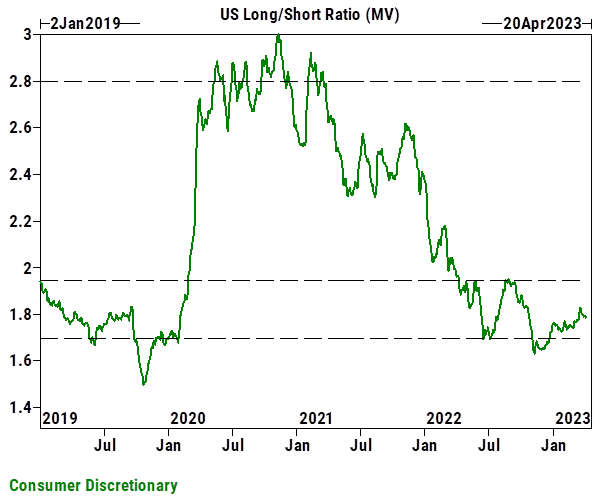
The silver lining in all this is that as the Goldman Prime Brokerage chart below show, positioning already largely reflects the consumer slowdown, with Discretionary positioning bumping along lows, vs Staples significantly net bought recently.
TG Therapeutics Logs 'Solid Jump' In Sales
TG Therapeutics' (TGTX) new multiple sclerosis drug, Briumvi, experienced a "solid jump" in March sales, according to a report that sent TGTX stock flying on Monday.
In the second month following Briumvi's launch, the MS treatment generated $3.3 million in sales, Cantor Fitzgerald analyst Prakhar Agrawal wrote in a note to clients Sunday. That compares with $500,000 in sales during February, he said, citing Symphony Health data.
Overall, first-quarter sales were about $4 million, above forecasts for $2.5 million to $3.8 million, Agrawal said. TGTX stock analysts polled by FactSet predict $3.8 million in sales.
"We estimate that Briumvi is likely to meet/exceed the current first-quarter consensus revenue estimates," Agrawal said.
https://www.investors.com/news/technology/tgtx-stock-rockets-on-solid-jump-in-ms-drug-sales/
David Crosby died from COVID, Graham Nash says
David Crosby died after contracting COVID-19 for a second time, his friend and former bandmate Graham Nash has revealed.
Crosby passed away in January at age 81 following a “long illness,” but no further details were given at the time.
On Friday, however, Nash disclosed details regarding Crosby’s demise while speaking on the “Kyle Meredith With …” podcast.
“He was rehearsing for a show to do in Los Angeles with a full band,” Nash stated. “After three days of rehearsals, he felt a little sick. And he’d already had COVID and he had COVID again. And so he went home and decided that he would take a nap, and he never woke up. But he died in his bed and that is fantastic.
“I mean, the fact that he made it to 81 was astonishing,” the rocker continued. “But [his death] was a shock. It was kind of like an earthquake, you know? You get the initial shock and then you figure out that you survived. But these aftershocks kept coming up, and they’re diminishing in size as I go along.”
Crosby had spent decades struggling with health issues after being diagnosed with hepatitis C in the early 1990s.
He underwent a liver transplant in 1994 that was paid for by Phil Collins.

In a 2002 interview with The Post, Crosby said he was feeling “very healthy” and talked about receiving the life-saving liver donation.
“I have seven extra years on my life after I was supposed to be dead,” the thankful musician said. “It’s a slow-moving disease, and it’ll take another 20 years for it to kill this liver. I’ll take the 20 years. Hep C is one of the worst problems the world has to face.”
Nash’s disclosure of the cause of Crosby’s death comes just months after his heartfelt tribute to his longtime on-and-off friend.
Nash and Crosby were estranged for many years, with Crosby saying in a 2021 interview with the Guardian: “Graham just changed from the guy I thought was my best friend to being a guy that is definitely my enemy, so I don’t see any future there at all.”
However, Nash posted a touching tribute on Instagram following Crosby’s death.


“I know people tend to focus on how volatile our relationship has been at times, but what has always mattered to David and me more than anything was the pure joy of the music we created together, the sound we discovered with one another, and the deep friendship we shared over all these many long years,” Nash wrote.
“David was fearless in life and in music. He leaves behind a tremendous void as far as sheer personality and talent in this world. He spoke his mind, his heart, and his passion through his beautiful music and leaves an incredible legacy. These are the things that matter most.”
Nash revealed to AARP magazine in February that the two of them were in the middle of making amends just before Crosby’s death.
“The fact is that we were getting a little closer at the end. He had sent me a voicemail saying that he wanted to talk to apologize, and could we set up a time to talk,” he told the magazine. “I emailed him back and said, ‘Okay, call me at 11 o’clock tomorrow your time, which is 2 o’clock on the East Coast.’ He never called, and then he was gone.”

Crosby last performed in February 2022 — the first time in three years — during a surprise set in Santa Barbara, California.
He is survived by his wife, Jan Dance, and his four adult children.
https://nypost.com/2023/04/10/david-cosby-died-from-covid-graham-nash-says-it-was-a-shock/
Crystal Run Healthcare under Unitedhealth ownership
In an email to employees obtained by Mid-Hudson News, Dr. Hal Teitelbaum, CEO of Crystal Run Healthcare, notified employees that effective Wednesday, February 22nd, Crystal Run became part of Optum.
Teitelbaum wrote, “We will join Optum as part of their Tri-State Team, and will no longer have physician owners.” In his message to employees, the CEO cited the reason for the change stating, “Crystal Run has long recognized that the fee-for-service reimbursement model is broken, and we committed to transition to value-based care focused on the quadruple aim.”
On its company website, Optum describes itself as a family of 60,000 doctors in 2,000 locations nationwide who help more than 20 million people live healthier lives. The message to employees indicates that there will be no changes to daily operations or patient care during the transition period.
https://midhudsonnews.com/2023/02/25/crystal-run-healthcare-under-new-ownership/
FDA advisers to weigh full approval for Eisai-Biogen's Alzheimer's drug
The U.S. Food and Drug Administration (FDA) plans to hold a meeting of its outside experts in June to discuss full approval of the Alzheimer's drug developed by Eisai Co Ltd and Biogen Inc, according to a federal filing on Monday.
The drug, Leqembi was granted accelerated approval by the FDA in January for patients in the earliest stages of the mind-wasting disease.
The U.S. health regulator grants the so-called accelerated approval based on data that show therapies are likely to work, and requires confirmatory trials later to give them full approval.
In the large trial of Leqembi, which is given by infusion, the drug slowed the rate of cognitive decline in patients with early Alzheimer's by 27% compared with a placebo.
The FDA's independent advisers, who are scheduled to meet on June 9, will discuss the data from the study.
Leqembi belongs to a class of treatments that aim to slow the advance of the neurodegenerative disease by removing sticky clumps of the toxic protein beta amyloid from the brain.
https://www.yahoo.com/lifestyle/us-fda-advisers-weigh-full-140121030.html
Pfizer, hundreds of US drugmakers call for reversal of Texas abortion pill ruling
Over 300 biotech and pharmaceutical industry executives, including Pfizer Inc CEO Albert Bourla, signed an open letter on Monday calling for reversal of a federal judge's decision to suspend sales of the abortion pill mifepristone.
A U.S. judge on Friday suspended the U.S. Food and Drug Administration's two-decade-old approval of the drug, effectively banning sales while a case brought by anti-abortion groups before him continues in the Northern District of Texas.
Last week's ruling by Judge Matthew Kacsmaryk undermines the FDA's authority, the letter's authors wrote, adding that it ignores decades of scientific evidence and legal precedent.
"We call for the reversal of this decision to disregard science, and the appropriate restitution of the mandate for the safety and efficacy of medicines for all with the FDA, the agency entrusted to do so in the first place," they wrote.
Bourla was the first leader of a major pharmaceutical company to add his name to the letter, which also bore the signatures of more than 300 executives from smaller U.S. biotechnology companies.
The letter was written by ReCode Therapeutics CEO Shehnaaz Suliman, Blackfynn co-founder Amanda Banks, and Ovid Therapeutics CEO Jeremy Levin, who is also a former chairman of biotech industry lobbying group BIO.
The decision puts the entire industry at risk, the letter says, and sets a precedent for undermining the agency's authority to approve drugs, adding regulatory uncertainty that they warned would disincentivize investment in new treatments.
"You have the real potential of having medicines not being developed because it's far too expensive, or medicines that are currently approved being withdrawn because they are political," Levin told Reuters.
The FDA approved mifepristone, part of a two-drug regimen that accounts for more than half of U.S. abortions, more than 20 years ago and has determined its safety several times since.
Subscribe to:
Posts (Atom)