announced further design features of its Phase 2 MARIO-8 study in Squamous Cell Cancer of the Head and Neck (SCCHN).
The adaptive design of the MARIO-8 study is intended to optimize the dose of the oral drug candidate, eganelisib, in combination with the standard dose of Merck & Co Inc's
Keytruda (pembrolizumab), in 40-70 patients in Part A of the study.
The dose optimization phase of the study will evaluate two dose regimens of eganelisib; a 30mg regimen, dosed daily for two out of every three weeks, and a 20mg regimen, with continuous daily dosing.
The company has received FDA feedback and, pending final FDA review and subject to the successful close of the company's proposed merger with MEI Pharma Inc
, preliminary safety and efficacy data to inform the dose selection are expected in the second half of 2024.
The selected eganelisib dose, in combination with pembrolizumab, will be further evaluated in Part B of the study in approximately 100 additional patients, with the primary endpoint of overall survival and secondary endpoints of progression-free survival and safety.
Infinity said that a second leading independent proxy advisory firm, Glass, Lewis & Co has joined Institutional Shareholder Services Inc in recommending that stockholders of Infinity and MEI vote FOR the merger.
said that the independent Data Safety Monitoring Board (DSMB) of the Phase 3 ASPIRE trial for patients with untreated metastatic pancreatic ductal adenocarcinoma has completed its pre-specified review of safety data for treated patients in the trial.
The DSMB has recommended that the study continue without modification.
The ASPIRE Trial is a global, randomized, double-blind, placebo-controlled clinical trial to evaluate ivospemin in combination with gemcitabine and nab-Paclitaxel in patients with metastatic pancreatic ductal adenocarcinoma.
"We are pleased that no safety concerns were identified, and the DSMB's recommendation is to proceed without modification to the ASPIRE Trial. With a focus on enrollment and completing site initiations, we are looking forward to the interim analysis in early 2024," said Jennifer Simpson, President & CEO.
HC Wainwright identifies potential expansion avenues for Ivospemin, including additional cancer types like ovarian, prostate, colon, breast, and lung.
Panbela has planned a Phase 1 clinical trial for the second quarter of 2023 to evaluate Ivospemin in treating platinum-resistant ovarian cancer.
Although the prospects for Ivospemin appear encouraging, the analyst acknowledges the inherent challenges in developing pancreatic cancer therapy, highlighting the limited success of recently developed drugs in improving overall survival.
The fact that Panbela possesses a pipeline that extends beyond PDAC provides some reassurance, according to the analyst, helping to mitigate risks and potentially offering value in treating other indications.
By Stefan Koopman, Senior Macro Strategist At Rabobank
The Global Daily is a publication of a Dutch bank, but it rarely discusses Dutch politics. Historically, the Netherlands is known for its financial stability and ‘poldermodel’ decision-making, so financial markets often have better things to focus on. However, the opportunistic manner in which Prime Minister Rutte pulled the plug on his fourth (and final) cabinet did grab international attention, as it caught his coalition partners completely off guard. They are expected to respond in kind: a vote of no confidence in the Prime Minister – initiated by opposition parties – is expected to be submitted today. The goal is to appoint a technocrat as caretaker until a snap election can be held in November. The collapse means that no ‘controversial’ decisions can be taken until there is a new government and that the status quo will be maintained.
This all adds to the degree of disillusionment among the Dutch electorate. The collective sentiment is that Rutte's manoeuvres regarding asylum policy are entirely driven by power politics. While it is true that society struggles with large migrant inflows, which the housing market and the education system can’t handle, it is also true that the VVD government, under the influence of Dutch business, strives for more labour migrants in order to solve for structural worker shortages. As such, Rutte’s VVD decided to set sights on the much smaller group of asylum seekers – and their families in particular – knowing in advance that this would corner their junior partner ChristenUnie and precipitate the fall of the coalition. That may be electorally opportunistic, but if the VVD was truly serious about reducing immigration, they would have done something about labour migration flows. However, this would negatively affect various key sectors of the Dutch economy, such as high-tech, professional services, education, distribution, food and agri, and horticulture, and that’s not something the VVD probably would ever consider.
The question is what this will achieve. After all, Rutte's fourth cabinet faced numerous crises, struggled to reach compromises, and relied on self-imposed deadlines and vague promises to mask its lack of power. Taking advantage of the low interest rates of late-2021, a significant amount of money was made available to achieve progress on key issues such as the energy transition, nitrogen emissions, the housing market and migration. It would have allowed some of the necessary financial interventions to be implemented relatively painlessly. Yet the lack of clear plans, delayed decision-making, an overall inability to address pressing issues, and the increasingly difficult funding environment as time progressed, made this coalition increasingly fragile.
The VVD seems to believe that new elections will result in a workable right-wing coalition, seeing it as the right timing given the ongoing increase in the BoerBurgerBeweging’s popularity at the expense of the CDA, D66's poor polling and the still-incomplete merger between the PvdA/GroenLinks. Whether this strategy pays off rests with the voters, but also depends on the willingness of other parties to try their luck with Rutte’s VVD. Current sentiment is that he may have pushed his luck too far this time.
That being said, a US non-farm payroll report has a bigger impact on markets than the collapse of the Dutch government, so let’s get back to it. Amidst the Great Confusion of 2021, one of the prevailing narratives was that "no one wanted to work" anymore. The story was that workers were quitting in large numbers, resisting returns to the workplace, and embracing self-employment. These stories were supported by evidence of declining labor force participation and increased job vacancies. It particularly impacted consumer-facing businesses like restaurants and hotels, which struggled with persistent shortages and needed to pay up.
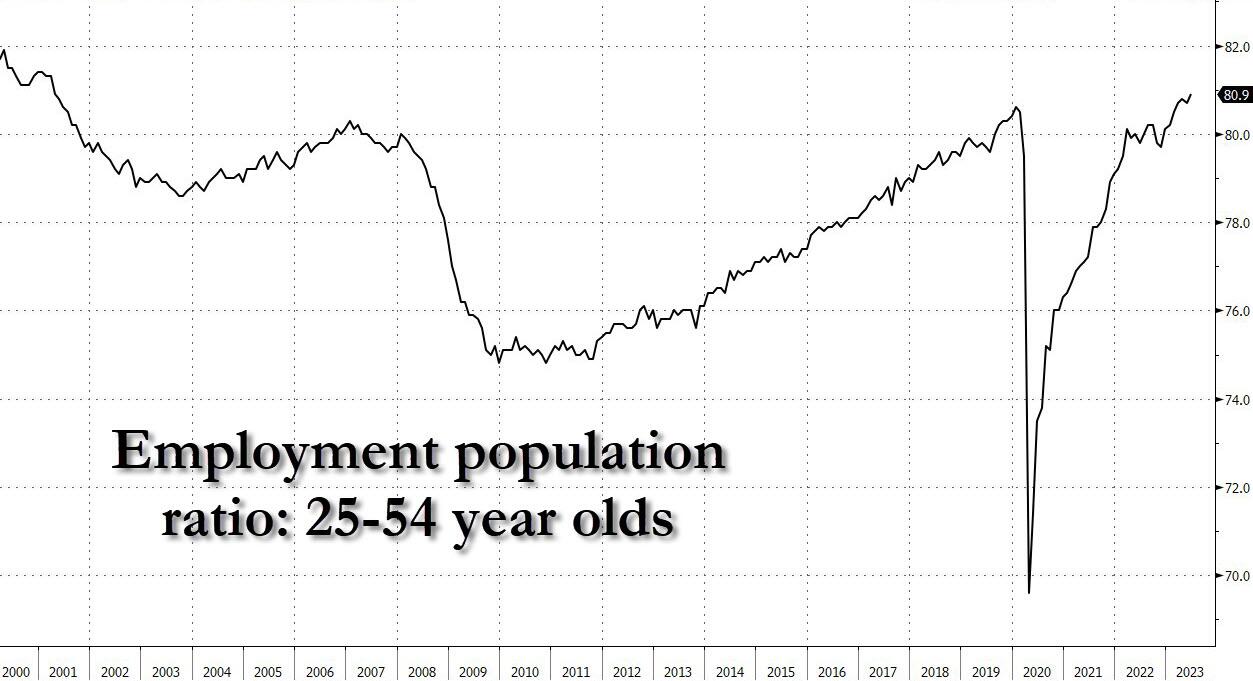
This narrative was also completely wrong. The June Employment Report revealed that 80.9% of Americans aged 25-54 (considered "prime age") were employed, the highest rate in over twenty years and only one percentage point below the record high of April 2000. While overall labor participation still lags pre-pandemic levels, every age group has now returned to pre-pandemic participation levels except for those aged 65+. While there have been some earlier than expected retirements, describing these as "early" would be inaccurate unless there is a demand for grandparents to re-join the workforce.
The ADP’s nowcast of the official US nonfarm payrolls suggested half a million jobs could have been added in June, prompting a big sell-off in both equities and bonds on Thursday. Instead, actual payrolls printed below-consensus for the first time in more than a year. As hopes were so high, the 209k rise was a bit disappointing, even more so in light of the -110k of net revisions. So it does look like employment growth is cooling, but it also seems that we’re still at a healthy pace of growth that absorbs new inflows and keeps the labour market relatively tight. Average hourly earnings growth had its third successive 0.4% m/m print, remaining sticky at 4.4% y/y. All in all, the report had something for the doves and for the hawks and is not likely to change the July rate hike that is widely anticipated.
It also stands in sharp contrast to China, which continues its slide into the world of deflation. This morning, China CPI came in at 0.0% y/y while factory prices declined sharply by -5.4% y/y. The CPI has now fallen for a fifth consecutive month, indicating weak consumer demand and a clouded growth outlook. As a result, there is an increasing need for more economic stimulus. However, due to the current levels of debt and the ongoing real estate crisis, we do not anticipate any significant economic stimulus measures. We could see more strategic sectors receiving tax breaks, and some stimulus may come in the form of additional investments in digital infrastructure such as data centres, cloud computing, and the semiconductor sector. However, demand-side stimulus would likely be more effective given the disappointing revival of domestic consumption so far.
Treasury Secretary Janet Yellen has concluded her visit in China. While no agreements on US-China disputes were announced, she did confirm that Washington will open up a channel of communication with China's economic team and that it is open to respond to unintended consequences of its own actions. She again tried to reassure her Chinese counterparts that the US doesn’t want to decouple or separate its economy from China, but that it mainly tries to "de-risk" trade in ‘narrowly’ targeted areas that are relevant to national security. That is easier said than done.
She also suggested that the possibility of a US recession cannot be entirely dismissed. In combination with confirmation of weak demand and excess supply from China, this leads to a subdued start of the week. European equities are down -0.3% in the first hour of trading, following last week’s big sell-off. Government bond yields are little changed, with the two-year German note down 2bp to 3.22% and the 10-year unchanged at 2.63%. The dollar is up 0.1% vis-à-vis the euro and trades at 1.095.
Presidential candidate Robert F. Kennedy Jr. has blasted Joe Biden’s decision to send cluster bombs to Ukraine, calling it part of a “ceaseless escalation” that is endangering the planet.
Kennedy noted in a tweet that former Biden Press Secretary Jen Psaki admitted last year that the use of cluster bombs constitutes a war crime.
“Now President Biden plans to send them to Ukraine. Stop the ceaseless escalation! It is time for peace,” RFK Jr. added.
He also noted that Biden has historically opposed monstrous cluster bombs, but is now seemingly not all that bothered.
Here is Psaki making the aforementioned admission in 2022:
In separate posts, Kennedy pointed out how practically every civilised nation has banned cluster bombs because of how horrific they are and how many innocent people, including children, are killed by them:
The Biden administration announced plans to primarily send to Ukraine M864 155-millimeter artillery shells, known as Dual-Purpose Improved Conventional Munitions (DPICM).
Exscientia plc (Nasdaq: EXAI) today announced that it has enrolled the first patient in its Phase 1/2 "ELUCIDATE" (GTAEXS617-001) study evaluating GTAEXS617 (‘617), Exscientia’s precision-designed CDK7 inhibitor, for the treatment of advanced solid tumours. The clinical trial will evaluate the safety, efficacy and pharmacokinetics of ‘617 across multiple ascending doses in patients with advanced solid tumours including head and neck cancer, colorectal cancer, pancreatic cancer, non-small cell lung cancer (NSCLC), HR+/HER2- breast carcinoma and ovarian cancer. ‘617 is a novel CDK7 inhibitor that has been designed by Exscientia in collaboration with GT Apeiron for high potency, selectivity, oral bioavailability and safety.
Novartis said regulators have approved an expanded indication for its cholesterol drug Leqvio.
The Swiss pharma giant said Monday that the U.S. Food and Drug Administration approved a label update for Leqvio that allows for earlier use by patients with elevated low-density lipoprotein, or "bad," cholesterol who have an increased risk of heart disease.
The expanded indication for primary hyperlipidemia enables broader use of the drug beyond the previously approved atherosclerotic cardiovascular disease and heterozygous familial hypercholesterolemia patient populations, Novartis said.
The expansion is effective immediately in the U.S.
Novartis said the FDA's approval underscores the robust safety and effectiveness data for Leqvio.
Hunter Biden’s former psychiatrist Dr. Keith Ablow now also has a sideline career as an artist — and he has created a surreal new artwork for his former patient: a gigantic prescription form advising him to “blow paint,” not “blow.”
The first son has taken up a painting career in recent years, creating artworks in which he blows droplets of ink with a metal straw onto paper — and then tries to sell them for as much as $500,000 apiece.
While at pains to say he is not talking about the president’s son, whom he treated for drug addiction in 2018 and 2019, Ablow says “relapsing for people who have been addicted to cocaine is very common. … It is such an easy way to dodge your inner truth [but] one thing about emotional pain is you can’t outrun it forever.”
Photos from Hunter’s abandoned laptop of his Porsche dashboard that show him hitting speeds of 172 mph in the summer of 2018, or appearing to smoke crack behind the wheel, also prompted comment from Ablow.
Hunter Biden’s former psychiatrist has taken up a side career as an artist.AP
Ablow said that when he saw the photos recently in the press, he viewed them as a “metaphor for Hunter’s life.”
“It doesn’t take a psychiatrist, and certainly not his psychiatrist, to ask whether that picture doesn’t tell the story of his life in some way because he lost his mother and his sister in a car crash [when he was 2] and there he is in a car going at 170 miles high on crack.
“You can’t outrace that magnitude of loss. You can’t drug yourself into oblivion after you’ve experienced that. …
“Hence the suggestion to be an artist, if that is where your passion is, and don’t drug yourself.
“Artists are often reprocessing pain but productively. They are alchemists. They take pain and they turn it into meaningful images.”