New insights into how COVID-19 infects cells may help explain why coronaviruses are so good at jumping from species to species and will help scientists better predict how COVID-19 will evolve.
Throughout the pandemic, there has been much discussion of how COVID-19 infiltrates cells by hijacking a protein called ACE2 found on human cells. But the new research from the School of Medicine reveals that ACE2 isn't required for infection. Instead, the virus has other means it can use to infect cells.
That versatility suggests that coronaviruses can use multiple "doors" to enter cells, potentially explaining how they are so good at infecting different species.
"The virus that causes COVID-19 uses ACE2 as the front door to infect cells, but we've found that if the front door is blocked, it can also use the back door or the windows," said researcher Peter Kasson, MD, PhD, of UVA's Departments of Molecular Physiology and Biomedical Engineering. "This means the virus can keep spreading as it infects a new species until it adapts to use a particular species' front door. So we have to watch out for new viruses doing the same thing to infect us."
Understanding COVID-19
COVID-19 has killed almost 7 million people around the world. Thankfully, the availability of vaccines and the increase in population immunity means that the virus is no longer the threat it once was to most people (though it remains a concern for groups such as the immunocompromised and elderly). With the expiration of the United States' official Public Health Emergency in May, most Americans have largely returned to lives similar to the ones they knew before the pandemic emerged in 2019. But COVID-19 continues to evolve and change, and scientists are keeping a close eye on it so that they can take quick action if a more dangerous variant emerges. They also continue to monitor other coronaviruses in case they jump to humans and become the next great public health threat.
As part of this effort, Kasson and his team wanted to better understand how the virus responsible for COVID-19, SARS-CoV-2, can enter human cells. Scientists have known that the virus essentially knocks on the cell's door by binding to ACE2 proteins. These proteins are bountiful on the surfaces of cells lining the nose and lungs.
SARS-CoV-2 can also bind with other proteins, however. Was it possible, the scientists wondered, that it could use those other proteins to infiltrate cells? The answer was yes. ACE-2 was the most efficient route, but it was not the only route. And that suggests that the virus can bind and infect even cells without any ACE-2 receptors at all.
That unexpected finding may help explain why coronaviruses are so adept at species-hopping, Kasson says. And that makes it even more important that scientists keep a close eye on them, he notes.
"Coronaviruses like SARS-CoV-2 have already caused one pandemic and several near misses that we know of," he said. "That suggests there are more out there, and we need to learn how they spread and what to watch out for."
Findings Published
The scientists have published their findings in the scientific journal Chemical Science. The research team consisted of Marcos Cervantes, Tobin Hess, Giorgio G. Morbioli, Anjali Sengar and Kasson. The researchers have no financial interest in the work.
The work was supported by the Commonwealth Health Research Board, grant 207-01-18; UVA's Global Infectious Diseases Institute; and the Knut and Alice Wallenberg Foundation, grant KAW2020.0209.
UVA's Department of Biomedical Engineering is a joint program of its School of Medicine and School of Engineering and Applied Science.
Journal Reference:
Marcos Cervantes, Tobin Hess, Giorgio G. Morbioli, Anjali Sengar, Peter M. Kasson. The ACE2 receptor accelerates but is not biochemically required for SARS-CoV-2 membrane fusion. Chemical Science, 2023; 14 (25): 6997 DOI: 10.1039/D2SC06967A
Two prominent climate scientists have taken on the Environmental Protection Agency’s (EPA) new rules to cut CO2 emissions in electricity generation, arguing in testimony that the regulations “will be disastrous for the country, for no scientifically justifiable reason.”
Citing extensive data to support their case, William Happer, professor emeritus in physics at Princeton University, and Richard Lindzen, professor emeritus of atmospheric science at Massachusetts Institute of Technology (MIT), argued that the claims used by the EPA to justify the new regulations are not based on scientific facts but rather political opinions and speculative models that have consistently proven to be wrong.
“The unscientific method of analysis, relying on consensus, peer review, government opinion, models that do not work, cherry-picking data and omitting voluminous contradictory data, is commonly employed in these studies and by the EPA in the Proposed Rule,” Mr. Happer and Mr. Lindzen stated. “None of the studies provides scientific knowledge, and thus none provides any scientific support for the Proposed Rule.”
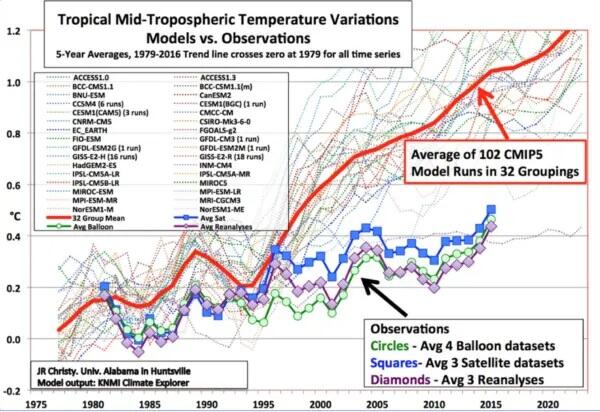
“All of the models that predict catastrophic global warming fail the key test of the scientific method: they grossly overpredict the warming versus actual data,” they stated. “The scientific method proves there is no risk that fossil fuels and carbon dioxide will cause catastrophic warming and extreme weather.”
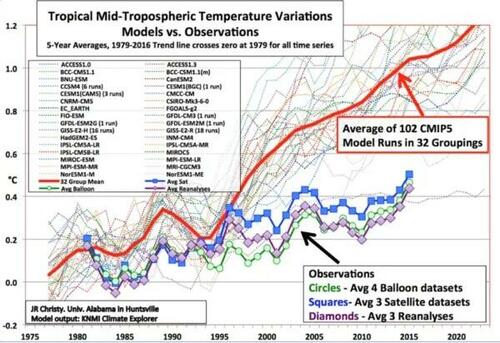
Climate models like the ones that the EPA is using have been consistently wrong for decades in predicting actual outcomes, Mr. Happer told The Epoch Times. He presented the table below to the EPA to illustrate his point.
Modeled climate predictions (average shown by red line) versus actual observations (source: J.R. Christy, Univ. of Alabama; KNMI Climate Explorer)
“That was already an embarrassment in the ‘90s, when I was director of energy research in the U.S. Department of Energy,” he said. “I was funding a lot of this work, and I knew very well then that the models were overpredicting the warming by a huge amount.”
He and his colleague argued that the EPA has grossly overstated the harm from CO2 emissions while ignoring the benefits of CO2 to life on Earth.
Many who have fought against EPA climate regulations have done so by arguing what is called the “major questions doctrine,” that the EPA does not have the authority to invent regulations that have such an enormous impact on Americans without clear direction from Congress. Mr. Happer and Mr. Lindzen, however, have taken a different tack, arguing that the EPA regulations fail the “State Farm” test because they are “arbitrary and capricious.”
“Time and again, courts have applied ‘State Farm’s’ principles to invalidate agency rules where the agency failed to consider an important aspect of the problem, or cherry-picked data to support a pre-ordained conclusion,” they stated. The case they referred to is the 2003 case of State Farm v. Campell (pdf), in which the Supreme Court argued that “a State can have no legitimate interest in deliberately making the law so arbitrary that citizens will be unable to avoid punishment based solely upon bias or whim.”
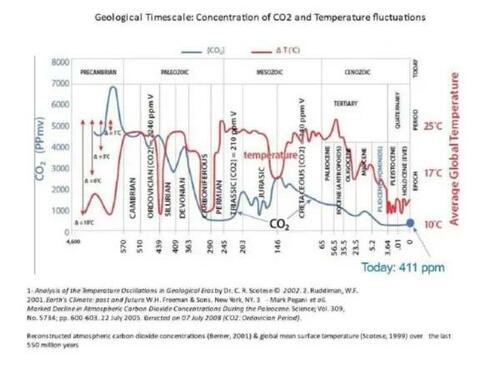
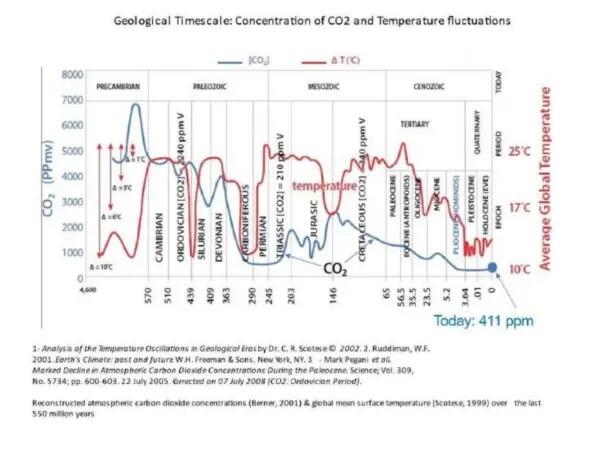
According to Mr. Happer and Mr. Lindzen’s testimony, “600 million years of CO2 and temperature data contradict the theory that high levels of CO2 will cause catastrophic global warming.”
They present CO2 and temperature data indicating much higher levels of both CO2 and temperatures than today, with little correlation between the two. They also argue that current CO2 levels are historically at a low point.
This chart shows CO2 levels (blue) and temperatures (red) over time, indicating little correlation and current levels of both at historic lows. (Source: Analysis of the Temperature Oscillations in Geological Eras by Dr. C. R. Scotese; Earth's Climate: Past and Future by Mark Peganini; Marked Decline in Atmospheric Carbon Dioxide Concentrations During the Paleocene, Science magazine vol. 309.)
“The often highly emphasized 140 [parts per million] increase in CO2 since the beginning of the Industrial Age is trivial compared to CO2 changes over the geological history of life on Earth,” they stated.
In addition, the scientists' testimony to the EPA stated that the agency’s emissions rules fail to consider the fact that CO2 and fossil fuels are essential to life on earth, particularly human life.
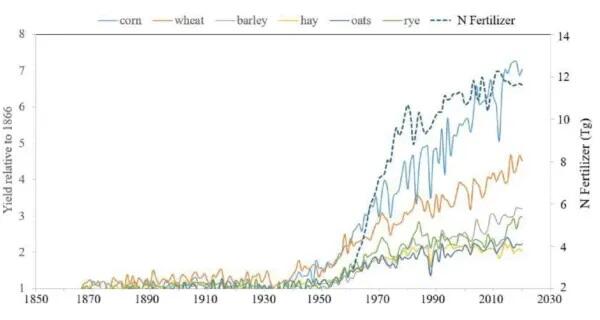
“Increased levels of carbon dioxide in the atmosphere create more food for people worldwide, including more food for people in drought-stricken areas,” they stated. “Increases in carbon dioxide over the past two centuries since the Industrial Revolution, from about 280 parts per million to about 420 ppm, caused an approximate 20 percent increase in the food available to people worldwide, as well as increased greening of the planet and a benign warming in temperature.”
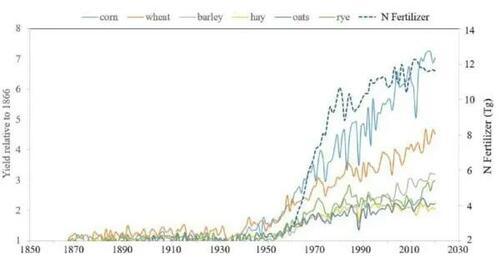
Synthetic fertilizers (dotted line) have increased crop yields dramatically since their introduction. (Source: crop yields from USDA; fertilizer usage from Food Agriculture Organization).
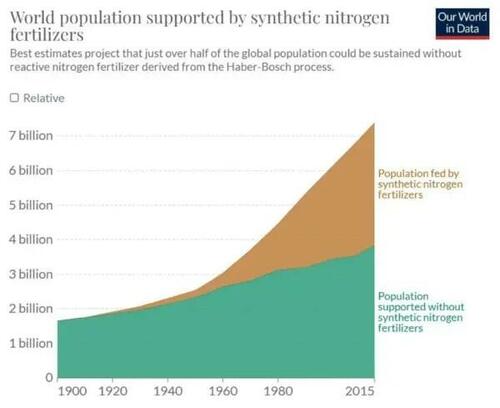
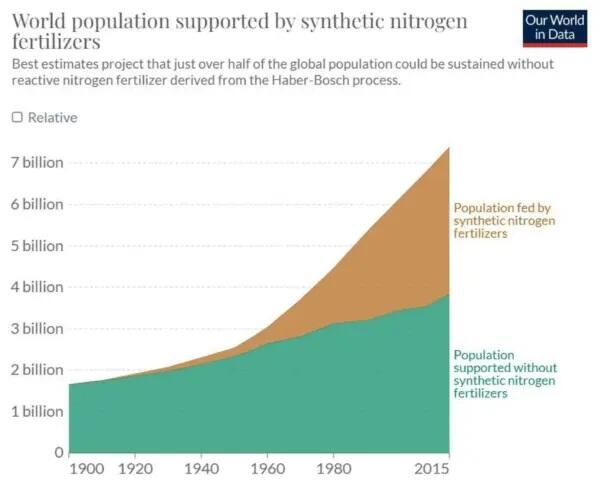
More CO2 in the atmosphere leads to more plant growth and higher farming yields, they argued. In addition, synthetic fertilizers, which are derivatives of natural gas, are responsible for nearly half the world’s food production today. “Net zero” goals would reduce CO2 emissions by more than 40 gigatons per year, reducing the food supply proportionally, they said.
The world's population is increasingly dependent on synthetic fertilizers, a derivative of fossil fuels. (Source: ourworldindata.org)
In addition to disregarding the benefits of CO2, they stated, the EPA’s emission rules and the global warming narrative that has been used to justify them are based on flawed data.
In addition to teaching physics at Princeton, Mr. Happer’s decades of work in physics has focused on atmospheric radiation and atmospheric turbulence, and his inventions have been used by astronomers and in national defense.
“Radiation in the atmosphere is my specialty,” Mr. Happer said, “and I know more about it than, I would guess, any climate scientists.”
His expertise, he said, “involves much of the same physics that’s involved in climate, and none of it is very alarming.”
The global warming narrative argues that as people burn fossil fuels, they emit higher concentrations of carbon dioxide into the earth’s atmosphere, which absorbs sunlight and creates a “greenhouse effect,” trapping the sun’s radiation and warming the earth.
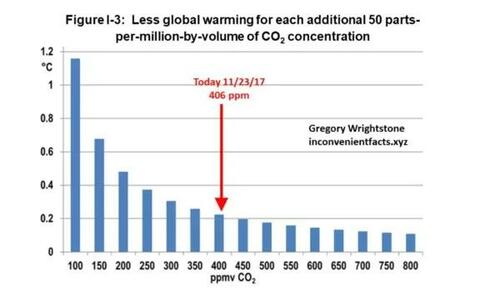
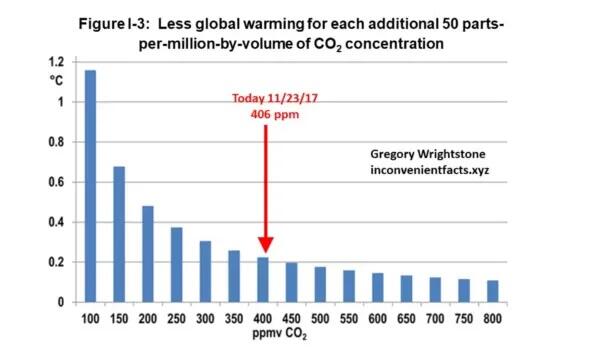
But one aspect of CO2 emissions that global warming models fail to take into account, Mr. Happer said, is a phenomenon called “saturation,” or the diminishing effect of CO2 in the atmosphere at higher concentrations.
“At the current concentrations of CO2, around 400 parts per million, it decreases the radiation to space by about 30 percent, compared to what you would have if you took it all away,” Mr. Happer said. “So that’s enough to cause quite a bit of warming of the earth, and thank God for that; it helps make the earth habitable, along with the effects of water vapor and clouds.”
“But if you could double the amount of CO2 from 400 to 800, and that will take a long time, the amount that you decrease radiation to space is only one percent,” Mr. Happer said. “Very few people realize how hard it is for additional carbon dioxide to make a difference to the radiation to space. That’s what’s called saturation, and it’s been well known for a century.”
The "greenhouse effect" of additional CO2 does not increase in proportion to the amount of CO2 added (source: William Happer).
In addition to scientific arguments about why global warming is overblown, the scientists also cite data showing large discrepancies between global warming models and actual observations. In some cases, Mr. Happer and Mr. Lindzen say, data has been disingenuously manipulated to fit the climate-change narrative.
“The most striking example of that is the temperature record,” Mr. Happer said. “If you look at the temperature records that were published 20 years ago, they showed very clearly that in the United States by far the warmest years we had were during the mid-1930s.
“If you look at the data today, that is no longer true,” he said. “People in charge of that data, or what the public sees, have gradually reduced the temperatures of the ‘30s, then increased the temperature of more recent measurements.”
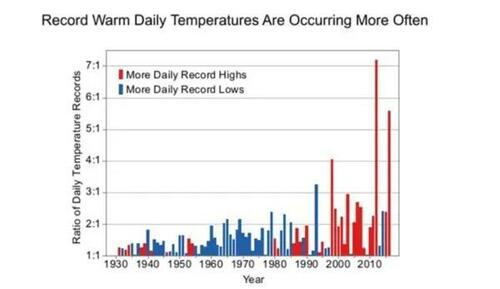
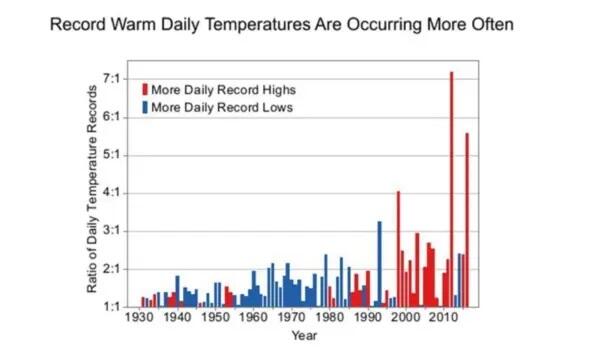
An example of misleading data used by the EPA as proof of global warming is shown in the chart below, Mr. Happer and Mr. Lindzen claimed.
EPA data shows an increasing ratio of daily record high-to-low temperatures in order to indicate rising global temperatures (Source: NOAA/NCEI).
“This chart does not actually show ‘daily temperatures,’” they state. “Instead it show a ‘ratio’ of daily record highs to lows - a number that appears designed to create the impression that temperatures are steadily rising.”
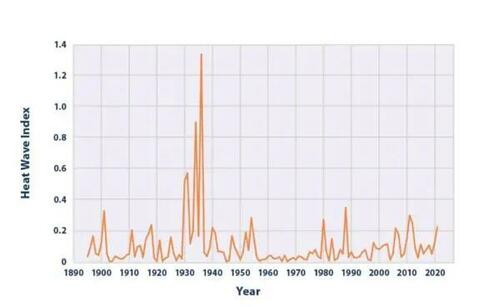
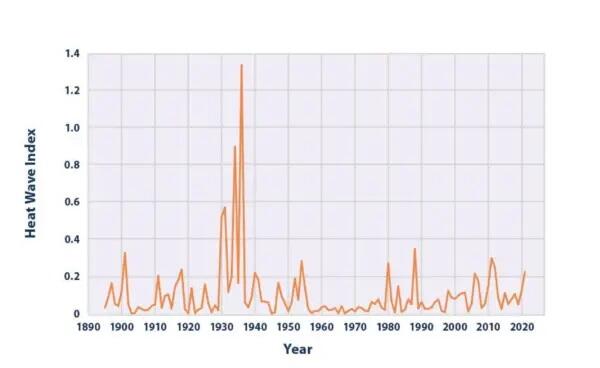
By contrast, the scientists presented the following table, which indicates significantly higher temperatures in the 1930s versus today.
This data indicates that heat waves were more severe in the 1930s than today. (Source: EPA).
The Scientific ‘Consensus’ for Climate Change
Proponents of the global warming narrative often state that it is “settled science” and that nearly all scientists agree that global warming is real and the result of human activity.
According to an official NASA statement, “the vast majority of actively publishing climate scientists—97 percent—agree that humans are causing global warming and climate change. Most of the leading science organizations around the world have issued public statements expressing this, including international and U.S. science academies, the United Nations Intergovernmental Panel on Climate Change, and a whole host of reputable scientific bodies around the world.”
A report by Cornell University states that “more than 99.9% of peer-reviewed scientific papers agree that climate change is mainly caused by humans, according to a new survey of 88,125 climate-related studies.”
But Mr. Happer argues that consensus is not science, citing a lecture on the scientific method by renowned physicist Richard Feynman, who said, “if it disagrees with experiment, it’s wrong.”
“Science has never been made by consensus,” Mr. Happer said. “The way you decide something is true in science is you compare it with experiment or observations.
“It doesn’t matter if there’s a consensus; it doesn’t matter if a Nobel Prize winner says it’s true, if it disagrees with observations, it’s wrong,” he said. “And that’s the situation with climate models. They are clearly wrong because they don’t agree with observations.”
The National Library of Medicine cites a speech by physician and author Michael Crichton at the California Institute of Technology in 2003 in which he said, “consensus is the business of politics.”
“Science, on the contrary, requires only one investigator who happens to be right, which means that he or she has results that are verifiable by reference to the real world,” Dr. Crichton said. “In science, consensus is irrelevant. What are relevant are reproducible results.”
“The initial predictions of climate disasters had New York flooded by now, no ice left at the North Pole, England would be like Siberia by now,” Mr. Happer said. “Nothing that they predicted actually came true. You have to do something to keep the money coming in, so they changed ‘global warming’ to ‘climate change.’”
The Price of Dissent
Regarding the consensus in published literature cited by Cornell University, some experts counter that academic publications routinely reject any submissions that question the global warming narrative.
“I’m lucky because I didn’t really start pushing back on this until I was close to retirement,” Mr. Happer said. He had already established himself at that point as a tenured professor at Princeton, a member of the Academy of Sciences, and director of energy research at the U.S. Department of Energy.
“If I’d been much younger, they could have made sure I never got tenure, that my papers would never get published,” he said. “They can keep me from publishing papers now, but it doesn’t matter because I already have status. But it would matter a lot if I were younger and I had a career that I was trying to make.”
In an interview with John Stossel, climate scientist Judith Curry said she paid the price for contradicting the narrative and called the global warming consensus “a manufactured consensus.”
Ms. Curry, the former chair of Georgia Tech’s School of Earth and Atmospheric Sciences, said that when she published a study that claimed hurricanes were increasing in intensity, “I was adopted by the environmental advocacy groups and the alarmists and I was treated like a rock star; I was flown all over the place to meet with politicians and to give these talks, and lots of media attention.”
When several researchers questioned her findings, she investigated their claims and concluded that her critics were correct.
“Part of it was bad data; part of it was natural climate variability,” she said. But when she went public with that fact, she was shunned, she said and pushed out of academia.
Mr. Lindzen tells a similar tale, once he began to question the climate narrative.
“Funding and publication became almost impossible,” he said, “and I was holding the most distinguished chair in meteorology,” which was MIT’s Sloan Professorship of Meteorology.
Nobel Prize-winning physicist John Clauser told The Epoch Times that he, too, was abruptly canceled from giving a speech on climate at the International Monetary Fund (IMF) on July 25.
Mr. Clauser had stated during a previous speech at Quantum Korea 2023 that “climate change is not a crisis.”
He said that climate is a self-regulating process and that more clouds form when temperatures rise, resulting in a compensatory cooling effect. Although he agrees that atmospheric carbon dioxide is increasing, he argued that the gas's effect on global warming is swamped by the natural cloud cycle.
However, only days before his IMF discussion was to take place, Mr. Clauser received an email indicating that the IMF's Independent Evaluation Office (IEO) director, Pablo Moreno, didn't want the event to happen. An assistant who was coordinating the event wrote to Mr. Clauser: “When I arranged this the Director was very happy about it but things have evidently changed.”
The IMF’s current policy on climate change is that “large emitting countries need to introduce a carbon tax that rises quickly to $75 a ton in 2030, consistent with limiting global warming to 2° [Celcius] or less.”
The Climate Money Machine
Asked why there would be a need to censor, alter, and cherry-pick data to support the global warming narrative, Mr. Lindzen said “because it’s a hoax.”
Mr. Clauser said of the climate consensus, “We are totally awash in pseudoscience.”
“There is this huge fraction of the population that has been brainwashed into thinking this is an existential threat to the planet,” Mr. Happer said. “I don’t blame the people; they don’t have the background to know they are being deceived, but they are being deceived.”
The World Bank announced in September 2022 that it paid out a record $31.7 billion that fiscal year to help countries address climate change, a 19 percent increase from the $26.6 billion it paid out over the previous fiscal year. And according to Reuters, the United States is projected to spend about $500 billion to fight climate change over the next decade, including $362 billion from the Inflation Reduction Act, $98 billion from the Infrastructure Act, and $54 billion from the CHIPS law.
“What would happen to sustainable energy, the worthless windmills and solar panels if suddenly there were no climate change emergency,” Mr. Happer said. “They’re really not very good technology and they’re doing a lot more harm than good, but nevertheless people are making lots of money.”
Many investors, most notably BlackRock, the world’s largest asset manager, have cited government regulations and subsidies as a key reason why investments in “green” energies would be profitable.
Research grants to study climate change are offered by many government agencies, including the EPA, the National Institute of Environmental Health Sciences, the National Oceanic and Atmospheric Administration (NOAA), as well as by non-profits including Bloomberg Philanthropies and the MacArthur Foundation, which paid out $458 million since 2014.
“Going back to [19]88 to ’90, funding went up by a factor of 15,” Mr. Lindzen said. “You created a whole new community.
“This was a small field in 1990; not a single member of the faculty at MIT called themselves a climate scientist,” he said. “By 1996, everyone was a climate scientist, and that included impacts. If you’re studying cockroaches and you put in your grant, ‘cockroaches and climate,’ you are a climate scientist.”
Asked to respond to the professors’ comments, an EPA spokesperson stated: “The Agency will review all comments we received as we work to finalize the proposed standards.”
Kevin Stocklin is a business reporter, film producer and former Wall Street banker. He wrote and produced "We All Fall Down: The American Mortgage Crisis," a 2008 documentary on the collapse of the mortgage finance system. His most recent documentary is "The Shadow State," an investigation of the ESG industry.
The 21st Century Cures Act (Cures Act), signed into law in December 2016, was created to help accelerate medical product development and “bring new innovations and advances” to patients quicker and more efficiently. Yet some researchers suggest the law is being used to bypass the once rigorous and evidenced-based standards for new drug approvals, allowing novel drugs to flood the market without adequate data and public transparency.
According to a research letter published on August 8 in the Journal of the American Medical Association Network Open (JAMA), 24 of the 37 drugs approved in 2022 by the U.S. Food and Drug Administration (FDA) were based on a single study, with only four drugs having more than three studies to support their approval.
“I’m not surprised,” David Gortler, a pharmacologist, pharmacist, and FDA reform advocate at the Ethics and Public Policy Center, told The Epoch Times in an email. As a former senior advisor to the FDA commissioner, Mr. Gortler said he saw the agency grant expedited approval to a medication called aducanumab—used to treat Alzheimer’s disease “based on zero positive studies.”
“They did the same with other monoclonal antibodies for Alzheimer’s disease,” Mr. Gortler said.
According to the research letter, most of the 413 studies evaluating the 37 drugs approved in 2022 were sponsored by the industry—meaning they were manufactured, funded, and analyzed by the company producing the product, seeking FDA approval, and standing to benefit financially from the drug.
Of the studies available for analysis, only 25 percent of study results have been made publicly available, with the results of six percent of those studies published after the FDA had already approved the drug for use.
Furthermore, researchers found that only 55 percent of studies evaluating drugs in 2022 consisted of randomized clinical trials—the “gold standard” of evidence-based medicine—despite the FDA justifying most approvals based on randomized clinical trial data.
For comparison, only 20 percent of medical products in 2016 were approved based on a single study, and 55 percent were approved based on three or more studies, whereas 65 percent of drugs in 2022 were approved based on a single study, with only 11 percent having three or more studies.
“We believe consumers deserve access to the full range of evidence for the drugs they are considering, not just from the selected studies released to the public,” the authors wrote.
The researchers say their results “highlight a trend toward less rigorous standards for novel drug approvals that has evolved over the past few decades” and are consistent with other reports showing a widespread decrease in the number of trials used for drug approvals.
“The authors point to the deterioration of the quality and rigor of the regulatory review and approval of new drugs over time,” Sasha Latypova told The Epoch Times in an email. Ms. Latypova is a retired pharmaceutical industry executive with 25 years of experience in pharmaceutical research and development and co-founder of several organizations that work with pharmaceutical companies to design, execute, collect data, and submit clinical trial data to the FDA.
Ms. Latypova says this trend began with a “fast track” designation implemented in 1988 that increased the number of special regulatory programs available by the FDA and decreased the evidentiary requirements for approval. In the 2000s, Ms. Latypova said many blockbuster drugs became generic medicines, which started a “patent cliff” where industry investments began to focus on narrower niches in an effort to get patent exclusivity—which is more profitable for a pharmaceutical company.
“For example, approvals receiving an ‘orphan’ designation or what is considered rare disease increased to over 50% percent,” Ms. Latypova said. “These products are sometimes approved on as little as a single observational study with fewer than 20 subjects, however, once approved, the drug’s price increased one million to three million dollars per treatment and was fully covered by the taxpayer and private insurance—driving the costs of premiums.”
Thus, the “regulatory requirements are minimal, but the profits are outsized,” she added.
FDA Cures Act Made It Easier for Pharma and Regulatory Agencies to Cut Corners
The FDA, on its website, states the intent of the Cures Act (pdf) passed by Congress in December 2016 was to “incorporate the perspectives of patients into the development of drugs, biological products, and devices in FDA’s decision-making process” and enhance its ability to “modernize clinical trial designs,” including the use of “real world evidence” to speed up the development and review of novel medical products, including emergency and preparedness response countermeasures used to justify rapid authorization of COVID-19 vaccines.
Republican presidential hopefulVivek Ramaswamysaid Monday that he would be less attentive to China’s threat toTaiwanonce he’s had four years to attain US “semiconductor independence.”
“Xi Jinping should not mess with Taiwan until we have achieved semiconductor independence, until the end of my first term when I will lead us there,” Ramaswamy told conservative radio host Hugh Hewitt.
“After that, our commitments to Taiwan — our commitments to be willing to go to military conflict — will change after that, because that’s rationally in our self-interest. That is honest. That is true, and that is credible.”
Since the end of the Chinese Civil War in 1949, Beijing has claimed sovereignty over Taiwan, but the island maintains its own government, currency, and military.
Chinese President Xi Jinping has made reunification a core objective and kept military force on the table.
The US currently operates a so-called “One China” policy, in which Washington acknowledges Beijing’s claim while considering Taiwan’s sovereignty unsettled. The US also engages in “strategic ambiguity” on the matter and has close ties with Taipei.
For more than 70 years, US officials have sought to deter China from launching an invasion by leaving open the specter of American intervention — including with nuclear weapons.
The 38-year-old multimillionaire entrepreneur dubbed Taiwan a “top US interest” due to its production of cutting-edge semiconductors.
“We are dependent on a tiny island nation off the southeast coast of China for our entire modern way of life,” he told Hewitt. “We would not live a modern lifestyle if it were not for the global semiconductor supply chain, specifically leading edge advanced semiconductors that come from Taiwan.”
Vivek Ramaswamy took note of China’s advanced weaponry and naval capabilities.Taiwanâs Military News Agency (M
“You are saying ‘I will go to war, including attacking the Chinese mainland, if you attack before semiconductor independence. And afterwards, you can have Taiwan. So if you just wait until 2029, you may have Taiwan.’ Is that clear?” Hewitt asked. “I mean, that’s what you’re saying. ‘I’ll go to war until 2028 …'”
“Well, Hugh, I’m running to be the next president, and so I expect to be the president inaugurated on January 20th, 2025. So I’m wearing that hat when I’m choosing my words very carefully right now. And I’m being very clear,” the candidate answered.
Ramaswamy was noncommittal about firing the first shot against China if Beijing launched an invasion before 2029, as well as about whether the US could prevail in such a conflict.
China has long dangled the specter of invading Taiwan.EPA
“That depends,” he said. “I think right now, if we take the risk of entering serious major conflict in a circumstance where Russia and China are still in a military alliance with one another and we have not gotten India fully committed … then I think we’re in serious danger of not only losing that conflict, Hugh. I think there are serious threats to the continued existence of the United States of America as we know it.”
Ramaswamy later cut the interview short as Hewitt started to drill down on whether he drew a “red line” with China on Taiwan over the short term, claiming a misunderstanding over how long the conversation would last.
Hewitt thought he would have the candidate for an hour, while Ramaswamy thought it would be a 20 to 30 minute hit, a campaign aide told The Post. The interview lasted about 45 minutes.
Vivek Ramaswamy argued that he was being credible and honest about how the US should handle the Taiwan matter.Getty Images Ramaswamy first floated the Taiwan timeline in a post on X, the platform formerly known as Twitter, this past Friday.
“We will further deter China from annexing Taiwan by shifting from strategic ambiguity to strategic clarity,” he wrote, “we will defend until 2029 but not afterward, at which point we will have full semiconductor independence from Taiwan.”