What if we could identify the earliest warning signs of cardiovascular disease from a simple saliva sample? Scientists think they have found a way to do so. Gum inflammation leads to periodontitis, which is linked with cardiovascular disease.
The team used a simple oral rinse to see if levels ofwhite blood cells—an indicator ofgum inflammation—in the saliva of healthy adults could be linked to warning signs for cardiovascular disease. they found that high levels correlated with compromised flow-mediated dilation, an early indicator of poor arterial health.
"Even in young healthy adults, low levels of oral inflammatory load may have an impact on cardiovascular health—one of the leading causes of death in North America," said Dr. Trevor King of Mount Royal University, corresponding author of the study published in Frontiers in Oral Health.
Tooth care for heart health
Periodontitis is a common infection of the gums which has previously been linked to the development of cardiovascular disease: scientists suspect that inflammatory factors may enter the bloodstream through the gums and damage the vascular system. King and his colleagues set out to study currently healthy young people without diagnosed periodontal issues to determine whether lower levels of oral inflammation can be clinically relevant to cardiovascular health.
"We are starting to see more relationships between oral health and risk of cardiovascular disease," said Ker-Yung Hong, first author of the study, now studying dentistry at the University of Western Ontario. "If we are seeing that oral health may have an impact on the risk of developing cardiovascular disease even in young healthy individuals, this holistic approach can be implemented earlier on."
The team chose pulse-wave velocity, which can measure the stiffness of arteries, and flow-mediated dilation, a measure of how well arteries can dilate to allow for higher blood flow, as key indicators of cardiovascular risk. These measure arterial health directly: stiff and poorly functioning arteries raise patients' risk of cardiovascular disease.
The scientists recruited 28 non-smokers between 18 and 30, with no comorbidities or medications that could affect cardiovascular risk and no reported history of periodontal disease. They were asked to fast for six hours, except for drinking water, prior to visiting the lab.
At the lab, participants rinsed their mouths with water before rinsing their mouths with saline which was collected for analysis. Participants then laid down for 10 minutes for an electrocardiogram, and stayed lying down for another 10 minutes so that the scientists could take their blood pressure, flow-mediated dilation, and pulse-wave velocity.
"The mouth rinse test could be used at your annual checkup at the family doctors or the dentist," said Dr. Michael Glogauer of the University of Toronto, a co-author of the study. "It is easy to implement as an oral inflammation measuring tool in any clinic."
The heart of the matter
The scientists found that high white blood cells in saliva had a significant relationship to poor flow-mediated dilation, suggesting these people may be at elevated risk of cardiovascular disease. However, there was no relationship between white blood cells and pulse wave velocity, so longer-term impacts on the health of the arteries had not yet taken place.
The scientists hypothesized that inflammation from the mouth, leaking into the vascular system, impacts the ability of arteries to produce the nitric oxide that allows them to respond to changes in blood flow. Higher levels of white blood cells could have a greater impact on vascular dysfunction; the levels found in the participants are usually not considered clinically significant.
"Optimal oral hygiene is always recommended in addition to regular visits to the dentist, especially in light of this evidence," said King. "But this study was a pilot study. We are hoping to increase the study population and explore those results. We are also hoping to include more individuals with gingivitis and more advanced periodontitis to more deeply understand the impact of different levels of gingival inflammation on cardiovascular measures."
More information: Oral inflammatory load predicts vascular function in a young adult population: A pilot study, Frontiers in Oral Health (2023). DOI: 10.3389/froh.2023.1233881
Our movements are controlled by multiple neural pathways that connect the brain and spinal cord. In particular, neurons in the cerebral cortex send commands to the motor neurons in the spinal cord and then to the muscles, thus eliciting the required movement. This flow of neural information is compromised in amyotrophic lateral sclerosis (ALS)—a widespread progressive neurodegenerative disease in which the muscles gradually atrophy, making movement and breathing difficult.
A protein called TDP-43 has been found to abnormally accumulate in theneuronsaffected by ALS, leading to the degeneration of these neurons andmotor dysfunction.
In patients with ALS, the motor dysfunction symptoms usually appear in one part of the body, such as the limbs, and then progress to others. This further suggests that degeneration starts in one type of motor neuron and, thereafter, propagates to other motor-related neurons.
Previous studies have highlighted the accumulation of TDP-43 in motor neurons as a co-occurrence with ALS. Given these seemingly disparate but related findings, researchers from the Brain Research Institute at Niigata University couldn't help but ask: could TDP-43 be responsible for propagating degeneration in ALS?
To address this question, the researchers developed ALS mouse models that primarily accumulate TDP-43 in the cortical motor neurons, spinal motor neurons, or skeletal muscles. They then examined how the TDP-43 in specific motor neurons initiates disease progression to other motor-related neurons. The study, "TDP-43 differentially propagates to induce antero- and retrograde degeneration in the corticospinal circuits in mouse focal ALS models," was published in Acta Neuropathologica on Aug 9, 2023.
"TDP-43 accumulation is seen in most of the patients with ALS, but there has been a long-standing debate on whether it propagates through the motor pathway and causes disease progression," says senior author Dr. Osamu Onodera, professor at the Department of Neurology, Brain Research Institute at Niigata University.
The researchers found that TDP-43 induced in the cortical neurons of the mouse ALS models caused mild degeneration. They further found that TDP-43 was transported along the axons and transferred to the oligodendrocytes—non-neuronal cells that support neurons by wrapping axons with a protective layer called myelin to facilitate neuronal signal transmission.
In contrast, TDP-43 induced in the spinal motor neurons did not spread to other cortical or spinal neurons but broadly induced cell death in the motor neurons and other neighboring neurons in the spinal cord. In addition, it led to severe atrophy of the muscles, which further led to motor dysfunction.
Co-senior author Dr. Masaki Ueno, a professor in the same institute, says, "Our findings suggest that pathogenic TDP-43 has multiple properties to propagate degeneration in the motor pathways in ALS, probably by spreading itself and inducing other toxic events such as degeneration and inflammation."
Their data revealed that TDP-43 spreads across neuroglial connections in the motor pathway and causes different pathological events to degenerate the spinal cord, suggesting that TDP-43 has distinct mechanisms for degeneration in the motor circuits of ALS.
"Elucidating the mechanisms of TDP-43 spreading and other pathological events of propagation will lead to the development of a novel therapeutic approach to prevent disease progression in ALS," concludes first author Dr. Shintaro Tsuboguchi, an assistant professor at the same institute. The findings of this study could pave the way for the effective treatment of ALS, offering hope to many patients with ALS worldwide.
More information: Shintaro Tsuboguchi et al, TDP-43 differentially propagates to induce antero- and retrograde degeneration in the corticospinal circuits in mouse focal ALS models, Acta Neuropathologica (2023). DOI: 10.1007/s00401-023-02615-8
According to new research in the journalImmunity, T cells have a nuclear receptor doing something very odd—but very important—to help them fight pathogens and destroy cancer cells. This receptor, called retinoic acid receptor alpha (RARα), is known to control gene expression programs in the nucleus, but it also now appears to operate outside the cell nucleus to coordinate the early events triggered at the cell surface that lead to T cell activation.
Scientists wouldn't normally expect to see a nuclear receptor such as RARα playing this role outside the cell nucleus. And yet the new findings suggest T cells cannot begin to fight disease without a form of RARα on the scene in the cytoplasm.
"Cytoplasmic retinoic acid receptors turn out to be central for a T cell to link sensing at the cell surface with downstream signaling cascades and gene expression programs that transform the T cell to become an active fighter," says Professor Hilde Cheroutre, Ph.D., who led the new study at La Jolla Institute for Immunology (LJI) with LJI Assistant Professor Samuel Myers, Ph.D., LJI Professor Mitchell Kronenberg, Ph.D., and LJI Professor Emeritus Amnon Altman, Ph.D.
The study is also the result of a successful collaboration with scientists at the RIKEN Center for Integrative Medical Sciences in Japan and local teams at UC San Diego and the Salk Institute.
Helping T cells respond to danger
To understand this finding, it helps to picture the geography of a T cell. The cell nucleus (with its bundled-up DNA) sits in the middle of the cell. Other molecules and cellular structures called organelles float in the cytoplasm outside the nucleus surrounded by a membrane at the border of the cell (cell membrane).
Special molecules called T cell receptors (TCRs) sit on the cell membrane, where they receive messages from other cells. You can imagine TCRs as fire-spotters, the lookouts who scan for smoke from remote cabins in the wilderness. Just as fire-spotters need to alert officials to any smoke in the distance, TCRs need to quickly signal headquarters—the cell nucleus—if they detect a potential threat, such as a virus or cancer cell.
Sending that signal to the cell nucleus is critical for activating gene expression to transform the T cell to a fighter cell. But TCRs can't just pick up a phone, so how do they alert the distant cell nucleus to trouble?
The signaling process is fascinating. Once the TCR is triggered, molecules called kinases (enzymes that add phosphates to proteins) work with adaptors that tell nearby proteins to "click" together and assemble a special molecular "activation complex." This complex is called a TCR signalosome, and it comes together just inside the cell membrane. "The TCR signalosome is extremely important for mediating communication between the outside and the inside of a cell," says Cheroutre.
And although the TCR signalosome has been studied by many people for many, many years, no one had ever detected RARα in this activation complex before.
"This new finding will change the way we think about TCR signals," says Kronenberg.
RARα's secret came to light thanks to the development of CRISPR techniques, advances in imaging and mass spectrometry—and years of hard work from the LJI team and collaborators.
RARα belongs to a large family of retinoic acid receptors that normally sit on control regions of target genes in the nucleus. These retinoic acid receptors recruit repressor and activator molecules that let them "switch off" or "switch on" expression of these target genes. This important job in the nucleus has earned retinoic acid receptors the title of "nuclear receptors."
Several years ago, Cheroutre and her colleagues published research showing that retinoic acid (RA), which we get from vitamin A, triggers nuclear RARα and gene expression important for the differentiation of suppressive regulatory T cells that reduce the immune response.
For the new study, Cheroutre wanted to investigate how retinoic acid controls that suppressive T cell fate, so her laboratory started to look at retinoic acid receptors, such as RARα, more closely.
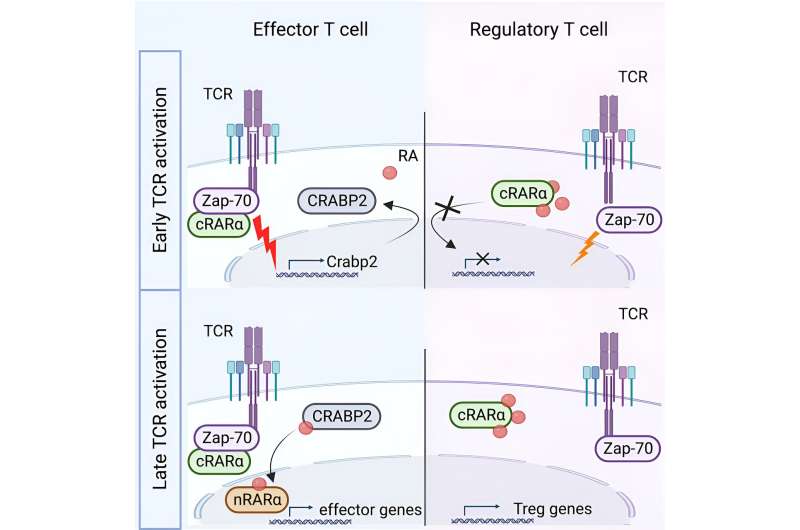
The researchers were intrigued to find that RARα actually comes in two variants, called isoforms. "These isoforms are encoded by the same gene, but they differ a little bit at one end. The consequences however are more significant and lock one form in the cytoplasm whereas the other form is confined to the nucleus" says Cheroutre.
Could these two isoforms play different roles in T cells? Looking closer, the researchers realized this RARα isoform did not respond to retinoic acid and didn't even have the right equipment to function as a nuclear receptor.
"It didn't have the tools that are important for nuclear receptors, namely the ability to interact with DNA and the ability to translocate from the cytoplasm to the nucleus," says Cheroutre.
Using CRISPR gene editing techniques to modulate expression of the two isoforms, the researchers found that modulating the cytoplasmic isoform caused major problems for TCR signaling in the cytoplasm and impaired the communication with the control center in the nucleus.
RARα is in the right place at the right time
Once they knew where to look for this RARα isoform, the researchers tried to figure out what other proteins RARα interacted with. This work revealed interactions with the kinase ZAP70, a major component of the TCR signalosome.
Another important, early clue that RARα had a role outside of the nucleus came from proteomics work led by the Myers Lab. The researchers used techniques in mass spectrometry to detect a process called phosphorylation, which is when a molecule called a phosphoryl group is attached to proteins by an upstream kinase.
For T cells, phosphorylation spurs key proteins into action when a threat is near. "There are hundreds to thousands of dynamic phosphorylation events that occur during the first hour or so of T cell stimulation," says Myers.
As Myers and his colleagues examined their data, they were surprised to spot a phosphorylation event related to RARα. In fact, phosphorylation of RARα began just three minutes into T cell activation. "Because this event was that early, our findings suggest that this phosphorylation of RARα is near the T cell receptor—and it has a burst in activity right after the TCR is stimulated," says Myers.
This discovery added to the evidence that the cytoplasmic isoform of RARα is activated by the TCR instead of by RA like the nuclear RARα. Thus, this new form of RARα represents an essential component of the TCR/ZAP70 activation complex at the cell surface.
Cheroutre and her colleagues then shed light on another fascinating phenomenon in the cytoplasm. Scientists knew that RA, which is present in the blood and taken up by the T cells, is further transported to the nucleus by a molecule called cellular retinoic acid binding protein 2 (CRABP2). CRABP2 in the cytoplasm binds to RA and carries it into the cell nucleus where it activates nuclear RARα.
The researchers showed that without CRABP2, RA remains in the cytoplasm of the T cell and instead of activating cytoplasmic RARα, it interferes with TCR-activated RARα in the cytoplasm and blocks T cell activation. As a result, the T cell can no longer effectively fight infections or kill cancer cells. The good side of this phenomenon is that the interference of RA with the cytoplasmic RARα reduces the inflammatory response of the T cell. The researchers think this process may make an important target to fight autoimmune diseases and other inflammatory diseases.
Next steps for understanding TCR signaling
The new study emphasizes the importance of understanding not just a receptor's location but its special talents and interacting partners.
"Retinoic acid receptors are really 'complex formers' and it all depends on who they recruit or reject. They have the unique capacity to engage molecules and release other molecules," says Cheroutre. "Retinoic acid receptors are the 'architects' of complexes."
The current study focused on T cells, but it may have implications for understanding signaling in many other cell types. For example, the Cheroutre Lab has gone on to show over-expression of this RARα isoform in the cytoplasm of cancer cells. What is extranuclear RARα doing there? What signals does it help relay?
"Understanding the role of this receptor has such major implications for studying protective immunity, anticancer therapies, autoimmune disease, and neurological diseases," says Cheroutre.
The Myers Lab will spearhead the next steps in this research. Myers hopes to figure out exactly what RARα does in the TCR/ZAP70 signaling complex. "Does it modulate the signaling strength or duration? How does that change in signal propagate to gene expression and T cell activity?" he asks. His laboratory plans to use a "systems biochemistry" approach to further study the role of cytoplasmic and nuclear RARα in T cell activation and differentiation.
"The ultimate goal is to see if we can identify a new pathway, or set of pathways, that could be exploited to control autoimmune diseases and inflammation or enhance protective immunity to eradicate tumors or fight infections," says Myers.
More information: Alexandre Larange et al, A regulatory circuit controlled by extranuclear and nuclear retinoic acid receptor α determines T cell activation and function, Immunity (2023). DOI: 10.1016/j.immuni.2023.07.017
Researchers at the National Heart, Lung, and Blood Institute at NIH, Bethesda, have discovered a potential breakthrough for people with myalgic encephalomyelitis/chronic fatigue syndrome (ME/CFS), marked by extreme exhaustion, post-exertional malaise and cognitive issues.
The study focused on a woman (S1) who experienced severe long-term fatigue. Measuring her muscles for phosphocreatine regeneration after exercise revealed a significant delay in mitochondrial ATP synthesis capacity. This discovery was followed up with a cell assay which found increased phospho-activation of an enzyme in a signaling pathway (MPAK).
In a large database meta-analysis, MPAK was previously associated with chronic fatigue syndrome. In that meta-data study, the gene WASF3, which produces a protein that can activate increased phospho-activation, was highlighted as a good candidate for further investigation.
The researchers tested S1's muscle tissue and revealed elevated levels of WASF3, indicating that her condition and the mechanism behind it were related to a larger pathology of chronic fatigue syndrome seen in other research.
Taking the investigation further, a genetically engineered mouse model with elevated WASF3 levels showed mice exhibiting mitochondrial dysfunction and reduced treadmill performance.
Turning once again to the scientific tool of reading previous research, the team found WASF3 reported to be regulated by BiP (GRP78), an endoplasmic reticulum (ER) chaperone for protein quality control whose defective response can cause ER stress and metabolic disorders. With an understanding of interactions between the ER and mitochondria for muscle function, the current team reasoned that ER stress may regulate WASF3 in muscle cells.
To test the link between ER stress and WASF3, researchers treated human myoblasts with ER stress inducers and observed increased WASF3 protein. The level of WASF3 was inversely correlated with that of MTCO1, the last enzyme in the mitochondrial electron transport chain, which drives oxidative phosphorylation.
This disruption leads to reduced mitochondrial oxygen consumption, providing a molecular explanation for symptoms like exercise intolerance and post-exertional malaise in patients with chronic fatigue.
Muscle samples from ME/CFS patients also displayed higher WASF3 levels and lower levels of associated mitochondrial protein complexes.
While the research only focused on one individual, the connections to larger study cohorts, correlations to previously discovered mechanisms, along with the new findings could have broad treatment implications for chronic fatigue.
More information: Ping-yuan Wang et al, WASF3 disrupts mitochondrial respiration and may mediate exercise intolerance in myalgic encephalomyelitis/chronic fatigue syndrome, Proceedings of the National Academy of Sciences (2023). DOI: 10.1073/pnas.2302738120
For decades, neuroscientists have been trying to better understand how humans learn behaviors and flexibly adapt to new situations or real-world challenges. While humans and other mammals are acquiring new behaviors, neural circuits in their brain are known to re-organize themselves, along with the connections between them.
Studies have found that specific subgroups of inhibitory interneurons can contribute differently to learning. However, the unique contributions of these genetically defined classes of interneurons are still poorly understood.
Researchers at Johns Hopkins University School of Medicine and the Max Planck Florida Institute for Neuroscience carried out a study exploring the role of a subgroup of interneurons known as chandelier cells (ChCs) in supporting the robust and flexible acquisition of new behaviors.
Their paper, published in Nature Neuroscience, unveiled an adaptive inhibitory pattern of inter-connections in the brain that contributes to the re-organization of cortical circuits during learning.
"It is well known that inhibition plays a critical role in shaping learning-dependent circuit changes," Hyungbae Kwon, one of the researchers who carried out the study, told Medical Xpress.
"The core function of interneurons is generally known to provide inhibitory tones in network. For example, when interneurons fire, overall network excitability is reduced, and synaptic plasticity induction at excitatory synapses become difficult. However, just defining interneuron functions as a uniform inhibition is overly simplified, and it is presumed that their roles are much more specialized when considering a high diversity of subtypes," Kwon added.
In their recent study, Kwon and his colleagues targeted ChCs, also known as axo-axonic cells, a type of genetically specialized GABAergic interneurons found in the outer layer of the brain (i.e., cortex). Their objective was to unveil the specific role of these interneurons in performing cortical computations, by performing a series of experiments on live mice that were learning to navigate a maze, using transgenic techniques.
"Our analyses employed in vivo calcium imaging during a spatial navigation task," Kwon said. "We analyzed a population vector code from a sparse ensemble of direction-tuned premotor neurons. Functions of chandelier cells during the navigation were determined by selectively manipulating chandelier cell activity. Systematic analysis of chandelier cell axonal boutons on the axon initial segment was then performed via antibody staining."
The experiments and analyses conducted by the researchers yielded very interesting results. The team found that ChCs supported the refinement and re-organization of cortical circuits by selectively inhibiting control over individual pyramidal neurons, rather than suppressing the collective activity of these neurons.
"Our results demonstrate an adaptive logic of the inhibitory circuit motif responsible for organizing distributed cortical computations," Kwon said. "Thus, chandelier cells permit efficient cortical computation in a target cell specific manner, which highlights the significance of interneuron diversity."
The recent work by Kwon and his colleagues gathered new valuable insight about the unique contributions of genetically defined ChCs to the adaptive learning of new behaviors. In the future, it could pave the way for further investigations focusing on ChCs or other interneuron subgroups, potentially leading to exciting new discoveries.
"We will now continue to perform system-level and molecular approaches to comprehensively elucidate the multiscale mechanisms by which ChCs shape cortical circuit motifs, which includes the quantification of the correlative functional connectivity at single synapse level," Kwon added.
More information: Kanghoon Jung et al, An adaptive behavioral control motif mediated by cortical axo-axonic inhibition, Nature Neuroscience (2023). DOI: 10.1038/s41593-023-01380-x
Agriculture stocks are beating their global peers this quarter as extreme weather, the war in Ukraine and rising protectionism drive up food prices. Exposure to the sector is a good hedge for inflation, some investors say.
An index tracking total returns from select agricultural producers has outperformed the broader MCSI World Index by about three percentage points since the start of July, data compiled by Bloomberg show. The industry has outperformed as a gauge of food commodity prices posted its biggest gain in 16 months last month.
Some exposure is advised to food stocks, similar to what is usually given to oil sector, as a form of insurance, said Marc Elliott, energy transition investment specialist at Union Bancaire Privee in Geneva. “Investing in agricultural names is perhaps a good way to hedge against climate change and certain geopolitical risks.”
Among the drivers for higher food prices were heavy rains in Europe and China, unusually dry weather in Thailand, Russia’s decision to scrap its grain accord with Ukraine, and India’s move to ban some rice exports.
There are plenty of reasons to think prices will keep climbing. A food-supply crisis is one of the top four threats facing the world this year, according to the World Economic Forum’s Global Risks Report 2023 published in January.
“With weather patterns becoming more volatile our view is that food prices will continue to rise at a faster pace than in previous decades,” said Peter Garnry, head of equity strategy at Saxo Bank AS in Copenhagen. The outlook remains positive for the industry, and even acquisitions will accelerate, he said.
Machinery, Fertilizers
Among the key beneficiaries of food inflation will be companies producing farming inputs such as equipment and fertilizers, according to Lombard Odier Investment Managers.
The farmer has been a winner of soft commodity inflation and is eager to upgrade equipment, said Conor Walsh, a fund manager for new food systems at Lombard Odier in London. “Companies like Deere & Co., AGCO Corp. and CNH Industrial have all been well positioned in this environment.”
Longer-term trends are also working in favor of the industry, he said.
“With the world’s population set to reach 10 billion by 2050, we need to find a way to meet this increased demand in a sustainable way. Equity markets are beginning to see early signs of growth in areas designed to produce food more efficiently and sustainably.”
Food Producers
BNP Paribas Asset Management says it favors stocks related to food production and trading as they have so far done a good job of passing on inflation to their customers.
Specifically, producers in Asia “should benefit from higher raw material prices,” said Minyue Liu, an investment specialist for Asian and Greater China equities at BNP Paribas Asset in Hong Kong.
At the same time, investors should also be aware that governments may step in to control prices, while food inflation may curb volume growth and exports may be restricted, she said.
India, the world’s largest rice exporter, banned the export of several varieties of the staple in July to protect domestic supplies. That has pushed up prices of the commodity outside the country and stoked global food-market tensions. Traders are concerned sugar will be the next to face export restrictions.
Some of the food-trading stocks that may benefit from higher prices include Australia’s GrainCorp Ltd., Singapore-listed Wilmar International Ltd., and India’s Shree Renuka Sugars Ltd. and rice producer KRBL Ltd.
Supermarkets
Other firms set to profit from food inflation may be supermarkets and discount retailers, according to Janus Henderson Investors.
“Trading down has been a feature as the shopper has to make their limited budget go further,” said Stephen Payne, a fund manager at the money manager in London. Supermarkets, private-label makers and discount retailers “make higher margins on own-label than branded sales,” he said.
Janus Henderson holds shares in London-listed B&M European Value Retail SA and UK meat supplier Cranswick Plc to benefit from the trend of consumer shifting to lower-priced products, he said.
Discount-store chains such as Turkey’s BIM Birlesik Magazalar AS, Russia’s Magnit PJSC and Portugal’s Jeronimo Martins SGPS SA have all gained more than 15% this year to rank among the best performers in an index of food retailers compiled by Bloomberg Intelligence.
Pepsi, Hostess
Some of the world’s biggest food and beverage producers may also be able to beat their peers in the new world of food inflation, according to JPMorgan Chase & Co.
“Food insecurity is the ‘new normal’ with climate change and biodiversity loss pointing to recurring crises and structurally higher food inflation,” strategists at the bank including Joyce Chang in New York wrote in a research note this month.
JPMorgan has overweight ratings on PepsiCo Inc., Hostess Brands Inc. and Mondelez International Inc. on its view the companies “can adapt sustainable growth revenues at a faster pace than the industry average,” according to the note.
Men and women with prediabetes, undiagnosed diabetes, and, notably, diagnosed diabetes were at higher risk of incident cardiovascular disease (CVD), whereas those with low-normal A1c were at lower risk of this in a large, 12-year observational study of UK Biobank data.
The results highlight "the need for strategies to reduce risk of CVD across the [glycemic] spectrum," urge Christopher T. Rentsch, MPH, PhD, and colleagues in their study, which was published August 11 in the The Lancet Regional Health Europe.
The findings suggest "that excess [CVD] risks in both men and women were largely explained by modifiable factors and could be ameliorated by attention to weight reduction strategies and greater use of antihypertensive and statin medications.
"Addressing these risk factors could reduce sex disparities in [glycemia]-related risks of CVD," according to the researchers.
After accounting for age, the absolute rate of CVD events was higher among men than women (16.9 vs 9.1 events per 1000 person-years); however, the relative risk was higher among women than men.
Compared to men, women were more likely to have obesity (63% vs 53%) and were less likely to be using antihypertensive medications (64% vs 69%) or a statin (71% vs 75%).
"This is the largest study to date to investigate sex differences in the risk of CVD across the glycemic spectrum," say the researchers.
"The Lower the Better"
"We uncovered compelling evidence that for blood sugar levels within the 'normal' range, it was a case of 'the lower the better' in protecting against heart disease," Rentsch, assistant professor of pharmacoepidemiology, London School of Hygiene and Tropical Medicine, United Kingdom, told Medscape in an email.
Compared to people with normal blood glucose levels, those with lower than normal levels were at 10% lower risk of developing any form of heart disease, he noted.
The study findings "support women being proactive in asking about medications like statins and antihypertensives as an option to help lower their [CVD] risk, if clinically appropriate," Rentsch added.
"We found that men and women with diagnosed diabetes remained at elevated risk for three types of heart disease — coronary artery disease, stroke, and heart failure — even after accounting for a large number of sociodemographic, lifestyle, and clinical characteristics," he pointed out.
However, "total cholesterol, family history of CVD, estimated glomerular filtration rate, and C-reactive protein had relatively little impact on explaining the risk of heart disease associated with blood sugar."
"It is well established that being overweight can lead to higher blood sugar levels as well as higher blood pressure, these being factors that contribute to higher risk of heart attack and stroke," Robert Storey, DM, professor of cardiology, University of Sheffield, United Kingdom, told the UK Science Media Centre.
"This very large UK Biobank study," he said, "shows that the higher heart risk associated with blood sugar can be detected at a very early stage along the path towards the abnormally high blood sugar levels associated with diabetes.
"The study provides support for a strategy of assessing cardiovascular risk in people who are overweight, including assessment of blood sugar, cholesterol, and blood pressure levels, all of which can be effectively managed to markedly reduce the risk of future heart attack and stroke," according to Storey.
More Than 400,000 Men, Women
The researchers enrolled men and women aged 40-69 between 2006 to 2010 who were living in England, Scotland, and Wales. After excluding people with type 1 diabetes or those whose A1c data were missing, the current study included 427,435 people (46% men).
The participants were classified as having low-normal A1c (<35 mmol/mol or <5.5%), normal A1c (35–41 mmol/mol or 5.5% to 5.9%), prediabetes (42–47 mmol/mol or 6.0% to 6.4%), undiagnosed diabetes (≥48 mmol/mol or ≥6.5%), or diagnosed type 2 diabetes (medical history and in receipt of glucose-lowering medication).
Few participants (5%) had any of these outcomes prior to study enrollment.
During the follow-up, there were 51,288 incident CVD events.
After adjusting for age, compared with having normal A1c, having prediabetes or undiagnosed diabetes was associated with an increased risk of CVD for women and men (hazard ratio [HR], 1.30 – 1.47).
Among individuals with diagnosed type 2 diabetes, the age-adjusted risk of CVD was greater for women (HR, 2.00) than for men (HR, 1.55).
After further adjustment for clinical and lifestyle factors, especially obesity and antihypertensive or statin use, the risk of CVD decreased and became similar among men and women. The fully adjusted HR for CVD was 1.17 for women and 1.06 for men with diagnosed diabetes.
Compared to having normal A1c, women and men with low-normal A1c were at decreased risk of CVD (HR, 0.86 for both).
The study was funded by Diabetes UK and the British Heart Foundation. Rentsch and Storey have disclosed no relevant financial relationships. The disclosures of the other study authors are listed in the original article.
Lancet Reg Health Eur. Published online August 9, 2023. Full text