Analysts Jeff Jones and Kyle Yang see relapsed/refractory peripheral T-cell lymphoma as a gateway indication for soquelitinib, with regulatory guidance on the pivotal plan in r/r PTCL anticipated this quarter, following a scheduled FDA meeting.
Corvu plans to expand soquelitinib trials into multiple, larger oncology indications, including clear cell renal cell carcinoma (ccRCC), an indication 10x the size of r/rPTCL, and a trial that could begin in the coming months.
In May, Corvus Pharmaceuticals revealed updated data from the Phase 1/1b trial evaluating single-agent therapy with CPI-818 in patients with relapsed T cell lymphomas (TCL).
Targeting the adenosine pathway offers significant potential across various tumor types. CRVS has advanced two clinical programs focusing on A2Ar (ciforadenant) and CD73 (mupadolimab). Both candidates could work as standalone treatments and in tandem with immune checkpoint inhibitors.
Clinical trials are underway for ciforadenant in initial renal cell carcinoma treatments, while mupadolimab is set to enter Phase 2, contingent on adequate resources.
The analyst expects the declared cash reserve of $37 million to fund operations until mid-2024. It also anticipates that 3Q regulatory guidance will act as a catalyst to strengthen the balance sheet and overcome resource constraints, thereby facilitating the progress of this compelling portfolio.
Access to water should be predicated on “conversations about equity,” according to the Hawaii official under fire for delaying access to waterduring the Maui wildfires.
M. Kaleo Manuel, former deputy director of the Hawaii Commission on Water Resource Management, waited for more than five hours to release water during the wildfires that devastated Maui, according to reports.
In a livestream debate hosted by the University of Hawaii last year, Manuel described water as a sacred god.
“Let water connect us and not divide us,” said Manuel, referring to water distribution on the island. “We can share it, but it requires true conversations about equity…How do we coexist with the resources we have?”
A former Obama Foundation leader — part of a program by the former President’s non-profit to help participants with coaching and “practical skill building for social change” — Manuel said he considered water an important tool for social justice.
Manuel was transferred to another position within the Department of Land and Natural Resources Wednesday, according toHonolulu Civil Beat,which first reported the story of the delay.
The West Maui Land Company said in an Aug. 10 letter to Manuel that his commission refused its request to divert streams to fill landowners’ reservoirs in the hard-hit Lahaina area until the wildfires raged out of control, according to a report.
Sources told Honolulu Civil Beat that Manuel had asked the company to consult with a local farmer about the impact of water diversion before approving their request.
A downed power line near the destruction caused by a wildfire, the country’s deadliest in more than a century.James Keivom “We watched the devastation around us without the ability to help,” said the company in the letter. “We anxiously awaited the morning knowing that we could have made more water available to MFD [Maui Fire Department] if our request had been immediately approved.”
Thousands of West African migrants are pouring into the US after social media helped spread the word about a lesser-known, low-stakes path through Nicaragua.
Mauritanians are using WhatsApp, Instagram and other channels to guide fellow migrants along the route, which makes stops in Turkey, Colombia, El Salvador and Managua, Nicaragua, where they are whisked onto a bus by smugglers to cross the US-Mexican border, according to the Associated Press.
Nicaragua, crucially, has relaxed entry requirements that allow Mauritanians and other foreign nationals to purchase a low-cost visa without proof of onward travel.
Between March and June, more than 8,500 Mauritanians arrived by crossing the border illegally from Mexico, up from just 1,000 in the four months prior, according to US Customs and Border Protection data.
The new arrivals likely now outnumber the estimated 8,000 foreign-born Mauritanians already living in the US, about half of whom are in Ohio.
“Four months ago, it just went crazy,” said Oumar Ball, who arrived in Ohio from Mauritania in 1997 and recently opened his home to dozens of other new migrants that followed the new path.
People line up against a border wall in Arizona as they wait to apply for asylum after crossing the border from Mexico.AP
“My phone hasn’t stopped ringing.”
Unlike the massive influx of Mauritanians who arrived in the 1990s as refugees after the Arab-led military government began expelling Black citizens, the latest surge of migrants is not escaping any natural disaster, coup or sudden economic collapse, suggesting that the power of social media is reshaping migration patterns.
Travel agents have leaned into the new trend and have promoted the journey themselves on social media, including packages of flights that follow the new route.
Migrants leave from Mauritania, then connect through Turkey, Colombia and El Salvador before gaining visas in Nicaragua.Source: AP reports
Before the discovery of the new route, Mauritanians applying for asylum in the US would fly to Brazil and risk trekking through the dense jungle of the Darien Gap.
It also allows them to avoid the often-deadly boat voyages to Europe — one of which killed at least six of the 50 migrants that were crossing the English Channel last week.
The new path is not without its challenges, however.
Aissata Sall — a 23-year-old nurse who made her way to Cincinnati after discovering the Nicaragua route on WhatsApp — said she was robbed of her remaining money on a bus in Mexico by men dressed as police officers before she was hospitalized for dehydration.
“On WhatsApp they say, ‘Oh, it’s not very difficult.’ But it’s not true,” Sall said. “We confront so much pain along the way.”
Between March and June, more than 8,500 Mauritanians arrived by crossing the border illegally from Mexico.AP Many migrants say the treacherous trip is worth it to escape reported state violence directed against Black Mauritanians that has exploded since the May death of a young Black man, Oumar Diop, in police custody.
“No matter what is your burning desire to come, if there is no route, you will not even think about it. The reality is: People are seeing a window of opportunity, that’s why they are rushing,” said Bakary Tandia, a Mauritanian activist living in New York.
Hunter Biden’s lawyers warned prosecutors last year the defense would put the president on the stand to testify in his son’s defense if criminal charges were ever brought against him, according to a report.
Hunter’s lawyer, Chris Clark, wrote a letter to prosecutors last October after news leaked that federal agents had enough evidence to charge the first son with illegally buying a firearm while still using crack cocaine.
Clark said that if the Justice Department charged Hunter, the defense would be forced to put the commander in chief on the witness stand.
“President Biden now unquestionably would be a fact witness for the defense in any criminal trial,” Clark wrote in a 32-page letter obtained by Politico.
The email along with an additional 300 pages of emails reviewed by the outlet give a new, unreported insight into how Hunter’s sweet plea deal — which would have kept him out of prison — fell apart at the seams at the last minute last month.
The younger Biden, 53, pleaded not guilty to federal tax and gun charges in Delaware on July 26 after the deal — which was bashed by congressional Republicans for its leniency — was pulled by US District Judge Maryellen Noreika.
The judge had concerns over ongoing probes into other potential offenses committed by Hunter, including failing to register as a foreign agent for lucrative dealings with foreign countries that allegedly involved his father. After persistent questioning, Clark declared the deal “null and void.”
In exchanges in the months prior, Clark and his team often told prosecutors during private negotiations that they were worried about the intense political atmosphere surrounding the case, according to Politico.
Hunter Biden is charged with purchasing a gun while he was still abusing drugs.REUTERS
They raised concerns over pressure from Republican lawmakers and argued that the case could tarnish the DOJ’s reputation.
Clark said that trying the president’s son, pitting the president against his own Justice Department, would create constitutional chaos.
“This of all cases justifies neither the spectacle of a sitting President testifying at a criminal trial nor the potential for a resulting Constitutional crisis,” Clark wrote.
The appointment will allow him to bring charges without the approval of Biden appointees in other districts that blocked Weiss’s previous efforts to charge Hunter with millions of dollars with of tax fraud charges.
Ever gone out to an inexpensive buffet and marveled at the vast display of freshly prepared, hot food just waiting to be devoured? You choose the perfectly fried tempura shrimp—that unbeknownst to you—may have been mixed with a binding enzyme called transglutaminase—otherwise known as meat glue. This is not an unlikely scenario as meat glue—though banned in the European Union—is classified by the U.S. Food and Drug Administration as “generally recognized as safe.”
In the book, “A Consumer’s Guide to Toxic Food Additives” authors Bill and Linda Bonvie reveal the many additives lurking in our everyday food and outline ways we can identify and eliminate them from our diets. Following on the heels of our excerpt about the health implications of carrageenan, this one is sure to “stick” in your mind.
Back in 2012, an ABC news lead story about Pink Slime (called in the industry by the more appetizing name, “finely textured beef”) struck a chord of disgust in the meat-eating public.
Petitions were formed to get the product out of the school lunch program, and celebrity chef Jamie Oliver conducted pink slime demos where he put beef scraps in a washing machine and then soaked them in ammonia and water.
Right before the slime hit the fan, however, ABC news affiliates spilled the beans about another underground meat practice. It was the use of an enzyme called transglutaminase, or, as it’s more commonly referred to, meat glue.
Now, even though meat glue has the potential to be a lot more hazardous to your health than pink slime, for some reason, the public couldn’t quite seem to wrap its head around it in the same way.
While some stories appeared in the press at the time, there were no petitions or consumers calling on the FDA or USDA to do something about it. In fact, some big-name chefs even came out in praise of meat glue.
For example, Wylie Dufresne, who was both chef and owner of the super-pricy Manhattan eatery wd~50 (which closed in 2014), was quoted in Meat Paper as saying he had “concocted all manner of playful and bizarre food products with meat glue, including shrimp spaghetti, which he made by mixing salt, cayenne, deveined shrimp, and meat glue in a blender.”
However, even if you’re dining at an elegant establishment like wd~50, you may want to think twice about eating “glued” food. That’s one of the problems with this stuff—the appearance of food in which it has been used can definitely be deceiving.
How to Fake a Steak (or Eggs)
Since 2016, a certain restaurant chain has been using the catchy slogan “You can’t fake steak” in its TV commercials. While we can’t say whether or not that particular chain’s steaks are the real McCoy, the fact is that the slogan is wrong: You can indeed fake steak—by simply using a little meat glue.
At one time, transglutaminase was manufactured entirely from the clotting agent extracted from pig or cow’s blood. Now, it’s typically made by cultivating bacteria to do the job. Most of the meat glue supplied to the food industry comes from none other than Ajinomoto—the company that brought MSG to America.
Like MSG, Ajinomoto claims that transglutaminase is “ubiquitous in nature … typically found in various plants and animals.”Where MSG is concerned, that premise really doesn’t hold much water, as “bound” glutamic acid found in things such as meat, mushrooms, or tomatoes is quite different than the free glutamic acid added to food. Now, new research has found that this might also apply to transglutaminase sprinkled on meat or seafood.
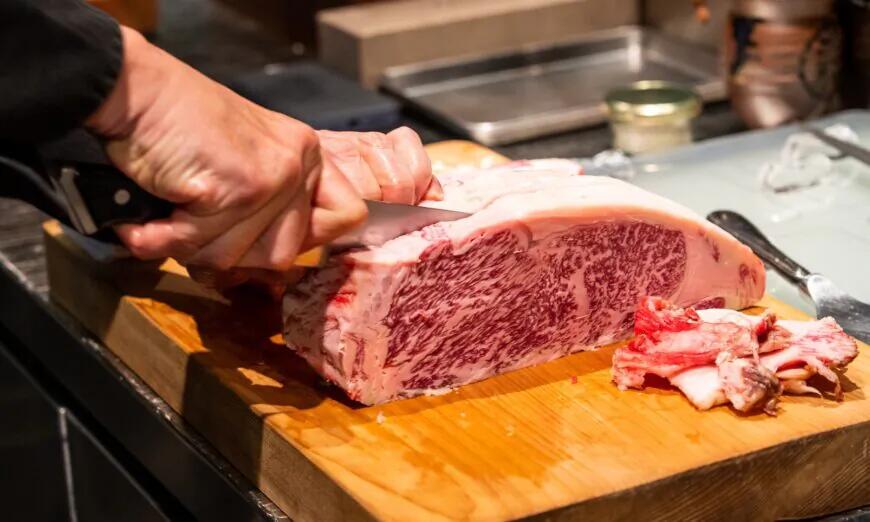
What meat glue does is to allow restaurants and manufacturers to get away with one of the most devious forms of food fakery. Even the meat industry, when it defends transglutaminase, has to acknowledge that it can be used to fool diners. Meat glue is used much more often to “fake a steak” than to make gourmet shrimp noodles, as chef Dufresne did. By sprinkling the enzyme on various scrap pieces of meat, chicken, or seafood, and then binding it tightly in plastic wrap and refrigerating it for several hours, you can turn out a picture-perfect filet mignon, solid piece of chicken, or a top-dollar-looking filet of fish.
Even experts can’t tell the difference.
If you’ve ever attended a banquet or a convention, or maybe even dined in a restaurant, and were served an expensive-looking steak or sushi at a bargain price, you may have wondered how that came to be. The answer is either that the restaurant owner is losing money with each meal or, more likely, that there’s a bag of meat glue in the kitchen.
The fake food industry has also found use for meat glue in a product bizarrely called “JUST Egg,” something that contains no trace of eggs. But along with brain-damaging amino acids, you will find transglutaminase listed on the JUST Egg label—yet another excellent reason to read food ingredients carefully no matter what brand names the products are given.
A Pathway for Pathogens to Get Inside Your Dinner
Fakery aside, meat glue could be contributing to the growing epidemic of food poisoning that hits millions (the CDC puts the number at 1 in 6 Americans or around 48 million every year).
That’s because pathogens, like Escherichia coli, Listeria, and Salmonella (with many strains now antibiotic resistant) mostly appear on the surface of meat. When the outer surface is seared, even if the meat is eaten medium rare or rare, that bacteria have most likely been killed.
When multiple pieces of meat are combined, however, those pathogens could be lurking in the center. Surfaces of the meat that once were on the outside are now in the middle. If you haven’t cooked that meat thoroughly inside and out, you could be in for big trouble.
On an Australian TV exposé of meat glue several years ago, an expert in microbiology commented that “the amount of bacteria on a steak that’s been put together with meat glue is hundreds of times higher” than your average piece of unglued meat.The same is true for chicken and fish.
Now, if you ask the FDA [U.S. Food and Drug Administration], USDA [U.S. Department of Agriculture], and certainly Ajinomoto, you’re going to hear that meat glue is perfectly safe. Sure, there’s that little problem of bacterial contamination, but these US consumer protection agencies appear to be quite confident that restaurants know that glued meat needs to be cooked thoroughly.
The USDA calls it TG enzyme, and gives instructions for cooking stuck-together meat that sounds exactly the same as what it would tell you about cooking all types of raw meat. As far as the FDA is concerned, there’s really no problem with Ajinomoto making its own determination that transglutaminase is generally recognized as safe, or GRAS.
Back in the late 1990s, the USDA received several petitions from both Ajinomoto and another company called AMPC about expanding the use of TG enzyme and attempting to get the consumer labeling (in the supermarket) to be as innocuous as possible.
Both companies got just about everything they wanted. Meat glue can now be used in meat products across the board—both the kind the USDA calls “standardized” and “non-standardized.” (This refers to what’s called a “standard of identity”—a legal description of what it takes for certain foods to be able to use a name such as hot dogs, milk, cheese, bread, etc. For example, if you want to sell something called “Salisbury steak,” it must contain at least 65 percent meat, among other requirements.)
In the case of meat glue, the agency had to change the standard of identity for numerous items like breakfast sausages, frankfurters, and bologna in order to allow for the use of the enzyme. Additionally, it was also approved to be used as a “binder” (something added to food to thicken or improve texture) for “certain meat and poultry products.”
As a result, it’s quite possible that manufacturers are putting it to uses way beyond faking expensive cuts of meat.
Perhaps one of the most important reasons you need to go out of your way to avoid this badditive has to do with a more recent discovery—one that might help explain the explosion of gut and digestive troubles that are plaguing so many these days.