Search This Blog

Sunday, August 20, 2023

FDA Pilot Program for Cancer Diagnostics Met with Skepticism

The FDA has established a voluntary pilot program intended to address the risks when targeted cancer treatments are approved without a companion diagnostic.

Companion diagnostic tests (CDx) analyze human samples for biomarkers to help match patients to specific treatments. Typically, the FDA will approve a CDx and a therapeutic product contemporaneously, but in some circumstances, a cancer therapy that requires the use of a CDx will be approved even if a corresponding test has not yet received marketing authorization.

In these cases, healthcare providers may use tests developed by laboratories—a laboratory developed test (LDT)—to make treatment decisions.

LDTs are intended to fill in the gap and are not necessarily regulated by the FDA in the same way as other in vitro diagnostics, Scott Danzis, partner and chair of the Medical Device Industry Group at Covington & Burling, told BioSpace.

As a result, the FDA said it has become “increasingly concerned” that some unauthorized LDTs may not provide reliable, accurate results, which can then negatively impact treatment decisions for cancer patients, the agency stated in a June 2023 press release announcing the pilot program. In 2015, the FDA published 20 case studies highlighting the potential dangers of unauthorized tests, including false negatives in detecting breast cancer and false positives in detecting ovarian cancer.

“Companion diagnostics are the only piece of information that a doctor and patient will get that will tell them whether they should take a particular targeted drug or not,” Liz Mansfield, vice president of regulatory policy at Foundation Medicine, told BioSpace. “You don’t want to get that wrong.” 

Regulatory Ping Pong

The FDA has a long regulatory history with LDTs. The agency views the tests as medical devices under its regulatory purview but exercises “enforcement discretion,” meaning that the agency chooses not to enforce FDA requirements. As such, LDT manufacturers are not required to submit a test for FDA approval.

But Mansfield told BioSpace that without that regulatory oversight, quality comes into question. “There’s really no way of knowing if a test that hasn’t gone through FDA review is high quality or not,” she said.

LDTs are overseen by the Centers for Medicare and Medicaid Services through the Clinical Laboratory Improvement Amendments (CLIA). When developed without FDA clearance or approval, the CLIA requires labs to establish a test’s analytical validity—that is, how well it reflects what it is intended to measure—before results are released.

“There are certainly a lot of reasons to think that the system is working quite well,” Danzis said. He noted that laboratories are subject to federal and state regulation and go through a rigorous process of validation.

Although the CLIA requires that analytical validity be established, however, it does not require labs to establish clinical validity—how accurately a test identifies people with a specific clinical condition or risk. LDTs seeking FDA approval through the in vitro diagnostic pathway, on the other hand, must provide information about both analytical and clinical validity.

To address this regulatory gap, the newly announced pilot program will publish minimum performance characteristics recommended for LDTs that are not authorized by the FDA.

The regulator will request performance information for tests that were used to enroll patients in clinical trials testing subsequently approved therapies and then post to its website the minimum recommended performance characteristics for similar tests that could be used after approval. Laboratories creating LDTs will then be able to use the published characteristics to guide the development of such tests.

This transparency aims to help facilitate better and more consistent performance of LDTs, potentially resulting in better drug selection and improved care for patients with cancer, an FDA spokesperson told BioSpace in an email.

For now, the program is entirely voluntary, the FDA spokesperson noted. The agency is inviting participation and will accept no more than nine drug sponsors into the pilot program.

Experts Remain Skeptical

Mansfield expressed skepticism that the pilot program will be beneficial for the industry, noting that LDTs are still effectively unregulated even if companies participate.

“[The pilot program] is effectively legitimizing tests that FDA has never looked at,” she said. “The FDA actually won’t review any of the tests. It’s up to the test manufacturer or the laboratory to say, ‘Hey, we meet the minimum performance characteristics,’ but there’s no proof they actually do because FDA isn’t looking.”

The FDA representative confirmed via email that it will not perform its own evaluations of test performance and said test developers and drug sponsors gather those data through clinical trials. Collecting this type of data is outside the purview of the agency, the representative added.

“At Foundation Medicine, we create LDTs. We don’t have to go to the FDA, but we choose to do that to demonstrate that we are high quality,” Mansfield said. “We would like to benefit from that extra effort and not be put in a pool with every other test that claims to meet minimum performance criteria.”

Danzis took a more neutral stance on the pilot program. “I’m waiting to see where it goes and how successful it is,” he said. “I think recognizing the role that laboratories play in the diagnostic industry is a positive thing for the agency and for the healthcare system more broadly.”

He added that the question of regulating LDTs extends beyond the pilot program. “If FDA wants to regulate LDTs, my view has long been that the legislation should be enacted by Congress, giving [the regulator] that clear authority and developing a system that’s suited for the unique characteristics of laboratory diagnostics.”

https://www.biospace.com/article/fda-pilot-program-for-cancer-diagnostics-met-with-skepticism-/

CRISPR Shows Preclinical Promise in Treating Alzheimer’s as Challenges Persist

 CRISPR-Cas9—the Nobel Prize–winning gene-editing system developed by Jennifer Doudna and Emmanuelle Charpentier—is on the cusp of breaking into clinical trials for Alzheimer’s disease, but experts note barriers that must be overcome and question whether scientists might be moving too quickly. 

In Amsterdam last month at the Alzheimer’s Association International Conference (AAIC), researchers from the University of California San Diego (UCSD) and Duke University School of Medicine presented two different approaches leveraging CRISPR to prevent and treat Alzheimer’s.

At UCSD, Brent Aulston’s team is using CRISPR to edit the amyloid precursor protein (APP), a transmembrane protein expressed in many tissues throughout the body but concentrated in the synapses of neurons.

Brent Aulston_UCSD
Brent Aulston

“We know from human populations that all the genetic causes of Alzheimer’s disease affect how APP is processed,” Aulston told BioSpace. “APP is essentially physically cut within the cell by one or two enzymes.”

The first of these enzymes is alpha secretase. When APP is cleaved by alpha-secretase, a protective molecule called secreted APP-alpha is released. “In healthy people, the majority of the APP is being cleaved to produce secreted APP-alpha,” Aulston said. However, in Alzheimer’s patients, APP is pushed toward the other cleavage pathway, mediated by beta-secretase. “This causes kind of the classical toxic fragments known as amyloid-beta peptides.” 

Using CRISPR tools, Aulston’s team is working to change the APP gene, “so that we get more alpha cuts and less of the beta cuts.” 

Aulston emphasized that the intention is not to knock out the entire APP protein. “APP is a very important protein in the brain. It has a lot of functions. If you take the APP protein out of a mouse, the mice are smaller, their brains are smaller, there’s more neuroinflammation [and] they’re cognitively compromised. We still want that protein expressed.”

So, the researchers designed their CRISPR to edit out only a small portion of APP, aiming to keep the resultant protein from coming into contact with beta-secretase. Testing out the approach in mice, the team showed that the animals had fewer amyloid-beta plaques and markers of brain inflammation but more of the neuroprotective APP.

“You keep all the physiological functions of APP . . . and you actually get an increase in secreted APP alpha,” Aulston said. The mice also showed improvement in behavioral and neural symptoms. “We believe this demonstrates that, in mice, our potential treatment strategy is both safe and efficacious,” Aulston said in the abstract presented at AAIC. “These results justify future studies aimed at getting APP CRISPR editing into human testing.”

But Rudolph “Rudy” Tanzi, a professor of neurology at Harvard Medical School and Massachusetts General Hospital who co-discovered the APP gene, told BioSpace he has concerns about using CRISPR to alter this protein. “For fun, we would say APP stands for ‘all-purpose protein’ because it does so many things,” he said. Among other roles, he noted that APP helps to stabilize and integrate synapses and helps blood to clot in the event of an injury.

Tanzi added that amyloid-beta acts as one of the brain’s main host defense mechanisms. In editing out the amyloid-beta domain, Tanzi said two things will be lost: an antimicrobial peptide property that protects against infection and a checks-and-balances system that quells synaptic excitation firing. “Without amyloid-beta, the cells will keep firing,” he said. Among other potential problems, overexcited neurons can trigger proteins in target muscle cells to become stressed, misfolded and non-functional.

Duke Targets APOE

On the opposite coast, researchers from Duke University School of Medicine are using CRISPR-Cas9 gene editing to downregulate the expression of the APOE ε4 gene, which is associated with an increased risk of Alzheimer’s. It is estimated that 15% to 25% of the population carry this allele, while up to 5% have two copies.

Ornit Chiba-Falek_Duke University
Ornit Chiba-Falek

Like Aulston, Ornit Chiba-Falek, professor in neurology, division chief of translational brain sciences at Duke and senior author of the study presented at AAIC, told BioSpace that the intention is not to entirely eliminate the APOE protein, which helps carry cholesterol and other types of fat in the bloodstream, but rather to fine-tune the levels of the different variants. APOE ε2, for example, is thought to provide some protection against Alzheimer’s, while APOE ε3, the most common variant, is believed to have no effect on the disease. The Duke team aims to specifically reduce the production of the protein encoded by APOE ε4.

The platform “demonstrated an efficient and precise editing of APOE ε4 and APOE expressions” in miniature brains derived from human induced pluripotent stem cell (hiPSC) from an Alzheimer’s patient and in humanized mouse models, the authors wrote in the abstract presented at AAIC. Importantly, they continued, the specific targeting of the ε4 allele “has resulted in no detectable editing of the ε3 allele in the isogeneic hiPSC-derived neurons.”

Chiba-Falek and Boris Kantor, associate research professor of neurobiology at Duke and the study's first author, co-founded a biotech company, CLAIRIgene, to further develop the platform, and Chiba-Falek said they are exploring collaboration opportunities with the pharmaceutical industry. Next up are IND-enabling studies, which she said will focus on safety, route of administration and durability.

Tough Translational Terrain

Having proven the APP-editing concept, Aulston said his team has climbed the first mountain. “Now, we’re at the base of the other mountain, which is the translational side,” he said. “As it turns out, the human brain is a little more difficult to treat than a small mouse.”

Gerold Schmitt-Ulms_University of Toronto
Gerold Schmitt-Ulms

Gerold Schmitt-Ulms, a professor at the University of Toronto studying Alzheimer’s, tauopathies and prion disorders, expressed his concerns about CRISPR’s translatability to neurological diseases. He told BioSpace the technology is “lagging behind” other gene therapy approaches in this space for two main reasons: immunogenicity and delivery challenges.

On the first point, Schmitt-Ulms said the adeno-associated virus (AAV) capsids used in the delivery of the CRISPR machinery will generate an immune response that can limit the effectiveness of the therapies. “Around 70% of us have had exposure to natural AAVs and therefore carry antibodies in our blood that would destroy AAV-based gene therapy vectors,” he said. In addition, “the body has never seen CRISPR enzymes. They’re like foreign agents, and when you express them, there will be immune responses raised to them.”

Most current gene therapy clinical trials for neurodegenerative diseases involve the delivery of a particular overexpressed protein, Schmitt-Ulms said. “These are proteins that the body knows. APOE ε2, for example, is known to the body and won’t raise an immune response.”

As for delivery, “To date, no one can deliver any of these gene therapies to every cell in the human brain,” Schmitt-Ulms said. “The best one can currently achieve is that a few percent of the brain cells take up the therapeutic virus. Often, that is not enough for the desired benefit to manifest.”

Given the challenges, Tanzi said he believes CRISPR should be used only in extreme cases, such as for people carrying two copies of APOE ε4.

“I think we’re moving a little too fast, honestly, into genomic editing,” he said. “As a geneticist, I kind of think about the genome the way the sailor thinks about the ocean. We respect it. We live with it. Once you think you know it, it can take you out.” 

US 'Rent-A-Womb' Industry Thrives Due To Demand From Parents In China: Researcher

 by Ella Kietlinska and Joshua Philipp via The Epoch Times (emphasis ours),

The “rent-a-womb” industry pipelines children born of surrogates in the United States to parents in China, a researcher said. Babies born this way automatically gain U.S. birthright citizenship.

Chinese “rent-a-womb” industry, has been burgeoning in the United States for about a decade, particularly in California, where laws regulating commercial surrogacy and in-vitro fertilization (IVF) are permissive, said Emma Waters, a research associate for the Center for Life, Religion, and Family at The Heritage Foundation.

Surrogacy, a practice where a woman carries a pregnancy and gives birth to a baby for another person or couple, is completely banned in China.

Therefore Chinese couples use services offered by American fertility clinics that create for them embryos potentially having the biological makeup of the Chinese nationals, and birth the baby in the United States, Ms. Waters said in an interview on Epoch TV’s “Crossroads” program on Aug. 11.

With birthright citizenship laws in the United States, that child, who may be 100 percent Chinese national in their biology and genetic makeup, actually gains and maintains the full rights of U.S. citizenship, Ms. Waters explained.

When that child turns 21, even the parents can apply for a green card and eventually get citizenship, “which is a much faster and cheaper process than if they were to apply for citizenship through some of the traditional methods,” she added.

Threat to National Security

Giving foreign nationals full access to American citizenship through the wombs of American women poses “a huge national security threat,” Ms. Waters said.

If a child is born and raised in China, inculcated in their culture, and very loyal to their lands, when they come to the United States, they’re not being flagged as a foreign national who’s applying for a job or applying to work in a research lab—they are applying as a U.S. citizen.”

“There’s not a database that’s publicly available or easy to access where these children are being listed. And so should they apply for jobs, employers in government or private sector have no idea of the background that they’re dealing with.”

The situation was made possible due to the lack of regulation and laws around this, Ms. Waters said.

Ms. Waters suggested that the House Select Committee on the Chinese Communist Party, which has been studying Chinese investment in areas such as entertainment, farmland, and media, needs to spend more time investigating Chinese investment in Americans through Chinese children created in America by in-vitro fertilization and commercial surrogacy.

How Fertility Industry Works

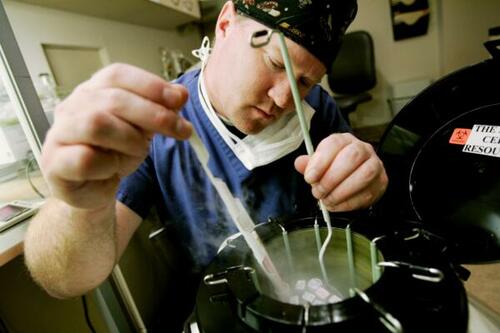
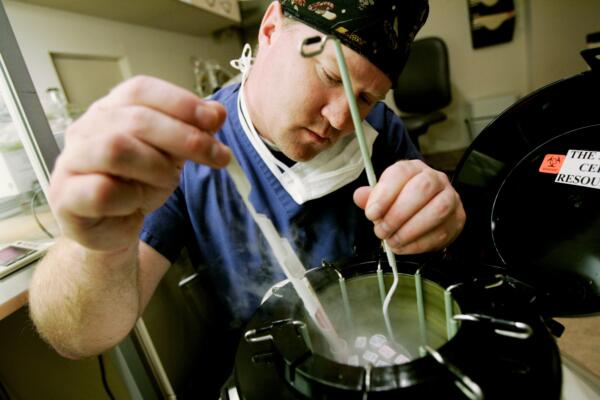
Embryologist Ric Ross pulls out vials of human embryos from a liquid Nitrogen storage container at the La Jolla IVF Clinic February 28, 2007 in La Jolla, California. (Sandy Huffaker/Getty Images)

When Chinese nationals connect with a fertility clinic, particularly in California, they have an option to “either create an embryo using their own sperm and egg or they can purchase a sperm or egg,” Ms. Waters explained.

In many cases, they travel to the United States, but with the current technology, they are technically not required to leave China in order to create an embryo, she continued.

“A Chinese couple or individual can simply work with a U.S.-based agency to send their reproductive material (sperm, egg, or embryo) to an IVF lab and implant it in a hired surrogate [in the United States] to produce a viable pregnancy,” Ms. Waters wrote for the Heritage Foundation.

Ms. Waters reviewed recently about 450 fertility clinics, particularly in California, but there is many more outside of that. she said. “Many of these fertility clinics actually have a direct or indirect connection to China.”

https://www.zerohedge.com/political/us-rent-womb-industry-thrives-due-demand-parents-china-researcher

FDA 'Clarifies' That Ivermectin Remains Unapproved For COVID-19 But Docs Can Prescribe

 by Aldgra Fredly via The Epoch Times (emphasis ours),

The U.S. Food and Drug Administration (FDA) on Aug. 17 clarified that it had not authorized or approved the use of ivermectin in preventing or treating COVID-19.

Ivermectin is an FDA-approved antiparasitic drug that is used to treat neglected tropical diseases, including parasitic worm infections (helminthiases), onchocerciasis (or river blindness), and scabies.

The FDA stated that while it had approved ivermectin for certain uses in humans and animals, it had not issued any statement affirming the safety or effectiveness of the drug for treating COVID-19.

"We've seen lots of chatter about ivermectin in the last week. Some of what you're seeing in videos and social media posts isn't true," the FDA stated on X, formerly known as Twitter.

Doctors in the United States, though, are able to and regularly prescribe approved drugs for purposes for which they are not approved.

"Health care professionals generally may choose to prescribe an approved human drug for an unapproved use when they judge that the unapproved use is medically appropriate for an individual patient," the FDA said.

The FDA pointed cited the National Institutes of Health COVID-19 treatment guidelines, which recommend against using ivermectin for COVID-19 treatment due to a purported lack of evidence supporting its effectiveness. Some studies have found that ivermectin is effective against COVID-19.

The agency was responding after some people, including Sen. Ron Johnson's (R-Wis.), claimed that the FDA has "quietly approved" the use of ivermectin for COVID-19.

“The doctors I’ve been dealing with and talking to for years now, they believe that probably hundreds of thousands of Americans lost their lives because they were denied early treatment and they were denied because the FDA sabotaged, for example, ivermectin,” Mr. Johnson told FOX News on Aug. 11.

"We are going down a very dangerous path, but it's a path that is being laid out and planned by an elite group of people that want to take total control over our lives, and that's what they're doing bit by bit," he added.

Ashley Cheung Honold, a Department of Justice lawyer representing the FDA, had said during recent oral arguments in a legal case that the FDA "explicitly recognizes that doctors do have the authority to prescribe ivermectin to treat COVID."

The government was defending the FDA's repeated exhortations to people to not take ivermectin for COVID-19, including a post that said "Stop it."

The case was brought by three doctors who allege the FDA unlawfully interfered with their practice of medicine with the statements. A federal judge dismissed the case in 2022, prompting an appeal.

Ms. Honold said the FDA's statements "don't prohibit doctors from prescribing ivermectin to treat COVID or for any other purpose." She said the agency advised people to consult their health care providers and that they could take medicine if the provider prescribed it.

"FDA is clearly acknowledging that doctors have the authority to prescribe human ivermectin to treat COVID. So they are not interfering with the authority of doctors to prescribe drugs or to practice medicine," she said.

Study On Ivermectin's Effectiveness

According to a new peer-reviewed ecological study, a natural experiment occurred when the government of Peru authorized ivermectin for use during the COVID-19 pandemic resulting in evidence of the drug’s effectiveness and ability to reduce excess deaths.

The paper’s results, published Aug. 8 in Cureus, found a 74 percent reduction in excess deaths in 10 states with the most intensive ivermectin use over a 30-day period following peak deaths during the pandemic.

When analyzing data across 25 states in Peru, researchers found these reductions in excess deaths correlated closely to ivermectin use during four months in 2020.

When ivermectin was available without restriction, there was a fourteenfold reduction in nationwide excess deaths. Once access to ivermectin was restricted by the government, a thirteenfold increase in excess deaths was observed in the two months following the limitation of its use. The findings align with summary data from the World Health Organization for the same time period in Peru.

Zachary Stieber and Megan Redshaw contributed to this report.

https://www.zerohedge.com/political/fda-clarifies-ivermectin-remains-unapproved-covid-19-docs-can-prescribe

How to remove PFAS “forever chemicals” from your tap water without breaking the bank


PFAS, forever chemicals, study
A recent USGS study sampling hundreds of drinking water sources around the nation found at least one PFAS “forever chemical” in 45% of samples. Some had more than one of the potentially toxic chemicals. But there are ways to filter them out. (USGS)

The best time for a helpful consumer guide from experts is right after a consumer scare from experts. Environmental Working Group and the U.S. Geological Survey have come through on both regarding the  dangers from PFAS “forever chemicals” in Colorado and U.S. tap water. 

July study from USGS of hundreds of drinking water agencies and private wells in every state found at least one of the toxic forever chemicals in 45% of samples. The PFAS variants found — there are thousands — included PFOA and PFOS, the limits of which the EPA revised sharply downward this year to four parts per trillion. 

The study’s rollout in the August edition of the journal Environment International was quickly followed, coincidentally, by the nonprofit Environmental Working Group’s release of a consumer’s guide to filtering PFAS out of home tap water. We talked with EWG senior scientist Tasha Stoiber about their findings.

What can consumers do about PFAS in their drinking water? 

“The first step is awareness,” Stoiber said. She recommends homeowners and renters first check EWG’s interactive map of PFAS test results from contaminated sites around the country. They can also go to the website of their local water provider, as they post their PFAS results with clear explanations. Consumers with private wells can often use state-supported programs or information sites to link up with testing. Here is one for Colorado.  

Should everyone be filtering their drinking water for “forever chemicals”? 

Environmental Working Group says “yes.” State governments have varying advice, but it often comes down to, if you’re worried, why not? Home filters can take out lead coming through old city water lines, chlorine, and smells and tastes from some municipal supplies that are not dangerous but can make home water unpleasant. Many can now take out all or most of the PFAS as well. 

“The emotional burden of worrying about this, obviously should not fall onto consumers, it should fall onto communities,” Stoiber said. “This is a regulatory failure that the drinking water has become so contaminated, and we do need top-down solutions, of course, and it should be the polluters that pay. But in the meantime, if people have questions about what filters remove, this testing was designed to answer those questions and to give people an idea of what can be effective for a quick solution.”

How can you filter PFAS from your tap water? 

The most effective way is also the most expensive: An installed under-sink water filter with optimal water cleaning can run up to $1,000, and the water is not chilled. 

EWG instead tested a number of pitcher-style filters. They look similar to the most popular brand, Brita, and to the pitchers given away by Denver Water to neighborhoods that may wait years to have their lead water lines replaced. But the replaceable filters they tested have been upgraded to target PFAS as well. 

“Pitcher filters have gotten a little bit more advanced, and I think there are some good options for people,” Stoiber said.  

Which pitcher filters effectively — and affordably — filter PFAS? 

“Four water filters reduced the PFAS in the water used in our testing by 100% or came close, offering a great boost to your efforts to protect your family’s health,” EWG’s report says. 

  • The Travel Berkey filter, online for $344, got a top rating for removing 100% of PFAS traces EWG found in pre-filtered tap water. EWG calculates the first-year cost of each product, when taking into account the pitcher cost and whatever number of replacement filters that brand needs in one year of average use. The Travel Berkey filter should last up to eight years, or 6,000 gallons. 
  • Clearly Filtered offers one of the other tested pitchers that removed 100% of the PFAS, according to EWG. Testers also liked the large pitcher size. It’s expensive to operate for the first year once replacement filters are factored in, at $436.50, however. The water passes through the filter more slowly than on other pitchers, and priming the filter the first time can pose challenges for those living with disabilities, EWG said. 
  • ZeroWater’s pitcher had a low purchase cost at $25, but takes a lot of replacement filters and consumes $646 to operate for the first year. It does remove all the PFAS tested, however. 
  • Epic Pure was a tester favorite at $247.87 to run for the first year. They liked the large pitcher volume and easy refilling, as well as easy filter replacement. The system removed 98% of the PFAS found in the sample water.  
  • The EWG report does sample other brands of pitchers, without recommending them as highly. The brand name you’ve likely heard of, Brita, gets good marks for affordability and convenience, but only removes 66% of the PFAS, which EWG calls “better than nothing” but not optimal. 

Stoiber notes that after years of terrible news about the spread of PFAS and the high costs of removing it from centralized water systems, there’s some hope with the EPA’s new stricter standards and lawsuits recovering cleanup costs from the chemical manufacturers. EWG would like consumers to keep thinking about the bigger picture, alongside bigger pitchers. 

“Speak up to local officials,” Stoiber said. “It should be asked of them, what is our community doing to improve the drinking water in our area? Do we have contamination, and are we tackling that at the community level?”

https://coloradosun.com/2023/07/13/remove-pfas-forever-chemicals-tap-water-filters/

'China’s Low Births, Weaker Growth Cut Infant Formula Demand'

 China’s falling birth rate and sluggish economic recovery are expected to cause a double-digit decline in the country’s infant formula market this financial year, a2 Milk Co. said Monday.

Still, the company expects to clinch a bigger share of the shrinking infant milk formula market, which comprises almost 70% of the company’s sales, in 2024, it said in its full-year earnings statement.

A2 Milk shares fell as much as 9% in early Wellington trade, hitting the lowest price since July 2022, after its full-year earnings met analyst estimates.

The China market is “challenging” for now but is expected to steady in the longer term, Chief Executive Officer David Bortolussi said in an interview.

“Even if it [the Chinese market] does decline more in the future, then it will eventually stabilize,” he said. “It’s not going to continue to decline at the rates that it is at the moment. We still have an enormous market opportunity for us and share gain opportunity going forward.”

The number of babies born in China fell 10% to 9.6 million in 2022, and is expected to fall further this year, due to the lagged impact of Covid-19, challenging macroeconomic conditions, and youth unemployment rates, with an increase in births expected next year, a2 said in its full-year results statement. Competition is also increasing in the Chinese market, it said.

A2’s overall revenue in Asia grew 38%, as the value of China’s overall formula market declined around 14%.

China posted sluggish economic recovery following the end of the nation’s Covid Zero policy late last year and Chinese parents are increasingly favoring local baby formula brands, Bloomberg Intelligence said prior to the earnings, adding to headwinds for companies such as a2.

The company, which gets about 63% of its revenue from China and other parts of Asia, reported earnings before interest and taxes of NZ$219.3 million ($129.9 million), meeting analyst estimates. Net income also met estimates, rosing 26% to NZ$144.8 million.

China granted a2 regulatory approval this year to keep selling its baby formula in the country until September 2027. The company’s products are sourced from cows that produce only the A2 type of beta-casein protein, which a2 says makes its products easier on digestion.

China’s infant formula milk market could shrink by almost a third by 2025 if the country’s birth rate continues falling at its current rate, according to a Bloomberg Intelligence report earlier this year. In 2022, the nation’s population started shrinking for the first time in six decades.

https://finance.yahoo.com/news/china-low-births-weaker-growth-233027192.html