Search This Blog

Wednesday, August 23, 2023

Ramaswamy company pitched govts on effort to install universal covid patient records surveillance database

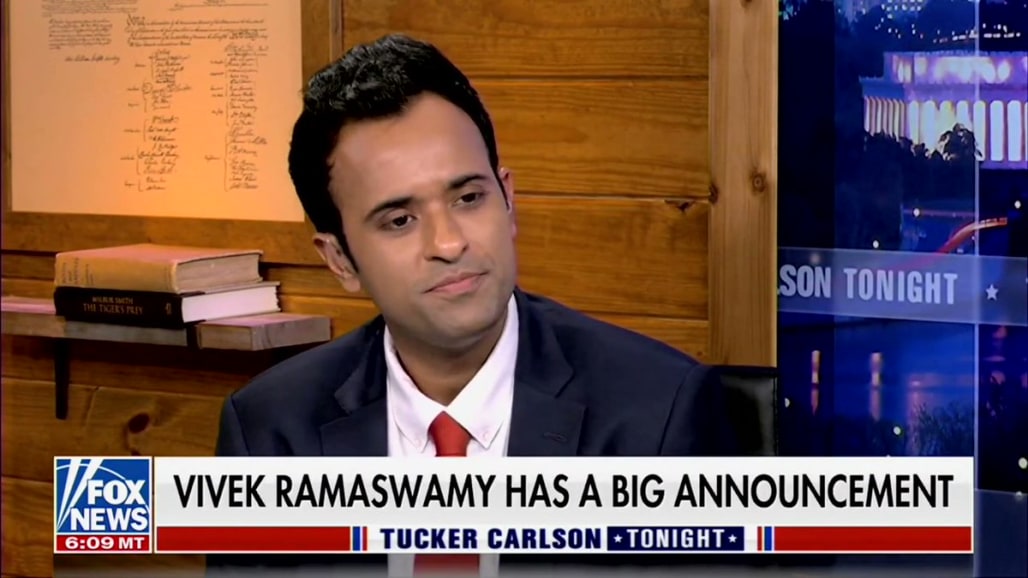
 Before rebranding as a warrior for free speech and a passionate crusader for privacy rights, newly announced presidential contender Vivek Ramaswamy was pitching the U.S. and world governments on his efforts to install a broad, centralized database of private medical records.

In a pursuit forged through one of his subsidiary companies, a “health information” data mining outfit called Datavant, Ramaswamy’s outfit pursued the establishment of a single national and global database for all covid-related patient health records.

Through a partnership with Snowflake, a San Francisco based cloud computing company, Ramaswamy wanted to “fight covid-19” by manufacturing a “single repository of all the real-world medical data” thanks to the production of a “national data infrastructure” of private and public patient records, all without the consent of the actual patients.

Datavant claimed the records would be anonymized through their internal systems and that the broad database would only be available to researchers and government officials. However, some weren’t buying the sales pitch, citing gross violations of medical privacy. Moreover, none of the methods to supposedly anonymize records were made open source for review.

Nonetheless Ramaswamy’s Datavant sought to profit off of the hysteria and violate basic ethical standards in the process. They succeeded in establishing a partnership with the National Institutes of Health (NIH).

While some companies were happy to contribute to the Datavant endeavor, citing the “national emergency” as the ultimate precedent for violating patient consent standards, many others balked at the idea, citing privacy issues.

Anthem Inc (now known as Elevance Health), the second largest health insurance company in the U.S., rejected the appeal to deliver customer records into a national and global database. When reached by the Wall Street Journal, an Anthem spokesperson said that “Anthem takes the security of its data and the personal information of health plan members very seriously.”

“Datavant’s proposed registry would be free for government and academic researchers to access, and would aim to include every patient who has been tested for Covid-19, the disease caused by the new coronavirus,” The WSJ story reported. “The consortium is aiming to have data covering 80% of U.S. medical claims, including those submitted to private insurers as well as Medicaid and Medicare Advantage.”

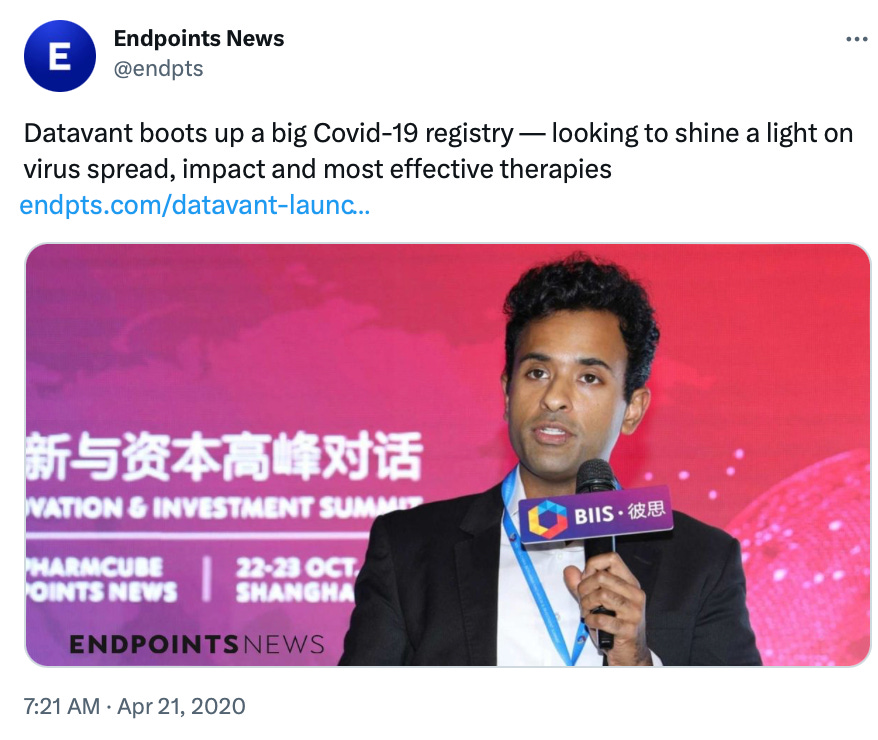
Harlan Krumholz, a cardiologist at Yale University, expressed concern about Ramaswamy’s data mining effort, telling Endpoints News: “This is highly sensitive information and the effort is important, but it is important to know the details.”

Datavant later helped to establish a Covid-19 research database. However, like most of Ramaswamy’s previous business ventures, the end product was not remotely successful. The database is linked to a handful of incredibly shoddy covid-19 studies.

On the campaign trail, Mr Ramaswamy has presented himself as a fierce privacy advocate and “free speech absolutist.” Nonetheless, his blunder-heavy business record shows a man who has long been invested in financing and developing tools to invade sovereignty and personal privacy.

For more on Ramaswamy’s paradoxical advocacy, and his continually changing political posturing, read Vetting Vivek Ramaswamy in The Dossier

Hat tip to Jurassic Carl on Twitter for his research on the Ramaswamy Datavant database.

https://www.dossier.today/p/ramaswamy-company-pitched-governments

Biopharma Patent Cliff: 9 Drugs Losing Exclusivity by the End of 2023

 The biopharma industry has been creeping over a patent cliff for months, with several drugs losing their primary patents and more patents expected to expire in the next seven years. This opens the door for new generics to enter the market, lowering drug prices and therefore reducing how much manufacturers can rake in from brand name products.

Maria Whitman, global head of ZS Associates’ pharmaceutical and biotech practice, previously told BioSpace that drugs going off-patent could impact between up to 79% of a company’s revenues. Drug prices go down any time a new generic becomes available, but the impact may be more pronounced around patent cliffs. One analysis found that the steepest price declines for brand name drugs between 2008 and 2014 occurred when the first three generics were introduced.

Not every company will experience this decline in the same way. For example, Eraxis, an antifungal drug owned by Pfizer, is expected to lose its exclusivity in September. But loss of exclusivity probably won’t have a major impact on the company, said S. Sean Tu, a law professor at West Virginia University and affiliated faculty at Harvard Medical School’s Program on Regulation, Therapeutics and Law.

“Even if a lot of generics [for Eraxis] went on the market tomorrow, I don’t think it would hurt Pfizer’s bottom line. They have a pretty diverse portfolio,” Tu told BioSpace.

Smaller companies like Eiger Pharmaceuticals may have more to lose. The company has one commercial product, Zokinvy, that will start losing exclusivity soon. In SEC filings, Eiger warns investors that it may never be profitable.

Just because the primary patent for a drug expires, it doesn’t automatically mean other companies are free to start marketing generics. For example, AbbVie filed hundreds of patents for its biologic drug Humira, preventing other companies from producing generic adalimumab. It was only after a 2017 settlement that Amgen was able to start marketing biosimilars overseas, and eventually in the U.S. in January of this year. Then, last month, a flood of new Humira biosimilars hit the market.

Owning multiple patents for a single drug, what’s known as patent thickets, help drug companies make up for lost time and costs during the FDA approval process, according to Tu. However, more companies are relying on them to limit competition. A research letter authored by Tu and others found that recently approved drugs have more patents filed and more patents litigated compared to older drugs, leading to delays in generics entering the market.

Here are some drugs that may see generic versions enter the market soon.

  1. Takeda’s Vyvanse, Aug. 24

Vyvanse (lisdexamfetamine dimesylate) is an oral amphetamine used for attention-deficit hyperactive disorder. New River Pharmaceuticals filed a provisional application for the drug in 2003 and the patent was issued in 2007. It was eventually acquired by Shire and later Takeda, bringing in $2.52 billion for the Japanese company between March 2021 and 2022. The patents covering adult indications of Vyvanse expired on Feb. 24, and those for the pediatric indications are due to expire Aug. 24. As of July 31, there were 12 tentative approvals for Vyvanse generics, with some issued as early as 2014 and others as recently as June 14, 2023. Companies looking to market these generics include Teva, Mylan and Sandoz.

Tu predicted that the breadth of Takeda’s portfolio would minimize the impact of the loss. Indeed, a financial forecast filed by the company July 27 says that growth and launch of new products are “largely offsetting” the impact of losing Vyvanse’s exclusivity.

  1. Pfizer’s Eraxis, Sept. 22

Eraxis (anidulafungin) is an intravenous antifungal drug. Its patent expired in 2020, but it’s under an exclusivity clause for the treatment of a new patient population that expires Sept. 22. Tu noted that he didn’t see any generic approvals in the pipeline for anidulafungin and therefore doesn’t anticipate a major loss of sales. The lack of generics runs contrary to predictions that generic anidulafungin would enter the market between early 2020 and mid-2022.

  1. Johnson & Johnson’s Stelara, Sept. 25

Stelara (ustekinumab) is a biologic used for psoriasis and Crohn’s disease. A patent for one of the molecules involved in Stelara expires Sept. 25. The drug already has some competition: J&J settled with Alvotech and Teva earlier this year preventing them from marketing biosimilars until 2025. Stelara is not the only drug driving pharmaceuticals sales growth, according to SEC filings, but it brought in more than 10% of the company’s revenue in 2022. Analysts predict that Stelara sales will fall $2 billion in 2024.

  1. Merck’s Isentress, Oct. 3

Isentress (raltegravir) is an antiretroviral drug used to treat HIV. It brought in $633 million in 2022, but sales have been declining due to competition, according to SEC filings. Some of the drug’s patents expired earlier this year, and two more are expected to expire soon, starting in October. Hetero Labs has received a tentative approval for generic raltegravir.

  1. Eiger’s Zokinvy, Oct. 17

Zokinvy (lonafarnib) is the first drug for rapid aging disorder progeria and Eiger Pharmaceuticals’ first commercial product. The drug, acquired from Merck, brought in $12 million for the company in 2022 and $4.1 million in the first quarter of 2023. The drug’s patents are expected to expire Oct. 17, 2023, and July 26, 2024, respectively. However, it has exclusivity clauses extending into 2027, which will protect the drug for a while. Additionally, there do not appear to be any immediate competitors.

  1. Astellas’ Myrbetriq, Nov. 4

Myrbetriq (mirabegron) is a urinary incontinence drug that garnered $1.35 billion for Astellas in 2022. More than one patent is expiring Nov. 4, and additional patents are expected to expire in May 2024. A recent court decision invalidated a patent that was set to expire in 2030, which the company plans to appeal. Zydus Cadila and Lupin Labs are among the companies that have tentative approvals for mirabegron generics.

  1. Novartis’ Entresto, Nov. 27

Entresto is a heart failure medication that combines sacubitril and valsartan. Some patents expired earlier this year, and more are slated to expire in November and the first half of 2024. Additionally, a patent set to expire in 2025 was recently invalidated by a court. Mylan is one company looking to offer generic Entresto. Novartis has settled with other companies looking to market the drug, according to SEC filings.

  1. Amgen’s Otezla, Dec. 9

Otezla (apremilast) is a psoriasis drug. Multiple patents for this drug expired in March of this year, and a patent for a specific formulation of the drug is expected to expire in December. Some of its exclusivity clauses also expired earlier this year. There are already multiple tentative approvals for generics in the wings, but recent court rulings have blocked drugmakers from marketing generic apremilast until 2028.

  1. Novo Nordisk’s Victoza and Saxenda, Dec. 30

Novo Nordisk’s liraglutide recombinant injections have patents expiring at the end of this year and in the first half of 2024. This includes the primary patent for diabetes drug Victoza, which brought in $1.8 billion in 2022. Teva, Pfizer and Mylan are expected to launch their generic liraglutide products in June 2024, per SEC filings. Sandoz is also cleared to launch its version of Victoza in 2024.

Saxenda brought in $1.5 billion in 2022, and the weight loss drug’s main patent expired in February of this year. Novo sued Orbicular Pharmaceutical Technologies and Sun Pharma in 2022 for attempting to market generic versions of the drug.

Novo still maintains a stronghold in the diabetes drug industry with Ozempic, which has also lost patents but likely won’t see generics until 2031. Ozempic sales will likely offset any losses from Victoza and Saxenda; the former brought in $2.9 billion in the first quarter of 2023, compared to $415 million for Victoza and $483 million for Saxenda.

https://www.biospace.com/article/9-drugs-losing-patents-or-exclusivity-clauses-by-the-end-of-2023/

Roche posts interim TIGIT overall survival data after 'inadvertent disclosure,' sending stocks up

 An “inadvertent disclosure” has given the world a look at Roche’s eagerly anticipated TIGIT data. Having kept its cards close to its chest throughout the phase 3 lung cancer study, the Swiss drugmaker published interim overall survival results Wednesday after they were mistakenly made public.

The data drop comes from Roche’s SKYSCRAPER-01, a phase 3 trial that is testing the anti-TIGIT antibody tiragolumab in combination with the checkpoint inhibitor Tecentriq in first-line non-small cell lung cancer (NSCLC) patients. Roche revealed that adding tiragolumab to Tecentriq failed to improve progression-free survival (PFS) last year, causing the study to miss one co-primary endpoint, but never shared numbers. 

Earlier this year, Roche said the clinical trial had continued past an interim analysis of its overall survival (OS) endpoint. The update confirmed that the interim OS data were neither so good nor so bad that the trial needed stopping, but beyond that said nothing about the chances of success in the final analysis. 

Now, Roche has shared the results of the second interim analysis that took place in February. As of the cutoff in November 2022, estimated median overall survival in the tiragolumab combination arm was 22.9 months, compared to 16.7 months in the Tecentriq monotherapy cohort. The hazard ratio was 0.81. Median follow-up at the time of the analysis was 15.5 months. 

The interim analysis shows people on tiragolumab are living longer, albeit not by an amount that was big enough to be statistically significant as of the November cutoff. The final analysis, which is scheduled for the third quarter, remains the key event that will determine whether Roche can recover from its PFS fail and get tiragolumab to market in NSCLC.

Roche’s OS data leak has increased investor confidence. Shares in Roche rose 4.5% to 264 Swiss francs ($300) in early trading in Switzerland in the hours after the release of the data.

The data dragged other TIGIT stocks up, too, with shares in Arcus Biosciences and iTeos Therapeutics rising more than 20% premarket as the interim analysis reignited investor interest in a target that has largely underwhelmed to date.

Analysts at Evercore heralded the unintended readout as “very good data.”

“If you look at the curves, they are expanding,” the Evercore analysts wrote in a Wednesday morning note. “In other words, it is possible that by the time final analysis happens, hazard ratio has improved to just under 0.8.”

J.P.Morgan analysts also noted that the latest findings “suggest … the trial could still be statistically significant at the final analysis.” However, they added that the “detailed data” didn’t change their overall view on tiragolumab’s potential.

“The clinical relevance of the benefit shown by the TIGIT combination is likely to be debated, which means that the product is unlikely to be commercially significant,” the analysts said.

Meanwhile, analysts at Leerink Partners said it remained “unclear to us whether tira[golumab]’s relative benefit will improve enough to meet SKY-01’s stringent statistical boundary.”

https://www.fiercebiotech.com/biotech/roche-posts-interim-tigit-overall-survival-data-after-inadvertent-disclosure-sending-stocks

Agenus Prioritizes Resources to Accelerate Lead Cancer Program

 Agenus Inc. ("Agenus") (Nasdaq: AGEN), a pioneer in immuno-oncology, today announced a strategic initiative to prioritize and focus resources to accelerate the development, registration, and commercialization of its flagship program botensilimab/balstilimab (BOT/BAL). Under this new plan, Agenus will temporarily postpone all preclinical and clinical programs not related to BOT/BAL. The plan will result in a workforce reduction of approximately 25% and deliver approximately $40 million in savings by the end of 2023.

The plan will reduce operating expenses across Agenus' global organization by concentrating its quality, manufacturing, clinical, regulatory, and research & development resources on the BOT/BAL program and drive commercial readiness.

https://finance.yahoo.com/news/agenus-prioritizes-resources-accelerate-registration-120000028.html

Pfizer, Astellas: FDA Grants Priority Review for XTANDI in Prostate Cancer

  Pfizer Inc. (NYSE: PFE) and Astellas Pharma Inc. (TSE: 4503, President and CEO: Naoki Okamura, "Astellas") today announced that the U.S. Food and Drug Administration (FDA) has accepted and granted Priority Review for the companies' supplemental New Drug Application (sNDA) for XTANDI® (enzalutamide) for the treatment of patients with non-metastatic castration-sensitive prostate cancer (nmCSPC; also known as non-metastatic hormone-sensitive prostate cancer or nmHSPC) with high-risk biochemical recurrence (BCR). The FDA grants Priority Review to medicines that may offer significant advances in treatment or may provide a treatment where no adequate therapy exists. The Prescription Drug User Fee Act (PDUFA) date for an anticipated FDA decision is in Q4 2023.

https://finance.yahoo.com/news/fda-grants-priority-review-xtandi-104500801.html