Search This Blog

Wednesday, September 20, 2023

Transgender Ideology Is Harming Vulnerable Patients

 Young patients struggling with gender dysphoria are being permanently harmed by the wrong treatment plan. And faithful families are running out of places to turn for evidence-based, life-affirming alternatives to the manipulative and destructive treatments currently being promoted by leading medical organizations and healthcare systems in order to serve their own profits and ideology. The Catholic Medical Association (CMA) recently published a landmark paper titled "The Ideology of Gender Harms Children," that challenges the medical community’s status quo treatment for these patients. 

Gender dysphoria, the “psychological condition in which the individual feels an incongruence between his or her experienced gender and his or her biological sex,” has for too long been promoted by left-wing politicians and a politicized medical community as a condition with limited solutions: destructive surgical intervention and/or gender affirmation. But these short-sited “solutions” merely exacerbate the intense pain and suffering young patients experience.  

CMA makes a convincing case, grounded in science and ethics, for empowering physicians to practice medicine according to its healing purpose, instead of affirming the child’s confusion, chemically blocking puberty, or administering life-altering cross-sex hormones to their young patients.  

As the paper points out, children struggling with gender dysphoria are often told to select their preferred pronouns as early as three years old, far before they are even old enough to set their own bedtimes or brush their own teeth. By the age of ten, children are put on puberty suppression hormones that “arrest bone growth, decrease bone density... and inhibit fertility.” Such a “treatment” plan is harmful and blatantly at odds with sound medicine.  

The truth is these young children suffer great emotional distress and deserve proper medical attention. CMA recognizes that doctors, parents, friends, and counselors have a responsibility to lovingly accompany and mentor those suffering from gender dysphoria, instead of promoting a dangerous, irreversible, and one-size-fits-all surgical “solution.” 

Indeed, science reveals that transgender “treatments” often do nothing to relieve the emotional pain of people who struggle with gender dysphoria. Studies reveal that between 80 and 90 percent of these individuals naturally embrace their biological sex, without receiving puberty blockers or cross-sex hormones, when given the necessary time and attention to overcome their internal conflicts. Another study from 2020 likewise found that patients who hormonally or surgically “transitioned” from one gender to the other saw no benefits from the procedures. In fact, those who undergo gender-affirming treatments are at a higher risk of “sterility, lifelong dependence on medication and the anguish of regret.”  

It should come as no surprise that so many European countries that once routinely prescribed hormone suppressing drugs, including Great Britain, Sweden, Finland, France and Denmark, no longer use puberty blocking drugs on children. Likewise, many nations and international professional organizations are waking up to the reality that psychotherapy is the most effective treatment for young children struggling with gender dysphoria. 

Catholic Church teachings affirm the use of compassionate counseling as well. In fact, Archbishop Paul S. Coakley of Oklahoma City recently said that the Catholic response to those experiencing gender dysphoria "must both affirm God-given sex and recognize the struggle of the person in front of us."  

Sadly even some in the faith-based medical community have caved to the anti-faith, anti-science transgender agenda which the Biden administration has been forcefully pushing on medical professionals and the patients they serve. Hospitals in America’s largest Catholic health network have been promoting and performing sex change operations in direct violation of Catholic Church teachings and USCCB directives, as well as in opposition to the science surrounding gender dysphoria. 

Intense pressure from lawmakers and hospitals to conform to the transgender narrative shines a light on the desperate need for reform in this important area of healthcare. Children deserve access to authentic care from life-affirming providers who are free to practice according to sound medicine and ethics which respects the dignity and worth of every individual. It is toward this end that we established Solidarity HealthShare as a way for families to access the quality of care they deserve. 

CMA should be applauded for pushing back against the widespread erosion of medicine which is causing great harm to vulnerable children, and we are thankful for their courage to speak out on such a divisive topic. There is great confusion and uncertainty today about what is and is not authentic healthcare as political ideology erodes, overwrites, and manipulates science to advance its life-denying agenda.  It’s our hope that powerful politicians, doctors, and every medical organization will soon join CMA in rejecting any form of harmful intervention – and replace it with loving concern for the authentic wellbeing of children. 

Chris Faddis is president of Solidarity HealthShare, a healthcare sharing ministry guided by the moral teachings of the Catholic Church that negotiates directly with providers to ensure delivery of high-quality and affordable, life-affirming healthcare for the more than 46,000 Members it has served since 2016.  

https://www.realclearhealth.com/blog/2023/09/20/transgender_ideology_is_harming_vulnerable_patients_980736.html

Eagle Pass mayor signs emergency declaration amid migrant surge, awaits numbers from feds

 Mayor Rolando Salinas of Eagle Pass today signed an Emergency Declaration after the new surge of migrants started arriving this weekend.

The mayor says he is still waiting to get official numbers from the federal government as to how many have actually crossed. In the meantime, Salinas says if Eagle Pass gets the disaster funding through this declaration it will go towards reimbursing fire and police resources that had to be used so far.

Salinas also stated the city of Eagle Pass would not be opening a shelter. "We don't have the funds or resources to do that," said Salinas.

The city says Mission Border will continue providing help to migrants dropped off at the shelter by Border Patrol after being processed.

https://news4sanantonio.com/news/local/eagle-pass-mayor-signs-emergency-declaration-amid-migrant-surge-awaits-numbers-from-federal-government

Free COVID test kits are coming back

 The Biden administration is preparing to resume taking orders for free at-home COVID-19 tests starting September 25, officials announced Wednesday. The administration is also planning a new infusion of money to boost domestic manufacturing of the test kits. 

How to order free COVID tests

Four free tests will be available for each household to request through the government's COVIDTests.gov portal beginning on Monday, Sept. 25 

Tests will be shipped through the U.S. Postal Service, and would not be directly affected by a potential government shutdown if Congress fails to pass a funding bill by the end of the month.

"We have been looking at what we've seen before in the increase in cases. We think being able to make tests available is just an important tool that we have and can make available," said Dawn O'Connell, head of the Administration for Strategic Preparedness and Response, which oversees the federal stockpile of tests.

The government previously offered free test kits last winter, but shipments through the website have been on pause since May to conserve supplies of the tests.

However, officials have stressed that other free testing options have remained available to many communities through efforts like the Centers for Disease Control and Prevention's Increasing Community Access to Testing program at retail drug stores. 

"We've had these stockpiled. We'd rather folks have these tests in their medicine cabinets that they can use now, than sitting in a stockpile somewhere. So we really think it's just been an important tool, and we made an active decision to make it available now," said O'Connell.

Four free antigen tests

The four at-home tests that will be shipped are coming out of a supply that will remain usable through at least the end of the year, under expiration date extensions greenlighted by the Food and Drug Administration

Authorities have said that COVID tests are continuing to work as well as they did with other recent variants, for the latest strains on the rise. That includes the highly mutated BA.2.86 variant that has been spotted around the world and in several U.S. states. 

The free COVID tests being offered will be antigen tests, which are generally cheaper and easier to use than some other at-home molecular or lab-based options, but have a higher chance of yielding false negative test results  — meaning they miss some cases where a person is actually infected.

After studies of false negative results last year from antigen tests, the FDA has urged Americans who are feeling sick or have been exposed to the virus to test again every 48 hours if they get an initial negative result. 

More tests could be made available for ordering later this year, O'Connell said, if there are enough supplies or a larger surge drives demand.

"We reserve the right to up that if we need to, if we were to see a surge different than what we've been seeing before, or if a new variant came along and we needed access to tests quicker. The wonderful thing about having a stockpile is we can use it," said O'Connell.

Millions to produce more COVID tests

As it prepares to ship out millions of previously purchased tests now nearing expiration, ASPR says it is also spreading new awards of $600 million across a dozen manufacturers to continue producing COVID-19 tests in the U.S. 

Put together, the contract awards also add up to some 200 million new over-the-counter COVID-19 tests that the Biden administration will be buying up for its future needs.

That will allow test manufacturers to remain as a "warm base" even after demand subsides, O'Connell said, able to ramp up faster for any unexpected surges. That was a lesson officials learned from the original surge of the Omicron variant, which led to shortages of kits.

"The lines will keep running. They will not throttle down. They will continue to run tests, as we pull them off the line," said O'Connell.

ASPR opened up the opportunity to enter into talks for this money to all companies, O'Connell said. Test companies will still be able to supply kits first to the private market, like to pharmacies and online retailers, and then switch to sending kits to the federal stockpile after demand slows.

The biggest award – $167 million – is going to California-based iHealth, which was also a major supplier in the last wave of free COVID-19 tests.

Some new test companies are also among the recipients, while others – like testmakers Abbott or Roche, which received millions earlier during the pandemic – were not mentioned.

"We negotiated the terms based on their capacity, based on what we thought they'd be able to maintain, based on their willingness to maintain. And so all of those factors went into thow these contracts were negotiated. We're super proud of the 12 that have emerged," she said.

https://www.cbsnews.com/news/free-covid-tests-how-to-order-online/

'Nopioids' for Chronic Pain: Only When Nothing Else Works

Neha Pathak, MD: Hello. Today we're talking to Dr Daniel Clauw, a professor at the University of Michigan in Ann Arbor, who is running a major trial on treatments for chronic back pain. When I started practicing, it was really opioid-centric in terms of our treatment modalities. Now, the pendulum is swinging to what some people are calling nopioids, where people — primary care providers, specifically — don't necessarily even want to prescribe opioids.

How do you see opioids fitting into the multimodal pain approach, the way that we're thinking about managing patients with chronic pain?

Daniel Clauw, MD: Let me first acknowledge that as a pain researcher, I'm on one far end of the continuum with respect to opioids, and I think opioids should hardly ever be used to treat chronic pain. I really worry — and I give lectures about this — that those of us in the pain field haven't been as strongly anti-opioid as we should be.

If you look, there have only been a couple of studies that have randomized someone with chronic pain to opioids vs non-opioids and followed them for a year, including the Krebs study 4 or 5 years ago, and then a very recent study did the same thing.

What people failed to note in both of those studies is that the group of people that received the opioids didn't just not do better than the non-opioid people, they did worse. In both of those trials, when people got to a year out, the opioid-treated patients had statistically worse pain scores than the non–opioid-treated patients; these were two long, prospective trials where people were randomized to either opioid or non-opioid therapy.

I have always worried that in any group of chronic pain patients, if you look at those on opioids, they always look worse in every way. People say that's been confounded by indication and that we put the people with worse pain on opioids. I don't think that's true. I think that opioids actually make pain worse for a subset of patients with chronic pain. Because of that, we really should be using these as a last line if people are refractory to everything else. There just is not the evidence base.

The other thing that I don't think people are aware of is how high the all-cause mortality is. When someone is on an opioid, it's 70% higher or double in every year. It's not because of overdose deaths, but it's due to higher rates of myocardial infarctions, motor traffic accidents, suicides, and many other things that people die of at very high rates when they're taking an opioid.

I'm sorry about the rant, but I really do think we should be putting opioids where they were 25 years ago: You use them only when nothing else has worked.

Pathak: I think that's really helpful, and I appreciate the synthesis of the information. I think that, for many of us, it's very confusing and there's a regulatory hurdle. There's also the patient expectation when they come in to the office and then there becomes this adversarial relationship sometimes because of what we have to do with regard to pain contracts or pain agreements, where you shift from feeling like you're a doctor to becoming a detective. It leads to difficulty in that physician-patient relationship.

Thank you to Dr Clauw for joining us and being our pain consultant, really helping us think about managing chronic pain in the post-opioid world.

https://www.medscape.com/viewarticle/995188

Glaucoma: A Hidden Threat to Vision Health Rising Swiftly

 A silent disorder is rising among older people worldwide, as millions unknowingly grapple with glaucoma – an eye condition that can cause irreversible blindness but shows no obvious symptoms until late-stage disease, ophthalmologists warn.

It's predicted that by 2050, the number of people with glaucoma will surge by more than 200%, highlighting an urgent need for heightened awareness, early detection, and advanced treatment strategies.

"That's a lot of people with a blinding disease who don't know they have it," said Joel S. Schuman, MD, a professor of ophthalmology and co-director of the Glaucoma Service at Wills Eye Hospital in Philadelphia. "Late in the disease, people may notice they're tripping over the curb, or walking into things they didn't see. It really is only in very advanced disease that people notice there's anything wrong."

Glaucoma is the second leading cause of blindness worldwide, affecting 3 million people in the United States, and yet half of those affected are unaware, according to the CDC. 

Recent research at the University of Gothenburg in Sweden underscores glaucoma's stealthy nature: 5% of 560 70-year-olds had the disease, and half of those did not know they had it before they took part in the study. 

"Living with glaucoma, especially without realizing it, can be very isolating," said Lena Havstam Johansson, a PhD student at the University of Gothenburg and a specialist nurse at Sahlgrenska University Hospital, who did the study. "It may lead people to stay at home to avoid the trouble."

Once symptoms arise, some may notice patchy blind spots in their peripheral vision, and in their central vision in late stages.

While many people assume they are getting clumsier with age, Schuman said, they often have a condition that can be slowed with the right treatment. 

Glaucoma occurs when there is increased pressure within the eye, causing damage to the optic nerve, which transmits information from the eye to the brain. If left untreated, it will result in partial vision loss or complete blindness. It often develops gradually and without noticeable symptoms in its early stages, earning it the nickname "the silent thief of sight."

Though there are various types of the disease, about nine in 10 people in the U.S. have primary open-angle glaucoma (POAG).  

It is most common among people over the age of 60, those with a family history of glaucoma, and people who have diabetes. It disproportionately affects Black people, who are six times more likely than White people to have advanced vision loss from the disease. 

More than 120,000 people in the U.S. are blind from glaucoma, accounting for 9% to 12% of all cases of blindness. 

Glaucoma treatments range from eyedrops to laser treatments to surgery, all of which aim to reduce eye pressure. Some doctors will recommend oral medication along with eyedrops.

"We have a lot of treatment options, and they work pretty well," Schuman said. "But the first step is the person knowing they have glaucoma, and the second step is that person seeking care.

Rarer types of glaucoma include normal-tension glaucoma, which is more common among people of Japanese ancestry, and congenital glaucoma, which is present from birth and affects about one in 10,000 babies born in the U.S.

The best way to ensure early detection and treatment is to get regular eye exams – every 2 to 4 years for adults under the age of 55, and annually thereafter, said Annie Wu, MD, a clinical assistant professor of ophthalmology at the Kellogg Eye Center at the University of Michigan. 

The fact that glaucoma's symptoms are slow to develop, coupled with a lack of access to eye specialists many Americans face, make the disease even more dangerous. 

The University of Pennsylvania is among those trying to change that. The Philadelphia school has hosted free glaucoma screening programs for Black residents. Black Americans are five to six times more likely to be diagnosed with glaucoma, the school said. 

There are a number of organizations that also offer access to free glaucoma screening

Glaucoma testing can be done during a regular eye exam and may involve one test or a combination of tests that are relatively quick and painless. Those include dilating the pupil with eyedrops to examine the optic nerve, along with measuring thickness of the cornea to find out your risk for the disease, which is higher if the cornea is thin.

 "It is important not to wait until you have symptoms – if glaucoma is getting so bad you're starting to notice it in your central vision, it means you've lost pretty much all of your peripheral field," Wu said. "Definitely go see an eye doctor, no matter what your family history is."

Sources

American Journal of Ophthalmology: "The Changing Face of Primary Open-Angle Glaucoma in the United States: Demographic and Geographic Changes from 2011-2050."

Acta Ophthalmologica: "The prevalence of glaucoma in a 70-year-old Swedish population in the city area of Gothenburg."

Joel S. Schuman, MD, professor of ophthalmology, co-director, Glaucoma Service, Wills Eye Hospital, Philadelphia.

Lena Havstam Johansson, PhD student, University of Gothenburg; specialist nurse, Sahlgrenska University Hospital, Gothenburg, Sweden.

Annie Wu, MD, clinical assistant professor of ophthalmology, Kellogg Eye Center, University of Michigan, Ann Arbor.

Penn Medicine: "Glaucoma Awareness Campaign Provides Free Screenings to Black Individuals in Philadelphia."

https://www.medscape.com/s/viewarticle/996638

Laboratory Testing: No Doctor Required?

 Welcome to Impact Factor, your weekly dose of commentary on a new medical study. I'm Dr F. Perry Wilson of the Yale School of Medicine.

Let's assume, for the sake of argument, that I am a healthy 43-year old man. Nevertheless, I am interested in getting my vitamin D level checked. My primary care doc says it's unnecessary, but that doesn't matter because a variety of direct-to-consumer testing companies will do it without a doctor's prescription — for a fee of course.

Is that okay? Should I be able to get the test?

What if instead of my vitamin D level, I want to test my testosterone level, or my PSA, or my cadmium level, or my Lyme disease antibodies, or even have a full-body MRI scan? All of these tests are available from a variety of direct-to-consumer testing companies. If I am willing to pay, should I be able to get those too?

These questions are becoming more and more common, because the direct-to-consumer testing market is exploding.

We're talking about direct-to-consumer testing this week, thanks to this paper: Policies of US Companies Offering Direct-to-Consumer Laboratory Tests, appearing in JAMA Internal Medicine, which characterizes the testing practices of direct-to-consumer testing companies.

But before we get to the study, a word on this market. Direct-to-consumer lab testing is projected to be a $2 billion industry by 2025, and lab testing megacorporations Quest Diagnostics and Labcorp are both jumping headlong into this space.

Why is this happening? A couple of reasons, I think. First, the increasing cost of healthcare has led payors to place significant restrictions on what tests can be ordered and under what circumstances. Physicians are all too familiar with the "prior authorization" system that seeks to limit even the tests we think would benefit our patients.

Frustrated with such a system, it's no wonder that patients are increasingly deciding to go it on their own. Sure, insurance won't cover these tests, but the prices are transparent and competition actually keeps them somewhat reasonable. So, is this a win-win? Shouldn't we allow people to get the tests they want, at least if they are willing to pay for it?

Of course, it's not quite that simple. If the tests are normal, or negative, then sure — no harm, no foul. But when they are positive, everything changes. What happens when the PSA test I got myself via a direct-to-consumer testing company comes back elevated? Well, at that point, I am right back into the traditional mode of medicine — seeing my doctor, probably getting repeat testing, biopsies, etc., — and some payor will be on the hook for that, which is to say that all of us will be on the hook for that.

One other reason direct-to-consumer testing is getting more popular is a more difficult-to-characterize phenomenon which I might call postpandemic individualism. I've seen this across several domains, but I think in some ways the pandemic led people to focus more attention on themselves, perhaps because we were so isolated from each other. Optimizing health through data — whether using a fitness tracking watch, meticulously counting macronutrient intake, or ordering your own lab tests — may be a form of exerting control over a universe that feels increasingly chaotic. But what do I know? I'm not a psychologist.

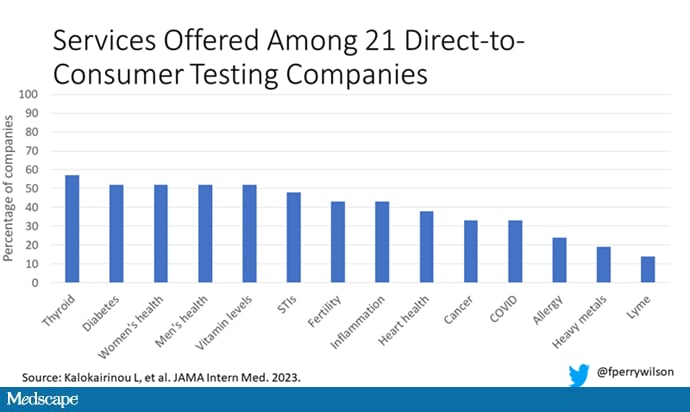
The study characterizes a total of 21 direct-to-consumer testing companies. They offer a variety of services, as you can see here, with the majority in the endocrine space: thyroid, diabetes, men's and women's health. A smattering of companies offer more esoteric testing, such as heavy metals and Lyme disease.

Who's in charge of all this? It's fairly regulated, actually, but perhaps not in the way you think. The FDA uses its CLIA authority to ensure that these tests are accurate. The FTC ensures that the companies do not engage in false advertising. But no one is minding the store as to whether the tests are actually beneficial either to an individual or to society.

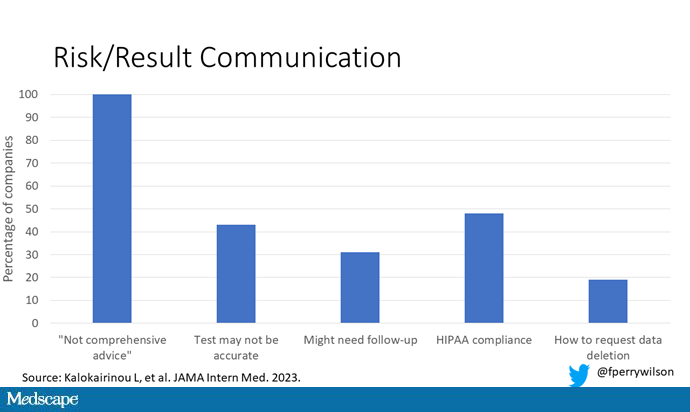
The 21 companies varied dramatically in regard to how they handle communicating the risks and results of these tests. All of them had a disclaimer that the information does not represent comprehensive medical advice. Fine. But a minority acknowledged any risks or limitations of the tests. Less than half had a statement of HIPAA compliance. And 17 out of 21 provided no information as to whether customers could request their data to be deleted, while 18 out of 21 stated that there could be follow-up for abnormal results, but often it was unclear exactly how that would work.

So, let's circle back to the first question: Should a healthy person be able to get a laboratory test simply because they want to? The libertarians among us would argue certainly yes, though perhaps without thinking through the societal implications of abnormal results. The evidence-based medicine folks will, accurately, state that there are no clinical trials to suggest that screening healthy people with tests like these has any benefit.

But we should be cautious here. This question is scienceable; you could design a trial to test whether screening healthy 43-year-olds for testosterone level led to significant improvements in overall mortality. It would just take a few million people and about 40 years of follow-up.

And even if it didn't help, we let people throw their money away on useless things all the time. The only difference between someone spending money on a useless test or on a useless dietary supplement is that someone has to deal with the result.

So, can you do this right? Can you make a direct-to-consumer testing company that is not essentially a free-rider on the rest of the healthcare ecosystem?

I think there are ways. You'd need physicians involved at all stages to help interpret the testing and guide next steps. You'd need some transparent guidelines, written in language that patients can understand, for what will happen given any conceivable result — and what costs those results might lead to for them and their insurance company. Most important, you'd need longitudinal follow-up and the ability to recommend changes, retest in the future, and potentially address the cost implications of the downstream findings. In the end, it starts to sound very much like a doctor's office.

F. Perry Wilson, MD, MSCE, is an associate professor of medicine and public health and director of Yale's Clinical and Translational Research Accelerator. His science communication work can be found in the Huffington Post, on NPR, and here on Medscape. He tweets @fperrywilson and his new book, How Medicine Works and When It Doesn'tis available now.

https://www.medscape.com/viewarticle/996528

Appeals court skeptical of Sam Bankman-Fried's push for release from jail

 A federal appeals court on Tuesday appeared skeptical of former cryptocurrency billionaire Sam Bankman-Fried's argument that being jailed just two months before his trial on federal fraud charges violated his right to free speech.

U.S. District Judge Lewis Kaplan revoked Bankman-Fried's $250 million bail on Aug. 11, finding probable cause to believe that the defendant had tampered with witnesses. This included his sharing the personal writings of Caroline Ellison, the former chief executive of his Alameda Research hedge fund, with a New York Times reporter.

Ellison has pleaded guilty to fraud and is expected to testify against Bankman-Fried, a former romantic partner.

A three-judge panel of the 2nd U.S. Circuit Court of Appeals in Manhattan challenged Bankman-Fried lawyer Mark Cohen's assertion that Kaplan had not sufficiently considered the defendant's right under the U.S. Constitution's First Amendment to speak with the press and try to restore his reputation.

"There isn't a First Amendment right to try to discredit or influence a witness who might testify against you, is there?" U.S. Circuit Judge Denny Chin said.

The judges did not say when they would rule on Bankman-Fried's

bid to be released

from Brooklyn's

Metropolitan Detention Center

.

Bankman-Fried faces seven charges of fraud and conspiracy stemming from the November 2022 collapse of FTX, the now-bankrupt crypto exchange he founded. Prosecutors accused him of looting billions of dollars in FTX customer funds to plug losses at Alameda, buy luxury real estate and donate to U.S. political campaigns. He has pleaded not guilty, while acknowledging risk management failures.

The judges appeared slightly more open to Bankman-Fried's argument that jailing him violates his right under the Constitution's Sixth Amendment to aid in his own defense because his case is complicated and he lacked internet access in jail to review prosecutors' evidence.

They questioned Danielle Sassoon, a prosecutor, about what Cohen said were inadequacies in accommodations Kaplan and the MDC had made to try to allow Bankman-Fried to access the internet, including by visiting his lawyers in a cell at the federal courthouse in Manhattan twice a week.

Sassoon said the government had taken "extraordinary measures" to try to help Bankman-Fried prepare for trial from behind bars, and that Bankman-Fried had seven months with unrestricted internet access while free on $250 million bail at

his parents

' Palo Alto, California, home.

U.S. Circuit Judge William Nardini said Bankman-Fried should have considered the possibility of losing internet access before sharing Ellison's writings.

"If it is true that he has intimidated witnesses, at a certain point, he makes his own bed, he sleeps in it," Nardini said.

Kaplan in a written ruling last week said that Bankman-Fried had not specified which pieces of evidence he had been unable to access and noted that the defendant had not asked for a trial delay despite the judge's offer to consider one.

https://www.marketscreener.com/news/latest/Appeals-court-skeptical-of-Sam-Bankman-Fried-s-push-for-release-from-jail--44877899/