by Matthew Vadum via The Epoch Times,
The Supreme Court may take steps to roll back the administrative state in its approaching term that begins next month, according to lawyers who frequently appear before the nation’s highest court.
The lawyers were appearing at a Sept. 20 event hosted by The Heritage Foundation think tank.
Attorney Paul Clement of the law firm of Clement and Murphy in Washington participated. Mr. Clement was U.S. solicitor general under President George W. Bush from July 2004 to June 2008.
Also participating was attorney Lisa Blatt, a partner at the law firm of Williams and Connolly in Washington.
The court agreed on June 30 to hear Securities and Exchange Commission (SEC) v. Jarkesy (court file 22-859) at some point in the upcoming term.
The SEC, an independent federal agency, enforces federal securities laws administratively or by filing civil actions in court.
George Jarkesy and his advisory firm, Patriot28, were sued in federal court in the District of Columbia in 2013 for infringing securities laws in managing two hedge funds. Mr. Jarkesy countersued, arguing that the structure of the commission ran afoul of the U.S. Constitution.
The lower court found for the SEC, which continued the proceedings and assigned the case to an administrative law judge who confirmed the violations. The SEC reviewed and ratified the decision and ordered the parties to pay $300,000 in civil penalties.
A divided U.S. Court of Appeals for the 5th Circuit found that the two levels of removal protections applying to administrative law judges unconstitutionally shielded them from presidential oversight. The court also held that SEC proceedings infringed the Seventh Amendment right to a jury trial and that Congress had unconstitutionally delegated its lawmaking powers to the commission, according to a Ballotpedia summary.
'Rethinking These Fundamental Questions'
Ms. Blatt said, “We’re at a place in our country, and I think with the court, where they’re rethinking these fundamental questions about the administrative state, and how people’s liberty interests are being taken away by bureaucrats.”
“SEC is an aggressive agency,” she said.
“To be gone after by the SEC, I think, triggers all the senses of big, bad, mean government.”
The 5th Circuit found the SEC’s system was unconstitutional “because Congress could not have, or should not have, delegated to the SEC the decision to proceed either internally by adjudication or go to court.”
With the Federal Trade Commission and many other agencies, “you can either do it in-house or go to court,” she said.
“Well, guess what you would do if you were an agency. I would do it in-house because you’re going to win. You get to be the judge, jury, and the executioner. And it is very unfair to have that.”
“I do think there’s some due process arguments to be made for the fact that the government can always go after you internally where your government’s always going to win.”
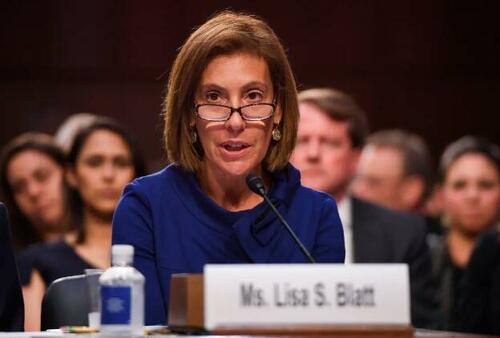
Lawyer Lisa Blatt speaks before the Senate Judiciary Committee during the confirmation hearing for Judge Brett Kavanaugh to be associate justice, in Washington, on Sept. 4, 2018. (Saul Loeb/AFP via Getty Images)
Ms. Blatt noted that in 2010 the Supreme Court found in Free Enterprise Fund v. Public Company Accounting Oversight Board that laws insulating lower-level federal officers from presidential removal authority with two levels of for-cause removal violated the Constitution.
Mr. Clement said, “The double for-cause removal issue is the one where I think the government definitely has the greatest vulnerability.”
“Part of the unfairness of all of this is that you’re stuck in front of this agency, and they’re adjudicating their own cases, and they never lose,” he said.
“What I think a majority of the court cares deeply about in this context is accountability.”
Oral arguments in the case, Loper Bright Enterprises v. Raimondo (court file 22-451), have not yet been scheduled.
'Chevron Deference'
The case challenges “Chevron deference,” a bureaucracy-empowering legal doctrine that critics say has distorted the U.S. system of government for decades at the expense of everyday citizens.
The doctrine, which arose out of Chevron v. NRDC (1984), holds that an executive agency’s interpretation of a statute is entitled to deference unless Congress has explicitly said otherwise.
Conservatives and Republican policymakers have long been critical of the doctrine, saying it gives unelected regulators far too much power to make policy by going beyond what Congress intended when it approved various laws. The authority of regulatory agencies has been increasingly questioned in recent years as the conservative majority on the Supreme Court has grown. Conservative Justices Clarence Thomas, Samuel Alito, and Neil Gorsuch have expressed skepticism of the Chevron doctrine.
“I don’t want to say that Chevron is responsible for all the ills of the modern administrative state, just most of them,” Mr. Clement said.
The appeal itself concerns a federal rule that requires the owners of fishing vessels, which tend to be small, to pay for having federal observers onboard to oversee operations and ensure compliance with a litany of federal regulations.
The court’s eventual ruling in the case could alter the current balance of power among Congress, executive agencies, and the nation’s judiciary by tearing away at the legal underpinnings of the modern administrative state, which critics deride as an illegitimate fourth branch of government.
Mr. Clement expressed outrage over the fisheries rule, saying it is the “maritime equivalent of the forced quartering of British soldiers,” a colonial-era policy that helped to spur the American Revolution.
The rule forces fishing companies “to give over precious space on the vessels,” and to make matters worse, “the fishermen themselves have to pay the salaries for the federal monitors who are monitoring them for compliance with all the federal regulations.”
This is “really a case about the separation of powers and how power is allocated in our system, particularly between Congress and the executive.”
The Chevron doctrine has contributed to the growth of government in part because “if Congress creates ambiguous statutes, the executive has a lot of leeway under Chevron to interpret them one way or another.”
Over time it has created a “dynamic where Congress has very little incentive to legislate clearly,” Mr. Clement said.
“At any given time, about half the members of Congress have allies in the executive branch, and at a certain point, they figure, ‘well, I'm not going to compromise anymore because compromising is difficult—compromising could make me look weak, I can get a primary challenge.’”
So lawmakers prefer to keep legislation “fuzzy and vague” because they know they are going to get what they want from their “friends in the executive branch, and so it creates these long-term incentives.”
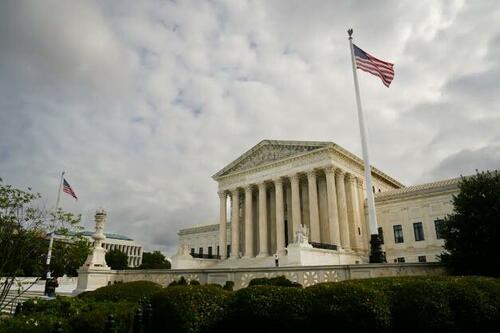
The U.S. Supreme Court in Washington on Sept. 18, 2023. (Madalina Vasiliu/The Epoch Times)
16th Amendment
Ms. Blatt said the government’s brief in the Loper Bright case “didn’t even acknowledge that for the last eight years, or at least since the Obama administration, the government has been disavowing reliance on Chevron.”
“And the court itself hasn’t been applying it so there’s somewhat of a disconnect between the government’s brief defending Chevron and the reality of the last eight years,” she said.
Mr. Clement said the tax case of Moore v. United States (court file 22-800), which has not yet been scheduled, is “the great 16th Amendment case of the court’s term.”
Charles and Kathleen Moore, a married Washington state couple, are challenging a wealth tax that was levied on capital gains they never received.
The mandatory repatriation tax, also known as the Section 965 transition tax, was part of the Tax Cuts and Jobs Act passed by the Republican-controlled Congress in 2017 and signed into law by President Donald Trump in December 2017.
The provision taxes U.S. citizens on certain accumulated foreign earnings of foreign corporations going back 30 years, even if the earnings haven’t been distributed.
This “pretty obscure statute” addressed a “concern that there were certain taxpayers who were leaving lots and lots of money in foreign companies, and they weren’t repatriated to the United States where it could be taxed. And so they were building up lots of wealth in a way that wasn’t giving any sort of benefit to the public fisc,” Mr. Clement said.
Before the 16th Amendment was ratified in 1913, “there were some real limits on how big the federal government could get because it was seriously revenue-constrained,” he said.
“The 16th Amendment just blew the doors off of that and paved the way for the income tax, which is now why we have a federal government of this huge size that we have.
“So other than thinking about this as a boring tax case, I think the 16th Amendment [and the] 17th Amendment, which also fundamentally changed the relationship between the states and the federal government by having direct election of senators—this is super interesting stuff, at least to me.”
Loper Bright is a “hugely important” case because “people are talking about a wealth tax and the constitutionality of a wealth tax may well be decided in the context of this case,” he said.
If the mandatory repatriation tax is upheld, “then there’s no reason for the federal government to wait until you actually take money from your stocks that have appreciated over time and take it as a capital gain.”
“I think the issue here is much more important than meets the eye,” Mr. Clement added.
Social Media
Ms. Blatt discussed O’Connor-Ratcliff v. Garnier (court file 22-324), and a related case, Lindke v. Freed (court file 22-611). The court granted both petitions on April 24 and will hear both cases on Oct. 31.
The issue is whether Americans can sue government officials who block them on social media. The court’s ruling in the matter is likely to have an impact on all levels of government as citizens increasingly turn to social media to interact with public officials.
The court is expected to decide if a public official is engaging in state action subject to the First Amendment when he blocks an individual from accessing his social media account.
One federal appeals court found in favor of the citizens; another found for the public official.
Petitioners Michelle O’Connor-Ratcliff and T.J. Zane were two elected members of a school district in California who used their personal Facebook and Twitter accounts to communicate with the public. They complained that parents of local students spammed their posts. The officials blocked the parents, who in turn, maintained they were exposing mismanagement.
Petitioner Kevin Lindke, a resident of Port Huron, Michigan, criticized the municipality’s response to the COVID-19 pandemic including the perceived hypocrisy of local officials. An official blocked Mr. Lindke and removed his comments.
“If you block somebody from your website based on their negative criticism that’s blatantly a First Amendment violation,” Ms. Blatt said.
Despite that, “I do think the public officials are more likely than not to win,” she said.
Several individuals also sued then-President Trump after he blocked them from accessing his account on Twitter, now called X, but the Supreme Court ordered that case dismissed in April 2021 as moot because he had already left office.
Mr. Clement said when it is a president doing the blocking “it does feel slightly different.”
“The president’s different because it’s such an all-encompassing, 24/7 sort of thing. Everything the president does is sort of official,” so it begins “to sound like an immunity argument that’s probably being made in some courts somewhere in the country right now, too.”
“It’ll be interesting to see how the court tiptoes around that issue because it’s definitely going to be in the backdrop, but I think there are probably some pretty good reasons for the court to not say anything in particular about that in the context of these cases.”
The Supreme Court is in recess for the summer. It resumes oral arguments on Oct. 2.
https://www.zerohedge.com/political/supreme-court-may-put-administrative-state-chopping-block-upcoming-term-lawyers-say


