Search This Blog

Thursday, September 21, 2023

Lawlessness Spreads To Suburbia: Westport Man Carjacked In Own Garage

 Violent crime appears to be spreading to suburbia. For the millions of Americans who fled crime-ridden metro areas where Democrat leaders failed to enforce law and order, the dramatic video of a carjacker assaulting a Westport, Connecticut, man in his garage for his Aston Martin serves as a wakeup call to better defend yourself and loves ones. 

Westport Journal reports that the Westport Police Department released dramatic security footage from a Ring camera that shows a residential burglary and carjacking on Bayberry Lane on Sunday afternoon. Two suspects assaulted the man in his garage and stole his Aston Martin. 

"They surround the vehicle and drag the man from the car as he calls for someone in the home to contact police. The intruders appear to repeatedly strike the man as he tries to fend them off," the local media outlet said. 

Westport police Lt. Eric Woods said the victim was targeted and followed back to his residence. "Therefore, Westport Police are encouraging residents to be aware of their surroundings and report any suspicious behavior to 911," he said. 

The consequence of failed Democrat policies in major cities has only emboldened criminals who are now expanding their theft wave to suburbia. It's also a cautionary sign for homeowners who might want to explore firearms training to defend themselves, their families, and their property. 

Meanwhile, the average police response time is more than ten minutes. And Democrat lawmakers want to strip the public of firearms (see New Mexico Governor Michelle Lujan Grisham's latest 2A overreach). 

The video proves the Westport man couldn't afford to wait just one minute. 

https://www.zerohedge.com/political/lawlessness-spreads-suburbia-westport-man-carjacked-own-garage

FAA issues alert to inspect some jet engines for unapproved parts

 The U.S. Federal Aviation Administration issued an alert on Thursday warning that unapproved parts might be installed in certain General Electric model CF6 jet engines, telling owners to inspect planes or inventories for the parts.

The FAA says UK-based AOG Technics sold bushings for GE Model CF6 engines without having FAA approval.

Jet engine maker CFM International said on Wednesday thousands of engine components may have been sold with forged paperwork by AOG Technics.

The problem predominantly affects CF56 engines built by CFM, with a smaller pool of parts for CF6 engines also suspected of having counterfeit paperwork. As of Monday, about 96 engines total are suspected to contain parts with forged documentation, CFM said.

Matthew Reeve, a lawyer for CFM and its co-owners General Electric and Safran, said in filings to London's High Court that the joint venture has so far identified two forged FAA forms for "hundreds" of CF6 parts.

The CF6 is used mainly to power cargo planes, including the vast majority of Boeing 767 freighters, as well as the KC-767 tanker operated by Italy and Japan.

If unapproved CF6 bushings are found, the FAA said aircraft owners and operators should remove and quarantine parts.

A GE spokesman said the company supports the FAA's action and is "fully engaged" with the FAA and other aviation regulators investigating claims that AOG Technics sold counterfeit parts.

“We continue to work with our customers to assess the authenticity of documentation for parts that came from AOG Technics," the spokesman said.

AOG Technics did not immediately respond to a request for comment on its main number, which went to voicemail.

Lawyers representing AOG and its director Jose Zamora Yrala said on Wednesday the defendants were "cooperating fully" with an investigation by Britain's Civil Aviation Authority (CAA)

https://finance.yahoo.com/news/1-faa-issues-alert-inspect-175211064.html

UAW Auto Strike Costs "Detroit 3" $250 M In Lost Profit Every Day, Will Lead To Much More Inflation

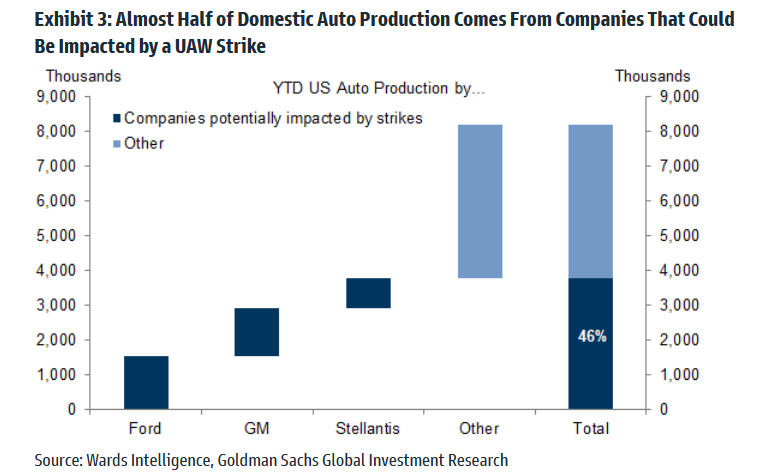
 One week ago, when previewing the three events that are about to slam US GDP in the tail end of the 3rd and the 3th quarter (including the return of student loan payments, the UAW strike and the government shutdown), Goldman calculated that reduced auto production from a potential UAW strike would reduce quarterly annualized growth by 0.05-0.10% for each week it lasted, if all three companies currently undergoing contract negotiations are impacted. "Those three companies—Ford, GM, and Stellantis—produce almost half of domestically-assembled cars. Auto production would likely fall sharply—we assume to roughly zero—at any company impacted by a strike", Goldman said in its 30,000 approximation of the impact..

Fast forward to today when Morgan Stanley's auto strategist, Adam Jonas, takes a closer look at the impact of the UAW strikes, which are now in their 5th day.

According to Jonas, investors have expressed a degree of trepidation over the strike outcome in a recent survey and now that it’s here, the path to resolution does appear to have matched investor fears.

Here is his quick calculation: "the value of N. American light production of the D3 (F, GM, STLA collectively) is approximately $750mm per day (approx. 15k units per day). Applying slightly more than a 30% decremental (yes, mix is that high) implies around $250mm of lost profit per day (assuming 100% of production impacted)."

Extrapolating to a full month of lost output (adjusted for production days) could be worth $7 to $8bn of lost profit for the D3, collectively.

According to Jonas, some of the lost production would be made back as some customers may be tempted to buy an import brand - or Tesla - with lack of availability.

But beyond the 1-time losses, Jonas says he is much more concerned about the potential for 30 to 40% labor inflation over the life of the next 4-year contract and how the domestic auto companies may recalibrate their ROIC and payback math for EV onshoring. The MS strategist thinks the outcome will be greater austerity and focus on the ICE run-off (that, however, would make many more workers redundant as EV require far less mechanical intervention than ICEs).

One must also consider that new car purchases account for roughly 5% of US CPI and soon car companies will have to raise prices (structurally) to compensate for higher labor input cost. Put simply, a 3% increase in new car prices could be worth 15bps to CPI over 4 years.

Finally, some thoughts on the UAW strike from One River CIO Eric Peters:

“The money is there. The cause is righteous. The world is watching, and the UAW is ready to stand up,” declared United Auto Workers boss Shawn Fain to his union members on a Facebook livestream. “This is our defining moment.”

Detroit automaker unionized labor costs, including wages and benefits, are estimated at an average of $66/hour. That compares with $45 at Tesla, which isn’t unionized, and $55 for Asian automakers.

Meeting all of Fain’s initial demands would boost average hourly labor costs to an estimated $136/hour.

Fein claims to be matching the roughly 40% compensation gains automaker CEOs have realized in the past decade. Ford’s CEO made $22mm last year. Stellantis’s $24.8mm. GM’s nearly $29mm.

“Competition is code word for race to the bottom, and I’m not concerned about Elon Musk building more rocket ships so he can fly in outer space and stuff,” Fain told CNBC, defending his demands. “Our concern is working-class people need their share of economic justice in this world.”

The secular trend toward ever rising inequality is turning. In August, UPS settled its labor dispute with the Teamsters 340k drivers who on average now make $170k in wages and benefits. That same month, Yellow failed to come to agreement with the Teamsters and ceased operations after nearly a century of trucking delivery -- it awarded ten executives $4.6mm in special retention bonuses, laid off all 30k drivers and went into liquidation.

A secular trend reversal to how society divides its economic spoils is not all that different from revolution. Bitterly fought, treacherous for all involved. And this latest episode promises to be particularly so.

Because in the timeless conflict between capital and labor, it is extremely rare for the imbalance to be so extreme. The wider the gap, the bigger the stakes. And the last time the chasm was so great was at the height of the Roaring 1920s. 

https://www.zerohedge.com/markets/uaw-auto-strike-costs-detroit-3-250-million-lost-profit-every-day-will-lead-much-more

Pfizer-Funded Study Shows Poor Effectiveness For COVID-19 Vaccine In Young Children

 by Zachary Stieber via The Epoch Times (emphasis ours),

A new study funded by Pfizer found the company's COVID-19 vaccine did not perform well in children under 5.

Children aged 6 months to 4 years are supposed to receive three shots of the Pfizer-BioNTech vaccine. The number was increased from two when early testing showed little effectiveness.

Three doses of the Pfizer vaccine provided little protection against emergency room visits, urgent care encounters, or outpatient visits, according to the new study.

Researchers with and funded by Pfizer analyzed records from Kaiser Permanente Southern California. They included patients who tested for COVID-19 at an emergency department, urgent care, or outpatient setting along with being diagnosed with acute respiratory infection. The date range was July 23, 2022 through May 19, 2023.

Positive cases were those with a positive test result. Controls tested negative and had no evidence of prior infection in the past 90 days. Children were only counted as vaccinated if they received a second or third shot two or more weeks before being exposed to COVID-19. Children were excluded if they only received one dose, received any doses from a different company, or did not follow the recommended dosing schedule.

After adjusting for factors such as age and sex, researchers estimated just 12 percent effectiveness against medically-attended encounters for children who completed the three-dose primary series.

Confidence intervals crossed well over one, indicating that the effectiveness might actually be worse or even negative.

The effectiveness was estimated to be higher, or 44 percent, for children who received two doses of the regimen.

Researchers speculated that the difference stemmed from more immune-evasive virus variants becoming dominant in the United States by the time children received a third dose.

"Updated vaccines will likely be needed to maintain protection against contemporary Omicron strains in young children," they wrote.

Sara Tartof, the study's corresponding author and an employee of Kaiser Permanente Southern California, did not answer questions, including why researchers included those with two doses but not those with one dose.

Pfizer did not return a request for comment.

Key Problems

Among the key problems with the research were only including children who were diagnosed with acute respiratory infection (ARI), Dr. Robert Malone, who was not involved in the research, said.

That "may predispose to young children that lack a primary care physician/pediatrician," Dr. Malone, who helped invent the mRNA technology Pfizer's vaccine utilizes, told The Epoch Times via email.

"Likewise, the control group of non-vaccinated with ARI will also have selection bias. These intrinsic study biases make the relevance of the measured outcome to the general population quite problematic."

Another issue is using positive results on polymerase chain reaction testing as the metric for having COVID-19, given the false positives the testing brings, Dr. Malone said. Some patients who tested positive may actually have another virus, such as influenza, he said.

Need a Trial

Pfizer's vaccine was authorized for children despite unreliable efficacy estimates against infection, and no efficacy estimates against severe disease.

The newly reported results are based on a test-negative design, which is inappropriate for measuring effectiveness, said Dr. Jay Bhattacharya, professor of health policy at Stanford University.

"The design starts with children who are already seeing a doctor and then makes strong and unsupportable statistical assumptions to derive the probability of seeing a doctor for vaccinated and unvaccinated children," Dr. Bhattacharya, who was not involved in the research, told The Epoch Times via email.

"What is needed to answer this question without bias is a randomized control trial. I am shocked that the FDA has not asked Pfizer and Moderna to conduct such a study," he added.

The U.S. Food and Drug Administration (FDA) cleared Pfizer's shot on the basis of immunobridging, or comparing antibody levels in children after vaccination with levels in adults after vaccination.

Antibodies are believed to protect people against COVID-19.

The authorization has been the subject of protests, including a complaint that said the FDA violated its own standards with the clearance.

The FDA this month cleared new vaccines from Pfizer and Moderna for children. The only trial data was from 50 people aged 12 or older who received Moderna's shot. The U.S. Centers for Disease Control and Prevention (CDC) recommended the shots to all people aged 6 months and older.

CDC Data

CDC data presented on Sept. 12 showed that both the Pfizer and Moderna vaccines failed to provide much protection to young children.

One dose of Pfizer's vaccine provided just 8 percent protection against emergency room and urgent care visits beyond 13 days, while two doses provided a peak of 44 percent protection, according to the data (pdf).

A third dose provided 71 percent protection between 14 and 59 days, but the shielding plunged to 16 percent after two months.

A two-shot primary series of Moderna's shot initially provided 46 percent protection. That shielding dropped even lower, to 24 percent, beyond 60 days.

The World Health Organization considers 50 percent as adequate effectiveness for vaccines.

A single dose of a bivalent shot, introduced in the fall of 2022, boosted protection to 61 percent, but no estimates were available over time and the estimate was based on just eight vaccinated patients who tested positive.

"This imprecision indicates that the actual [effectiveness] could be substantially different," the CDC said.

https://www.zerohedge.com/covid-19/pfizer-funded-study-shows-poor-effectiveness-covid-19-vaccine-young-children

China, India lead Asia's biggest hydropower crunch in decades

 Hydropower generation in Asia has plunged at the fastest rate in decades amid sharp declines in China and India, data shows, forcing power regulators battling volatile electricity demand and erratic weather to rely more on fossil fuels.

The two countries, which account for about 3/4 of Asia's power generation and most of its emissions, are also to a lesser extent using renewables to make up for the hydropower shortfall and address rising electricity use.

Major Asian economies have faced power shortages in recent years due to extreme weather conditions, including intense heat and lower rainfall over large swathes of northern China and Vietnam, as well as in India's east and the north.

Higher use of polluting fuels such as coal to meet electricity demand spikes and supply shortages underscore the challenges of lowering emissions. Asia's hydropower output fell 17.9% during the seven months through July, data from energy think tank Ember showed, while fossil fuel-fired power rose 4.5%.

"Despite a strong growth in solar and wind power generation in Asia, supply from fossil-fuel thermal power plants has also increased this year as a result of a large decline in hydropower generation," said Carlos Torres Diaz, Rystad Energy's director of power and gas markets.

"Intense and prolonged heatwaves across the region have resulted in low reservoir levels and the need for alternative sources of power to help meet demand," he added.

China's hydroelectricity generation during the eight months ended August declined at the sharpest rate since at least 1989, falling 15.9%, an analysis of National Bureau of Statistics data showed.

In India, hydropower generation fell 6.2% during the eight months ended August in the sharpest decline since 2016. Its share of power output plunged to 9.2%, the lowest in at least 19 years, according to an analysis of government data.


US judge will not block Biden rule on socially conscious investing

 A federal judge in Texas on Thursday rejected a bid by 25 states to block a Biden administration rule allowing employee retirement plans to consider environmental, social and governance (ESG) issues in investment decisions.

U.S. District Judge Matthew Kacsmaryk in Amarillo, Texas, declined to block the rule, which took effect Jan. 30. The judge granted a petition by President Joe Biden's administration to dismiss the Republican-led states' lawsuit claiming the rule will jeopardize millions of Americans' retirement savings.

Kacsmaryk in a 14-page opinion rejected the states' claim that the rule violates the federal law governing retirement plans. The rule still requires that financial considerations come first, and does not create "an overarching regulatory bias in favor of ESG strategies," the judge wrote.

The U.S. Department of Justice and the offices of the attorneys general of Texas and Utah, who led the lawsuit, did not immediately respond to requests for comment.

The decision will likely be appealed to a New Orleans-based federal appeals court. A subsidiary of oil drilling company Liberty Energy Inc and an oil and gas trade group are also plaintiffs in the case.

Congress in early March passed a Republican-backed resolution to repeal the rule. Biden, a Democrat, vetoed the proposal on March 20.

ESG investing involves weighing companies’ records on environmental, social justice and labor issues, as well as corporate governance matters such as board diversity and executive compensation, along with traditional financial considerations.

The rule, finalized in November, reversed restrictions adopted by former President Donald Trump's administration on considering ESG factors in making investment decisions. The rule covers plans that collectively invest $12 trillion on behalf of more than 150 million people.

The Biden administration has said the rule was needed to replace improper limitations on ESG investing imposed by the Trump administration, because issues such as climate change and social justice can impact companies' long-term financial health.

Kacsmaryk, a Trump appointee, in March rejected the Biden administration's claim that the states were improperly "judge shopping" by filing the lawsuit in Amarillo, where Kacsmaryk is the only judge.

https://finance.yahoo.com/news/us-judge-not-block-biden-230219745.html

Genetic biomarker may predict severity of food allergy

 Researchers from Ann & Robert H. Lurie Children's Hospital of Chicago and colleagues reported for the first time that a genetic biomarker may be able to help predict the severity of food allergy reactions. Currently there is no reliable or readily available clinical biomarker that accurately distinguishes patients with food allergies who are at risk for severe life-threatening reactions versus more mild symptoms. Findings were published in the Journal of Allergy and Clinical Immunology.

Dr. Lang and colleagues found that the presence of an enzyme isoform called α-tryptase, which is encoded by the TPSAB1 gene, correlates with increased prevalence of anaphylaxis or severe reaction to food as compared to subjects without any α-tryptase.

"Determining whether or not a patient with food allergies has α-tryptase can easily be done in clinical practice using a commercially available test to perform genetic sequencing from cheek swabs," said lead author Abigail Lang, MD, MSc, attending physician and researcher at Lurie Children's and Assistant Professor of Pediatrics at Northwestern University Feinberg School of Medicine. "If the biomarker is detected, this may help us understand that the child is at a higher risk for a severe reaction or anaphylaxis from their food allergy and should use their epinephrine auto-injector if exposed to the allergen. Our findings also open the door to developing an entirely new treatment strategy for food allergies that would target or block α-tryptase. This is an exciting first step and more research is needed."

Tryptase is found mainly in mast cells, which are white blood cells that are part of the immune system. Mast cells become activated during allergic reactions. Increased TPSAB1 copy number which leads to increased α-tryptase is already known to be associated with severe reactions in adults with Hymenoptera venom allergy (or anaphylaxis following a bee sting).

Dr. Lang's study included 119 participants who underwent TPSAB1 genotyping, 82 from an observational food allergy cohort at the National Institute of Allergy and Infectious Diseases (NIAID) and 37 from a cohort of children who reacted to peanut oral food challenge at Lurie Children's.

"We need to validate our preliminary findings in a much larger study, but these initial results are promising," says Dr. Lang. "We also still need a better understanding of why and how α-tryptase makes food allergy reactions more severe in order to pursue this avenue for potential treatment."

Rajesh Kumar, MD, MSc, from Lurie Children's is the co-senior author on the study. Dr. Kumar is the Interim Division Head of Allergy and Immunology and Professor of Pediatrics at Northwestern University Feinberg School of Medicine.

This work was supported in part by the Midwest Allergy Research Institute (MARI) Food Allergy Pilot Research Award and NIAID-sponsored T32 grant AI083216. This project was funded in part with federal funds from the Division of Intramural Research of the National Institute of Allergy and Infectious Diseases, NIH. This project has also been funded in whole or in part with federal funds from the National Cancer Institute, National Institutes of Health, under Contract No. 75N91019D00024.

Journal Reference:

  1. Abigail Lang, Stephanie Kubala, Megan C. Grieco, Allyson Mateja, Jacqueline Pongracic, Yihui Liu, Pamela A. Frischmeyer-Guerrerio, Rajesh Kumar, Jonathan J. Lyons. Severe food allergy reactions are associated with α-tryptaseJournal of Allergy and Clinical Immunology, 2023; DOI: 10.1016/j.jaci.2023.07.014