Search This Blog

Thursday, September 28, 2023

Bionomics' midphase PTSD trial hits primary endpoint, briefly tripling its battered share price

 Bionomics’ bid to bounce back from its stock-crushing anxiety trial failure has finally gained some momentum, with investors sending the share price up almost 200% on the strength of phase 2 data in post-traumatic stress disorder (PTSD).

The PTSD trial, which ran across 34 U.S. and U.K. sites, randomized 212 people to take BNC210 or placebo twice a day. After 12 weeks, scores on a PTSD symptom scale had improved by more in the treatment arm than in the placebo group, causing the study to hit its primary endpoint with a p-value of 0.048. The PTSD scores were also better in the treatment arm than the control group at weeks 4 and 8.

Bionomics shared the top-line primary endpoint data alongside a look at the results of two secondary objectives. Participants taking BNC210 scored significantly better on measures of depressive symptoms and sleep at Week 12, with the p-value in both cases coming in around 0.04. 

The trial found “signals and trends across visits in the other secondary endpoints,” Bionomics said, but the statement only included a sprinkling of efficacy data. Bionomics shared a glimpse at safety, reporting liver enzyme increases in 13.3% of patients on BNC210. The rate was higher than in the placebo arm, 0.19%, but no patients suffered liver injury and most cases resolved without drug discontinuation.  

Overall, Bionomics said the safety and tolerability profile was favorable and consistent with earlier trials of BNC210, the candidate tested in the failed anxiety trial. In the biotech’s view, the mix of safety and efficacy data is compelling enough to talk to the FDA about the path to approval for the drug candidate in PTSD. 

Bionomics continues to see a future for BNC210 in social anxiety disorder, too, despite its midphase trial missing the primary endpoint late last year. The biotech dug into its data after learning about the failure, pointing to a post hoc analysis as evidence that the drug candidate reduces distress. The company has since met with the FDA to discuss registrational studies and is awaiting receipt of the formal meeting minutes.

The anxiety indication is a first-in-class opportunity for Bionomics, with no drugs currently approved in the U.S. for acute treatment, but the biotech faces competition in PTSD. The generic antidepressants sertraline and paroxetine are approved in the indication, and a clutch of companies are working on new drugs, including Lundbeck and Otsuka, which reported mixed phase 3 data this month. 

Shares in Bionomics briefly increased almost 200% in premarket trading. Even so, the stock was still trading under $3, well below the $4 it started the year on.

https://www.fiercebiotech.com/biotech/bionomics-midphase-ptsd-clinical-trial-hits-primary-endpoint-doubling-its-battered-share

Old Habits...

 By Elwin de Groot, head of macro strategy at Rabobank

Old Habits...

… die hard, as the saying goes. And central bankers who – perhaps – may be getting some fears of height, after having talked tough for such a long time, are not immune to it. Take Minneapolis Fed President Neel Kashkari – who on Tuesday argued in a paper that he expected one more rate hike and attached a 40% probability to a scenario in which the Fed will have to increase rates by more than 25 basis points. Then on Wednesday he seemed to be more receptive to the ‘negative supply shock’ thinking, cautioning in a CNN interview that “higher oil prices won’t alone warrant more rate hikes” and warning that a materialization of downside risks to the economy, such as a government shutdown or an “extended strike” at US car manufacturers could imply that the Fed would have “to do less with [its] monetary policy to bring inflation back down”. But, doesn’t an extended strike in the auto sector simply mean that workers will not agree with anything less than a 40% wage hike? And in which country has a government shutdown ever led to (structurally) lower inflation?

In any case, US 10y yields reached a fresh post-2007 high yesterday and Asian markets are taking their cues this morning from a suspension of trading in China’s Evergrande and Japan’s 20y bond yield reaching its highest level since 2014, whilst European market participants may be having their eyes on the most recent inflation data from Germany, which will benefit from a sizeable ‘base effect’.

That – closer to the (probable) peak in rates – things would become more wobbly and uncertain was always to be expected. It could be one reason why term premiums have been on the up off late. But should central banks pay closer attention to the downside risks to the economy now and give less priority to the upside risks to inflation? I would argue that such a slippage from recent practice and, thus, a return to the pre-2020 practice could perhaps be defended if

  • i) there was a tangible decline in the perceived supply risks and/or
  • ii) a tangible easing of labor market pressures.

Unfortunately, we cannot say with any confidence yet that there has been any significant improvement on any of those fronts.

On the first prerequisite I would actually say “to the contrary”. That is not only motivated by the recent tensions between the EU/US and China (whether that is over high-tech, phones or cars) but also by renewed pressures on commodity prices, oil in particular. This morning sees the nearest future for Brent rise above the $97 mark, that’s up 6% in less than 48 hours. At Cushing, Oklahoma, which is the key delivery point for the US WTI benchmark, inventories fell below 22 million barrels, the lowest since July 2022 and, according to Bloomberg, close to operational minimums. Meanwhile, the Dutch TTF natural gas benchmark has been trading at around EUR40/MWh recently, despite the wage agreement between Chevron and labour unions at the Australian Wheatstone and Gorgon facilities that has brought strikes to an end there.

As our own Joe DeLaura points out: “front-month TTF gas now trades around €41/MWh, firmly within our forecasted band for the rest of the year between €32-€50/MWh. Henry Hub futures are also rangebound between $2.48- $3.00/MMBtu, we do not expect $3 to be breached until the first wave of cold hits in November. There is upside potential for Henry Hub to $4 and TTF to the low €60s if there are extended periods of cold and the macroeconomic outlook improves.“ But Joe expects upward pressure on oil and distillates to be sustained. He believes that “Brent has the momentum to touch $100”, but sees “more strength in Q1 2024 to stay above the $100/bbl mark.”

On the second condition I would add that the observation that not only unemployment rates are still close to record-lows on both sides of the Atlantic and that even (more cyclical) vacancy rates (Eurozone) or voluntary quits (US) haven’t yet returned to their historical averages would still put serious question marks behind that second point. And, remember, strikes are taking place for a reason and with considerable public and political backing. Even President Biden has thrown in his support for the autoworkers. Assuming that significant layoffs are not the immediate response by automakers after any agreement, the other options would either be a cut in profit margins or – again – higher prices. On that front, the jury is still out. Slowing global demand may make the second route more difficult, but the recent experience with the energy shock suggests that such dynamics were not as strong as many (including ourselves) had expected. In her last press conference ECB President Lagarde acknowledged that she saw some “very early” signs that businesses’ profit margins are starting to come back down. So perhaps we are at the beginning of more serious profit pain for businesses, but it’s still early days.

There is less uncertainty about the near-term economic pain. Indeed, this thinking is being ‘fed’ by the most recent Eurozone money supply figures that were released yesterday. M1 growth fell into double digit contraction (-10.4%), for the first time since (at least) the 1960s. This largely reflects ‘portfolio shifts’ out of low-interest paying current accounts into deposits with fixed maturities. However, broad money growth also fell further into negative territory, with a -1.3% y/y. Looking at the counterparts, there was a notable decline in the volume of loans provision to non-financial corporations. In y/y terms, growth (adjusted for sales/securitizations) fell back to 0.6% from 2.2%; the net-flow was EUR -22bn in August, the sharpest decline since April 2021. The bulk of this decline took place in the ‘up to 1 year’ segment and as such could reflect things like repayment of (TLTRO-funded) pandemic support loans to businesses and lower demand for working capital. And with EUR 6bn in August, the net flow of credit to households has basically ground to a halt.

So although there are also ‘technical’ explanations for the sharpness of the decline in money supply growth, the data do suggest that the pain of higher interest rates is increasingly being felt in the credit chain and is now contributing to the (mild) contraction in overall economic activity. Whether that is, in turn, sufficient to bring inflation back down in a sustainable manner, hinges on supply developments, how businesses handle those and the labor market. Rinse and repeat.

https://www.zerohedge.com/markets/old-habits

Personal Consumption "Unexpectedly" Collapses In Latest GDP Revision

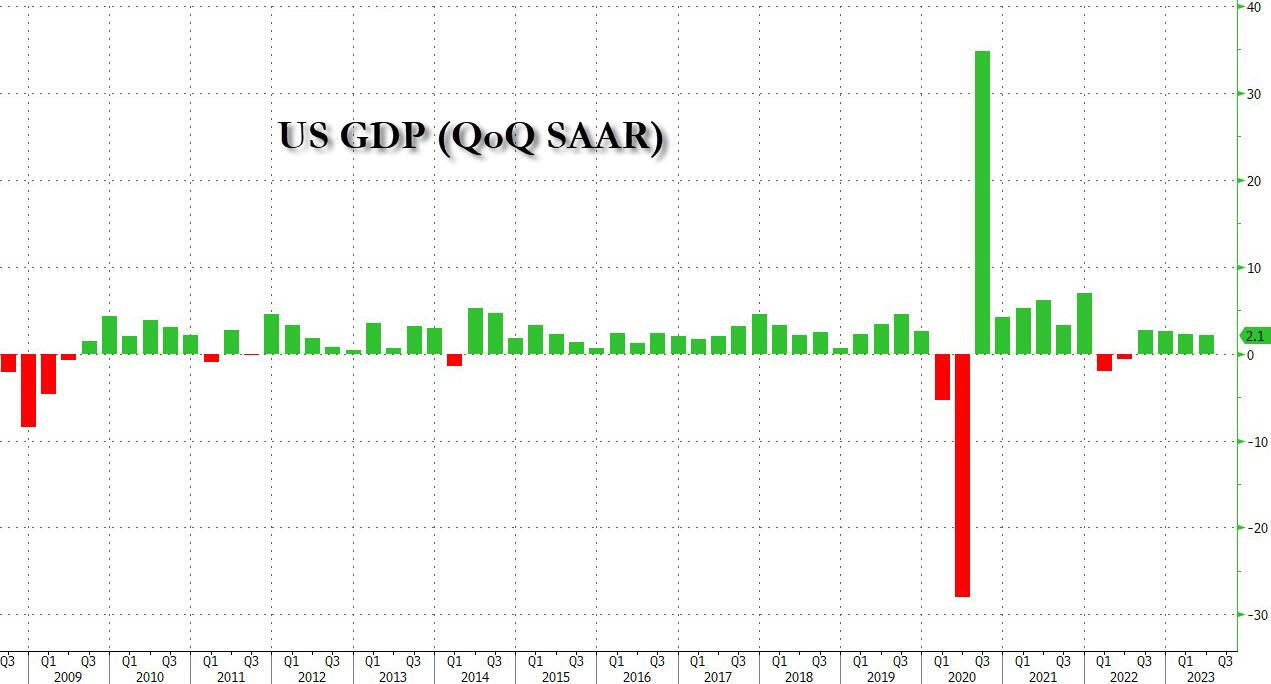
 Traditionally, the second revision to GDP data (which comes three months after the end of a given quarter) is a boring, subdued affair... except for once every five years when alongside the latest data revisions, the BEA (the B usually stands for Bureau but in this case it may as well stand for Biden's) also publishes a wholesale revision of all GDP going back some two decades. Today was one of those time, and boy was it a doozy.

As we warned one week ago in "Ignore The Hawkish Fed: Not Only Is GDP About To Tumble, Next Week It Will Be Revised Sharply Lower", moments ago the Bureau of Economic Analysis published Q2 GDP data which - at least at the headline level - was largely in line with previous numbers and expectations, printing at 2.1%, the same as the previous revised estimate published in August and just below the consensus estimate of 2.2% (range 2% to 2.5% from 54 economists).

Cities in New Jersey, Illinois and California Saw Jump in Jobless Rate


  • Unemployment also climbed in six California metro areas
  • Rate in Atlantic City rose by 2 percentage points in a year

In a nation where the unemployment rate has been hovering near decades lows for a year, fifteen small and mid-size cities in New Jersey, California and Illinois experienced a sizable increase in joblessness.

All but one of the 16 areas where the unemployment rate rose by at least 1.5 percentage points over the year were in those three states, according to Bureau of Labor Statistics data released Wednesday. Among them are Atlantic City, New Jersey, and Rockford, Illinois, where the unemployment rate climbed by about 2 percentage points each, to 6.1% and 7.4%, respectively.

https://www.bloomberg.com/news/articles/2023-09-28/unemployment-rate-rises-in-new-jersey-and-illinois-cities

Baudax orphan status for hemophilia A candidate

 Baudax Bio, Inc. (the “Company” or “Baudax Bio”) (NASDAQ: BXRX), a biotechnology company focused on developing T cell receptor (“TCR”) therapies utilizing human regulatory T cells (“Tregs”), as well as a portfolio of clinical stage Neuromuscular Blocking Agents (“NMBs”) and an associated reversal agent, today announced that U.S. Food and Drug Administration (FDA) has granted orphan drug designation to its lead clinical candidate TI-168 for the treatment of Hemophilia A with inhibitors. TI-168 is the Company’s next-generation, FVIII specific Treg therapy designed to reliably and effectively address Hemophilia A patients with FVIII inhibitors.

https://www.globenewswire.com/news-release/2023/09/28/2751180/0/en/Baudax-Bio-Announces-Orphan-Drug-Designation-Granted-by-U-S-FDA-for-TI-168-for-the-Treatment-of-Hemophilia-A-with-Inhibitors.html

Merck priority review for Pulmonary Arterial Hypertension candidate

 Application based on clinically meaningful results from the Phase 3 STELLAR trial

If approved, sotatercept would be the first in its class, bringing a novel approach to address a rare and progressive disease of the pulmonary arteries

https://www.businesswire.com/news/home/20230928840253/en/

J&J's lung cancer therapy succeeds in head-to-head study with AstraZeneca's

 Johnson & Johnson said on Thursday its cancer drug combination helped patients with a type of non small-cell lung cancer live longer without the disease worsening compared with AstraZeneca's blockbuster cancer drug Tagrisso.

J&J's therapy combination of antibody treatment Rybrevant and experimental drug lazertinib showed a clinically meaningful improvement in progression-free survival rate in patients.

The drugmaker expects the combination to become a first-line treatment for non small-cell lung cancer (NSCLC) patients with a type of mutation in EGFR protein that causes rapid tumor cell growth.

A rival treatment combining AstraZeneca's Tagrisso and chemotherapy also recently succeeded in a late-stage study.

The trial showed that the Tagrisso-chemo combination reduced the risk of disease progression or death by 38% when compared to Tagrisso alone.

The bar for J&J's study was high because Tagrisso has a compelling first line commercial profile, and physicians may prefer use of a single therapy compared to combinations for first line treatment, said Leerink Partners analyst David Risinger.

https://finance.yahoo.com/news/1-j-js-lung-cancer-114732347.html