Search This Blog

Saturday, September 30, 2023

US child care problem is about to get a lot worse

 Sarah Morgan was looking forward to enrolling her 1-year-old son Lucas at the Skagit Valley Family YMCA’s early learning center in Anacortes, Washington, this fall.

Her older son Jameson, 5, had a wonderful experience there, learning his letters, numbers and colors, as well as social skills – all of which smoothed his transition to kindergarten this year.

But in late August, Morgan found out that the YMCA was closing the Anacortes center.

Like many child care providers across the nation, the YMCA has had to rethink its operations with the looming expiration of a $24 billion federal Covid-19 pandemic support program that kept many centers afloat over the past two years. The nonprofit, which received $271,000 for its early learning programs, opted to close the Anacortes location, which served 21 families, so it could funnel its resources into its three remaining centers, said its CEO Dean Snider.

That decision has left the Morgan family scrambling to find alternate arrangements for Lucas. Child care is limited on Anacortes, an island in the northwest part of the state. The YMCA’s closest remaining centers are a 40-minute drive away, which doesn’t fit the work schedules of either her or her husband, Travus. And the nannies they interviewed asked for hourly rates that are close to what Morgan earns.

The Morgans had hoped to send their younger son to the same child care provider where their older son excelled.

So Morgan plans to place Lucas with an in-home provider, though she worries he won’t have the same educational opportunities that his older brother had at the YMCA.

“It’s really sad that my next one won’t have that type of experience,” said Morgan, a social worker employed by the state. “It’s just really been devastating.”

Widespread closures possible

Nationwide, more than 70,000 child care programs are projected to close, and about 3.2 million children could lose their spots due to the end of the child care stabilization grant program on September 30, according to an analysis by The Century Foundation.

The historic federal investment, which was part of the $1.9 trillion American Rescue Plan Act that Democrats passed in March 2021, supported more than 220,000 child care programs, affecting as many as 9.6 million children, according to the federal Administration for Children & Families. It reached more than 8 in 10 licensed child care centers, helping them hold onto workers by offering bonuses and raising wages, cover their rent, mortgage and utilities, buy personal protective equipment and other supplies, and provide mental health support.

“We have not spent that much money on child care previously in the US,” said Julie Kashen, women’s economic justice director at The Century Foundation. “What we learned was that it worked. It kept programs open. It helped address the staffing shortages. It kept children safe and nurtured. It kept parents working.”

Child care in America has long had issues: The costs are steep for both providers and parents, leaving it both in short supply and unaffordable for many families. Last year, the average annual price nationwide was nearly $11,000, according to Child Care Aware of America, though the rates can be much higher depending on the location.

A group of Democratic and independent senators and representatives are pushing to extend federal assistance for child care beyond September 30. They introduced the Child Care Stabilization Act, which would provide $16 billion each year for the next five years.

“There was a child care crisis even before the pandemic – and failing to extend these critical investments from the American Rescue Plan will push child care even further out of reach for millions of families and jeopardize our strong economic recovery,” Sen. Patty Murray of Washington said in a statement. “This is an urgent economic priority at every level: Child care is what allows parents to go to work, businesses to hire workers, and it’s an investment in our kids’ futures. The child care industry holds up every sector of our economy – and Congress must act now.”

Meanwhile, a bipartisan bill introduced in the House would enhance three existing tax credits – the Child and Dependent Care Tax Credit, the Employer-Provided Child Care Credit and the Dependent Care Assistance Program – to help make child care more affordable for families and to support employers in sharing the cost of care.

However, getting any additional funding through Congress will be difficult. House GOP hardliners are determined to cut spending in the fiscal 2024 government funding bill, making it more likely the government could shut down on October 1.

Vanessa Quarles is among the many child care providers who hope that Congress renews its support for the industry.

Quarles, who runs Bridges Transitional Preschool & Childcare in Evansville, Indiana, cannot take in more children until she can find more workers. But she can only afford to pay up to $14 an hour, which is barely a livable wage in the area, she said. Quarles raised tuition in February and stopped offering lunch, but she fears she’ll drive away parents if she asks them to shell out any more.

At least 17 states invested their own money into child care this year, according to a tally by Child Care Aware. These include historic investments by Alabama, Alaska, Maine, Massachusetts, Minnesota, Vermont and Washington.

Washington funneled more than $400 million this year into early learning, the largest investment in state history, according to Child Care Aware. It builds on the Fair Start for Kids Act, which state lawmakers passed in 2021. The effort increased the number of households eligible for assistance by raising income eligibility limits – a family of four earning as much as $5,600 a month in 2023 qualifies for monthly copays of only $165. It also bumped up the rates paid to providers for serving state-subsidized families.

But more needs to be done to keep providers afloat, said Ryan Pricco, director of policy and advocacy at Child Care Aware of Washington. Currently, reimbursement rates are determined by a market survey, but that reflects what parents can afford, not the true cost of care.

“Until we switch our subsidy system, and really our whole financing system, over to a cost of care model and reimburse programs that way, they’re going to continue to struggle to keep up with competitors and other low-income industries,” he said.

https://www.cnn.com/2023/09/27/politics/child-care-pandemic-support-program/index.html

Sweden Turns To Military For Help Amid Daily Shootings, Bombings In Migrant Gangland Chaos

 Last year Sweden witnessed its highest death toll from shootings on record, at more than 60 killed, with this year on track to possibly surpass that as the country's gang violence continues spiraling out of control.

At a moment scenes of illegal migrants flooding southern Europe from across the Mediterranean continue unabated, even mainstream publications like FT haven't hesitated to identify what's fueling the crime and turning Sweden's streets into war zones: "Police chiefs have said that Sweden is facing its most serious domestic security situation since the second world war as immigrant drug gangs engage in a bloody conflict," FT writes.

And there's even "child soldiers" in the heart of Scandinavian Europe: "Police believe the gangs are increasingly using children to commit the crimes, as those under 18 often go unpunished or receive low sentences from the courts."

Headlines like this one days ago from the Associated Press have tragically become almost commonplace: A 13-year-old boy found shot in the woods was a victim of Sweden’s gang violence. Gangs also regularly commit bombings and arson, sometimes destroying whole city blocks and districts.

Sweden has for much of the last decade been the leading bastion of liberal immigration policies in Europe, having welcomed hundreds of thousands of migrants and asylum-seekers from the Middle East and Africa. Simultaneously its third-largest city, Malmö, has for years been widely seen as Europe's gun homicide capital.

And yet, the European Left tends to only emphasize talking points of "failure to integrate" and "racism" and "rightwing extremism" - which has led to "parallel societies", serving to periodically unleash riots in places with large immigrant concentrations.

Now, after a dozen more lives were lost this month, which has included innocent bystanders and young gang members alike, government leaders are talking about 'getting tough' by calling in the military:

Sweden’s prime minister on Thursday said that he’s summoned the head of the military to discuss how the armed forces can help police deal with an unprecedented crime wave that has shocked the country with almost daily shootings and bombings.

Prime Minister Ulf Kristersson is meeting with both the armed forces’ supreme commander and the national police commissioner on Friday to consider "how the armed forces can help police in their work against the criminal gangs."

On Thursday an explosion ripped through the Storvreta area outside Uppsala, Sweden. A 25-year-old woman died. TT News Agency via Reuters

"Sweden has never before seen anything like this," Kristersson said of soaring violent crime during a Thursday televised speech to the nation. "No other country in Europe is seeing anything like this."

According to more from the AP:

Sweden has grappled with gang violence for years, but the surge in shootings and bombings in September has been exceptional. Three people were killed overnight in separate attacks with suspected links to criminal gangs, which often recruit teenagers in socially disadvantaged immigrant neighborhoods to carry out hits.

One of the victims was a woman in her 20s who died in an explosion in Uppsala, north of Stockholm. Swedish media said she was likely not the intended target of the attack.

Addressing this week's tragic bombing, Kristersson described that "A 25-year-old woman went to bed last night on a completely ordinary evening but never got to wake up."

He added: "We will hunt the gangs, we will defeat the gangs." The aforementioned powerful blast in a residential area had ripped the facades off multiple houses.

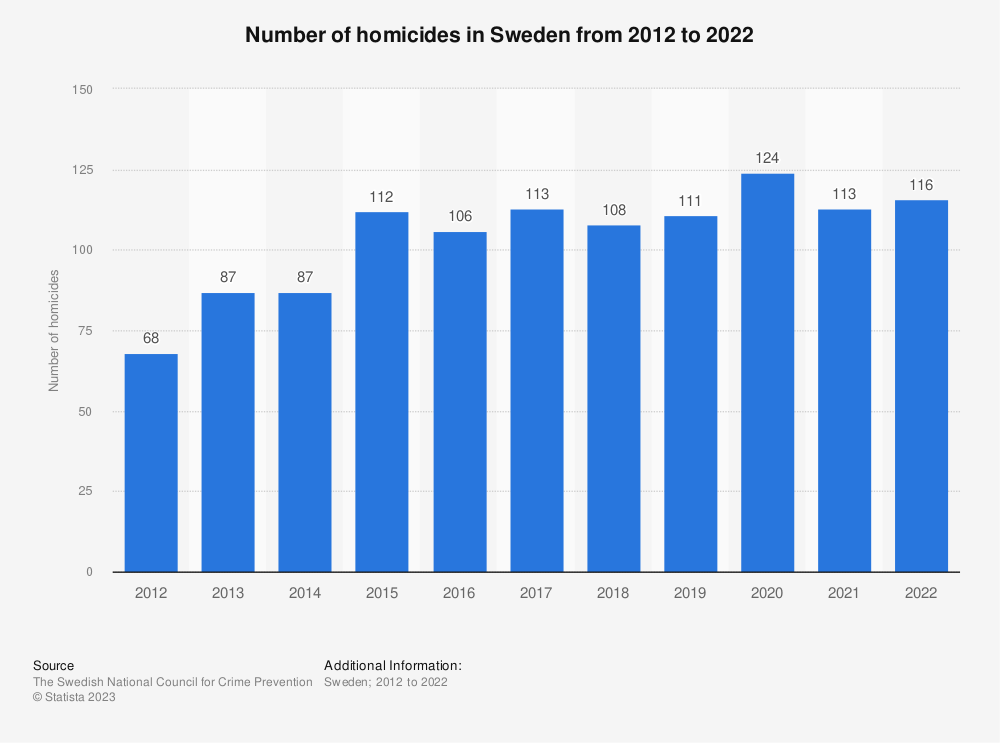
Below: Gang-related shootings and killings have been the bulk of overall confirmed homicides in the country...

You will find more infographics at Statista

Kristersson’s center-right government rose power last year largely on a platform of getting tough on crime. Kristersson has done a rare thing for a Swedish politician, placing blame squarely on "irresponsible migration policies and failed integration" under the previous government and years of failed policies.


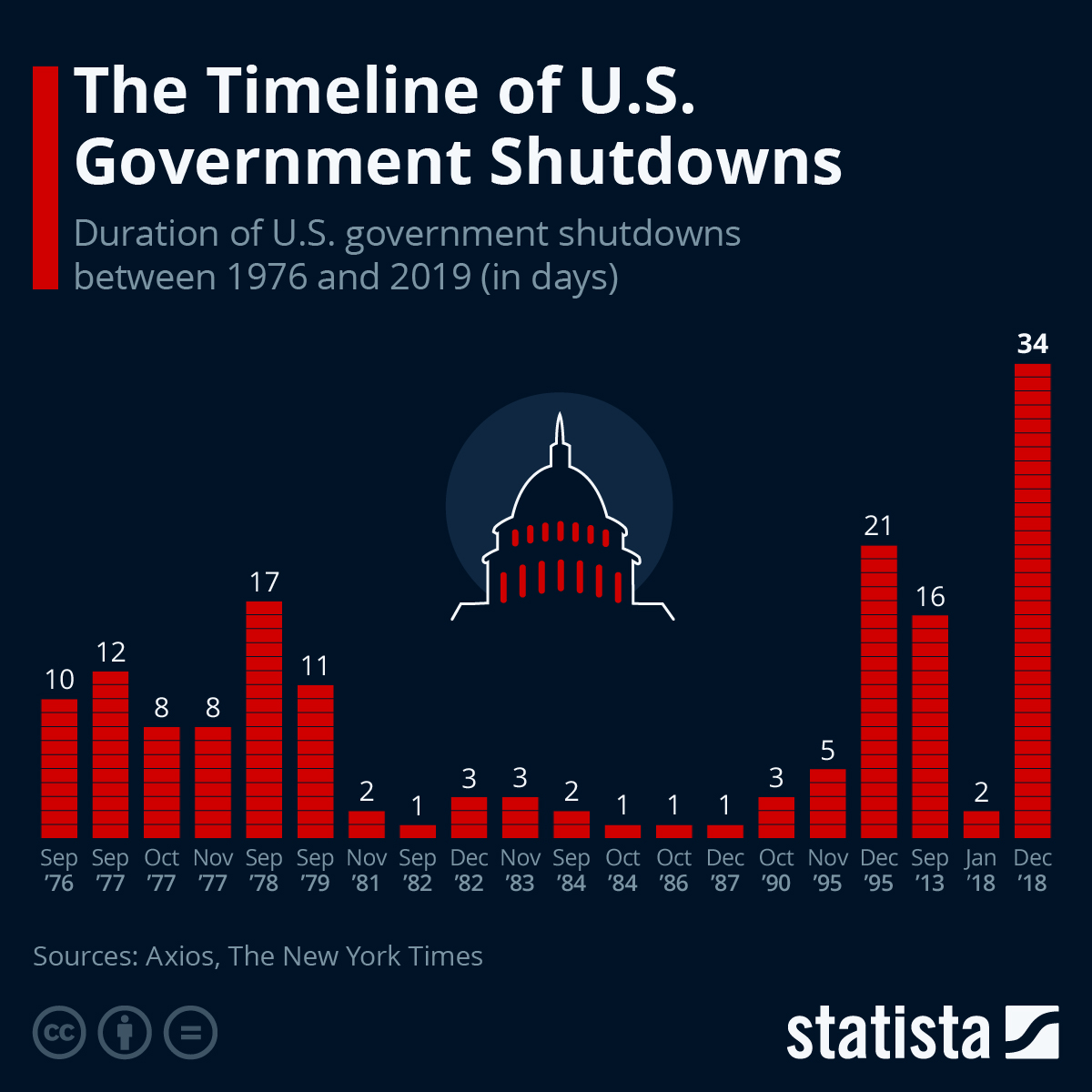
A Timeline Of US Government Shutdowns

 The 2018/19 shutdown was the longest in recent U.S. history at 34 days. 

As Statista's Katharina Buchholz shows in the timeline below, government shutdowns have been getting longer in the last three decades, with the second-longest and the fourth-longest shutdown taking place in 1995 and 2013, respectively.

Infographic: The Timeline of U.S. Government Shutdowns | Statista

Climbing stairs cuts heart disease risk by 20%

 Tired of living in a walk-up apartment?

Hate it when an escalator breaks down?

It’s a nuisance, but climbing those flights of stairs might be saving your life, according to a new study from Tulane University.

And stair-climbing might be even better than walking thousands of steps a day.

Medical researchers have found that taking at least 50 steps up stairs each day could slash your risk of heart disease — including coronary artery disease or stroke — by 20%.\

“Short bursts of high-intensity stair climbing are a time-efficient way to improve cardiorespiratory fitness,” study co-author Dr. Lu Qi, a professor at the Tulane University School of Public Health and Tropical Medicine, said in a news release.

“These findings highlight the potential advantages of stair climbing as a primary preventive measure” for cardiovascular disease, Qi added.

Medical researchers have found that taking at least 50 steps climbing stairs each day could slash your risk of heart disease — such as coronary artery disease or stroke — by 20%.
Research has shown that stair-climbing might be even better than walking thousands of steps a day.
Atherosclerosis Journal

To test the benefits of stair climbing, Qi and his colleagues analyzed data from the UK Biobank, a massive repository of health and lifestyle information collected from more than 458,000 adults.

The study calculated people’s susceptibility to cardiovascular disease based on their family history, established risk factors, lifestyle habits and frequency of stair climbing. The researchers followed up on the participants for an average of 12.5 years.

The study, published in the journal Atherosclerosis, found that people who regularly climbed 50 steps a day — about five flights of stairs — had an almost 20% lower risk of heart disease.

And because staircases are easily found in most cities, the authors noted that climbing stairs could be a low-cost, easily accessible way to reduce the risk of heart disease.

Taking the stairs is a low-cost, easily accessible way to improve your health - and might be better than taking thousands of daily steps.
Taking the stairs is a low-cost, easily accessible way to improve your health — and might be better than taking thousands of daily steps.
baona

Better than steps?

Stair climbing has some advantages over other forms of exercise — including walking thousands of steps per day.

Stair climbing “requires the use of more muscles as well as some balance and gross motor skills,” Dr. Nicolas Berger of the UK’s Teesside University told the Independent.

Even a brief stair workout tones muscles such as the glutes, quads, hamstring and calves, as well as muscles in the core, Berger noted.

It also “requires a lot of activity from your cardiovascular system and that is why people often find themselves out of breath whilst climbing stairs,” Berger added.

“These short, intermittent bursts of activity have large benefits in terms of reducing the risk of cardiovascular disease. They can significantly increase your heart rate and oxygen uptake and cause positive adaptations in the body.”

And although walking up 50 steps a day might not seem like much, “it can have a significant training effect,” Berger said.


Friday, September 29, 2023

Implant to cure cancer in just 60 days — with goal to slash death rates by 50%

 There’ll be an app for that.

Curing cancer could soon be as easy as a few taps on your mobile, according to a team of scientists at Rice University who have received $45 million in funding for a novel, implant-based treatment system that could cut cancer death rates by 50%.

The funds, granted by the Advanced Research Projects Agency for Health, will be used to develop “sense-and-respond implant technology,” with the aim to improve the outcomes of immunotherapy treatments for cancers that are usually difficult to treat.

“Instead of tethering patients to hospital beds, IV bags and external monitors, we’ll use a minimally invasive procedure to implant a small device that continuously monitors their cancer and adjusts their immunotherapy dose in real time,” Omid Veiseh, a Rice bioengineer and principal investigator on the project, said in a statement.

Similarly to diabetes treatments with insulin pumps, the three-inch implant, or “hybrid advanced molecular manufacturing regulator” (HAMMR), would deliver immunotherapy drugs to the patient in a “closed loop” system. The chargeable devices will communicate wirelessly, “potentially with a smartphone,” researchers told KHOU 11.

Researchers hope that the implant would be able to cure cancer in as little as two months.
Rice University
The roughly three-inch implant would both monitor cancer cells and deliver therapy drugs.
Brandon Martin/Rice University

Researchers hope that the implant will only be needed for short-term use — eradicating the cancer in as little as 60 days.

“Cancer cells are continually evolving and adapting to therapy. However, currently available diagnostic tools, including radiologic tests, blood assays and biopsies, provide very infrequent and limited snapshots of this dynamic process,” Dr. Amir Jazaeri, a co-principal investigator and professor of gynecologic oncology at the University of Texas MD Anderson Cancer Center, said in a statement.

“As a result, today’s therapies treat cancer as if it were a static disease.”

Veiseh, right, is leading a team of reachers from 20 labs across the country.
Brandon Martin/Rice University

Instead, their technology, which serves as both a cancer monitoring and drug administrating system, will provide “real-time data from the tumor environment that can in turn guide more effective and tumor-informed novel therapies” and, therefore, expedite the treatment process.

“The technology is broadly applicable for peritoneal cancers that affect the pancreas, liver, lungs and other organs,” said Veiseh.

The research team is comprised of experts from an array of fields spanning 20 labs in seven states under the project name THOR, which stands for “targeted hybrid oncotherapeutic regulation.”

The first clinical trial will investigate the implant’s effectiveness for recurrent ovarian cancer. They hope to begin human trials within five years.

The implant would, in theory, monitor cancer cells in real time.
Veiseh Lab/Rice University
Last year, Veiseh’s team of researchers already demonstrated the effectiveness of the “drug factory” technology in mice with bead-shaped implants that eradicated late-stage ovarian and colorectal cancers in six days.

Now, they’re able to “build on that experience” with clinical trials, Veiseh said, with HAMMR as “the next iteration of that approach.”

https://nypost.com/2023/09/29/scientists-developing-implant-to-cure-cancer-in-just-60-days/

US judge refuses to block Medicare from negotiating drug prices

 The U.S. government's Medicare health insurance program can begin negotiating prices for some prescription drugs this fall under a new program, a federal judge ruled on Friday, vindicating one of President Joe Biden's signature initiatives.

The order by U.S. District Judge Michael Newman in Dayton, Ohio, comes in a lawsuit brought against the Biden administration by the U.S. Chamber of Commerce.

The nation's largest business lobbying group argues that the program violates the U.S. Constitution by allowing the government to force drugmakers to accept unfairly low prices, and would stifle innovation.

Newman in a preliminary order rejected that argument, finding that drugmakers were unlikely to prevail in the case. He said they were not being forced to give anything up because participating in Medicare is "completely voluntary."

"As there is no constitutional right (or requirement) to engage in business with the government, the consequences of that participation cannot be considered a constitutional violation," he wrote.

The Chamber of Commerce and the U.S. Justice Department did not immediately respond to requests for comment.

The Biden administration "will continue fighting to lower health care costs for American families, no matter how many challenges Republicans and Big Pharma put in our way," White House spokesperson Karine Jean-Pierre said in a statement.

Although Newman's ruling allows the price negotiation program to begin as scheduled on Oct. 1, the judge allowed the lawsuit to continue, denying a motion by the government to dismiss it altogether.

The ruling is the first to come from multiple lawsuits by drug companies and industry groups challenging the program. Newman was appointed to the bench by Republican former President Donald Trump.

The drug price negotiation program is part of the Inflation Reduction Act, which Biden, a Democrat, signed last year.

'Robert Kennedy Jr to run as independent, could complicate Trump, Biden 2024 contest'

  U.S. presidential hopeful Robert F. Kennedy Jr. will announce he is running as an independent instead of pursuing his long-shot bid to oust President Joe Biden as the Democratic Party nominee, a shift that could complicate the 2024 election.

Anti-vaccine activist Kennedy, a member of a storied U.S. political dynasty, posted a video on YouTube on Friday asking Americans to join him for a "major announcement" in Philadelphia on Oct. 9.

"I'll be speaking about a sea change in American politics," he said, decrying corruption in "both parties."

"How are we going to win against the established Washington interests?" he asks. "It's not through playing the game" by the current rules, he said.

Kennedy is nephew of former President John F. Kennedy, who was assassinated in 1963, and the son of former U.S. Senator Robert F. Kennedy, who was assassinated in 1968 during his own presidential bid.

Kennedy said in April he would challenge Biden for the Democratic nomination to run against the Republican nominee, expected to be former President Donald Trump.

Since then, Kennedy has complained that the Democratic Party has "essentially merged into one unit" with the Biden campaign, denying him a fair shot in the nominating contest. Several opinion polls put Biden way ahead of Kennedy in single digit percentages or low double digits.

Kennedy's plan to run as an independent instead was first reported by Mediaite, a politics website.

Asked about the report, Kennedy's campaign emailed Reuters a link to Kennedy's video.

Democrats have expressed concern that any third-party bid could draw votes away from Biden, 80, who faces concerns about the economy and his age in an expected rematch against the Republican frontrunner and presumed nominee Trump, 77.

However, Republicans like Kennedy more than Democrats do by a wide margin, opinion polling compiled by FiveThirtyEight showed, suggesting Trump's campaign could be impacted as well. Trump faces four criminal prosecutions, including charges he illegally tried to overturn Biden's 2020 election victory, and his campaign is bleeding cash for legal expenses.

https://news.yahoo.com/robert-kennedy-jr-run-independent-234317825.html