Search This Blog

Saturday, September 30, 2023

Cigna Group announces settlement with US on claims it overcharged Medicare Advantage program

 Health insurer Cigna Group says it has reached a settlement with the United States over claims it overcharged the government's Medicare Advantage program by making it appear patients were more ill than they actually were.

The settlement, reached on Friday, includes a payment of about $172 million by Cigna. Cigna said it also will enter into a corporate integrity agreement with the U.S. Office of Inspector General.

U.S. prosecutors in Manhattan in October 2022 said Connecticut-based Cigna obtained tens of millions of dollars in Medicare funds between 2012 and 2019 by submitting false diagnoses for patients in cases in which providers retained by the company had not conducted the necessary tests.

Medicare is a government health insurance program for people ages 65 and older.

https://finance.yahoo.com/news/cigna-group-announces-settlement-us-152625524.html

Energy consumption 'to dramatically increase' because of AI

 Artificial intelligence is expected to have the most impact on practically everything since the advent of the internet. Wall Street sure thinks so. The tech-heavy Nasdaq (^IXIC) is up 26% year to date thanks to the frenzy over AI-related stocks.

But AI's big breakout comes at a cost: much more energy.

Take for example OpenAI's chatbot ChatGPT. Research from the University of Washington shows that hundreds of millions of queries on ChatGPT can cost around 1 gigawatt-hour a day, or the equivalent of the energy consumption of 33,000 US households.

"The energy consumption of something like ChatGPT inquiry compared to some inquiry on your email, for example, is going to [be] probably 10 to 100 times more power hungry,” Sajjad Moazeni, professor of electrical and computer engineering at UW, told Yahoo Finance.

Industry participants say this is only the very beginning of what's to come.

“We’re maybe at 1% of where the AI adoption will be in the next two to three years,” said Arijit Sengupta, founder and CEO of Aible, an enterprise AI solution company. “The world is actually headed for a really bad energy crisis because of AI unless we fix a few things.”

EAGLE MOUNTAIN, UT - OCTOBER 05: Construction proceeds on phases three through five at a Facebook data center on October 5, 2021 in Eagle Mountain, Utah. Facebook was shut down yesterday for more than seven hours reportedly due in part to a major disruption in communication between the company's data centers.  (Photo by George Frey/Getty Images)
An energy-hungry Facebook data center under construction. (George Frey/Getty Images)

Data centers are the heart of the advanced computing process. They are the physical locations with thousands of processing units and servers at the core of the cloud computing industry largely managed by Google, Microsoft, and Amazon.

"As you think of this shift towards these larger foundation models, at the end of the day you’re going to need these data centers to require a lot more energy as a whole," Angelo Zino, VP and senior equity analyst at CFRA Research, told Yahoo Finance.

Data centers have increasingly shifted from using simpler processors, called CPUs, to more advanced graphics processing units, or GPUs. Those components, made by companies like Nvidia (NVDA), are the most energy intensive.

"For the next decade, GPUs are going to be the core of AI infrastructure. And GPUs consume 10 to 15 times the amount of power per processing cycle than CPUs do. They’re very energy intensive,” explained Patrick Ward, vice president of marketing for Formula Monks, an AI technology consulting company.

How Cubans were recruited to fight for Russia

 Cuban seamstress Yamidely Cervantes has bought a new sewing machine for the first time in years, plus a refrigerator and a cellphone - all on Russia's dime.

She said her 49-year-old husband Enrique Gonzalez, a struggling bricklayer, left their home in the small town of La Federal on July 19 to fight for the Russian army in Ukraine. Days later, he wired her part of his signing-on bonus of about 200,000 roubles ($2,040) which she received in Cuban pesos, Cervantes told Reuters.

That represents a windfall on the economically stricken communist-run island. It's more than 100 times the average monthly state salary of 4,209 pesos ($17), according to the national statistics office.

Few places feel the pinch more than La Federal, a community of about 800 people on the outskirts of Havana where one in four residents are unemployed, government data for 2022 shows.

On the 100-meter dirt road where Cervantes lives, at least three men have left for Russia since June, and another had sold his home in anticipation of going, she said.

"You can count on one hand those who are left," the 42-year-old said as she surveyed the street from a small terrace where she'd repurposed two broken toilet bowls as flower pots.

"Necessity is what is driving this."

Reuters traced the stories of those four men, together with more than a dozen other Cubans recruited to go to Russia from districts in and around the capital Havana, ranging from a builder and a shopkeeper to a refinery worker and phone company employee. Eleven of the men ended up flying to Russia while the other seven got cold feet at the last moment.

Interviews with many of the men plus friends and relatives, together with a trove of WhatsApp messages, travel papers, photos and phone numbers they provided to corroborate their accounts, paint the most detailed picture yet of how Cubans are flocking to shore up Moscow's war machine.

The Kremlin and Russian defence ministry didn't respond to queries about Cubans being recruited for their military. The Cuban government also didn't respond to queries for this article.

News of Cubans ending up in the Russian military hit headlines this month when the Havana government - a longstanding ally of Russia that says it is "not part of the war in Ukraine" - said it had arrested 17 people connected with a human-trafficking ring that lured Cubans to fight for Moscow. Reuters could not establish the identities of those involved in the alleged trafficking ring and when or whether they were arrested.

The recruits identified by Reuters volunteered to go to Russia to work for the military following overtures on social media from a recruiter who identified herself as "Dayana". In La Federal, for example, all nine recruits identified by Reuters signed up to fight in the war. In Alamar, an eastern Havana suburb, most of the five men signed up for non-fighting roles such as in construction, packaging of provisions and logistics.

Cervantes' husband Gonzalez, speaking via video call from a Russian military base outside the city of Tula, south of Moscow, told Reuters he was one of 119 Cubans training there. When he arrived in Russia, he said, he had signed a contract to work for the military, translated into Spanish.

"Everyone here knew what they were coming for," he said, smiling in military garb as he gave Reuters a digital phone tour of the camp, ringed by pine trees. "They came for the war."

Gonzalez said the 119 Cubans there were being trained to fight in the war, though still wasn't clear where they'd be sent.

"I have several friends in Ukraine, and they are in places where bombs are falling but they haven't actually been in confrontations with Ukrainians," he added. "Everything is good here, but when we go there, we will be in a war zone."

Reuters was unable to contact any of the other men who joined the military, though confirmed via WhatsApp messages and photos that they had flown to Russia and two are now in Crimea.

Contacted for comment on the recruitment of Cubans into the Russian military, Ukrainian foreign ministry spokesman Oleg Nikolenko said: "I can confirm that the Ukrainian embassy in Havana has reached out to the Cuban authorities on this matter."

A U.S. State Department spokesperson said the United States was monitoring the situation closely. "We are deeply concerned by reports alleging young Cubans have been deceived and recruited to fight for Russia," the spokesperson said.

DAYANA IN CAMOUFLAGE CAP

The Cuban recruitment activity identified by Reuters began weeks after a May decree issued by President Vladimir Putin that allowed foreigners who enlisted with the military on year-long contracts to receive Russian citizenship via a fast-track process, along with their spouses, children and parents.

In La Federal, word of the army work began to spread in June, according to the residents interviewed. Offers to join up, shared via Facebook, Instagram and WhatsApp, became the talk of the town, with Dayana named as the contact.

More than two dozen young men interviewed by Reuters in and around Havana spoke of the scale of the exodus.

Cristian Hernandez, 24, broke into laughter when asked how many people had left the area around La Federal. "A ton of people," he said. "Almost all of our friends have gone over there."

Yoan Viondi, 23, who lives a few-minute bike ride up the road from the main drag, said he knew about 100 men in Villa Maria, the district that includes La Federal, had been recruited for the Russian war effort since June.

He said a friend gave him the WhatsApp contact for Dayana, a Cuban woman who he said bought plane tickets for recruits. Dayana was also mentioned as a key contact by most of the recruits and relatives Reuters spoke with.

Viondi wasted no time.

"Hi, good afternoon," Viondi said to her in a July 21 message, viewed by Reuters. "Please I need information."

Dayana, who appears in her chat icon as a dark-haired woman in a camouflage cap, responded with contract terms almost instantaneously, according to time stamps. The first line of the message states: "This is a contract with the Russian military by which you receive citizenship."

The contract was for one year and offered a signing bonus of 195,000 roubles followed by a monthly salary of 200,000 roubles, plus 15 days of vacation after the first six months of work.

Those terms are in line with those relayed to Reuters by other recruits and their families.

"If you're in agreement, you should just send (a copy of) your passport," Dayana's message read.

Within two minutes, Viondi had sent a digital copy of his passport. One hour later, Dayana responded in an audio message heard by Reuters: "Perfect, tomorrow I'll be able to tell you what day you will travel," she said.

Reuters was unable to reach Dayana for comment on the number used by Viondi and others, or to confirm her full name.

I WON'T DIE OF HUNGER

In the end, despite his initial enthusiasm, Viondi became anxious about going to Russia and cut contact with Dayana. He stressed that the people who signed up in La Federal knew they would be going to fight.

"It's hard living here. Everyone said, 'If I choose this, I won´t die of hunger in Cuba," he said. "But they knew where they were going. I knew perfectly well where I was going too."

Viondi told Reuters neither Dayana, nor anyone else, had asked him to keep their interactions a secret.

He said he maintained contact with at least four friends who had signed contracts in Russia with the army and that, as far as he knew, "they were fine". Most, he said, were now in Ukraine.

Cuba is mired in its worst economic crisis in decades, with long lines for even the basics like food, fuel and healthcare, spurring an exodus of Cubans to the U.S., Latin America and Europe last year.

Alina Gonzalez, president of a neighborhood block committee in La Federal tasked with mobilizing support for the communist-run government, recalled the excitement stirred by the Russian military work.

Many men jumped at the opportunity in her neighborhood, she said, including her nephew Danilo.

"The one that lives over there? He went with his wife and two children. That one over there, with his wife. And the mother of another lives further down," she said.

Roberto Sabori told Reuters that many of the men who left - including his 30-year-old son, Yasmani - had done so in a hurry, keeping their plans secret from even their families.

"I heard he was leaving the same day he left," said the 53-year-old, who lives around the corner from Gonzalez, adding that his son had called him as he prepared to board a flight from the resort town of Varadero to Moscow.

"He never told me anything."

'MAMI, I CAN'T TAKE IT'

Cervantes, the seamstress of La Federal, recalls the desperation her husband Gonzalez, now in Russia, had felt in the months before he left. "Work, work, work," she said of his life. "One day, he said to me, 'Mami, I just can't take it anymore'."

"One day he told me, 'I'm going to Russia. He showed me the photocopy of his passport, and had the ticket and everything. That was the 17th (of July) and he left on the 19th."

While Cervantes chose to stay behind, Reuters confirmed through WhatsApp photos and videos that at least three wives from La Federal had joined their husbands in Russia, as well as at least one child.

Cervantes said her cousin, Luis Herlys Osorio, had enlisted in the Russian army weeks after her husband departed, and that his wife, Nilda, was also now in Russia: "She went, and so did many of the women in the neighborhood."

Reuters reviewed photos on social media of Nilda, with two other wives from La Federal, at a rented home in the city of Ryazan in western Russia. Osorio is in Crimea, Cervantes said.

Cuba has sent mixed messages this month about its citizens fighting for Russia.

On Sept. 8, when it announced the trafficking-ring arrests, it also said it was illegal for its citizens to fight for a foreign army, punishable by life in prison.

Days later, though, Cuba's ambassador in Moscow said Havana didn't oppose Cubans "who just want to sign a contract and legally take part with the Russian army in this operation." Within hours, Cuba contradicted its envoy, reiterating that Cubans were prohibited from fighting as war mercenaries.

Gonzalez objects to being called a mercenary. The former bricklayer, who had received his Russian passport, likens his decision to fight with Russia to that of the Cubans who fought in a Soviet-backed war in Angola in the 1970s.

In that war in southern Africa, widely viewed as a Cold War proxy conflict, Cuba deployed tens of thousands of troops to fight for a communist guerrilla group supported by Moscow against a rival, U.S.-backed anti-communist movement.

"I'm following their example," Gonzalez said of those Cuban fighters in Angola, adding Moscow had been a steadfast ally of Cuba for decades and the Soviet Union had provided economic aid to the island.

"Russia helped to maintain my family."

https://news.yahoo.com/special-report-whatsapp-war-cubans-101318767.html

What is the Top Priority or Number One Concern of Most Americans?

 Think about the headline question at a personal level and also how you think the average person might answer.

Image from YouTube video below.

In answer to my lead question, I would expect a huge variety of opinions including but not limited to: Inflation, putting food on the table, rent, student loans, US debt, rising deficits, Social Security running out of money, broken political system, care of a sick or dying loved one, climate change, Trump, Biden, gas prices, crime, education, employment, unaffordable housing, saving for retirement, the UAW strike, auto repairs, home repairs, the cost of an auto, lack of saving, finding a job after college, credit card debt, and gasoline prices.

That’s over 20 legitimate concerns off the top of my head. Assistance to Ukraine as the #1 top priority is one thing that would not have crossed my mind until I saw this Tweet.

Senate Minority Leader Mitch McConnell says “Providing assistance for the Ukrainians to defeat the Russians is the number one priority for the United States right now, according to most Republicans“.

Would assistance to Ukraine be your number one priority? Top 10? Top 20? On your list at all?

Q: Are politicians that seriously out of touch with what people’s concerns are?
A: Of course they are.

It’s not just McConnell, or Republicans, or Democrats. It’s the whole stinking collective lot of them.

They all make decisions based on their priorities, not yours, often based on which donors are giving them the most money for their election campaigns.

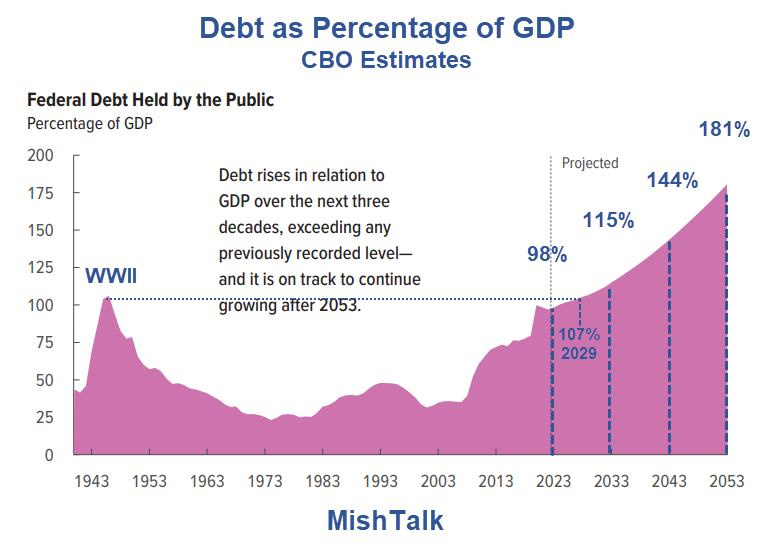
CBO Debt to GDP Estimates

Debt-to-GDP image from the Congressional Budget Office, annotations by Mish.

Debt to GDP Alarm Bells Ring, Neither Party Will Solve This

On September 7, I commented Debt to GDP Alarm Bells Ring, Neither Party Will Solve This

US Debt held by the public is soaring out of sight. It’s even worse than it looks for reasons I explain.

Yet, despite deficit spending and the national debt being enormous problems, I wonder how they would rate in a national poll.

The last concern of those struggling to put food on the table, pay rent, take care of elderly parents, pay down credit card or student debt, or pay the bills in general, is sending $100 billion and counting to Ukraine.

No One Will Fix This

Compromise is always more spending for this in return for more spending on that.

Bnd both parties want to spend more on the military.

Neither party will fix the deficits. Neither party will do anything about mounting debt. No one will do anything about anything because the political system is totally broken.” Mish

https://mishtalk.com/economics/what-is-the-top-priority-or-number-one-concern-of-most-americans/

Virgin Pulse eyes $3bn merger with HealthComp

 Digital health and wellness company Virgin Pulse has said it plans to merge with HealthComp, a health benefits administrator, in a $3 billion transaction that would create a wide-ranging health technology and data platform for employers.

The resulting service offering would “improve health outcomes, lower costs, and empower members” of healthcare plans, according to the companies.

Virgin Pulse’s digital health platform revolves around Homebase for Health, a programme which uses artificial intelligence and behavioural science to help people take control of their mental, physical, and social wellbeing.

It was recently adopted by Cigna Healthcare for use by customers who receive health coverage through their employer. HealthComp, meanwhile, calls itself the largest independent health plan administrator for self-funded employer groups in the US and also provides analytics software to customers.

Joining together will allow the creation of an “innovative and flexible” health plan offering that covers plan design, plan management, payment integrity, health navigation, preventative care, and digital therapeutics – all delivered via Homebase for Health, said the two firms in a statement.

If it goes ahead, the merger could create “a new category in the health space that will change the way employers address the two-fold challenge of reducing costs and improving member outcomes,” said Chris Michalak, Virgin Pulse’s chief executive, who will take on the same role at the combined company.

The aim is to simplify a benefit structure that is plagued by “waste, friction, and preventable risk” leading to “unmet needs and escalating costs”, he added.

“Our two companies have a shared mission to improve individual outcomes by engaging users early and often and making health and wellbeing more accessible, affordable, and personal for all.”

The merger is expected to close before the end of the year, subject to regulatory approval, and if consummated will create an entity with more than 20 million members, representing around 1,000 self-insured employers across the US.

“Self-insured employers pay for almost half of the nation’s healthcare expenditures and now require more innovative and affordable solutions,” said Chad Harris, HealthComp’s CEO.

Both companies are private equity-owned, and existing investors New Mountain Capital, Blackstone, and Morgan Health will share ownership of the new company. New Mountain will be the majority backer.

Virgin Pulse has been steadily growing its Homebase for Health platform via a string of deals, including an agreement with Headspace that layered in psychiatry, therapy, clinical care, self-guided care, behavioural health coaching, and employee assistance programmes.

https://pharmaphorum.com/news/virgin-pulse-eyes-3bn-merger-healthcomp

Path for BrainStorm ALS Treatment Remains Rocky, Hope for Others on Horizon

 Amyotrophic lateral sclerosis (ALS), known as Lou Gehrig’s disease, dominated this week’s news. An FDA advisory committee met on Wednesday to consider BrainStorm Cell Therapeutics’ much-debated experimental treatment NurOwn. The adcomm voted 17-1 that NurOwn did not demonstrate substantial evidence of effectiveness in mild to moderate ALS.

However, the near unanimous adcomm vote against BrainStorm’s candidate was not surprising. In briefing documents published Monday, ahead of Wednesday’s meeting, the FDA took issue with the cell therapy’s manufacturing plan and said BrainStorm failed to demonstrate substantial evidence of efficacy in its Biologics License Application. Further, the agency said that upon initial receipt of the BLA, it determined it was “scientifically incomplete” to demonstrate effectiveness, while the manufacturing information it received was “grossly deficient” to ensure adequate quality of the product.

Though Wednesday’s adcomm panelists expressed compassion for ALS patients, they pointed to “conflicting” information and a “lack of efficacy” in terms of survival and statistical evidence that didn’t meet the regulatory requirement. The one vote in favor of BrainStorm’s NurOwn came from Kathleen O’Sullivan-Fortin, founder of ALD Connect, who said “there’s no bigger risk than imminent certain deaths from ALS and these are unique and desperate circumstances that would require us to exercise flexibility.”

In the U.S., there are approximately 25,000 people living with ALS, a fatal neurodegenerative disease that damages nerve cells in the brain and spinal cord. While ALS has no cure and there is no effective treatment to reverse its progression, there are more than half a dozen drugs approved by the FDA to treat the neurological disorder and its symptoms. However, there is a pipeline of potential candidates on the horizon.

Clene reported this week that the company’s experimental drug reduced the risk of death by 49% compared to the largest U.S. database of previous ALS therapy trials. “Improved survival status is an important measure of drug effect,” Merit Cudkowicz, chair of the neurology department at Massachusetts General Hospital and principal investigator of the HEALEY ALS Platform Trial, said in a statement.

Also, Seelos Therapeutics’ SLS-005 (Trehalose) is being evaluated in the HEALEY ALS Platform Trial, which is examining the effectiveness of the candidate at stabilizing proteins and promoting autophagy in the brain to clear toxic protein aggregations characteristic of ALS. Top-line data from the registrational Phase II/III trial is expected before the end of 2023. It is among four late-stage Neurodegenerative Trials to Watch in Q4.

Takeda this week pledged up to $580 million in a development and commercialization deal with AcuraStem for the latter’s PIKFYVE program for ALS. The Japanese multinational pharma will gain access to AcuraStem’s PIKFYVE program, which includes AS-202, an investigational antisense oligonucleotide and the biotech’s most mature candidate. PIKFYVE is an emerging therapeutic target in ALS and Takeda now has exclusive worldwide license to AS-202 as well as to AcuraStem’s other PIKFYVE-directed assets.

https://www.biospace.com/article/path-for-brainstorm-als-treatment-remains-rocky-hope-for-others-on-the-horizon-/

IRS contractor charged with leaking tax returns of Donald Trump, wealthy people

 A former contractor for the Internal Revenue Service was charged Friday with leaking tax information to news outlets about thousands of the country’s wealthiest people.

Charles Edward Littlejohn, 38, of Washington, DC, is accused of stealing the tax return information and giving it to two different news outlets between 2018 and 2020, the Justice Department said in a statement. Littlejohn declined to comment when reached by The Associated Press, which also left a message for his attorney, Lisa Manning.

The outlets are not named in charging documents, but the description and time frame align with stories about former President Donald Trump’s tax returns in The New York Times and reporting about wealthy Americans’ taxes in the nonprofit investigative journalism organization ProPublica.

Both organizations published numerous articles about the tax information, some of which dated back more than 15 years, charging documents state.

The 2020 New York Times report found Trump paid $750 in federal income tax the year he entered the White House and no income tax at all some years thanks to colossal losses. Six years of his returns were later released by the then-Democratically controlled House Ways and Means Committee.

The United States Internal Revenue Service (IRS) Building is seen in Washington on September 20, 2010.
Charles Edward Littlejohn, a former IRS contractor, is accused of stealing the tax return information and giving it to two different news outlets between 2018 and 2020.
UPI

A message seeking comment was left for the newspaper.

ProPublica reported in 2021 on a trove of tax-return data about the wealthiest Americans. It found the 25 richest people legally pay a smaller share of their income in taxes than many ordinary workers do.

A spokesman for the outlet declined to comment on the charges, adding that ProPublica reporters have previously said they don’t know the identity of the source. The stories sparked calls for reform and for an investigation into the leak of tax information, which has specific legal protections.

Donald Trump
The New York Times published stories about former President Donald Trump’s tax returns.
AP
Littlejohn is charged with one count of unauthorized disclosure of tax returns and return information. He faces up to five years in prison if convicted.

The IRS declined to comment specifically on the case, but Commissioner Danny Werfel said “any disclosure of taxpayer information is unacceptable” and the agency has since tightened security.

https://nypost.com/2023/09/29/irs-contractor-charged-with-leaking-tax-returns-of-donald-trump-wealthy-people/