Search This Blog

Sunday, October 8, 2023

Feds Rein in Predictive Software That Limits Care for Medicare Advantage Patients

 Judith Sullivan was recovering from major surgery at a Connecticut nursing home in March when she got surprising news from her Medicare Advantage plan: It would no longer pay for her care because she was well enough to go home.

At the time, she could not walk more than a few feet, even with assistance -- let alone manage the stairs to her front door, she said. She still needed help using a colostomy bag following major surgery.

"How could they make a decision like that without ever coming and seeing me?" said Sullivan, 76. "I still couldn't walk without one physical therapist behind me and another next to me. Were they all coming home with me?"

UnitedHealthcare (UHC) -- the nation's largest health insurance company, which provides Sullivan's Medicare Advantage plan -- doesn't have a crystal ball. It does have naviHealth, a care management company it bought in 2020, and one of several businesses that use computers to help insurance companies make coverage decisions.

Its proprietary "nH Predict" tool sifts through millions of medical records to match patients with similar diagnoses and characteristics, including age, preexisting health conditions, and other factors. Based on these comparisons, an algorithm anticipates what kind of care a specific patient will need and for how long.

But patients, providers, and patient advocates in several states said they have noticed a suspicious coincidence: The tool often predicts a patient's date of discharge, which coincides with the date their insurer cuts off coverage, even if the patient needs further treatment that government-run Medicare would provide.

"When an algorithm does not fully consider a patient's needs, there's a glaring mismatch," said Rajeev Kumar, MBBS, the president-elect of the Society for Post-Acute and Long-Term Care Medicine, which represents long-term care practitioners. "That's where human intervention comes in."

The federal government will try to even the playing field next year, when the Centers for Medicare & Medicaid Services (CMS) begins restricting how Medicare Advantage plans use predictive technology tools to make some coverage decisions.

Medicare Advantage plans, an alternative to the government-run, original Medicare program, are operated by private insurance companies. About half the people eligible for full Medicare benefits are enrolled in the private plans, attracted by their lower costs and enhanced benefitsopens in a new tab or window like dental care, hearing aids, and a host of nonmedical extras like transportation and home-delivered meals.

Insurers receive a monthly payment from the federal government for each enrollee, regardless of how much care they need. According to the Department of Health and Human Services' inspector general, this arrangement raises "the potential incentive for insurers to deny access to services and payment in an attempt to increase profits." Nursing home care has been among the most frequently deniedopens in a new tab or window services by the private plans -- something original Medicare likely would cover, investigators found.

After UHC cut off her nursing home coverage, Sullivan's medical team agreed with her that she wasn't ready to go home and provided an additional 18 days of treatment. Her bill came to $10,406.36.

Beyond her mobility problems, "she also had a surgical wound that needed daily dressing changes" when UHC stopped paying for her nursing home care, said Debra Samorajczyk, a registered nurse and the administrator at the Bishop Wicke Health and Rehabilitation Center in Shelton, Connecticut, the facility that treated Sullivan.

Sullivan's coverage denial notice and nH Predict report did not mention wound care or her inability to climb stairs. Original Medicare would have most likely covered her continued care, said Samorajczyk.

Sullivan appealed twice but lost. Her next appeal was heard by an administrative law judge, who holds a courtroom-style hearing usually by phone or video link, in which all sides can provide testimony. UHC declined to send a representative, but the judge nonetheless sided with the company. Sullivan is considering whether to appeal to the next level, the Medicare Appeals Council, and the last stepopens in a new tab or window before the case can be heard in federal court.

Sullivan's experience is not unique. In February, Ken Drost's Medicare Advantage plan, provided by Security Health Plan of Wisconsin, wanted to cut his coverage at a Wisconsin nursing home after 16 days, the same number of days naviHealth predicted was necessary. But Drost, 87, who was recovering from hip surgery, needed help getting out of bed and walking. He stayed at the nursing home for an additional week, at a cost of $2,624.

After he appealed twice and lost, his hearing on his third appeal was about to begin when his insurer agreed to pay his bill, said his lawyer, Christine Huberty, supervising attorney at the Greater Wisconsin Agency on Aging Resources Elder Law & Advocacy Center in Madison.

"Advantage plans routinely cut patients' stays short in nursing homes," she said, including Humana, Aetna, Security Health Plan, and UHC. "In all cases, we see their treating medical providers disagree with the denials."

UHC and naviHealth declined requests for interviews and did not answer detailed questions about why Sullivan's nursing home coverage was cut short over the objections of her medical team.

Aaron Albright, a naviHealth spokesperson, said in a statement that the nH Predict algorithm is not used to make coverage decisions and instead is intended "to help the member and facility develop personalized post-acute care discharge planning." Length-of-stay predictions "are estimates only."

However, naviHealth's website boasts about saving plans money by restricting care. The company's "predictive technology and decision support platform" ensures that "patients can enjoy more days at home, and healthcare providers and health plans can significantly reduce costs specific to unnecessary care and readmissions."

New federal rulesopens in a new tab or window for Medicare Advantage plans beginning in January will rein in their use of algorithms in coverage decisions. Insurance companies using such tools will be expected to "ensure that they are making medical necessity determinations based on the circumstances of the specific individual," the requirements say, "as opposed to using an algorithm or software that doesn't account for an individual's circumstances."

The CMS-required notices nursing home residents receive now when a plan cuts short their coverage can be oddly similar while lacking details about a particular resident. Sullivan's notice from UHC contains some identical text to the one Drost received from his Wisconsin plan. Both say, for example, that the plan's medical director reviewed their cases, without providing the director's name or medical specialty. Both omit any mention of their health conditions that make managing at home difficult, if not impossible.

The tools must still follow Medicare coverage criteria and cannot deny benefits that original Medicare covers. If insurers believe the criteria are too vague, plans can base algorithms on their own criteria, as long as they disclose the medical evidence supporting the algorithms.

And before denying coverage considered not medically necessary, another change requires that a coverage denial "must be reviewed by a physician or other appropriate health care professional with expertise in the field of medicine or health care that is appropriate for the service at issue."

Jennifer Kochiss, a social worker at Bishop Wicke who helps residents file insurance appeals, said patients and providers have no say in whether the doctor reviewing a case has experience with the client's diagnosis. The new requirement will close "a big hole," she said.

The leading Medicare Advantage plans oppose the changes in comments submitted to CMS. Tim Noel, UHC's CEO for Medicare and Retirement, said Advantage plans' ability to manage beneficiaries' care is necessary "to ensure access to high-quality safe care and maintain high member satisfaction while appropriately managing costs."

Restricting "utilization management tools would markedly deviate from Congress' intent in creating Medicare managed care because they substantially limit MA [Medicare Advantage] plans' ability to actually manage care," he said.

In a statement, UHC spokesperson Heather Soule said the company's current practices are "consistent" with the new rules. "Medical directors or other appropriate clinical personnel, not technology tools, make all final adverse medical necessity determinations" before coverage is denied or cut short. However, these medical professionals work for UHC and usually do not examine patients. Other insurance companies follow the same practice.

David Lipschutz, JD, associate director of the Center for Medicare Advocacy, is concerned about how CMS will enforce the rules since it doesn't mention specific penalties for violations.

CMS' deputy administrator and director of the Medicare program, Meena Seshamani, MD, PhD, said that the agency will conduct audits to verify compliance with the new requirements, and "will consider issuing an enforcement action, such as a civil money penalty or an enrollment suspension, for the non-compliance."

Although Sullivan stayed at Bishop Wicke after UHC stopped paying, she said another resident went home when her Medicare Advantage plan wouldn't pay anymore. After 2 days at home, the woman fell, and an ambulance took her to the hospital, Sullivan said. "She was back in the nursing home again because they put her out before she was ready."

https://www.medpagetoday.com/special-reports/features/106668

Weight-Loss Drug Benefit in Heart Failure

 Semaglutide 2.4 mg (Wegovy) improved outcomes across the range of moderately reduced and preserved ejection fraction in heart failure (HFmrEF, HFpEF) related to obesity, a prespecified secondary analysis of the STEP-HFpEF trial showed.

The benefits were consistent across subgroups, reported Javed Butler, MD, MPH, MBA, of the Baylor Scott and White Research Institute in Dallas, at the Heart Failure Society of Americaopens in a new tab or window (HFSA) meeting and in the Journal of the American College of Cardiologyopens in a new tab or window.

For quality of life, semaglutide improved Kansas City Cardiomyopathy Questionnaire Clinical Summary Score by an average 5.0 points more than placebo in those with EF 45-49%, 9.8 points in the EF 50-59% patients, and 7.4 points with EF ≥60%, without a significant interaction (P=0.56).

The same was true for the other primary endpoint of body weight loss, which showed significant loss compared with placebo of 7.6 percentage points in those with EF 45-49%, 10.6 percentage points with EF 50-59%, and 11.9 percentage points with EF ≥60% (P=0.08 for interaction).

These findings, together with the overall positive results from the trial, "signify an initial paradigm-shifting step toward positioning semaglutide, and possibly other emerging incretin-based therapeutics and weight/metabolism-oriented approaches, at the center of obesity-related HFpEF management strategies," according to the authors of an accompanying editorialopens in a new tab or window.

Muthiah Vaduganathan, MD, MPH, and John W. Ostrominski, MD, both of Brigham and Women's Hospital and Harvard Medical School in Boston, noted that obesity-related HFpEF "has emerged as among the most prevalent, debilitating, and deadly" phenotype of HFpEF.

Whereas the effects of beta-blockers, renin-angiotensin system inhibitors, angiotensin receptor-neprilysin inhibitors, and mineralocorticoid receptor antagonists drop off with higher EF, the GLP-1 receptor agonist semaglutide appears to be like SGLT2 inhibitors in consistent treatment effects across an LVEF range ≥45%, they pointed out.

That begs the question of whether the semaglutide benefit is just due to weight loss or if the drug does something more, noted HFSA late-breaking trial session discussant John McMurray, MD, PhD, of the University of Glasgow in Scotland. "Has it some other pharmacological action that is beneficial? Clearly, if that were the case, it becomes very important because it means that this treatment might do good things in non-obese patients and might do good things in patients with other types of heart failure."

Whereas if it is just about weight loss, research is needed into diet and exercise and other pharmacological therapies like the novel oral GLP-1 receptor agonist orforglipronopens in a new tab or window, dual GIP/GLP-1 receptor agonist tirzepatideopens in a new tab or window (Mounjaro), and the novel triple GIP/GLP-1/glucagon receptor agonist retatrutideopens in a new tab or window, he added.

McMurray agreed with Butler that one of the most interesting findings from the STEP-HFpEF secondary analysis was NT-proBNP, which decreased with semaglutide similarly across EF categories.

A diet-induced weight loss trial in a pretty similar patient population showed similar results as seen in STEP-HFpEF. While it didn't have natriuretic peptide data, one other small randomized weight loss trial in HFpEF had shown an increase in levels as did observational data in patients undergoing bariatric surgery, McMurray noted.

"We found this result to be very meaningful in terms of our understanding of the mechanism of action" of semaglutide, Butler said, suggesting that its benefit goes beyond just weight loss.

As to whether the drug might find a place for obesity-related HF with reduced EF, the results offered "vital reassurance" regarding safety into the below-normal EF range as well, the editorialists noted. Prior data with GLP-1 receptor agonist exenatide (Byetta) had suggested potential harm in HF with reduced EF. Semaglutide, as in the main trial results, tended to be safer than placebo across the LVEF groups.

"Further, although more definitive studies are needed, the observation of treatment benefits on health status at LVEF <50% tentatively supports the existence of a more general, LVEF-independent, obesity-related HF phenotype capable of favorable modification with incretin-based therapies," they concluded.

STEP-HFpEF included 529 HF patients with an LVEF of at least 45%, BMI of 30 or higher (median 37), and New York Heart Association functional class II, III, or IV symptoms, among other criteria. Participants were randomized to once-weekly semaglutide 2.4 mg delivered subcutaneously or placebo for 52 weeks along with lifestyle advice.

The prespecified secondary analysis included 85 patients with an LVEF of 45-49%, 215 in the 50-59% range, and 229 with LVEF ≥60%.

Limitations included the predominantly white population studied and lack of central laboratory measurement of LVEF, which could have introduced normal variability of clinical practice.

Disclosures

STEP-HFpEF trial was funded by Novo Nordisk.

Butler disclosed being a consultant to Abbott, American Regent, Amgen, Applied Therapeutic, AstraZeneca, Bayer, Boehringer Ingelheim, Bristol Myers Squibb, Cardiac Dimension, Cardior, CVRx, Cytokinetics, Edwards, Element Science, Innolife, Impulse Dynamics, Imbria, Inventiva, Lexicon, Lilly, LivaNova, Janssen, Medtronics, Merck, Occlutech, Novartis, Novo Nordisk, Pfizer, Pharmacosmos, Pharmain, Roche, Sequana, SQ Innovation, 3live, and Vifor.

Vaduganathan disclosed financial relationships with American Regent, Amgen, AstraZeneca, Bayer AG, Baxter Healthcare, Boehringer Ingelheim, Chiesi, Cytokinetics, Lexicon Pharmaceuticals, Merck, Novartis, Novo Nordisk, Pharmacosmos, Relypsa, Roche Diagnostics, Sanofi, and Tricog Health, and participating on clinical trial committees for studies sponsored by AstraZeneca, Galmed, Novartis, Bayer AG, Occlutech, and Impulse Dynamics.

Ostrominski reported no relevant conflicts of interest.

McMurray disclosed payments to his employer, Glasgow University, for his work on clinical trials, consulting and other activities from Alnylam, Amgen, AstraZeneca, Bayer, Boehringer Ingelheim, BMS, Cardurion, Cytokinetics, Dal-Cor, GSK, lonis, KBP Biosciences, Novartis, Pfizer, and Theracos as well as personal payments from Abbott, Alkem Metabolics, AstraZeneca, Boehringer Ingelheim, Cardurion, Eris Lifesciences, Hikma, lonis, Lupin, Novartis, ProAdWise Communications, and Sun Pharmaceuticals.

Primary Source

Journal of the American College of Cardiology

Source Reference: opens in a new tab or windowButler J, et al "Semaglutide effects according to ejection fraction in heart failure with preserved ejection fraction and obesity" J Am Coll Cardiol 2023; DOI: 10.1016/j.jacc.2023.09.811.

Secondary Source

Journal of the American College of Cardiology

Source Reference: opens in a new tab or windowVaduganathan M and Ostrominski JW "Glucagon-like peptide-1 receptor agonists in heart failure: STEPping across the ejection fraction divide" J Am Coll Cardiol 2023; DOI: 10.1016/j.jacc.2023.09.812.

https://www.medpagetoday.com/meetingcoverage/hfsa/106684

WAR IN THE MIDDLE EAST [UPDATED]

 As I write it is the middle of the night in the U.S., but morning here in central Europe, where we are awakening to the shocking and barbaric attack Hamas has launched inside Israel from the Gaza strip. Some of the early videos and news accounts are horrific. This is no minor raid. Hamas is targeting civilians, clearly aiming at mass casualties. According to one TV report, Hamas has taken control of some population centers. It can be compared to 9/11.

Early reaction includes some criticism that Israeli intelligence may have missed seeing this coming, especially as this attack occurs around the 50th anniversary of the Yom Kippur war when Israel came perilously close to losing. I think there is a more obvious motive for the timing. Hamas and Hezbollah want to derail the much-rumored normalization of relations between Israel and Saudi Arabia, which will marginalize Hamas and Hezbollah to some extent.

No doubt Hamas expects—and likely hopes for—a strong Israeli response against them in Gaza, and I hope Netanyahu doesn’t hesitate, in the world of Marsellus Wallace, to get medieval on Hamas, and Hezbollah too while they are at it. It risks a wider war with Iran. So be it. (If it were up to me, the entire “civilian” leadership of the Palestinian Authority would be dead by sundown.)

The most urgent question for Americans is how the Biden Administration will react. I do not hesitate go on record with the view that Biden has long been anti-Israel, and is likely a closet anti-Semite. At a minimum we should cut off all U.S. aid to Gaza; Republicans in Congress should demand this. Expect the worst from our State Department.

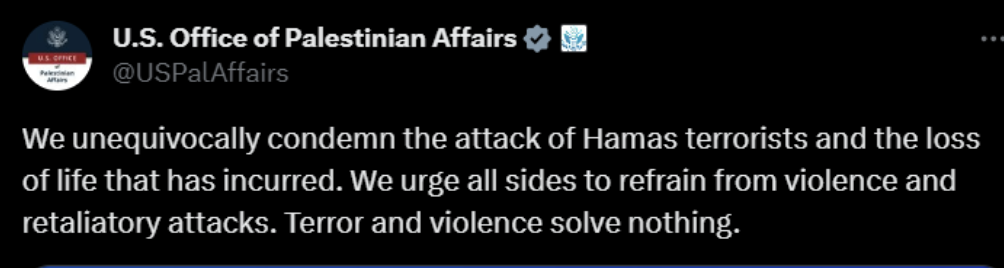
UPDATE—As predicted in the last sentence above, notice the difference in the statements issued by our State Department (“refrain from retaliatory attacks”), and the European Union (“Israel has the right to defend itself”). It’s a rare day that the EU is tougher than the United States, but there it is.

P.S. Has anyone sent word of the matter up to a certain beach house in Delaware?

More—Netanyahu declares “Israel is at war.”

As "Most Important Election Of Our Lives" Looms, Trump Blasts "Weak & Ineffective" Biden For Hamas Attack

 During a campaign rally on Oct. 7 in Waterloo, Iowa, former President Trump responded to the surprise attack on Israeli towns by the terrorist group Hamas earlier in the day, criticizing President Biden for being a "weak leader".

"We're here today for a very important reason: to commit to caucus, we know what that means right, commit to caucus, exactly 100 days from now each and every one of you is going to cast the most important vote of your lives.

I believe that too. I believe that this will be the most important election of our lives because this country is headed in a horrible horrible direction and you so what took place today in Israel.

This country is just headed so badly [sic]."

Trump made it clear who was to blame for the attacks in Israel:

"The Israeli attack was made because we are perceived as being weak and ineffective and with a really weak leader and and uh the brutal murder of citizens is an act of savagery that must and will be crushed, has to be... It has to be dealt with very powerfully.

This is a time where the United States needs leadership -  we don't have leadership - but Israel is at War and the United States obviously is going to stick with Israel and strongly..."

Trump concluded with a pitch for his caucus:

"if we don't take back our country, we're not going to have a country. If we do take back our country, our country will be greater than ever before, I promise you that..."

Watch the clip below:

The Ron Paul Institute's Adam Dick made an interesting point as Republican Party presidential candidates rushed out statements setting forth their related views, the statement of Donald Trump stood out as relatively noninterventionist.

While placing blame on Hamas, Trump refrained from promising support for the government of Israel in the conflict. This set him apart from the other prominent Republican candidates who made comments pledging support for Israel.

Here is Trump’s Saturday statement on the matter:

These Hamas attacks are a disgrace and Israel has every right to defend itself with overwhelming force. Sadly, American taxpayer dollars helped fund these attacks, which many reports are saying came from the Biden Administration. We brought so much peace to the Middle East through the Abraham Accords, only to see Biden whittle it away at a far more rapid pace than anyone thought possible. Here we go again.

So far so good. Trump is not endorsing in his statement the United States government supporting the Israel government in this conflict. But, there certainly is much pressure on him to make such an endorsement soon.

Other Republican presidential candidates, in contrast, jumped immediately at the opportunity to declare their support for aiding Israel in this new rising conflict. Tara Suter reported Saturday at The Hill on other prominent Republican candidates’ early statements on the matter. Every one of them took a step beyond Trump, pledging their support to the Israel government in the rising conflict.

Below are excerpts from those candidates’ statements presented in Suter’s article.

Doug Burgum: “Iran and its terror sponsors in Gaza are showing the world their true face: pure evil. Israel is at war with brutal terrorists and the United States must provide maximum support to our democratic ally.”

Chris Christie: “We must do whatever it takes to support the State of Israel in its time of grave danger, and we must end the scourge of Iran-backed terrorism.”

Ron DeSantis: “Israel not only has the right to defend itself against these attacks, it has a duty to respond with overwhelming force. I stand with Israel. America must stand with Israel.”

Nikki Haley: “Israel has every right to defend its citizens from terror. We must always stand with Israel and against this Iranian regime.”

Mike Pence: “Our prayers are with the families and soldiers of our most cherished ally. @netanyahu [Israel Prime Minister Benjamin Netanyahu)] says Israel is ‘at war’ America Stands With Israel[.]”

Vivek Ramaswamy: “Israel’s right to exist & defend itself should never be doubted and Iran-backed Hamas & Hezbollah cannot be allowed to prevail. I stand with Israel and the U.S. should too.”

Tim Scott: “Israel has a right to defend itself and the United States must stand in support of its steadfast ally.”

Can Trump continue to resist the pressure being put on him to declare that he does, and the US government should, “stand with Israel” in regard to this rising conflict?

We’ll see.

Taking a solitary course concerning this matter would be consistent with Trump’s apparent effort to run as the peace candidate among the contenders in the race for the Republican presidential nomination.

https://www.zerohedge.com/political/during-iowa-rally-trump-blasts-weak-ineffective-biden-hamas-attack-israel


Bristol-Myers Squibb to acquire Mirati in a $4.8 billion deal

 Bristol-Myers Squibb is set to acquire cancer drugmaker Mirati Therapeutics for $58 per share in cash, representing $4.8 billion equity value.

Bristol-Myers Squibb will finance the transaction with a combination of cash and debt.

The transaction is expected to be dilutive to Bristol-Myers Squibb's non-GAAP earnings per share by approximately 35 cents per share in the first 12 months after the transaction closes.

https://finance.yahoo.com/news/1-bristol-myers-squibb-acquire-215410059.html

Israel's Opportunity to Destroy Hamas

 The surprise attack on Israel by Hamas, the Islamist organization ruling Gaza, is a humanitarian horror. It is also a strategic opportunity for Israel, the U.S. and democracies everywhere.

Hamas is an offshoot of the Muslim Brotherhood, which author Cynthia Farahat describes as "the world's incubator of modern Islamic terrorism." From Hamas's origins in 1987, it has engaged in violence against Israelis, Palestinians and whoever else might cross its path. A sequence of Israeli missteps led in 2007 to its taking power in the Gaza Strip, an area the size of Omaha, Neb., with a population of two million. It imposed a totalitarian rule on Gaza similar to that of the mullahs in Iran, attempting to implement medieval strictures, oppressing its own population, and threatening to destroy Israel. ...

The Hamas charter of 1988 calls for Islam to "obliterate" Israel. After Saturday's vicious assault, the time has come for Israel to obliterate Hamas.

https://www.danielpipes.org/21921/israel-opportunity-to-destroy-hamas

Renewable energy stocks plunge as going green gets 'expensive'

 Renewable stocks are taking an outsized beating among other stocks in the utility sector, which was down more than 10% last quarter.

Investors may be betting that going green will take longer and require more capital in a higher-for-longer interest rate environment.

“As utilities struggle with converting to more green energy, their operating margins are getting squeezed until they can get their utility rates increased,” Louis Navellier, founder of Navellier, a money management firm, told Yahoo Finance.

Higher interest rates are impacting the renewable sector because clean energy projects are capital intensive.

To make matters worse, falling valuations are making it harder for companies to tap into public markets to fund their projects. Also, bonds offering higher yields are competing against dividend yields on utility stocks.

“There is an exodus from ESG products that are suffering from outflows,” said Navellier.

The Global Clean Energy ETF (ICLN) is down about 30% year to date. The solar and wind energy benchmarks Invesco Solar ETF (TAN) and First Trust Global Wind Energy ETF (FAN) are down 35% and 32% during the same period, respectively.

The selling in renewables intensified after NextEra Energy Partners (NEP), a subsidiary of NextEra Energy (NEE) focused on renewables, cut its growth target by half to 6% through at least 2026.

"Tighter monetary policy and higher interest rates obviously affect the financing needed to grow distributions at 12%," read the company statement on Sept. 27.

NextEra Energy Partners is down 69.27% year to date, on pace for its worst year on record, while its parent company NextEra Energy hit a 52-week low on Friday, down 42% year to date.

Bank of America analysts called the recent sell-off "overblown with collateral damage unfounded."

"Rates have indeed moved higher through the same period and utilities and renewables are rates sensitive," wrote Julien Dumoulin-Smith and Paul Zimbardo in a note to clients.