Search This Blog

Tuesday, January 9, 2024

Cellectar's blood cancer therapy succeeds in trial

 Cellectar Biosciences said on Monday its therapy iopofosine for Waldenstrom's macroglobulinemia, a type of blood cancer, met the main goal when tested in patients who received at least two prior lines of therapy.

https://finance.yahoo.com/news/cellectars-blood-cancer-therapy-succeeds-114037386.html

Seres fast tracked for GI antibacterial

 Seres Therapeutics Inc 

+ Free Alerts
 received FDA Fast Track Designation for SER-155, an investigational oral, cultivated microbiome therapeutic designed to prevent GI-associated bacterial infections and to reduce the incidence of severe acute graft-versus-host disease in immunocompromised patients undergoing allogeneic hematopoietic stem cell transplantation.

  • SER-155 Phase 1b Cohort 1 clinical data showed favorable tolerability, successful drug bacteria engraftment, and a substantial reduction in pathogen domination in the gastrointestinal microbiome, supporting progression to the placebo-controlled Cohort 2.
  • SER-155 Phase 1b placebo-controlled Cohort 2 data readout is anticipated in the third quarter of 2024.
  • Seres anticipates that a 2023 year-end cash balance of $128 million, in conjunction with the anticipated savings from the restructuring announced in November 2023 and the expected receipt of the $45 million Tranche B under its existing senior secured debt facility with Oaktree Capital Management, will support its operations into Q4 of 2024.

The company also announced preliminary key VOWST (fecal microbiota spores, live-brpk) launch metrics.

VOWST, the first FDA-approved orally administered microbiome therapeutic, received FDA approval in April of 2023 and is indicated to prevent the recurrence of Clostridioides difficile infection (CDI) in adults following antibacterial treatment for recurrent CDI (rCDI)

VOWST Commercial Performance

  • Preliminary Q4 net sales were approximately $10.4 million and reflected a gross-to-net reduction of 11%. Total 2023 net sales since launch in June were approximately $19.6 million and reflected a gross-to-net reduction of 13%.
  • Q4 completed prescription enrollment forms received for VOWST were 1,322; 1,082 resulted in new patient starts by year-end 2023.
  • The total 2023 completed prescription enrollment forms received for VOWST since launch were 2,833; of those, 2,015 resulted in new patient starts by year-end 2023.
  • In 2023, prescription enrollment forms were submitted by approximately 1,330 unique healthcare providers since launch; approximately 340 HCPs have prescribed VOWST to more than one patient.

Atea Positive Initial Data from Phase 2 Study for Hepatitis C Virus, Enrollment Milestone for Phase 3 Trial for COVID-19

 A 98% Sustained Virologic Response at Week 4 (SVR4) Post-Treatment Observed in Initial Data From 52 Patients in Lead-In Cohort in Phase 2 HCV Study

Phase 3 SUNRISE-3 Enrollment Surpassed 650 Patients in Monotherapy Arm; First Interim Analysis by the Independent Data Safety Monitoring Board (DSMB) Expected in March 2024

https://www.globenewswire.com/news-release/2024/01/08/2805848/0/en/Atea-Pharmaceuticals-Announces-Positive-Initial-Data-from-Phase-2-Study-for-Hepatitis-C-Virus-HCV-and-Significant-Enrollment-Milestone-for-Phase-3-SUNRISE-3-Trial-for-COVID-19.html

FDA Decisions: Astellas Hit with CRL for Claudin 18.2-Targeted Hopeful

 Astellas has failed to gain approval for what would be the first approved therapy targeting claudin 18.2 (CLDN18.2), a transmembrane protein expressed on the surface of gastric epithelial cancer cells. “Unresolved deficiencies” at a third party manufacturing facility are what tripped Astellas up in its bid for approval of zolbetuximab, according to the company’s announcement of the Jan. 4 Complete Response Letter.

Zolbetuximab is being proposed to treat patients with locally advanced unresectable or metastatic human epidermal growth factor receptor 2 (HER2)-negative gastric or gastroesophageal junction (GEJ) adenocarcinoma whose tumors are CLDN18.2 positive.

https://www.biospace.com/article/biospace-fda-decision-tracker-2023-biomarin-celltrans-pfizer-and-opko-health/

Vertex's Viacyte Backs Out of CRISPR Diabetes Deal

 Vertex Pharmaceuticals’ subsidiary ViaCyte Inc. is not pushing through with its diabetes deal with CRISPR Therapeutics, the Swiss biotech announced Monday.

The partners—which had recently won the FDA’s approval for Casgevy (exagamglogene autotemcel), the first CRISPR-based gene therapy for sickle cell disease—were supposed to advance a gene-edited stem cell therapy for diabetes. Vertex’s opt-out of the deal will take effect in early February 2024.

As per the original agreement, which was signed in September 2018 between ViaCyte and CRISPR, the biotechs would combine ViaCyte’s stem cell expertise with CRISPR’s gene editing technologies to develop a potential beta-cell replacement product that could help patients produce their own insulin without inducing an immune reaction.

In February 2022, the partners dosed the first patient in their Phase I trial of this allogeneic gene-edited cell replacement therapy, dubbed VCTX210.

Vertex bought ViaCyte a few months later, in July 2022, for $320 million in cash. At the time, CEO and president Reshma Kewalramani said that the acquisition would “accelerate our goal of transforming, if not curing T1D.” VCTX210, along with ViaCyte’s platform, was meant to complement Vertex’s own diabetes portfolio, headlined by VX-880, likewise a stem-cell derived insulin-producing islet cell therapy.

Now, because Vertex is backing out of the partnership, all ongoing collaboration assets will be completely owned by CRISPR, though ViaCyte will still be eligible for royalties on net future sales.  

Outside of the ViaCyte collaboration, Vertex is still partnered with CRISPR for a non-exclusive license to the latter’s CRISPR/Cas9 platform to develop a potentially curative cell treatment for type 1 diabetes. This agreement was signed in March 2023 and saw Vertex pay $100 million upfront, as well as pledge up to $230 million in research and development milestones, plus royalties.

ViaCyte opting out of the CRISPR partnership comes one day after Vertex Pharmaceuticals announced that it had paused the Phase I/II study of VX-880 following two patient deaths. The company had found that the mortalities were unrelated to the study drug and said that the suspension was “protocol-specified.” Global regulatory authorities and an independent data monitoring committee will review the data from that study.

Aside from VX-880, Vertex is also advancing VX-264 for type 1 diabetes, for which it is currently in Phase I/II assessments. The candidate uses stem cell–derived islet cells encapsulated in a protective device, which in turn will be implanted into a patient and help produce insulin. According to Vertex’s website, the device protects VX-264 from the immune system, thereby eliminating the need for immunosuppressive therapy.

https://www.biospace.com/article/vertex-s-viacyte-backs-out-of-crispr-diabetes-deal/

Oil Supertanker Rates Are Soaring After Korean Shipper Sparks Market Frenzy

 Last week, when looking at the latest global container shipping rates, we observed a surge in prices for all legacy Red Sea routes such as US and Europe to China, while simple trans-Atlantic or trans-Pacific routes remained subdued.

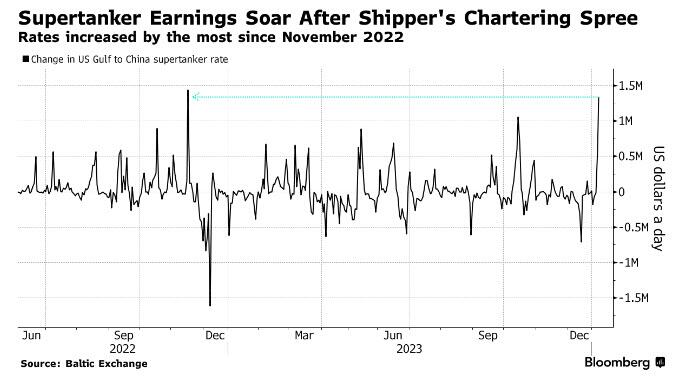
However this surge pricing in container rates is also shifting over to tankers: as Bloomberg reports, the cost to ship crude oil from the US Gulf to China surged after a slew of vessel hires by a South Korean shipowner.

A flurry of booking activity by Sinokor Merchant Marine in the past week rapidly tightened the availability of tankers, spurring what Bloomberg said was a "market frenzy." While the transporters were booked for long-haul voyages, the motivation for the unusually large hiring spree was unclear.

At least one vessel bound for the US to China route was chartered for just shy of $10 million, compared with about $7 to $8 million last week. Surprisingly, some of the tankers were booked with no underlying cargo.

As a result of this booking spree, tanker rates have soared: the cost for VLCCs (or very-large crude carriers) from the US Gulf to Asia jumped by more than $1 million a day on Monday, the largest gain since November 2022. The vessels can haul 2 million barrels. That rippled across the world, impacting other key oil routes often served by supertankers. Rates for the benchmark Middle East to China route rose by the most since September.

“Sinokor continues to charter VLCCs in what appears to be a major punt on the VLCC freight market,” shipbroker Braemar wrote in a note. It was unclear if the Korean shipping company is hoping to corner at least a small part of the VLCC market, but one thing that's certain is that tanker shipping clients will now have no choice but to pass on the surging costs to end-users, sending oil prices higher.

The pricing spike comes amid a risk of disruption in tanker markets due to Houthi attacks on merchant vessels in the Red Sea, which has led many ships traversing the world’s oceans to take safer but longer routes, adding to their voyage length and reducing availability. Meanwhile, the volume that needs to be transported could be boosted by the allocation of bumper quotas to refineries in top importer China and near-record US exports.

Sinokor’s fleet covers a range of sectors, according to Clarkson Research Services Ltd., a unit of the world’s largest shipbroker. In addition to roughly 22 oil tankers, it also has bulk commodity, LNG and container transporters.

https://www.zerohedge.com/markets/oil-supertanker-rates-are-soaring-after-korean-shipper-sparks-market-frenzy

With Tehran closer to nukes, Congress must end Biden’s Iran appeasement before it’s too late

 President Biden’s three years of appeasing Iran has brought the world’s leading state sponsor of terrorism closer than ever to developing a nuclear weapon. 

While most Americans were on winter break, the United Nations’ nuclear watchdog reported that Iran had tripled its production rate of near-weapons-grade nuclear fuel — 60%-high-enriched uranium — with a stockpile large enough to potentially produce one nuclear bomb in a week or six bombs in a month.

On Monday, former UN weapons inspector David Albright assessed Tehran could build a few crude weapons to marry with this nuclear material, mostly in secret, in just six months.

How did we get here? 

By the end of 2020, Iran was down to just $4 billion in accessible foreign-exchange reserves due to the Trump administration’s imposition of maximum economic pressure on Tehran.

The regime’s terror mastermind, Quds Force Commander Qassem Soleimani, had been killed in a US drone strike.

The godfather of its nuclear-weapons program, Mohsen Fakhrizadeh, had been assassinated (likely by Israel).

Nuclear-weapons scientists were being put on US sanctions lists while the president spoke openly about considering military strikes inside Iran.

Tehran’s nuclear-escalation curve had been flattened for months. 

But Biden and his closest aides, like horses wearing ideological blinders, could not accept a strategy that was successfully containing, if not destabilizing, one of America’s greatest adversaries.

Biden pledged to restore the Obama-era Iran nuclear deal that effectively offered Tehran hundreds of billions of dollars to merely delay its nuclear breakout by a few years. 

The deal’s supporters argue the nuclear crisis at hand exists only because Donald Trump pulled America out of the agreement in 2018.

But the record shows that every major escalation in Iran’s nuclear program started in 2021: jumping from low-enriched uranium production to 20% enrichment; jumping from 20% enrichment to 60%; producing uranium metal, which is a key component in nuclear weapons; denying UN inspectors access to an advanced-centrifuge manufacturing plant; ending cooperation with a probe into four undeclared nuclear sites; expanding construction of a potentially impenetrable underground nuclear facility; harassing inspectors and denying their visas. 

Any one of these escalations should have prompted Biden to restore pressure on Tehran and ensure the mullahs feared a potential military strike.

That the White House responded to the totality of them with continued offers of sanctions relief defies belief. 

Nothing has been able to disabuse Biden of his almost-religious commitment to appeasement as the only viable path to containing Iran’s myriad threats.

Not the selection of Ebrahim Raisi, the so-called hangman of Tehran, as Iran’s president.

Not the transfer of drones to Russia for use against Ukraine.

Not the daily crimes committed against Iranian women, which prompted a national uprising to bring down the regime.

Not the largest massacre of Jews since the Holocaust.  

Not even assassination plots targeting former US officials, attempts to kidnap Iranian Americans from US soil, Iran-directed attacks on US troops in Iraq and Syria, injuring dozens of servicemembers — one critically — or the suicide-drone attacks on US destroyers in the Red Sea.  

It should terrify every American that as the sands of nuclear time slip by, the Biden administration’s Iran policy remains as it was on Jan. 20, 2021.  

Two weeks after the International Atomic Energy Agency’s startling report, there has been no American call for an emergency board meeting to censure Iran and refer its file to the UN Security Council.  

Two months after the expiration of a UN missile embargo, with news that Russia may soon import Iranian ballistic missiles for use against Ukraine, there has been no American initiative to restore all international restrictions on Iran — a process that merely requires sending a letter to the Security Council. 

Most concerning, Tehran today fears no threat of military force against its nuclear sites.

Washington appears helpless in the face of Iran-backed Houthis firing missiles at ships in the Red Sea, while the secretary of state tours the Middle East telling allies he’s doing everything possible to avoid a confrontation with Iran.

Instead, a State Department sanctions waiver remains in effect, issued after the Oct. 7 Iran-backed Hamas massacre, to give Iran access to $10 billion.

Further, China keeps importing Iranian oil with no attempt by the White House to enforce US sanctions.

Clearly, the ayatollah sees a green light both to expand his ring of fire around Israel and to move closer and closer to a nuclear-weapons capability. 

Congress has a duty to intervene.

The House has already passed bills to shut down the $10 billion for Iran, crack down on Chinese imports of Iranian oil and impose sanctions on Iran’s leaders for their abuse of women.

Senate Republicans should mount a pressure campaign on Senate leader Chuck Schumer to vote on all three measures.

Members of both parties in both chambers should also push the White House to ensure America’s military option remains credible and at the ready. 

Biden’s Iran strategy of appeasement has failed.

America must course-correct quickly to stop the emergence of a nuclear-armed Iran. 

Richard Goldberg, a senior adviser at the Foundation for Defense of Democracies, is a former National Security Council official and senior US Senate aide.

https://nypost.com/2024/01/08/opinion/with-tehran-closer-to-nukes-congress-must-end-bidens-iran-appeasement-before-its-too-late/