Search This Blog

Tuesday, January 9, 2024

Novo Nordisk Foundation puts $25m into antimicrobial resistance program

 The Novo Nordisk Foundation has come up with more funding to help battle the scourge of antimicrobial resistance (AMR), putting $25 million into a non-profit accelerator programme hunting for new ways to prevent, diagnose, and treat infectious diseases.

The cash injection for the Combating Antibiotic Resistant Bacteria Biopharmaceutical Accelerator (CARB-X) will complement funding provided by four G7 governments and three of the world’s biggest foundations that is aimed at taking projects from basic research into clinical development.

It is the latest in a series of funding rounds by Novo Nordisk Foundation – a philanthropic affiliate of Danish drugmaker Novo Nordisk – and follows a $260 million initiative to find new respiratory infection vaccines and approximately $140 million for cell and gene therapy (CGT) manufacturing.

According to the Foundation, AMR “threatens to unravel societies and the global economic system by increasing the risks of performing routine medical procedures, such as caesarean sections, hip replacements, and chemotherapy, impairing our food chain, and diminishing productivity.”

It cites an assessment of the burden of AMR published in The Lancet – still considered to be the most comprehensive carried out to date – which found that drug-resistant bacterial infections alone caused an estimated 3,500 deaths every day in 2019, a number greater than both HIV/AIDS and malaria.

According to the World Bank, in a high AMR-impact scenario, the world could lose 3.8% of its annual GDP by 2050, with an annual shortfall of $3.4 trillion by 2030.

CARB-X is a public-private partnership set up in 2016 that aims to accelerate the development of antibacterial medicines, spanning antibiotics, vaccines, rapid diagnostics, and other products. The organisation is based out of Boston University and is funded by various countries and partners, such as the Wellcome Institute, UK Aid, the US National Institute of Allergy and Infectious Diseases, and others.

It already has a good track record, having funded 93 projects in 12 countries, including 19 that have advanced into or completed clinical trials and 12 that are still in clinical development, and helping two diagnostic products to reach the market.

Novo Nordisk Foundation is providing the funding over three years to help plug a funding gap in the early stages of development for products that tackle AMR. A report for the European Commission recently estimated that an additional global investment of $250 million to $400 million from public and philanthropic sources is needed every year for this purpose.

“This new funding is a testament to our shared commitment to supporting the pioneering efforts of antibacterial product developers, mainly university spin-offs and small biotech companies, in advancing much-needed innovation to prevent, diagnose, and treat the most dangerous drug-resistant bacterial infections,” commented CARB-X' executive director, Kevin Outterson.

News of the funding round comes shortly after reports emerged of an all-too-rare new antibiotic class – discovered by scientists at Roche and Harvard University – that has shown promise as a treatment for resistant forms of ‘superbug’ carbapenem-resistant Acinetobacter baumannii (CRAB).

https://pharmaphorum.com/news/novo-nordisk-foundation-puts-25m-amr-programme

FDA Chief Promotes Off Label Product Ads, Illegal Pharma Marketing Scheme Long Criticized By Dems

 by Paul Thacker via The Disinformation Chronicle,

During his first stint as FDA Commissioner during the Obama administration, Dr. Robert Califf proposed allowing companies to advertise their products off-label. This marketing practice is illegal under FDA’s regulations that cover drug advertising, and Dr. Califf received pushback from Senator Ed Markey who sent him a stiff letter demanding that he address off label use of opioids.

“The FDA must not become complicit in the growing prescription fentanyl problem this country is combating,” Senator Markey wrote. Indeed, Pfizer pled guilty to a U.S. criminal charge and paid a record $2.3 billion in 2009 for illegally marketing over a dozen drugs off label. Multiple federal agencies investigated Pfizer at that time, including the FDA’s Office of Criminal Investigations (OCI).

“We expect this agreement to increase integrity in the marketing of pharmaceuticals," the Justice Department claimed in the settlement’s announcement.

When Biden chose Dr. Califf to run the FDA a second time in 2021, The New York Times reported that Obama officials had actually killed Dr. Califf’s attempt to allow increased off label promotion. “[T]he proposal, which many public health experts considered dangerous, was blocked by others in the Obama administration, according to a person familiar with it.”

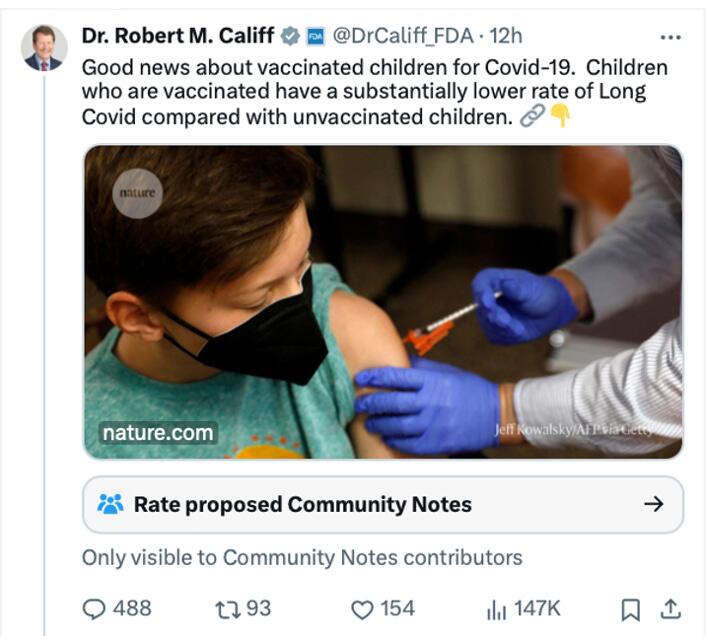
But with his critics now in the rearview mirror, Dr. Califf is speeding forward with his “dangerous” proposal. And this time, the Commissioner himself is promoting products off label. A week before the Christmas break, Commissioner Califf posted a message on X, promoting COVID vaccines off label to allegedly protect children against long COVID.

“The FDA-approved and authorized coronavirus vaccines are indicated for active immunization to prevent COVID-19 caused by severe acute respiratory syndrome coronavirus 2 (SARS-CoV-2),” an FDA official emailed me. “The vaccines are not approved or authorized as a treatment for long COVID.” In follow up email, FDA clarified that the COVID vaccines are also not approved or authorized to “prevent” long COVID.

In his promotional post on X, Commissioner Califf linked to a news article in Nature Magazine as proof the vaccines prevent long COVID. And here’s where the story gets even weirder.

Nature’s news story discusses a small, observational study that had been presented at a conference some months prior and has not been peer reviewed. Even more disturbing, Nature’s reporter supported this slim study with positive quotes sprinkled throughout the article from Dr. Jessica Snowden, a pediatric infectious-disease specialist at the University of Arkansas for Medical Sciences. However, Nature failed to provide readers with one rather important detail: Pfizer has disclosed paying Dr. Snowden to provide marketing talks for their COVID vaccine and she serves on the company’s advisory board. 

She clearly should have disclosed her Pfizer funding, especially as her commentary could contribute to increased sales of Pfizer’s vaccines,” said Dr Barbara Mintzes, a professor of evidence-based pharmaceutical policy, at the University of Sydney. “Companies choose who to fund. They don’t fund experts who highlight a product’s limited effectiveness or have serious safety concerns.”

Science news or pharma advertising?

The December news article in Nature reported on a presentation given last October at a medical conference and that was led by a medical officer at the US Centers for Disease Control and Prevention (CDC). The study evaluated mRNA COVID-19 vaccines’ impact on children getting long COVID, but relied on self-reports of long COVID, not a physician’s diagnosis. The results that found a positive correlation with vaccination were based off 28 kids who either self-reported or were reported by a parent to have long COVID.

“This is really important data,” Dr. Snowden told Nature in one of her many quotes littered throughout the article. “This will demonstrate to families how important it is that we protect our kids, not just from acute COVID, but from the longer-term impacts of COVID as well.”

In a 2018 report, Nature Magazine editor Richard Monastersky stated that Nature was updating their news section’s conflict-of-interest and ethics policies to make them more comprehensive. Last week, I sent several questions to Monastersky asking why Nature had not included Dr. Snowden’s ties to Pfizer and whether Nature reporters are required to look into an experts’ financial ties before quoting them in news pieces.

https://www.zerohedge.com/medical/fda-commissioner-promotes-products-label-illegal-pharma-marketing-scheme-long-criticized

Toddlers' Screen Time Tied to Atypical Sensory Outcomes

 Screen time early in life was associated with atypical sensory outcomes, an observational study showed.

Children who watched any television or videos at age 12 months had a significant, two-fold greater risk of a high degree of failing to notice obvious stimuli (low registration) compared with those who didn't spend any time in front of a screen, reported Karen Heffler, MD, of Drexel University College of Medicine and Tower Health in West Reading, Pennsylvania, and colleagues.

These children were also significantly less likely to have a low degree of low registration, sensation seeking (actively seeking stimuli throughout the day), and sensation avoiding (trying to control the environment to limit exposure to stimuli), with odds ratios of 0.64 (95% CI 0.44-0.92), 0.55 (95% CI 0.35-0.87), and 0.69 (95% CI 0.50-0.94), respectively.

Some similar findings were seen at ages 18 and 24 months, the researchers noted in JAMA Pediatricsopens in a new tab or window.

Atypical sensory processing is common in neurodevelopmental disorders, affecting approximately 60% of children with attention deficit-hyperactivity disorder (ADHD) and up to 90% of children with autism, Heffler told MedPage Today in an email.

"Sensory symptoms are associated with hyperactivity, restricted/repetitive behavior, irritability, behavioral problems, and emotional dysregulation," she said. "Sensory-related meltdowns and behaviors can be very disruptive to family-life, interfere with family participation in community events, and are associated with increased caregiver stress."

"This study adds atypical sensory processing to the list of other developmental outcomes, including autism, ADHD, language delay, negative brain findings, and behavioral problems associated with early-life screen exposure," she further noted.

The study could not determine that screen time caused sensory issues, Heffler cautioned.

However, "potential mechanisms for this association include screen time displacing other important social and play opportunities which are important for typical sensory development, and/or the audiovisual stimulation of early-life screen time may be directly impacting early brain development," she said.

The research team used data from the National Children's Study, a cohort study of environmental influences on health and development, with enrollment from 2011 to 2014. Data were analyzed in 2023.

The study categorized nearly 1,500 kids for high, low, or typical levels of sensory outcomes, grouped according to Dunn's Model of Sensory Processing: low registration (failing to notice obvious stimuli), sensation seeking (actively seeking stimuli throughout the day), sensory sensitivity (being overly irritated or upset by stimuli), and sensation avoiding (trying to control the environment to limit exposure to stimuli).

Specifically, parents or caregivers rated their children's behavior based on the Infant/Toddler Sensory Profile (ITSP) at approximately age 33 months. ITSP items were then regrouped to obtain quadrant scores based on Dunn's Model of Sensory Processing.

Half of the children included were male. Information on screen time was missing for 26.6% of kids at 12 months, 14.5% at 18 months, and 9% at 24 months. There were 910 kids with viewing information from all three measurement periods.

Overall, most of the 1,471 children studied were in the typical sensory group. About one-fifth exhibited less frequent sensory sensitivity and sensation avoiding.

Greater screen time at age 18 months was associated with an increased risk of being in the high category of sensation avoiding (OR 1.23, 95% CI 1.03-1.46) and low registration (OR 1.23, 95% CI 1.04-1.44).

And greater screen time at age 2 was associated with an increased risk of being in the high category of sensation seeking (OR 1.20, 95% CI 1.02-1.42), sensory sensitivity (OR 1.25, 95% CI 1.05-1.49), and sensation avoiding (OR 1.21, 95% CI 1.03-1.42).

Limitations of the study included use of the ITSP. Although it is a validated caregiver questionnaire, a more objective measure of sensory processing would be important in future research, Heffler and colleagues noted.

Additionally, only children whose parents completed the ITSP were included, and other developmental delays that might impact sensory processing were not accounted for in analyses.

"Further research is needed to determine if high early-life screen time is a risk factor contributing to the sensory hyper-connectivity and audiovisually oriented attention mechanisms found in some children with autism," Heffler said.

Disclosures

The authors reported no conflicts of interest.

Primary Source

JAMA Pediatrics

Source Reference: opens in a new tab or windowHeffler KF, et al "Early-Life Digital Media Experiences and Development of Atypical Sensory Processing" JAMA Pediatr 2024; DOI: 10.1001/jamapediatrics.2023.5923.


https://www.medpagetoday.com/pediatrics/generalpediatrics/108172

Why Are Some Medicines Linked to Suicide?

 An EMA Safety Committee is assessing whether GLP-1 receptor agonists Ozempic, Wegovy, and Saxenda (all made by Novo Nordisk) are linked with increased risk of suicidal thoughts and thoughts of self harm.

In the EU, suicidal behavior is not listed as a side effect for any of the drugs, but it’s a different story in the US. The FDA acknowledges that there was a suicide during a clinical trial for Saxenda and recommends that patients be monitored for depression and suicidal thoughts. Wegovy contains a warning about “increased heart rate and suicidal behavior or thinking.” Ozempic uses the same API, albeit at a lower dose.

The review is expected to conclude in November 2023, with the EMA analyzing around 150 reported cases of suicidal thoughts and self harm relating to the drugs.

Numerous media outlets have picked up on the safety review, with some claiming that the FDA has also received around 60 reports of suicidal thoughts in patients taking Ozempic or Wegovy. Novo Nordisk has reportedly said that its own post surveillance activities do not show a “causal association” between the drugs and self harm.

A number of approved drugs (including, antidepressants) carry warnings about side effects that include depression and suicidal thoughts, particularly in younger patients – with some including the strongest warning mandated by the FDA: a black box warning. For example, a study in suicidal behavior in adults taking paroxetine (Paxil/Seroxat) found an increase in attempted suicide in the drug group compared with placebo – and GSK has faced a major lawsuit connected with the drug.

But exactly how does a medicine trigger suicidal behavior? The link is not well understood. Some people may question whether a drug can ever be fully proven to be responsible for a patient’s suicidal actions, but the links are clear. One disturbing case is that of Sanofi’s anti-obesity medicine Acomplia, which was approved in Europe before being suspended in 2008. The drug was found to almost double the risk of psychiatric disorders in patients versus placebo. I also came across an informative article that gives examples where medication appears to have contributed to suicide attempts. Some have hypothesized that drugs, such as antidepressants, may energize already suicidal patients to act on impulse or worsen existing symptoms of depression that lead to suicidal thoughts. Some patients may also have other undiagnosed conditions (such as bipolar disorder), where selective serotonin reuptake inhibitors exacerbate psychosis. You can read more here.

Some have also theorized that hormone changes can play a role. For example, premenstrual dysphoric disorder – a disorder that affects neurobiological sensitivity to changes in hormone levels – was found to be linked to suicidal thoughts and actions in a study published last year. Some researchers have also found a link between hormonal contraceptives and suicidal behavior. It’s entirely possible for some medications to affect hormone levels.

When pharma companies develop new medicines, they want them to have a positive impact on patient lives. Novo Nordisk’s Ozempic and Wegovy are used for the treatment of type 2 diabetes and weight management, and Saxenda is indicated for weight management. With obesity increasing worldwide, these drugs may play important roles – and though suicidal behavior as a result of medication is perhaps one of the most difficult side effects to study, study it we must.

https://themedicinemaker.com/business-regulation/why-are-some-medicines-linked-to-suicide

Alcon: Positive Topline Results From Phase 3 Trials of Candidate for Dry Eye


  • AR-15512, a topical transient receptor potential melastatin 8 (TRPM8) agonist, is a first-in-class product candidate for the treatment of the signs and symptoms of dry eye disease
  • In both pivotal efficacy and safety studies (COMET-2 and COMET-3), the primary endpoint was achieved (p <0.0001)
  • Dry eye affects an estimated 38 million people in the U.S. and less than 10% of diagnosed patients are treated with a prescription product

EV maker VinFast aims to raise free float to 10%-20% by end-2024 -chair

 Vietnamese electric vehicle maker VinFast aims to increase its free float, or shares available to the public for trading, to 10% to 20% by the end of this year from roughly 2% currently, the company's chairperson said on Tuesday.

"This year we plan as the markets recover and as we show more achievements of progress, we will do follow-on transactions ... increasing the free float, bringing in many more investors, including long-only investors," Le Thi Thu Thuy, the former CEO and current VinFast chairperson, told Reuters on the sidelines of the CES trade show in Las Vegas. The free float "hopefully would be 10% to 20% at least," she said.

A larger free float could lessen the intense volatility in the company's stock, which has tumbled since a splashy debut on the Nasdaq in August, when shares surged more than 255%, notching a market value of roughly $85 billion. It is now valued at nearly $16 billion.

VinFast, which is yet to make a profit, entered the EV market as car prices were under pressure, led by cuts at market leader Tesla and Chinese companies including BYD.

The company sells 60% of its EVs to an affiliate company owned by its founder Pham Nhat Vuong, Vietnam's richest man, who also controls VinFast. In the first three quarters of 2023, VinFast sold more than 21,000 EVs and posted a net loss of $1.73 billion.

At CES on Tuesday, the automaker launched a prototype of its new pickup truck VF Wild, which will not be ready for deliveries before 2026. It also said it plans to launch its mini electric SUV VF 3 globally, rather than just in Vietnam as initially planned. It expects to start delivering the model in the United States early next year.

Last week, VinFast announced a plan to set up manufacturing and battery facilities in India. It also aims to expand in more markets in the Middle East, Latin America and Asia, including Indonesia.

Latin American healthcare company Auna files for an estimated $200 million US IPO

 Auna, which provides healthcare plans and operates hospitals in Peru, Colombia, and Mexico, filed on Tuesday with the SEC to raise up to $100 million in an initial public offering. However, this is likely a placeholder for a deal we estimate could raise up to $200 million.


This is Auna's second attempt to go public. The company had previously filed to dual list its shares in the US and Peru in late 2020 but never set terms, and eventually withdrew in early 2022.

Auna was originally founded in 1989 as Oncosalud, a healthcare coverage provider selling prepaid plans for cancer prevention and detection. The company now operates 15 hospitals and 16 outpatient, prevention, and wellness facilities across Mexico, Peru, and Colombia, including three hospitals specializing in oncology, while also continuing to provide oncology healthcare plans. 

The company was founded in 1989 and booked $985 million in revenue for the 12 months ended September 30, 2023. It plans to list on the NYSE under the symbol AUNA. Auna filed confidentially on October 30, 2023. Morgan Stanley, J.P. Morgan, BTG Pactual, Santander, Citi, and HSBC are the joint bookrunners on the deal. No pricing terms were disclosed.