Search This Blog

Wednesday, January 10, 2024

AIM Starts Phase 1b/2 Study of Imfinzi Combo for Pancreatic Cancer

 AIM ImmunoTech Inc. (NYSE American: AIM) (“AIM” or the “Company”) today announced that enrollment is open at Erasmus Medical Center (“Erasmus MC”) in a Phase 1b/2 clinical trial combining AIM’s Ampligen® (rintatolimod) with AstraZeneca’s anti-PD-L1 immune checkpoint inhibitor Imfinzi® (durvalumab) for the treatment of pancreatic cancer (the “DURIPANC Study”). Ampligen has shown therapeutic synergies with checkpoint inhibitors, potentially increasing survival rates and efficacy.

AIM announced in January 2023 that it had entered into an external sponsored collaborative clinical research agreement with Erasmus MC and AstraZeneca. The DURIPANC Study is an investigator-initiated, exploratory, open-label, single-center study with the full name “Combining anti-PD-L1 immune checkpoint inhibitor durvalumab with TLR-3 agonist rintatolimod in patients with metastatic pancreatic ductal adenocarcinoma for therapy effect.” The primary objective of the Phase 1b portion is to determine the safety of combination therapy with durvalumab and Ampligen. The primary objective of the Phase 2 portion is to determine the clinical benefit rate of the combination therapy.

https://www.biospace.com/article/releases/aim-immunotech-announces-open-enrollment-for-phase-1b-2-study-evaluating-ampligen-rintatolimod-in-combination-with-astrazeneca-s-imfinzi-durvalumab-for-the-treatment-of-pancreatic-cancer/

'JPM2024: Big Tech Poised to Disrupt Biopharma with AI-Based Drug Discovery'

 2024 will continue to see Big Tech companies enter the artificial intelligence-based drug discovery space, potentially disrupting the biopharma industry. That was the consensus of panelists at a Tuesday session on AI and machine learning held by the Biotech Showcase, co-located with the 42nd J.P. Morgan Healthcare Conference.

The JPM conference got a reminder of Big Tech’s inroads into AI-based drug discovery with Sunday’s announcement that Google parent Alphabet’s digital biotech company Isomorphic Labs signed two large deals worth nearly $3 billion with Eli Lilly and Novartis.    

“Big Tech is coming for AI and it’s coming in a big way,” said panel moderator Beth Rogozinski, CEO of Oncoustics, who noted that the AI boom has seen the rise of the “Magnificent 7,” a new grouping of mega-cap tech stocks comprised of the seven largest U.S.-listed companies—tech giants Amazon, Apple, Alphabet, Microsoft, Meta Platforms, Nvidia and Tesla.

Last year, the Magnificent 7’s combined market value surged almost 75% to a whopping $12 trillion, demonstrating their collective financial power.

“Six of the seven have AI and healthcare initiatives,” Rogozinski told the panel. “They’re all coming for this industry.”

However, Atomwise CEO Abraham Heifets made the case that with Big Tech getting into biopharma there is a “mismatch of business models,” with the Isomorphic Labs deals looking, in his words, “like traditional tech mentality.” Heifets contends that “it’s unclear whether the physics of the business will support the risk models” in the industry, adding that the influence of small- to mid-size companies focused on AI-based drug discovery should not be underestimated.

Google DeepMind’s AlphaFold is the foundation of Isomorphic Lab’s platform. The problem, according to ArrePath CTO Kurt Thorn, is that it’s easy for these technologies to “have fast followings” only to see their market shares wane over time. “If you look at AlphaFold, which was a breakthrough when it came out, within two or three years afterwards there were two or three alternatives.”      

Thorn concluded that “it’s not clear that the market sizes are large enough to amortize a large AI platform for drug discovery across an entire industry.”

Rogozinski emphasized that these switching costs are a potential “barrier to entry” in moving to such drug discovery platforms as Big Tech tries to get companies to transition.        

Vivodyne CEO Andrei Georgescu commented that drug discovery and development is a difficult and complex process that “is not a function of how big your team is or how many people you have behind the bench.” The key to the success of AI in biopharma “is in the generation and curation of datasets,” according to Georgescu, who said the industry is “facing a bottleneck on the complexity of the data and the applicability of the data to the outcomes that we want to confirm.”      

Providing some levity and perspective to Tuesday’s AI session, Moonwalk Biosciences CEO Alex Aravanis told the audience he was late to arrive as a panelist due to an accident on the freeway involving a Tesla self-driving vehicle. “So, clearly, they need more data,” Aravanis said.

Marc Cikes, managing director of the Debiopharm Innovation Fund, told BioSpace that while he has been heartened to see the rise of AI and machine learning usage in biopharma, the forecast remains murky in 2024.

“The impact of AI for drug discovery is still largely unknown,” Cikes said. “The public market valuation of the few AI-drug discovery companies is significantly down versus their peak price, and a large chunk of the high-value deals announced between native AI companies and large pharmas are essentially based on future milestone payments which may never materialize.”

https://www.biospace.com/article/jpm2024-big-tech-poised-to-disrupt-biopharma-with-ai-based-drug-discovery/

FDA’s CAR T Probe ‘Not a Big Deal’ for Oncology-Focused Biotechs: Triumvira President

 The CAR T sector has been under the regulatory microscope since the FDA announced in late November 2023 that it was investigating 20 reports of T cell lymphoma in patients who had previously received CAR-T therapies. However, at least one cell therapy oncology company is not concerned. 

At the 42nd J.P. Morgan Healthcare Conference, Triumvira Immunologics President and Chief Operating Officer Rob Williamson told BioSpace that internal discussions and those with other analysts and oncology-based cell therapy companies indicate the investigation is not a “big deal.” He was also adamant that it would not affect Triumvira and its business. 

“(For) these patients, the risk-benefit is significantly in favor of the therapy,” Williamson said.

That is not to say that the CAR T industry has not had some rough times recently or that everything is sailing along smoothly. 

“I think cell therapy within biotech is still in the penalty box,” Williamson said. He said cell therapy companies may continue to be seen less favorably than other biotechs during the next year, except for those who can differentiate themselves in showing value, good efficacy data or by targeting unmet needs. He said he is hopeful that cell therapy can get out of this penalty box, "but it's a very crowded space." 

Williamson noted that it has been an “awful” time for private and public biotechs the past few years but called the recent uptick in deals at the end of 2023 “heartening.”

“The public biotech market caps are still quite diminished,” he said, “which makes it harder for public and private companies to raise money. I think there will be a recovery there.” 

Triumvira has a proprietary T cell “antigen coupler” designed to work directly with a T cell receptor to assist the T cell in recognizing and attacking cancer cells. It is developing an asset, TAC100-HER2, which is targeting HER2-positive tumors. Williamson expects a Phase I readout from TAC100-HER2 sometime in the Fall of 2024.

In the differentiation game, Williamson said Triumvira is separating itself from the pack with its safety and tolerability; Triumvira’s therapy is administered in the outpatient setting, which is not typical in cell therapy, and it is focused on solid tumors. 

In terms of funding for Triumvira, Williamson said there is “inbound interest” for some of its programs and that current investors have supported the company “appropriately.” He said he sees the public markets as a great place to go at some point but added that a private company “needs to understand the right time to go public and the risks and [to] make sure that you have a story.”

As for the broader market, Williamson noted that he is “cautiously optimistic” for the future and believes M&A activity will pick up at JPM.

https://www.biospace.com/article/fda-s-car-t-probe-not-a-big-deal-for-oncology-focused-biotechs-triumvira-president-/

WTI Slides After Unexpected Crude Build, Cushing Stocks Decline For First Time Since Oct.

 Oil prices extended their recent gains, as traders weighed escalating violence in the Red Sea and tighter US inventories (following last night's API report showing a big crude draw, but product builds) against a fragile market demand backdrop.

As Bloomberg notes, crude has seesawed in a roughly $5 range for the past month as traders attempt to gauge the outlook for coming quarters.

Turmoil in the Middle East, a shutdown of Libya’s biggest oil field and production cuts by OPEC+ are buttressing prices, while demand forecasts such as Vitol’s are tempering them.

But any signs of tightness in the official inventory and production data could extend the current trend.

API

  • Crude -5.125mm (-600k exp)

  • Cushing -625k

  • Gasoline +4.896mm (+2.1mm exp)

  • Distillates +6.873mm (+1.00mm exp)

DOE

  • Crude +1.2338mm (-600k exp)
  • Cushing -506k - first draw since Oct '23

  • Gasoline  (+2.1mm exp)

  • Distillates  (+1.00mm exp)

In a big shift from API's sizable crude draw, the official (adjusted) DOE data showed an unexpected 1.34mm barrel build in crude stocks. Cushing stocks did decline for the first time since October. And for the second week in a row, product builds were huge...

Source: Bloomberg

The Biden admin added 606k barrels to the SPR last week (the 4th weekly addition in a row)...

Source: Bloomberg

Cushing stocks rolled over from their highest level since July 2023..

Source: Bloomberg

US Crude production was flat, just off record highs....

Source: Bloomberg

WTI was hovering just above $73 ahead of the official print, and slid lower on the unexpected build...

On the bright side (for oil bulls), the US benchmark’s prompt spread, a critical barometer for supply and demand, has flipped to a bullish structure known as backwardation for the first time since November...

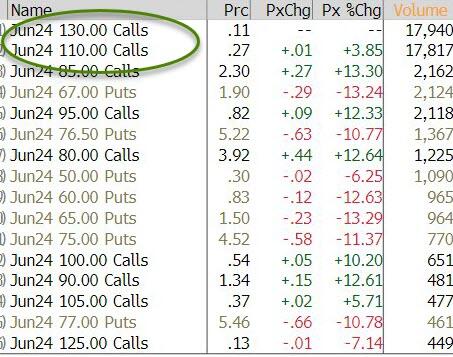
In the options market, some traders are betting that the worst of oil’s early-year malaise may be over, with contracts that would profit from a rally above $110 in June futures changing hands in large volumes yesterday.

Finally, the EIA said in its monthly report that it expects, global oil demand will exceed supply by 120,000 barrels a day in 2024 as output cuts by OPEC+ tighten the market. That modest supply deficit could push Brent futures to average $85 a barrel in March.

Recent days have also seen a surge in oil-tanker rates as one Asian shipper sparked a frenzy by hiring a slew of vessels. The move has tightened the availability of the world’s largest tankers and led to the biggest one-day gain in the cost of hauling oil from the US to China since November 2022. High freight rates can sometimes make it difficult to send cargoes over long distances.

https://www.zerohedge.com/energy/wti-slides-after-unexpected-crude-build-cushing-stocks-decline-first-time-oct

TG JP Morgan prelims, licensing deal

 TG Therapeutics, Inc. (NASDAQ: TGTX) yesterday announced preliminary U.S. net product revenue for BRIUMVI® for the fourth quarter and full year ended December 31, 2023 (unaudited), as well as financial guidance and development milestones for 2024, during a preannounced presentation at the 42nd Annual J.P Morgan Healthcare Conference. An audio replay of the event, as well as the corresponding slide deck are available on the Investors and Media section of the TG corporate website at ir.tgtherapeutics.com/events.

Michael S. Weiss, Chairman and Chief Executive Officer of TG Therapeutics stated, “We are excited to share our preliminary fourth quarter and year end U.S. BRIUMVI net product revenue. As we head into 2024, we have our sights set on achieving revenue and expense targets and have built an ambitious plan to potentially expand the utility of BRIUMVI into new indications and for use as a subcutaneous injection. We are also excited to expand our R&D program with the recent licensing of azer-cel, an allogeneic CD19 CAR T therapy which we believe has the potential to become a meaningful therapy to treat various autoimmune disorders.”

https://www.globenewswire.com/news-release/2024/01/10/2806976/8790/en/TG-Therapeutics-Provides-Preliminary-Fourth-Quarter-and-Full-Year-2023-Net-Revenue-and-2024-Anticipated-Milestones.html

Where Boeing's 737 Max 9 Is In Operation

 On Friday January 5, the 'door plug', replacing a possible extra exit in the fuselage of a Boeing 737 Max 9 operated by Alaska Airlines, was ripped off shortly after take-off.

The aircraft was supposed to be flying from Portland, Oregon, to Ontario airport, on the outskirts of Los Angeles.

Luckily, there were no casualties and the plane made a successful emergency landing.

A few days later, Alaska Airlines and United Airlines, the latter of which operates the world's largest fleet of the aircraft, announced that they had discovered loose bolts on several of their planes of the same model.

As Statista's Martin Armstrong notes, these issues add to a growing list of damaging incidents and issues for the American manufacturer. Of particular significance, accidents in October 2018 in Indonesia and March 2019 in Ethiopia, caused by a faulty in-flight stabilization system, resulted in the deaths of almost 350 people. The two aircraft in question were Boeing 737 Max, albeit the Max 8 variant.

As the infographic below shows, alongside Alaska and United, 7 other airlines are currently known to operate the 737 Max 9, with over 200 aircraft in operation as of January 2024 according to the travel industry news site, Skift.

Infographic: Where Boeing's 737 Max 9 Is in Operation | Statista


The Federal Aviation Administration (FAA) issued an 'Emergency Airworthiness Directive' for all owners and operators of 737 Max 9 aircraft on January 6.

In response, Boeing stated in a press release:

"Safety is our top priority and we deeply regret the impact this event has had on our customers and their passengers. We agree with and fully support the FAA's decision to require immediate inspections of 737-9 airplanes with the same configuration as the affected airplane".

"Not sure that can be attributable to just one line. Might have to ground all Boeing aircraft delivered in a given window of time?" one X user said.

https://www.zerohedge.com/markets/where-boeings-737-max-9-operation

Blue States Just Can't Stop Taxing

 by Stephen Moore via The Epoch Times,

The latest Census Bureau data on population changes in America should have been a wake-up call to lawmakers in blue states and cities. The Census data provide even further evidence that “soak the rich” tax policies have incited a blue-state meltdown.

California, New York, and Illinois all lost the most population last year.

These states have nearly lost a combined 5 million people over the past decade.

California and New York could both lose another three congressional seats by the end of the decade, and Illinois another two.

Did I mention that these are the three states with the highest taxes?

Is this just a coincidence?

Democratic governors evidently think so...

This year, seven blue states are pursuing even higher tax rates on the top 1 percent of earners, despite the evidence that these policies are detrimental to their citizens.

One such state is Washington. Once an importer of talent and brainpower because of its no-income-tax status, the Democrats who control all the levers of power in Olympia just enshrined a 7 percent capital gains tax, and the Democratic Washington Supreme Court strangely ruled that it’s constitutional. This is one of the highest taxes on the sale of assets in the country.

State Sen. Noel Frame (D-Seattle) wants a 1 percent annual tax on financial intangible assets—such as cash, stocks, and bonds—valued at more than $250 million. And then they wonder why one of the world’s richest human beings, Jeff Bezos, has moved to South Florida.

In Vermont, Democrats have just proposed raising their top income tax rate to more than 8 percent. Pretty soon, Ben and Jerry will be the only rich people left in the state—and don’t be surprised if they move out, too.

Meanwhile, Maryland Democrats are pushing a “millionaire tax” ($750,000 in income and above), a capital tax, and a new corporate tax.

California just raised its top income tax rate to the highest in the United States—from 13.3 percent to 14.4 percent. The Golden State just moved past New York to reclaim the income tax top spot. It must be so proud. The Democrats in Sacramento also expanded the state’s 1.1 percent payroll tax to include all income earners. The tax was previously applicable only to those making up to about $153,000 annually.

Meanwhile, Jonathan Williams, chief economist at the American Legislative Exchange Council, which is an association of more than 2,000 conservative state legislators, reports that eight red states are cutting income taxes: Arkansas, Indiana, Kentucky, Montana, Nebraska, North Dakota, Utah, and West Virginia. Oklahoma is set to cut rates this year to as low as 2 percent. Several of these states now have flat taxes, not tiered “progressive” rates. Every state on this list is a red state, except Connecticut.

What does all this mean?

The blue-state deep thinkers can’t see that their “progressive” tax systems are bleeding their states dry. Or they don’t care.

Once upon a time, it was the Northeast that was the financial and industrial capital of the world.

Now Miami, Nashville, Dallas, Austin, Charlotte, Tampa, and Salt Lake City are the hot destinations.

The Southeast now produces more GDP than the Northeast.

I call it a blue-state dysphoria. They must change their ways or die. So far, their political leaders are choosing the latter course.

https://www.zerohedge.com/political/blue-states-just-cant-stop-taxing